
Home » Public Transport (Page 34)
Category Archives: Public Transport
Back to school – concerns about congestion and safety
Many roads again are expected to become more congested as school resumes in most parts of the country especially in cities. But while congestion is usually the top issue along roads near many schools, one concern that usually takes a back seat to congestion is safety. Many public schools in the provinces are located along national highways. Many if not most of their students walk to and from school, usually on the carriageway when the shoulders are too rough, dusty or muddy. This situation for students increase the likelihood of their being hit by vehicles using the road. The risk increases because of their exposure to the dangers posed by motor vehicles. Following are a couple of photos showing typical cases at public schools along national roads. Both are in Antipolo City.
 Typical at-grade pedestrian crossing in front of a school. Students in most public schools often commute by walking or taking public transport like jeepneys or tricycles.
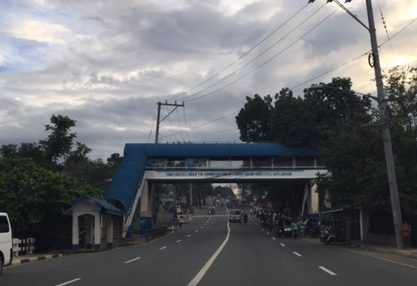 Despite this pedestrian overpass across a public school along Sumulong Highway, most students still prefer to cross on the road rather than go up and down the overpass.
Oftentimes, the seemingly obvious solution of constructing overpasses for safer crossings for students does not pan out as planned or intended. There are many underutilized pedestrian bridges since the natural way is still to cross at-grade. Then there is the issue of providing them safer walking paths or walkways. In both photos above, the sidewalks are only token (“puwede na iyan”) and insufficient for the pedestrian traffic supposed to use them. We need to plan, design and provide such facilities for our pedestrians, especially children, who are marginalized compared to those who have their own vehicles for travel.
–
Construction starts for the Line 2 Masinag Station
After several months of waiting, the Masinag Station of the Line 2 Extension project will finally start construction. The contractor has already mobilized and very soon the actual construction work will be starting. Following are photos I captured via my dash cam:
 The contractor, DMCI, already installed temporary traffic signs from Masinag Junction.
 The contractor, DMCI, also already installed concrete barriers to delineate their staging area for the project.
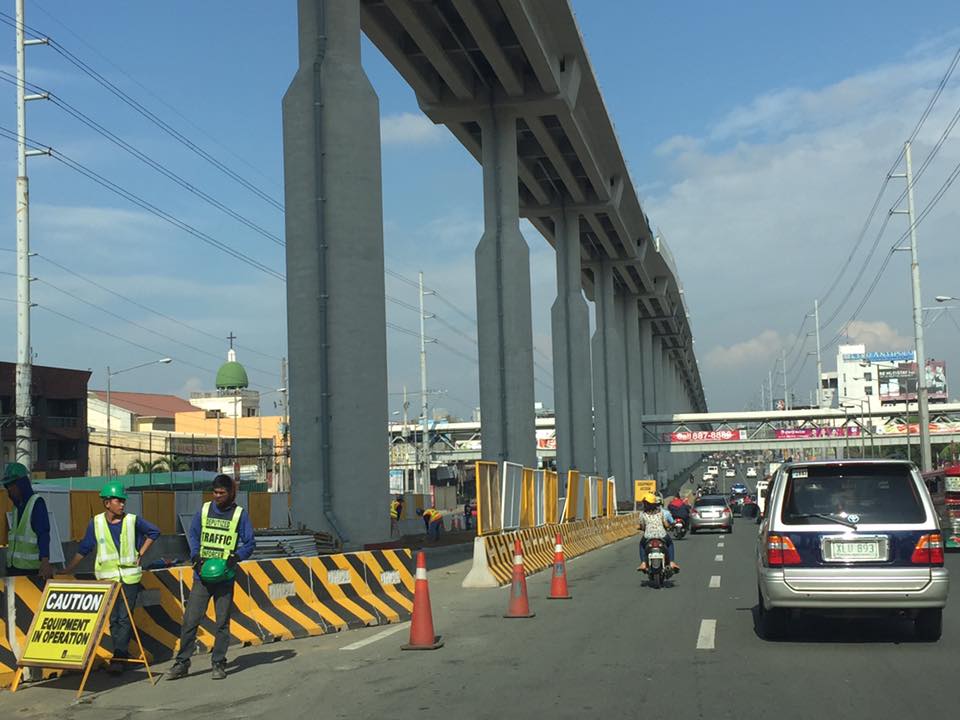 This is the likely location of the elevated Masinag Station; right across SM City Masinag and Cornell Hospital.
Masinag Station will probably be the highest station for any railways in the entire country judging from the height of the elevated tracks. I have yet to see the plans for this station but it should be a challenge in accessibility. How many steps would it take to go up or down the station and the platforms? How will, and will it be integrated with the surrounding developments like SM?
The Antipolo City Government’s official Facebook page already announced the official ceremony starting the construction to be held on May 30, 2017 (Tuesday). The advisory also cautioned travelers about the traffic congestion expected in the area affected by the construction. Masinag is a major junction where Marcos Highway and Sumulong Highway intersect. Construction period will be 18 months or 1.5 years but given the efficiency by which the same contractor was able to complete the elevated tracks, I am optimistic that they may be able to complete Masinag Station in less time. I wonder though if the ceremony tomorrow also includes the start of construction for the Emerald Station across Robinsons Metro East in Pasig. Let’s just hope that the Line 2 Extension will be operational by end of 2018 and be able to help alleviate the traffic woes along its corridor. This will definitely help improve the transport to the east of Metro Manila and directly benefit those from Antipolo and Cainta in Rizal, and Marikina and Pasig in Metro Manila.
–
Landscaping for the LRT Line 2 Extension
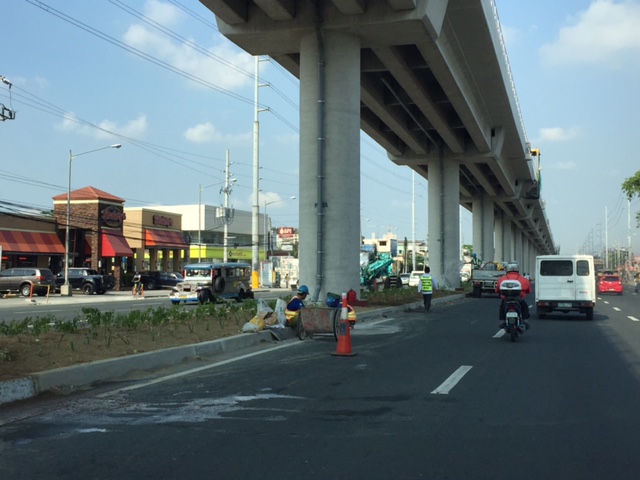
A friend posted about the removal of trees along the median of Commonwealth Avenue as part of the construction of the MRT Line 7 in Quezon City. Many if not all trees in the Fairview area have been cut or balled. A similar thing happened during the construction of the Line 2 Extension from Santolan, Pasig City to Masinag, Antipolo City. All the plants and trees along the median island were removed to give way to the construction of the elevated tracked of Line 2. Recently though, as the median has been cleared of construction materials and equipment, landscaping work was implemented. This makes sense considering there is enough space to make the area underneath the elevated tracks green. Trees and other plants can grow here providing a natural barrier for traffic as well as to improve the overall environment along Line 2.
Following are photos taken as we passed by Marcos Highway, taken a few weeks ago. Some of the plants have survived and but many seem to have simply dried up. Wha seems to be the early arrival of the wet season should help bring life to the plants under the elevated tracks of Line 2.

–
On e-tricycles again
This is also another late post. I was driving in Tagaytay when I spotted these electric tricycles near the junction of Aguinaldo Highway and the Tagaytay-Nasugbu Road. It was the first time for me to see these e-trike models that obviously got inspiration from the tuktuks of Thailand.
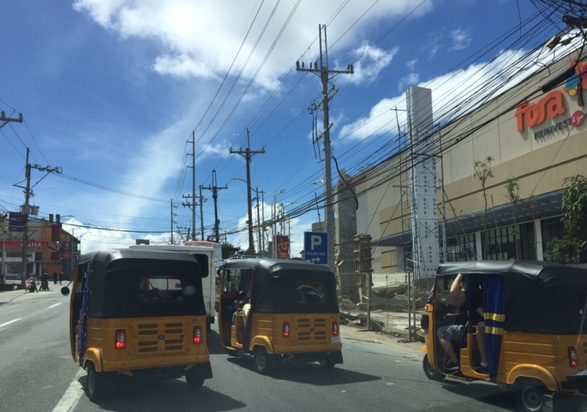
Counterflowing, racing, or maneuvering just about anywhere their drivers seem fit mean these e-trikes are operated just like their more conventional relatives. While their deployment are supposed to ease air pollution attributed to the exhausts of conventional tricycles, these likely will not contribute to easing traffic congestion in Tagaytay. I wonder though if these e-trikes are replacing the conventional ones. Many LGUs seem to have embraced e-trikes but as additional units to the current ones comprised of legal and illegal (colorum) trikes. Too often, LGUs are too careful in phasing out the old tricycles fearing a social backlash that can affect votes whenever there are elections. And so they could not properly address public transport issues directly pertaining to tricycle operations leading to worsening transport and traffic conditions especially in the CBDs.
–
New publication on urban transport by ITDP and UC-Davis
There is a new publication on urban transportation from Institute for Transportation and Development Policy (ITDP) and the University of California-Davis. The link may be found here:
Three Revolutions in Urban Transportation

The content reminded me of similar exercise we did back in 2013-2014 for ASEAN where we did visioning and simulations for low carbon transport in the region by 2050. Electrification was a major assumption for the Philippine case as electric vehicles were gaining ground (they seem to be in a limbo now) back then and on the verge of a breakthrough. Not yet evident for the Philippines was the eventual rise of sharing, and though the idea is out there, automation seems to be too high tech for the country (even Metro Manila) for now.
–
Some issues abroad on car sharing/ride sharing companies
There are two articles recently that are worth reading for those who are into ride-sharing/car-sharing. And I am not necessarily referring to those who regularly take Uber or Grab, or those who opt to use these whenever they need a taxi ride. There are many who are already studying these services being provided not by your traditional or conventional taxi companies or rental vehicle companies but by supposedly private individuals who supposedly have the spare time and spare vehicle that they can use to provide transport for other people. I use the word “supposedly” here because this is a big assumption and the premise by which transport network companies like Uber, Grab and Lyft have been able to go around the bureaucratic processes that taxi and other companies have to go through as formal public transport (i.e., public utility vehicles). These articles are along the lines of the discussions in previous articles I have posted here about ride-sharing/car-sharing, and are mostly based on the experiences in countries who have more developed and presumably better transport than us in the Philippines.
Denton, J. (2017) Two Federal Lawsuits Could Spell Big Trouble for Uber, Pacific Standard, http://www.psmag.com, April 10, 2017.
McGraw, D.J. (2016) How Lyft and Uber are Ignoring the Poor, Pacific Standard, http://www.psmag.com, May 12, 2016.
I leave it up to my readers (any researchers out there?) to pick-up the main points and perhaps look at the issues from different perspectives. I have pointed out before that the situation in Metro Manila could be very different from the situations in other major cities like Cebu, Davao and Iloilo. And so transport network companies may not necessarily succeed in cities where taxi services, for example, are significantly better than what we have in Metro Manila.
–
List of infrastructure projects for the Philippines’ BuildBuildBuild initiative
I was looking for a list of projects said to be prioritized by the current administration in the Philippines and mentioned in the presentation made by government yesterday. Here’s one I found from GMA News:
Infrastructure projects lined up by the Duterte administration
Noticeable for me are the following:
1. No mention of major bridge projects that were heavily hyped both on mainstream and social media – these bridges include those that were proposed to connect the islands of Panay and Negros, Negros and Cebu, and Cebu and Bohol. It doesn’t mean, of course, that these have been abandoned but likely only sidelined for the moment.
2. Break-up of Clark Green City into several components – this seems to be a more realistic approach especially considering how big and complex this project is, and how many agencies or entities are and will be involved
3. Mass transit projects in Metro Manila – these include big ticket projects such as the proposed subway, BRT and the rehabilitation of PNR lines. These are all projects that should have been done a long time ago but for various reasons have been delayed. Say what you will about so much resources being poured into Metro (Mega?) Manila but it is the economic center of the country and efficient transport will go a long way in generating resources that can eventually be used in other parts of the country.
4. Emphasis on Clark Airport – it seems to me that the current administration is focused on developing Clark as the alternative (if not the main) gateway to the greater capital region. This is a departure from the hype we have received about a replacement for NAIA including one that was proposed at Sangley Point in Cavite.
5. Scaling down of Mindanao Railways – instead of pushing for a much grander (and unrealistic I think) railway project for the entire island, they identified a more realistic and perhaps practical line connecting Tagum, Davao and Digos. One colleague noted, however, that this corridor is already heavily serviced by buses and vans so rail ridership is at best threatened from the start.
What’s your take on the proposed projects and the list in general?
–
Grab at NAIA Terminal 2
Here is another useful post for travelers especially during this Holy Week and the summer holiday season in the Philippines. Many people usually look for a ride heading out from the airport. Not everyone would have someone to fetch them. There are several options now for those wanting to take public transport. Aside from the conventional taxis, there are also airport taxis, vans and the more recent airport bus service provided by UBE Express. Ridesharing or car sharing services are also available and the most visible will be Grab with options for either car or taxi available via you own app or through their booths located at the NAIA airport terminals. There should be a Grab booth located at the arrival areas of NAIA’s terminals. They also have a booth at the Mactan Cebu International Airport terminal.
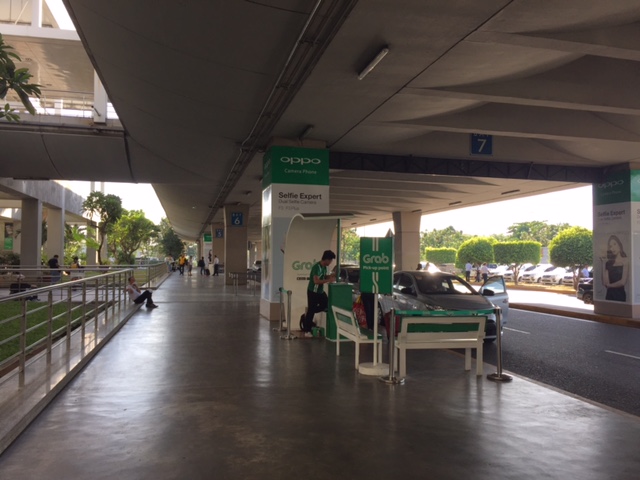 You can easily spot the Grab booth and pick-up area as you exit the terminal’s arrival lounge.
 You can book a ride with the grab staff at the booth if you don’t have a smart phone and the Grab app. You can also just call for a car or taxi using the app. This is the pick-up point for Grab Cars. Grab Taxis would have to use the driveways for taxis parallel and just to the left of this driveway.
Grab has become a game changer for taxis out of the airport. In fact, my own father found them to be a convenient and safe option for a recent trip from Terminal 2 to our home in Cainta. He didn’t have to negotiate fares and he paid a very reasonable fare while enjoying his ride on a recent model car.
–
On motorcycle taxis becoming the “new king of the road” (cont.)
This is a continuation of the yesterday’s post on motorcycle taxis. The feature appearing in Sunstar Philippines also focuses on the case of Cebu City where there is a rising demand for motorcycles and issues on public transport have given rise to a motorcycle taxi use despite their being basically illegal under current laws/guidelines. Habal-habal as these motorized 2-wheeler taxis are known have been in service in many cities and municipalities but are mostly tolerated in rural areas where conventional public transport services are scarce.
Part II of the feature by Sunstar:
New King of the Road – Part II
There are three articles in Part II:
Ramirez, J.A.C. (2017) Motorcycles on the rise, Sunstar Philippines, Retrieved from: http://www.sunstar.com.ph, April 4.
Ramirez, J.A.C. (2017) Habal-habal drivers form group to ‘professionalize’ services, Sunstar Philippines, Retrieved from http://www.sunstar.com.ph, April 4.
Ilano, M.V. (2017) Hailing a motorcycle taxi with your smartphone, Sunstar Philippines, Retrieved from http://www.sunstar.com.ph, April 4.
Part III of the feature by Sunstar:
New King of the Road – Part III
Ilano, M.V. (2017) Even with BRT, motorbikes still needed in Cebu City, Sunstar Philippines, Retrieved from www. sunstar.com.ph, April 4.
Ilano, M.V. (2017) Will Cebu City lead the way?, Sunstar Philippines, Retrieved from http://www.sunstar.com.ph, April 4.
I hope these articles on motorcycles and motorcycle taxis will generate meaningful discussions pertaining to their applications and perhaps their regulation. One issue, of course, that should definitely be on the table is safety. That is non-negotiable and assurances by motorcycle taxi transport providers should not be enough to persuade their becoming formalized as a public transport mode. The basis for mainstreaming these should be evidence-based including assessments based on crash (accident) data. Here is something that can be studied by the various schools around the country especially universities that have the capacities and capabilities to conduct such studies in aid of policy formulation at the national and local levels.
–
On motorcycle taxis becoming the new “king of the road”
There is a really nice feature on Sunstar about motorcycle taxis that came out today. This was shared by a good friend on his social media account, which got my attention as we just completed a study on motorcycles last January 2017. Here is the feature:
Part I includes two articles:
Ilano, M.V. (2017) Habal-habal invades cities, Sunstar Philippines, Retrieved from http://www.sunstar.com.ph, April 4.
Anunciado, D.D. (2017) Deadly motorcycle rides, Sunstar Philippines, Retrieved from http://www.sunstar.com.ph, April 4.
Here’s a graphic from the second article that says a lot about motorcycle safety in Metro Manila:

I would just like to comment that the graphic shows MMDA-recorded crashes in Metro Manila. There can be a lot of incidents that went unrecorded or unreported with the MMDA. It would be interesting to check with the local government units about their own statistics and compare these with the MMDA’s. Also, “crashes” is the preferred term over “accidents” as road safety practitioners and advocates argue that these are preventable incidents.
Sadly, such statistics can only be shown by cities doing the diligent work of recording such incidents. The Department of Public Works and Highways (DPWH) has already ceased collecting, processing, analyzing and reporting road crash reports many years ago (which is quite surprising for an agency mandated to plan, design, construct and maintain national roads). There is currently no agency (no, the Department of Transportation (DOTr) has not yet taken over the enormous task) that is collecting, processing, analyzing and reporting on road crashes at a nationwide scale and few LGUs do so at their levels.
I will also post about Part II once its out. There is a preview of what articles will be in the next feature and so that is something to look forward to.
–
 Caught (up) in traffic