
Home » Public Transport (Page 42)
Category Archives: Public Transport
Interesting site: Japan Railway Journal
We start the month of March with a link to a television show on Japan’s NHK World. Japan Railway Journal features articles in English that includes topics on rail technology (e.g., the latest shinkansen or bullet train) and stories related to railways in Japan such as operations, trends and even history.
Here’s the link:
Japan Railway Journal (http://www3.nhk.or.jp/nhkworld/en/tv/japanrailway/)
–
When conventional taxis were a little better
There was a time when conventional taxis were at least a bit better than what they are perceived to be now. I say “a bit” because then as now, unruly taxi drivers were quite rampant and many drivers were into negotiating fares or choosing passengers. But to those who remember the taxis from the 80s and the 90s, there was one R&E taxi company that was supposed to be more reliable than others. There was even one movie starring the father of a current presidential candidate where the recognized king of Philippine cinema played a taxi driver along with a host of popular basketball players. That was a time when people preferred R&E over other taxis and it was easy to spot their yellow and green cabs.
Then there was also Basic taxi company, which featured a phone-a-taxi (on demand) service. The wife used to call for a taxi to her home or office so she didn’t need to stand out to wait and hail a taxi when she had some heavy stuff with her. I was reminded of this feature of their service when I spotted a Basic taxi in front of our vehicle earlier today. Pick-up call services are still available and I guess there are other taxi companies with similar services for the convenience of passengers. However, with the eventual deregulation of taxis and the proliferation of individually owned cabs, services continued to deteriorate in Metro Manila and other cities.

These convenience features are not new ones as what it seems to younger people these days who have their Uber and Grab apps on their smart phones. I guess if there were smartphones in the 1980s and 1990s, then similar apps could have been developed for taxi services. I had written about one taxi company in Iloilo City that has these pick-up call services and an app for people who prefer to use these with their gadgets. One just wonders if conventional taxi companies could have been preferred by more people over Uber and Grab if their drivers were more professional (i.e., stuck to their meters and weren’t choosy of passengers).
–
Line 2 Extension construction at full swing
The construction of the LRT Line 2 Extension from Santolan, Pasig City to Masinag, Antipolo City is now in full swing. The contractor, DM Consunji, Inc., has occupied several lanes of Marcos Highway and the reduced capacity of the highway has led to moderate to severe congestion along sections from Ligaya to Masinag. At certain times, construction work required more space than the 2 lanes usually occupied by construction equipment and materials. Following are a few photos of the project showing various stages in the construction of the Line 2 extension.
 Section in front of SM Masinag also showing the pedestrian overpass across Marcos Highway
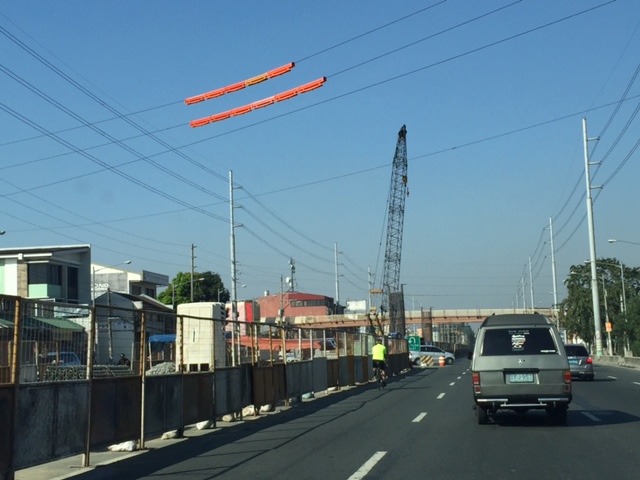 Section in front of Vermont Royal Executive Village also showing a newly constructed pedestrian overpass that looks like it will be cleared by the elevated tracks.
 Columns under construction along Marcos Highway across from Golden Meadows Subdivision.
 Columns completed and under construction across Town & Country Executive Village – the photo also shows another pedestrian overpass but from the completed column its clear that modifications aren’t needed for the overpass.
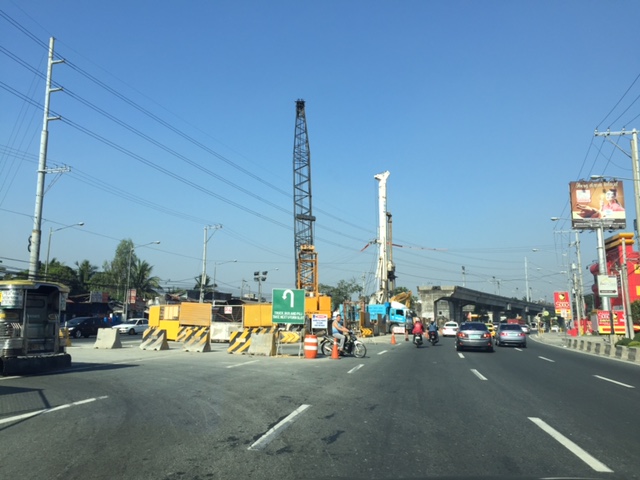 Construction at the current end of the elevated tracks at Santolan, Pasig City
Construction works are expected to go on for at least a year before the trains can start test runs along the new tracks. This is definitely going to be a game changer in terms of commuting along this corridor once the extension becomes operational and hopefully DOTC is already planning an extension further towards Cogeo or perhaps branch out to Marikina via Sumulong Highway.
–
Buses giving way to pedestrians
We saw a sign on a bus at Bonifacio Global City (BGC). Hopefully, the drivers of all buses plying routes in BGC practice this and stop for pedestrians crossing at the designated lanes. Perhaps they should also be proactive in stopping also for jaywalkers as this is the safe practice even if these pedestrians also endanger others by crossing juts anywhere including the most unsuitable places (e.g., blind spots).
 Signs at the back of a Fort Bus including one regarding giving way to pedestrians crossing at designated lanes. Another sign cautions drivers of following vehicles about the bus making wide turns. These are good for promoting road safety.
–
Mainstreaming the motorcycle taxi via current transport tech trends
The motorcycle taxi is common in Southeast Asia and it seems that bringing it to the next level means taking advantage of available technology to facilitate getting a ride. In the forefront is Grab, the company behind GrabTaxi and GrabCar, which is a similar service to the popular Uber. GrabTaxi facilitated getting a taxi and is already popular for being quite effective to many who have availed of the service. I am among those who have used GrabTaxi and so far has been satisfied with the service.
Recently, Grab had been in the news for a service it has been providing elsewhere and which also appeared on their app in the Philippines – GrabBike. I also saw this feature on their app and was curious about how they were able to go mainstream on this in the Philippines because motorcycle taxis (e.g., habal-habal) are basically illegal in most cities and are unregulated except by barangays or a few local governments where their services have been recognized. The Land Transportation Franchising and Regulatory Board (LTFRB) ordered Grab to stop offering this feature of their services. It seems they haven’t done so as GrabBike is still there and the service very much alive.
 GrabBike feature on the old GrabTaxi App available in the Philippines
In fact, we tried to check if there was a GrabBike near our office and voila! There was one unit that appeared in our screen. I would bet that there would be more appearing on one’s screen if he/she happened to be in an area where there’s demand for motorcycle taxis services (e.g., Eastwood, BGC, Ortigas, Makati CBD, Cubao, etc.).
 GrabBike featured on Grab’s new look app
Motorcycle taxis are popular in the provinces and especially in rural areas not just because of the convenience they provide (easily hailed and can maneuver through congested roads) but because they are a necessity, being practically the only public transport mode available to people. The main issues against them in the Philippines are safety-related. Not all providers practice safe riding and most if not all are sure to have no insurance to cover their passengers in case they are involved in a crash. One cannot fully blame motorcycle taxi service providers for offering their services considering the traffic mess in many highly urbanized cities especially in Metro Manila. However, offering such services to the public means that service providers should bear responsibility for ensuring the safety of their passengers. This would basically be in the form of insurance and regulation particularly for fares they charge. I wouldn’t even go to the tax implications of the income they derive from their operations.
These services will no doubt continue to be offered, even clandestinely, as traffic conditions remain bad and continue to worsen. People will gravitate towards such services in order to reduce the travel times in their commutes. This is expected to happen as long as people perceive that nothing is happening to significantly improve transportation in this country.
–
EDSA MRT 3 chronicles
A friend referred an article to me today and I thought it would be a very good read to a lot of people interested in what has happened and what is happening to the EDSA MRT 3. I think that this article is so far the most comprehensive, not-necessary-legal treatment of events leading to what we now have as a mass transit system along arguably the country’s busiest thoroughfare:
On a clear day you can see the MRT
It’s a must read for a lot of people who want to know about the dealings related to MRT 3 and perhaps understand how complex this has become. I would also recommend people read the very good discussions in the comment section of the article. It’s good to see the healthy exchange of opinions rather than have trolls ruin them.
–
Emergence of motorcycle taxis in Metro Manila and other cities
Motorcycle taxis operate in many Asian cities. In Southeast Asia, in particular, there are formal and legal motorcycle taxi services in cities like Bangkok and Jakarta. These motorcycle taxis are called “habal-habal” in many parts of the Philippines and are accepted modes of public transport particularly in rural areas where roads are not the same quality as those in urban areas. Motorcycles and motor tricycles are the most preferred modes of transport and their characteristics are usually most suitable for such roads.
In Metro Manila, there are motorcycle taxis operating in many locations including Bonifacio Global City, Eastwood City and White Plains. These are basically discrete operations and providers are low key so as not to attract the attention of authorities. Services though are worst kept secrets considering they have a steady clientele. In Pasig City, and I assume other Metro Manila cities as well, there are ‘formal’ habal-habal terminals. I took a photo of one in a low income residential area that was designated as a relocation site for many informal settlers around the metropolis.
 Habal-habal terminal in Pasig City near the Napindan Channel where the Pasig River meets Laguna de Bay
A friend at the Cebu City Traffic Operations Management (CCTO or CITOM) told us that there is a growing number of motorcycle riders offering transport services in their city. These are illegal but are being tolerated in many cases due to the growing demand for their services particularly during unholy hours late at night or in the early morning. I also saw many of these operating in Tacloban and even crossing the San Juanico Bridge to Samar Island from Leyte.
There are also many habal-habal in tourism areas including in island resorts where there is a lack of formal public transport services. This mode is a necessity and so far, there are only rare reports of these vehicles and their riders being involved in road crashes. This is the case despite their being perceived as unsafe modes of transport. I guess they will continue to be popular in rural areas and will quickly become popular should they be mainstreamed in urban areas just like their counterparts in neighboring countries in Southeast Asia. In fact, the demand is already there and just waiting to be tapped given the horrendous traffic jams that will drive people towards modes they think can allow them to escape traffic congestion.
–
Mactan Cebu Airport taxi terminal
I wanted to post about the new taxi stands at the Mactan Cebu International Airport as early as September of last year but I didn’t have good photos to show in the article. Last December, however, I was able to get a load of pictures during 2 trips to Cebu. The terminal at the arrival level of the airport is basically divided into 2 stands – the White Taxi Stand and the Yellow Taxi Stand. Here are the photos of the taxi terminal at Cebu’s airport.
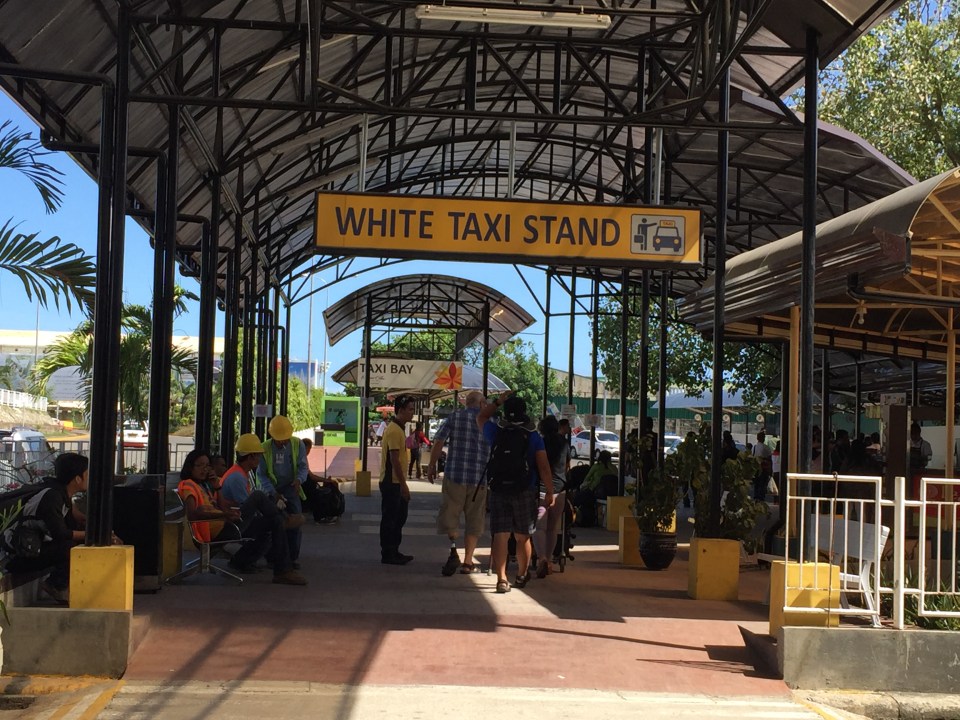 Covered facilities allow for all-weather queuing of passengers.
 White taxis are regular taxis while the yellow ones are ‘airport taxis’ charging higher fares.
 The lines for the white taxis are definitely longer and this is basically due to the lower fares charged by regular taxis.
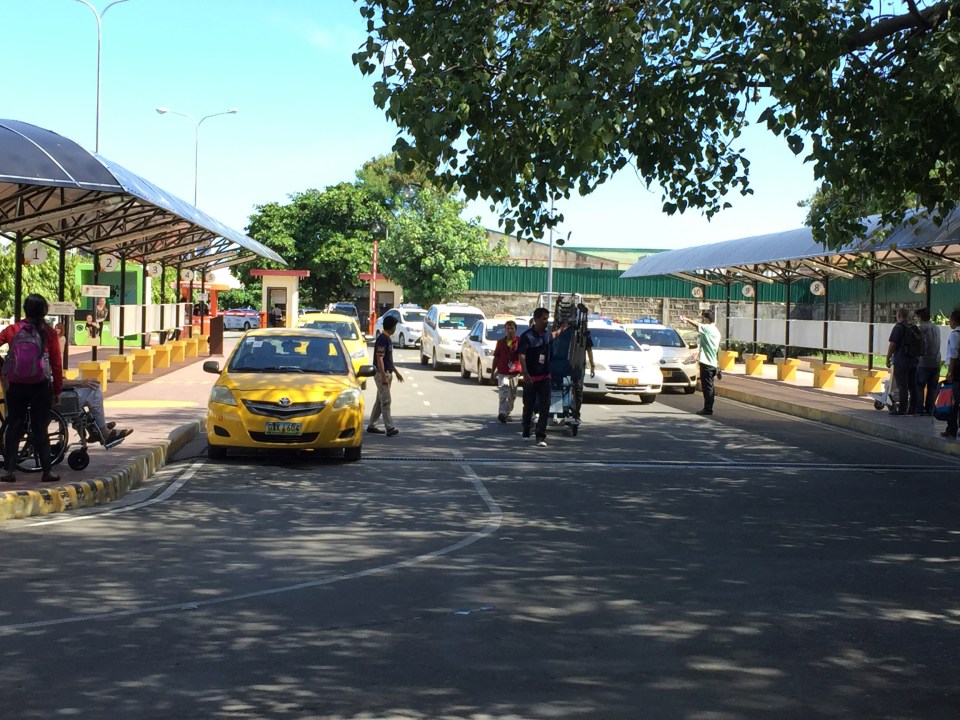 Obviously, there are more regular (white) taxis than yellow taxis so the queue proceed well and the waiting times are not so long.
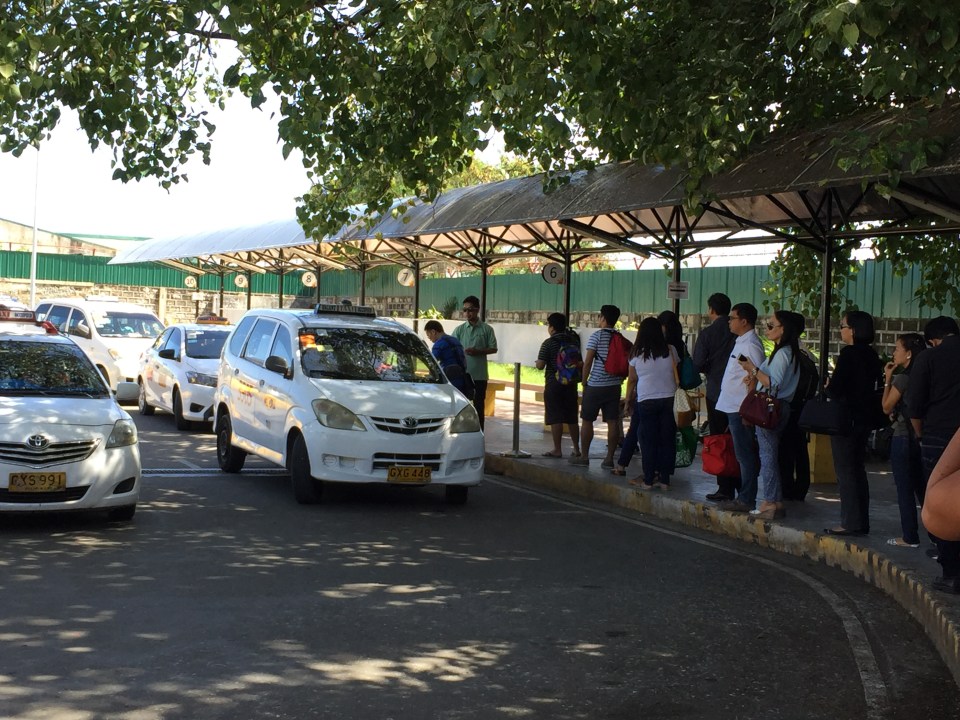 There are 5 spaces for taxis but everyone seems to be queuing for the first one. The dispatchers could do better to make the lines go faster.
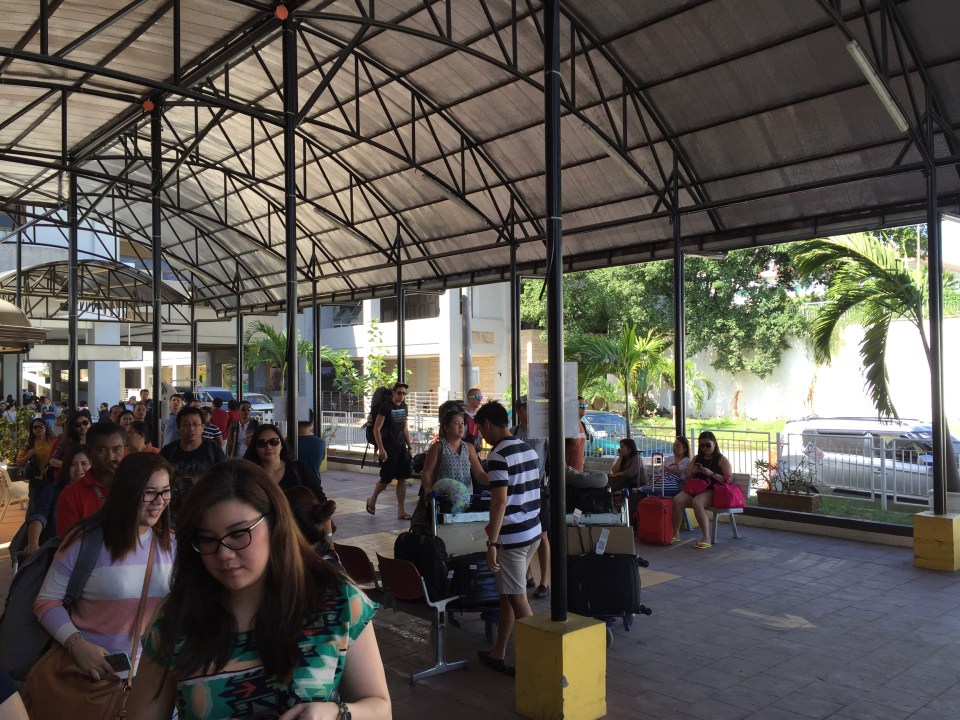 That’s the queue behind us, all going for the regular taxis.
 If the queue for the white taxis is proceeding at an acceptable pace, few people take the yellow taxis. Vehicle-wise, yellow taxis are newer and better maintained models. My observation (based on limited experience) is that yellow taxi drivers are also less reckless than drivers of white taxis.
 There are two booths for app-enabled taxis like Grab Taxi and Easy Taxi. Passengers for these may proceed to the area near the booths and board their taxis at the bays near them.
–
Here are a few photos from the second trip last December when we experienced long queues for taxis. I think we arrived during the morning peak at the airport when a couple of international flights using wide-bodied planes arrived.
 A very long queue for the white taxis greeted us when we got out of the airport terminal.
 There was a constant arrival of taxis but the demand was just too high; resulting in the long queue.
 There is a priority lane for senior citizens, expectant mothers and families with children. Dispatchers make sure that these people get their taxis ahead of others.
–
Some interesting (and required) readings on traffic engineering
Christmas breaks allow me to catch up on a lot of reading. The previous months comprising our university’s semester were spent preparing for lectures though I had to do some readings related to researches I am involved in. Browsing the net and social media, I came across 2 articles shared by an acquaintance. He is a very progressive planner who has extensively studied and written about the most relevant issues in urban planning, focusing on transport. A third article I found while reading one of the two. These were very interesting for me in part because they are thought provoking in as far as traffic engineering is concerned.
- What traffic engineers can learn from doctors
- As traffic deaths rise, blame engineering dogma
- The new science of traffic engineering
The author seems to call out traffic engineers in general but these articles should also be contextualized properly. The situations mentioned in the articles are to be found in cities in the United States and may not be applicable in other cities in other countries. Traffic engineers in Europe, for example, have been working on exactly the solutions being mentioned in the articles that would make streets inclusive and safe especially for pedestrians and cyclists. The same with Asian cities like Singapore and Tokyo.
In the Philippines, however, there is so much that we can learn from the articles. The mere mention of the design guidelines being used in the US betrays the flaws of highway and traffic engineering in the Philippines. The Philippines’ highway planning manual and other guidelines used by the Department of Public Works and Highways (DPWH) are heavily drawn from US references. Most highway and traffic engineers in the country are educated using curricula that use US textbooks and references. There are even civil engineering programs that use licensure exam review materials as their references! These exam materials are also known to be based on DPWH guidelines and manuals aside from problems “outsourced” or patterned after the Professional Engineer (PE) exams in the US. Few schools have progressive curricula that look to best practices that take into account the complexities of roads especially in the urban setting. Such ‘copying’ of American standards and practices in many cases do not consider Philippine (local) conditions and blind applications to our roads instead of proper adaptation often have lead to unsafe and inequitable roads.
–
Honest Iloilo taxi driver
As if on cue, I just read a news article reporting on a taxi driver who returned a big amount of money left by one of his passengers. The driver is of a Light of Glory taxi. Call it coincidence but then the article mentions that the driver also was in the news before for returning a notebook computer another passenger has left in his cab.
Taxi driver returns P300,000 left by passenger
So it’s the driver and not necessarily the company? Likely, and we do need more trustworthy drivers like him behind the wheel of our taxis.
–

