
Home » Public Transport (Page 46)
Category Archives: Public Transport
Bullish about electric vehicles in the Philippines
We were invited to the opening of an electric vehicle assembly plant in Cavite recently. BEMAC Electric Transportation Philippines, Inc. formally opened their plant last February 11 at the Almazora compound at the Golden Mile Business Park in Carmona, Cavite. We were very impressed at the plant and learned that BEMAC is partnering with Almazora, a local company specialised and experienced in vehicle body assembly. I am sharing photos I took of the plant so readers can have an appreciation of what an assembly plant looks like.
 BEMAC’s e-tricycle model, the 68VM, has a comfortable seating capacity for 6 passengers at the back with the driver the sole occupant of the front seat.
 Batteries by Toshiba Japan
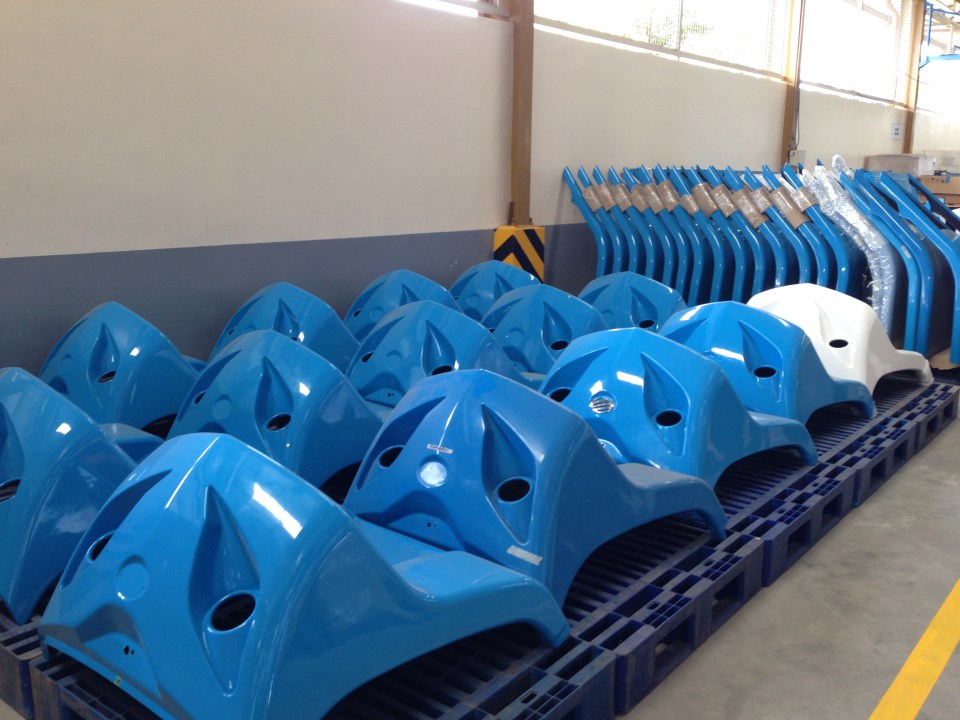 E-trike body parts
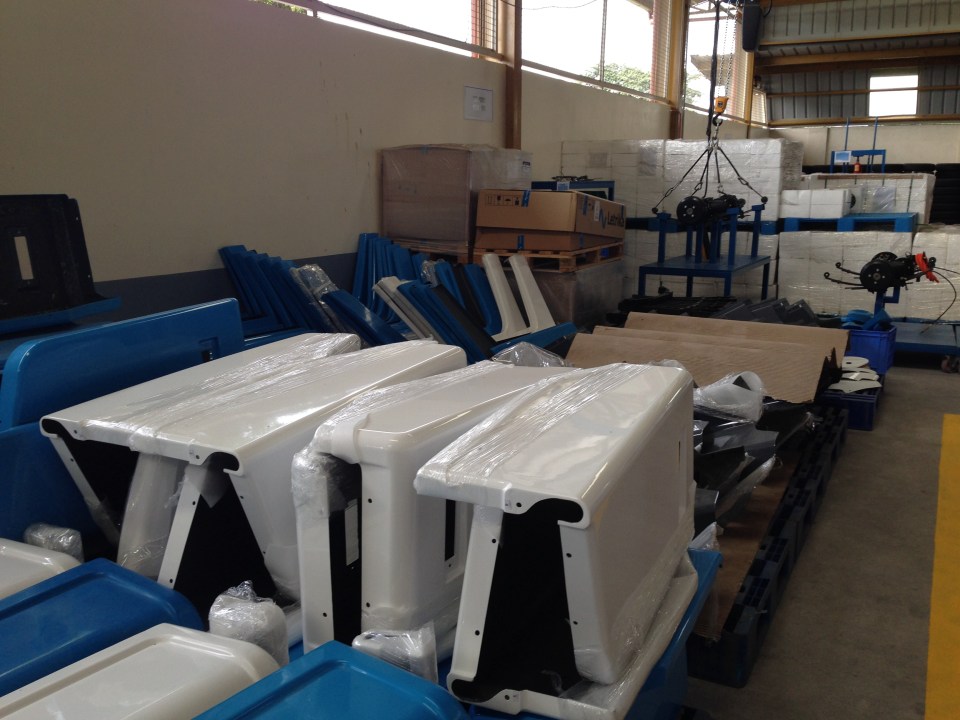 More parts
 Assembly area for the drives
 Axles stacked and waiting for assembly
 A closer look at the drive assembly
 Assembly line showing e-trikes in various stages of assembly
 Another look at the assembly line
 Assembly line showing the chassis of the e-trike and the body being assembled.
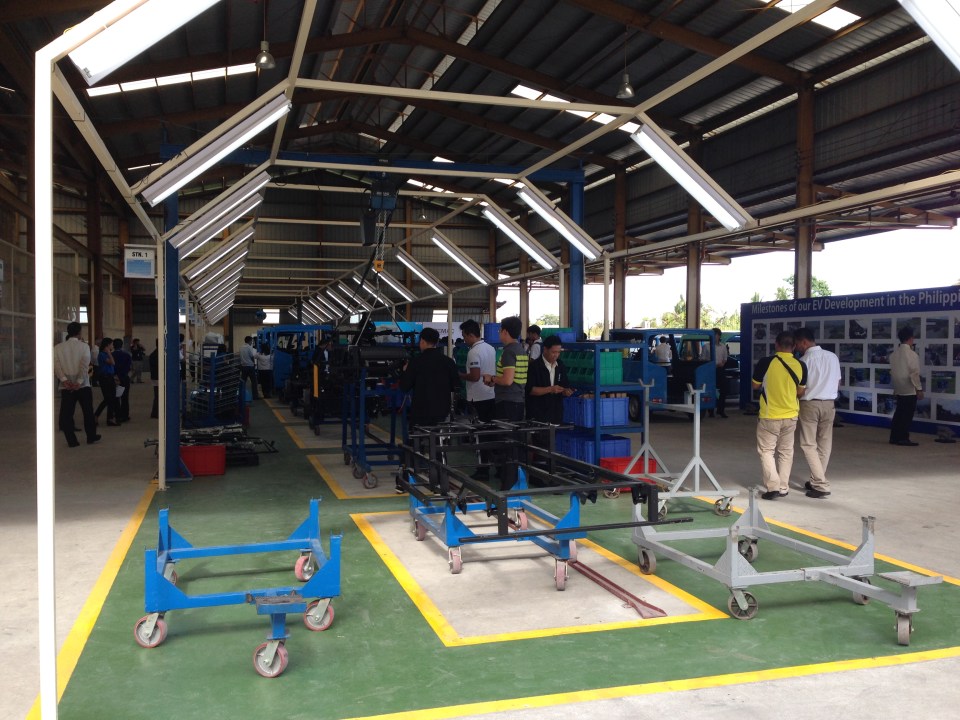 A view of the assembly line from the rear
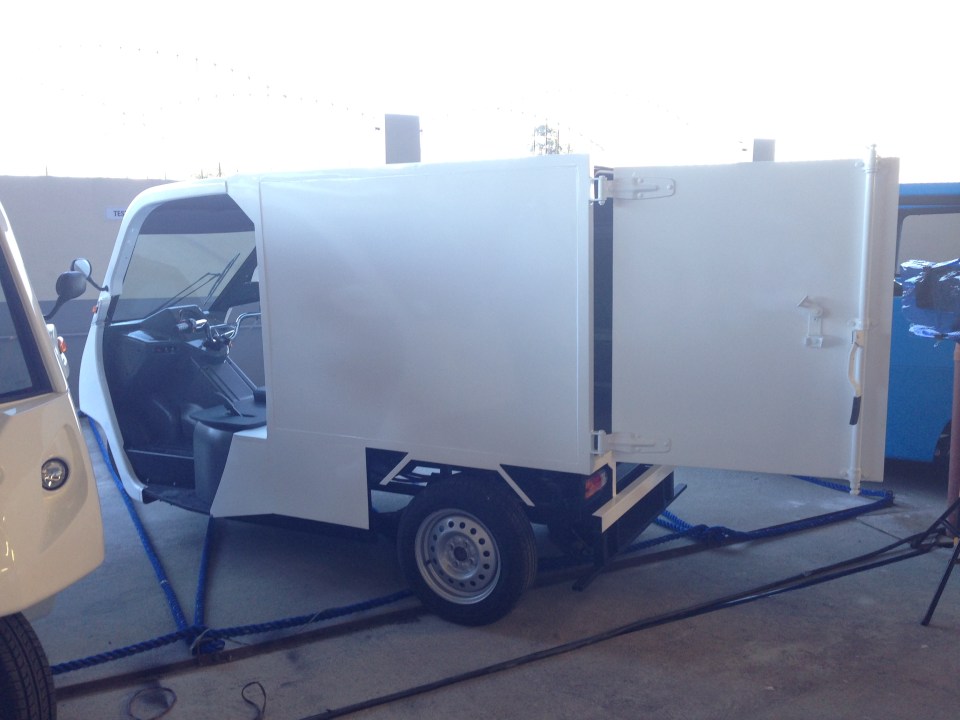 E-vehicle intended for goods transport
 A closer look at the initial stages of assembly showing the e-trike chassis and body frame
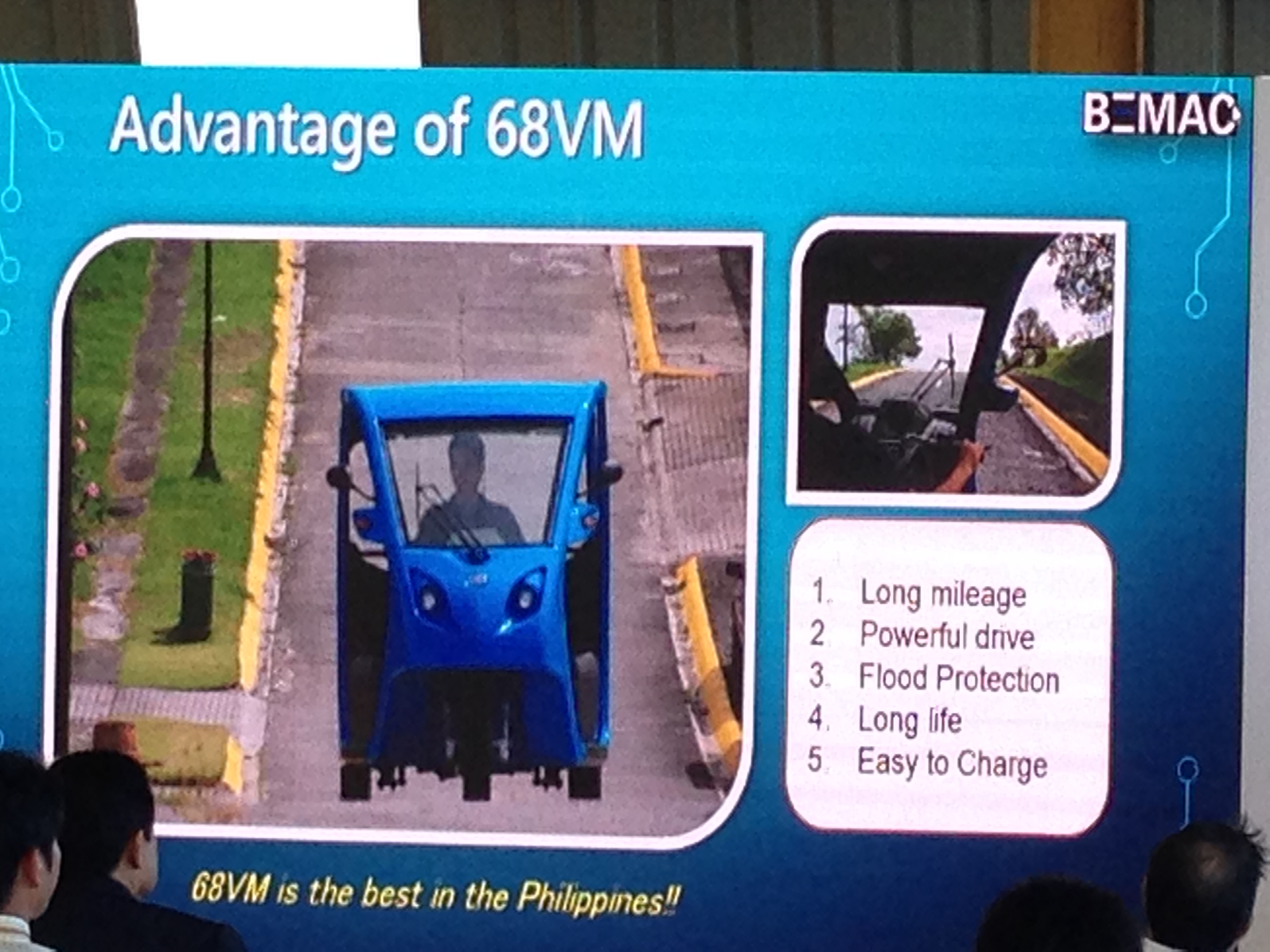 A slide in BEMAC’s presentation shows its 68VM
BEMAC’s e-trike model is the best we’ve seen so far among e-trike models in the Philippines. It is supposed to have been tested under various conditions except actual (or simulated) operations that are closer to real-world conditions (i.e., operation as conventional tricycles in the country). It is claimed to be capable of running at a top speed of 80 kph and its motor can power the vehicle up steep slopes, which is a typical feature in many municipalities and cities in the Philippines. Details for BEMAC Philippines may be found in their website.
There will be an Electric Vehicle Summit on February 26-27, 2015. The 4th Philippine EV Summit will again be held at the Meralco Multi-Purpose Hall in Ortigas, Pasig City. The two-day summit organised by the Electric Vehicle Association of the Philippines (EVAP) in partnership with Meralco and the Partnership for Clean Air (PCA) will feature an exhibit on the current electric vehicle models available in the Philippines, which I think is among if not the main highlight of the summit. There will also be several talks and panel discussions on e-vehicles including those on technology/R&D, industry, incentives and green communities. The program also mentions a lot about sustainable mobility, a term prolifically used by advocacy groups but not really one I’d attribute to e-vehicle proponents (One colleague made the observation before that not everyone is really into e-vehicles because of its environmental aspects.). I’m not sure all the top officials they invited will show up or give good talks. Past summits had good potentials as venues for serious discussions that could have led to fruitful outcomes. However, it seems that they fell short of these objectives and ended up with boring talks that to me often were reduced to lip service from government agencies especially on topics like incentives that will pave the way for the turning point for e-vehicles.
Hopefully, this year’s talks would be more interesting and engaging considering the plenary set-up where people farther from the front tend to have meetings and discussions of their own. E-vehicles have a great potential in improving air quality in a country like the Philippines. There is also the promise of less noise and, more important to many especially operators and drivers, better revenues than translate to increased incomes to those dependent on it for their livelihood. We look forward especially to the transformation of the tricycle sector from the current conventional trikes to the more modern and environment-friendly models such as those by BEMAC.
–
Resurrected bus companies
I posted something recently on an old bus line plying routes between Rizal and Metro Manila. I mentioned there about bus companies somehow being resurrected many years after what I thought were my last sightings of their buses. Of course, it is known that some bus companies have closed shop for one reason or another including what was a government-owned and operated Metro Manila Transit Corporation that used to operate the popular Love Bus. One of the major causes for bus companies folding up is labor problems. Among those that reportedly succumbed to this were Philippine Rabbit, Pantranco and BLTB Co. A few years ago, however, we was surprised to see a familiar bus along the South Luzon Expressway but upon closer look, we found that it wasn’t the old BLTB Co. that was written in the livery but DLTB Co.
BLTB Co. stood for Batangas, Laguna, Tayabas Bus Co. The name alludes to the provinces served by their buses including Tayabas, which eventually became Quezon and Aurora provinces. Their terminal was landmark along EDSA in Pasay City. It is still there along the southbound side and near the junction with Tramo. That will be just beside the left turn overpass from EDSA to Tramo and towards NAIA.
 The livery on this bus is very familiar to many who rode on the old BLTB Co. buses many years ago. Was this deliberate from the owner/operator who obviously wanted to use this to their advantage? People are still familiar with the BLTBCo logo and brand so seeing these buses evoke memories of long distance travel back in the day.
There were few large bus companies in the old days. Among them were Victory Liner, Dangwa, Philippine Rabbit, Pantranco and BLTB Co. Victory, Dangwa and Philippine Rabbit served routes to the north of Manila while Pantranco plied both northern and southern routes. The latter company eventually split into Pantranco and Philtranco, with the northern routes under Pantranco (whose terminal was along Quezon Avenue where Fisher Mall now is located) and the southern routes under Philtranco (terminal is still there along EDSA in Pasay City). Pantranco is no more but Philtranco survives despite the current competition from many other bus companies plying routes south of Metro Manila.
Dangwa’s terminal was in what is still now being referred to as Dangwa in Manila, where you can get all the flowers you’ll need for all occassions. It was, after all, the “bagsakan” of flowers from the north, particularly from Baguio City. Victory’s old terminal is still the one in Pasay though it now has a couple in Cubao. It has expanded its points of destination and is perhaps the largest firm now operating north of Metro Manila.
The Philippine Rabbit Bus Co.’s terminal was at the northbound side of EDSA in the Balintawak area. It has a curious story about it; the stuff of urban legends. The name of the bus company is supposed to be Philippine Rapid Transit (another and real bus company). One time they asked their new buses to be painted, the instructions were misunderstood. “Rapid” sounded like “Rabbit” and that stuck to this day. They also had a labor problem and did not operate for a while until they resolved these issues with their drivers and conductors.
–
Enforcing bus lanes along Commonwealth Avenue
Commonwealth Avenue always seems to be the subject of road safety or traffic discipline initiatives every now and again. Quezon City together with partners in other government agencies like the Philippine National Police (PNP) and the Department of Transportation and Communications (DOTC) have embarked on another program aimed at reducing the occurrence of road crashes and other incidents along this busy corridor. It actually reminds me of the “traffic discipline zone” designation of Commonwealth not a decade ago and before public transport lanes were physically allocated along the highway.
They are failing miserably if I am to base success on observations of the behavior of drivers of public transport vehicles alone along this major highway. They get away with a lot of reckless driving including suddenly switching lanes, speeding, and tailgating. There are also cases where vehicles and pedestrians cross the wide highway at points that are prone to crashes. I am not aware of a lot of apprehensions being made of these reckless drivers along Commonwealth except perhaps at the foot of the Tandang Sora flyover where MMDA enforcers seem to be congregating on most days armed with one of two of the agency’s speed guns. But then it seems “business as usual” for the same drivers and riders along the rest of Commonwealth so the initiatives are not effective deterrents against irresponsible road use.
 You can always see buses on the wrong side of the road along Commonwealth Avenue especially along the section between Fairview Market and Regalado. They do this to get ahead of other buses and then bully their way to make a stop or turn right at an intersection.
 This bus in particular was weaving in traffic, bullying smaller vehicles to give way as it raced other buses along Commonwealth Avenue. Such behavior among public transport drivers is one of the major ingredients for road crashes.
It’s been a year now since the tragic crash involving an out of line provincial bus in the Cordillera. That was partly the result of poor monitoring and enforcement by the LTFRB. While the major reason for the crash was reckless driving (i.e., the driver was allegedly speeding at a critical section of the highway), this could have been avoided if the bus wasn’t operating in the first place. The very same policies along Commonwealth apply to these provincial buses and fatal crashes could’ve been avoided or minimised if the LTFRB can just exercise its mandate effectively.
–
On jaywalking, overpasses and informal terminals
I had some errands last December and decided to take public transport instead of taking our car and wasting time parking the vehicle. There was significantly less traffic at that time of the year because schools already on Christmas break and everyone else seemed to be on the slow side of the holiday mode (read: not in shopping mode). I needed to cross the wide road that is Quezon Avenue and there was a sign where I usually crossed that it was now prohibited to cross there. I had to take the overpass to get to the other side and to the jeepney stop to board one to get back to the university.
The overpass at the Quezon Ave.-Araneta Ave. intersection is under-utilized. I base this on the several times I’ve used the overpass. Most people prefer to cross at road level, taking advantage of the traffic signal cycle that allows for gaps in the traffic for pedestrians to cross safely. Of course, there are those who cross any time and seem to tempt fate by their behaviour. They seem to tempt also the MMDA traffic enforcers assigned in the area but from what I have observed, enforcement of the “no jaywalking” policy is usually lax or non-existent. People regularly cross at ground level in plain view of traffic enforcers.
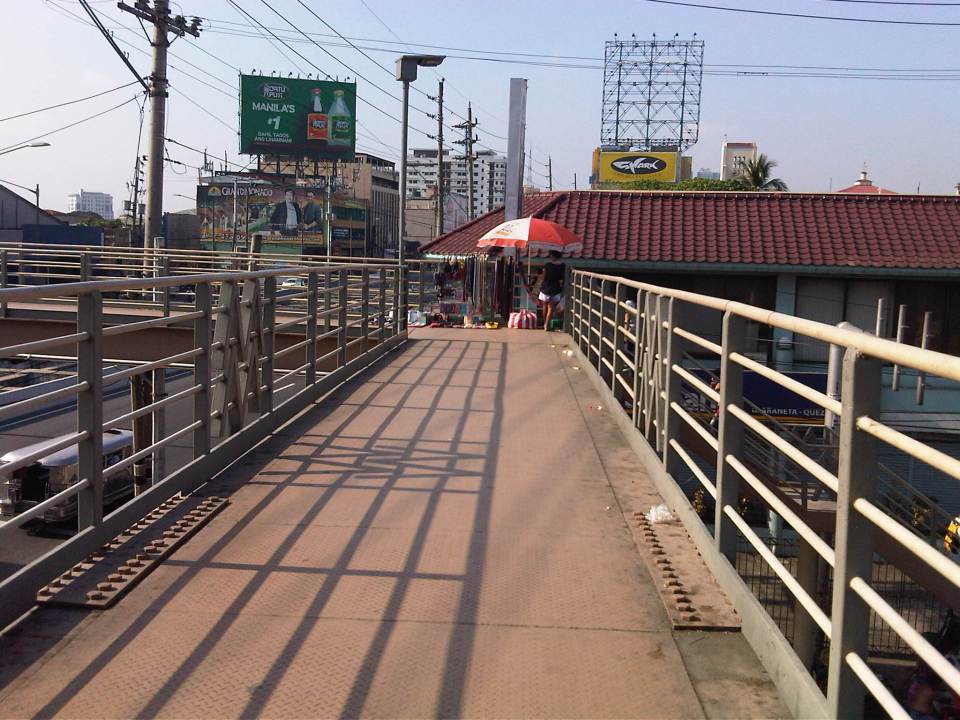 A vendor set-up at the corner of the pedestrian overpass at the Quezon Ave.-Araneta Ave. intersection. Obviously, there are few pedestrians using this overpass as most prefer to cross at ground level.
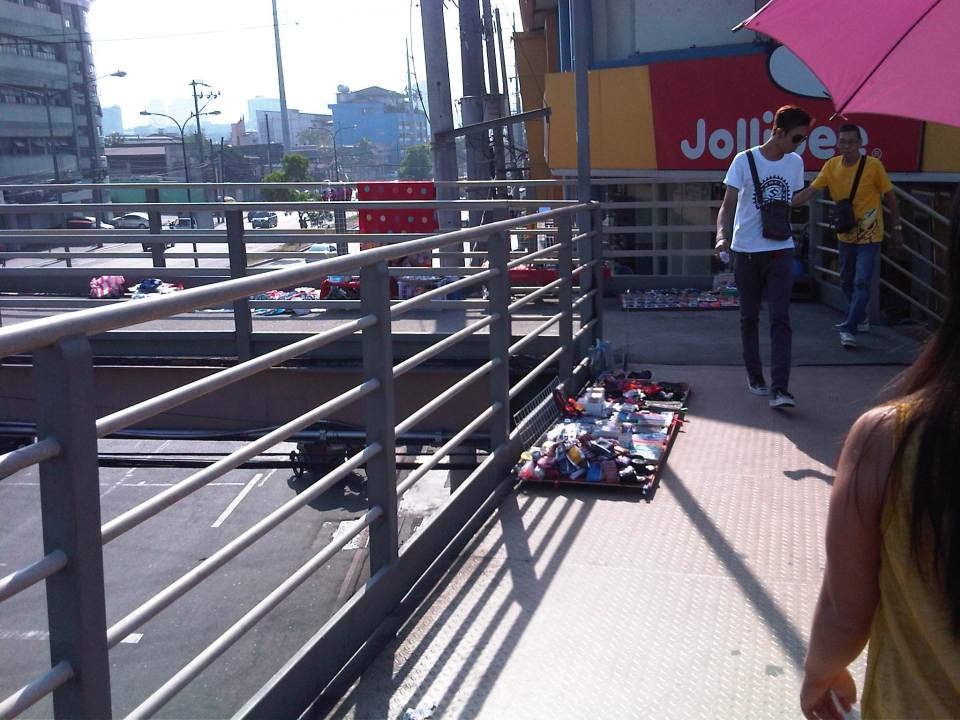 More vendors on the overpass – fortunately, there were few pedestrians using the overpass at the time. Its not the same for other overpasses that are crowded due in part to vendors occupying much of the facility.
 The stairs for many overpasses around Metro Manila are a bit on the steep side. That’s generally not okay with senior citizens, children or persons with disabilities.
There is an informal, on-street jeepney terminal right at the foot of the overpass. If you are in a hurry, its best to try to board a jeepney on the second lane as they are more likely to proceed when the approach is given a green light. From my experience, it takes about 2-3 cycles before the “queued” jeepneys finally cross the intersection. It takes that time to at least have several passengers for the jeepneys before it proceeds to cross the intersection. Most passengers here are transferring from jeepneys plying routes along Araneta Ave. There shouldn’t be an informal terminal here and jeepneys occupy 1-2 lanes of the road at a critical point – the intersection approach. This means intersection capacity is significantly affected and many vehicles could not proceed as they are blocked by the jeepneys. Special mention is made of vehicles wanting to make a right turn but have to go through this “gauntlet” of public utility vehicles. Again, there are MMDA enforcers in the area but it seems the jeepneys and the barkers hold sway and likely with the blessing of enforcers. Such situations are commonplace in Metro Manila and many other cities, and contribute to traffic congestion and other problems commuters regularly encounter.
–
Legit or kabit?
Traveling one morning from Antipolo, I spotted a bus with a familiar company name – EMBC. The last time I saw these buses operating as public transport was when I was in college, and I thought that the company folded up after losing money. However, I have seen some of their buses being used as shuttle services. It seems that the company has been revived but how is a bit unclear. EMBC stands for Eastern Metropolitan Bus Corporation, which was an old company that served the towns of Rizal along with the Antipolo Bus Co., G-Liner and CERT buses during the 1970’s and 1980’s. EMBC buses competed with the Antipolo Buses with their routes overlapping between Tikling Junction in Taytay, Rizal and Divisoria via Ortigas Avenue, E. Rodriguez Ave. (C-5), Pasig Blvd., Shaw Blvd., and Aurora Blvd. These two had overlapping routes with G-Liner and CERT, which plied the Taytay/Cainta to Quiapo route via the same Ortigas Ave. Extension.
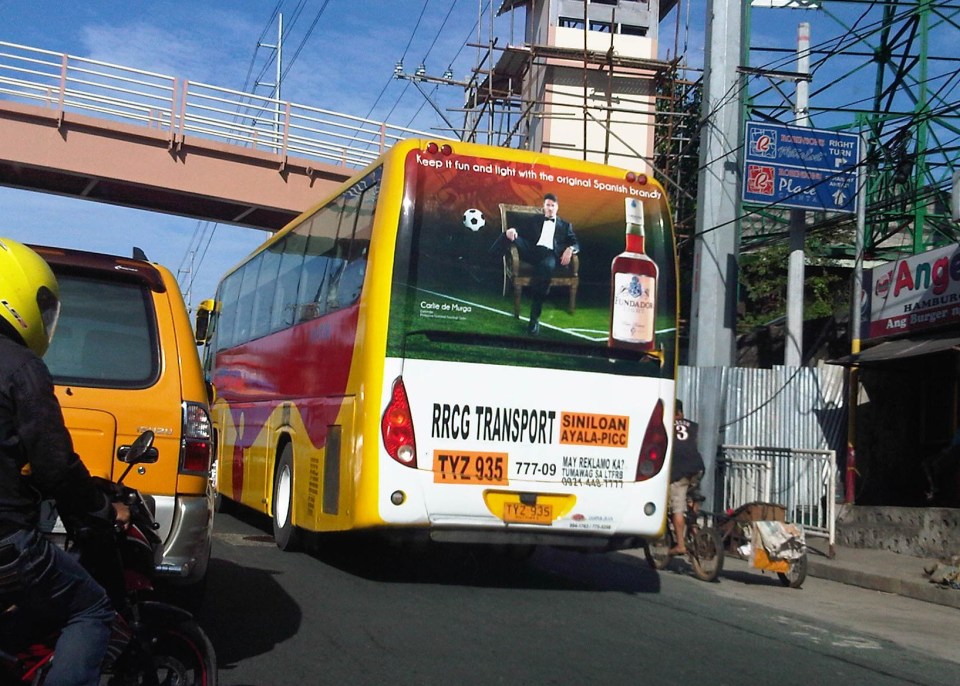 The back of the EMBC bus states that it is run by RRCG Transport with a route connecting Siniloan, Laguna and Ayala Avenue-PICC (it probably turns around at the PICC, where Gil Puyat/Buendia Ave. terminates).
 Closer inspection reveals that the bus is operated by Jasper Jean, another bus company that is better known for its Fairview-Alabang services.
EMBC is an old company and one that has been dormant if not extinct for quite some time. Was its franchise resurrected like what allegedly happened to another old bus company, BLTBCo. a few years ago? In this latter case, certain LTFRB officials were supposed to have been axed as they were allegedly behind the revival or “resurrection” of the franchise. I think it is not a “resurrection” case as I have also seen what looked like legitimate EMBC buses with information on the bus body showing EMBC as the operator of the bus unit. Unfortunately, I haven’t had the opportunity to take a photo of such examples. Thus, it is likely that the bus in the photo above is a case of “kabit.”
The concept of “kabit” (literally “connect” in English) in public transportation is not a new one. It has been used (and abused) in many cases) where the existing franchise holder(s) along a specific route could not deploy the number of vehicles necessary to address the demand for transport. In such cases, the franchisee (an operator) enlists other entities to provide the vehicles. And so there is an agreement among the formal franchise holder/operator and the “kabit” entities outside the contract between the government and the franchisee.
This is one reason why it is not necessarily the main company (franchise holder) that can be the guilty party in an incident involving one bus. However, the penalties (e.g., suspension and fines) are imposed on the franchisee and not necessarily to the “kabit” operators. The latter’s vehicles in turn continue to operate despite the suspension being technically applicable to ALL vehicles bearing the company’s name. Such are among the many issues concerning “kabit” and perhaps also among the strongest arguments to put a stop to this practice that is detrimental to the interests of people taking these buses.
–
Getting a taxi at Mactan Cebu International Airport
It is easy to get a taxi in many airports in the Philippines not named NAIA. The list includes, of course, Mactan Cebu International Airport. There is a regular taxi stand just a few meters walk from the arrival area. You have to cross the driveway and there are directional signs to guide travelers towards the taxi stand that is just a short flight of stairs from the corridor across the arrival area.
 Directional sign to the taxi stand – definitely not international standard but is clear and sufficient for its purpose.
 Queue for taxis – there has been an improvement here as there is now a tent for passengers’ shelter and a driveway for taxis. It used to be an open area along the MCIA driveway where taxis are lined up.
 The stand is manned by airport security and staff who also issue information on the taxi on a piece of paper containing a phone number of the MCIA for complaints. I don’t know if they get a lot of complaints and if the airport acts on these if and when there are complaints from passengers.
 Passengers loading luggage in the trunk of a taxi – there are many LPG-fueled taxis in Cebu and if you have many pieces or large luggage it would be better to select a taxi with more trunk space. LPG taxis have their tanks inside the trunk, limiting space for luggage.
 Some workers are busy doing the lane markings for the driveway. We thought that these probably being undertaken in preparation for the APEC meetings that several Philippine cities will be hosting.
–
Comet – rare sightings
A colleague was saying that he has not seen the Comet, a jitney-type vehicle currently plying the SM North – Katipunan route via Mindanao Avenue and Commonwealth Avenue, for quite some time. I shared the same observation and this is based on my regular commute that includes travel along Katipunan Avenue. The Comet is becoming, if it is not yet, a rare sighting even considering its relatively long and apparently convenient route. The route passes through residential and commercial areas and would be a direct, single ride for students in particular of three major schools in the Katipunan area – UP, Ateneo and Miriam. It also connects to 2 large malls, SM North and Trinoma, and 2 rail stations, LRT 2 Katipunan Sta. and MRT 3 North EDSA Sta. Despite these traffic generators along its route, it seems that the Comet still has less than the desired ridership. I say ‘seems’ because I currently don’t have the hard statistics on ridership but only observations from those who have seen the vehicle along its route.
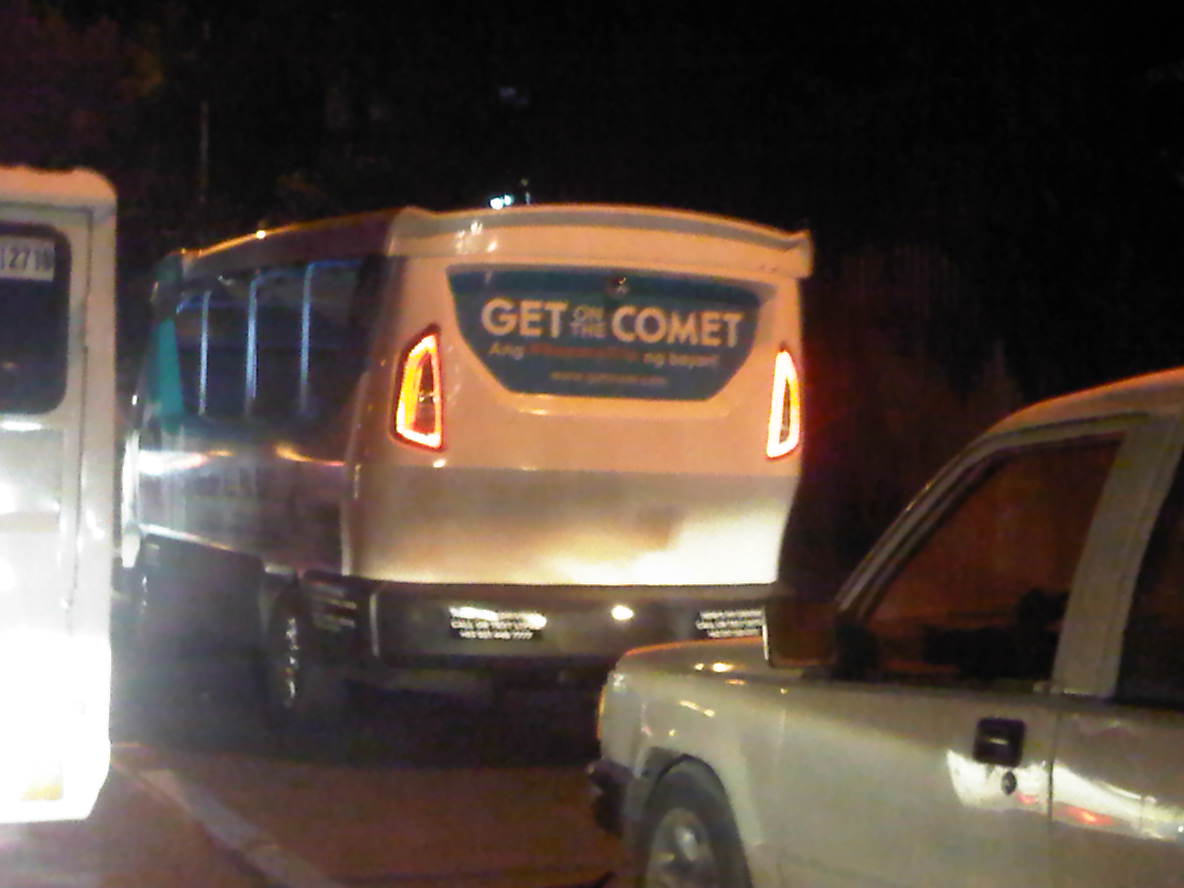 I saw this one on my way home last December in heavy traffic as our jeepney approached the Katipunan – C.P. Garcia intersection. It had few passengers considering its long route from SM North EDSA to Aurora Boulevard via Katipunan Ave.
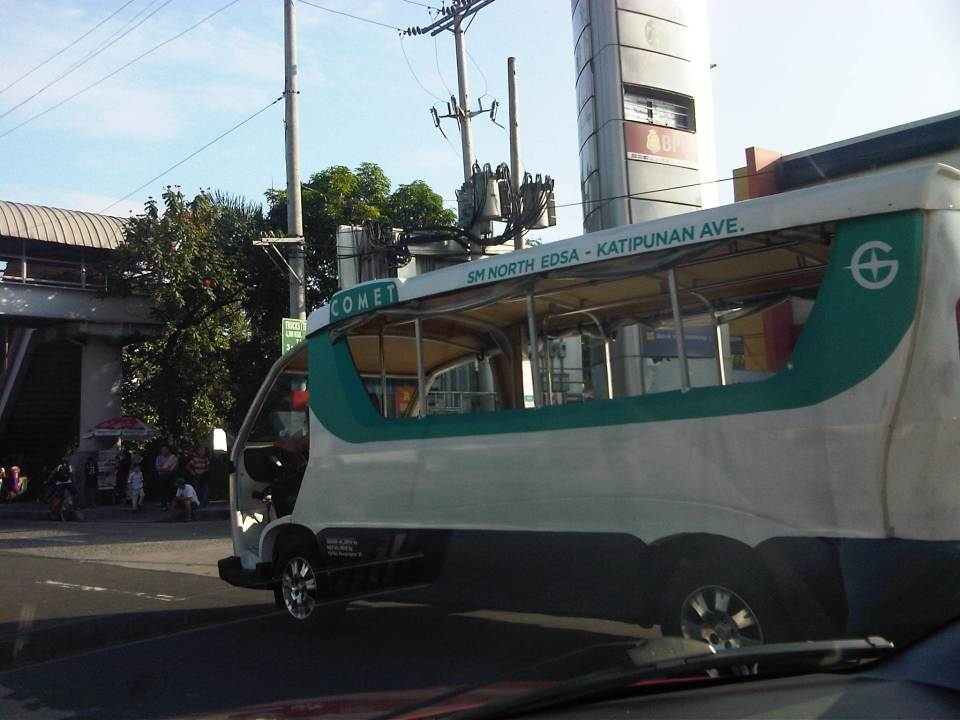 An almost empty Comet spotted one morning this January along Katipunan
What is the future for the Comet? It is unclear so far despite the hype and claims that this is supposed to be the vehicle to replace the conventional jeepney. (To be fair, this is what was also said of the e-jeepney that precluded the Comet.) The DOTC does not have a clear and firm policy or commitment to making this work. Its pronouncements have so far been towards deploying the Comet along new routes instead of replacing existing jeepneys on existing routes with this low emission vehicle. I believe that the only way for the Comet to work is for it to be mainstreamed as a replacement for the jeepney and along suitable routes, of course. The DOTC could and should review jeepney franchises to determine how the Comet and other similar low emission vehicles can be phased in over a realistic period in order to modernize public transportation currently being supplied by conventional jeepneys.
I recently noticed that there are jeepneys along Katipunan bearing tarps on their sides stating “No to additional jeepneys.” Underneath are the names of three jeepney groups supporting this call but with the exception of a major jeepney group that’s supposed to be supportive (even owning several units) of the Comet. Are the signs a form of resistance to change? Do the groups know or understand what they are saying and what they stand for? Or are these indicative of disagreements among jeepney groups, operators and drivers regarding the future of their operations using conventional jeepneys?
There will surely be resistance from these sectors if there are changes to be made that will affect their sources of income. It is a very daunting and sensitive task to decouple transport and livelihood in the Philippines. However, the issues coming out of such changes to improve public transport services should be met head on rather than skirt them, particularly in the case of the agencies responsible for these services – the DOTC and the LTFRB. Only then can we have the transformation we need for road-based public transport in this country.
–
The Metro Manila Transportation Planning Study II (JUMSUT II)
Similar to the previous JUMSUT Phase I, the recommendations of Phase II focused on route structure planning and improvement for road public transport to avoid unnecessary competition between LRT, bus and jeepney. Recommendations for route structure planning included the modification of route schemes for the central eastern sector of Metro Manila mainly to alleviate traffic congestion and improve schedules. The study reiterated the recommendations of Phase I.

Following are more photos showing the recommendations of JUMSUT II:

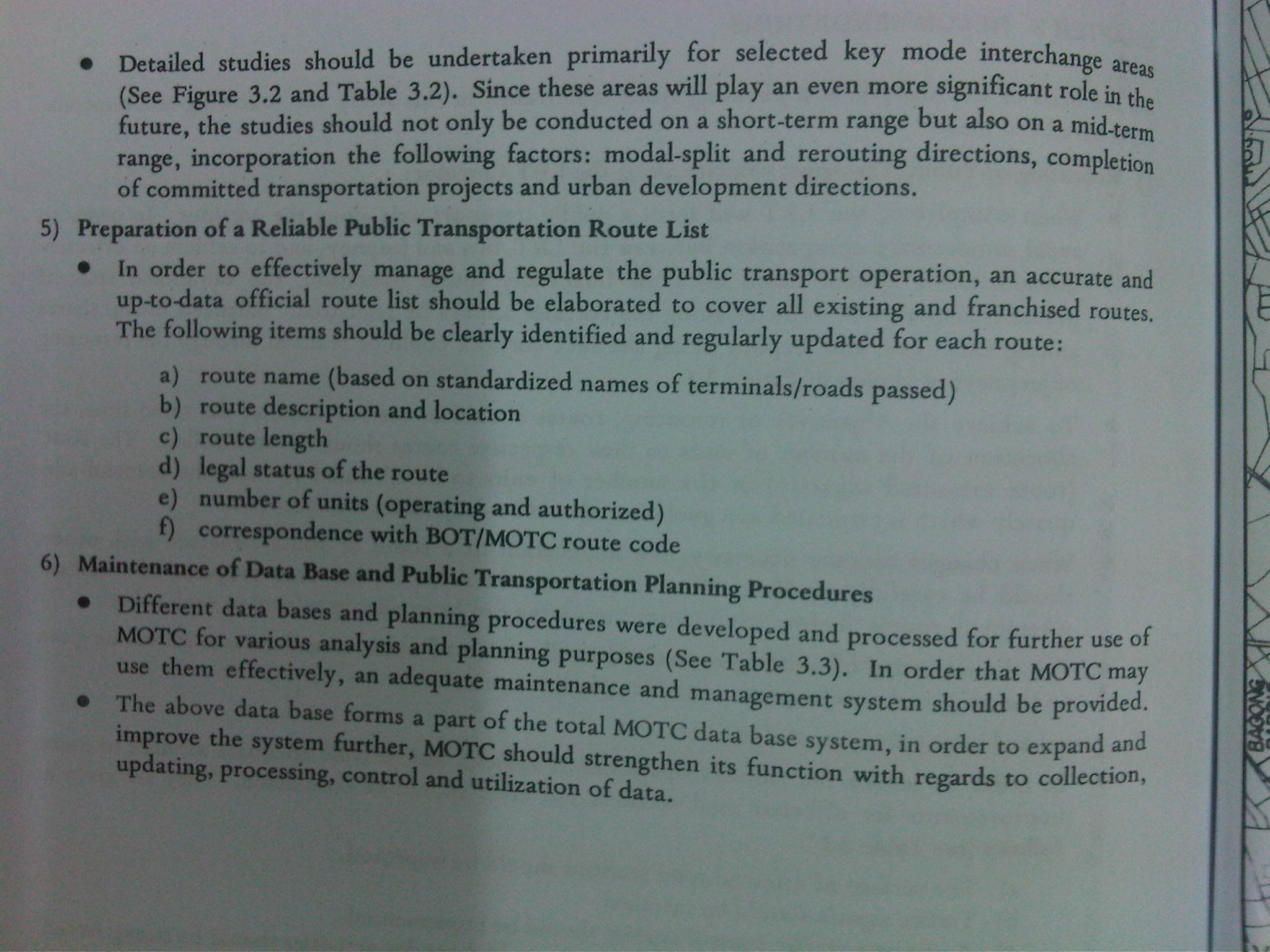
[Reference: JUMSUT II Final Report, NCTS Library, University of the Philippines Diliman]
–
The Metro Manila Transportation Planning Study I (JUMSUT I)
I continue with the series of posts I had started last year on past studies conducted for Metro Manila. It is important to review these studies in order for us to understand how transport in the metropolis came to be how it is now. I believe there are many lessons to be learned and history does not need to repeat itself (although as we can see, it has in as far as transport in Metro Manila is concerned).
The Metro Manila Transportation Planning Study better known as the JICA Update on Manila Study on Urban Transport (JUMSUT) was conducted in two phases, the first one from November 1982 – March 1984 and the second from June 1984 – March 1985, respectively, as a follow-up to MMUTSTRAP. JUMSUT focused on studies to support the implementation of the LRT Line 1 project along Rizal and Taft Avenues.

Recommendations of the first phase are mostly on the rerouting of public transport vehicles along LRT corridor and the traffic management required for the construction and eventual operation of the LRT Line 1. The rerouting is presented as a necessity to avoid unnecessary competition between LRT, bus and jeepney as well as to achieve balanced mode share among LRT, bus and jeepney along the corridor. Following are photos showing a summary of recommendations for JUMSUT I.

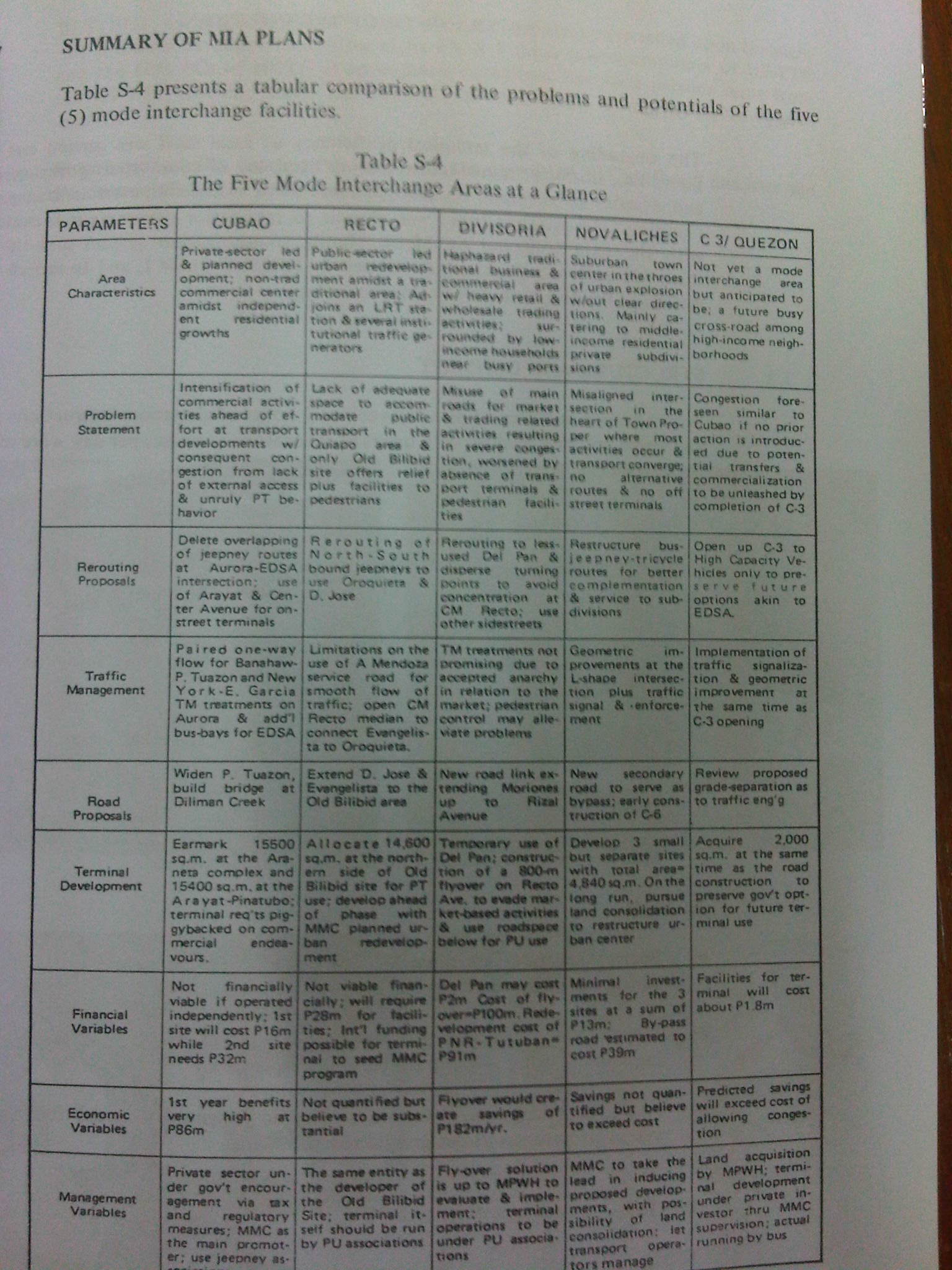
[Reference: JUMSUT I Final Report, NCTS Library, University of the Philippines Diliman]
Next: JUMSUT II
–
A tale of two consultants
I attended a seminar last November where there were two foreign consultants who gave talks about public transport and the reforms required for Metro Manila. One consultant had extensive experience in public transport, having worked in Hong Kong and Singapore, and is currently a consultant in Jakarta. The other appeared to have the more limited experience but claimed credit (I think partial at best) for public transport reforms in a major Asian city. I was impressed by the first in part because he was very honest with his statements especially as he explained a list of prerequisites for fixing public transport in Metro Manila (and other large cities). The bottomline from his presentation was that it was not possible to have a quick fix and there are no easy paths towards solving public transport problems in Metro Manila and elsewhere in the Philippines.
The second consultant was more on the patronizing side – promising a lot and a little too optimistic to be realistic or practical in his presentation on how to solve Metro Manila’s public transport woes. His material was hodge-podge at best with lots of visuals but not really getting to the point in terms of concrete solutions. It only betrayed his very limited if not unfamiliarity with transport and traffic in the metropolis despite his being a consultant with the office of the highest official of the transport department. There is a saying that if something seems to good to be true, it probably is. I think the same applies to what the second consultant presented to us that morning.
We need more of the first type of consultants who will tell us how it really is with regards to the “challenges” we face in solving transport and traffic problems in this country. The second type just lets us into a false sense of confidence or a feeling that the problems are not so big or complicated and that we are not in a big, deep hole that we need to climb out of. Its one thing to throw caution to the wind and another to have oneself firmly grounded in terms of the understanding of the problem at hand. Understanding the problem is the first step in the formulation of suitable alternatives and allows for the elimination or at least the minimisation of non-practical and non-realistic options.
–
 Caught (up) in traffic