
Home » Public Transport (Page 51)
Category Archives: Public Transport
Preventable tragedies
Last Friday, a provincial bus plunged into a ravine somewhere in the Mountain Province. The bus rolled several times before coming to a stop, instantly killing 14 people. Among the fatalities in this crash is a popular comedian/media personality who went by the name Tado and part of a group doing civic work in the area. Foreign visitors were also killed in the crash, leaving many to wonder if perhaps the Department of Tourism (DOT) should also get into the act as it is in the interest of the department to also establish that “It’s safer in the Philippines!” as part of its “It’s more fun in the Philippines!” tagline.
According to initial reports, the driver lost control due to defective brakes but later one report suggested that the driver had dozed off and awoke too late to bring the bus back in control. The slope of the road was downwards and there was significant curvature. This combination is definitely a challenging one for most drivers, even professionals who, like the bus driver, would probably have encountered such combinations of slope and curvature many times, even on a daily basis along mountain routes. One has to be awake and focused on maneuvering a vehicle for such sections. It didn’t help that probably, and I base this on photos of the section I’ve seen online, the road’s barriers were not up to standard in as far as stopping large vehicles like the bus from falling off and into the ravine.
These are preventable incidents, preventable tragedies that occur on a daily basis around the country. It is clear to many that the LTFRB needs to address these problems by taking steps to insure that public transport vehicles such as provincial buses are properly maintained and drivers are fit and in the best condition to drive these vehicles. To do that, they have to be proactive in evaluating bus, jeepney, UV express, and taxi and other franchises under them. These evaluations should delve into involvements in road crashes as well as the frequencies and types of traffic violations drivers have been involved in. Such records of crashes and violations should form part of a set of criteria to suspend and ultimately revoke franchises of public transport entities.
The LTO also has a responsibility here because they are the agency in-charge of licensing drivers. They should make sure that those applying for professional licenses are indeed qualified and not just to drive any vehicle. Therefore, perhaps there is a need to have different types of licenses for different types of professional drivers. Public utility vehicles differ in size and maneuverability so a different skill set and experience is required for buses compared with taxis. Another type of license should apply for those seeking to drive trucks as well as heavy equipment such as payloaders and bulldozers. The TESDA has certification programs for these that are sought out by people who want to drive professionally abroad. These should also be made as requirements for those seeking to drive professionally here. These would ensure that drivers will be qualified and competent as they are responsible for lives and property.
It is also clear that the DPWH and local authorities in-charge of road safety along roads should look into how to make travel safer by investing more into safety devices such as barriers. Crash or accident prone sections can be identified and sturdier barriers designed to keep vehicles on the road should be constructed/installed in order to prevent such types of fatal crashes (i.e., barriers would not prevent head-on collisions, etc.). That is why the DPWH and local governments need to have capacity and capability to assess road safety along national and local roads. These actions address vulnerabilities. These actions save lives.
What can you do to help in this effort? You don’t have to be part of an organized group or a lobbyist to be involved in promoting road safety. You can be involved in simple ways. Be aware of your rights on the road and your being among those vulnerable to road crashes. I am sure you don’t want to be involved in a crash nor would you like a loved one to get injured or, God forbid, perish in a crash. If your bus, jeepney, UV express or taxi driver drives recklessly, be firm in reminding him of his responsibility. You may enjoy a fast ride but are you sure your destination isn’t the afterlife? Think about it. Act on it. Save lives!
–
On commuting and jeepneys
There is an online petition calling for public officials to take public transportation instead of traveling in their own cars (with or without chauffeurs). The assumption seems to be that our so-called leaders, particularly those tasked to come up with solution to our transport and traffic problems, do not themselves used public transportation. As such, they are basically oblivious to the daily frustrations of many commuters who have to suffer the uncomfortable, inefficient and, in many cases, unsafe transport that we have in most if not all our cities and towns.
But who’s afraid of riding public transport and jeepneys in particular? I would like to think that many if not most or all Filipinos had to ride a jeepney at one point in their lives. After all, the jeepney is second only to the motor tricycle in terms of being the most widespread mode of transport in the country. [Yes, that’s right. The jeepney is not really the king of the road in the Philippines. That title is perhaps more suitable to the tricycle, and I’ve explained this in past posts about the tricycle.] Why do people continue to ride the jeepney despite it being perceived as unsafe and not an environment-friendly mode of transport? Why are these aspects not being corrected by the responsible agencies? These are questions that are difficult to answer only because of the social implications that the government does not want to deal with head-on.
–
The way jeepneys are designed all over the country, drivers have to deal with the cramped space of the front seat that have implications personal health as well as road safety. The cramped space and overall design of the vehicle affects the driver’s posture as he is forced to stoop in order to have a good view through the windshield. In some cases, those with longer legs would have to orient their seated bodies in a position that is not ergonomic. Such practices or positions may contribute to injury over the long term as well as affect the way the driver operates the vehicle.
 I’m not into taking photos inside jeepneys (quite risky as it invites attention to you and to your phone) so there’s few (and not so good) photos of my commutes. This one is a good one inside a jeepney bound for Quiapo, Manila from Philcoa, Quezon City.
I think that for visitors from other countries, a trip to the Philippines would not be complete without experiencing a jeepney ride. When we do have visitors at the university and if they have the time, we take them around the campus on a jeepney. Of course, this is an easy and relatively safe ride for them considering the “Ikot” and “Toki” jeepneys have routes within the campus and do not pass through busy streets or wide highways that tend to invite speeding.
It’s a different thing and quite an experience when you ride the “patok” jeepneys usually plying the longer distance routes like Cubao-Montalban or Cubao-Antipolo. The drivers of these jeepneys are generally risk takers and many are reckless to the point that a slight mistake in driving would likely lead to a serious if not fatal crash. It’s a wonder that they don’t make mistakes often enough for authorities to clamp down on them. Despite this, many people take such jeepneys because they have no choice or if they did, they opt for the aggressive drivers because of the perception that these will get you to your destination faster (Jokingly, it is said that hopefully your destination is not the afterlife.).
–
Habal-habal ambulance
I came across a documentary one late night after watching the news on GMA’s Channel 11. Motorcycle Diaries featured an episode on Surigao and a segment was devoted to habal-habal, those ubiquitous motorcycle taxis that are popular in the rural areas but are also found in many cities around the country. What caught my attention was not really the habal-habal itself (I’ve seen many other features in the past about these taxis.) but the use of the same for a purpose other than public transport. A habal-habal was fitted for use as an ambulance by a community in Surigao to transport people needing medical treatment to the nearest hospital. All photos below were taken from the television screen.
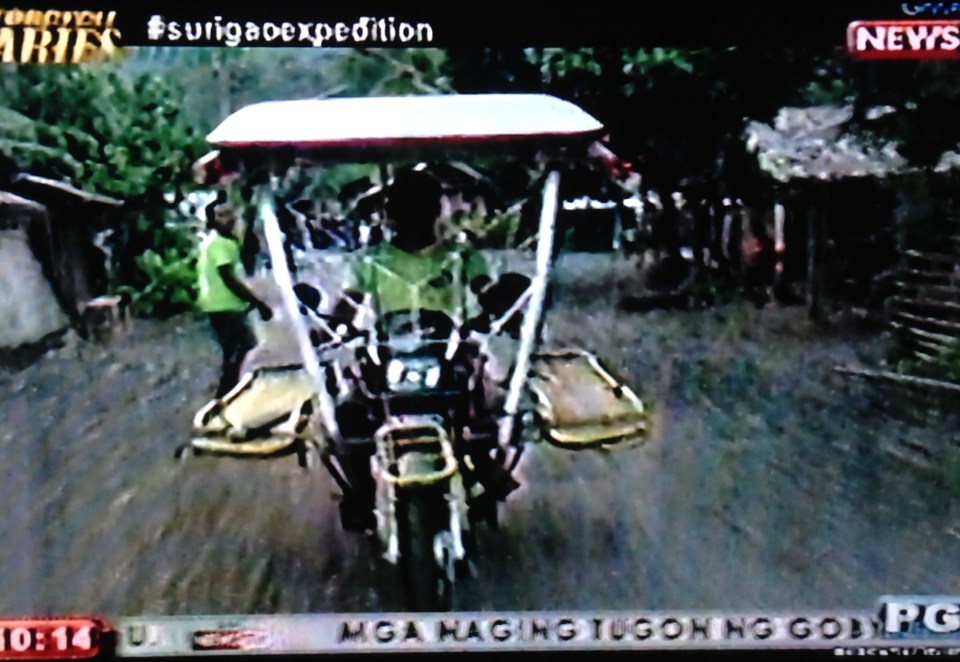 Unlike other habal-habal, this one has a roof and two planks on either side where patients lie down for transport. While I’ve seen habal-habals in Leyte and Samar that have roofs, the planks are more “skylab” than the typical habal-habal. “Skylab” is a term coined for the shape of motorcycle taxis with a plank installed perpendicular to its body. Passengers seated on the plank have to be balanced by the rider/driver.
 All terrain – the habal-habal is popular in rural areas as it can operate on bad roads, trails, no roads and even cross rivers and streams.
 The documentary also had interviews with the owner and driver of the motorcycle ambulance.
 Rough roads, typical of municipal and farm to market roads, do not deter haba-habal operations.
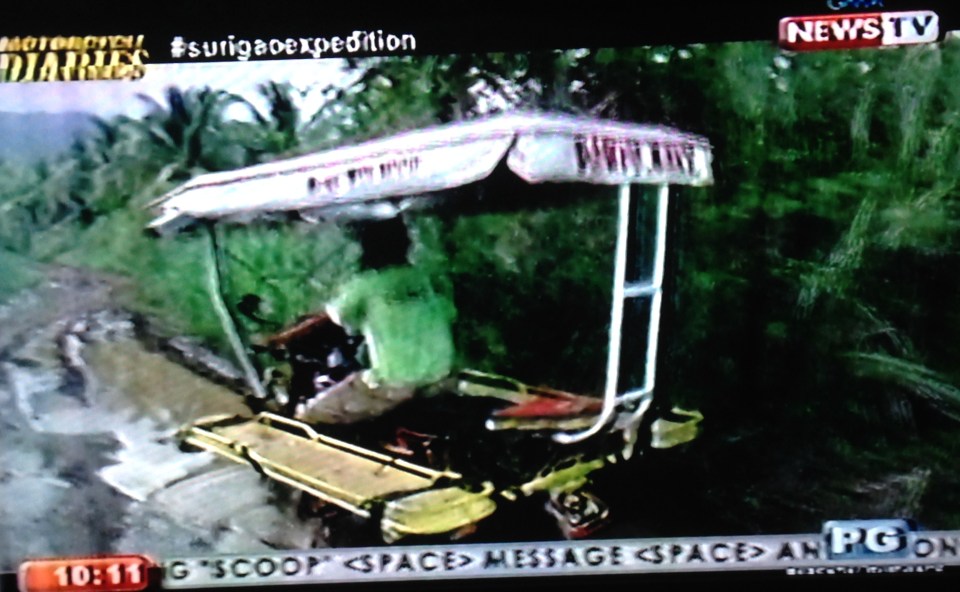 Rural roads are a big challenge given the conditions like these huge holes filled with water. I’ve seen roads like this that are like rivers or streams during the rainy season.
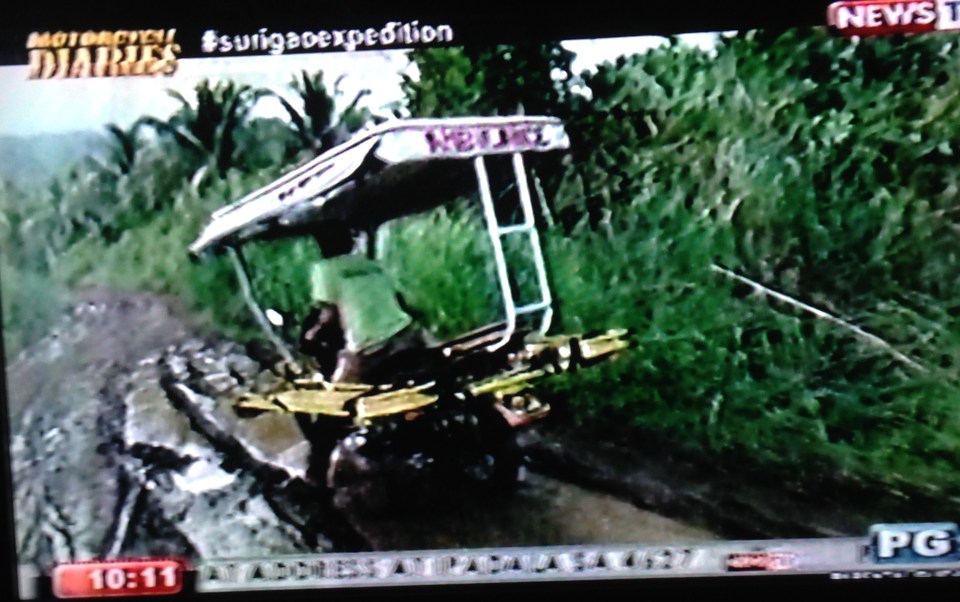 Travel is quite treacherous along these roads and I can only imagine how difficult it would be to transport a patient on a motorcycle ambulance. The risks are quite high that there can be a mishap along the way that could result in not only serious injuries but death.
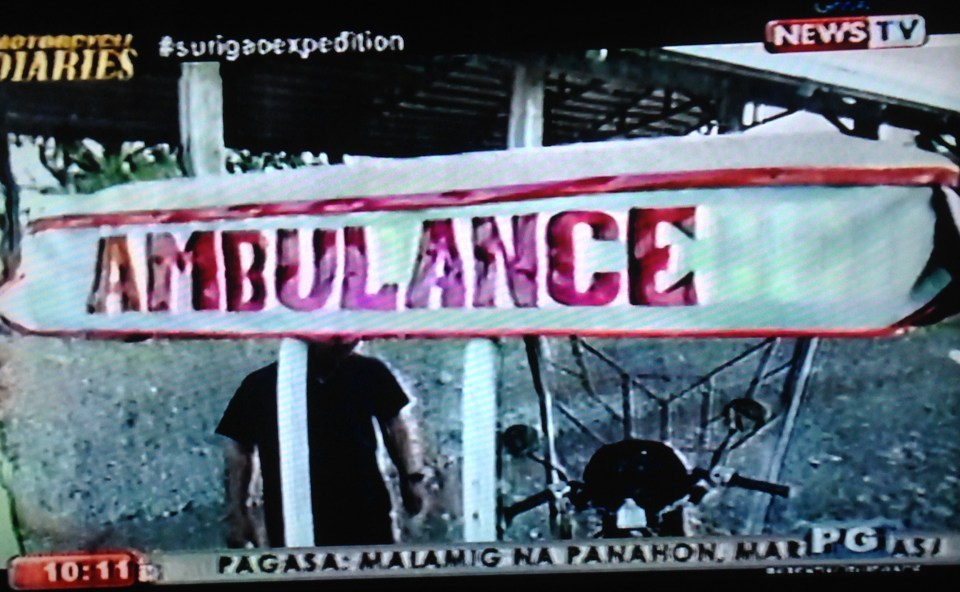 The sign makes it unmistakable for what the vehicle is for.
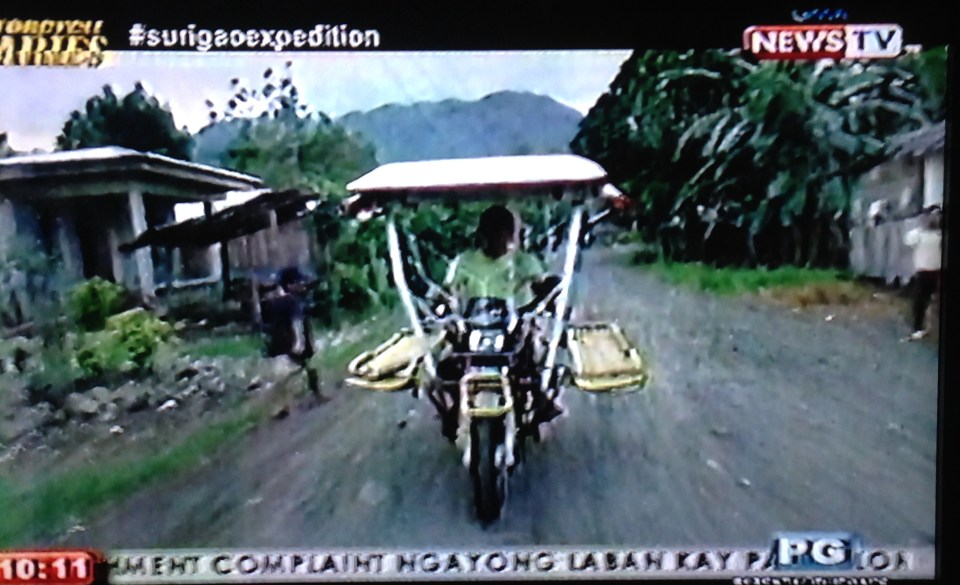 The ride is a balancing act and the driver should be highly skilled for the task.
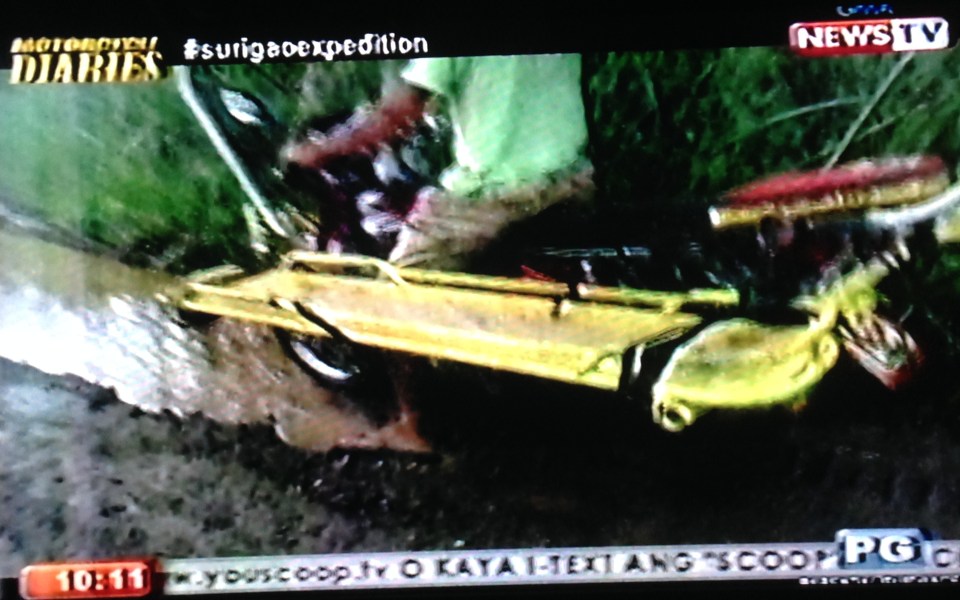 Patients or people needing medical attention are made to lie down on one of these cots on either side of the habal-habal. There are what looks like straps to secure the person. I assume that another person or weight should be placed on the other cot for balance. Likely, another person will ride behind the driver to care for the patient(s).
Such vehicles used for emergency are fitted out of necessity for these communities. As shown in the photos, the roads connecting these communities to the municipal or city centers are unpaved and conditions can be quite bad during the rainy season. It is clear that many such roads need to be paved so that they can be used under all weather conditions. Paving the roads also makes them usable by regular vehicles such as your typical ambulances. It makes me angry to see many such ambulances in Metro Manila being used for personal travel while communities in dire need of emergency vehicles can only improvise with the habal-habal to get people to hospitals.
It’s a shame that our government can spend a lot or engage the private sector in major projects while hundreds or even thousands of communities remain under-served for basic needs including access to schools, hospitals and workplaces. These are not even the typical farm-to-market roads but appears to be municipal, city or provincial roads. The fruits of economic development will not trickle down or cannot be felt in these areas if transport facilities cannot be upgraded. These are requirements for inclusive growth that government should address – and with urgency.
–
Clear message to transport service providers
The cancellation of the franchise of the Don Mariano Bus Transit last January 14, 2014 is a long overdue decision. I say this because there have been so many incidents of road crashes in the past involving public transportation that led to the deaths and serious injuries of a lot of people whether they are passengers, the drivers themselves, pedestrians or even innocent people who happen to be at the wrong place and the wrong time (i.e., when and where the crash occurred). The cancellation of the franchise sends a strong message to erring operators and drivers of public utility vehicles including those of buses, jeepneys, UV express and taxis that the Land Transportation Franchising and Regulatory Board (LTFRB) is dead serious about enforcing franchise rules and regulations particularly in the light of road and public safety concerns. The decision is also a strong statement by the agency. One that says they have the balls to make game-changing decisions that is assumed to be intended for operators and drivers to take heed.
I had the opportunity to attend a few congressional hearings at the Batasan a few years ago that were convened by the Committee on Metro Manila Development. The main topics of those hearings were on public transportation. I recall that one hearing focused on the proposal to increase the penalties for traffic violations while others focused on policies being introduced by the MMDA (e.g., dispatching scheme, painting the bodies of buses with their plate numbers, RFID, etc.). In these hearings, the MMDA had been asked by the congressmen to present statistics on road traffic violations by public transport vehicles and they did present the numbers indicating also which bus companies were involved in the most crashes and which incurred the most violations. One question asked by a congressman was why, despite all the incidents and violations that bus companies were involved in, have no franchises been cancelled or revoked. The MMDA quickly and correctly replied that it is the LTFRB that has authority over the franchises. I do not recall how the LTFRB managed to answer the follow-up question trained on them but I don’t think anything close to a solution came out of those hearings. The transcript of these meetings and the data reported by the MMDA should be with the committee and, I presume, should be for public consumption given that these hearings were made in the interest of the general public.
Public transport as a form of “livelihood” should not be made an excuse for the poor quality of public transport services. A driver cannot drive like crazy, crash into other road users and claim that they were only trying to earn a living. Operators cannot scrimp on maintenance and spare parts costs (resulting in poorly maintained vehicles that are prone to mechanical failure and obviously violate emission regulations) just because they want to earn a larger profit. It is a card that is always put on play by public transport operators, drivers, conductors and their lawyers when interviewed, especially by TV reporters. One take on the news reports on TV is that those interviewed were nagpapaawa lang (acting for people to pity them or sympathize with them. Yet afterwards, once the suspension is lifted, these same drivers go back and drive as if nothing happened and still oblivious to the dangers they pose on others travelers. I have written about this in the past and share the opinion that we will get nowhere near the efficient and safe transport services we aspire to have unless we do away with the current practices of reckless driving and smoke-belching PUVs. And the improvement begins when the LTFRB starts canceling franchises of erring operators of public utility vehicles and the Land Transportation Office (LTO) starts revoking the licenses of irresponsible drivers.
Now, if we can only have the LTFRB cancel the franchises of erring jeepney, taxi and UV express operators, then that will send even clearer messages to all that government is really serious about road safety and public transport regulations. Included also are initiatives on truck operators and drivers who are also guilty of irresponsible driving. Perhaps the LTO should follow suit and be more aggressive in their part to rid our roads of erring private vehicle drivers and motorcycle riders? I think such actions are definitely what’s needed under the banner of “Matuwid na Daan” (literally “straight path” but also translates to “right or correct path”). In order to achieve “Matuwid na Daan,” we should also have “matuwid na pagmamaneho” (“responsible driving”).
–
Some updates on the AGT prototype and test site at UP
Passing by the test site for the Automated Guideway Transit (AGT) prototype at the University of the Philippines Diliman campus, you will notice the ongoing work on the construction of three platforms for the AGT. These are the latest improvements to the test track and I assume involves faculty members at the UP’s College of Architecture in the design (based on previous discussions pertaining to this project). Nevertheless, the station at Jacinto Street end of the test track already has a mock-up of a ticketing office and I learned from the staff there that there will also be turnstiles once the station is completed. These would allow for a simulation of passenger operations for the AGT system, which is part of the R&D for this locally-developed transit system.
We were back at the AGT test track last Monday to show the prototype and related works to Prof. Fumihiko Nakamura, Professor and head of the Transportation and Urban Engineering Laboratory at Yokohama National University. He is also currently the Dean of YNU’s Institute of Urban Innovation. Prof. Nakamura is an expert in public transportation and has done extensive work on bus and bus rapid transit (BRT) systems. He was Visiting Professor at the Asian Institute of Technology in Bangkok, Thailand as well as at the Pontifical Catholic University of Parana in Curitiba, Brazil. Previously, we have taken other Japanese professors to visit the site and have a first-hand look at the AGT prototype. These include Prof. Tetsuo Yai, Dr. Daisuke Fukuda and Dr. Hirata of the Tokyo Institute of Technology (Tokyo Tech).
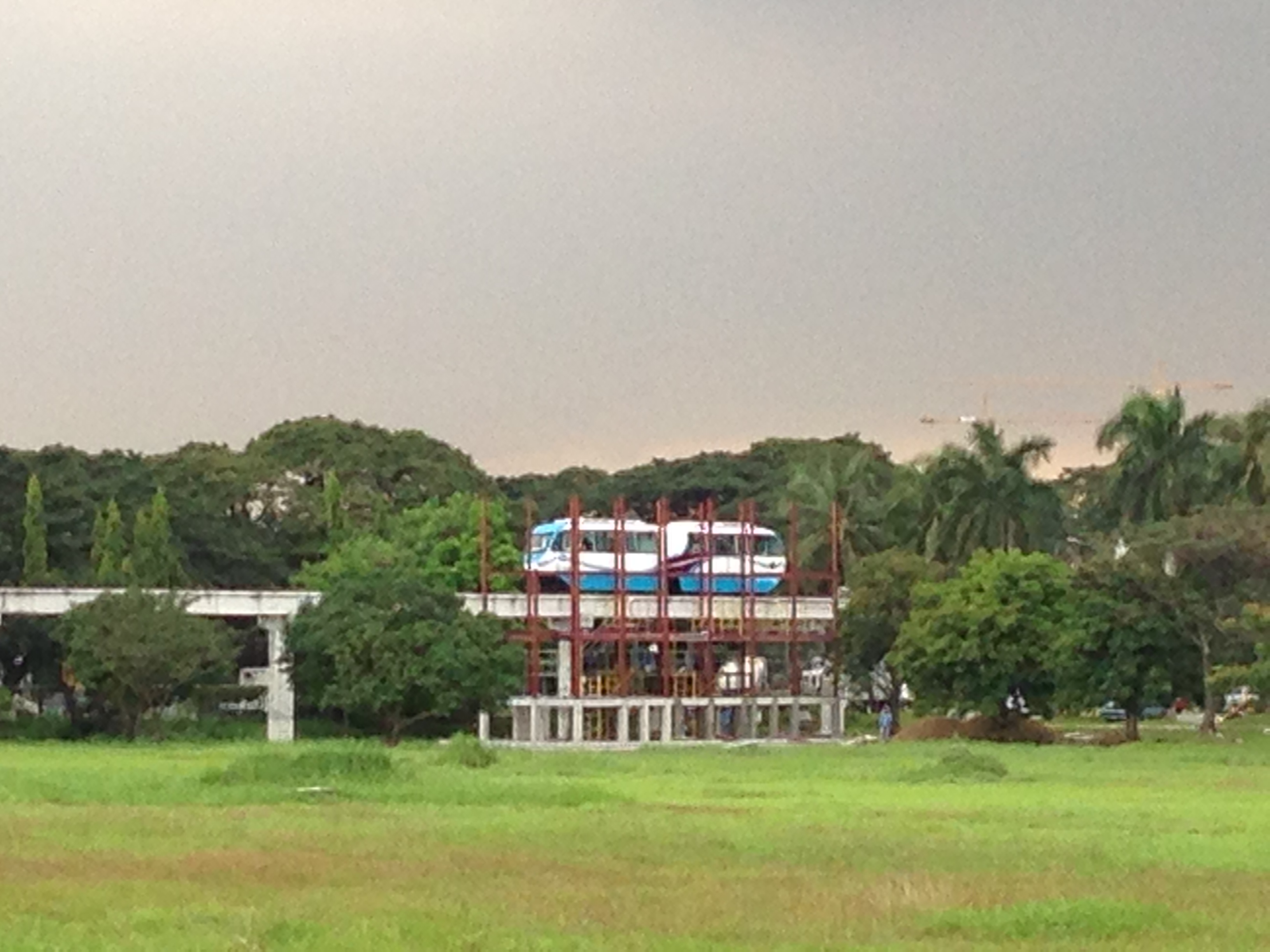 Prototype AGT stopped at the University Avenue end of the test track, where a platform is currently under construction.
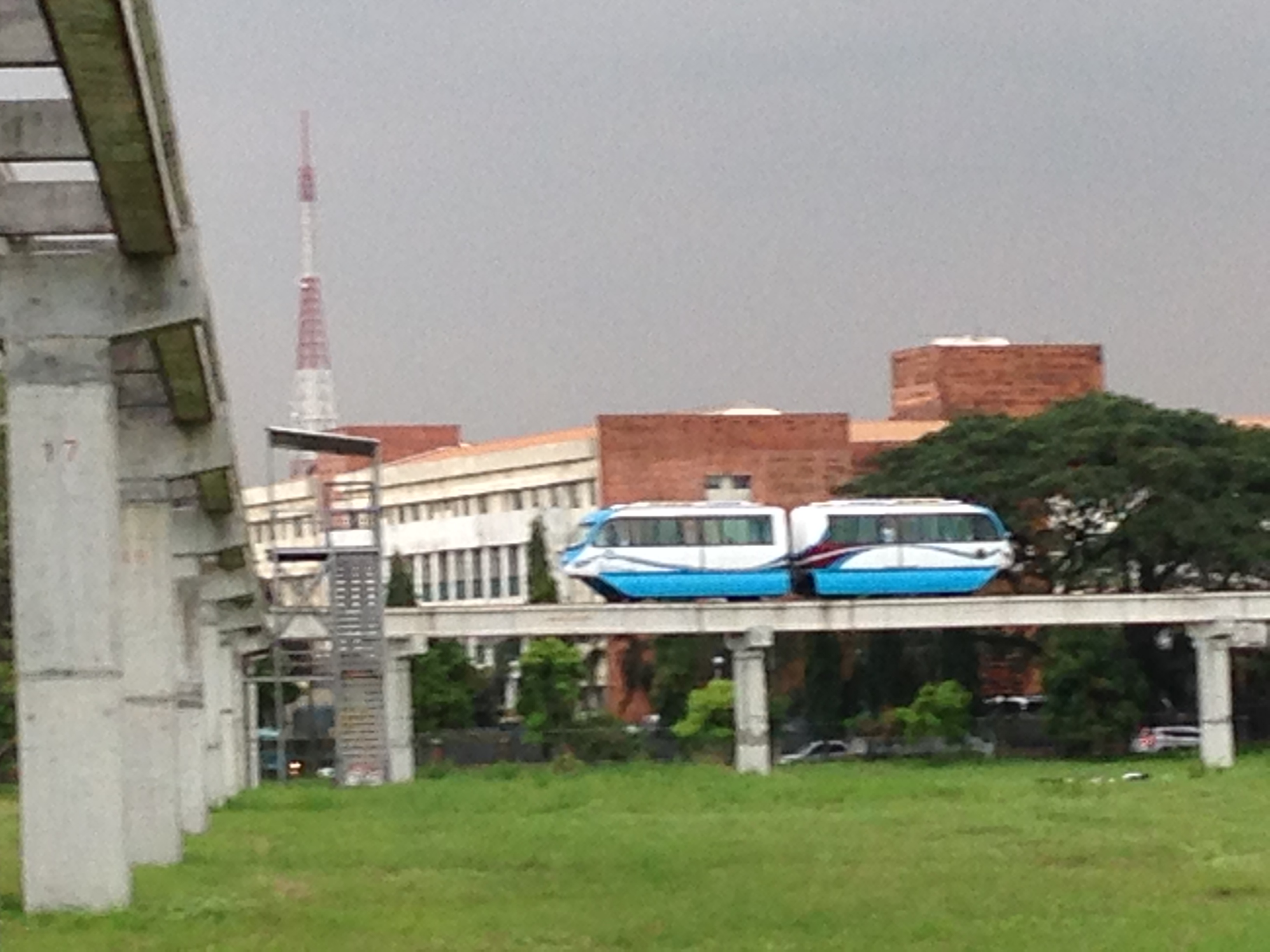 Prototype running along the test track with the photo also showing the unfinished platform at the midpoint of the track. On the background is the CHED building.
 AGT running along the test track towards the Jacinto Street end of the line.
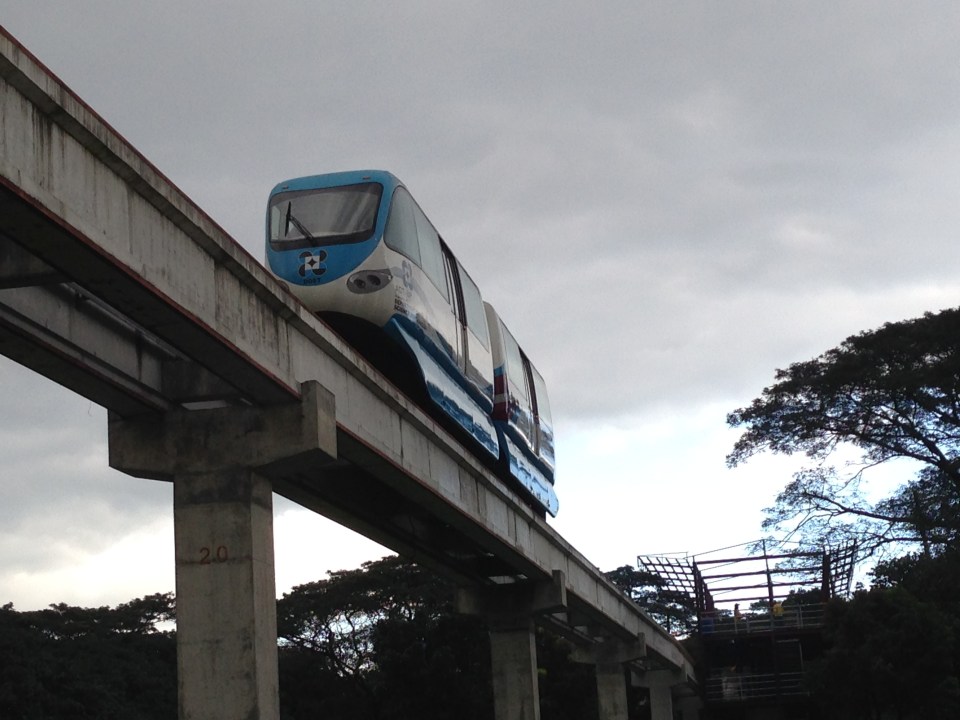 AGT leaving the Jacinto “station.” In the photo is the station under construction near Jacinto Street and the entrance to the College of Fine Arts and Veterinary Hospital.
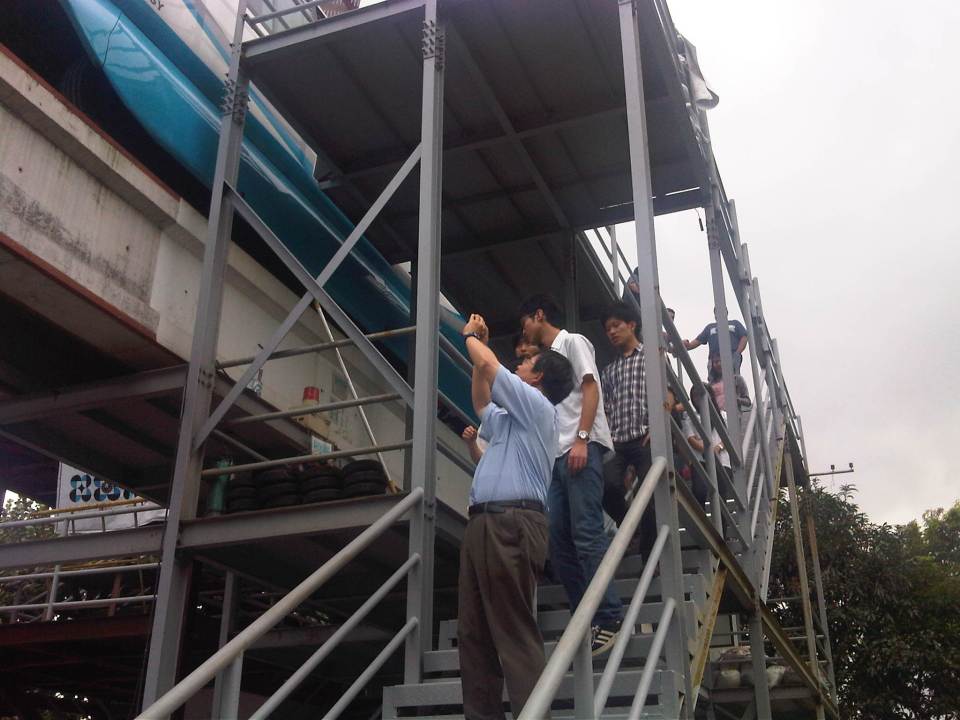 Our guests, Prof. Fumihiko Nakamura, Dean of the Institute of Urban Innovation of Yokohama National University, and his students rode on the prototype and took photos of the ongoing work at the Jacinto station platform.
 The Jacinto Station will have a ticketing station and turnstiles to simulate passenger operations. These were demonstrated last year during the test runs conducted in conjunction with the UP Diliman Lantern Parade.
The prototype is now being run at faster speeds (30+ kph?) and this was noticeable for me considering I have taken the test runs several times already including the initial ones when the vehicle was only topping 10 kph. Unfortunately, other tests/assessments have not performed yet including those for stability that will be critical to ensure the safety of the system for actual use. We look forward to the succeeding work including the determination of the AGTs suitability for application along several alignments/corridors identified by the DOST. There is also the current work on another test track at the MIRDC compound in Bicutan, Taguig where they hope to test a larger AGT vehicle. I hope to see that one soon…
–
To commute or not to commute
To commute or not to commute? That seems to be the question many people would like our political leaders and government officials to ponder the answer to. Of course, the word “commute” itself refers to traveling whether by public or private transport. However, in the Philippines we have equated “commuting” with taking public transportation. Anyhow, the reality is that most of our top officials, elected or appointed are car owners and are most likely to drive or be driven between their homes, offices and appointments. This is what is perceived by many people as “The Reason” why public officials have little or no appreciation of the difficulties experienced by the commuting public.
While sympathy is usually assumed or claimed by responsible persons, it is empathy that is most desirable from our public officials as they should feel how most people feel when they commute every working day. But how can you empathize if you have not experienced the difficulties of commuting in Metro Manila or other city? How can you say you understand the plight of pedestrians, cyclists and those taking public transport if you prefer or opt to drive or be driven in your car or SUV to and from your office? Did you really commute when you were in high school or college? Or maybe you were one of those cool guys or gals driving their own cars?
Almost every week, I have left my car at the office to commute or hitch a ride with my wife where our routes overlap. I have used public transportation since I was in high school so I am quite familiar with taking pedicabs, tricycles, jeepneys, buses and trains. I have also commuted whenever I am on trips to other cities including those abroad. Public transport is part of the experience whenever I am on trips and when I am in a new place, I make it a point to take long walks first to explore the surrounding area. It is a familiarization of sorts and makes me comfortable with the area. I remember that when I was a student in Japan, I would try to look for the nearest church to where I was staying, especially if I was there over the weekend.
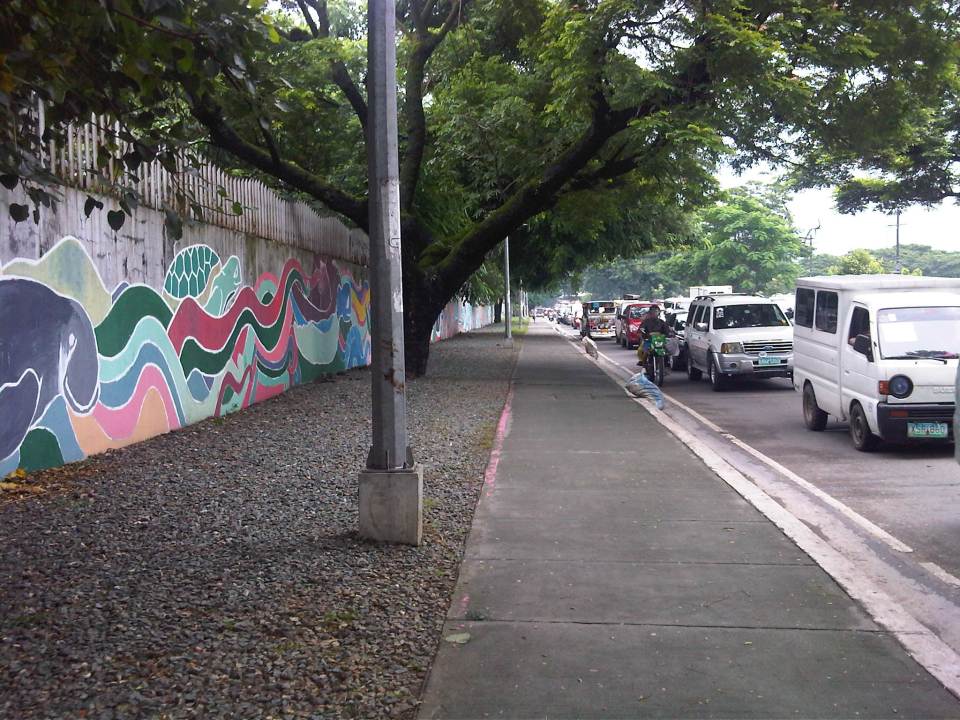 Walking is part of commuting and I am thankful that where I work, the surroundings are basically pedestrian-friendly. The photo above shows the sidewalk along Katipunan Avenue on the side of the university.
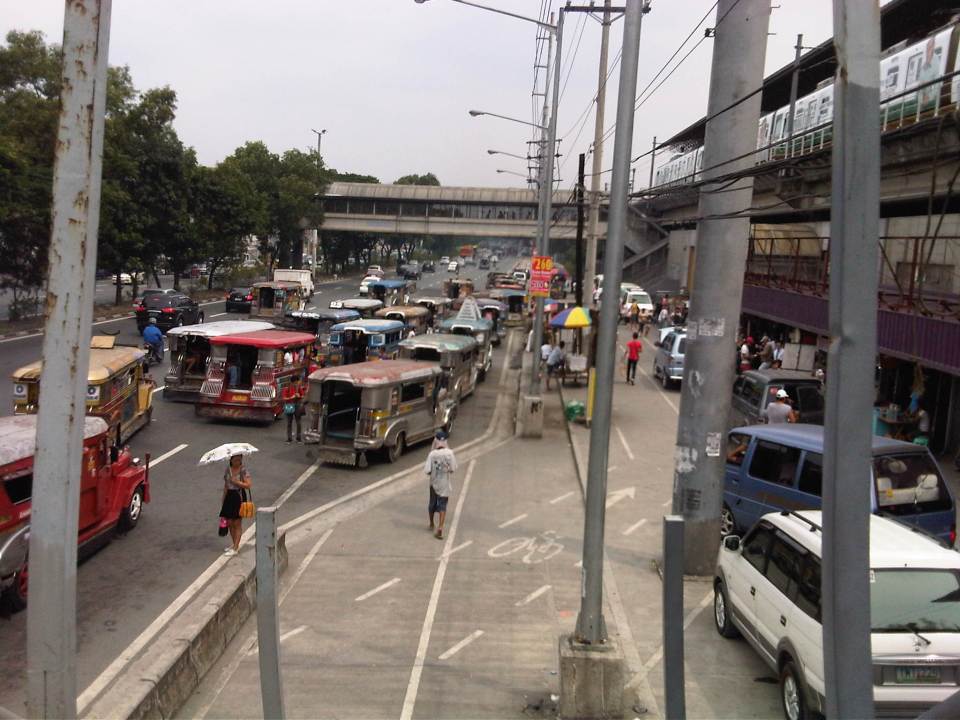 Seamless transfers are not yet quite the norm in the Philippines. The photo shows one of the better examples where transfers between modes are more convenient. This is at the LRT 2 Santolan Station. Note the markings for the bicycle path. I took this as I was descending from the pedestrian overpass that connected with a nearby mall by the Marikina River.
While traveling within other cities, whether in the Philippines or abroad, the first option for many if not most people would be to take public transportation. Taking out a rental vehicle is not common and taxis are considered as part of the public transport system. As such, we try to get information on how to get to places of interest from relatives, friends, hosts or staff of the hotel we are staying at. These include maps like the old fashioned ones we can get at airports, train stations and tourist booths. Nowadays, there’s a wealth of information available online and apps that can help us navigate around cities.
We tend to comment on how good the public transportation is in the places we’ve visited or how easy it was to commute in these cities. And upon returning to our country we are quick to criticize our public transport, pedestrian and cycling facilities. The irony, of course, is that many of those who are quick to criticize don’t even use public transport, walk or cycle. Even more tragic (for lack of a better word, I think) is that we don’t demand for better public transport, pedestrian or cycling facilities. Perhaps that should change and in this New Year, we should resolve to push the government and its partners for better transit, pedestrian and cycling infrastructure for our cities. And part of that push is by getting involved in advocacies, including projects, for these causes on transport. We should not forget that though we need and seek champions for public transport, walking and cycling among our leaders, we should also be champions in our own ways.
–
Identifying opportunities with the MRT 7 and the LRT 1 extension
As we welcome 2014, we also look forward to major projects that will help alleviate transport and traffic problems in our cities and elsewhere in the Philippines. With the approval of the MRT 7 and LRT 1 south extension projects late last year, there should be less impedance to these much-delayed projects starting construction within the current term. These lines should have been built way back, – “ideally” in the 1980s, “practically” in the 1990s, and “urgently” in the last decade. At this time, I think the need for these lines are beyond urgent. I think perhaps we have reached the state of “desperation” is so far as mass transportation is concerned for Metro Manila and its surrounding cities and municipalities.
 MRT 7 map from a public presentation made by the line’s proponents about 5 years ago.
Opportunities that can be related to the MRT 7 and LRT 1 lines include land development that fall under the category of transit oriented development (TOD). I think the government should not be too dependent on the private sector for developments around and near the future stations of the rail lines. The prevailing assumption that the private sector will do what’s best is only applicable to themselves and not the public good. Note the difference between perspectives here where it is only to be expected that private companies will be concerned with their own bottom-lines, i.e., revenues generated towards the maximization of profits. Economic benefits are and should be treated or regarded differently from such a perspective. The latter is the responsibility of the government as it concerns the public good and interest, and with a more macroscopic and strategic scale, with a long-term vision for development.
One such opportunity concerns informal settlers and their resettlements to areas outside the CBDs. Why do these people keep on returning to the cities when they are already supposed to have been provided housing elsewhere (e.g., Bulacan, Laguna, Cavite, Rizal)? The answer seems almost automatic: they don’t have the means for livelihood where they have been relocated and access to basic services and jobs/workplaces is limited (i.e., very difficult). The government must be involved and very deliberate in developing lands for housing around or near rail stations such as those for the future MRT 7 development. It cannot rely on the private sector to push for public housing when, frankly, those companies are driven by their desires to maximize their profits rather than push for the public good. That’s a bit of reality that we must accept and we must factor in decision making. The government already lost a huge opportunity when the National Housing Authority (NHA) effectively gave away prime lands in Quezon City for an upscale development. I leave it up to the reader to check the mandate of the NHA. It could have pushed instead for a development much like the HDBs in Singapore, which are not located in the boondocks but in prime locations in the city state. It need not be purely residential but a healthy mix of commercial development should be pursued along the lines of equitable transit oriented development (TOD).
Note that it should be clear here that when I say public housing this does not necessary mean the mass housing or low cost housing we tend to associate with failed projects in the peripheral provinces to Metro Manila. These are more like multi-level, medium to high rise developments you now find in major cities in Japan, China, Thailand and Singapore, which can be the model development for replication in other cities around the country. These can be reasonably priced units that can be affordable in terms of payments over a reasonable period of time. The concept is not new as there have already been BLISS projects before and Quezon City continues to collaborate with private sector for projects like Smile, Sunny Villas and the current Bistekville. These should be extended not just to your middle class and upper class (yes, they do make investments and have their units rented out to derive income) but formulated for the lower income classes (e.g., informal settlers), which now occupy much lands with their shanties. “Formalizing” these settlements should be a priority and the best locations for such developments, I think, should be around stations. Of course, there should be clear rules regarding the neighborhood and these rules should be strictly enforced for the buildings and area to keep their integrity (e.g., no extensions to the balconies or windows).
The concept and application of land-banking is not new and has been used by the private sector especially major developers like Ayala Land, Filinvest, Sta. Lucia, SM and Robinsons. Properties are acquired based on criteria regarding their potential for development. These lands are usually of low value and in many cases the land use need to be changed in order for these to be developed (e.g., agricultural lands being converted into residential, commercial or industrial uses). The national government and local government units should also do land-banking perhaps to address issues, for example, on informal settlers. And land banking should be along transit lines that are being planned (e.g., in Bulacan for MRT 7, in Cavite for the LRT 1 Extension, in Rizal for the LRT 2 Extension, and in Laguna for the PNR Commuter Line) so that issues pertaining to access to jobs, education and other services can be addressed by such transport infrastructure.
We look forward to the government realizing such opportunities that have for so long been available yet it has not taken into serious consideration. These require both strategic and practical thinking to be able to undertake master planning for such developments and their implementation over the immediate to long terms. No easy task but if our leaders are focused and determined to see these through, there’s no reason why these cannot be implemented and operational soon. Hopeful we are for these things this 2014.
Happy New Year!
–
Crowded EDSA MRT 3 stations
There have been a lot of posts on social media about the very crowded MRT and LRT stations. These posts are not new and the situation is not because of the Christmas season when a lot of people seem to be out and about the entire day, many doing their shopping. In fact, the stations have become very crowded mainly due to the increasing number of people taking the MRT and LRT lines. Unfortunately, the LRT 1 and MRT 3 stations were not designed to handle so many people. Only LRT 2 stations, which were designed like metro or subway stations in Singapore and Japan, seem adequate for its passengers.
Below are two photos taken by a good friend, Raul, who is a regular user of the MRT 3. He took these photos sometime September of this year while heading home from his workplace. The photos don’t lie about the platforms being filled by people so much so that there’s a big risk of an incident occurring when people might fall off the platform. So far, there has been none reported. But of course, we don’t want such accidents to occur despite the conditions indicating one or more are likely to happen sometime soon if precautions are not taken.
 One cannot tell arriving from departing passengers except maybe by the direction they are going at the stairs to the platform at an MRT station.
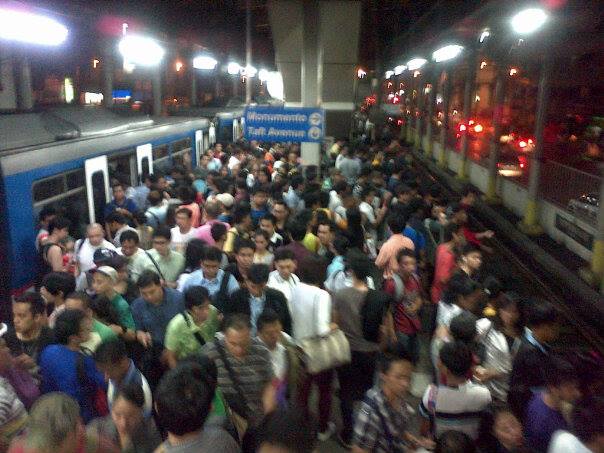 “Walang mahulugan ng karayom” translates into “nowhere a pin can be dropped” is a saying that is apt to the very crowded platform of the MRT 3’s Boni Avenue Station. Meanwhile, the conditions inside the trains are said to be like “sardines in a can.” I have even heard some of my students say it is more like “corned beef in a can” to describe how packed trains are during peak periods. I have experienced riding trains during the peak hours in Tokyo and Singapore and the experiences of my friend who took these photos (who also studied in Japan) are pretty much the same.
The obvious issue aside from platform capacity is the fact that the MRT and LRT lack the rolling stock (i.e., cars or trains) to increase their frequencies of service (or reduce the headways between trains). They cannot lengthen their trains also because they are limited by the lengths of the station platforms. It doesn’t take a genius to determine how many units more the LRTA and MRTC need to add to the rolling stocks of LRT 1 and MRT 3 to improve their services. It is also imperative that the stations be improved, perhaps re-designed, to accommodate more passengers with more sophisticated fare machines and turnstiles, and longer, more spacious platforms. This is something that could have been anticipated by the agencies responsible like the DOTC, LRTA and MRTC years ago. For some reasons, however, there have been no significant actions regarding these transport needs. The end result is what we now see as the supply side of transport being inadequate for the increasing demand.
There are many questions that commuters are asking regarding this situation with the LRT and MRT. The biggest seem to be about when the government will finally act on the issues mentioned. Is this something that requires Public-Private Partnership (PPP)? Is the government reneging on its responsibilities by not investing in mass transit? What can be done in the immediate term? Hopefully, these questions will be answered soon and agencies will have the sense of urgency to address the needs of the commuting public.
–
Manila’s jeepney experiment
A few months ago, and almost right after the local elections, the City of Manila embarked on a campaign to reduce the number of colorum or illegal buses plying along the streets of the city. The result was confusion and mayhem as commuters and authorities were unprepared to deal with the sudden decrease in the number of buses (some companies even restrained all of their buses from entering Manila to protest the city’ move) and the jeepneys and UV express couldn’t handle the demand. Much of that seems to have been resolved and buses are now back in Manila; although whether all these buses are legal ones is still unclear. The city, it seems to some quarters, was only after buses with no formal terminals in the city and appeared to have made the drive to show bus companies who’s in-charge there.
Now comes a drive against jeepney drivers, particularly those undisciplined ones that are often found violating traffic rules and regulations, and endangering their passengers with their brand of driving. The result was a one-day strike (tigil pasada) of jeepneys belonging to the Federation of Jeepney Operators and Drivers Associations in the Philippines (FEJODAP), one of several organized jeepney groups in the country. Others like operators and drivers from Pasang Masda, PISTON and ACTO, opted not to join the transport strike. The result was a transport protest that had little impact on most people’s commutes though the group did manage to attract media attention and gave interviews to whoever cared to listen.
Not to judge Manila as I believe it has made huge strides by confronting the many urgent issues in transport in the city. Not many cities take these problems head on as Manila has done this year. However, the jury is still out there if their efforts have been effective and if these will be sustainable and not the ningas cogon kind that we have seen so much of in the past. For definitely, there are a lot of other transport issues that Manila needs to contend with including how to make the city more walkable and bicycle-friendly (not an easy task!) and how to address the excessive number of pedicabs (non-motorized 3-wheelers) and kuligligs (motorized 3-wheelers using generator sets or pumpboat motors for power) in the city. Hopefully, again, the city will be up to the task of addressing these problems along with the persistent congestion along its roads.
–
Back in Bangkok
Back in Bangkok after a year, it was good that we are staying in the Siam Square area where I have become familiar with in the last decade when I seemed to be in Bangkok at least twice a year for official and personal trips. As we took the expressway en route to the city, I took a few shots from the perspective of a passenger of a van traveling along the elevated expressway.
 Our hosts arranged transport between the airport and our hotel. This was in the form of a van, with which we traveled to the city via the expressway.
 The elevated expressway connecting the airport to the city center is impressive for its capacity. The photo above shows a section with at least 4 lanes and shoulder space. Personally, I could have taken the express rail transit that connects with the BTS Skytrain. The elevated airport railway line is seen along the right side of the expressway in the photo.
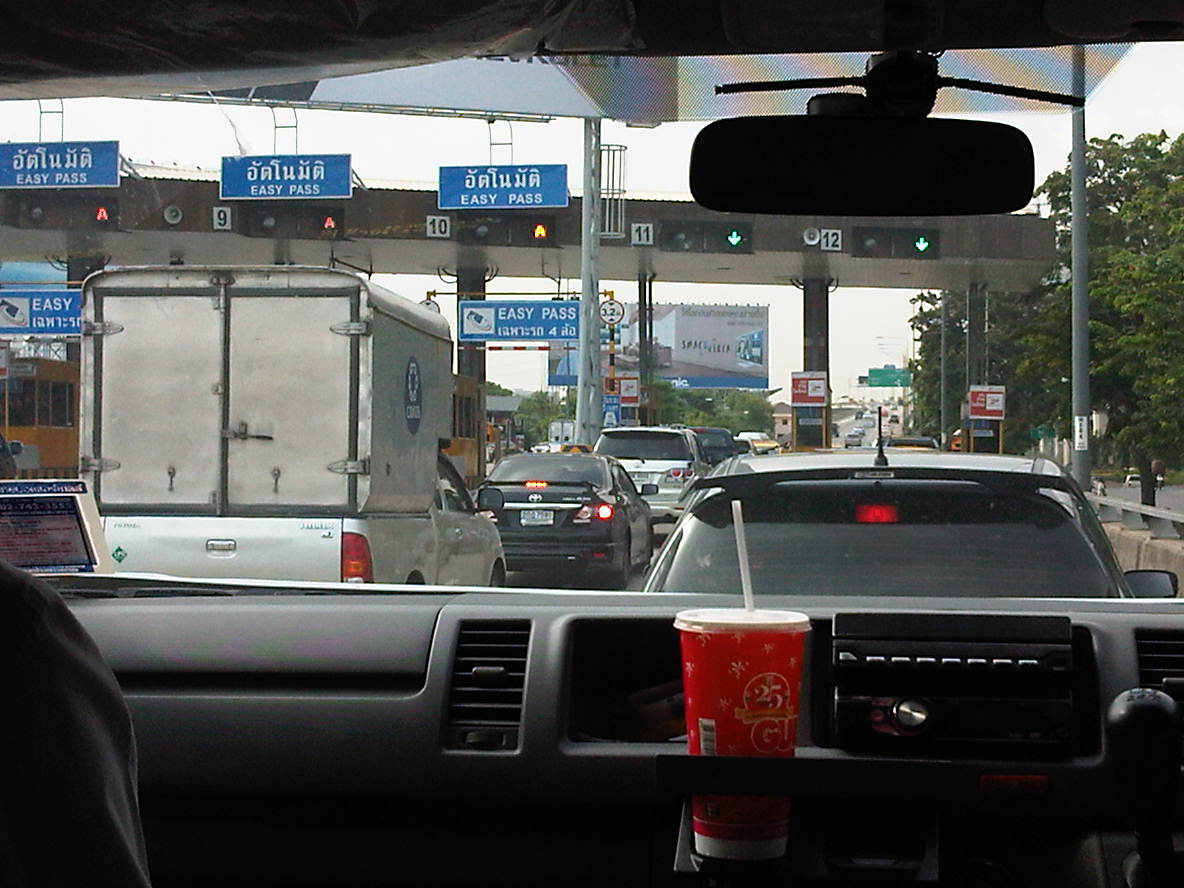 Queuing at the toll plaza.
This time around, I’d like to be able to some photos of street scenes in the city. Of course, that includes pictures of paratransit modes like the tuktuk and their motorcycle taxis. Here’s a couple of sample photos of tuktuks I took near our hotel.
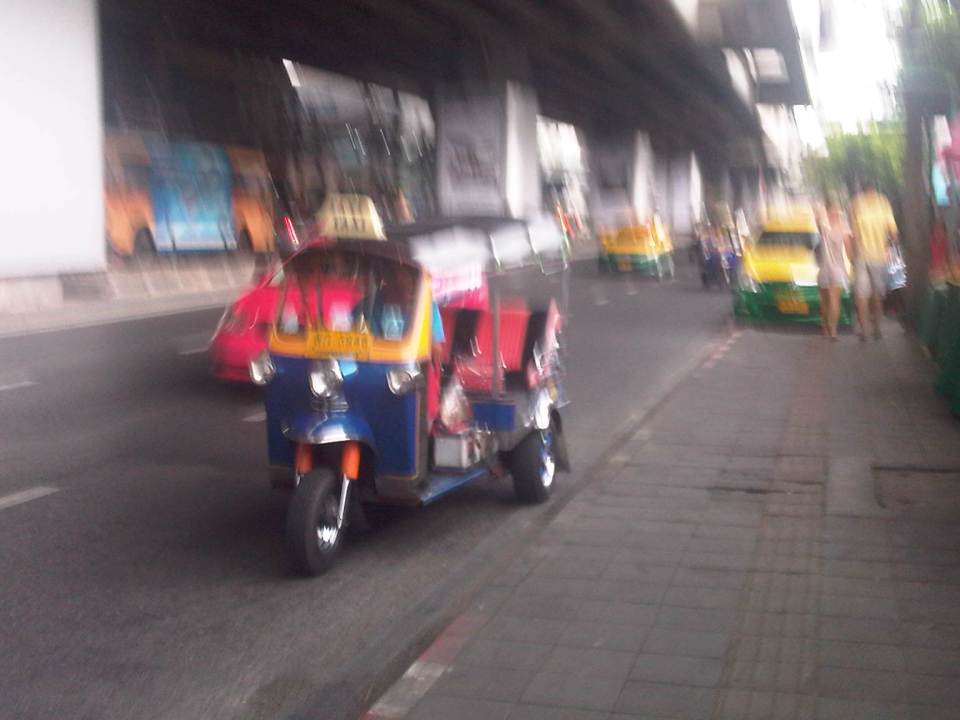 Tuktuk running along a city street.
 On-street tuktuk terminal.
More on Bangkok transport and traffic in the next posts!
 Caught (up) in traffic