
Home » Public Transport (Page 57)
Category Archives: Public Transport
Suitability of public NMT in the city?
Paratransit systems are a common thing all around the Philippines. Some have been part of the mainstream that to call them paratransit seems inappropriate. Among the most dominant modes of transport in the country are the jeepneys and motor tricycles that serve short to very long routes in many areas in the country including the National Capital Region. There is also the so-called kuliglig in the City of Manila that is a 3-wheeler comprised of a bicycle and a side car. The bicycle is motorized, using a small motor much like the one used by pumpboats or bancas. These are very much the same as the “tricyboats” of Davao City and other parts of Mindanao and the Visayas. The “original” kuliglig may be found in rural areas and these are basically farm tractors pulling carts that may be used to transport people or goods (e.g., farm products, raw materials, etc.).
When the term “non-motorized transport” or NMT is mentioned, the first things that come to mind are probably bicycles and walking. There are other NMT modes around including animal drawn vehicles and pedicabs. Perhaps the most well-known animal drawn vehicles in the Philippines are the calesas and caretelas, which are pulled by horses. Pedicabs are 3-wheeled vehicles consisting of a bicycle and a side car. These are quite popular in residential areas particularly in residential subdivisions or villages where tricycles have been prohibited or restricted due to their noise and emissions.
Pedicabs, however, have become an attractive means of livelihood for people who have less options for employment (i.e., many drivers have no qualifications to apply for more formal jobs). As such, one will find them proliferating where there is a perceived demand for them; including urban streets where they serve as feeder services quite similar to those offered by their motorized counterparts. While tolerated along minor streets, many have tested the waters and the limits of regulations by taking major roads. The following photos show such examples where pedicabs are seen operating along major roads.
 NMT along national roads – pedicab at the intersection of Quezon Avenue and Agham Road
 Informal terminal for informal transport – pedicab queue along the Quezon Ave. service road
 Cause of congestion? – pedicab (and tricycle) operating along the bus lanes of EDSA in Pasay City. Such situations expose drivers and their passengers to risks of being hit by larger motorized vehicles such as buses and trucks.
 Over-reaching? – pedicabs defy regulations against them using national roads and particularly major ones like EDSA.
There is the persistent challenge of how to rationalize public transportation in many Philippines cities. In fact, there are cities that have embraced paratransit modes as part of their character and thus seem unlikely to upgrade or phase out such transport modes from roads or routes that require higher capacity vehicles to deliver higher levels of service. For one, there are socio-economic and political factors that have to be considered in any initiative focusing on these modes of transport. Many are already organized or members of organizations such as tricycle operators and drivers associations (TODA) and jeepney operators and drivers associations (JODA). These have become quite influential over the years and have even participated in elections as party list groups while also exerting pressure on government agencies when issues like fuel price increases and fare setting are in the spotlight.
Many public NMTs are not as organized or empowered as their motorized counterparts. However, many are connected with groups such as those of the urban poor and NGOs taking their side when issues are raised regarding their operations. Perhaps these NGOs should take a closer look at public transport as not just a source of livelihood considering the responsibilities that come with providing such services. And perhaps they should also busy themselves with helping people learning skills that will not commit them and their descendants to being jeepney, tricycle or pedicab drivers.
–
Using the Bangkok subway
I have gone around Bangkok in the past using the BTS Skytrain, buses, taxis and once using the tuktuk. I have only used the subway once as it has only one line and in the past trips to Bangkok I really didn’t need to use it considering most of my destinations were within walking distance of a Skytrain station or required the services of a taxi. And so I took the opportunity to take some photos at the Bangkok Metro during one commute to meet up with a friend.
 Directional sign guides people coming from the Skytrain platform to the MRT, Bangkok’s lone subway line
 Descending from the Skytrain station to the entrance to the subway station
 Directional signs guide commuters to the subway station
 Another descent, this time to the subway station plaza to purchase a token (instead of a ticket) to ride the train
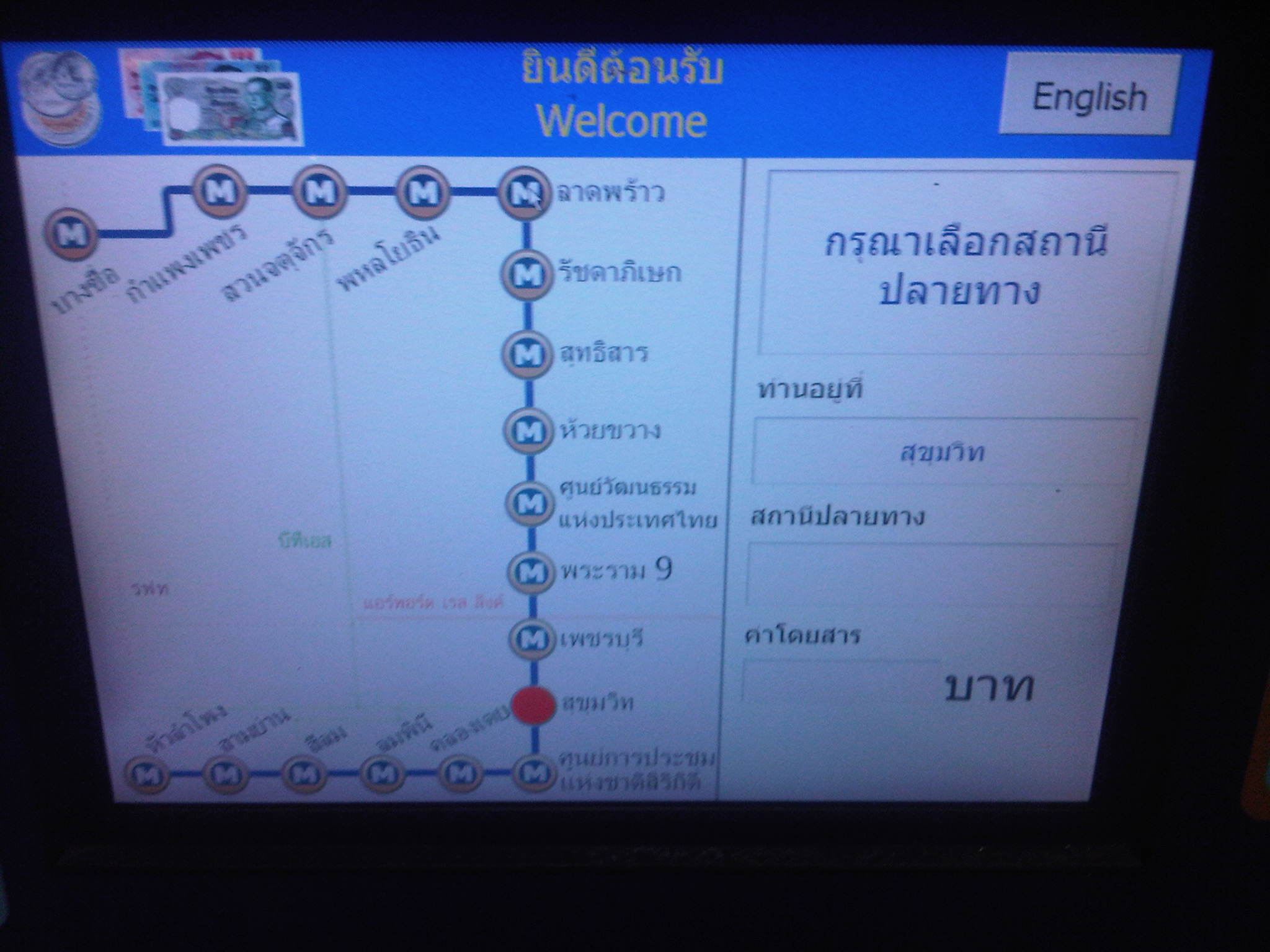 User interface for the Bangkok subway – commuters who can’t read Thai may opt to go for the English option. Unfortunately, the MRT’s system is not integrated or compatible with the Skytrain’s and so I could not use my Rabbit card for my fares. I think the MRT should work on this as it would be to their advantage.
 The station is spacious and there seems to be still few passengers using the subway – Fares have been criticized before for being expensive compared to bus and Skytrain. As such, the system is not as crowded as Singapore’s MRT or the Philippines’ elevated rail systems.
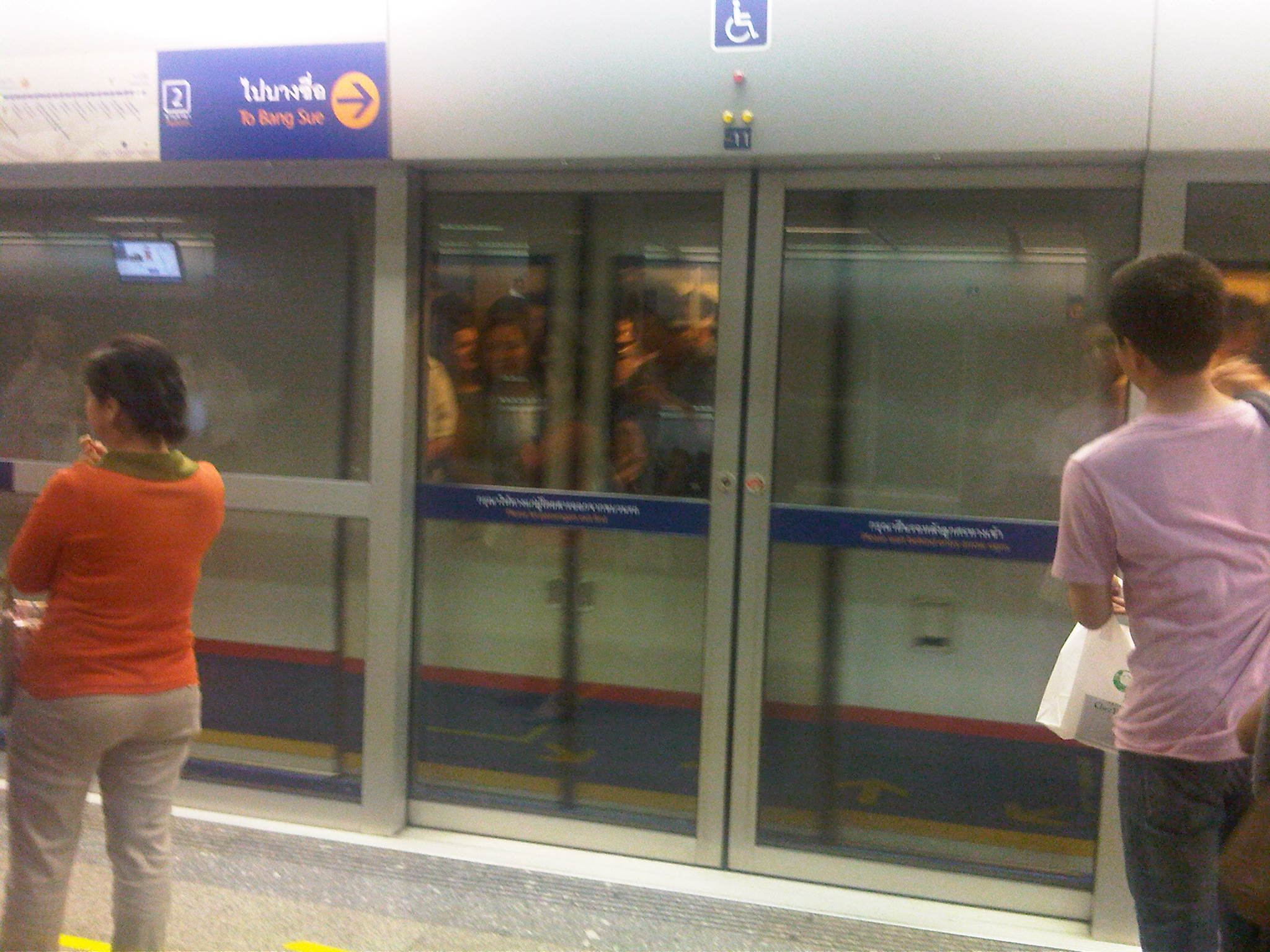 Platform doors are synchronized with the train doors, ensuring safety for commuters.
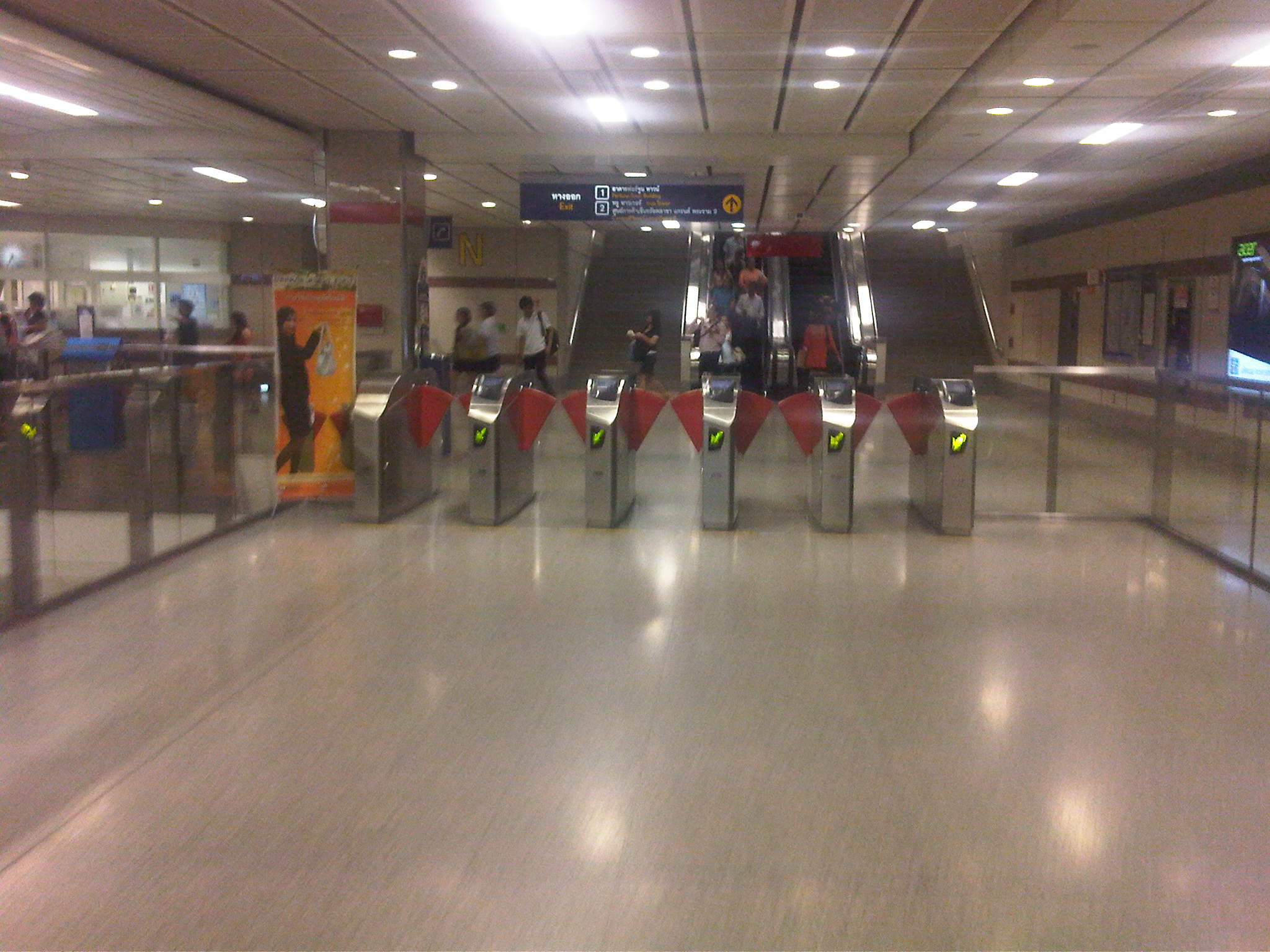 Turnstiles are similar to those in Singapore and Japan
I think the Bangkok subway is still a good option along the corridor it serves though it would be better if it is extended to increase its reach and consequently its ridership. Issues on inter-connectivity with other modes especially the Skytrain have been addressed to some extent but remain. Its most difficult challenge pertains to fares and is something that would probably be difficult to tackle given the financial implications but is necessary to encourage more people to use it regularly.
–
Of stored value cards and other ways for paying fares
I was in Thailand for at least once a year during a certain stretch in the last decade as part of my university work. Whenever I was in Bangkok, I bought a one-day pass for me to have practically unlimited use of the BTS Skytrain for a day. Other times, I bought a 3-day pass in order for me to also see and experience the system. Those times in the past, there were no IC or stored value cards for use in commuting in the Thai capital like those in Singapore, Hongkong or Japan. And so I was quite happy to see the availability of a stored value card when I familiarized myself with the Skytrain last week.
The Rabbit card, as it was called, is a stored value card that still has limited use for commuting and other purposes. At present, it can only be used for the BTS Skytrain and a few shops. It cannot be used for buses, taxis or the MRT (Bangkok’s subway). There are three variants for the Rabbit card – one for students, one for senior citizens, and another for adults (all other people).

 Back of the card where simple instructions for use of the card are indicated in both Thai and English.
The Rabbit card is not yet as useful, versatile or convenient as Singapore’s EZ-Link or Japan’s Suica and Pasmo commuter cards. Still, it is an improvement that will surely and steadily have more uses in the future. And so I look forward to the next trip to Bangkok when perhaps my Rabbit card will be useful for other modes of transport as well.
I am posting this article about the Rabbit Card as I listen to news about problems currently being experienced by the EDSA-MRT 3 in Metro Manila. It seems they had run out of stored value cards (maximum load of 100 PhP) and single journey cards that the administration had to resort to issuing paper tickets to accommodate the many commuters using the system.
There used to be RFID cards issued by the two giant telecommunications companies in the Philippines that could have been the solution to the current problems for the MRT3. Unfortunately, these have been phased out a few years ago. And so perhaps for the sake of the thousands of commuters using the MRT3 and other rail lines (and later even buses, jeepneys and taxis) in Metro Manila, transport officials finally invest in a card and/or pass that can be used by commuters and tourists alike. One would think that many who are with the DOTC, MRTC and the LRTA would have already experienced the systems in other countries and so they could have an idea of what could be so beneficial to public transport users here.
–
Airport Rail Link in Bangkok
The last time I was in Bangkok was in 2005 or 2006 and so it has been a while since that last trip that I was curious about how the city would look like after 6 years. Was there anything new? Did it change much since the last time? At the very least, I was expecting to have new experiences and it didn’t take long before I had one, trying out the express rail link between Suvarnabhumi Airport and the city. The rail link was still under construction the last time I was in Bangkok and one had no choice at the time but to take a taxi or a shuttle between the airport and the hotel.
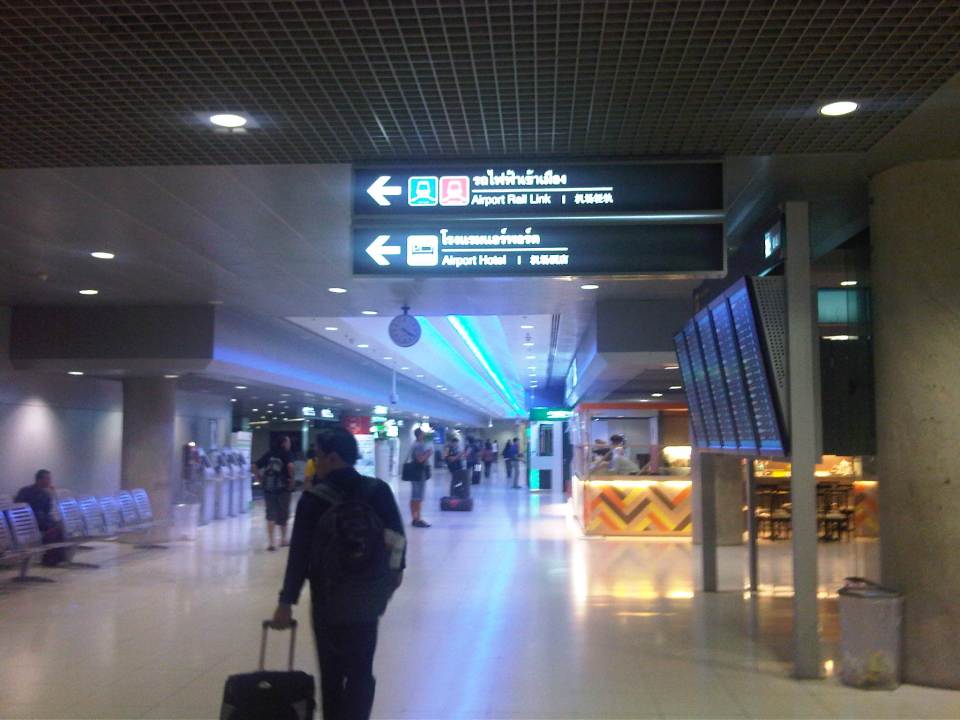 The walk from the arrival area to the Airport Link
 Ticket vending machine with English instructions upon the press of a button. We purchased tickets for the Phaya Thai Express to transfer to the BTS Skytrain
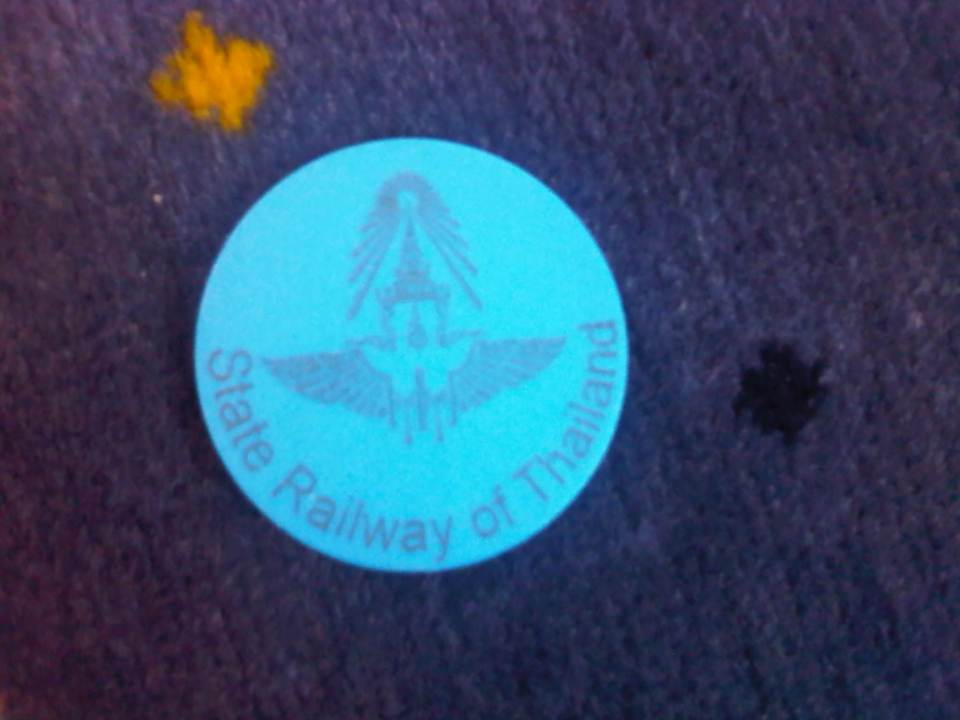 Token for the Express Rail Link trip from the airport to Phaya Thai Station – the link is operated by the State Railway of Thailand, their counterpart of our Philippine National Railways. The trip cost 90 Baht (~ 130 PhP), very cheap compared to taking a taxi.
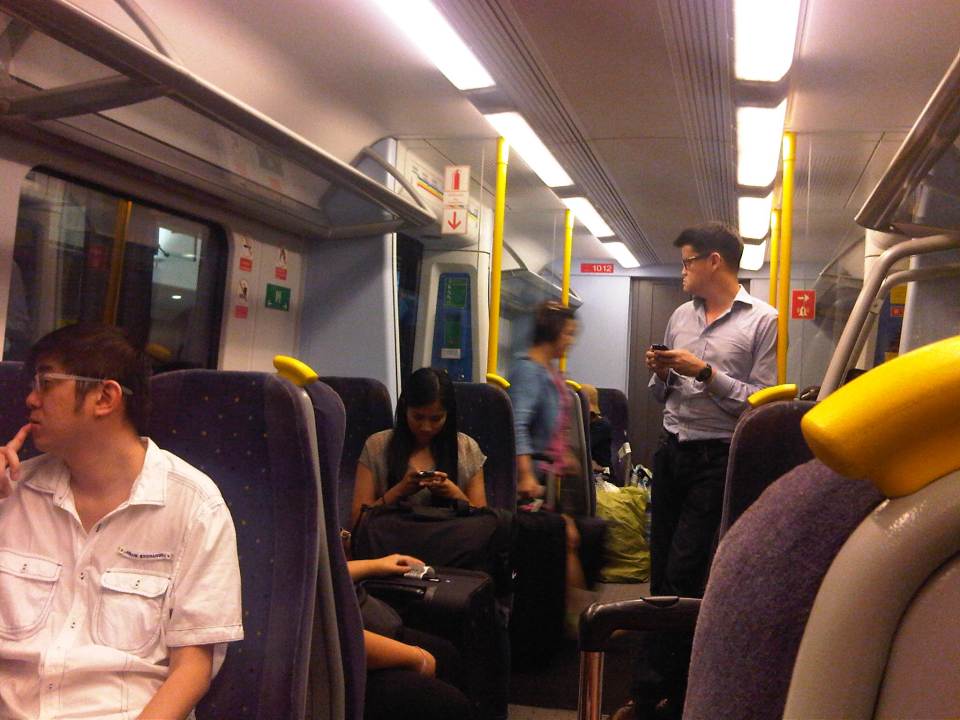 Passengers inside the Airport Link Train
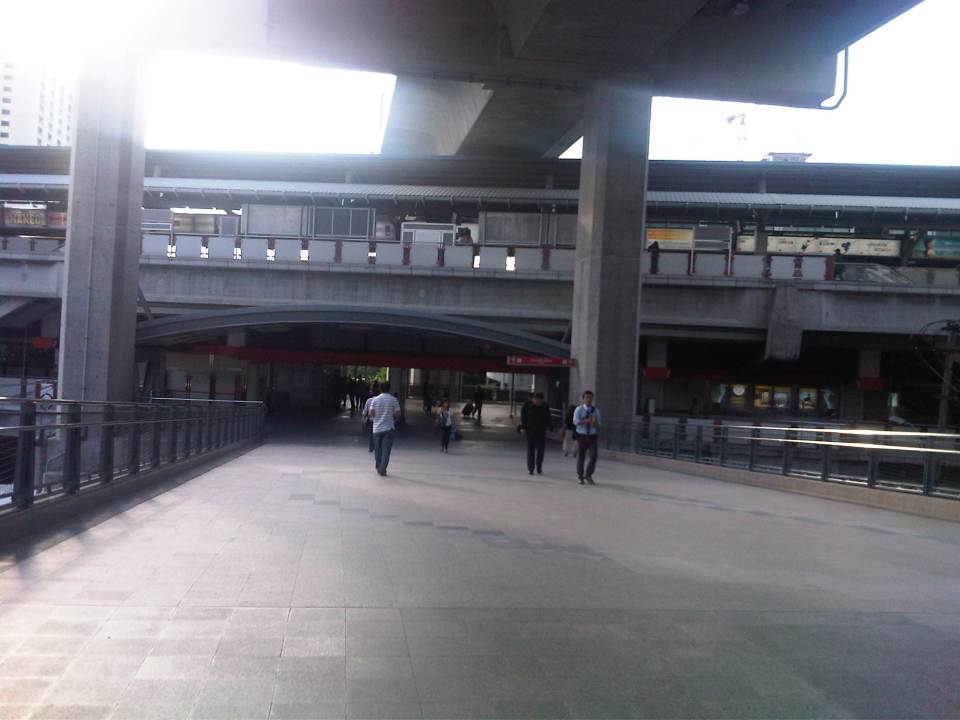 Walk from the Airport Rail Link’s Phaya Thai Station to the BTS Skytrain Station
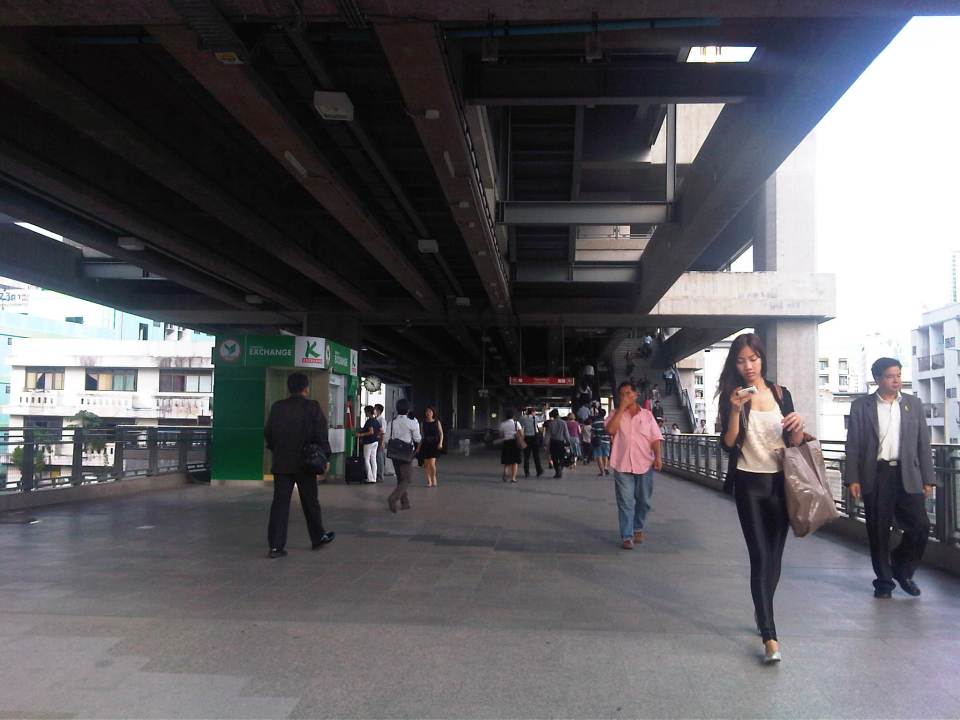 Looking back at the Phaya Thai Station
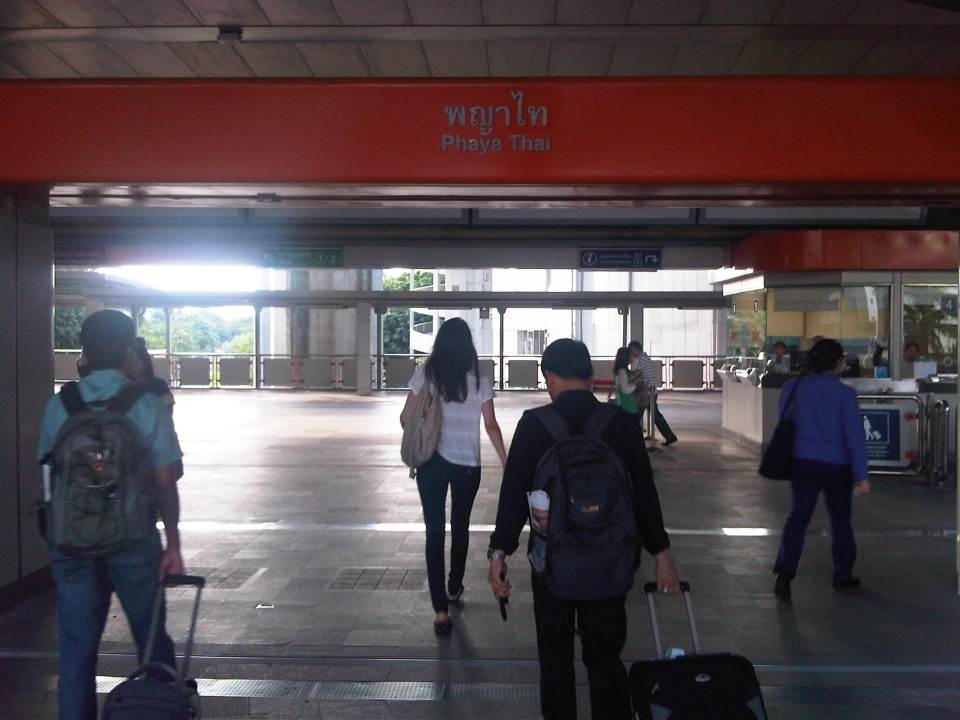 Phaya Thai Station of the BTS Skytrain
It would be very nice to have a similar rail link between the MRT 3 or LRT 1 Lines and NAIA in Manila. In fact, how difficult would it be for the LRT1 Line to have an extension to the airport terminals of NAIA when it’s depot is just across the road from the old domestic terminal? This would probably be easier than constructing a new monorail or whatever system it is that is being planned between Bonifacio Global City and NAIA. It is definitely much easier and perhaps cheaper compared to the still-born Northrail between Caloocan and Clark. One thing for sure is that we are really behind our ASEAN neighbors when it comes to providing the infrastructure for public transport, in this case airport access.
Comparative study of jeepneys: LPG Jeepney
The University of the Philippines Diliman, through its National Engineering Center (NEC), National Center for Transportation Studies (NCTS) and the Department of Mechanical Engineering’s Vehicle Research and Testing Laboratory (VRTL), is conducting a comparative study on jeepneys. Three jeepneys will be the subject of road and laboratory tests including one conventional (diesel), one LPG, and an electric jeepney. The study is supported by the Department of Energy (DOE) through its Energy Utilization and Management Bureau (EUMB).
The following photos show the LPG jeepney provided by Pasang Masda that will be used for the study. Road tests will simulate actual operation along an actual jeepney route. The DOE secured permits from the Land Transportation Franchising and Regulatory Board (LTFRB) for the deployment of the 3 jeepneys for the UP-North EDSA (SM) route. A similar permit was also secured from the Metropolitan Manila Development Authority (MMDA) for the jeepneys to be exempt from the number coding scheme.
 LPG jeepney unit used in the study
 The LPG jeepney provided by Pasang Masda was assembled by David Motors, the pioneer of the LPG jeepney, and is owned by the jeepney group’s leader himself, Ka Obet Martin.
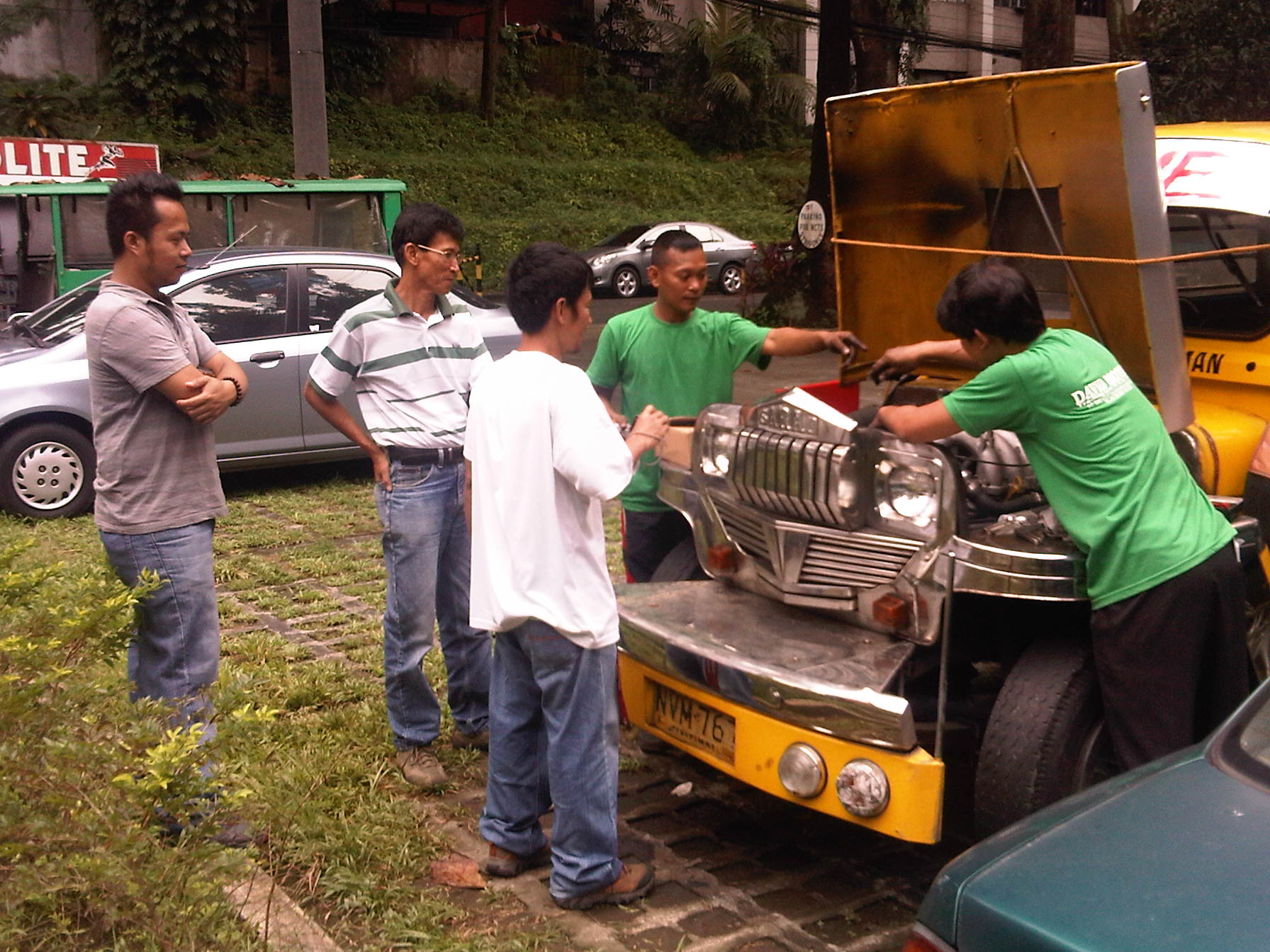 NCTS and David Motors staff work on the LPG jeepney’s engine in preparation for road tests. All jeepneys must be in tip-top condition prior to the tests in order for the comparisons to be objective.
 A look at the LPG jeepney engine
 The jeepney’s engine is supposedly not a converted one from a gasoline engine but is said to be an original Hyundai LPG engine.
 The LPG engine needed some maintenance work as it was apparently not well-maintained according to David Motors’ staff.
 Fuel indicator for the LPG jeepney
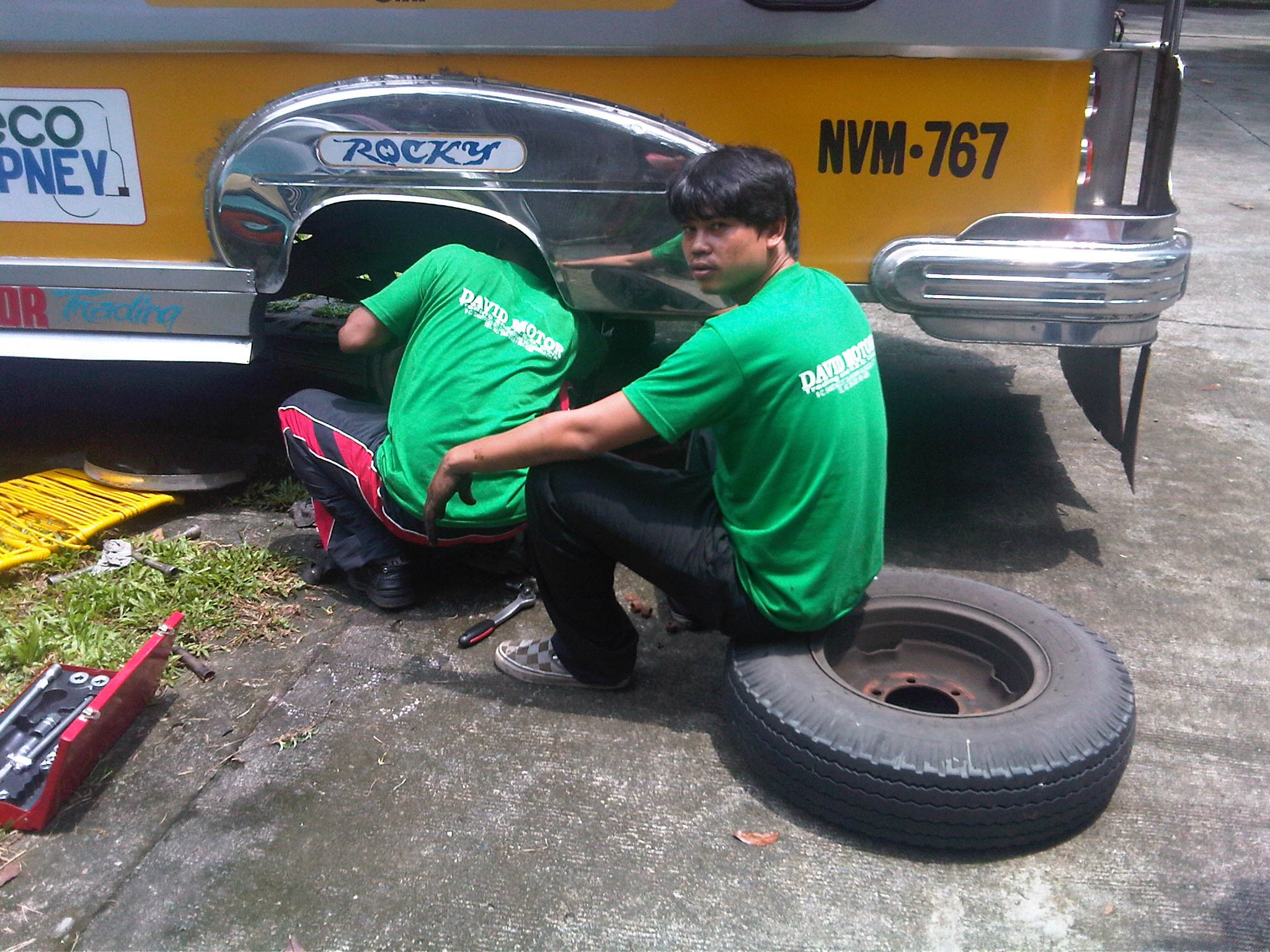 It turned out that it wasn’t only the engine that needed some attention. David Motors staff had to check everything that may affect the performance of this jeepney unit.
 9The brakes on this unit seemed to be defective; something that will affect the performance in both road and lab tests to be conducted.
As of this writing, the road and lab tests have not been conducted for the LPG jeepney due to the many issues about the unit provided by Pasang Masda. Apparently, the group was not doing its part in the study and it was as if they were passing on the costs of fixing the unit they provided to the study team. We hope it was not a conscious effort on their part, which if it did meant they were dealing with us in bad faith – not a good thing if they wanted to be a partner in this research collaboration.
–
Take public transport…it’s good for you!
An article came out of the Philippine Daily Inquirer where a contributor wrote about her experience riding a jeepney ride from Ateneo to UP Diliman and then back after having lunch and some fishballs somewhere at the Shopping Center (more likely at the Coop rather than at the SC). The link to the article may be found below:
After being shared on social media like Facebook, the author and her article received a lot of flak from people whom I think didn’t quite get the lesson of the story – something deeper than how the writer related her story of her commute. Some found it amusing but others focused (more like ridiculed) on the Arneow aspect of the article. There is even a parody of the article where a blogger wrote about his “experience” riding an MRT train. I won’t post that here despite it being humorous as it is irrelevant to the points I will highlight in this post.
I think we should encourage more people who probably mainly travel by car and have little experience taking public transport to try taking a jeepney or bus ride. This experience (an honest one I believe for the writer) will be something that hopefully changes their perspective of transport (and life in general). Who knows? The person might one day be in a position to make a significant impact on our transport system. And we do need decision-makers who take public transport rather than private cars if only to have an appreciation of how it is for most other people who take public transport in this country.
I am reminded of experiences commuting in other countries where they have good public transport and people from most income levels take these everyday. Cars are used mostly during the weekends or when it is really necessary (e.g., emergencies, fetching someone at the airport, etc.). Snooty as some may seem, people have to be educated and have the experience of riding public transport in order to enlist them among the many clamoring for better transport services and facilities. Who knows that person might be able to influence well-placed people to make the decisions that will lead to the improvement we seek for public transportation. If you don’t use or haven’t used public transport, you likely to be detached from the reality that most other people encounter everyday as they travel between their homes and the workplaces or schools.
I reproduce the article from the Inquirer below for reference now and the future:
Lessons from a jeepney ride
Nicole Ki
Philippine Daily Inquirer, 12:43 am | Friday, September 7th, 2012It was lunchtime. My blocmate, who so badly wanted to go to the University of the Philippines (UP) for lunch, suggested that we go.
We were walking in the heat of the sun, and it had just started to get even warmer when we finally reached the underpass. Many jeepneys were parked, as barkers tried to lure passengers to ride.
I went through the motion with my blockmates and did whatever else they did throughout the commute; I was allowed to take public transportation only in college. I sat quietly, recalling how much I hated the thought of riding a jeepney, but how real it was that I was actually in one.
It didn’t turn out so bad; I didn’t experience the one-foot-in-and-the-jeepney-suddenly-jerks-pulling-you-in, like I did when I was a kid. That was my first jeepney ride, by the way.
I thought all jeepney drivers were impatient, like in the first ride I had. I guess I was wrong.
The jeepney came to a stop; finally we were at UP.
A short walk brought us to its Shopping Center. It had all sorts of stuff—photocopying shops, computer shops, a clothing store, mini restaurants, a barber shop, a hair salon, even a Bayad Center and Western Union; everything you could possibly ever need for school and more.
It was amazing. I had wanted to stop to look in every store, but we had a little less than an hour, and we still didn’t have a place to eat.
We continued walking until we reached a cafeteria which served cheap home-cooked meals. We all ooh-ed and ahh-ed with each bite, not only because the food was good but also because food here was cheaper than at Ateneo. Even if we were already full, we had set our minds to try out the famous UP isaw, kwek-kwek and fish balls.
We stumbled upon a stall which offered only fish balls. It took some 15 minutes for the food lady to fry them. As we looked at our watches, we knew we weren’t going to make it on time.
We walked some more to the nearest waiting shed to hail a jeepney. With our consolatory fish balls in hand, we saw kwek-kwek—but too late.
I had not expected the ride back to go as smoothly as the ride to UP. First off, I wasn’t seated in the farthest end anymore, nearest the door; I was nearest the jeepney driver. Just the thought of how I’d get off the jeepney at our stop made me cringe.
With all this negativity, I was genuinely surprised at how interesting my seat turned out to be! This was where the action happened, and I’m so glad I got to be in it.
“Para po.”
“Bayad ho.”
“Senior.”
“Estudyante.”
New language
When I first heard the passengers say these lines, I was amazed. It sounded like a new language to me altogether. The words sounded sincere and friendly. And since I was seated just behind the jeepney driver, most of the payments coming from these seemingly interesting human beings were passed to me. It felt like I had a sudden connection with all the passengers. I was suddenly part of something. I was wide-eyed in wonder. I got my P8 out of my pocket; “Bayad ho,” I said.
“Para po. Sa may National,” I said to the driver.
“Excuse me, bababa lang po,” I said to the person beside me, as I wiggled out.
And as I stepped down the jeepney and my feet hit the ground, a sudden realization hit me. Both of the jeepney rides I had that day, I realized, were a lot like life.
Our first experiences may not always turn out to be so great, like my first jeepney ride. We start just wanting to only try out things, and to test the ground, but as if with a sudden jerk, we’re pushed into a world we don’t know about yet. This would leave an unwelcome mark in our hearts, plus a bad memory, and this is usually the reason we stop and don’t give it another chance; we’re afraid to fail again.
But sometimes, life leaves us no choice; like this jeepney ride I was forced to take. I had unintentionally given public transportation another chance.
So if you tried something new for the first time and it didn’t turn out so well, try again. Don’t be like me, who had to wait for about 10 years just to be able to appreciate something. Who knows? It might be the most wonderful thing to ever happen to you.
It’s interesting how two simple jeepney rides can change your outlook in life. And guess what? I can honestly say I enjoyed them.
–
Some thoughts on transport and traffic while commuting between Cainta and Antipolo
Commuting from the Ortigas (Cainta) end of Imelda Ave. to its other end at Marcos Highway (near where Pasig, Marikina, Cainta and Antipolo meet), one should be able to observe and make a quick assessment of the positives and negatives of our local transport system. While there are more negatives at Cainta Junction and along Imelda Avenue, Marcos Highway definitely has improved particularly in terms of walkability. It is a commute that I have taken so many times since my childhood days and I can only now remember times when one could walk safely from one end to the other when there were far less vehicles than the volume that flows along Imelda Ave. these days.
Junction is still quite the mess despite some road widening at the intersection owing to various factors including the fact that the intersection simply cannot handle the volume of vehicles using it even after the elimination of some turning movements from Ortigas Ave. in favor of U-turns particularly for traffic coming from the eastbound side of Ortigas. It seems the traffic signal settings can no longer handle peak period traffic and manual traffic management probably aggravates the situation especially when enforcers employ the buhos technique of trying to dissipate as much of the queued vehicles per approach or movement. The latter technique does not take into consideration that the longer a movement or group of movements are allowed to move, there are corresponding build-ups in traffic along all other approaches. It is a vicious cycle (pun intended) that is supposed to be addressed by an optimally times signal system. Saturated conditions, though, are inevitable due to the sheer volume of vehicles using the intersection given that Junction is a catchment for vehicles from Rizal Province that ultimately uses Ortigas Ave. to head into Metro Manila in the mornings. The reverse is true in the afternoon to evening periods.
Imelda Avenue, which was also known for a time as Francisco Felix Ave., is plagued congestion due to notoriously bad pavement conditions, so many median openings, and high vehicle trip generation rates from the many residential subdivisions or village along the road. The pavement conditions are due mainly to damage brought about by trucks and, during the wet season, frequent flooding along many sections of the avenue. Bad pavement conditions and flooded streets significantly slow down traffic as Imelda Ave only has two lanes along each direction and is divided by a narrow median island that’s just enough for a few plant boxes and lamp posts.
There are mostly middle class subdivisions including the large Vista Verde, Village East, Karangalan, and Pasig and Cainta Green Parks along the road. There is also a DMCI medium rise development has its main access road also connecting to Imelda Ave. These villages generate much vehicle traffic and each have their own median openings that practically function as intersections along the entire stretch of the avenue. These openings create a lot of conflict between through traffic and vehicles entering and exiting the villages, especially those taking left turns to or from their gates.
While there are commercial establishments along the avenue, most were small and traffic generation characteristics were not so significant as to cause severe congestion. The first major generator in the middle of the avenue was a branch of the membership-concept Makro supermarket cum depot. Makro generated significant traffic but did not cause much congestion along the stretch in front of the Village East gate. It was eventually acquired by commercial giant SM and the branch is now an SM Supercenter that seems to be generating much more traffic than Makro did at its peak. While traffic studies are usually the norm before such developments are constructed given the trips attracted by SM, the congestion experienced along Imelda Ave has been reported to be generally un-managed despite the need for more disciplined loading and unloading by public transport, pedestrian movements and vehicle entries and exits.
Jeepneys are the main public transport mode along Imelda Ave. although there are tricycles serving the various subdivisions that often not only cross the road but also travel along Imelda Ave. for short distances. I remember in the 1970’s and early 80’s that the tricycles used to be the primary mode of transport from Junction and the Cainta Public Market as Imelda was not yet connected to the still to be completed and unpaved Marcos Highway. There was even a Metro Manila Transit Corp. bus service (probably missionary route and with low frequency of service) along Imelda Ave. that turned around near Kasibulan Village, one of the first subdivisions in the area. Many jeepneys are noticeably the patok or popular type known for their loud stereos and reckless driving. Still, there are the smaller, older jeepneys whose route connects either ends of Imelda Avenue. Most patok jeepneys are from the many longer routes between Rizal towns and Cubao overlapping along Imelda Ave (e.g., Angono-Cubao, Antipolo-Cubao, Binangonan-Cubao, Taytay-Cubao, etc.).
–
Update on the UP AGT Test Track construction
Visiting the site at the University of the Philippines Diliman (UPD) where a test track for the Department of Science and Technology’s (DOST) is currently being constructed, one wonders if this is a precursor of a transit system that might eventually replace the ubiquitous jeepneys plying several routes within the campus. There have been misleading stories about this “replacement” going around the internet and being passed on from one person to another. I am aware of both as I regularly see posts in some online discussion threads that make it appear as if the UP administration and DOST are in discussion for a mass transit system to replace the IKOT jeepneys. They are not in any such discussions that I am aware of considering I am a member of the UP Diliman Transportation Committee. Perhaps people are inspired by an existing system in Germany at the University of Dortmund. I caution the reader against making any sweeping conclusions as UP Diliman’s travel demand characteristics are quite different from that of the University of Dortmund’s.
I also get asked a lot about what will happen to the jeepneys once the “monorail” is operational. My response is always that nothing will happen to them because there simply won’t be a monorail. What is being constructed is the superstructure for the test track of an Automated Guideway Transit (AGT) prototype. Being a test track, its being operational means it can be used for research & development (R&D) for future systems (hopefully, homegrown) that can be constructed where they are needed and appropriate.
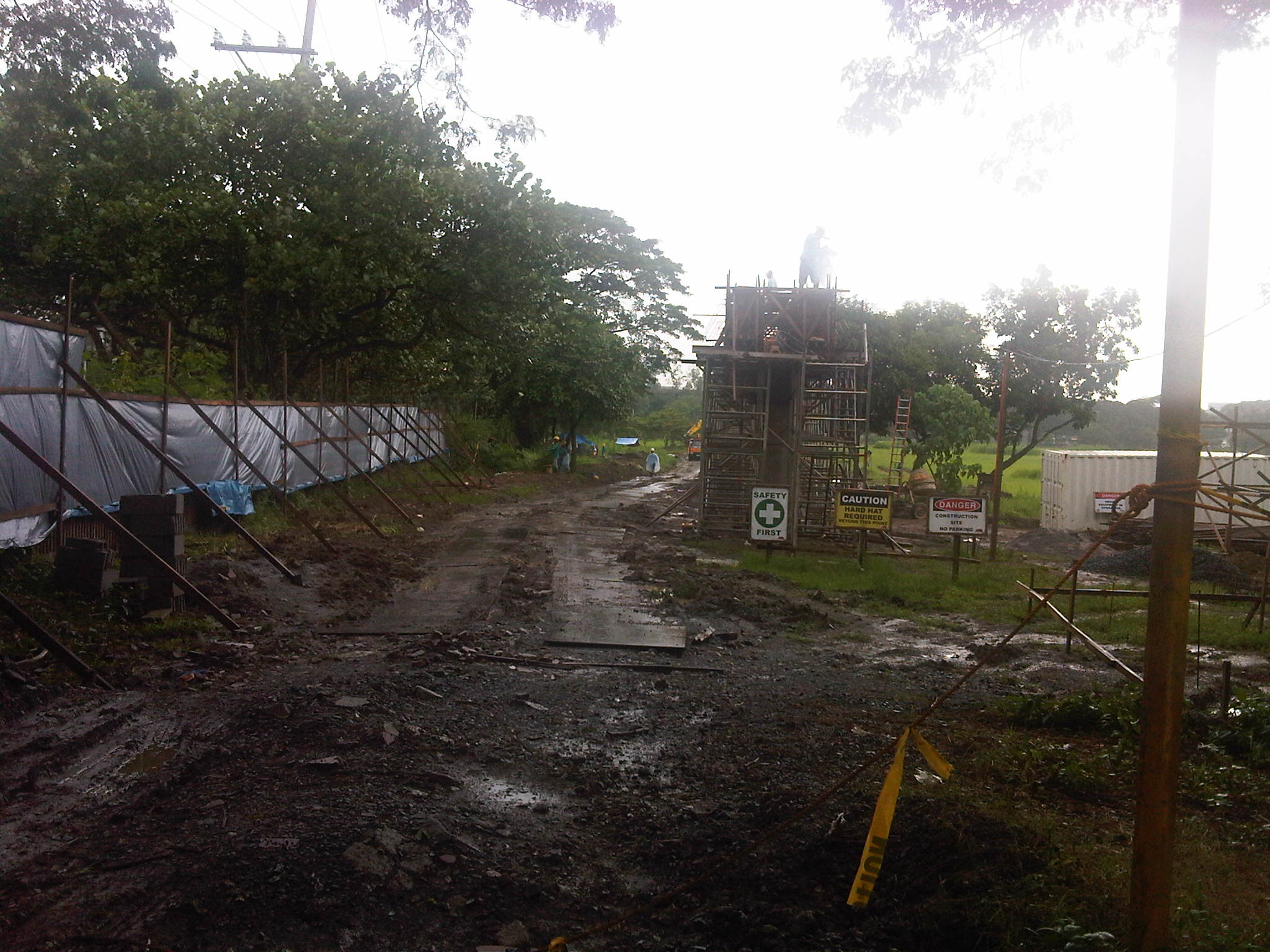 The site has been fenced off to minimize the appearance on-site of curious people (usiseros?). One such person even climbed a column to take photos of the construction work and posted these in the internet. As this is a construction site, such incidents are not supposed to happen mainly due to safety concerns.
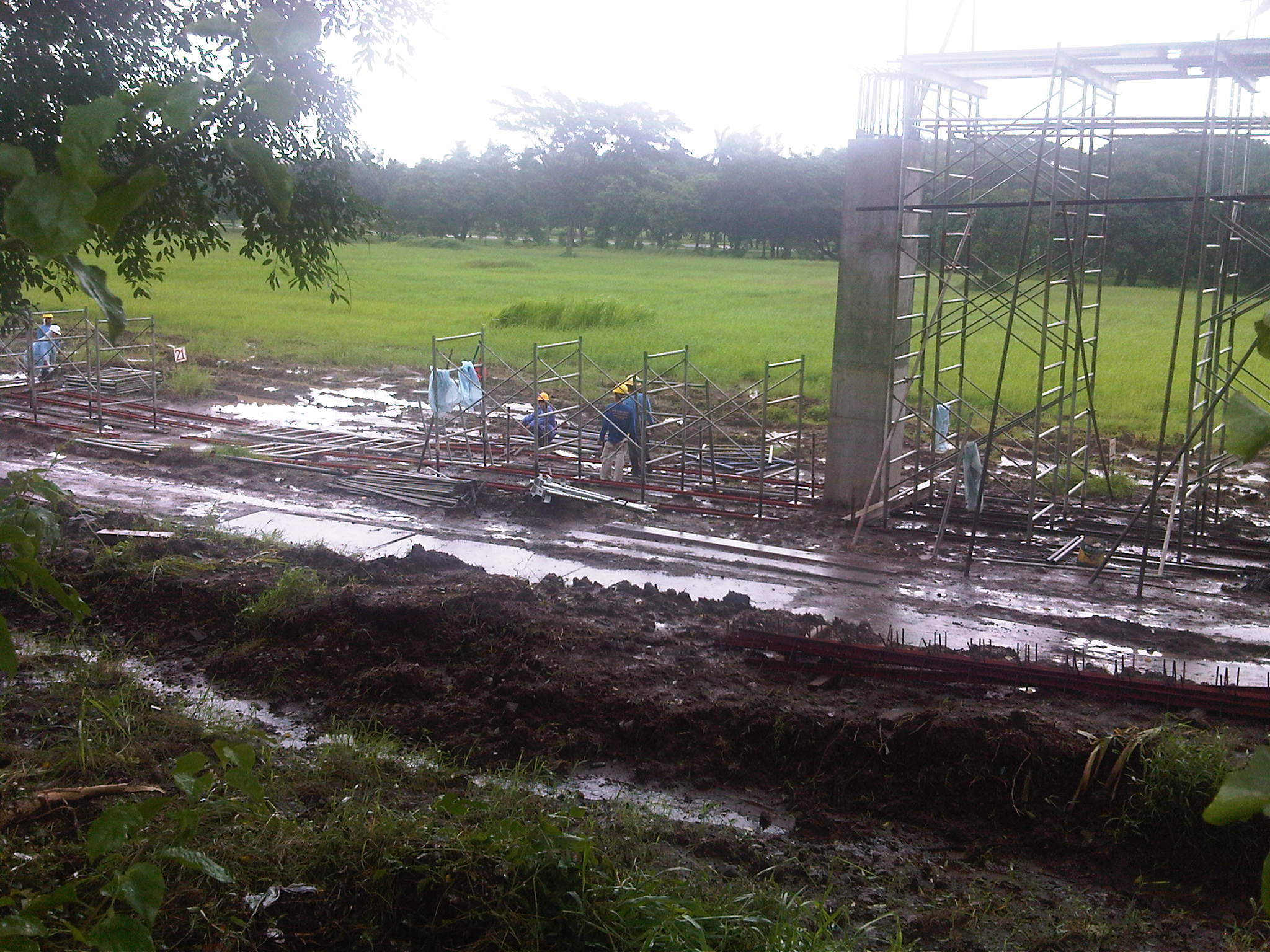 Construction work continues despite the wet weather. The week-long monsoon rains have rendered the ground muddy or mushy but workers are busy as if it were summer.
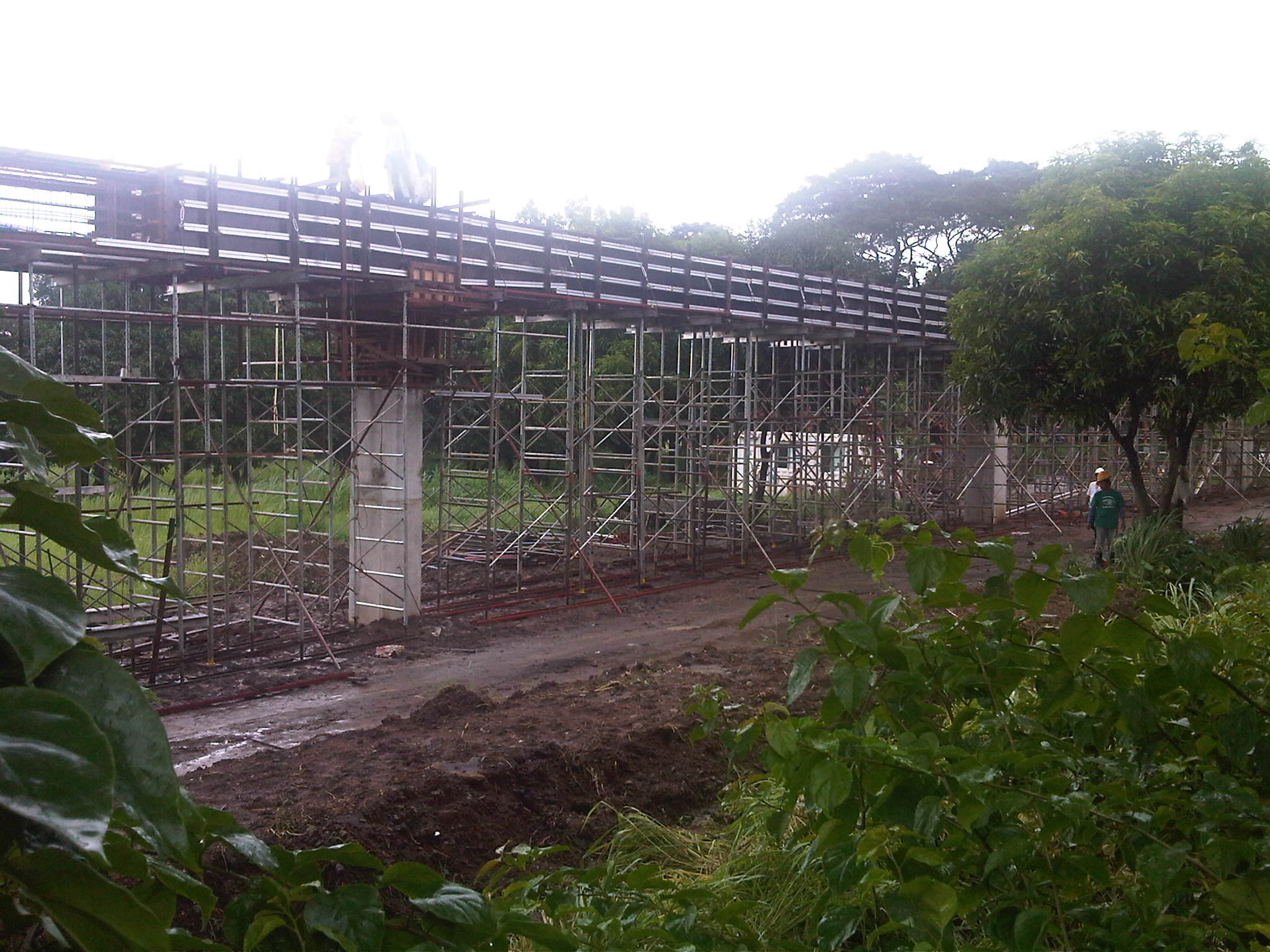 The columns for the elevated structure are all in place but in various stages of completion. Those along C.P. Garcia until the intersection with the University Avenue only have the reinforcing steel bars in place and awaiting the pouring of concrete.
 Construction materials are piled up on top of tarp-covered ground as workers take some time-out from their work.
The test track is supposed to be completed by October including the installation of power lines and a power station for the electric-powered vehicle. The DOST has also bidded out the assembly of the vehicle that will be used for the experiments. Hopefully, the vehicle will be ready by the time the test track is completed. It is expected that the AGT would have manned tests by late November or early December, in time for a demonstration before or on the day of UP Diliman’s Lantern Parade.
–
Paratransit in Davao City
While visiting a jeepney assembler in Davao, we took the opportunity to take not a few photos of paratransit vehicles along one road in Davao City. Of particular interest to us were what appeared to be three-wheelers that resembled the tuktuks of Thailand and the four-wheeled multicabs that served as an intermediate mode with passenger capacities between that of the tricycle and the typical jeepney.
What at first seemed to be three-wheelers were actually four-wheeled vehicles. For propulsion, they used typical motorcycles but instead of one-wheeled sidecars like the typical tricycles found in many cities and towns across the country, the fabricated body has 2 wheels and provided for two benches to accommodate more passengers.
Following are photos of these 4-wheeled paratransit vehicles we took while visiting a jeepney assembly in Davao. While there is a basic form for each vehicle, there are actually some distinct features for each, probably the manufacturer’s or assembler’s signature. There is no distinct color for any particular route so commuters would have to check the panel information before flagging one to make sure whether the PUV serves their destination although these seem to have fixed routes.
 Maroon body with white roof [Agdao – Jerome route]
 Gold body and roof [Agdao – South Bay route]
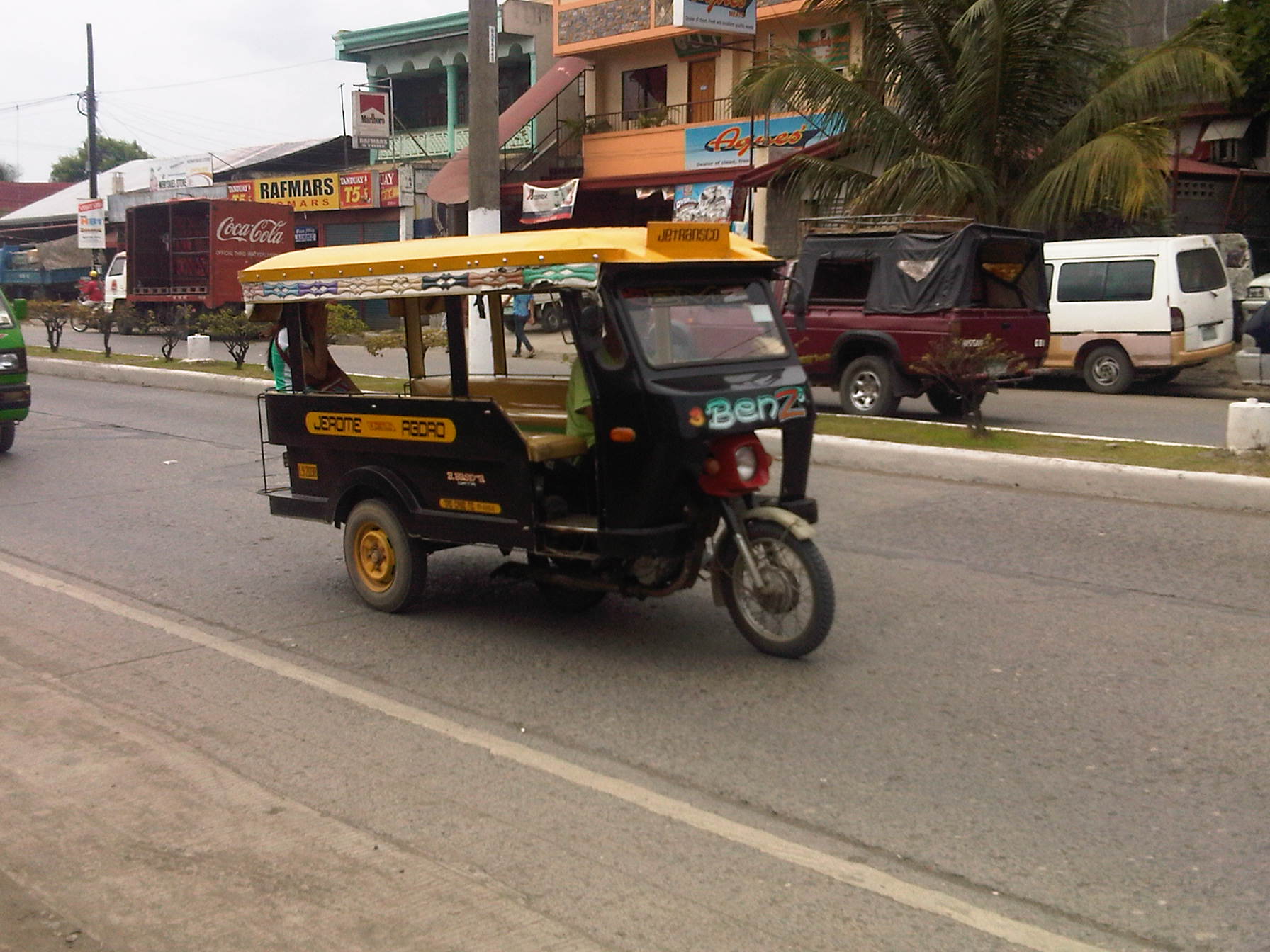 Black body and yellow roof [Agdao – Jerome route]
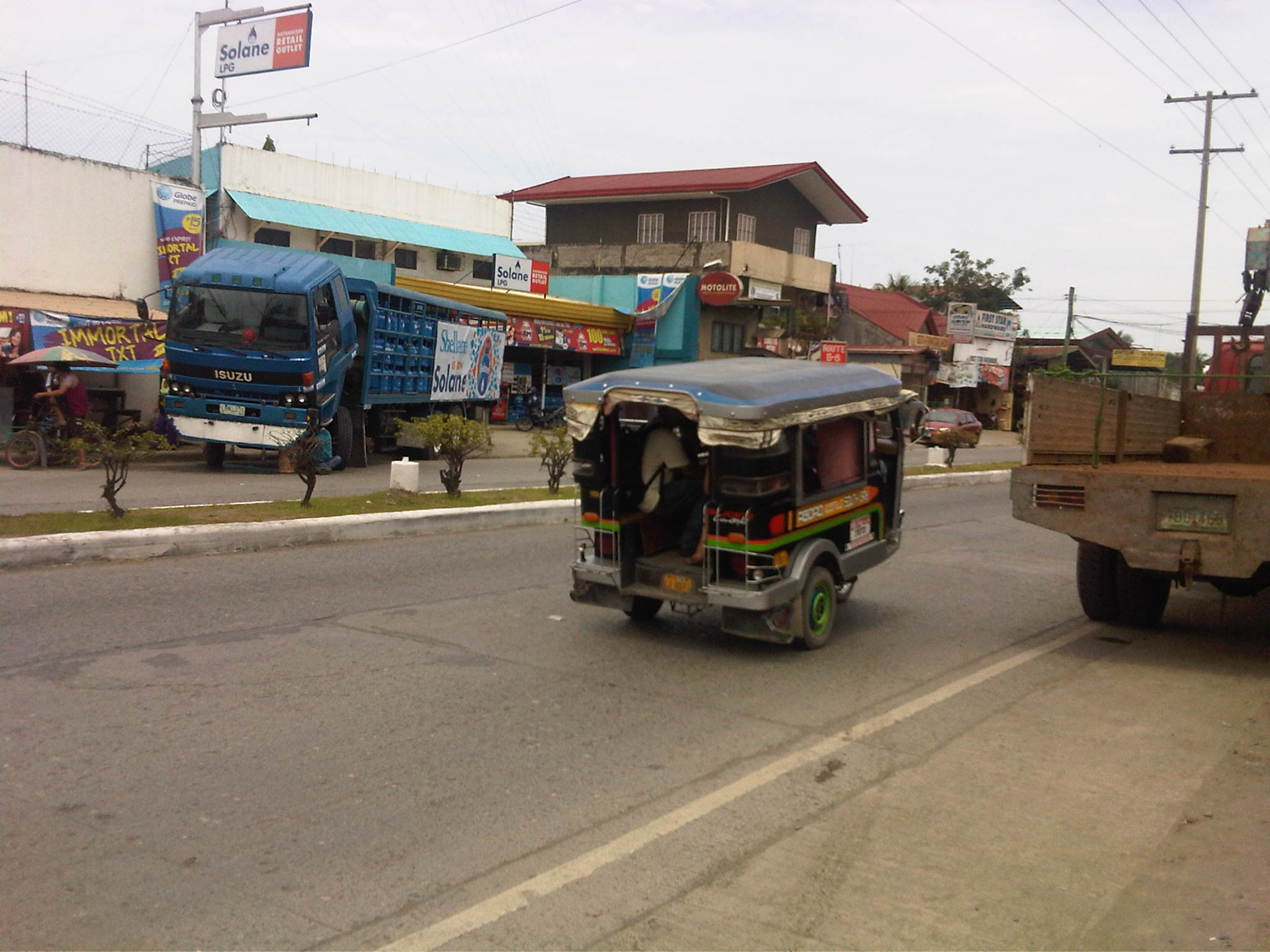 Black body and blue roof [Agdao – South Bay route]
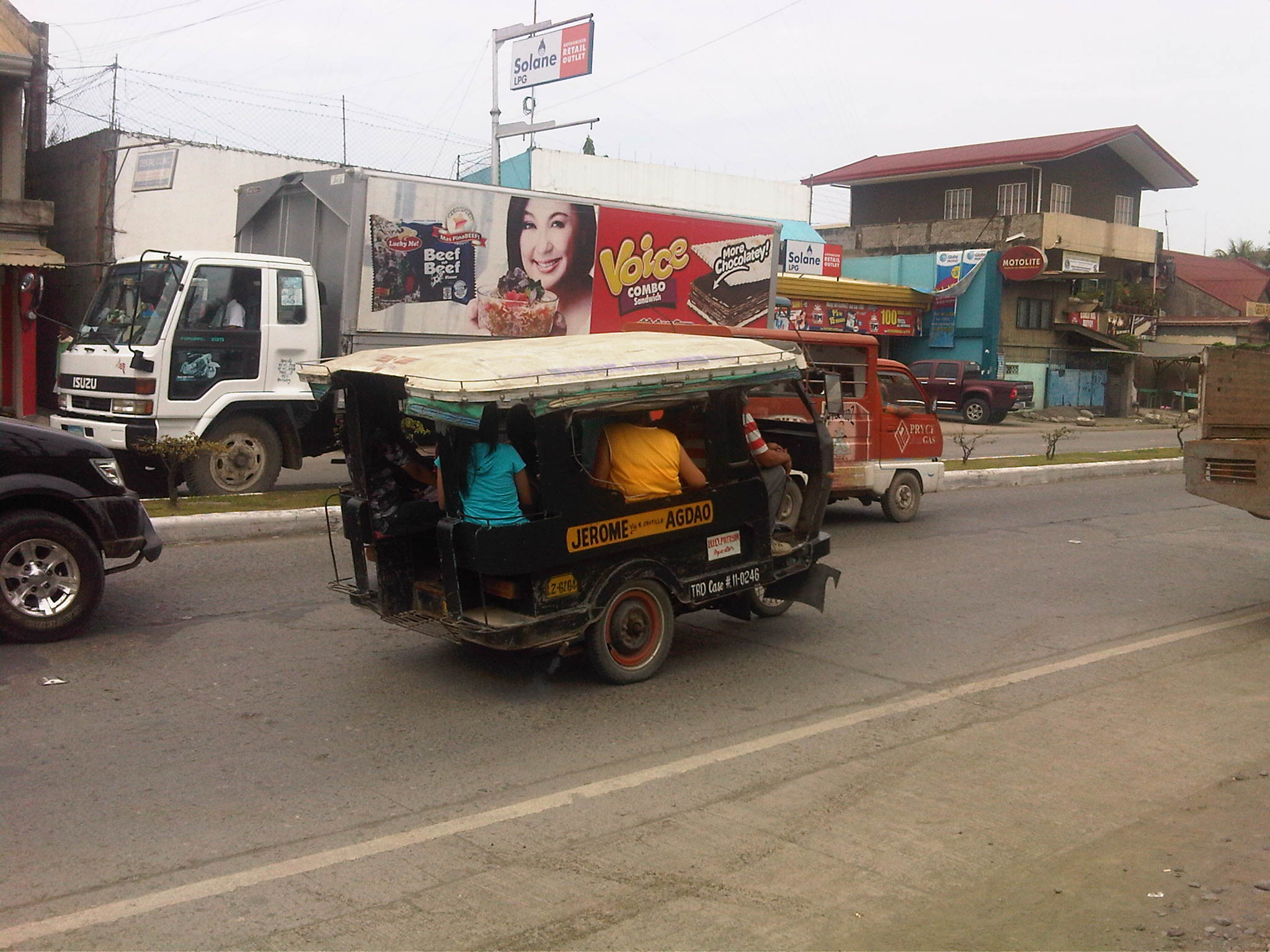 Black body and white roof [Agdao – Jerome route]
We were also able to observe another form of jitney, which are generally called multicabs in the Philippines. The term multicab seem to have originated from a brand for these 3-cylinder engine vehicles that are fitted to carry passengers or in some cases as small freight vehicles. These are very popular in the Visayas and Mindanao where they typically seat 10 – 14 passengers excluding those in the front seat. The vehicle is narrower than the typical jeepney so only two people can usually fit in the front.
 12-seater multicab
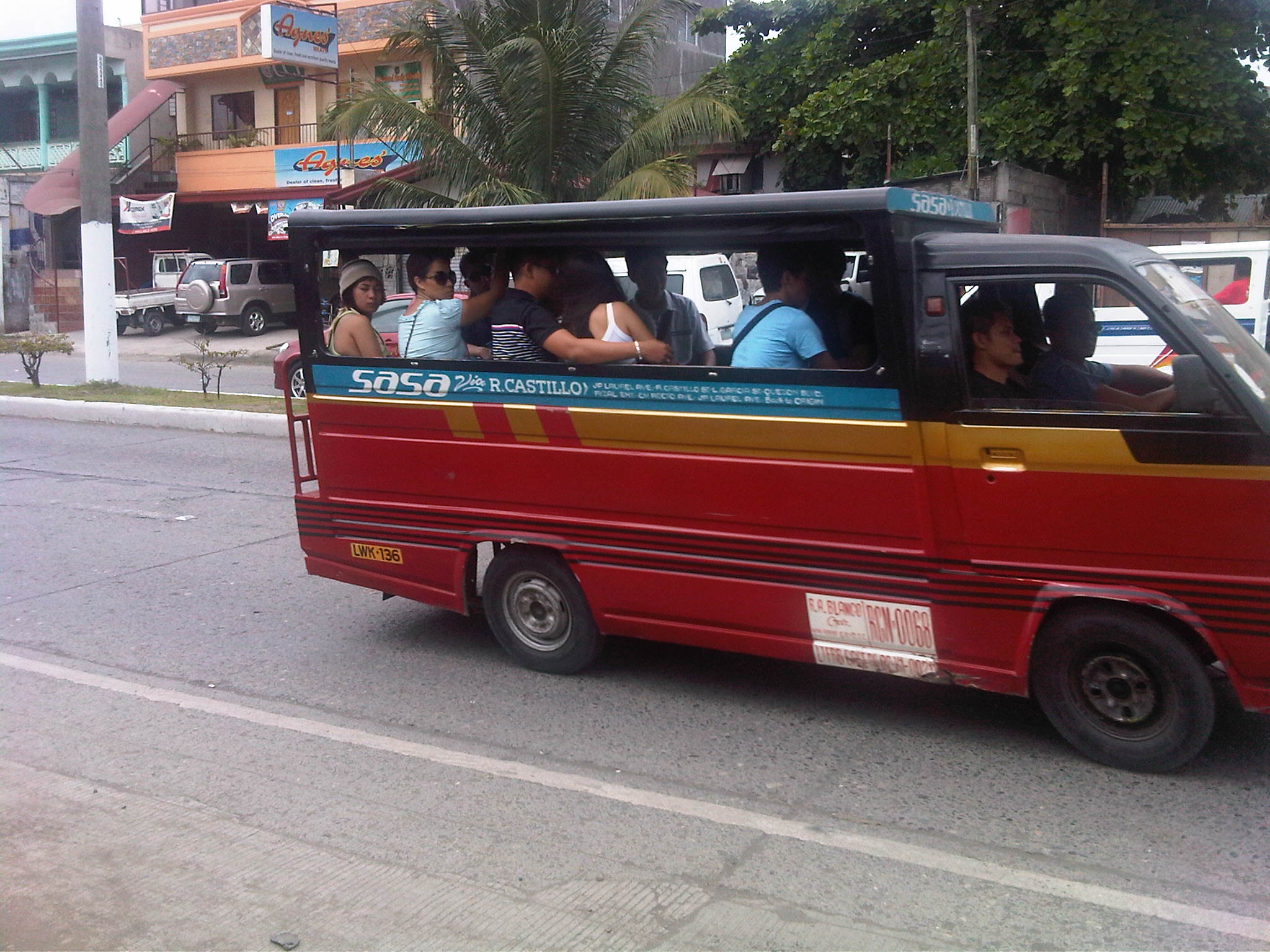 14-seater multicab
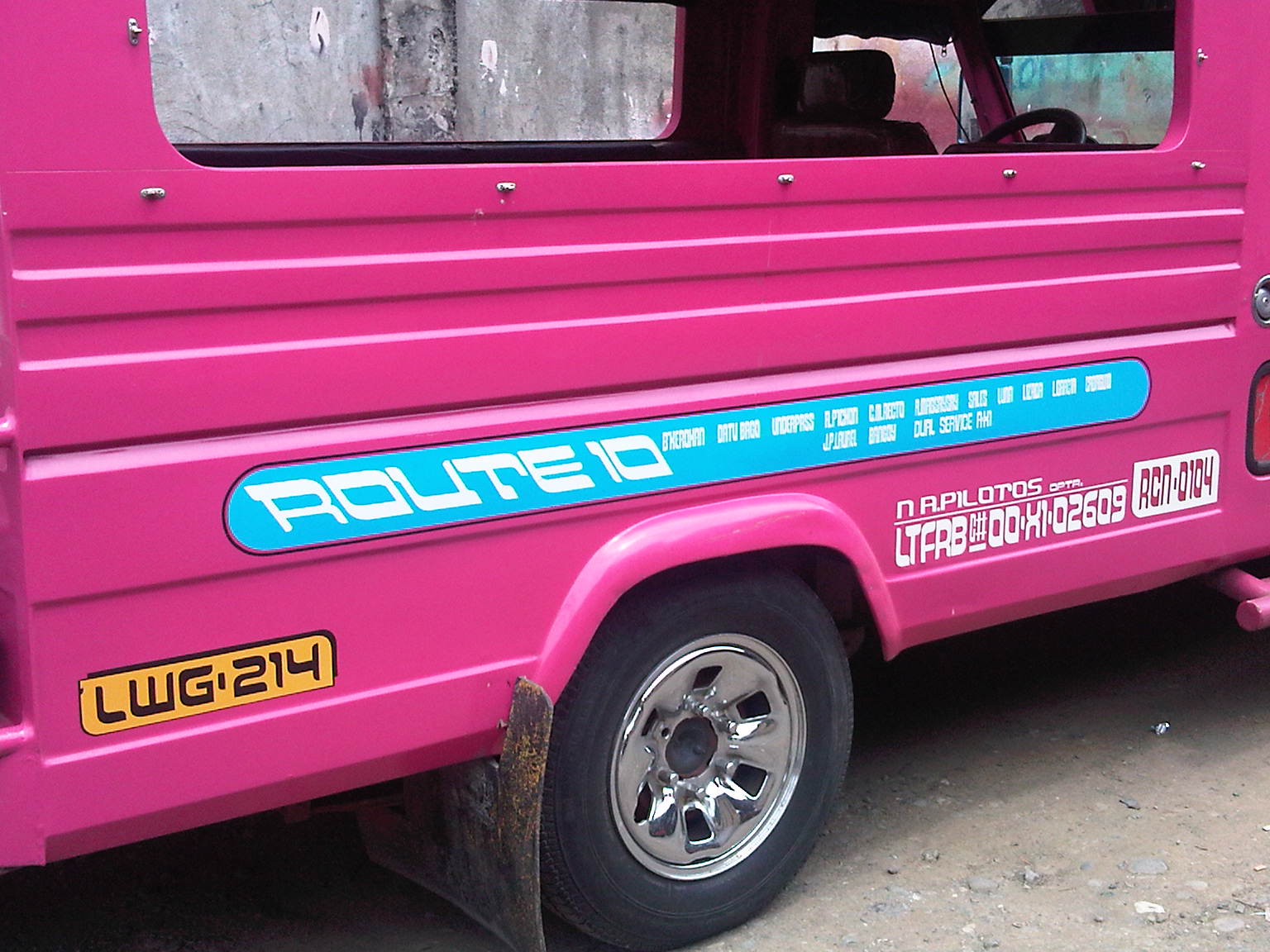 Typical jeepney design in Davao
–
Manila East Road
The Manila East Road is located in the province of Rizal to the east of Metro Manila. The section of the highway featured in this post connects the towns of Taytay and Angono in the province of Rizal while also in the vicinity of Antipolo City, Cainta and Binangonan. References will tell us that the road actually stretches all the way to Laguna where it passes through the towns of Pangil, Pakil and Paete along the east coast of the Laguna de Bay and continues through more towns of Laguna until Calamba.
The following photos were taken one rainy afternoon while we were listening to the radio about senators giving their individual verdicts on the first article of impeachment for the Chief Justice of the Supreme Court of the Philippines. While there are rain drops visible in the photos, these did not obscure the view of the highway allowing us to take good enough shots to illustrate the stretch of the road from Angono to Taytay (junction with Ortigas Avenue Extension (R-5) and just before the ascent to Antipolo). It is supposed to be part of Radial Road 5 or R-5 but other references also point to the continuation of Ortigas Extension through Antipolo and Teresa as also part of R-5. These roads eventually converge in the town of Morong, Rizal.
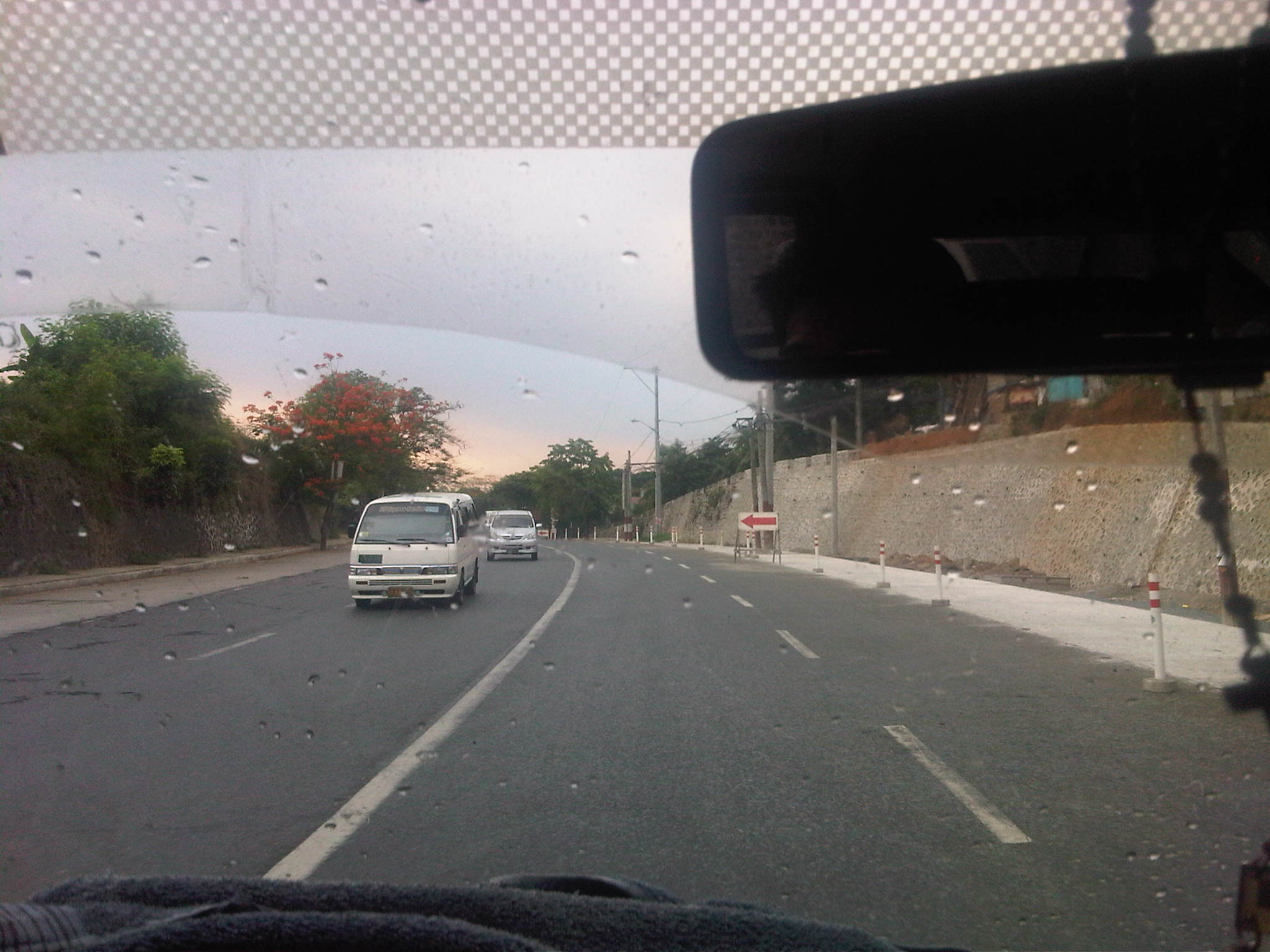 Descending from an exclusive resort where we just had a workshop hosted by a national government agency, we traveled along a section that was a 4-lane undivided road being widened to have 3 lanes per direction. While there’s a sidewalk on one side, the other side did not have pedestrian facilities.
 The section, it turns out, is a continuation of what was already a 6-lane highway as shown above.
 The 6-lane section, however, constricts into 4-lanes near the junction to the original road passing through Angono town proper. Pavement conditions were good but most markings have faded or non-existent.
 Typical of rural highways around the country, there is a proliferation of tricycles traveling along the Manila East Road. These often cause congestion due to their operations including having informal terminals along the highway.
 The lack of pavement markings can be a source of confusion for motorists who are not guided and would have the tendency to encroach into the paths of other vehicles.
 Rather simple sign to mark the boundary between Angono and Taytay. Elsewhere, there would have been an arch designed and put up by one of the towns and reflecting its character or showing off products or attractions.
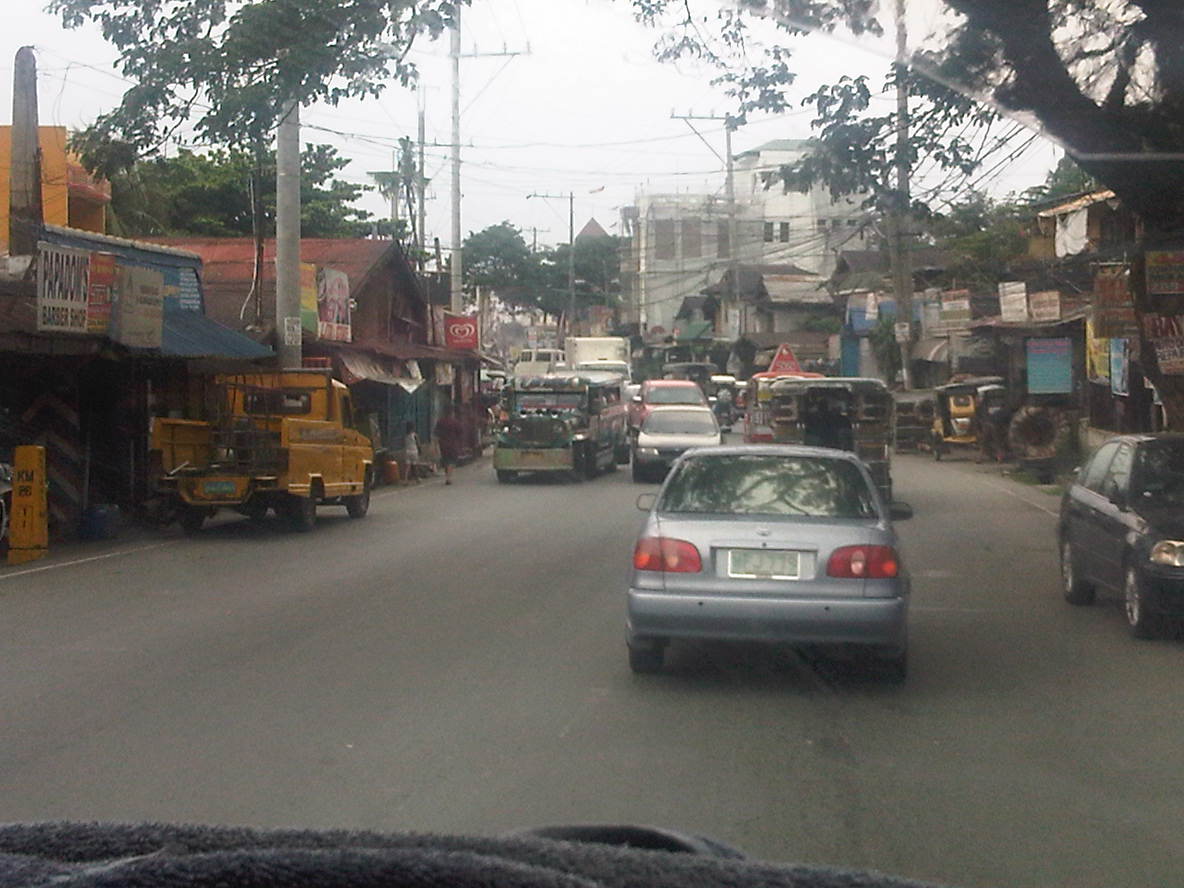 Shanties and other structures of informal settlers line up along this section of the road, effectively constricting traffic. This is supposed to be a 4-lane section (perhaps more if we check the RROW) but roadside friction including the presence of roadside parking and informal structures reduce space to about 3 lanes as shown in the photo.
 Most properties along the stretch of the highway seem unaware of building code provisions for pedestrian sidewalks and clearance in front of the building. These are matters that should have been inspected and ensured by local government.
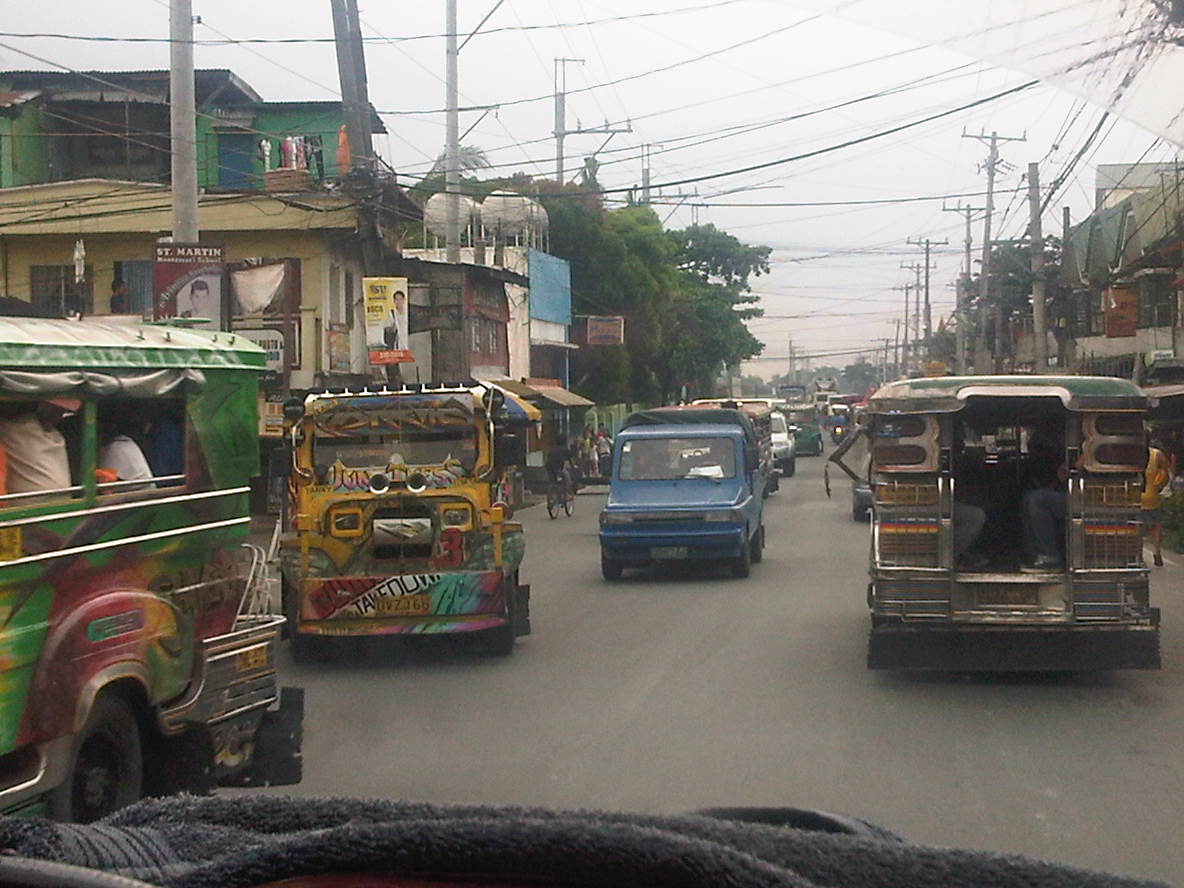 Taytay is one of the more densely populated towns of Rizal and would probably already qualify for cityhood ahead of many other LGUs that became cities in the last few years despite having shaky incomes among other qualifications. Land use planning, however, does not look like something that was undertaken for much of the areas adjacent to the highway.
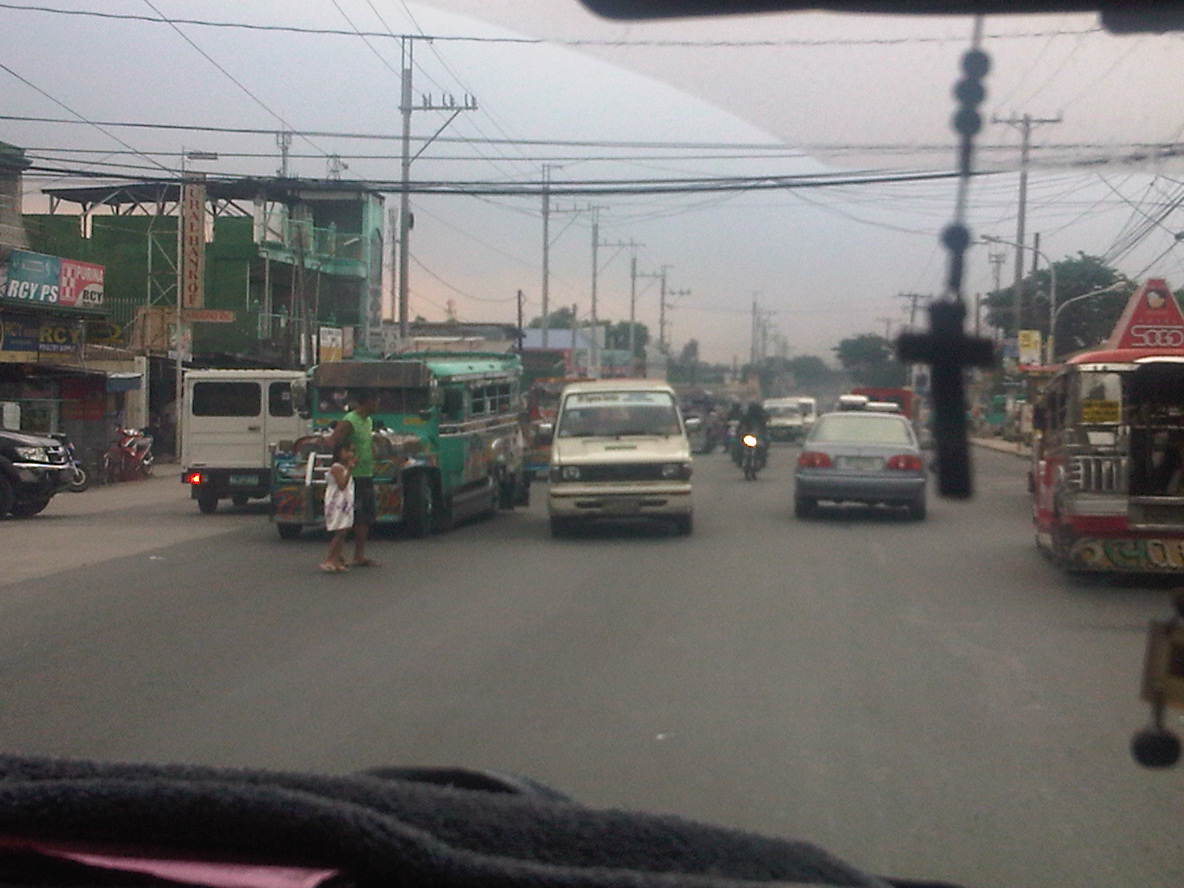 Pedestrians practically cross anywhere along the highway, with most like the man with a child in the photo seemingly uncaring about the risks posed by motor vehicles. In the case above, there are no pedestrian crossing signs or markings but in places where there are such designations people rarely follow the zebra crossings mainly out of ignorance and partly out of stubbornness.
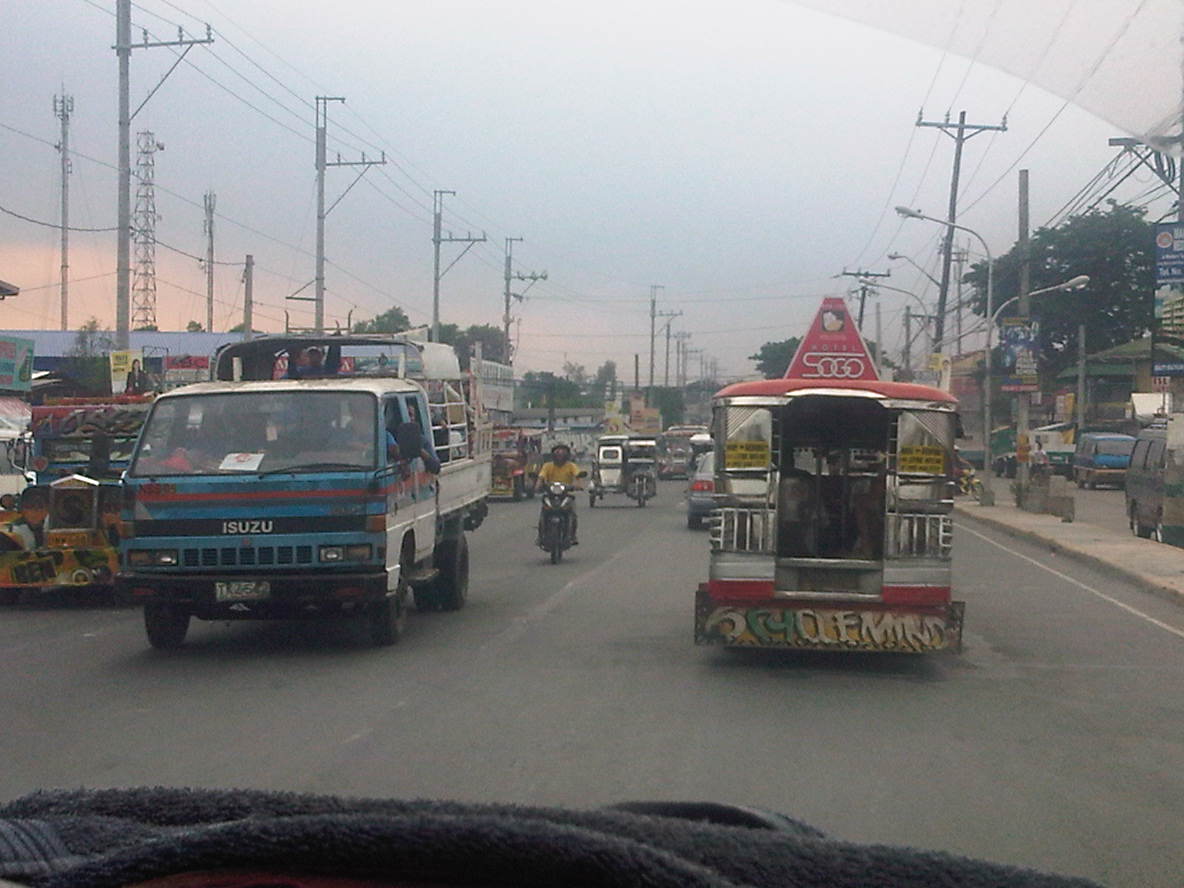 Along one section, the road widens and has along the Ortigas-bound side (right in the photo) a 2-lane service road separate from the main carriageway by a narrow concrete island. The service road is also plagued by parking though its purpose seems to be that for loading and unloading of passengers.
 Electric posts are located dangerously close to the road and would probably fall over if hit by a wayward vehicle. Such is probably the result of road-widening and shortcomings with coordination with the utility company as well as some fault, too, with the utility company as well.
 Another section with excellent pavement conditions but no pavement markings.
 There are short bridges along the highway due to the streams that run across the road from the mountains in the east to the general direction of Laguna De Bay and the Manggahan Floodway to the west. These bridges also tend to limit the width of the carriageway as shown in the photo.
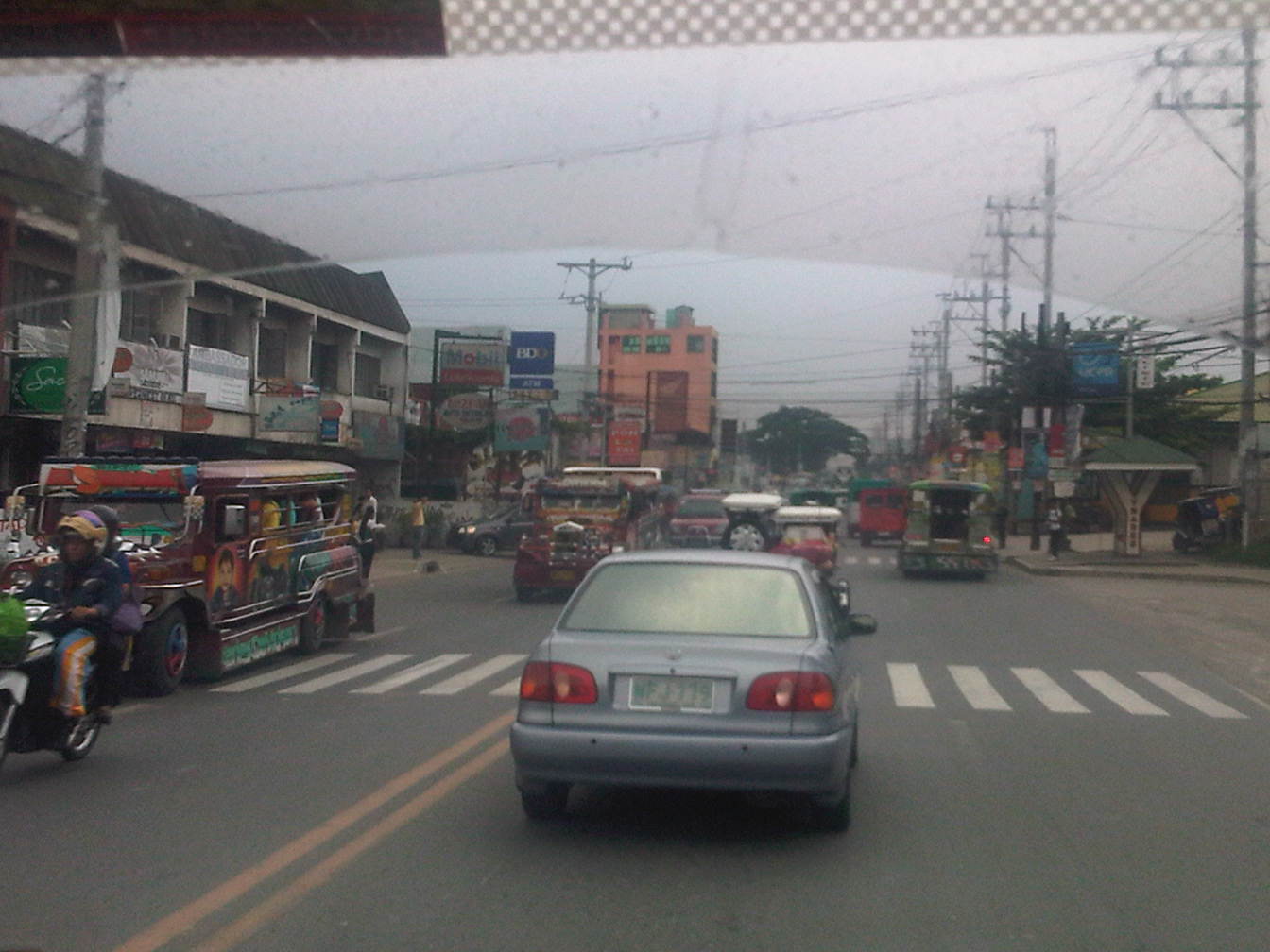 After the bridge, the road widens back to 4 lanes and complete with standard markings. For the entire length of the road from Angono to Taytay there is a trend, based on our observations, that sections alternately widen and narrow based on the developments on either side of the road.
 On-street mayhem is when you mix different kinds of vehicles and pedestrians on the road in the Philippines.
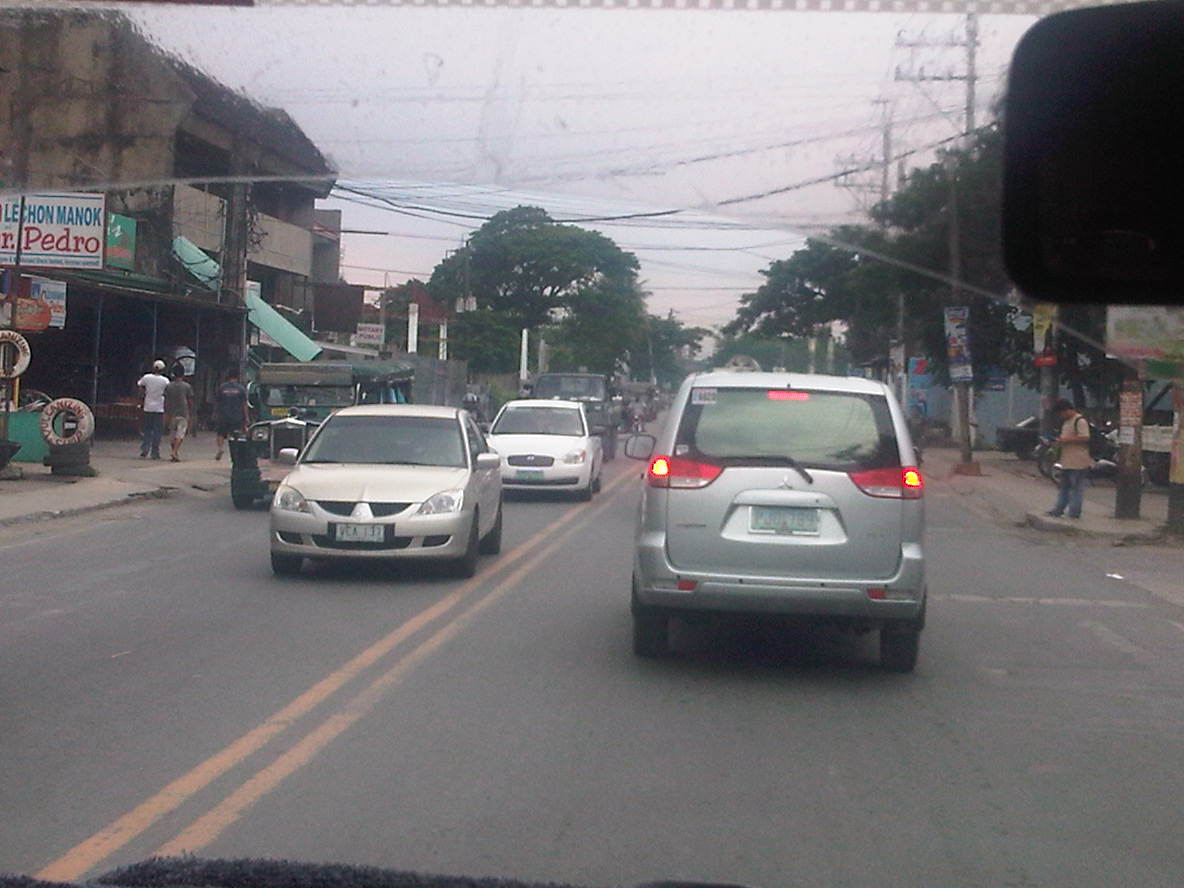 What is supposed to be a 4-lane road seems like a 2-lane carriageway because of some delineations missing and vehicle tending to hog the equivalent of 2 lanes like the vehicle in front of us.
 Junction with A. Bonifacio Ave (from Imelda Ave. and the Cainta Junction). A. Bonifacio passes through the town centers of Cainta and Taytay but is usually a very congested road having a narrow 4-lane carriageway that’s effectively a 2-lane road. The Manila East Road effectively bypasses that road. Notice that after the junction, the road markings are all there.
 Curve right after the junction
 This section has a total of 8 lanes based on the pavement markings but effectively has only 6 as the outermost lanes are often occupied by parked vehicles or used by pedestrians in the absence of sidewalks along either side of the highway.
 Pedestrian bridge between two buildings comprising the SM City Taytay. People have a tendency to cross at street-level so to force them to use the overpass, barriers were placed along the median. The barriers seem to be quite porous and I only wonder if anti-jaywalking policies are enforced in the area.
 An 8-lane stretch of the highway featuring a covered court with the name of a provincial politician stamped on its roof. This section used to have only 4 lanes with some shoulder space on either side of the highway. The DPWH and the local government had a measure of success in recovering land from encroachments and easing informal settlers off from the RROW, something that should probably be undertaken but which requires much more effort along sections shown in the previous photos.
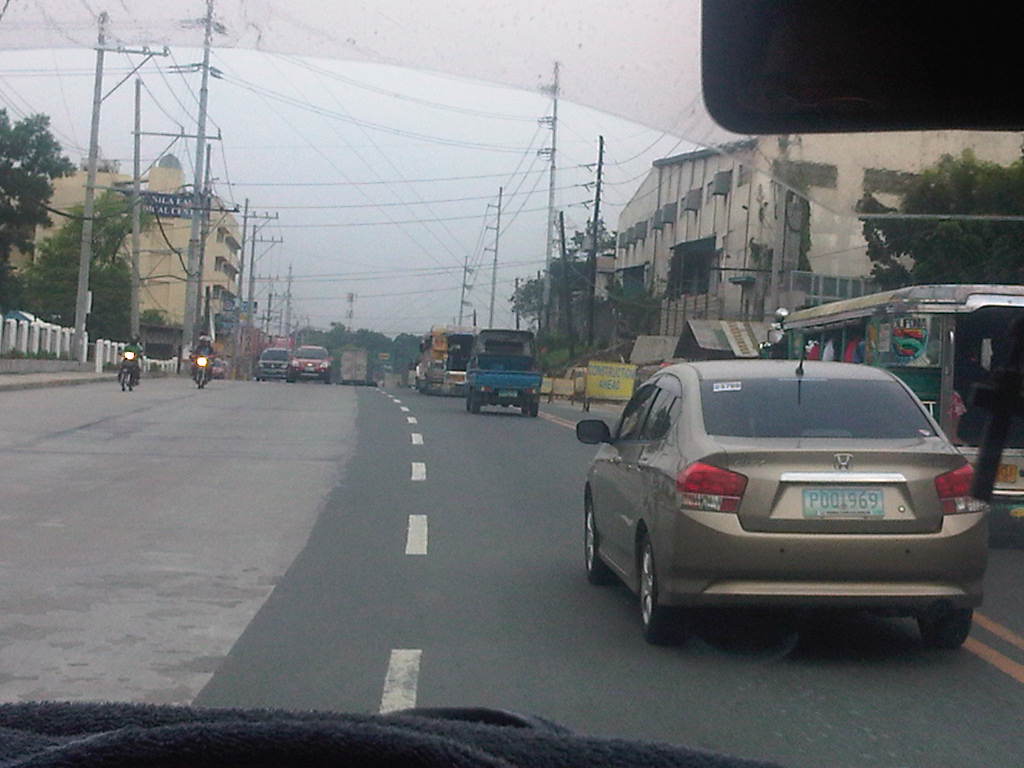 Road widening was still being implemented along the Ortigas-bound side of the highway when we passed through. There was no congestion though since the carriageway was wide enough to carry the light traffic during the early afternoon.
 The 8-lane section narrows to the equivalent of 6 lanes though the pavement markings seem to indicate only 4 lanes as shown in the photo. Already visible in the photo downstream of our position is the Tikling Junction – the intersection of the Manila East Road with Ortigas Avenue.
 Approach to Ortigas Avenue Extension and Leonard Wood Road (which is to the left just before the intersection with Ortigas)
 Junction with Ortigas Avenue Extension
–
 Caught (up) in traffic

