
Home » Railways (Page 6)
Category Archives: Railways
Whatever happened or is happening to the Metro Manila Subway?
There is an article that came out today stating issues and concerns about the Metro Manila Subway Project. I will not summarize the article here but leave it to the reader to click on the link and read the article himself/herself. The writer has been attacked for his sharp criticisms of this administration and has had his share of being branded a liar. What is lost in the attacks vs him (many if not most by organized trolls) is that he is usually on target and factual despite the denials by those who are the subject of his exposes and criticisms. Also, note that he has been a consistent and persistent critique of any administration. This is important as he is being objective rather than protective of vested interests. He represents the interests of a lot of people who are considered the silent majority.
Bondoc, J. (2020) Subway works at standstill since realigned to fault line, The Philippine Star, https://www.philstar.com/opinion/2020/02/14/1992947/subway-works-standstill-realigned-fault-line?fbclid=IwAR2yN_qpwTJ9AHfJaws_3VXztVu6etZsxOBkSj-Zw2KS7v7Tv9hcnJc1K-s&utm_medium=Social&utm_source=Facebook&utm_term=Autofeed [Last accessed: 2/14/2020]
While I am still hopeful about this project, I already feel some disappointment for something that I have supported from Day 1. The delays and escalation of costs are serious matters. It can only get worse during construction.
–
National Transport Policy is out!
The National Transport Policy is out and there’s a lot of buzz about the wording of the policy. NEDA released the following infographics on their official Facebook page:
 Definition of what the policy is about
 Hierarchy of transport modes (note the emphasis on walking and cycling)
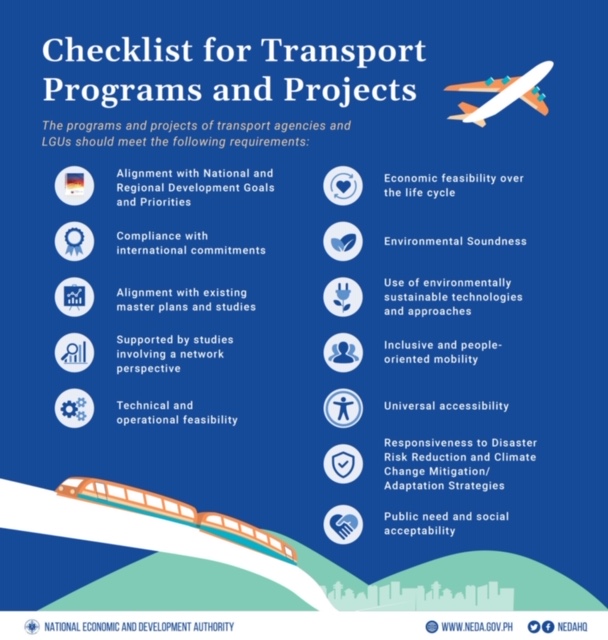 Checklist for programs and projects: I am already anticipating what proponents will be writing to justify projects according to this checklist.
I will reserve my commentaries for future blogs. There is really a lot to discuss about this policy and how it will implemented (properly or improperly), There are lots of different ideas, advocacies, interests and agendas on transportation that come into play here. And we can only hope that the policy and its implementing rules and regulations will be clear enough (not vague as to have so many loopholes) for this policy to effect transformation and inclusive and sustainable development.
–
Comments on current transport issues – Part 3: On the obstacles to the PNR trains
2) On the obstacles to the PNR operations
We have done studies before when studies on the PNR were not considered fashionable. People who did research on rail transport were more interested in Lines 1, 2 and 3, and dismissed the PNR as a lost cause. There were many transportation experts who ridiculed it and even taunted PNR about their poor service. And yet we did our studies because we had an appreciation of the importance of this line and how it could play a major role in commuting if given the resources to improve their facilities. It was shown that the line could be more advantageous for commuters particularly those traveling between the southern parts of Metro Manila and Makati and Manila. These would be both workers and students who will benefit from the shorter travel times and less expensive fares. The downside then (and still at the present time) was the long headways between trains. That is, you can only catch a train every 30 minutes.
 This photo taken more than a decade ago show the typical conditions along many sections of the PNR. It is pretty much the same today and the agencies involved (DOTr and PNR) have done little to reduce the informal settlers along the line. No, they didn’t just appear now, and are throwing garbage, rocks and other debris on the trains. This was already happening years ago.
Fast forward to the present and they seem to be getting a lot more resources than the last 30+ years. A Philippine Railway Institute (PRI) has been created. New train sets have just been delivered and went into operation. Unfortunately, the new trains were met with rocks and other debris as they traveled along sections occupied by informal settlers. The incident damaging the new trains puts further emphasis on the need to the need to address the squatter problem along the PNR line. Should fences be built to protect the trains and passengers? Should people be relocated? I think both need to be done in order to secure the line and in preparation for service upgrades including more frequent train services (i.e., shorter intervals between trains). And we hope to see the DOTr and PNR working on this as they attempt to attract more passengers to use their trains.
–
Comments on current transport issues – Part 1
I end the year with commentaries on transport issues. I recently responded to a request for an interview. This time, it was not possible to do it in person so we corresponded through email. Here are my responses to the questions sent, which are mainly about the public utility vehicle modernization program of the government.
· Will old-school jeepneys finally disappear on Philippine roads before the term of President Rodrigo Duterte ends, barely three years from now? What is a more realistic timeline of jeepney modernization?
Old school jeepneys won’t disappear from Philippine roads. For one, the modernization program has slowed down a bit and even the DOTr and LTFRB have stated and admitted that it is not possible to have 100% modernization before the end of term of the current administration. It’s really difficult to put a timeline on this because of so many factors that are in play including social, political, institutional and economic ones. The technical aspects are not issues here as there are many models to choose from and suitable for replacing jeepneys in terms of capacity.
· What are the bumps on road to jeepney modernization?
As mentioned earlier, there are many factors in play here. Economic/financial-related bumps pertain mainly to vehicle prices. The new models are quite pricey but it should be understood that this is also because the new ones are compliant with certain standards including technical and environmental ones that most ‘formally’ manufactured vehicles must pass unlike so-called customized local road vehicles (CLRV) like the conventional jeepneys. The financial package is not affordable to typical jeepney operators/drivers. The cost of a modern jitney (the technical term for these vehicle types) is close to an SUV and revenues may not be able to cover the combination of down payment, monthly payments, and operations & maintenance costs of the vehicle.
· Should local government units dictate the pace of jeepney modernization, not national agencies such as the Department of Transportation and the Land Transportation Franchising and Regulatory Board? Why?
I think the word “dictate” may be too strong a term to use. Instead, I prefer the word “manage”. After all, LGUs are supposed to capacitate themselves to be able to rationalize and manage public transport operations. That is why the DOTr and the LTFRB are requiring them to formulate and submit for evaluation and approval Local Public Transport Route Plans (LPTRP). Though the deadline was supposed to be 2020, the agencies have relaxed this deadline after few submissions from LGUs. Few because there were only a few who were capable or could afford consultants to prepare the plans for the LGUs. These plans should be comprehensive covering all modes of public transport including tricycles and pedicabs that are already under the LGUs. Buses, jeepneys, vans and taxis are still under the LTFRB. Plans may also contain future transport systems that are being aspired for by LGUs such as rail-based mass transit systems and other such as monorail or AGT.
· Transport groups like PISTON are against drivers and operators merging into cooperatives. Is consolidation into cooperatives unworkable? Why?
I think consolidation into cooperatives is workable and should be given a chance. Unfortunately, there are still few examples of successful transport cooperatives. And the success also depends on the routes served by their vehicles. And that is why there is also a need to rationalize transport routes in order to ensure that these are indeed viable (i.e., profitable) for drivers and operators.
Another angle here is more political in nature. Note that while PISTON and other like-minded transport groups oppose cooperativism, there are others that have embraced it and even went corporate to some extent. Perhaps there is a fear of a loss in power that the leaders of these opposition transport groups have wielded for a long time? Perhaps there’s a fear that success of cooperatives means the drivers and operators will turn to cooperativism and leave those transport groups? Surely there are pros and cons to this and groups should not stop being critical of initiatives, government-led or not, that will affect them. This should be constructive rather than the rant variety but government should also learn to accept these rather than dismiss them or be offended by them as is often the case.
–
More comments in the next year!
–
Transit station connections in Singapore
The connections between transit stations in Singapore show us examples of how to encourage people to walk long distances. The links, mostly underground, are interconnected with branches to common exits to hotels, office and residential buildings. These are basically transit malls lined with cafes, restaurants and shops. There are even gyms (e.g., UFC) and play venues along some connections.
 Underground transit mall between a City Hall Station (red line) and Esplanade Station (orange line)
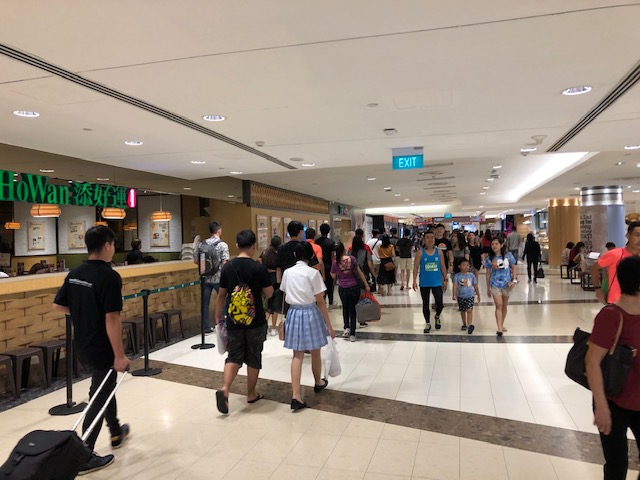 The connection is lined with restaurants, cafes and shops
Singapore’s underground connections reminded me of similar structures in Tokyo and Yokohama. You can just walk underground and come up near your destination. This is especially advantageous and comfortable during the summers when the hot weather becomes a detriment to walking outdoors. Underground transit malls or connections are usually air-conditioned or air is pumped into them for ventilation. As such, temperatures are significantly lower compared to the surface/ground. Will we have similar facilities/developments here in the Philippines and particularly in Metro Manila once the MM Subway is developed?
–
Some advantages of transit access – the case of a stadium and an arena
One of the advantages of having mass transit access to a major venue is that mass transit can carry more people than any other modes of transport to and from the venue. In the recent U2 concert held at the National Stadium in Singapore, we experienced first hand how a mass transit system is able to serve the surge in the demand to and from the Stadium Station of the SMRT’s Orange Line.
 People filing towards the station – most people calmly I say most because there were some who apparently were not so familiar with the ways in Singapore and tried to muscle their way into the crowd. Maybe its like that in their own countries?
 It was just like rush hour conditions at the station. Only, people weren’t going to work but home from the concert
Previous to this, I had similar experiences when I was residing in Japan. One time it was a surge in demand due to the popular fireworks display at Yamashita Park in Yokohama covered by three of JR Stations and the end station of the old Tokyu Toyoko Line. There was no Minato Mirai Line at the time that terminated at the park so people had only the JR Sakuragicho, JR Kannai and JR Ishikawacho Stations and the Tokyu Sakuragicho Station.
This is the weakness of the Philippine Arena, which can only be accessed via the NLEX and by road transport. The result for the larger capacity stadium’s hosting of a U2 concert resulted in horrendous traffic jams and hellish travel times for attendees. Friends stated that whatever high that they got from the concert was steadily depleted by their commutes to their homes. This will not improve even with Manila-Clark railway line because the line will be along the other side of the tollway. It won’t make sense for a branch to be constructed for the arena given the intermittent demand for the events it typically hosts in a year. But there can be a road transport connection to the nearest rail stations to at least alleviate the car traffic generated by the venue.
–
Commuting in Singapore
Another thing we miss about Singapore is the public transportation. It was easy to go around Singapore especially with its comprehensive, extensive rail transport network. This is complemented by even more extensive bus transit services. All these are offer convenient, comfortable and reliable public transportation. As such, there is practically no need to use your own private vehicle for transportation unless there really is a need arising for their use (e.g., emergencies).
 Passengers wait for the train to arrive at an SMRT platform
 Passengers line up before the platform gates at an underground station
The transport system in Singapore actually reminded me of how efficient and reliable it was to commute in Japan where I’ve lived in three area – Tokyo, Yokohama and Saitama – for various lengths of time. These transport systems are what Metro Manila and other rapidly urbanizing cities in the Philippines need in order to sustain growth while providing for the transport needs of its citizens.
–
Evidences of demand for Line 2 beyond Masinag (again)
My commute between my home and office usually takes me to Masinag where I make the choice between traveling via the typical Marcos Highway route or via the alternative Marikina/Tumana route. Here is a scene that I usually see whenever I pass by the informal UV Express terminal just past the Masinag junction along the westbound side of Marcos Highway and just before the Decathlon sports facility currently under construction.
 Passengers waiting for UV Express vans or AUVs to return around 8 AM. The latter serve the Cogeo – Makati (Greenbelt) route, which could take 2 or 3 rides using other modes of public transport (e.g., one ride to Cubao and another from Cubao to Makati)
Note how many people cannot get a ride around 8 AM. If only there were more efficient options then these people would likely take them but for now the obvious and practical choice for them is the UV Express. Others, of course, can just walk further to SM Masinag where there is a P2P bus service also heading to Makati. Recently, a new “experimental” route was opened between Cogeo and SM Aura in Taguig using modern jitneys.
Once completed, Line 2 should be able to provide an alternative for these commuters but there is still the issue of a seamless transfer in Cubao. There is no direct connection between the Line 2 and Line 3 stations with the former connected to the Gateway Mall while the latter is connected to Farmers. That is a significant walk between the two stations.
But where do the commuters in the photo come from (origin?)? Most likely don’t reside around Masinag Junction though there are many residential area around this location. Many are ferried here by tricycles, jeepneys or private vehicles. Many likely have their own cars but opt not to drive to/from Makati. That is actually a good thing and something that needs to be sustained rather than give a reason for these people to use cars for their commutes. And so there is a need to extend Line 2 perhaps to Cogeo, and a branch to Marikina. The Marikina branch, as I’ve mentioned before, could terminate at the Marikina Sports Center. Meanwhile the extension to Cogeo should not stop there but continue further towards Antipolo’s new government centre. This corridor’s population is steadily increasing and the transport demand must be addressed not by low capacity modes but by a mass transit system. The low to medium capacity modes should be in support or at most supplementary to the high capacity system with the Line 2 as backbone.
–
Another look at the PNR tracks in Bicol
Before I post on more recent photos I took from our road trip to and from Baler, Aurora, I just wanted to share photos I took of the PNR railway tracks from an earlier trip to Naga City.
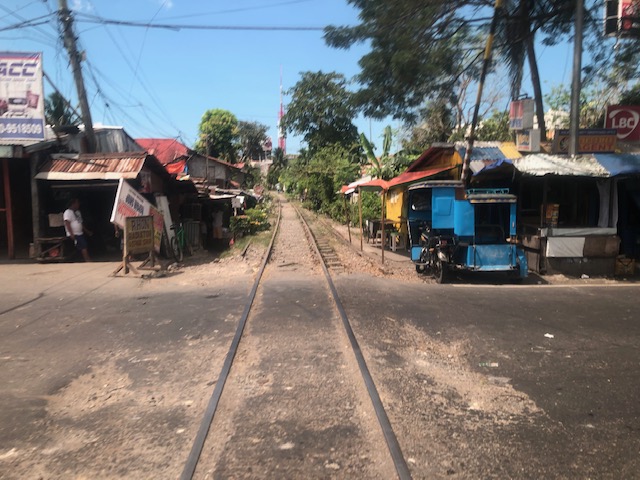 Railway crossing somewhere in Quezon – there are many crossings such as these in many towns in Laguna and Quezon
 Notice that this is a single track set-up, which means only one train at a time along either direction may use the railway tracks.
 Another railway crossing with an informal tricycle and sled terminal. Yes, that’s another paratransit on the right that runs along the seldom if ever uses railway tracks.
 There seems to be no trace of railway ties or sleepers here.
 The tracks here look like they are not longer in use even by sleds.
 Old railway barrier that looks like its no longer functioning
 Idle tracks as evidenced by the grass and the parked vehicles. A narrow road runs parallel to the tracks; giving access to homes along the riles.
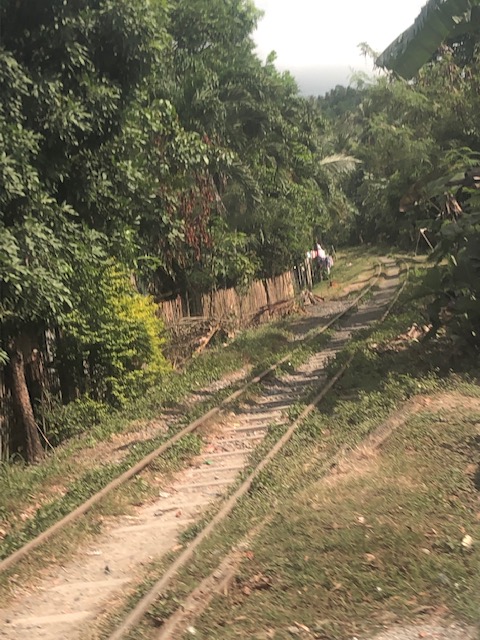 There are railway ties/sleepers along these tracks that seem to be still in use judging from the limited growth of grass and the space being clear of obstructions.
 More idle tracks including rails buried in the ground
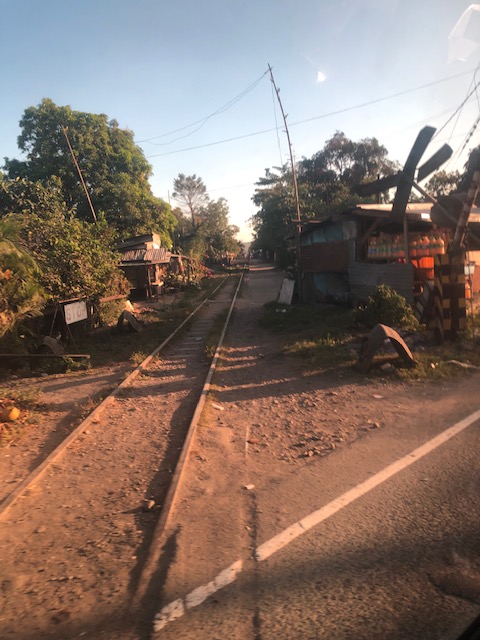 Another railway crossing along the national highway
–
Some concerns about future rail ridership
Traveling along Commonwealth Avenue and Marcos Highway the past week, I both hopeful and worried about what happens after the Line 7 and Line 2 Extension finally becomes operational. Much has been said or reported about the potential of these two lines to change the way people commute; at least from the areas served by these two mass transit lines. However, how big an impact these would have in terms of actual reduction of private car use remains to be seen.
Will there be significant decreases in the volume of motor vehicles along Commonwealth Avenue, Marcos Highway and Aurora Boulevard? Or will there be just the same traffic along these roads? The worry is based on the likelihood that those who would be taking Lines 2 and 7 would be people who are already taking public transportation and not those who have chosen to leave their cars (or motorcycles) at home.
Our students have been studying ridesharing and P2P bus operations the past few years and the conclusion has so far been a shift from one mode of public transport to what’s perceived as a better one. It’s somewhat a difficult thing to accept for advocates of public transport especially those behind TNVS, P2P buses and railways but it is what it is, and its important to accept such findings in order for us to understand what’s going on and come up with better ways to promote public transport and convince car users to use PT.
 Traffic flows at the Masinag junction with the Line 2 Masinag Station and elevated tracks in the background
What is more intriguing is the proposed subway line for Metro Manila. The alignment is different from the ones identified in previous studies for the metropolis and from what I’ve gathered should have stations that serve a North-South corridor that should make for a more straightforward commute (i.e., less transfers) for those taking the subway.
 Probable MM Subway alignment (from the internet)
It is another line that has a big potential as a game-changer for commuters but we won’t be able to know for sure until perhaps 5 or 6 years from now. What we know really is that there was a lost opportunity back in the 1970s when government should have pushed for its first subway line instead of opting for the LRT Line 1.
–
 Caught (up) in traffic