
Home » Research (Page 13)
Category Archives: Research
Research topics for undergraduates?
Looking at the recent statistics for this site, I noticed the surge in interest on research topics for undergraduates. What they found were posts I made over the last few years that included lists of titles of researches being undertaken by our undergraduate students at UP Diliman Civil Engineering. In addition, there are also a lot of articles I posted about various topics on transport and traffic that could be used as basis for developing or identifying research topics for their undergraduate research work. There are a lot of problems or issues or challenges that the Philippines needs to solve. Thus, there should be a number of topics that students can choose from depending on their interest as well as perhaps the capacities or capabilities of their respective advisers to guide them in the implementation of their researches. Among the more “in demand” topics are those relating to road safety, public transport, traffic congestion, walking, cycling and even parking. Topics for undergraduate research should be something that could be implemented over a semester or two including the required review of literature, data collection (i.e., field surveys as well as secondary data collection from various sources) and the analysis of such data. Some topics can be more challenging than others and those requiring specific software (e.g., commercial rather than open-source) should not be encouraged if a school doesn’t have the resources. For the “techies,” topics involving development of software tools or apps may be encouraged as long as the objectives and data requirements are well defined and students don’t end up with useless products.
The National Center for Transportation Studies (NCTS) receives a lot of inquiries every year from students of various universities about research topics on transportation. Most of these are emails and letters without the endorsement of their advisers or teachers. And so we advise them to get the necessary endorsements first before they could do their researches at the Center. This gives the request a bit of a formality though we can only usually extend limited assistance as the Center’s resources are also limited. We have to state, however, that we are not in the business of advising or guiding students from other universities or colleges. That is the responsibility of your faculty whose job is to guide your students. The Center can provide whatever it has in terms of data or information but the specific data or information should first be identified by the students and their advisers by doing research on the topics of interest.
I have not yet posted on research topics for Academic Year 2014-2015 as UP has moved its academic calendar from June to August starting this year. At this time of year, we usually already have a list of topics for our students to choose from. These are topics that faculty have provided and which they could confidently guide students who would be under them (i.e., those who selected the topics they listed). It is highly likely that I would be selecting topics from some of the articles I have posted here and my co-faculty would be listing topics that address current issues or challenges in transport. Until perhaps the middle to last part of August when we would already know how many students will be assigned to our Transportation Engineering Group could we come up with a long list. By early September, our students would have selected their topics to embark on their undergraduate research work.
–
The Philippines’ National EST Strategy – Final Report
Friends and some acquaintances have been asking about whether there is a master plan for sustainable transport in Philippines. There is none, but there is a national strategy that should serve as the basis for the development and implementation of a master plan, whether at the national or local level. This strategy was formulated with assistance of the United Nations Council for Regional Development (UNCRD) through the Philippines’ Department of Transportation and Communication (DOTC) and Department of Environment and Natural Resources (DENR), which served as the focal agencies for this endeavour. The formulation was conducted by the National Center for Transportation Studies (NCTS) of the University of the Philippines Diliman. For reference, you can go to the NCTS website for an electronic copy of the National Environmentally Sustainable Transport Strategy Final Report.
 Cover page for the National EST Strategy Final Report
–
120-passenger capacity AGT prototype
The DOST-MIRDC has built another prototype vehicle for its Automated Guideway Transit (AGT) project. The vehicle is larger than the one at the University of the Philippines Diliman as each vehicle would have a capacity of 120 passengers (seated and standing). They are also building another elevated test track at the MIRDC compound across from the main DOST compound in Bicutan, Taguig City, and along Gen. Santos Avenue. This is a significant upgrade from the 30-passenger capacity vehicles at UP Diliman (60 for a 2-car train) as a 2-car train with 240 passengers means much more capacity for a real line using such vehicles. To compare, 5-minute headways along one direction could carry 720 passengers per hour for the UP Diliman prototype while the Bicutan model can carry 2,880 passengers per hour.
 Two prototype AGT vehicles with maximum capacity of 120 passengers at the MIRDC compound in Bicutan, Taguig City.
 The design is very much the same as the first prototype vehicle, with its distinctive look including the snout, headlights and skirt.
 The vehicle looks like it was inspired by the large provincial buses that, if seats are configured as benches and the body is stretched to be longer, can accommodate more passengers.
 The MIRDC is also building a test track in Bicutan within their compound and parallel to Gen. Santos Avenue.
I don’t know how long this elevated test track will be but to be able to have substantial tests for the new vehicles this should be longer and would need to be extended beyond the MIRDC compound. That means the tracks would pass through land occupied by the Polytechnical University of the Philippines (PUP), which is a state university, and Camp Bagong Diwa, which is under the Philippine National Police. Can this line serve the areas along Gen. Santos Avenue? I think so but it will be competing with tricycles and jeepneys. Tricycles are the dominant public transport mode here despite Gen. Santos being a national road. Taguig City would have to find a way to address issues pertaining to a reduction or phase-out of tricycles as the communities in the area might be dependent (unfortunately) on these for their livelihood.
–
A study on a long-term transport action plan for ASEAN
The National Center for Transportation Studies of the University of the Philippines Diliman participated in the project “Study on the Long-Term Action Plan for Low Carbon Transport in ASEAN.” The study was funded by the Nippon Foundation and implemented by the Institution for Transport Policy Studies (ITPS) and Clean Air Asia with experts coming from ASEAN countries including Indonesia, Malaysia, the Philippines, Thailand and Vietnam, and Mizuho of Japan, which led the development of the Backcasting and Visioning Tools employed in the study. Detailed case studies were performed for Indonesia through the Universitas Gadjah Mada and for the Philippines through the University of the Philippines Diliman.
The Final Symposium for the study was held last February 20, 2014 at the Hotel Okura in Tokyo, Japan. A link containing information on the study, the symposium program, information on speakers, and presentation files are hosted by the Japan International Transport Institute, which is affiliated with ITPS.
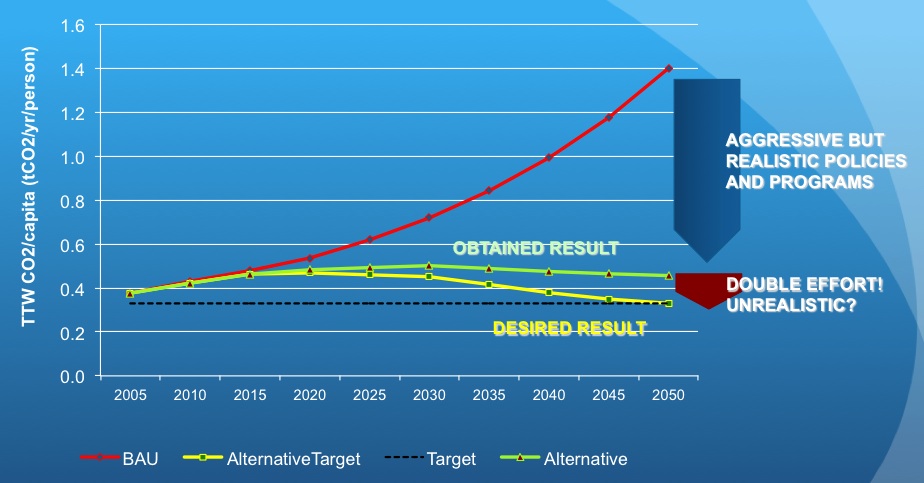 Graph of the result of backcasting for the Philippines using available transport data, policies and other information on various socio-economic and transport factors. (Image capture from the presentation by UP’s Dr. Regin Regidor)
–
Some updates on the AGT prototype and test site at UP
Passing by the test site for the Automated Guideway Transit (AGT) prototype at the University of the Philippines Diliman campus, you will notice the ongoing work on the construction of three platforms for the AGT. These are the latest improvements to the test track and I assume involves faculty members at the UP’s College of Architecture in the design (based on previous discussions pertaining to this project). Nevertheless, the station at Jacinto Street end of the test track already has a mock-up of a ticketing office and I learned from the staff there that there will also be turnstiles once the station is completed. These would allow for a simulation of passenger operations for the AGT system, which is part of the R&D for this locally-developed transit system.
We were back at the AGT test track last Monday to show the prototype and related works to Prof. Fumihiko Nakamura, Professor and head of the Transportation and Urban Engineering Laboratory at Yokohama National University. He is also currently the Dean of YNU’s Institute of Urban Innovation. Prof. Nakamura is an expert in public transportation and has done extensive work on bus and bus rapid transit (BRT) systems. He was Visiting Professor at the Asian Institute of Technology in Bangkok, Thailand as well as at the Pontifical Catholic University of Parana in Curitiba, Brazil. Previously, we have taken other Japanese professors to visit the site and have a first-hand look at the AGT prototype. These include Prof. Tetsuo Yai, Dr. Daisuke Fukuda and Dr. Hirata of the Tokyo Institute of Technology (Tokyo Tech).
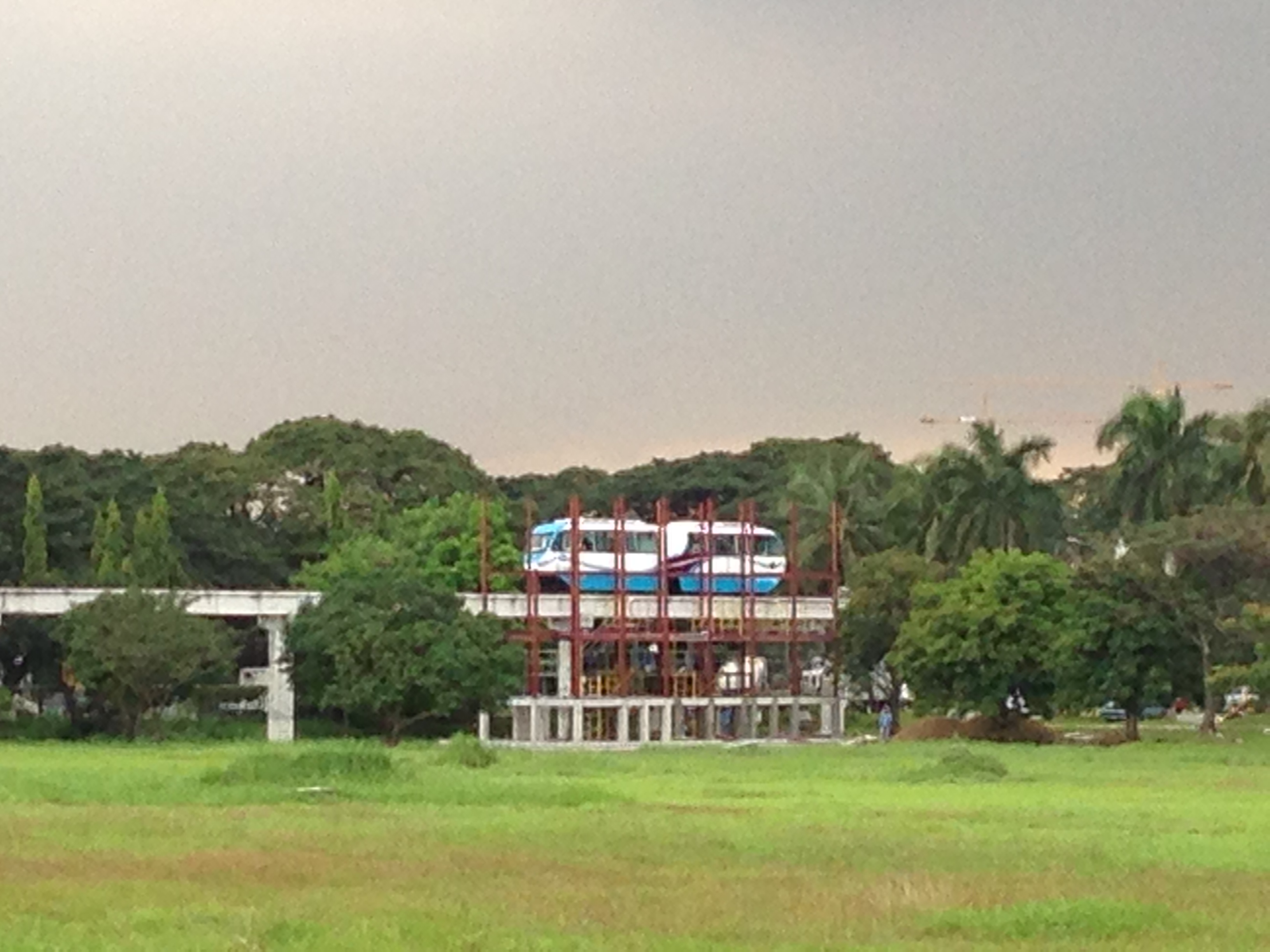 Prototype AGT stopped at the University Avenue end of the test track, where a platform is currently under construction.
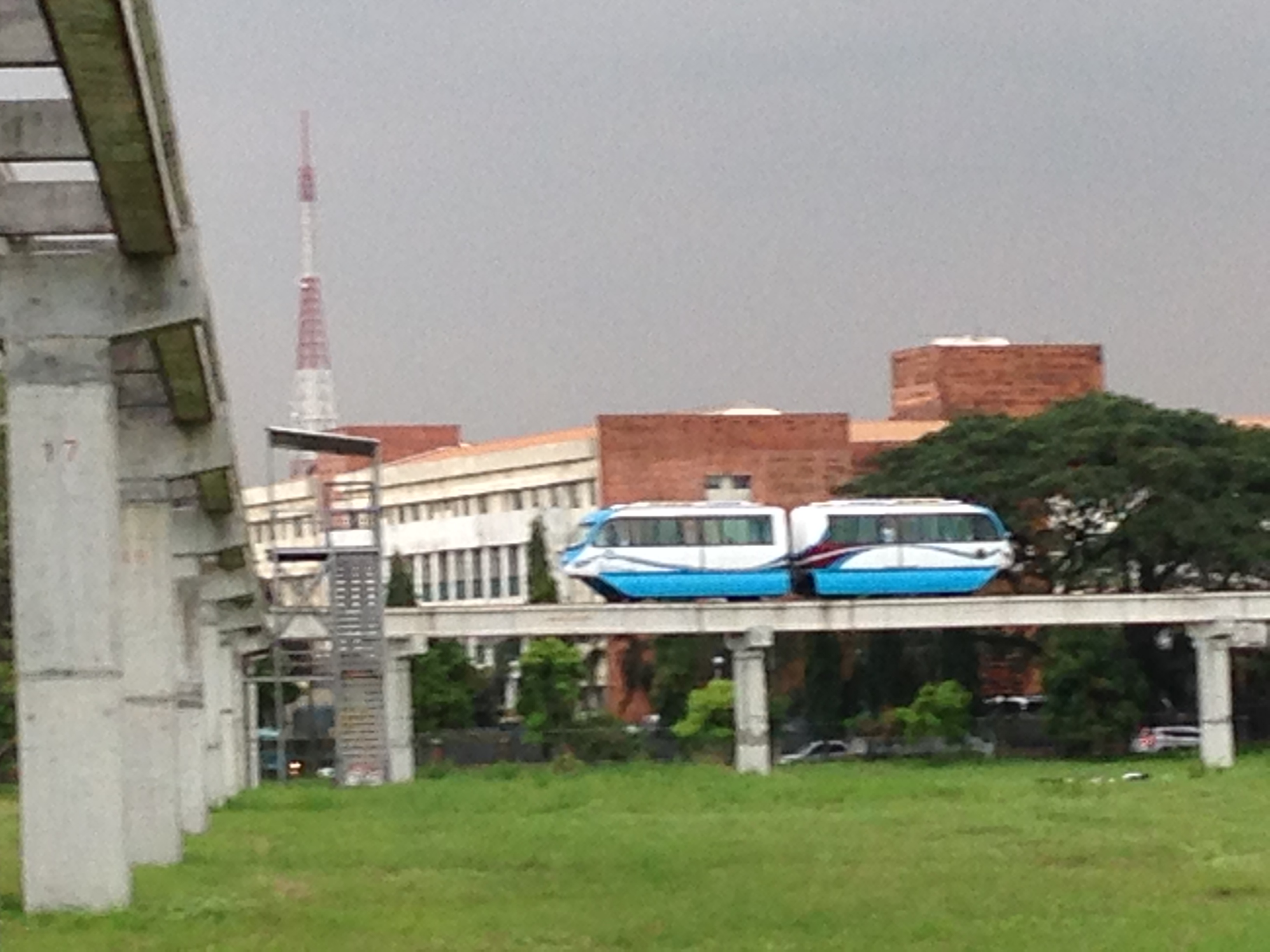 Prototype running along the test track with the photo also showing the unfinished platform at the midpoint of the track. On the background is the CHED building.
 AGT running along the test track towards the Jacinto Street end of the line.
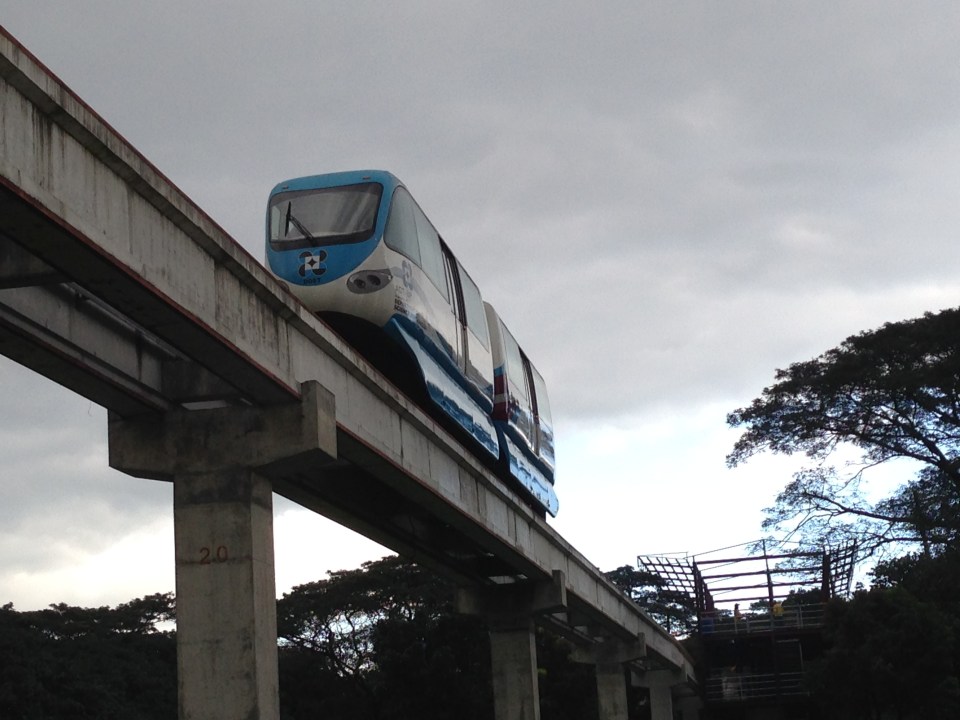 AGT leaving the Jacinto “station.” In the photo is the station under construction near Jacinto Street and the entrance to the College of Fine Arts and Veterinary Hospital.
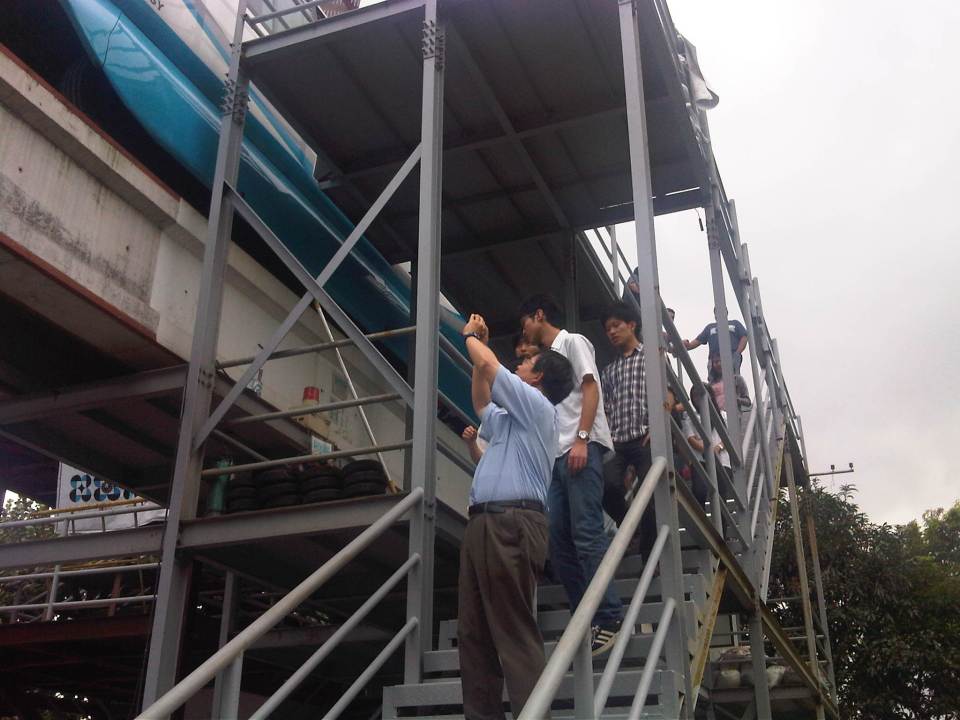 Our guests, Prof. Fumihiko Nakamura, Dean of the Institute of Urban Innovation of Yokohama National University, and his students rode on the prototype and took photos of the ongoing work at the Jacinto station platform.
 The Jacinto Station will have a ticketing station and turnstiles to simulate passenger operations. These were demonstrated last year during the test runs conducted in conjunction with the UP Diliman Lantern Parade.
The prototype is now being run at faster speeds (30+ kph?) and this was noticeable for me considering I have taken the test runs several times already including the initial ones when the vehicle was only topping 10 kph. Unfortunately, other tests/assessments have not performed yet including those for stability that will be critical to ensure the safety of the system for actual use. We look forward to the succeeding work including the determination of the AGTs suitability for application along several alignments/corridors identified by the DOST. There is also the current work on another test track at the MIRDC compound in Bicutan, Taguig where they hope to test a larger AGT vehicle. I hope to see that one soon…
–
On data requirements and requests from the NCTS
The National Center for Transportation Studies of the University of the Philippines Diliman regularly gets a lot of requests for transport and traffic data. Most of these requests are quite specific for traffic counts along various roads. In many cases these are national roads but there are also requests for data on local roads. While the center has a library and laboratories where data and other information are available, most of those we can provide for public consumption may be quite dated and would need to be validated or updated. In certain cases, data were derived from our projects with private entities and we are not at liberty to share these without the permission of our clients. Many of these information are covered by non-disclosure agreements since these may be sensitive information or may lead to revealing projects that are still in the pipeline and which clients might prefer to keep to themselves at the time for one reason or another.
The best we could do for data requests would be to refer them to the sources or those who are supposed to collect data first-hand. For traffic counts along national roads, for example, the Department of Public Works and Highways (DPWH) publishes data on Annual Average Daily Traffic (AADT) for sections of national roads throughout the country. Most if not all these counts are made through manual surveys. That is, a team of surveyors literally count the number of vehicles according to categories set by the DPWH as they pass along specific road sections. Complacency, however, coupled with varying degree of quality control or supervision for manual counts can lead to erroneous data. Also, in several cases, one colleague allegedly was able to spot some trending that led him to conclude that some counts are actually projections from previous years rather than those derived from actual counts that should have been performed! It is highly recommended for researchers to make representations to the DPWH District Engineering Office where their study area or site is located or perhaps contact the many bureaus under the department (e.g., Bureau of Construction, Bureau of Design, Bureau of Maintenance, etc.) for other types of information.
Another source for transport data is the Land Transportation Office (LTO), which has information on vehicle registration and licensing. Unfortunately, not all of these data are published or readily available to researchers. Also, specific data requests (e.g., vehicle engine age, fuels, demographics of licenses drivers, etc.) are not easily accessible and may require time to process. In the past, we have also had first hand experience of the private IT company under contract with the LTO suggesting a fee for data processing. For public transport, the primary source would be the Land Transportation Franchising and Regulatory Board (LTFRB), which would have information on road transport routes, franchises, number of units of buses, jeepneys or taxis, etc. These agencies are under the Department of Transportation and Communications (DOTC), which also has several other agencies under it.
While most local transport and traffic data (e.g., number of tricycles and pedicabs, traffic along local roads, etc.) are with local governments, LGUs generally do not have up-to-date transport and traffic data. Only a few conduct regular data collection or will have recent data that would be useful for any meaningful analysis. Even big cities that have been recipients of transport studies have not been able to update basic data like traffic counts and travel speed along major roads. Perhaps the only updated information they would have are AADT for national roads (care of the DPWH District Engineering Office) and data on the number of public transport vehicles like buses, jeepneys and tricycles within their jurisdictions. AADT data from the DPWH are limited to few stations along national roads and there are none for intersections where counts per movement are important for analysis. Meanwhile, public transport operational characteristics are not generally measured so only the number of registered vehicles are known, basically from the LTO, LTFRB and the local tricycle franchising office. And so for very specific data on specific roads, for example, it is recommended that primary data collection (i.e., field surveys) be conducted.
Contrary to popular belief, the Center no longer has copies of reports of the more recent major studies or projects on transportation and traffic. The DPWH and the DOTC no longer furnish the NCTS library with copies of such reports and this limits the recent materials in our library that can be used by researchers for whatever purpose they may have. And so, the center will usually refer researchers to these and other agencies for data or reports that they need for the work they are doing. If the Center knows specific people from the agencies who are involved in the study or project or have worked on the data that’s subject of the inquiry/request then the researcher will be referred to those people.
–
Dissertation defense
After a series of posts on my recent travels, here’s something on the serious side:
The oral defense of the dissertations of Ph.D. in Civil Engineering (Major in Transportation Engineering) Program doctoral candidates, Mr. Ernesto B. Abaya (staff/affiliate student/ERDT scholar) and Mr. Alex S. Ladaga (affiliate student/CHED scholar) with topics on transportation & environment and traffic flow theory, respectively, will be on October 21, 2013 (Monday) from 9:00 AM and from 1:00 PM at the National Center for Transportation Studies. Details are shown below:
ERNESTO B. ABAYA
“DEVELOPMENT OF DRIVE CYCLES & ESTIMATION OF FUEL CONSUMPTION FACTORS OF LIGHT DUTY VEHICLES IN METRO MANILA”
21 October, 2013, Monday, 9:00 AM at the Toyota Training Room, NCTS, UP Diliman
Dr. Edwin N. Quiros (UPD-DME), Panel Chair
Dr. Hilario Sean O. Palmiano (UPD-ICE), Panel Member
Dr. J. B. Manuel M. Biona (DLSU-COE), Panel Member
Dr. Karl B. N. Vergel (UPD-ICE), Panel Member (Adviser)
Dr. Ricardo G. Sigua (UPD-ICE), Panel Member (Co-adviser)
Abstract: The urban drive cycles for five different light duty vehicles (LDV) are developed in this study. Furthermore, the fuel consumption factors for each of the type of LDV are estimated. The study presents the methodology in the development of the drive cycles in which the speed profile of the specific type of vehicle is surveyed, downloaded and processed. In the survey of speed data, a Global Positioning System (GPS) device is used as an on-board instrument. The GPS device is placed on the dashboard of every surveyed vehicle and it recorded instantaneous speed in its memory. The speed data is downloaded from the device using software provided by the maker of the device (Garmin) called Mapsource. The speed data is processed using a program to execute the methodology in generating candidate drive cycles. The program creates drive cycles by randomly appending microtrips to form a minimum of twenty minute speed time profile. Furthermore, along with the generated drive cycle, the program also indicated how it compared with the target drive cycle by computing their individual absolute value difference of their joint speed-acceleration probability distribution. Ten drive cycles for each type of LDV are developed which have absolute value differences less than 20%. The final drive cycle is selected from the ten (10) candidate drive cycle developed from each type of LDV. The selected drive cycles are then used in the Vehicle Research and Testing Laboratory at UP College of Engineering, Mechanical Engineering Department, to estimate the fuel consumption factors of each type of light duty vehicle considered. The developed drive cycles for the different types of light duty vehicles, namely (1) private cars, (2) taxicabs, (3) public utility jeepneys, (4) asian utility vehicles express, and (5) light cargo vehicles have average speeds of 17.97 kph, 13.57 kph, 10.87 kph, 14.69kph and 8.43 kph respectively. The fuel consumption factors estimated for all the light duty vehicles tested in the chassis dynamometer laboratory ranges from 9 to 12 km/liter.
Keywords: light duty vehicles, drive cycles, chassis dynamometer laboratory
—
ALEX S. LADAGA
“EFFECTS OF GAP FORCING ON THE CAPACITY OF TWO LANE ROUNDABOUTS IN THE PHILIPPINES”
21 October, 2013, Monday, 1:00 PM at the Toyota Training Room, NCTS, UP Diliman
Dr. Karl B. N. Vergel (UPD-ICE), Panel Chair
Dr. Jose Regin F. Regidor (UPD-ICE), Panel Member
Dr. Hilario Sean O. Palmiano (UPD-ICE), Panel Member
Dr. Ma. Sheilah G. Napalang (UPD-SURP), Panel Member
Dr. Ricardo G. Sigua (UPD-ICE), Panel Member (Adviser)
Abstract: Traditional method in estimating roundabout capacities using gap acceptance theory involves the assumption that vehicles entering the roundabouts give way to vehicles running along the circulatory road. Parameters usually used include the critical gap and the follow up times used by the entry vehicles. Gap forcing persists in local roundabouts and this common Filipino driver behaviour renders the existing models derived from traditional assumptions unsuitable for local applications. The study embarks on the development of the simulation model which takes into account gap forcing in the estimation of capacity of roundabouts in the Philippines. It explores the feasibility of introducing more realistic driver behaviour assumptions and the inclusion of additional parameters to come up with a model suitable for local use.
Keywords: roundabouts, gap forcing, capacity
—
How to cite social media
Given the popularity of internet sources among researchers (especially the less experienced ones) these days, there is a tendency for many to rely on online resources rather than put some effort to browse actual libraries for references such as hard copies of books and journals. Research supervisors usually allow this for cases when the online resource happens to be electronic or digital versions of published material. There are both formal and informal sources online for such published material including online versions of journals managed by reputable publishers like SpringerOpen and Science Direct and websites by researchers and research centers themselves like the Victoria Transport Policy Institute. These are rich sources of refereed/reviewed material that are highly recommended for any literature review that students and researchers need to do before embarking on any serious work.
Nowadays, however, there have been a lot of other material found online including those on blogs, YouTube video, Twitter, Facebook and email that have been gaining acceptance as valid references. For example, it is possible that an interview may be conducted through an exchange of emails or via the chat features of Facebook. Lectures or talks like the popular can be found on YouTube or at TED. As such, these materials should be cited properly in research work.
I found this article on “How to cite social media…” on Facebook and below is a graphic that provides a guide for social media citation:

Obviously, I deliberately posted this material on proper citations here to remind people using or intending to use material from my posts in their research or other purposes. It is also quite timely considering the news featuring a plagiarist (i.e., a person passing off someone else’s work as their own).
–
EASTS 2015 in Cebu
The Eastern Asia Society for Transportation Studies (EASTS) held its 10th conference recently in Taipei, Taiwan. I was supposed to go but another more important activity came up that required me to stay in Manila for the duration of the conference. It is my first time to miss an EASTS conference since I started regularly attending the conference in 2003 when the 5th conference was held in Fukuoka, Japan. Previous to that, I missed 3 straight – the 2nd held in Seoul, Korea, the 3rd that was also in Taipei, and the 4th in Hanoi, Vietnam.
I learned from friends and colleagues that the 11th conference will return to the Philippines after 20 years for the 21st anniversary of the society. While the inaugural conference was held in Manila in 1995, the 11th will be in Cebu in 2015. This is an exciting development for the Philippines, especially for those in the field of transportation including researchers and practitioners. In the past conferences, the host country is presented an opportunity to present more academic and practical papers than what are usually presented by the country when the conference is held elsewhere and participation is limited due mainly to limited resources for travel and accommodations overseas.
A friend posted a couple of images apparently taken from the presentation made by the delegation representing the Transportation Science Society of the Philippines (TSSP). I’m reposting these here as an early promotion of the conference in 2015.
 The iconic jeepney as mascot of the EASTS 2015 conference to be held in Cebu
 Logo for the EASTS 2015 conference in Cebu featuring the monument commemorating Magellan’s voyage that led him to the island in 1521.
–
Undergraduate research topics on Transportation at UP Diliman, 2013
Topics this year for undergraduate researches on transportation under the Transportation Engineering Group (TEG) of the Institute of Civil Engineering of the University of the Philippines Diliman are quite a mix. There are topics focusing on issues at the the UP Diliman campus, traffic signals, driver behavior, public transport, environment and aviation. Following are the current topics being developed and for implementation during this academic year 2013-2014:
- Development of a micro-simulation model for the UP Diliman College of Science complex
- Traffic impact analysis of new academic complexes in UP Diliman
- Study on parking supply and demand in UP Diliman
- Field testing of Smart Traffic Light, a video-actuated traffic signal system
- Pinoy driver behavior at uncontrolled intersections
- Characteristics of demand and operations of UP-Katipunan jeepneys
- Improving passenger flows at Metro Manila LRT/MRT stations
- Use of carbon footprint tool (TransCO2) to estimate carbon emissions and energy consumption of transportation measures
- Philippine air transport safety: analysis of incidents over the last decade
–
 Caught (up) in traffic