
Home » Road Safety (Page 26)
Category Archives: Road Safety
Mainstreaming the motorcycle taxi via current transport tech trends
The motorcycle taxi is common in Southeast Asia and it seems that bringing it to the next level means taking advantage of available technology to facilitate getting a ride. In the forefront is Grab, the company behind GrabTaxi and GrabCar, which is a similar service to the popular Uber. GrabTaxi facilitated getting a taxi and is already popular for being quite effective to many who have availed of the service. I am among those who have used GrabTaxi and so far has been satisfied with the service.
Recently, Grab had been in the news for a service it has been providing elsewhere and which also appeared on their app in the Philippines – GrabBike. I also saw this feature on their app and was curious about how they were able to go mainstream on this in the Philippines because motorcycle taxis (e.g., habal-habal) are basically illegal in most cities and are unregulated except by barangays or a few local governments where their services have been recognized. The Land Transportation Franchising and Regulatory Board (LTFRB) ordered Grab to stop offering this feature of their services. It seems they haven’t done so as GrabBike is still there and the service very much alive.
 GrabBike feature on the old GrabTaxi App available in the Philippines
In fact, we tried to check if there was a GrabBike near our office and voila! There was one unit that appeared in our screen. I would bet that there would be more appearing on one’s screen if he/she happened to be in an area where there’s demand for motorcycle taxis services (e.g., Eastwood, BGC, Ortigas, Makati CBD, Cubao, etc.).
 GrabBike featured on Grab’s new look app
Motorcycle taxis are popular in the provinces and especially in rural areas not just because of the convenience they provide (easily hailed and can maneuver through congested roads) but because they are a necessity, being practically the only public transport mode available to people. The main issues against them in the Philippines are safety-related. Not all providers practice safe riding and most if not all are sure to have no insurance to cover their passengers in case they are involved in a crash. One cannot fully blame motorcycle taxi service providers for offering their services considering the traffic mess in many highly urbanized cities especially in Metro Manila. However, offering such services to the public means that service providers should bear responsibility for ensuring the safety of their passengers. This would basically be in the form of insurance and regulation particularly for fares they charge. I wouldn’t even go to the tax implications of the income they derive from their operations.
These services will no doubt continue to be offered, even clandestinely, as traffic conditions remain bad and continue to worsen. People will gravitate towards such services in order to reduce the travel times in their commutes. This is expected to happen as long as people perceive that nothing is happening to significantly improve transportation in this country.
–
The benefits of walking
I came across an old article on walking that appeared in The New Yorker in 2014. This was after reading another article my wife shared that also was about walking. One is about both the physical and intellectual benefits of walking while the other was about walking without a purpose. Both were about walking and thinking, and definitely about the benefits of even a short stroll to our physical and mental being.
Here’s the article from The New Yorker: Why walking helps us think
And the article from BBC: The slow death of purposeless walking
I highly recommend both articles as we ponder about making our cities safe for pedestrians/walking.
–
Tire conditions
While stopped at an intersection, my eyes wandered to look at the vehicles around me. I took a photo of the rear tires of a truck stopped beside me. Following are some observations about the tires:
- Most if not all the tires were re-treads
- Most of the tires are worn out
- One tire is already damaged and should not have been used in the first place

Such conditions of trucks’ tires reflect the state of many commercial vehicles in the country. The same observation applies to public utility vehicles. I guess there have been many instances of tire blow-outs involving trucks and jeepneys. These have not been reported as they often lead to traffic congestion (i.e., when a vehicle is forced to stop and block traffic), which is not at all an uncommon experience to many. Few perhaps have led to high profile road crashes featuring fatalities. Still, the potential for major crashes is there and it is contributory to disasters that are always just waiting to happen in many of our roads.
–
Endangering others by your behavior on the road
A major concern in road safety is the behavioral aspect that includes the attitudes of drivers and riders. Aggressive and irresponsible driving can be observed along many Philippine roads including low traffic roads along which there is a tendency for motorists to speed up. Social media contains many posts of videos showing reckless behaviour (e.g., vehicles zig-zagging along roads), placing other road users in danger with the possibility of crashes involving or influenced by these same vehicles. There are also posts of photos allegedly taken by speedsters boasting of the high speeds they are able to attain or cruise along on tollways and even regular roads.
Such behavior, however, may be influenced by strict and proper enforcement of traffic rules and regulations. I would like to believe that it it should be easier these days to determine if vehicles are speeding beyond the safe speeds roads are designed for. There are many tools such as speed guns or radars. However, these are few with the Metro Manila Development Authority (MMDA) having only two guns at their disposal. Operators of NLEX and SLEX are supposed to have their own speed guns and they have been apprehending speedsters as best they can. However, it seems that there are still many who are not apprehended and continue to pose as dangers to their fellow travelers. (I assume that those apprehended may also continue to speed up and do not get caught in most times they do.)
One creative approach for traffic law enforcement should be to browse social media of posts by people who claim to be running their vehicles at high speeds, violating road speed limits. Speeding is dangerous because drivers and riders will have less control over their vehicles and other elements affecting the vehicle. Perhaps the Land Transportation Office’s (LTO) enforcement arm should have an internet unit charged with searching for such cases online and investigate the identities of these people in order to flag them in the LTO licensing system?
 Example photo posted on social media where the driver boasts of his reaching high speeds while driving in a Metro Manila road.
–
Sudden intended acceleration? Intended ones are more dangerous!
The motoring community in the Philippines has been in rather heated discussions regarding the Mitsubishi Montero’s alleged defect that causes what has been termed as ‘sudden unintended acceleration’ or SUA. This term refers to the vehicle suddenly, and without the driver doing anything, rapidly accelerating, forward or backward, and hitting anything in its path. The proofs to these alleged incidences are supposed to have been documented by many including videos that have been uploaded to YouTube and even shared or used by mainstream media. The vehicle’s manufacturer itself denies that there is a defect in the model(s) being cited for SUA. They have also released a new model of the vehicle in the market and most people not paranoid about SUA seem not to mind the buzz about the alleged defect. The new model, after all, is supposed to be free of that particular defect considering the manufacturer, despite its denials, should have been aware of the complaints and concerns.
Defect or none, I think what’s more dangerous is not the ‘sudden unintended acceleration’ of vehicles. In fact, I am not aware of any fatalities attributed to this and all the videos I’ve seen alleging the defect happened in parking lots and driveways. These have caused only minor injuries and, surely, damage to properties. What is more dangerous and should be the concern by all is the intended acceleration leading to speeding (or over-speeding) that is so common in our roads regardless of whether these are expressways or city streets. Such behaviour are almost always intended and therefore the drivers are very much aware of their actions and in control of their vehicles. In control, that is, until they hit something or, worse, someone. Such irresponsible and often reckless behavior plague our roads and one person’s folly can be the doom of others as is usually the case in road crashes involving (over)speeding.
–
Helmet or no helmet when biking?
We were at the Department of Science and Technology – Philippine Council for Industry, Energy and Emerging Technology Research and Development (DOST-PCIEERD) this morning to help defend our proposal for a bike sharing system. UP Bike Share is an initiative coming out of a group of students from various programs in their respective colleges at the University of the Philippines Diliman.
One question that was raised among the technical panel to whom the proposal was presented for evaluation was concerning safety of people participating in the bike share. One panelist asked if cyclists were required to wear helmets. We replied that those participating in the bike share were not required to wear helmets and that despite helmets being available few, if any, borrowed the available helmets. I mentioned that there was an article I came upon before that stated the requiring people to wear helmets discourage biking. It seems a coincidence that as I browsed my Facebook just now, I found a link to that very same article I mentioned in a meeting earlier today:
To encourage biking, cities lose the helmets [by Elisabeth Rosenthal from The New York Times, Sunday Review, September 29, 2012]
The article makes a lot of sense especially the observation that requiring helmets seem to send the message that it is dangerous to bike. People associating danger with biking with helmets tend to opt out of biking. I recall that in Japan before, I didn’t have a problem biking in urban areas and helmets were not required. Of course, drivers of vehicles in are very admirable by the way they drive safely and respecting other road users’ right to the road. Instead of having a campaign to require helmets for bikers perhaps efforts should be focused on how to make our roads safer for all users including bikers and pedestrians.
–
Towards safer roads: design, respect and education
Fatal crashes involving cyclists have been posted in social media including a recent one involving a mother of two who was run over by a garbage truck that encroached on the on-street/painted bike lane in, of all places, Marikina City. Emphasis on Marikina is made here because it is a city well-known for its comprehensive bikeways network. The network is comprised of segregated and on-street bikeways.
Following are some photos showing examples of good and bad practices pertaining to bikeways design in the Philippines:

Example of segregated bikeway at the University of the Philippines Diliman campus. Cyclists actually share the carriageway lane allocated from the Academic Oval with pedestrians and joggers. They are not physically protected from motor vehicles that can encroach on the bike lane.

Example of segregated and protected bikeway along Marcos Highway in Pasig City (similar design for the sections in Marikina, Cainta and Antipolo) – bikeway is on the sidewalk and cyclists essentially share space with pedestrians despite delineations.

Example of segregated and protected bikeway/walkway along EDSA in Makati City – note that space to be shared by pedestrians and cyclists is very constricted.

Example of poor design along White Plain Avenue – the MMDA seems to have designated the entire sidewalk space for cyclists.
Three examples from Marikina’s bikeways are shown below:
 Painted, segregated bikeways on the carriageway on either side of a two-way road [Note: This is basically the design along the street where the crash in Marikina occurred.]
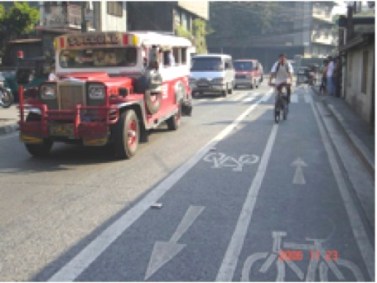 Painted, segregated bikeways on the carriageway along a one way road
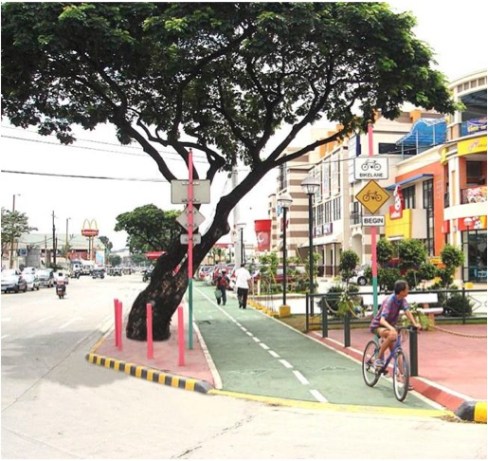 Segregated and protected bikeway off the carriageway along Sumulong Highway
Granted that the ideal set-up would have segregated or protected bikeways that are designed properly, we take a look at two other very important elements that are not at all as technical as design and planning of bikeways – respect and education.
Education is an important aspect of driving. Many Filipino drivers are poorly educated in terms of traffic rules and regulations, road design as well as local policies pertaining to transport and traffic. As such, there is a tendency for many drivers to disregard rules and drive/ride aggressively and recklessly. This must change and it starts with reforms in the way licenses are issued to all types of drivers including perhaps stricter certification systems for truck drivers and public utility vehicle drivers. Traffic education should also be integrated into the academic curricula of schools starting at a very young age. Road safety parks are one way to promote traffic education for kids.
Respect is partly derived from education but is also related to attitude. No matter how much driver or road user education or skill you get if you have a bad attitude, you will still have the tendency to be reckless or irresponsible with your actions on the road. One way to curb bad attitudes on the road and to educate road users (particularly errant drivers and riders) is strict traffic enforcement. Many cities already have CCTVs installed at major intersections that allow law enforcement units to be able to monitor traffic behavior and perhaps zoom in to determine driver and vehicle information including license plate numbers.
The crash that killed the single parent in Marikina is not so much as an issue one whether we need segregated and protected bikeways but is more an urgent need to assess the state of traffic education and enforcement in this country.
–
Articles on the crash and calls for reforms may be found in this link.
Common causes of crashes involving bicycles
I found a guidebook of sorts as I browsed one of my shelves for some references on public transport. It was something that I got from a seminar hosted by the Land Transportation Authority (LTA) of Singapore many years ago (I think in 2009.). The book contains tips for road users, whether motorist, pedestrian or cyclist. One page from the guidebook provided a list of common causes of accidents involving pedal-cyclists.

The page is practically a checklist for cyclists – reminding them of items that they need to keep in mind when traveling. In Singapore and elsewhere, there are rules for cyclists to follow in order to ensure safety on the roads. The assumption here is that other road users, especially motorists, will respect the right of cyclists. Each road user is expected to be responsible with his/her behavior whether as driver, rider, pedestrian or cyclist. Everyone is vulnerable and even the most safety conscious and careful road user may be involved in a road crash.
–
Another look at Iloilo’s main bikeway
Much has been written and said about Iloilo’s bikeways and particularly about the grander one built along the main highway that is Ninoy Aquino Avenue. This bikeway is already usable but is being extended along with the road widening works for the national road that connects major towns in central Iloilo province including Sta. Barbara and Cabatuan, which host the international airport. Here are some photos and commentaries on the bikeway.
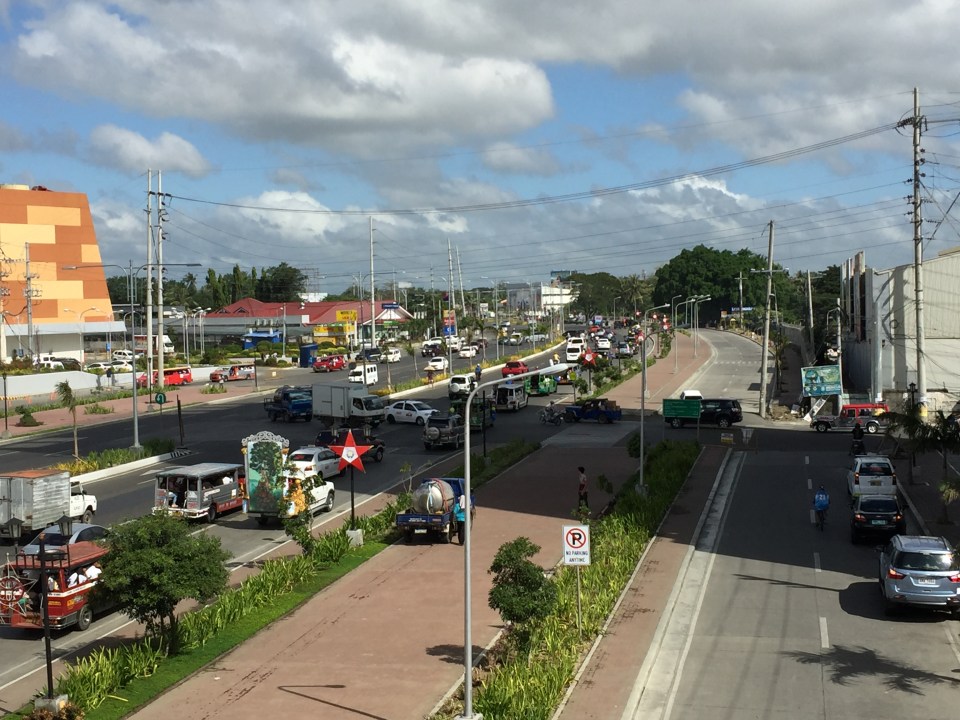 Iloilo City’s wide bikeway along Ninoy Aquino Ave (formerly the Iloilo Diversion Road) – the building on the left is SM City’s recently opened expansion. The photos were taken from the pedestrian overpass across the diversion road.
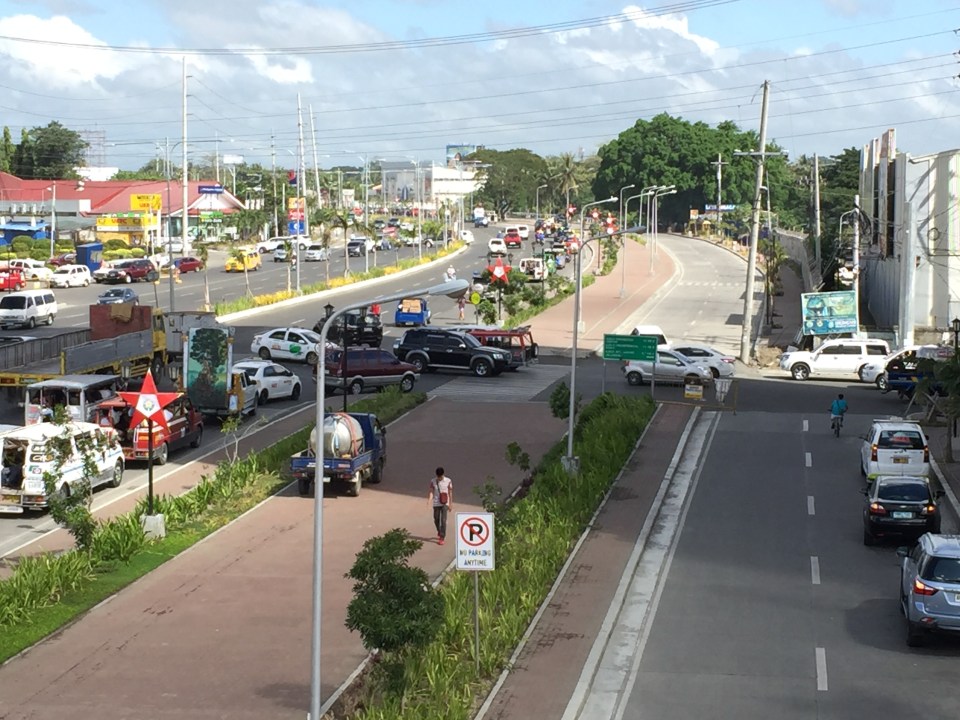 A closer look of the traffic conflicts at the intersection with Jalandoni Street – the 3-leg intersection is not as simple as it initially looks because of traffic coming from/going to the service road on the right. It is quite obvious in the photo that the alignment of the service road changes abruptly, affecting the trajectory of flow along the road.
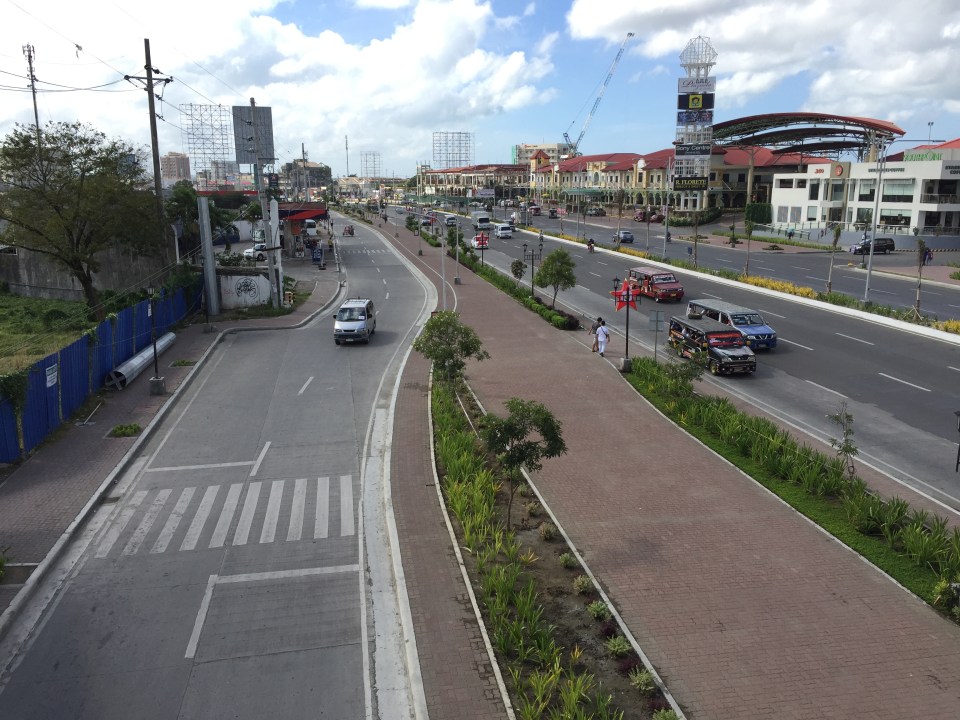 The photos were taken around 9:30 AM and there was practically no bicycle traffic to be seen. To be fair, perhaps there is significant bicycle traffic, particularly the commuting kind, earlier in the morning and later in the afternoon. Bicycle volumes need to be measured and monitored to determine if the bikeways indeed have encouraged more people to take up cycling as a mode for their regular commutes. That’s the Plazuela in the background on the right.
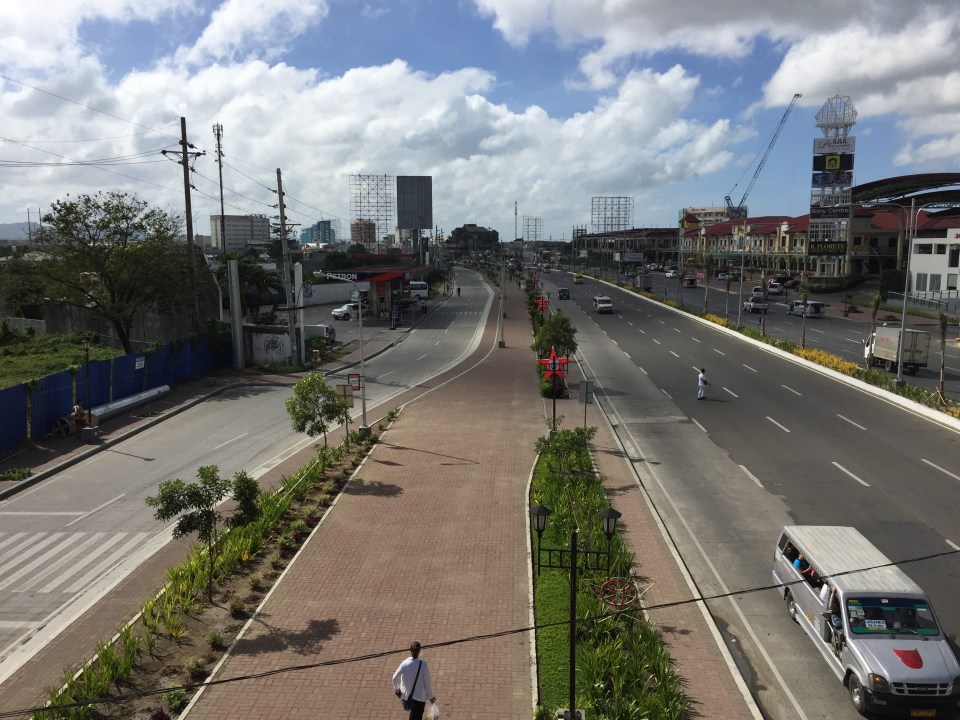 Another look at the bikeway shows it emanating from Iloilo City proper where it ultimately connects to the bikeways at the Promenade along Iloilo River. There are no bikeways within Iloilo’s CBD itself.
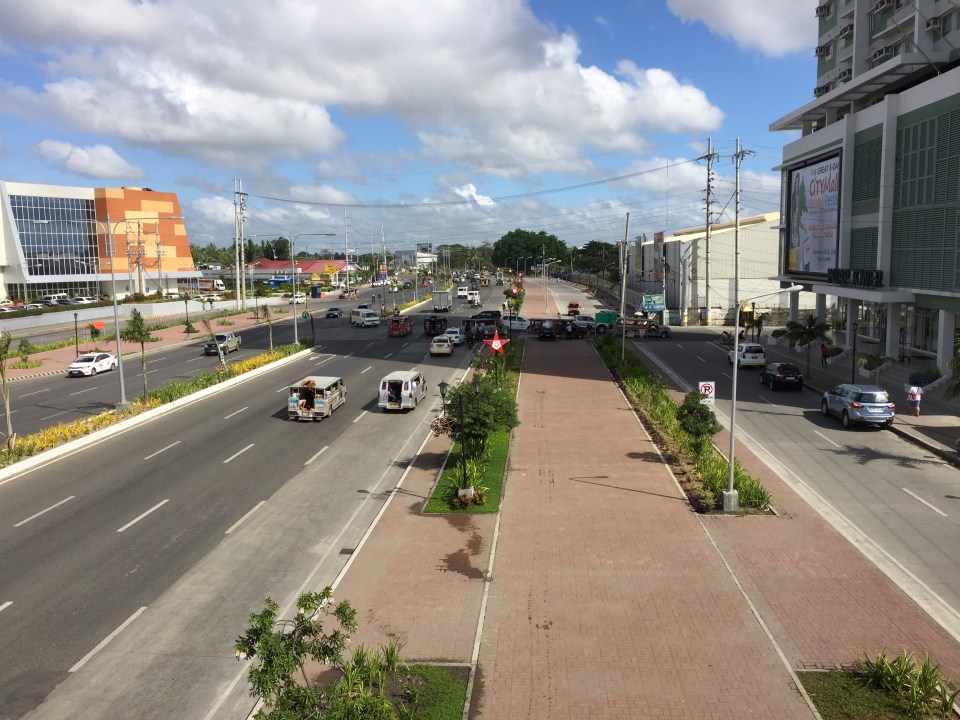 The photo above shows the bikeway and beyond (towards Jaro and Pavia) with the new SM annex at left and the Injap Tower Hotel on the right.
–
Tricycle fares in Antipolo City
Tricycles in Antipolo City practically have no defined or restricted areas of operations. Unlike other cities, say Quezon City or Manila, tricycle operations in Antipolo is practically free ranging. You can get a tricycle in Mambugan and ride it directly to the National Shrine of Our Lady of Peace and Good Voyage (Simbahan ng Antipolo); a distance of 8 to 10 kilometers depending on the route taken. As such, there has been a tendency for tricycle drivers to overcharge passengers even though fares were subject to negotiations and there have bee established average or usual fares for certain trips. Nevertheless, there have been and are still lots of complaints about tricycle fares in the city. This is evidenced from the queries posted on the city’s social media accounts.
This situation begs an important question on whether Antipolo City has official tricycle fare rates. The answer is yes, it does have official rates and this is stated under City Ordinance No. 2009-316. I assume that ‘2009’ here refers to the year the ordinance was signed into law by the City Council. Here’s a graphic from Antipolo City’s Facebook page showing official tariffs and warnings against negotiating fares as well as the maximum number of passengers a tricycle can carry.
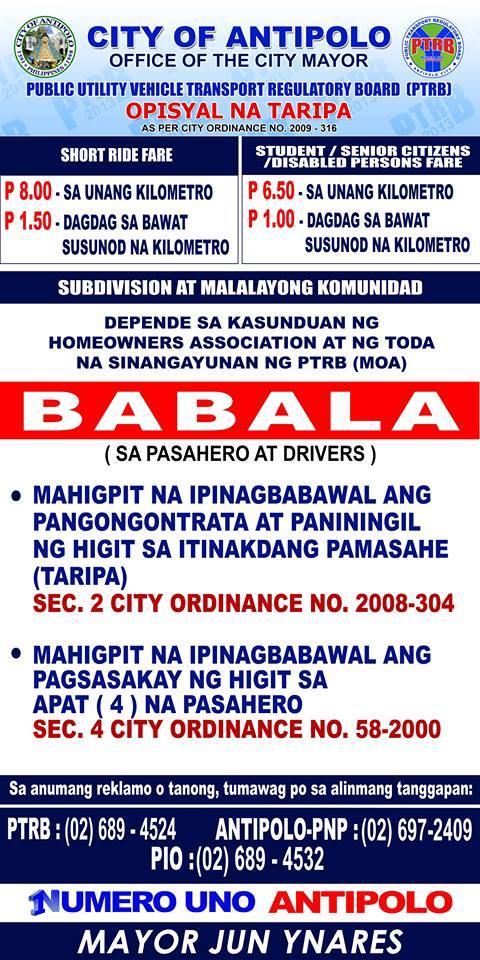 Tricycle fares based on official tariffs under City Ordinance No. 2009-316
Those two other ordinances seem to be among the most abused by tricycle drivers and likely very difficult to enforce considering the ranges of tricycles. According to netizens, many tricycle drivers still tend to negotiate fares for long trips and tricycles carrying more than 4 passengers is a common sight in the city especially tricycles that are used as school service vehicles. I tend to wince myself whenever I see a tricycle overloaded with school children negotiating Ortigas Ave Extension or Sumulong Highway. These are unsafe and put a lot of young lives at risk.
Below is an example fare matrix for tricycles posted at the New Public Market along Sumulong Highway and across from the new Robinsons mall in the same area:
 Illustrative fares to/from the New Antipolo Public Market
I think there should be similar information posted in other areas around Antipolo City. This is so that people will not be confused about the tricycle fares and so as to minimize the instances when tricycle drivers take advantage of passengers not familiar with trip distances and the fare rates.
The Antipolo City Government is working towards improving transport and traffic in this highly urbanized city. I think this should include regulating tricycle services so that the city could reduce their numbers along national roads like Marcos Highway, Sumulong Highway and Ortigas Ave. Extension. Tricycles have become a nuisance in traffic and not just for motorists but for cyclists and pedestrians as well. They shouldn’t be traveling long distances and along rolling and mountainous terrains. They tend to be noisy and, perhaps most problematic, are smoke belchers. Hopefully, this can be addressed in the next years as the city continuous to grow and become more progressive. This only means that the city should strive towards a modern, efficient and people & environment-friendly transport system.
–
 Caught (up) in traffic