
Home » Traffic Management (Page 15)
Category Archives: Traffic Management
Traffic mayhem in Antipolo
I had written earlier about traffic management in Antipolo City. My daily commute allows me to observe transport and traffic in this pilgrimage city east of Metro Manila. For a highly urbanised city (HUC), its traffic management is quite rural or provincial at best with enforcers trying to do their thing based more on gut feel rather than sound knowledge of traffic principles. Intersection traffic management, for example, needs a lot of improvement as enforcers are pre-disposed to apply the buhos approach to dissipating queues that actually lead to longer queues, tremendous delays to travellers, and therefore low levels of service (LOS) at the intersections. The signalised Masinag Junction is probably one of the worst intersections outside of Metro Manila with queues along the south approach (Sumulong Highway from Antipolo) stretching to Mambugan (about 2 km) even on a Saturday. Along the east approach (Marcos Highway from Cogeo) the queues can stretch all the way to Cherry Foodarama supermarket (about 1 km).
Masinag, of course, is a big intersection with heavy traffic due its being the junction for 2 major highways (Marcos and Sumulong) that collect much of traffic from Rizal and Marikina bound for the general direction of Quezon City and Manila. Marcos Highway is the main alternative corridor to Ortigas Avenue, which is itself a very congested road, between the eastern towns and Metro Manila. There are many other problematic intersections in the city, which are mostly unsignalized where traffic is managed manually by enforcers. I’m sure there are some minor intersections that are manageable at most times of the day and may not actually require enforcers if motorists give way to each other. However, there are those intersections that require stricter and more systematic (if not scientific) methods to manage traffic. For example, along roads leading to the Antipolo cathedral where there are a lot of people posing as parking attendants going over to aggressively engage motorists at the intersection. Enforcers routinely turn a blind eye to these people who pose as safety risks along the roads.
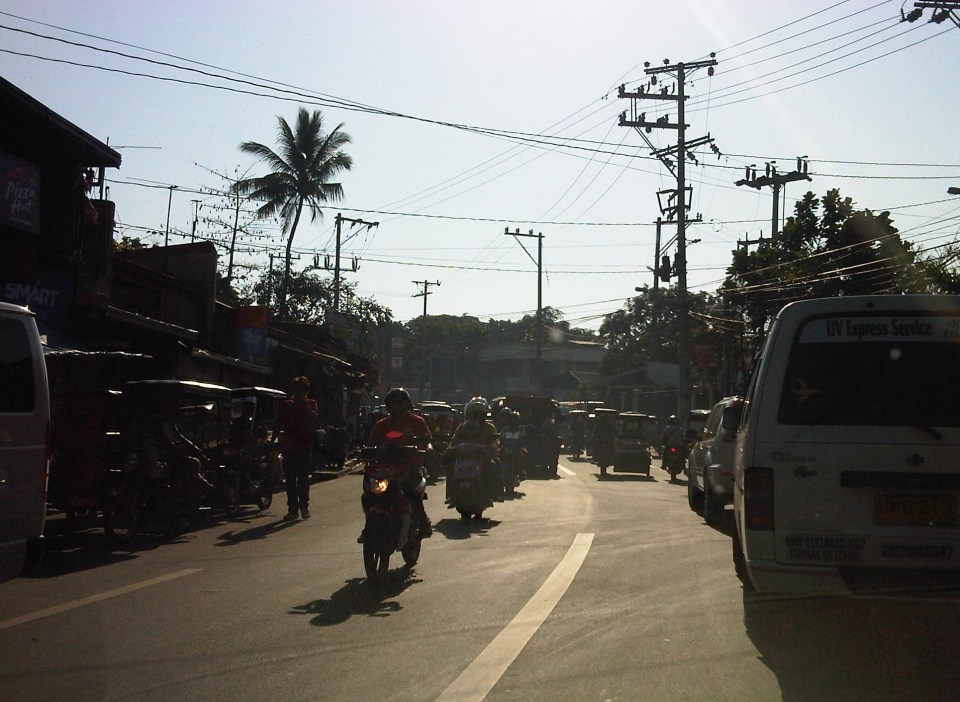 Tricycles occupying the outermost lane along Ortigas Ave. Ext. and Oliveros Street at the junction with Sumulong Memorial Circle and just across from the Rizal Provincial Capitol – to exacerbate the situation, jeepneys and UV Express vehicles usually stop in the middle of the road to load/unload passengers. Such informal terminals should not be allowed in these areas considering it is a chokepoint for traffic along these busy roads. So far, enforcers around the capitol seem oblivious to the mayhem caused by these terminals and turn a blind eye to the disruptive manoeuvres of tricycles in the area.
 Dangerous intersection along Sumulong Highway – there is road at the right (where a tricycle is coming from) that is used by trucks and other vehicles coming from Marcos Highway. Olalia Road connects to Marcos Highway and there are many residential subdivisions along this road that generate the traffic to and from Marcos and Sumulong Highways.
More on Antipolo traffic soon!
–
More snippets of Manila streets
The City of Manila has always been fascinating from the perspective of transport and traffic due to the many peculiarities and contradictions you’ll find around the city. Here are a few more photos and some comments on the Manila’s transport and traffic.
 Pedestrian overpass along Espana Avenue right after P. Campa Street and just before Morayta Street. Most overpasses in Metro Manila are roofless so this overpass is an exception. Most roofless overpasses were constructed when Bayani Fernando was MMDA Chair and were made so to discourage vendors from setting up on the overpass. The roof, however, makes sense considering the high pedestrian traffic (mainly students) in this area, which is dubbed the University Belt due to the many universities and colleges located here.
 Another overpass in Manila, this time roofless, along Quezon Boulevard. Notice the large umbrellas in the photo? Under these are informal vendors who have set-up shop atop the overpass, effectively constricting pedestrian movement on the facility. Notice, too, the signboard bearing a message from the incumbent Mayor of Manila who happens to be a former Philippines President. The message in Filipino translates to “There’s hope for a New Manila.”
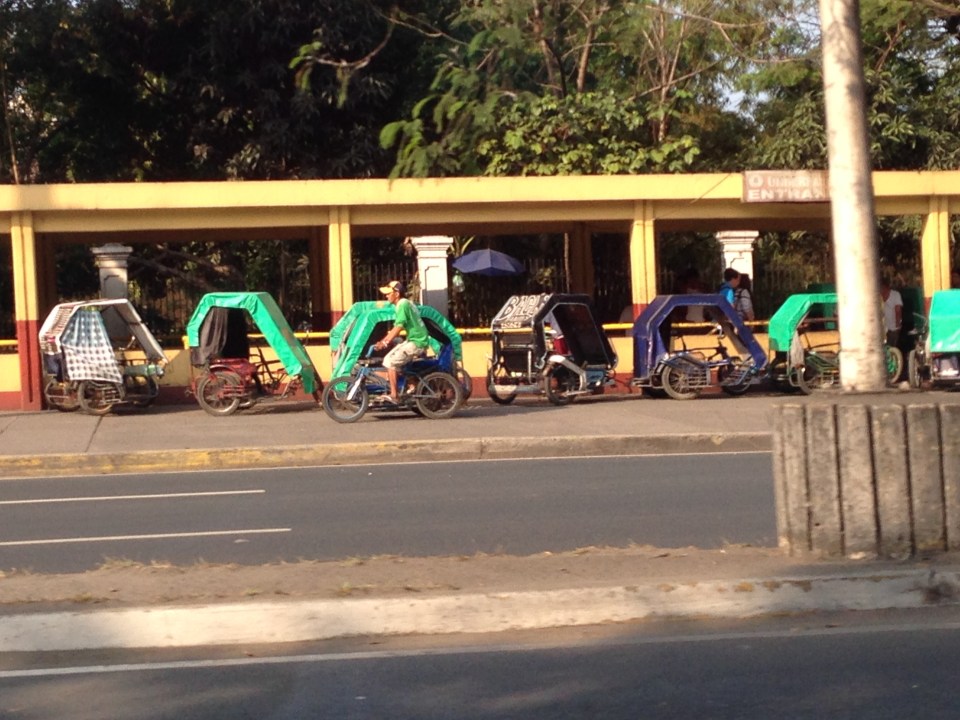 Non-motorized pedicabs proliferate in Manila and particularly in and around Intramuros, the historic walled city that was Manila during the Spanish period. There are just too many of these 3-wheelers in this city and most if not all drivers are oblivious to traffic rules and regulations. In Intramuros they have narrow streets and most destinations of interest don’t really require a vehicle. Walking is the most suitable transport within the walled city. These pedicabs are quite peculiar for a district that is supposed to be walkable and very accessible to public transport along its main streets. Manila has tolerated (some say spoiled) the operators of these vehicles and has made “livelihood” as the standard excuse for their existence and proliferation especially in low income areas of the city.
 There are a lot of “tambays” or people just loitering around or spending (wasting?) time in the open spaces near and at the Liwasang Bonifacio just across from the Manila Central Post Office and Manila City Hall. Many of these are homeless people that the city as well as the Department of Social Welfare and Development (DSWD) have not attended to. Their presence are just too obvious to passers by and mingling among them if not they themselves are snatchers, muggers and other unwelcome elements of our society. The tarpaulin is placed over a sign stating trucks are prohibited from using Roxas Boulevard. The new truck policies in Manila have been a hot topic since early this year but everything now seems to be back to “normal” after somewhat spirited reactions from truckers that again exposed issues pertaining to the traffic impacts of the Port of Manila.
–
Traffic consultants for Philippine cities?
I was driving to the office one morning, and as I was slowing down to stop at the Masinag junction I spotted a familiar face giving instructions to Antipolo traffic personnel. Robert Nacianceno was formerly the General Manager (Undersecretary level position) with the Metropolitan Manila Development Authority (MMDA) when it was chaired by Bayani Fernando, the first MMDA Chair to gain a cabinet level post (previously the MMDA Chair was not a Secretary level position). He was in an office barong while leading Antipolo staff in positioning orange traffic cones to mark the lanes for turning traffic along the Sumulong Highway approach from Antipolo.
Nacianceno is a cyclist so I would like to think that he can take that perspective in transport planning and traffic management for Antipolo. Unfortunately, his track record at the MMDA does not provide strong evidence as to his competence in transport planning or traffic management. Insiders say most policies and schemes during BF’s time was the latter’s ideas (e.g., U-turns, bike lanes, etc.) and he had his own consultant (and reportedly an inner circle) for various matters including traffic. In fairness to the man, Nacianceno probably has tremendous experience on the job but one has to note that there were other people with the MMDA who also dabbled in transport and traffic. Also, as GM he had other things to attend to during his stint including waste management and flood control.
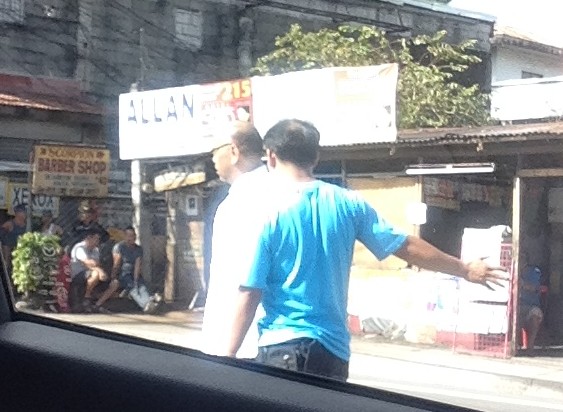 Remember this guy? He used to be the MMDA GM during BF’s stint at the agency.
I recall that the previous traffic consultant of Antipolo City was also a former MMDA official, Ernesto Camarillo. Unfortunately, I couldn’t say that Antipolo traffic improved during the last few years. Based on what I have seen in my daily commute, transport and traffic conditions have degenerated. Antipolo is overrun by tricycles and people generally do not follow rules and regulations. Informal terminals dot the city and you don’t have to go far to find inappropriate terminals as these are in plain view and across from the Rizal Provincial Capitol. Antipolo has a new mayor in the former Rizal Governor and his mother now sits as governor of the province. I’m crossing my fingers as to how they will improve transport and traffic in Antipolo if there is really a desire to do so. For starters, is there a transport and traffic plan for this Highly Urbanized City (HUC)? There should be one as the city needs it badly together with a land use plan to bring some order in development.
Antipolo is rapidly developing but at the same time conditions (including traffic) are also rapidly deteriorating. Hopefully, the LGU will address these issues and eventually make this city a modern one and fit for its being an HUC as well as a popular pilgrimage site for decades if not centuries due to the Shrine of Our Lady of Peace and Good Voyage (Is there some irony here?). Nacianceno’s work has just started and I hope he is up to the challenge of bringing order to Antipolo’s chaotic transport and traffic situation. I hope, too, that he will take note of good practices in other cities (Philippine or foreign) and won’t be relying purely on his experiences in Metro Manila. And hopefully, whatever improvements from the traffic schemes he will be introducing and implementing will be felt immediately by travellers. Good luck!
–
Quiapo traffic
Fridays in Manila are associated with Quiapo and the devotion to the Black Nazarene. People flock to Quiapo Church to hear Mass or pray at the Basilica, which is arguably among the most popular for Roman Catholics. Fridays are regarded as feast days dedicated to the Black Nazarene and since many people go to Quiapo Church throughout the day, there is almost always traffic congestion in the area. These days, however, any weekday is a congested day in that area what with more vehicles and more people coming to this area or just passing through.
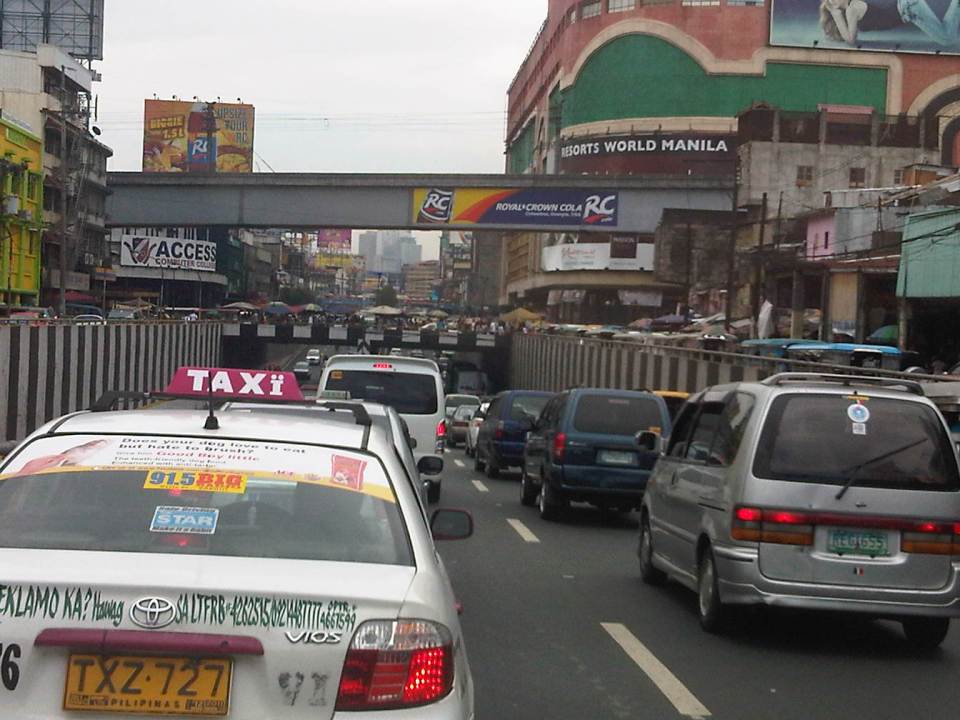 Espana Avenue ends at its junction with Quezon Boulevard and turning left leads the traveler to the Quiapo District. The photo shows heavy traffic along the underpass and the elevated LRT Line 2.
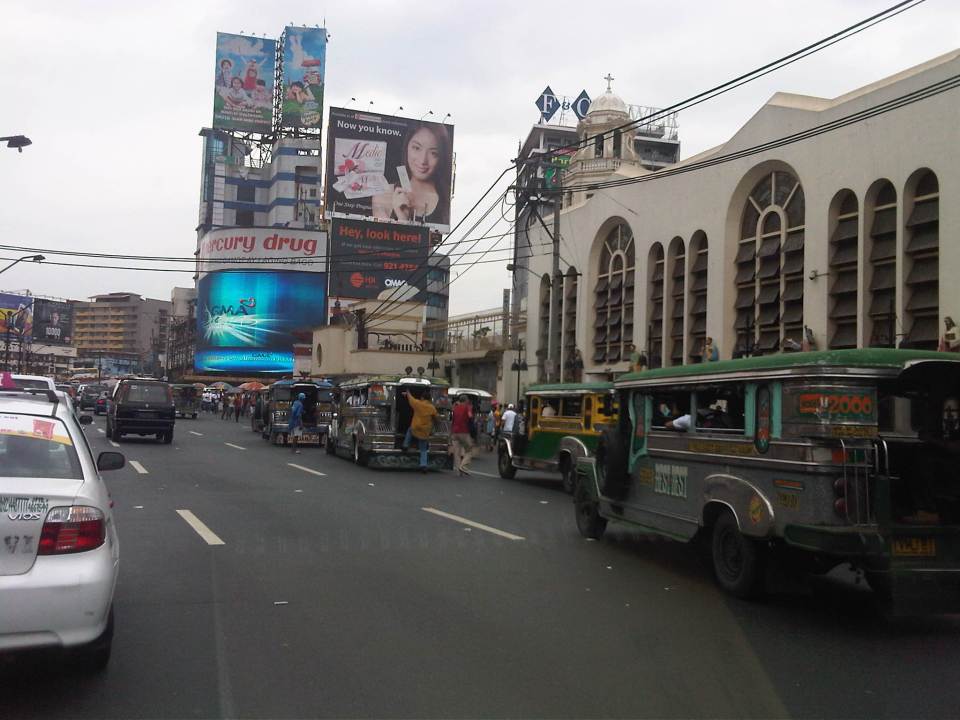 Quiapo Church is just beside Quezon Boulevard and jeepneys loading and unloading passengers occupy up to 3 lanes nearest to the church.
 There is a door at the side of the church along Quezon Boulevard and people seem to be everywhere even the middle of the road as they walk or wait to ride a jeepney.
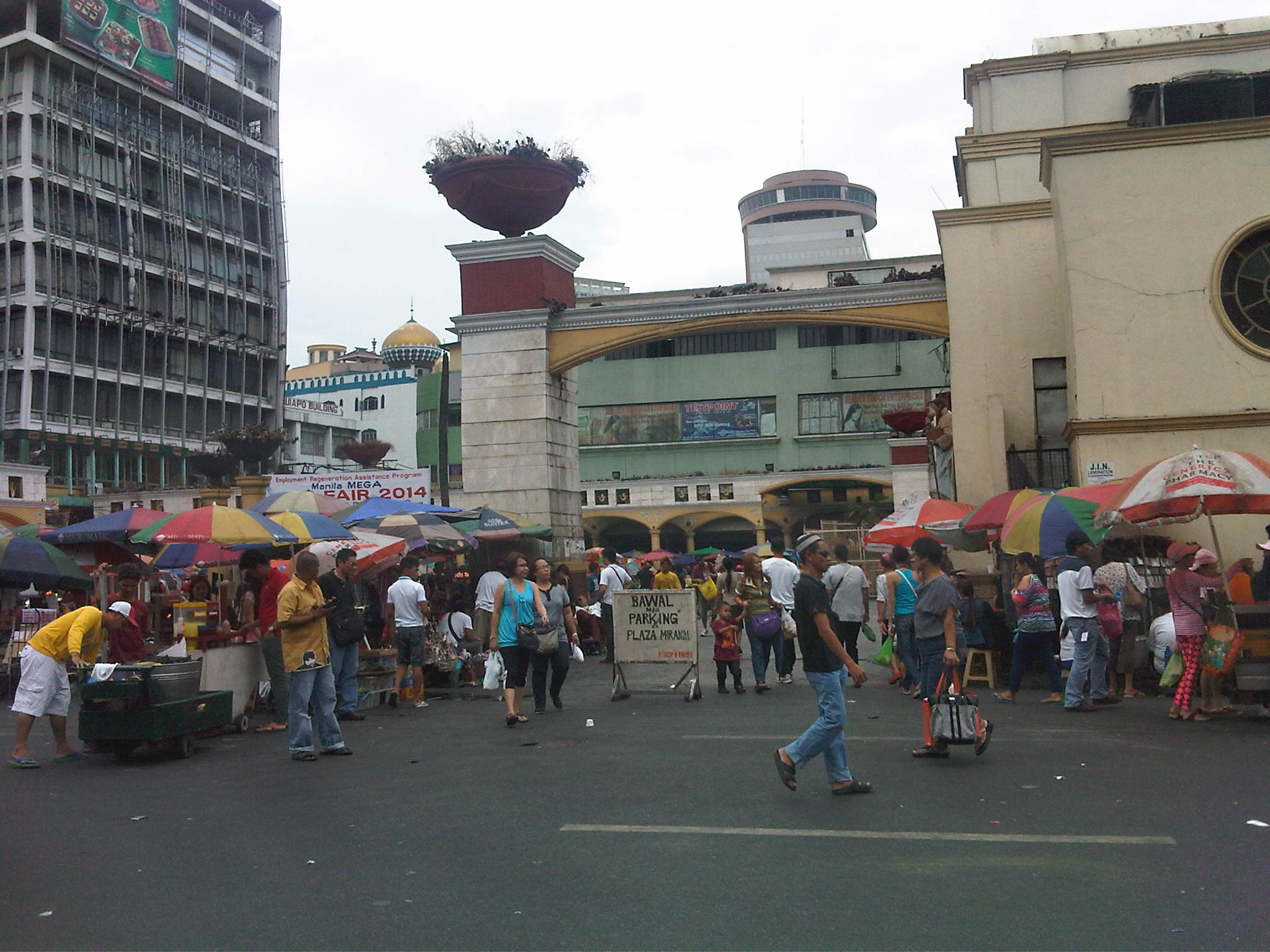 Historic Plaza Miranda in front of the church is witness not only to a lot of the frenzied processions during the feast day of the Black Nazarene every January. Plaza Miranda has also been a venue for many political rallies including the infamous one in the early 1970s that was among the triggers for Martial Law. On “normal” days, the plaza is home to vendors, fortune tellers and other denizens of this area.
There are other popular churches around Metro Manila that attract a lot of people throughout the year and not just during feast days. Among these are Baclaran in Pasay City (Our Lady of Perpetual Help), St. Jude in Manila, Sto. Domingo in Quezon City, San Agustin and the Manila Cathedral in Intramuros, Manila. Nearby in Antipolo is the Shrine to Our Lady of Peace and Good Voyage. These churches are among the busiest especially on certain days of the week (e.g., Wednesdays are for Baclaran, etc.) and with the coming Holy Week, a lot of people are again expected to flock to these churches for the Visita Iglesia tradition. Hopefully, these devotions are really a manifestation of faith rather than the pretentious kind where the road trip is more touristy than religious or prayerful.
–
“Sharing the road” – bandwagons and fads? Let’s hope not!
There seems to be a lot of talk about “sharing the road” and the initiatives to have more bikeways. I hope I am proven wrong but it seems to me as if these current programs and projects are more of a fad. A lot of people (and local governments) join the bandwagon with little understanding of what needs to be done. It’s usually because of the good PR they get out of these that they agree to coming up with the token carless street or the haphazardly implemented bicycle lanes. More than PR, some cities are aware of the opportunities that come with such initiatives as international agencies and groups are willing to spend money to support such programs and projects. The question really is on sustainability and doing the right thing not only on initiating things or coming up with programs but on the substance itself. And by substance I mean that programs should also go into the details of designs. Too often, the “pwede na yan” approach is taken and this just won’t do.
 The MMDA painted the sidewalks in White Plains and designated them as bikeways, in a way alienating pedestrians.
A vision for what people want to have is there but it is ultimately how the achieve the vision that needs a lot of work. For example, bills are being filed in congress to force the creation of bicycle lanes along major highways. (And mind you there are a lot of similar bills filed in congress that upon closer inspection actually have little substance.) The premise here seems to be that if you build them then people will start cycling. That was not the experience in Marikina, which boasts of the country’s only bikeways network that includes many off-street sections. These bikeways were built at a time when the perception and analysis pointed to a critical mass of cyclists in that city that was thought to be surely the tipping point in terms of non-motorised transport. Nowadays, the same bikeways are used by motorcycles and tricycles and most cyclists we see are not commuters (e.g., cycling between home and work/school) but recreational cyclists. It would take Marikina some effort to promote commuting by bicycles and much effort in enforcement to correct the misuse of the bikeways. The “new” bikeways in Quezon City appear to be poorly conceptualised as the MMDA decided to paint the sidewalks along EDSA northbound without addressing the obstacles like electric posts. Still, it is an effort to put NMT in the consciousness or awareness of the general public (thanks in part to media’s making these news worthy items).
Cities like Pasig and Taguig like to show-off Ortigas Center and Bonifacio Global City, respectively, as their faces when in fact the cities have not done much in their original cores. The running joke is that the real Taguig is not the areas to the west of C-5 but the old Taguig, which is to the east. This Taguig is the one plagued by narrow streets and the proliferation of tricycles. It was not so long ago that a former mayor imposed e-tricycles on BGC (where they were not suitable) while not doing much to lift a finger in the mayhem of tricycles in old Taguig (e.g., along Gen. Luna). As for Pasig, you just have go along the Pasig River and the Manggahan Floodway to see what it has accomplished so far in those areas.
There are no quick fixes to the transport and traffic problems our cities are facing. In the case of Metro Manila, much is at stake for the long-delayed mass transit projects. And the DOTC’s announcements of projects being formulated or proposed are no longer taken seriously as they have not delivered on any of these despite 4 years of this current administration. For other cities, it is important to learn the hard lessons from the experience of Metro Manila. There is also a need for a drastic change in transport and traffic policies in our cities. Iloilo, for example, has built an expensive bike lane along Ninoy Aquino Avenue (Diversion Road) and has marketed its Esplanade as a haven for pedestrians and cyclists. Yet the city has not acted on the clamour to revisit the overpasses along Gen. Luna (Infante and Jalandoni flyovers). The latest information I got from the city is that there are issues in the design of the bikeway along the Diversion Road as the surface (they used pavers) is not suitable for cycling. It seems, also, that the city and cyclists were not consulted by the DPWH when the bikeway was designed and constructed resulting in many cyclists using the Diversion Road itself for traveling. This last example is a lesson for our local governments and national agencies that they need to cooperate with each other and turfing has no place in transport and traffic if we are really serious about bringing solutions to problems we encounter everyday.
–
Snippets of Manila streets and traffic
Coming from a forum held at a hotel in Manila, I took a few photos of scenes along our route back to the university. These are snippets of everyday scenes in the Philippines capital city, which now has for its mayor the former President of the country who was ousted back in 2001 for allegations of plunder. He has been on the news quite frequently as his administration has introduced traffic schemes intended to address traffic congestion in that city. These include going after buses without terminals in Manila last year and quite recently an expanded truck ban that renewed discussions about logistics and the Port of Manila (i.e., decongesting the port in favor of Subic and Batangas ports).
 Traffic at the intersection of Bonifacio Drive, Roxas Boulevard and Padre Burgos Avenue. The trucks in the photo are coming from the Port of Manila and at the time this was taken, the window of the extended truck ban in Manila allowed these trucks to travel.
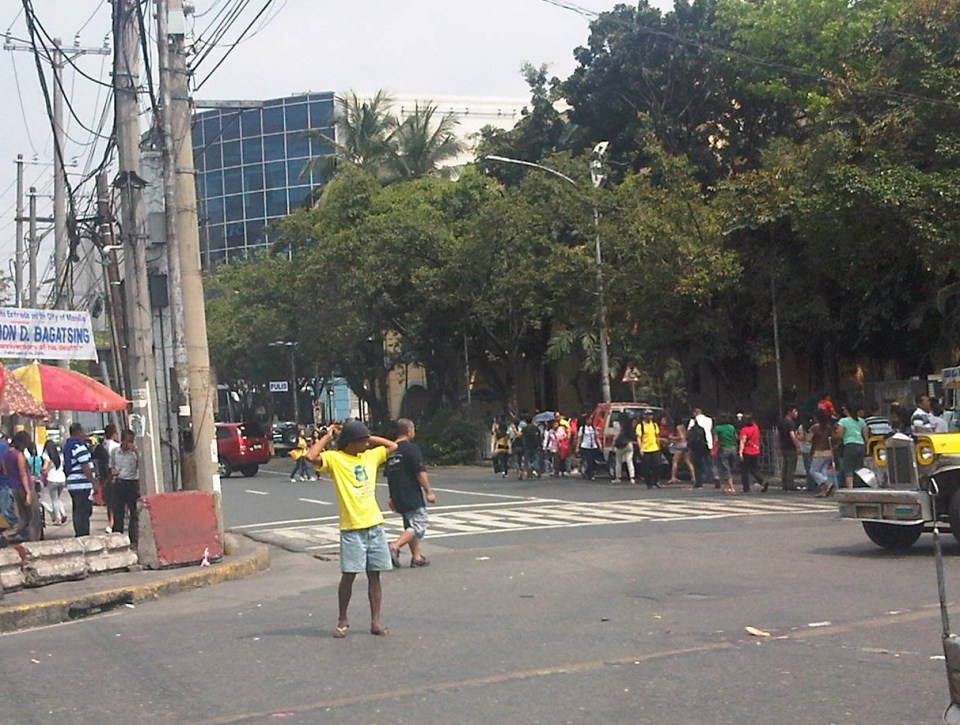 Barkers meet jeepneys head-on in the middle of the street just past Manila City Hall. A friend posted sometime ago that in Philippine streets, the uneducated dominate the educated and this seems so true in the case of public transport where barkers, paratransit drivers and their lot control how people should get a ride and how vehicles should operate.
 Organized mayhem – pedicabs run along most of Manila’s streets with many even traveling counter-flow. This photo was taken just across from the old, decrepit Metropolitan Theater just before the Quezon Bridge towards Quiapo.
 More pedicabs (also called padyak or trisikad), non-motorized 3-wheelers that notoriously violate traffic rules and regulations as they proliferate in many parts of the city.
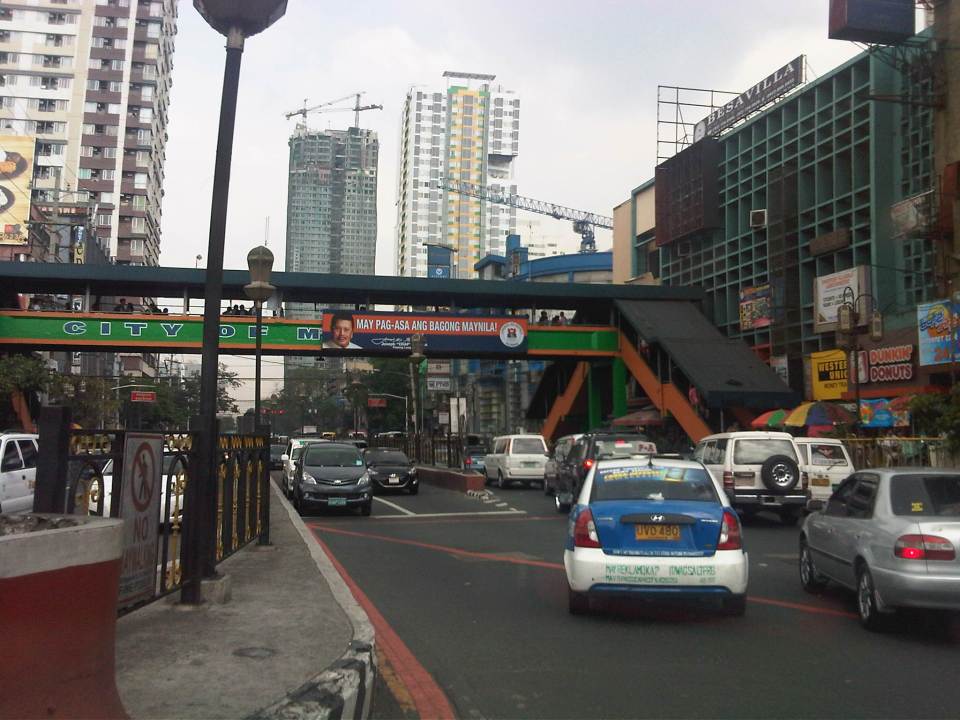 A sign stating “There’s hope for a new Manila.” with the face of former Philippines President Estrada, who was elected Manila Mayor last year.
 A modern public transport stop along the eastbound side of Espana Avenue shows a guide map and electronic message board that informs people who was responsible for the project.
 Another modern bus stop, this time just in front of the University of Sto. Tomas campus, which is along Espana Avenue.
 A side street to Espana Avenue reveals an on-street motorized tricycle terminal. There is a sign at the entrance to the street saying buses are not allowed along the road.
More on Manila in the next posts…
–
Transport and traffic purgatory, paradise and inferno
A lot of people have been referring to the traffic congestion and other derivative issues that will be the result of the construction of several transport projects around Metro Manila as “traffic armageddon.” Some friend have appropriately (I think) referred to it more as “car-mageddon.” This seems to be the case since it is perceived to have the most impact on car users than public transport users, cyclists or pedestrians. This is far from the truth as there are more people taking public transport, cycling or walking than those driving their own cars. In fact, estimates for Metro Manila indicate that 70-80% of travelers take public transport while 20-30% take private vehicles. These mode splits do not include bicycles or walking, which obviously will further decrease private car shares.
I would rather refer to this period of construction as a sort of “purgatory” though it has nothing to do with the cleansing that’s associated with it. There is still the suffering involved while improvements are being implemented. But, most importantly, there is hope at the end of this process. This “hope” is not necessarily the “light at the end of a dark tunnel” kind of thing as surely population and the number of vehicles will surely increase over time even as the transport projects are being implemented. By the time these are completed, there are sure to be more people, more vehicles, as well as more of other developments that will put our transport system to a stress test. We can only hope that the designs of these infrastructure we are building now are based on honest to goodness trip or traffic forecasts. Otherwise, we’ll end up with congested or saturated systems by the time they start operating.
Unfortunately, most projects mentioned and those we know have the green light and would likely be proceeding with construction in the near future are basically road projects. It’s ironic considering that what Metro Manila urgently, and maybe desperately, needs now are public transport systems including the much delayed MRT 7, LRT 2 Extension and LRT 1 Extension. The proposals for Bus Rapid Transit (BRT) seem to be in a limbo, too, despite extensive studies and surveys to support BRT along corridors such as Ortigas Avenue and Circumferential Road 5. These are blamed on institutional and legal impediments including allegations of shortcomings among officials of agencies responsible for these infrastructure.
I am aware of an initiative led by an environmental lawyer seeking to effect the redistribution of road space in favor of public transport users, cyclists and pedestrians. I think such actions are useful from the perspective of getting the attention necessary to push government and private sector players to have a sense of urgency not just in words but also in actions in as far as transport infrastructure programs and projects are concerned. We are already lagging behind our ASEAN neighbors with regards to infrastructure and at this pace, it is likely that less developed countries like Cambodia and Myanmar might just overtake us in the foreseeable future. From another perspective, it is hard to push for sharing the road when people really don’t have better options for commuting. Walking and cycling are not for everyone and many people have turned to the motorcycle to solve their transport woes. In the latter case, motorcycles are perceived as a vehicle that’s fuel efficient and allows the users to zip through congested streets often at high risks of being involved in a crash or spill.
We can only achieve “paradise” in our highly urbanized cities if we build these mass transit systems along with the pedestrian and cycling facilities that will complement each other. Those for whom car travel is a necessity would also benefit from reduced road congestion so it will eventually (hopefully) play out well for most people. Meanwhile, we would have to endure transport and traffic hell (some more and longer than others) as the government and private sector embark on this round of infrastructure projects implementation. It helps to look back at our experiences with the last major batch of projects in the latter part of the 1990’s when the number coding scheme was first implemented. At the time, it was implemented as a temporary measure to alleviate congestion while projects where being implemented. What was a temporary measure is now still being implemented along with a truck ban that has also been evolving the past years with the latest being the one implemented by the City of Manila starting last February 24. Will these vehicle restraint schemes be modified to cope with the traffic congestion expected from projects like the Skyway connector? Will these be relaxed or removed after all these projects have been completed? Your guess is as good as mine.
–
Manila’s truck ban experiment
The City of Manila has announced that it will implement a truck ban from February 10, Monday. Trucks of at least 8-wheels and 4,500kg gross weight will not be allowed to travel in Manila’s roads from 5AM to 9PM. Manila’s City Ordinance No. 8336 calls for the daytime truck ban in the city in order to reduce traffic congestion that is perceived to be brought about by trucks. 8-wheelers are likely 3-axle trucks with a 4-wheel, 2-axle prime mover pulling a 1-axle, 4-wheel (double-tired) trailer. I am not aware of the technical basis for the ordinance. Perhaps the city has engaged consultants to help them determine the pros and cons of this daytime truck ban. I hope it is not all qualitative analysis that was applied here as logistics is quite a complicated topic. And such schemes in favor of passenger transport (and against goods movement) actually creates a big problem for commerce due to the challenges of scheduling that they have to deal with. To cope with this ordinance, companies would have to utilize smaller vehicles to transport goods during the daytime. This actually might lead to more vehicles on the streets as companies try to compensate for the capacity of the large trucks that will be banned from traveling during the restricted period by fielding smaller trucks.
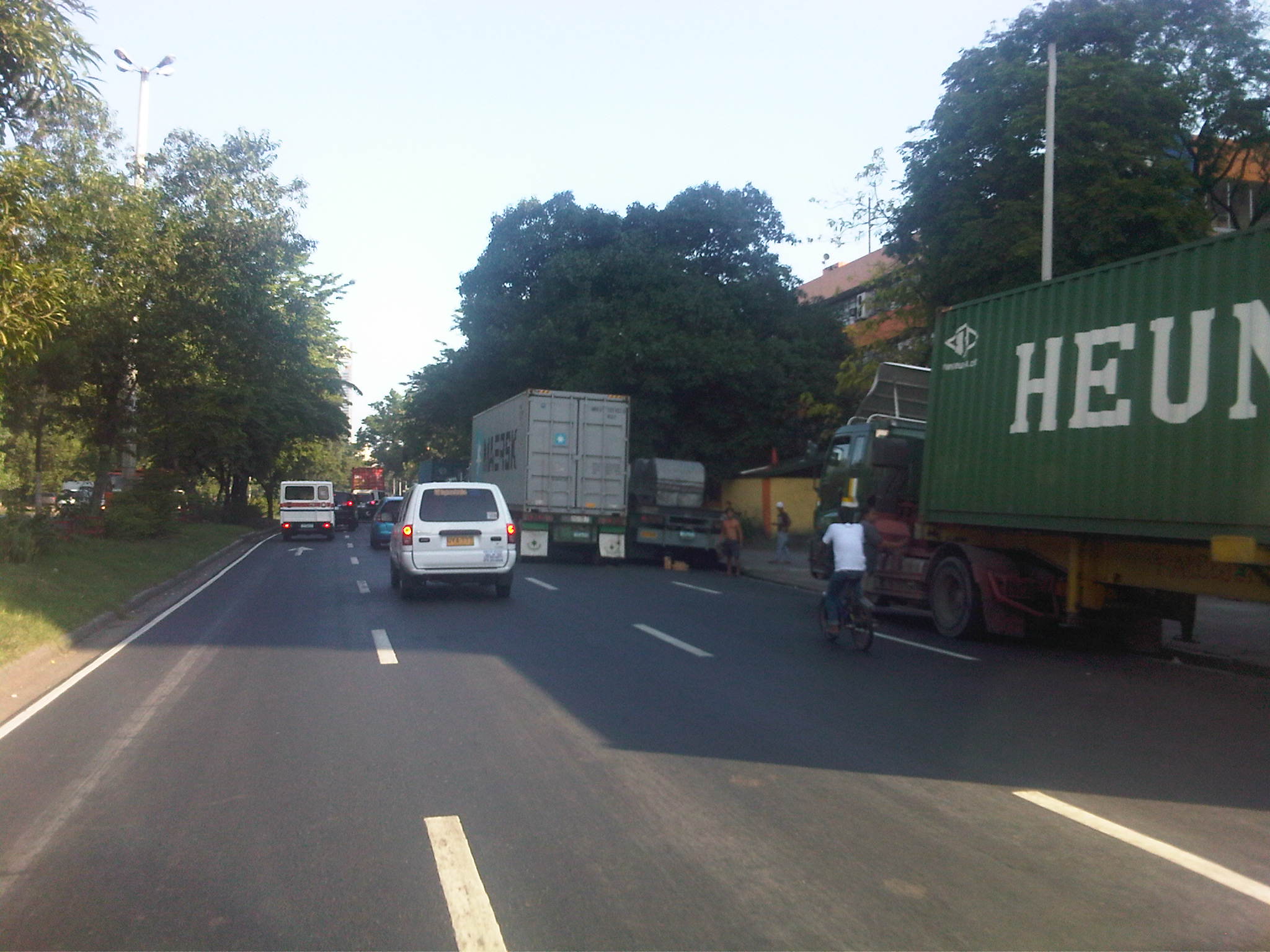 Trucks parked along Bonifacio Drive near the DPWH Central Office in Manila’s Port Area.
The latest word is that Manila has postponed implementation of the ordinance to February 24. This was apparently due to the reaction they got from various sectors, especially truckers and logistics companies who would be most affected by the restrictions. It was only natural for them to show their opposition to the scheme. Reactions from the general public, however, indicated that private car users and those taking public transport welcomed the truck ban as they generally stated that they thought trucks were to blame for traffic congestion in Manila. The truck ban will definitely have impacts beyond Manila’s boundaries as freight/goods transport schedules will be affected for the rest of Metro Manila and beyond. The Port of Manila, after all, is critical to logistics for the National Capital Region, and its influence extends to adjacent provinces where industries are located. Such issues on congestion and travel demand management measures focused on trucks bring back talks about easing freight flow to and from the Port of Manila to major ports in Subic and Batangas. There have been studies conducted to assess the decongestion of the Port of Manila as Batangas and Subic are already very accessible with high standard highways connecting to these ports including the SLEX and STAR tollways to Batangas and the NLEX and SCTEX to Subic. Perhaps it would be good to revisit the recommendations of these studies while also balancing the treatment of logistics with efforts necessary to improve public transport. After all, trucks are not all to blame for Manila’s and other cities’ traffic woes as buses are repeatedly being blamed for congestion along EDSA. In truth, there are more cars than the numbers of buses, trucks, jeepneys and UV Express combined. And the only way to reduce private car traffic is to come up with an efficient and safe public transport system. –
On high definition cameras to improve traffic enforcement and management
Watching the news one evening, I saw a report that featured traffic enforcers being caught on camera extorting money from drivers caught violating traffic rules and regulations. Extortion, “kotong” or “pangongotong” is not a new thing. It is actually a given to many motorist, particularly those who spend a lot of time on the road like drivers of public utility vehicles and trucks. In many cases, the enforcer or police officer is already or automatically assumed to be an extortionist even without the subtle suggestions via talk or body language. Motorists simply slip a bill with their license or in the form of a handshake to the apprehending officer. This, of course, translates into bribery, which is also a crime for both parties involved.
Traffic violations carry penalties in the form of fines that vary in amount depending on the violation. Usually, the amount is commensurate to the bribe or the “suggested” amount being extorted by the apprehending enforcer(s). In other cases, a larger amount is “suggested,” often to remind the erring motorist Of course, this assumes that the motorist is indeed guilty or in any case (guilty or not) didn’t want to waste time and opts for the perceived easy way out. However, there have also been cases when corrupt enforcers/officers meet their match in motorists who are aware of their rights and are knowledgable of traffic laws (e.g., lawyers, etc.) or are well-connected and simply show business cards of influential people (e.g., politicians, high government officials, police or military officers, etc.) to get out of a traffic bind. These instances actually reveal that many enforcers/officers are not so familiar with traffic rules and regulations so are unable to justify their apprehensions beyond their very basic knowledge.
The MMDA has made a lot of effort in trying to simplify the process of paying the penalties with the guilty party now being allowed to take the ticket and pay the fine through accredited banks within a certain grace period. Traffic enforcers can no longer take your driver’s license (Note: Only Land Transportation Office officers and deputized personnel may confiscate licenses.) and this eliminated the long lines of drivers at the MMDA offices to get back their confiscated licenses. This has also reduced the incidence of extortion as many private motorists can just opt to have tickets issued to by the apprehending officer. The latter is basically no longer allowed to collect money and contact time is also reduced. There is a grace period for the erring driver so he/she has to pay the fine within this period or else risk being flagged by the LTO itself.
The new camera system that the MMDA has in place is part of Phase 1 of its traffic signalization project. With this project, the MMDA hopes to upgrade the network of traffic signals in Metro Manila and have in place a dynamic, adaptive system to better address traffic circulation in the metropolis. This is actually a departure from a past program that was premised on the continuous traffic flow that was supposedly derived from U-turns masquerading as rotundas or roundabouts. Though the sensors and software for the traffic signal system are not yet in place, the MMDA already has a new traffic control center just across its building at the corner of EDSA and Orense Street in Makati City, from where they can now monitor traffic conditions using high definition cameras installed across the metro.
Davao has been in the forefront of using such high definition cameras for traffic management as well as for monitoring the behavior of traffic enforcers and motorists. Their traffic management center has been operational for the past few years and I’ve had the chance to have a look at how the city is able to monitor traffic conditions in that city. With this tool, they are able to address issues by deploying personnel on sight or by changing the setting of traffic signals. In certain cases, they can watch out for incidents like road crashes or monitor apprehensions to make sure both apprehending personnel and erring motorists are honest and no anomalies are encountered.
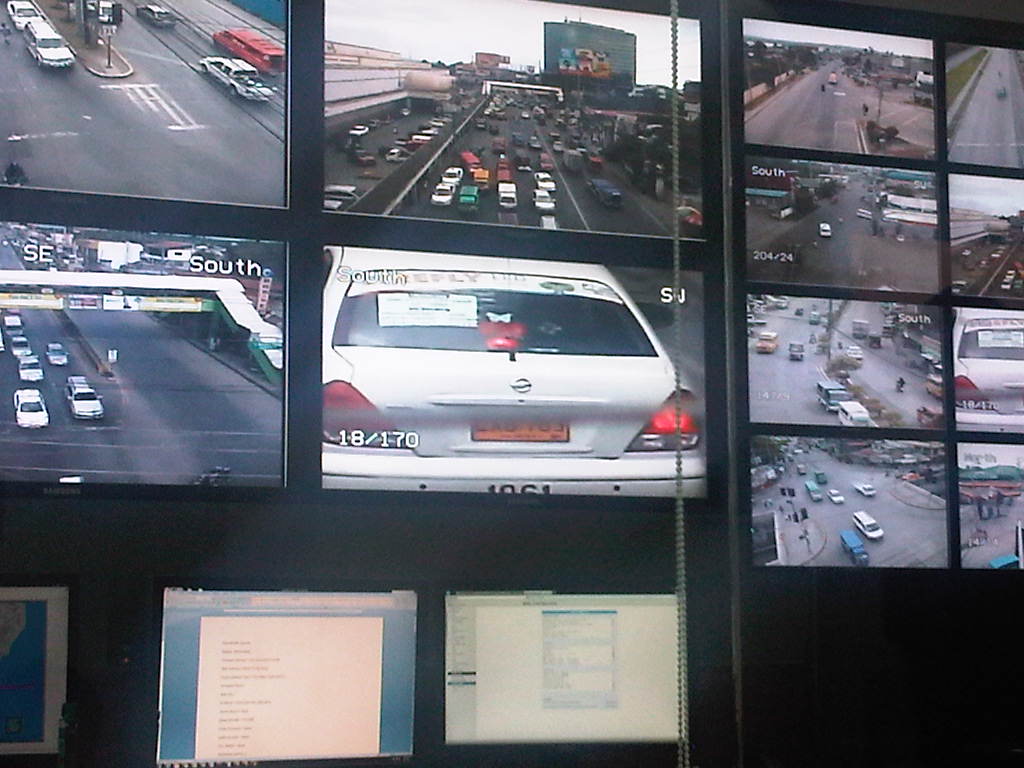 Davao’s cameras have been used to monitor not just erring motorists and pedestrians but also erring traffic enforcers and policemen who might be preying on road users. The city has also been able to use their system to record and evaluate incidences of road crashes.
Perhaps in the near future, many other cities would be able to acquire and apply such tools in traffic management. I think the larger and highly urbanized cities in the country already require sophisticated systems for traffic. Unfortunately, there is always the issue of having limited resources, which usually discourages a city from investing in expensive systems, often opting for basic signals for their intersections. Such basic systems, however, can be optimized if city personnel in-charge of these have the knowledge or capability for setting signals to be synchronized with each other. These are fundamentals necessary for whoever will be dealing with traffic engineering and management in these cities. Also, there are now ongoing researches at universities with some now sponsored by the Department of Science and Technology (DOST) through its Philippine Council for Industry, Energy and Emerging technology Research and Development (PCIEERD) seeking to produce traffic systems at lower costs. These should eventually be deployed in our cities to help alleviate traffic problems.
–
To commute or not to commute
To commute or not to commute? That seems to be the question many people would like our political leaders and government officials to ponder the answer to. Of course, the word “commute” itself refers to traveling whether by public or private transport. However, in the Philippines we have equated “commuting” with taking public transportation. Anyhow, the reality is that most of our top officials, elected or appointed are car owners and are most likely to drive or be driven between their homes, offices and appointments. This is what is perceived by many people as “The Reason” why public officials have little or no appreciation of the difficulties experienced by the commuting public.
While sympathy is usually assumed or claimed by responsible persons, it is empathy that is most desirable from our public officials as they should feel how most people feel when they commute every working day. But how can you empathize if you have not experienced the difficulties of commuting in Metro Manila or other city? How can you say you understand the plight of pedestrians, cyclists and those taking public transport if you prefer or opt to drive or be driven in your car or SUV to and from your office? Did you really commute when you were in high school or college? Or maybe you were one of those cool guys or gals driving their own cars?
Almost every week, I have left my car at the office to commute or hitch a ride with my wife where our routes overlap. I have used public transportation since I was in high school so I am quite familiar with taking pedicabs, tricycles, jeepneys, buses and trains. I have also commuted whenever I am on trips to other cities including those abroad. Public transport is part of the experience whenever I am on trips and when I am in a new place, I make it a point to take long walks first to explore the surrounding area. It is a familiarization of sorts and makes me comfortable with the area. I remember that when I was a student in Japan, I would try to look for the nearest church to where I was staying, especially if I was there over the weekend.
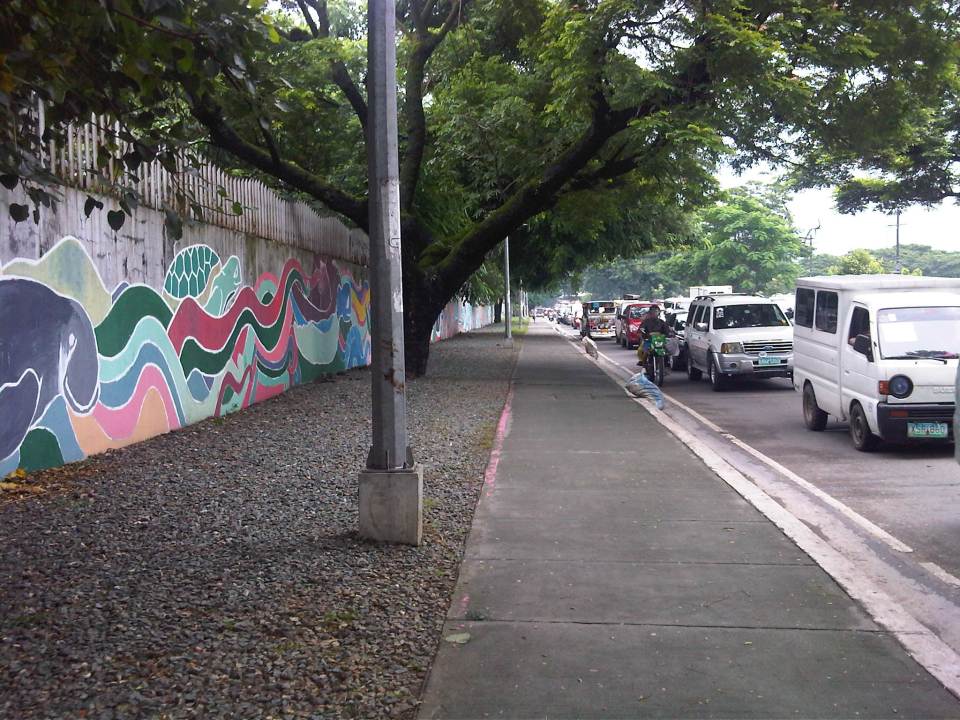 Walking is part of commuting and I am thankful that where I work, the surroundings are basically pedestrian-friendly. The photo above shows the sidewalk along Katipunan Avenue on the side of the university.
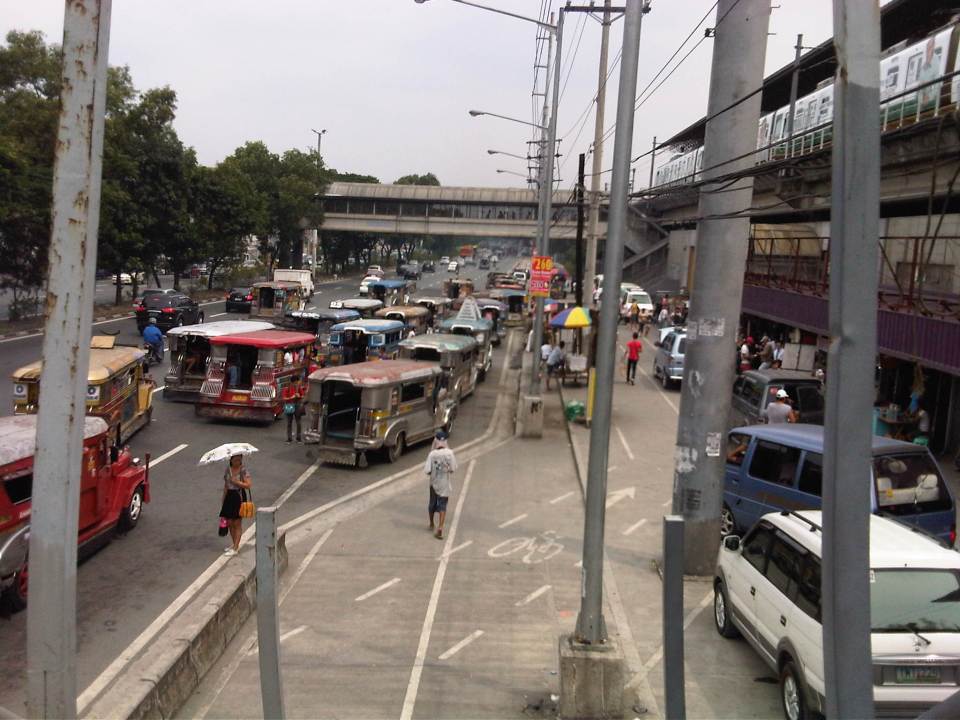 Seamless transfers are not yet quite the norm in the Philippines. The photo shows one of the better examples where transfers between modes are more convenient. This is at the LRT 2 Santolan Station. Note the markings for the bicycle path. I took this as I was descending from the pedestrian overpass that connected with a nearby mall by the Marikina River.
While traveling within other cities, whether in the Philippines or abroad, the first option for many if not most people would be to take public transportation. Taking out a rental vehicle is not common and taxis are considered as part of the public transport system. As such, we try to get information on how to get to places of interest from relatives, friends, hosts or staff of the hotel we are staying at. These include maps like the old fashioned ones we can get at airports, train stations and tourist booths. Nowadays, there’s a wealth of information available online and apps that can help us navigate around cities.
We tend to comment on how good the public transportation is in the places we’ve visited or how easy it was to commute in these cities. And upon returning to our country we are quick to criticize our public transport, pedestrian and cycling facilities. The irony, of course, is that many of those who are quick to criticize don’t even use public transport, walk or cycle. Even more tragic (for lack of a better word, I think) is that we don’t demand for better public transport, pedestrian or cycling facilities. Perhaps that should change and in this New Year, we should resolve to push the government and its partners for better transit, pedestrian and cycling infrastructure for our cities. And part of that push is by getting involved in advocacies, including projects, for these causes on transport. We should not forget that though we need and seek champions for public transport, walking and cycling among our leaders, we should also be champions in our own ways.
–
 Caught (up) in traffic