
Home » Traffic Management (Page 21)
Category Archives: Traffic Management
Fine-tuning the motorcycle lanes
I tried following the motorcycle lanes along Commonwealth Avenue one weekend to see if the MMDA has been able to mark the designated lane (4th lane from the roadside) throughout the entire stretch of the highway. I was optimistic considering all the hype about the lanes but still crossed my fingers given past experiences on such schemes’ implementation in Metro Manila and other Philippine cities. I wasn’t happy with what I saw while traveling along Commonwealth, particularly at points where public utility vehicles stop to drop-off or pick-up passengers. In a previous post, I already explained that where buses, jeepneys and AUVs tend to congregate, they occupy several lanes and effectively block through traffic. Among the lanes occupied are the ones designated for motorcycles. In all my observations, traffic enforcers seem always helpless and inutile against errant motorists occupying the motorcycle lane and posing danger through their maneuvers.
Following are a few photos I took along Commonwealth to “survey” the motorcycle lanes.
 Motorcycle lane along section past Toyota Commonwealth – note the “Motorsiklo” sign on the overpass indicating the lane designated for motorcycles
 Motorcycle lane along section in vicinity of Diliman Prep School – the lane is identifiable by the alternating blue and white lines, as well as the sign (“Motorsiklo”) on the overpass. While motorcycles are required to use only this lane while traversing the highway, other vehicles like the taxi shown in the photo are allowed use of the lane. I believe this is something that should be discouraged as they create situations where there is a high probability of crashes occurring.
The lane disappears after the St. Peter church and there are no markings or signs that would help guide motorcyclists to stay on the lane and perhaps also guide other motorists as well against using the lane. Many motorists, especially private vehicles, seem to respect the “blue lane,” usually and consciously leaving this lane for motorcyclists. We need more of that respect and much of courtesy in our streets and highways!
 Section past Sandiganbayan and approaching the Commonwealth and Fairview Markets – while some motorcycle riders can be observed as trying hard to follow the scheme, there are no markings to help guide them nor are there signs on the overpasses along the rest of the way. Perhaps the MMDA and the DPWH have not yet painted the markings or installed the signs along these sections? But then perhaps the implementation of the scheme is premature considering the lack of pertinent signs and markings?
 A bit of mayhem along Commonwealth and Fairview Markets – buses and jeepneys are practically everywhere here and occupy around 4 lanes as they load/unload passengers at this very crowded area. Motorcycle riders understandably veer away from the outer lanes of Commonwealth
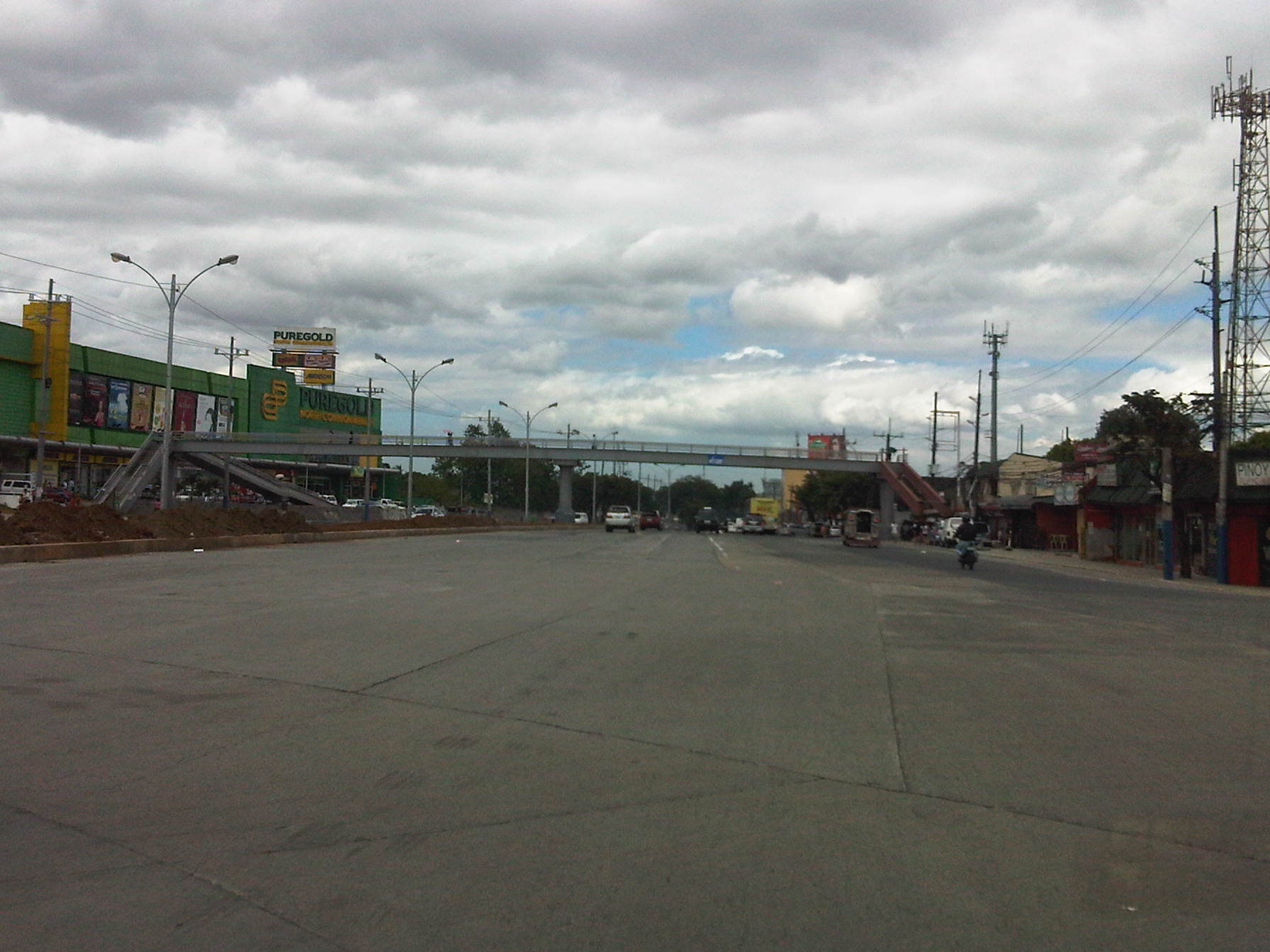 Section past the new rotonda along Commonwealth just before the overpass across the new Puregold branch – the highway was widened along this stretch and narrows to 3 lanes per direction after the overpass. There are no pavement markings yet for the newly added lanes and most of those for the previous lanes are already faded.
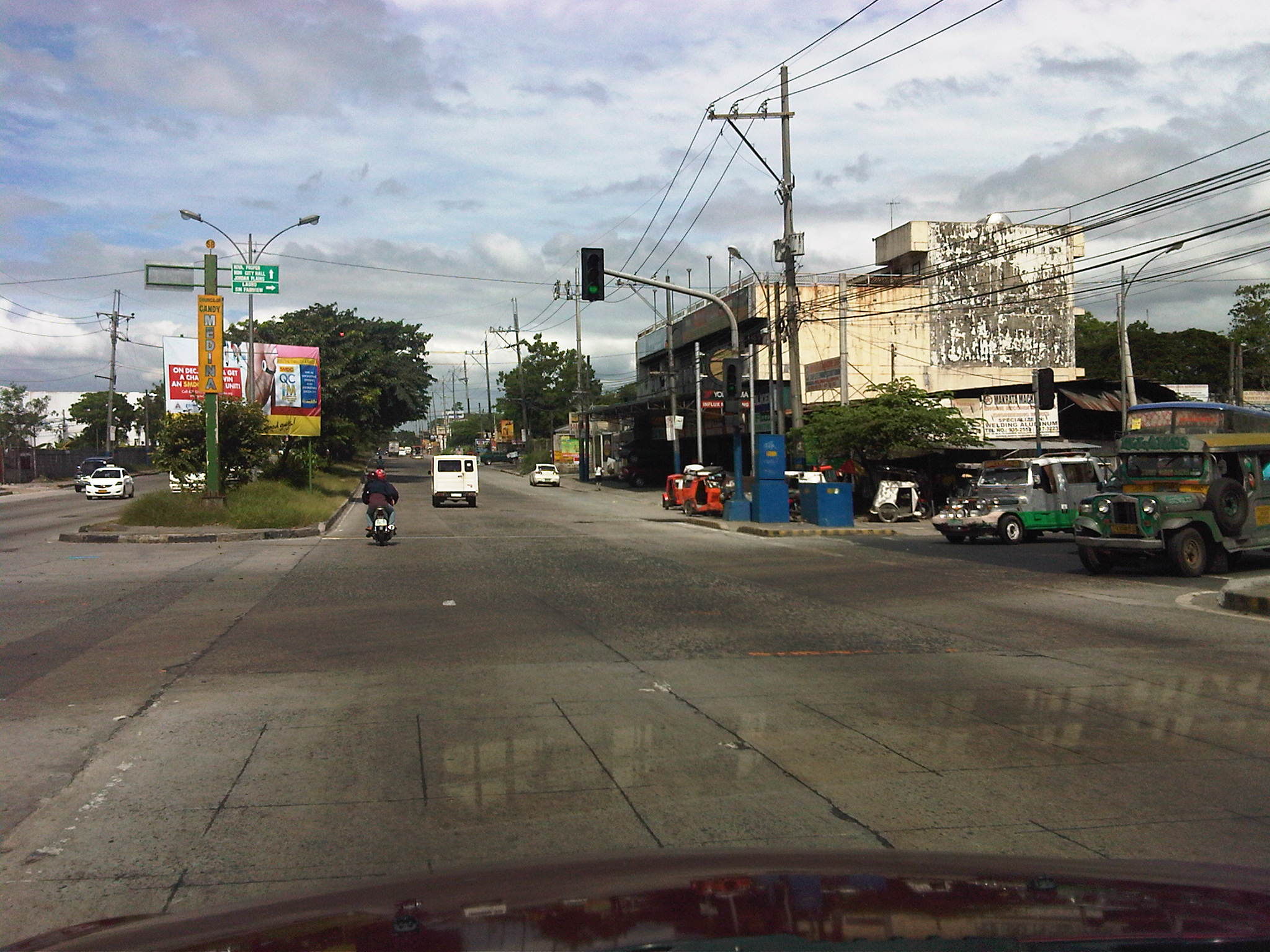 Junction of Commonwealth and Regalado – pavement markings are practically weathered and there are no indications of motorcycle lanes along these sections of Commonwealth
The formulation and implementation of motorcycle lanes along Commonwealth (and Macapagal Boulevard) are based on very good intentions (i.e., to reduce the incidence of road crashes involving motorcycles). However, the absence of pavement markings and signs to guide motorists and especially motorcyclists send the wrong signals in as far as enforcement is concerned. Add to this the serious matter of traffic management along PUV loading/unloading areas that is required to ensure that PUVs will not occupy motorcycle lanes and forcing riders to take to other lanes, thereby coming into conflict with private vehicle traveling along the inner lanes. These two issues clearly need to be addressed and fast so that the scheme can be effectively implemented throughout the entire length of Commonwealth Avenue.
The current situation pertaining to the implementation of motorcycle lanes in Metro Manila is perhaps another case where the agency implementing the scheme again “bit off more than it could chew.” As in the case of the 60 kph speed limit, effective enforcement throughout Commonwealth is limited by the availability and deployment of speed measurement equipment. As such, many vehicle still exceed 60 kph at sections where there obviously are no speed guns or radars. These situations and conditions are highly likely to lead ultimately to a ningas cogon outcome for such traffic management schemes. Such is undesirable since motorists will only become jaded (if they are not yet at this point) about traffic management in Metro Manila and elsewhere. And yet there are already indications that, like the PUV lanes, the MMDA would eventually slack on the enforcement side after realizing it needs to employ and deploy much more trained/skilled enforcers to implement all these schemes at the same time.
More congestion due to Imelda Ave. water and road works
Days before the long weekend break for the days commemorating All Saints and All Souls (Undas), I was surprised to experience severe congestion during the evenings that I drive to my home in Antipolo. To me it was quite unusual knowing from experience that traffic should be lighter considering most schools were already on semestral break and, closer to the weekend, many people would have already gone on vacation leave to return to their hometowns. I took a couple of photos of the progress of civil works as I drove, quite slowly, to my parents’ home at a subdivision along Imelda Ave. I wanted to take more photos but there was a sudden rainfall that obscured vision over my windshield and it became dangerous to take chance photos while driving in the rain.
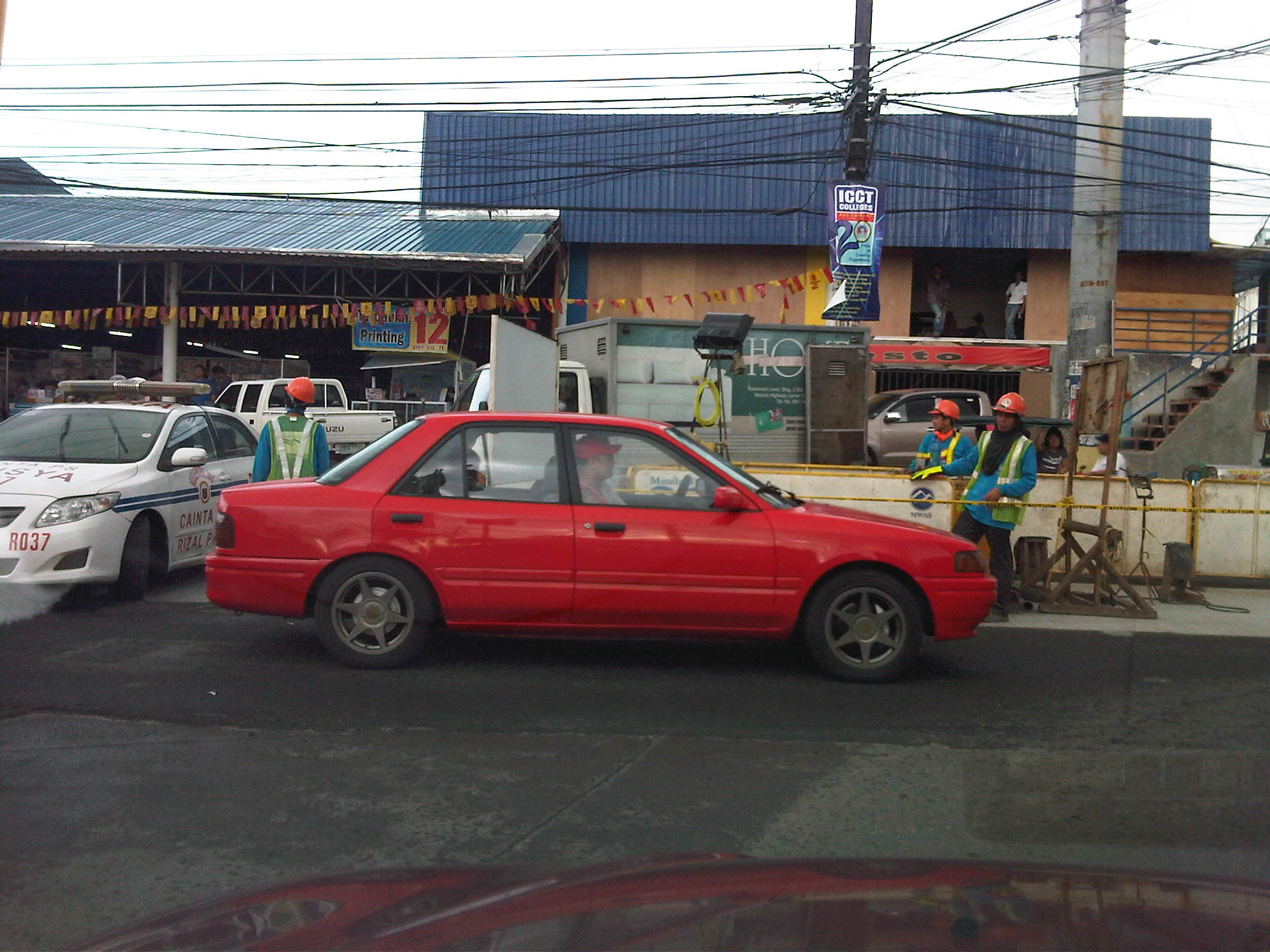 Water and road works at the junction of Imelda Ave. with the Sta. Lucia access road – the activity area effectively occupies a full lane of southbound direction of Imelda Ave. This has resulted in significant reduction in the capacity of the highway, and leads to sever congestion during the afternoon to evening peak periods. During these times, a very high volume of traffic including large trucks pass through the avenue from Marcos Highway and the resulting queues spill over and block traffic at the junction with Marco Highway. At its worst, the congestion extends towards Amang Rodriguez (Ligaya).
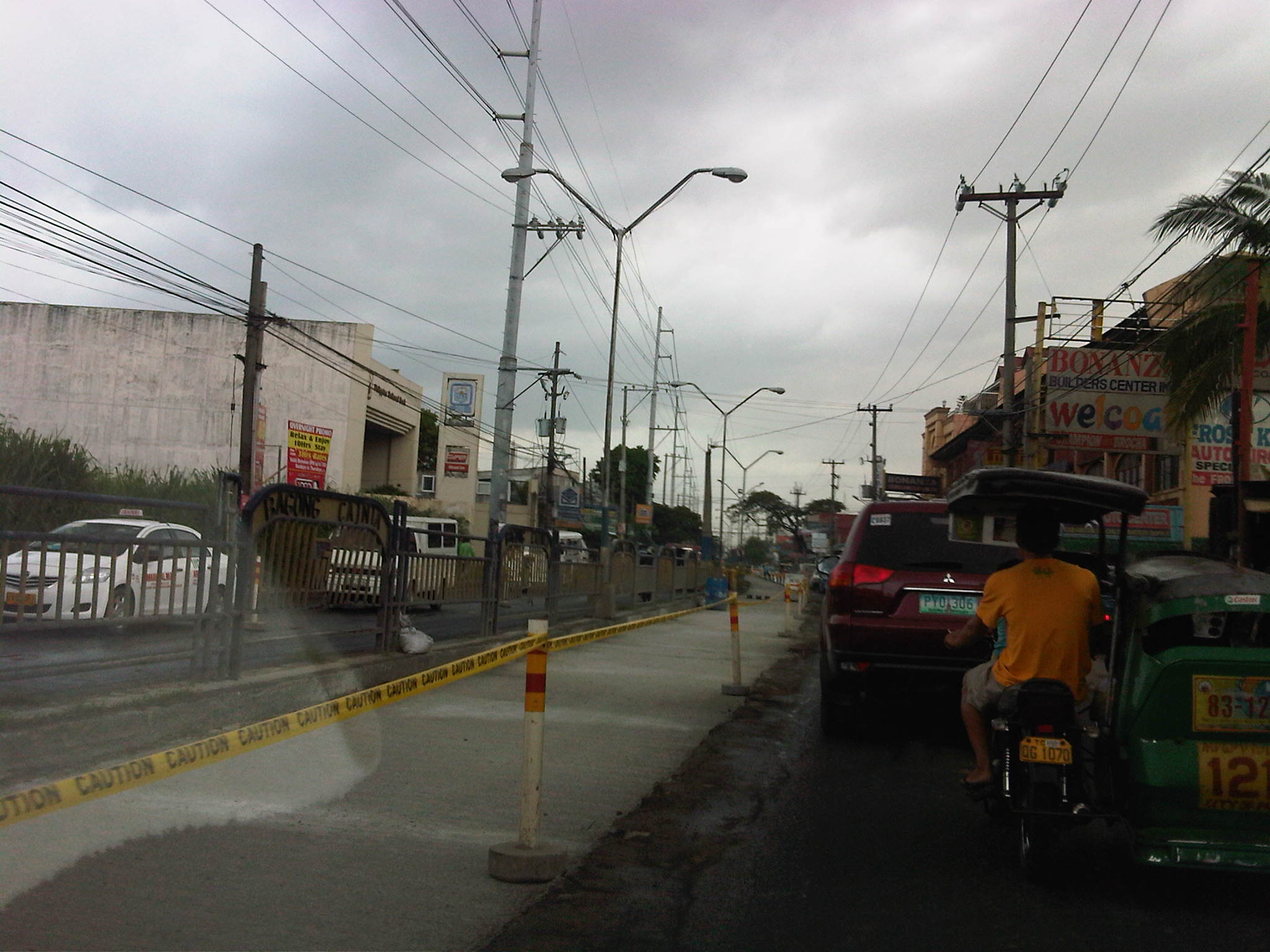 Single lane available to southbound (to Cainta Junction) traffic – all vehicles had to use one lane due to civil works being undertaken along the lane shown in the photo. New water pipes were laid down under the lane to increase capacity for the increasingly growing populations of the progressive towns of Rizal Province.
From the looks of the progress of work I’ve seen personally this weekend, I guess we can expect the congestion to start easing from the latter part of this week. The contractor tried to ease southbound traffic by employing a counter-flow scheme using one lane on the northbound side but the result was not as successful as the contractors desired as congestion quickly set in along this direction causing more misery to travelers along Imelda Ave. Apparently, the contractor underestimated the traffic along the avenue.
Motorcycle lanes – a few comments
The Metropolitan Manila Development Authority (MMDA) recently established motorcycle lanes along Commonwealth Avenue in Quezon City and Macapagal Boulevard in Pasay City. The main intention is to reduce crashes involving motorcycles by attempting to segregate them from other vehicles in traffic. Following are a few photos I took this afternoon along Commonwealth where I observed the MMDA painting blue lines to mark the motorcycle lane. In this case, the lane is the 4th from the outer edge (shoulder) of the highway.
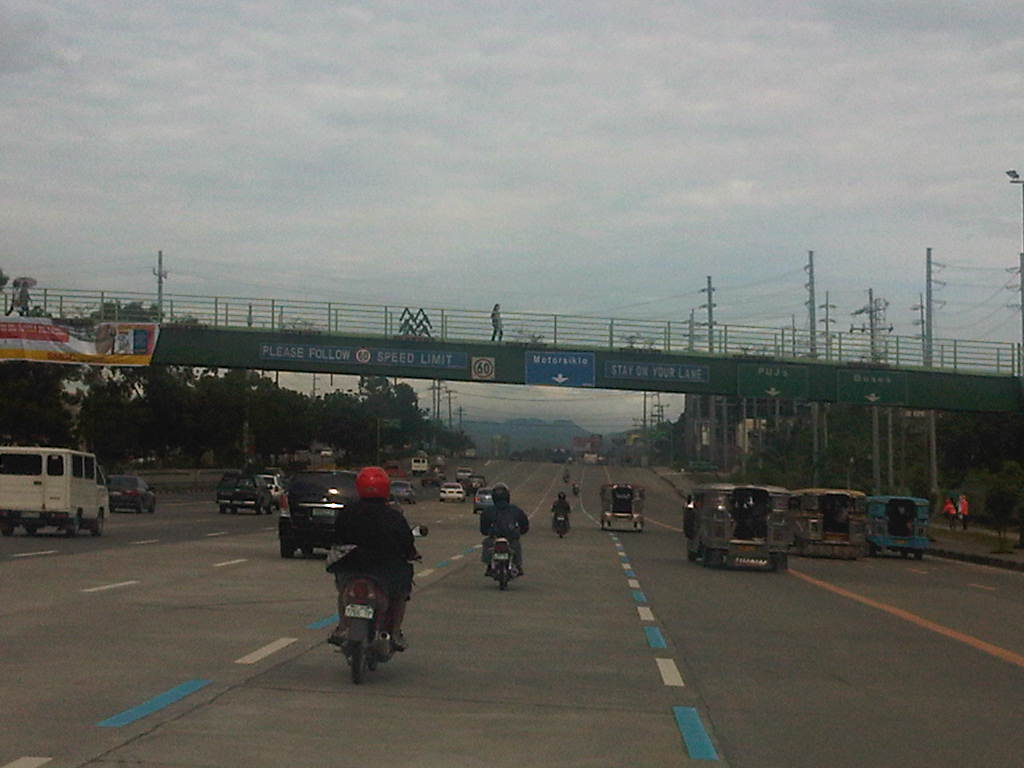 Newly painted blue lines mark the motorcycle lanes. Photo shows riders following the new policy, probably knowing that getting apprehended will lead to a 15-minute lecture on motorcycle safety. Such a penalty will only be applicable this week when the MMDA is implementing a dry-run of the policy. From Monday next week, the penalty would be a 500-peso fine for every apprehension.
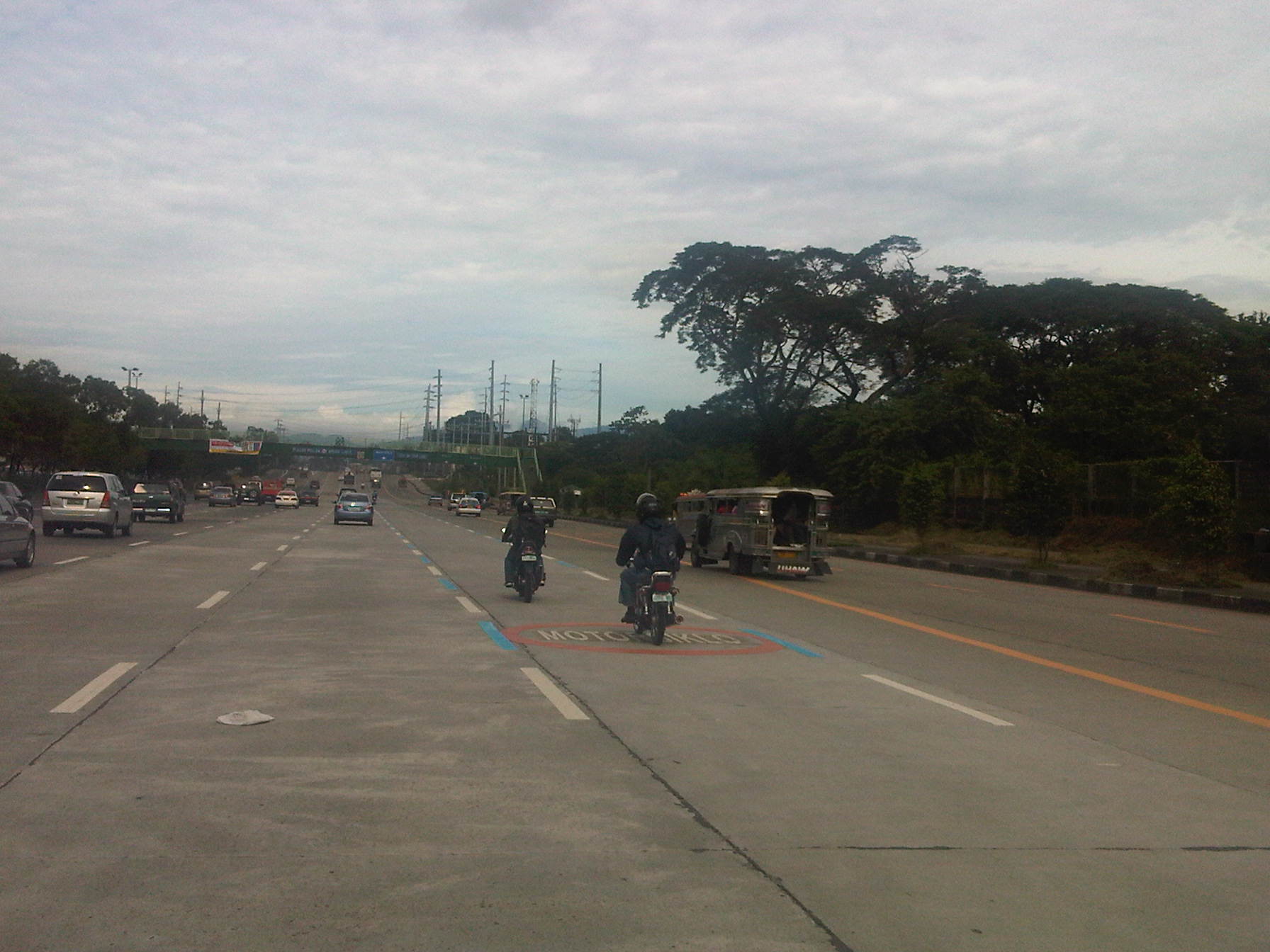 Pavement markings for the motorcycle lane along Commonwealth. Note that the lane is quite close to the lanes designated for public utility vehicles like jeepneys and buses. This situation creates a high potential for the occurrence of crashes involving motorcycles and PUVs. Of particular concern is the behavior of PUVs, especially buses that tend to encroach upon the lanes to the left of the PUV lanes including the motorcycle lane. Another issue is the fact that private vehicles are allowed along the motorcycle lanes and not just for maneuvering. I share the opinion of riders that motorcycle lanes should be for motorcycles only.
Intelligent Transport for the Philippines
The development of an App by the MMDA for use by travelers in Metro Manila is definitely a step in the right direction and represents a breathe of fresh air for the otherwise stale and irritating smog derived from the traffic. Such tools allow for travelers to be informed of the traffic conditions The app is in a sense actually quite crude considering that it is dependent on the observations of MMDA personnel from live feeds from cameras installed along roads throughout Metro Manila, as well as inputs from motorists including Tweets or Facebook messages. The results are often subjective because of the interpretation though quite accurate due to verification made via CCTV. Thus, it employs a more basic approach than what is already being used in other countries such as Japan, the UK and Germany, where traffic conditions are determined using probe cars or systems that are no longer subject to human observation or interpretation.
Vehicles equipped with GPS and communications systems much like the ones already used by the leading logistics companies to track their vehicles now routinely send information about location and such data can be used to construct real-time maps that, if compiled for 24 hours and all throughout the year, may provide a more automated and objective approach to providing travel information. Only incidents like road crashes would then require special treatment. A variation of this type of application of ITS would have been implemented for the MMDA’s bus dispatching for EDSA a couple of years ago using RFID technology to monitor the progression of bus travel along the highway. Unfortunately, after meeting opposition from the transport sector and experiencing some glitches, the project never went underway. Sayang!
Intelligent Transport Systems (ITS) has been available for quite some time now with the 1st World Congress held in1994 in Paris, France. Since then, the developments in ICT have been quite rapid though costs seem to have only reduced significantly in the past 5 years. One reason why ITS has not been able to grab a foothold in many countries is the prohibitive costs of many systems that are supposed to have more significant impacts on transport and traffic in their cities. With more resources and tools becoming available, and with many people able to acquire or access some form of tech (e.g., cell phone, internet), ITS has become available to many people though it is not necessarily cheap (how much is an iPhone?). While Metro Manila could probably afford to make investments for ITS, other cities will not have the resources for such, opting instead to put their money where it is more needed (or so we hope and assume).
Wikipedia provides a pretty decent description of ITS as derived from several sources. Depending on the reference, ITS typically has four functional components:
• Advanced Traffic Management Systems (ATMS)
• Advanced Public Transport Systems (APTS)
• Advanced Vehicle Control Systems (AVCS)
• Commercial Vehicle Operations Systems (CVO)
A fifth one, Advanced Traffic Information Systems (ATIS), is supposed to be embedded or integrated with the four. The MMDA app falls under ATIS and has applications for ATMS and potentially APTS. Leading logistics companies including local ones already employ ATIS for CVO.
I had an opportunity last year to talk about ITS when I was invited to present at the Smarter Cities Summit sponsored by IBM Philippines in December. A pdf of the presentation is found below:
SmarterCities – Transport and Traffic
ITS applications in the Philippines include the very basic ones like the parking management systems now used by shopping malls to inform about the availability of parking spaces to the more comprehensive ones like the electronic toll collection systems of NLEX and SLEX, and the SCATS traffic signal control system of Cebu City. Vehicle manufacturers now routinely use ITS in many vehicles including those sold in the Philippines. These include information on fuel consumption displayed on the dashboard, proximity alarms, and many already have navigation systems as options when purchasing the vehicle.
The 18th ITS World Congress will be held in Orlando, Florida, USA later this month. It promises to again provide participants with a taste of what has been deployed so far and how effective these systems are in addressing traffic problems. Companies participating in the congress would also be displaying products under development and perhaps postulate what can be done in the near future using technology for leverage in solving issues on transport and traffic. It should be noted, however, that ITS remains a tool that would be effective only if both authorities and stakeholders also address the roots of the transport and traffic problems in this country. Dependence on ITS alone will have very limited impacts compared to more comprehensive programs for managing transport demand and supply. Nevertheless, ITS presents a powerful tool that can tremendously enhance traditional solutions. In fact, the “full potential” for ITS combined with traditional TDM and TSM is regularly on display in Singapore with its Electronic Road Pricing (ERP) scheme. But that’s another story.
Traffic going bananas
I’ve written about land use and parking along Katipunan Avenue, which is part of Metro Manila’s Circumferential Road 5. Katipunan extends southwards to Blue Ridge, St. Ignatius and White Plains (the latter subdivisions just across the street from Camp Aguinaldo) where there are also many establishments along either side of the road. Most of these establishments are restaurants that attract significant private vehicle traffic. Note that there are no public transport routes along Katipunan/C5 in the Blue Ridge, St. Ignatius and White Plains areas. As such, establishments are more likely to attract people with cars rather than those taking public utility vehicles.
Many of these establishments are on lots formerly occupied by residential buildings (i.e., houses) considering the predominant land use in the areas. These were eventually purchased and converted for commercial use, resulting in layouts that generally do not include adequate parking spaces. The consequence of shortcomings in parking have been the propensity for on-street parking such as shown in the following photo in the Blue Ridge area.
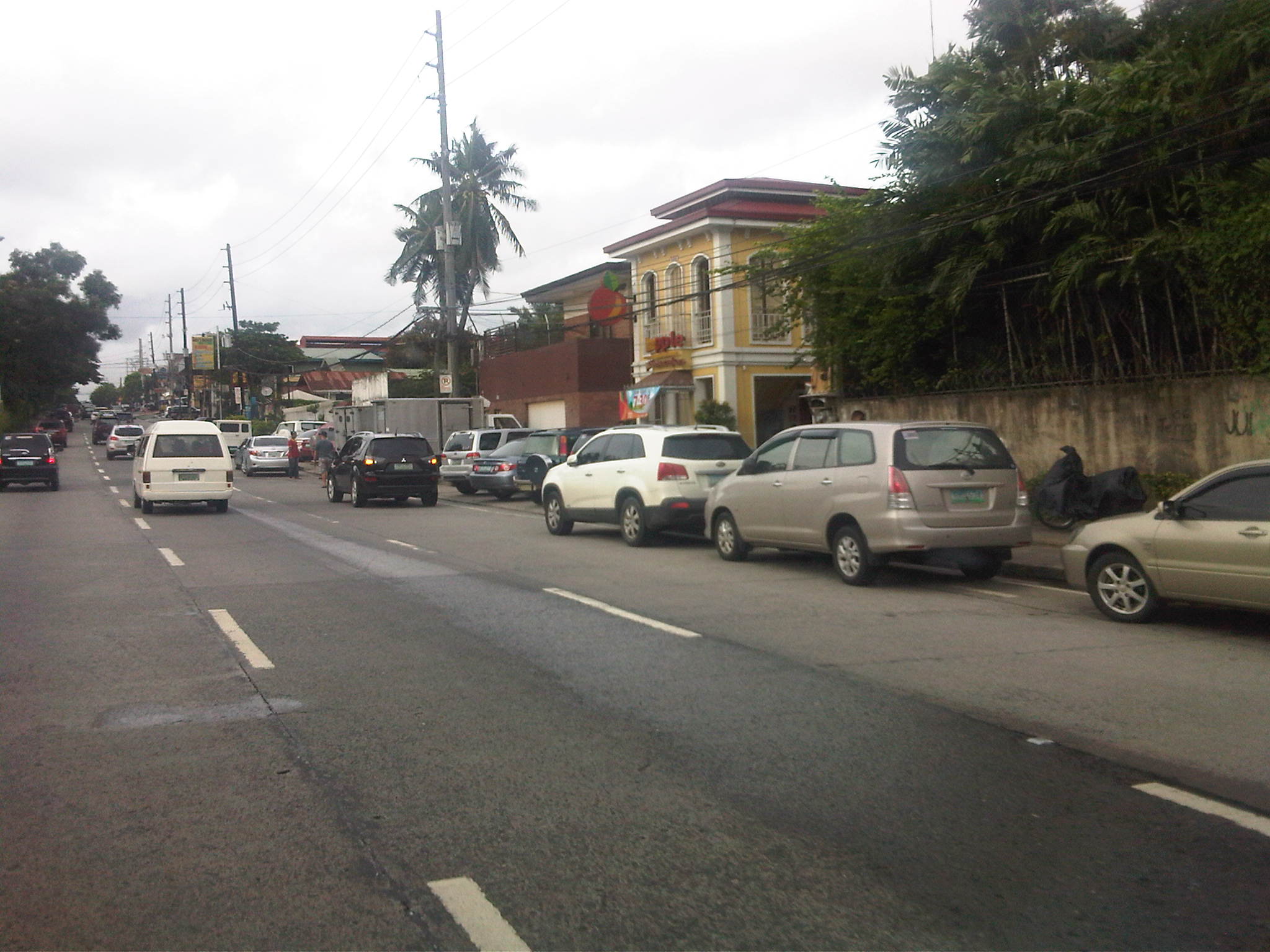 On-street parking for a popular restaurant/cafe along Katipunan/C5 at Blue Ridge.
Such case and many others like it along Katipunan (and other Metro Manila or Philippine cities roads) are the result of both poor planning and lax enforcement of traffic rules and regulations in this country. Being a primary arterial, Katipunan/C5 should be clear of such unnecessary sources of roadside friction that effectively decreases road capacities while also increasing the risk of crashes as vehicles maneuver, or in some cases wrestle, for parking spaces.
Congestion along Ortigas Ave. Extension
The severe traffic congestion experienced along Ortigas Avenue Extension these days are due partly to civil works related to a water project. This is similar to works that were implemented along Marcos Highway that coincided with the road widening and drainage project along that Highway. Ortigas Ext. traffic is always bad during the weekdays due to the limited capacity of the road combined with the sheer volume of traffic it has to carry. The highway still serves as the primary artery connecting the populous and progressive towns of Rizal Province to Metro Manila. These include Antipolo City and the towns of Cainta, Taytay, Binangonan and Angono. I’ve written a piece about traffic along Ortigas Ext. as well as the management schemes that have been employed to address peak period congestion including allowing counterflow traffic on weekday mornings. Following are a few more observations and assessments

Civil works in the middle of Ortigas Ave. Ext. in the De Castro Subdivision area – road capacity is substantially reduced along significant sections of the road due to waterworks project. Both eastbound and westbound traffic are affected as one lane each are taken up by the project. Traffic flow will surely improve once the project is completed, automatically adding two lanes (one for either direction) to increase capacity.

Sunday jam – I can only imagine how bad traffic congestion can be during the weekdays. The photo above is one I took on a Sunday afternoon showing congestion along the westbound direction typically associated with peak period traffic on weekdays. Meanwhile, traffic is practically free flowing on the eastbound side once you get past the work area across De Castro. I was a little surprised about the discipline of drivers considering only few (mostly motorcycles) dared to counterflow.

More diggings – this time 2 lanes are taken away from the wide section of Ortigas stretching from across the former Riverside Mills to the BF Metal Corp. This is where vehicles usually make U-turns because of the space available for vehicles making such maneuvers that are no longer allowed during most periods past the vicinity of Cainta Junction.

Approach to Cainta Junction – this is probably one of the most congestion or saturated intersections outside Metro Manila. Most traffic though can be attributed to Metro Manila as most vehicles are either bound for MM or are coming from it. At this Junction, Ortigas Ext. meets Imelda Ave. (formerly known also as Francisco Felix Ave.), which continues as A. Bonifacio Ave. as it extends to towards Cainta town proper. Ortigas Ext. from the eastbound approach has only 2 lanes (another 2 on the opposing direction) widening to 5 (additional lane for right turning traffic to Cainta) at the entry. Meanwhile the westbound approach from Antipolo/Taytay also has 3 lanes with one dedicated to right turning traffic, which is significant due to left turns being disallowed from the eastbound approach towards Imelda Ave. Vehicles now go through Ortigas and take a U-turn after the junction and then turn right to Imelda. At the median opening, Ortigas has been widened to allow for such maneuvers.
Cainta traffic and the MMDA has been experimenting on a number of schemes for the signalized junction. One proposal that has been on the shelf for quite some time now is for an overpass to be constructed along Ortigas to allow for continuous traffic flow along the highway. So far, there just seems to be not enough space for an overpass to be constructed and some quarters are saying that the only way to improve traffic really is to widen Ortigas to something like Marcos Highway on the other end of Imelda Ave. Such propositions could have been averted if a mass transit system was constructed along this corridor when congestion was just starting to set-in. Actually, history tells us that there was a mass transit system before with trains running regularly between Manila and Antipolo. But that is a topic we’ll reserve for another post. Abangan!
Road and drainage improvements along Marcos Highway – Part 2
Previous posts on Marcos Highway road works and the resulting congestion did not include photos and discussions on a significant section of the highway. This is the stretch that runs from P. Tuazon/Imelda Ave. to Masinag Junction, where Marcos Highway intersects with Sumulong Highway. Some friends have pointed out the bottlenecks that include Masinag Junction itself and the uncompleted work in the vicinity of the newly opened SM City Masinag. Following are a few photos I took on a Saturday morning while traveling along that stretch of road and a few observations pertaining to some causes of congestion.
 Unfinished drainage and roadworks along eastbound direction of Marcos Highway approaching Golden Meadows gate – note that materials occupy practically 2 lanes of the highway.
 Construction along Marcos Highway eastbound in front of AMA Computer College just after Filinvest East Gate – only 3 lanes available to traffic, sometimes 2 due to heavy equipment maneuvers.
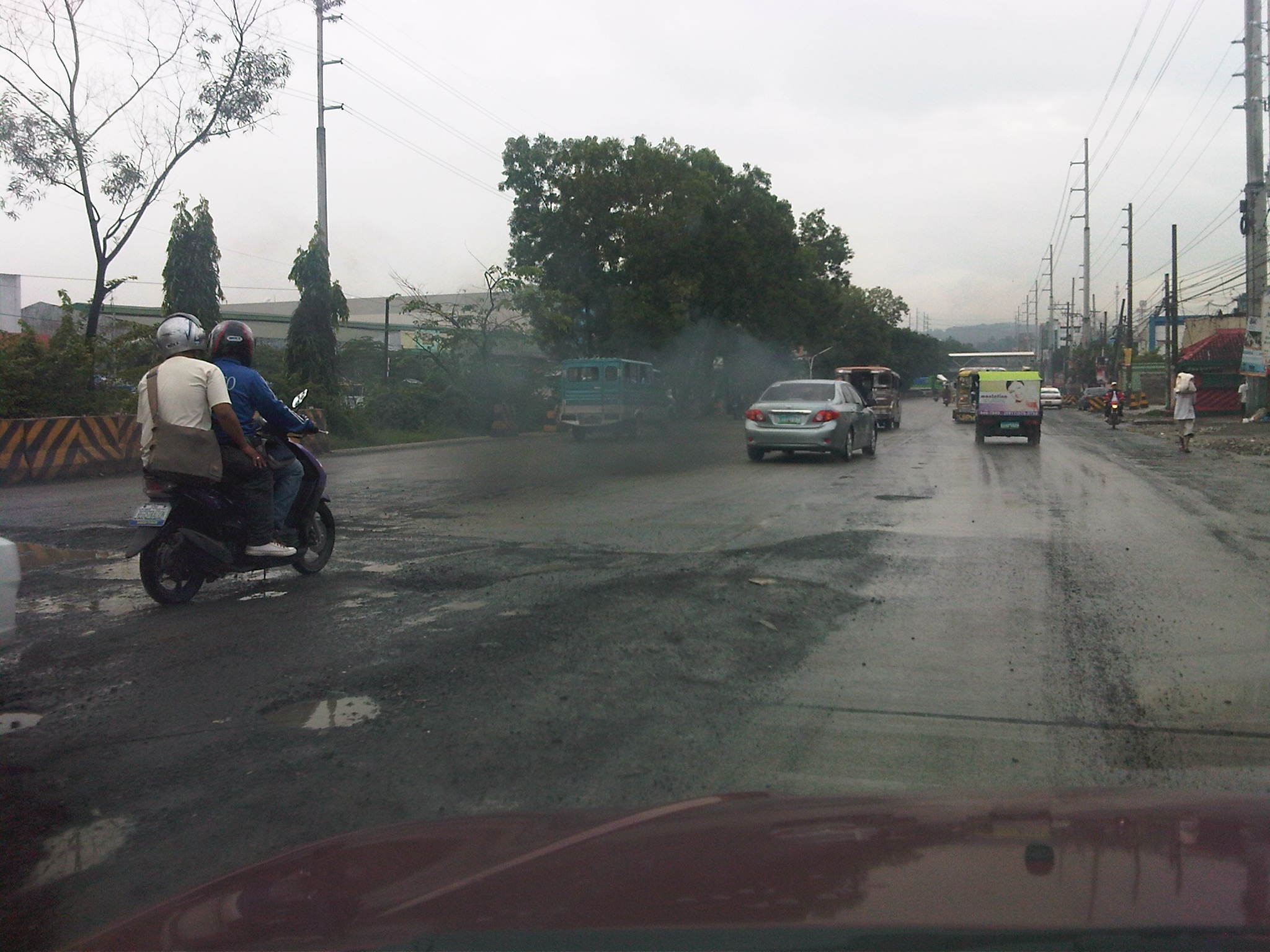 Unfinished road works near Kingsville Gate along Marcos Highway eastbound – bad road conditions lead to congestion as vehicles are forced to slow down due to the potholes and uneven pavement surface.
 Completed PCC pavement sections along Marcos Highway eastbound approaching SM City Masinag area – note that standard signs and pavement markings are still lacking along completed sections. Perhaps there is also a plan to have asphalt overlay as a protective or weathering layer for the concrete slabs?
 Completed section and newly constructed pedestrian overpass across SM Masinag – despite the overpass, many people still brave crossing the wide highway and risk getting run over by speeding vehicles.
 Jaywalking and risky crossing at Masinag Junction – I think traffic enforcers usually fail in managing pedestrians and cyclists crossing at the intersection resulting in the decrease in the throughput of the intersection. In any case, poor control may just lead to a road crash involving pedestrians and/or cyclists.
 More pedestrians crossing at Masinag junction – in this case, the only conflict is with vehicles turning right from Sumulong Highway.
 Another look at the new pedestrian overpass across SM Masinag along Marcos Highway westbound – this was a necessary facility for the safety of people (likely shoppers) crossing the 8-lane highway. The overpass would probably have to be modified later should LRT Line 2 be extended towards Antipolo City.
 Concrete barriers delineating lanes intended for vehicles making a U-turn along Marcos Highway just after SM Masinag – the barriers are also meant to reduce weaving caused by vehicles generated by the mall and intending to make the U-turn. These barriers, however, are also hazards as vehicles accelerating after Masinag will suddenly encounter these without adequate warnings. At present the lane is blocked right after the median opening due to uncompleted roadworks. Thus, erroneously entering the leftmost lanes will require a U-turn. Such barriers would have to be removed so traffic can still opt to pass through the section.
 Unfinished section along Marcos Highway westbound – the number of lanes are reduced from 5 to 2, drastically reducing capacity and causing serious queuing due to the shockwave resulting from the bottleneck.
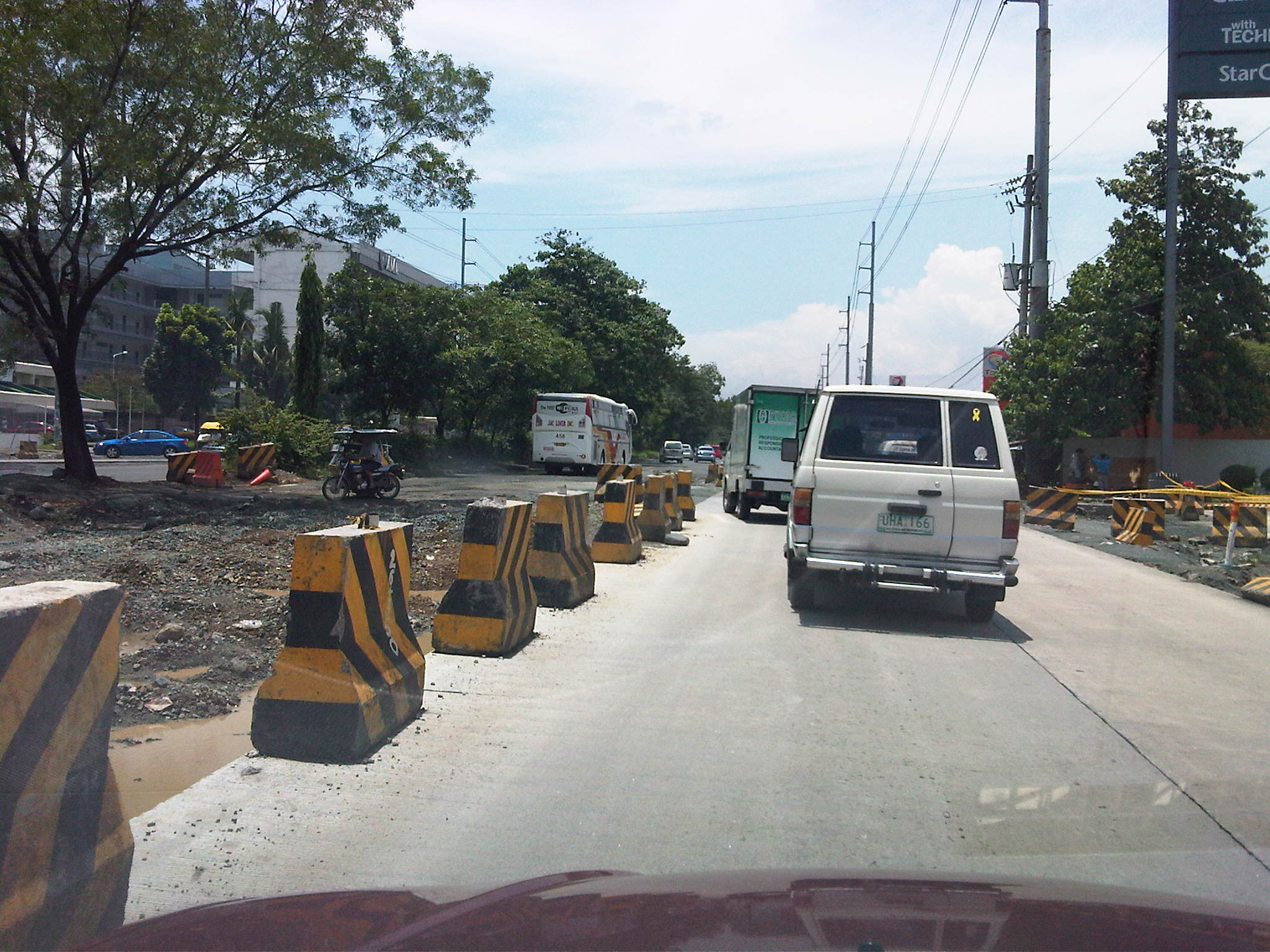 Unfinished drainage and roadworks along Marcos Highway westbound across the Caltex service station approaching the Filinvest East and Vermont Park gates – the section widens just before the subdivision gates and median opening but the inner lanes have not been paved at the time the photo was taken.
 Median opening (U-turn slot) for westbound traffic coming from Imelda Avenue – the old median opening across Burger King was closed and traffic was diverted to this slot located between the Shell and Phoenix service stations right after the Town & Country gate and CVC grocery. The result was less congestion due to weaving traffic between Imelda and this slot. This, however, came with a price – a longer trip for vehicles coming from Imelda Avenue.
With the completion of road and drainage works along Marcos Highway, it is expected that congestion will eventually be eased and the inherent costs will be reduced. Perhaps there will also be an opportunity to revisit traffic management and traffic control at critical junctions including Masinag, Imelda Ave./A. Tuazon, and A. Rodriguez/J.P. Rizal. So far, the perception of continuous movement due to the U-turn schemes along Marcos Highway have resulted in many adjustments to the locations of the slots while only producing congestion and perhaps encouraging aggressive driving behavior. Traffic signals should again be considered though traffic and travel behavior will surely be affected by a proposed extension of LRT Line 2.
Bottlenecks along Marcos Highway
Motorists and commuters using Marcos Highway which connects towns in the Province of Rizal to Metro Manila (particularly Marikina, Pasig and Quezon City) typically experience severe congestion due to two bottlenecks. These are at Santolan in the general area of the LRT 2 Station and near the junction with Evangelista Street, and at Ligaya near the junction with Amang Rodriguez/J.P. Rizal Avenues (note that the road intersecting with Marcos Highway is known as Amang Rodriguez on the Pasig side and J.P. Rizal in Marikina). Even without the current road and drainage projects being implemented on both sides of the highway, severe congestion is experienced in these areas.
There are mainly two reasons for congestion. The first is the operation of public utility vehicles, particularly jeepneys, in these areas. The second is the traffic flow characteristics, particularly merging and weaving activities, along Marcos Highway. Undisciplined operations of jeepneys in both areas have always led to congestion as they have tended to occupy significant road space (say 2 or 3 lanes) as they compete among themselves for space and for passengers. This generally results in the reduction of road capacity as there are less lanes available for all other vehicles traversing the highway. Chaotic loading and unloading have also influenced commuters to also compete for their rides with people often found advancing to meet up with the approaching jeepneys, and occupying road space in the process.
In the case of Santolan, people occupy 2 lanes just after the junction with Evangelista street right after the bridge. Such results in usually 2 to 3 lanes available to motor vehicles. Combined with jeepneys stopped across the LRT2 station, only 2 to 3 lanes are effectively available to traffic along a stretch of the highway. I always wonder why the MMDA and Pasig City enforcers are always appear to be helpless against these people when the former should be preventing the latter from occupying road space and causing congestion that can reach as far as Aurora Boulevard along and also fill up the bridge from C5. The situation is very similar for Ligaya where Pasig-Marikina jeepneys tend to establish informal, on-road terminals at the intersection itself and clogging both sides of Marcos Highway. Again, people are everywhere and occupy road space, ensuring that only a couple of lanes are usable for general through traffic. Here also, there seems to be enough enforcers from the MMDA and Pasig City but I always observe them not doing their jobs of managing the traffic and preventing mayhem in the area.
From the perspective of traffic flow, these two areas also have weaknesses. Santolan is already located in the vicinity of an LRT2 station so it is a natural stop for both public and private vehicles. Complicating its situation is the fact that for the eastbound side of the highway, two major streams merge. One comes from the highway bridge fed by both Aurora Boulevard and Maj. Dizon (Industrial Valley), and another comes the Macapagal Bridge that connects to C5. Since the general direction of most vehicles are towards Rizal, there is tremendous weaving activity in the area causing much friction among motor vehicles. On the westbound side of Marcos Highway, there is the tendency for divergence of traffic flow again due to the two bridges plus the presence of an SM Mall whose access road is to the right of the ramp leading to Macapagal Bridge. Again there is weaving activity here that has caused not a few road crashes.
The Ligaya junction used to be a signalized intersection that was closed and replaced by a pair of U-turn slots sometime during the past dispensation at MMDA. Thus, vehicles that used to go through Rodriguez/J.P. Rizal are now required to take a right turn and weave towards the U-turn slots a few meters downstream and weave again to take a right to Rodriguez or J.P. Rizal. Many of these are public utility jeepneys, the same ones that have informal terminals at the intersection itself. Vehicles negotiating the U-turn slots tend to block through traffic as they maneuver towards the outer lanes of the highway and head for the intersection, resulting in daily congestion at the already widened section of the highway in the vicinity of the U-turn slots. The morning case is usually the more severe one and there are usually no traffic enforcers in the area between 5:30 and 6:30 AM. If there happens to be a few early birds from the MMDA and Pasig, these seem to be more concerned with setting up the barriers for the counterflow scheme they implement in relation to the road and drainage project along the highway. Pasig enforcers do not manage the traffic but seem to be engrossed in apprehending those violating the number coding scheme. During the evenings, they are unmindful of the congestion and the people spilled out and occupying the traffic lanes seemingly content on watching vehicles crawling by.
These bottlenecks along Marcos Highway are examples of situations where simple traffic management in the form of active enforcement would be enough to alleviate congestion and perhaps help reduce the potential for road crashes (that may also result in more congestion). The enforcers’ presence and absence in these cases seem to add insult to the injury that is already caused by congestion that can be solved if the enforcers were doing their jobs in the first place. I would not even consider the relocation of the U-turn slots or the criticize the flaws of the design of the bridges’ ramps because the weaving behavior of vehicles may be effectively addressed by proper traffic management. And there are many similar cases throughout Metro Manila and other Philippine cities where this is happening. Hopefully, the agencies or local governments can address such concerns and with urgency considering the time and fuel wasted due to such bottlenecks.
Buses tagged…now what?
The MMDA issued a memo requiring all Metro Manila buses to paint their license plates at strategic areas of the bus exterior. These include standard sizes for “tags” to be placed on the roof, front, sides and back of the bus that are supposed to clearly show consistency with the license plate. Needless to say, if the license plate and the painted tags do not match, then the bus will be labeled colorum or illegally operating. Tags are also colored according to the general routes of the buses, with the yellow background applicable to buses plying routes along EDSA while an orange background applies to non-EDSA routes like those along Ortigas Ave. and Quezon Ave.
The tagging seems to be the latest in a long list of schemes that have been implemented to address the issue of colorum public transportation. While this is generally a matter for the LTFRB, the agency with the mandate to regulate road public transportation, the enforcement aspect is really quite demanding for an agency with few personnel to do this. As such, the LTFRB is usually assisted by other agencies like the MMDA or local government units. Franchise enforcement, however, is generally not the province of the MMDA or LGUs unlike their being deputized by the LTO in enforcing traffic rules and regulations (thus allowing the MMDA and LGUs to issue traffic tickets). The deputized MMDA and LGU enforcers may apprehend public utility vehicle drivers for traffic violations and in an ideal set-up, such violations should be considered when evaluating franchises for renewals. The propensity for violating traffic rules and regulations is a manifestation of poor driving habits and unsafe behavior on the road. Again ideally, such should be taken against operators who have the responsibility for hiring and training their staff. Operators should be held accountable should there be a high incidence of traffic violations and especially when there are incidences of crashes.
I am curious as to how the MMDA will be taking advantage of the bus tags in managing not only public transport but overall traffic as well. The tags present an opportunity where data collection may be facilitated and for various purposes. Such include a variation of the license plate surveys that are usually conducted to trace the movement of vehicles and determine whether they are speeding or travelling too slowly. An application of the outcomes of such surveys is the estimation of travel time along particular routes. For enforcement purposes, one can determine the reasonable turnaround time for public transport vehicles and allow for the checking of trip-cutting and the verification of the incidence of multiple plates. With the video cameras located at strategic points along Metro Manila’s major thoroughfares, sophisticated software employing image processing may be able to expedite the process, an example of an intelligent transport systems (ITS) as applied to public transportation.
The MMDA could even go further by consolidating travel time/speed data from public transport vehicles in order to derive real-time road network statistics. These could easily be visualized using digital maps that can be made online and shared to motorists and commuters alike to allow for better travel planning around the metropolis. Travel time/speed data have been used by researchers and agencies in other countries to estimate road traffic performance throughout the day and may be employed in modeling traffic in order to predict travel characteristics given typical factors affecting the traffic stream. Private vehicle characteristics are approximated by taxis that operate pretty much like private vehicles given that they do not have fixed routes and are not confined to lanes normally assigned to buses and jeepneys.
Such a comprehensive and sophisticated system for traffic management would require that all public transport vehicles be tagged including jeepneys and taxis. This also requires both hardware and software, and most importantly, capacity and on the part of Perhaps this is an alternative to requiring all to have GPS or RFID installed. Of course, the latter devices have more applications due to their potential for data storage (e.g., vehicle registration, franchise, location, etc.) but unfortunately, there are issues that still need to be addressed and questions left unanswered that are associated with these devices. Sayang! But even so, the bus tags (and maybe jeepney and taxi tags in the future) already present a lot of opportunities for monitoring, evaluation and improvement of traffic in Metro Manila. If only such potential can be realized and maximized by the MMDA and other agencies…
Still on Katipunan
Katipunan is again the subject of attention thanks to the Sunday newspaper article by Prof. Randy David in his column at the Inquirer. The problem is not really new and I have been familiar with the congestion and its derivatives from the time I first studied in UP Diliman in 1988 and up to now when I continue to pass through the avenue between home and workplace.
I was able to dig up a 2003 study on Katipunan conducted by the National Center for Transportation Studies (NCTS) of UP for a consortium chaired by then DENR Secretary Bebet Gozun. The study was the group’s response to the MMDA’s effort to install their U-turn scheme along Katipunan, encouraged at the time by the scheme’s apparent success along Commonwealth and EDSA while not acknowledging the problems experienced along Quezon Avenue. The photos below were taken during the time when the study was being undertaken and are very much the same picture of Katipunan today during the peak periods.
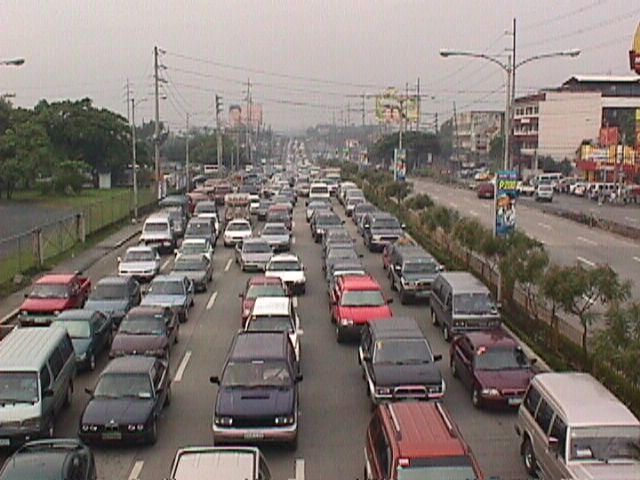 Figure 1: Morning traffic congestion in 2003 along the northbound direction of Katipunan Avenue in front of the Ateneo De Manila University (notice that there was no U-turn slot near Gate 2 at the time)
 Figure 2: Ateneo-bound vehicles blocking through traffic along the service road and the Aurora flyover
The study involved contributions from most if not all stakeholders including Ateneo and Miriam, the private sector and civil society groups, the Transportation Science Society of the Philippines (TSSP), and some government agencies particularly the DENR, who convened the group to formulate an alternative to the MMDA’s initiative that was personally being pushed by its then Chair Bayani Fernando. I reproduce below, word for word, the conclusions and recommendations from that 2003 study:
{Conclusion}
“After a thorough evaluation of the traffic problems along Katipunan as well as the solicited and unsolicited solutions from stakeholders, it becomes clear that the answer to the Katipunan traffic question is not the introduction of the U-turn scheme into the system. Indeed, while the U-turn scheme has met with relative success along major thoroughfares including Marcos Highway and Commonwealth Avenue, it has also contributed if not created congestion along Quezon Avenue. The notion that “success in EDSA and Commonwealth means there is no reason why the scheme won’t work in Katipunan” would not hold water in the light of the requirements for effective implementation of U-turns. Simply said, the traffic volume along Katipunan during the peak periods alone will assure that the U-turn scheme will cause more congestion rather than mitigate it.
{Recommendations}
- Optimization of traffic signals – coordination of signals need to be implemented particularly for the intersection pairs identified in this report. The Traffic Engineering Center (TEC) must be consulted with respect to the operation of the traffic signals along Katipunan.
- Restriction of roadside parking – parking restrictions must be strictly enforced and establishments along Katipunan should adhere to the required parking slots corresponding to the traffic they generate.
- Removal of parts of the islands to improve flow – geometric improvements to ease flow (i.e., increase road capacity) may be explored. Note that this report is not entirely opposed to removal of parts of the islands. However, their outright removal with the trees for the sole purpose of the U-turn scheme is not acceptable to most stakeholders. This must be carefully evaluated.
- Construction of an internal road between Ateneo and Miriam – the internal road will allow common vehicles to circulate within the campuses thereby eliminating traffic that would otherwise make several entries and exits to the campuses via Katipunan.
- Open additional gate at Ateneo – the possibility of opening another gate at Ateneo between the existing Gates 2 and 3 must be explored.
- Encourage carpooling or car-sharing – it is strongly recommended that Ateneo and Miriam consider carpooling or car-sharing schemes. It has been found that traffic along Katipunan is primarily composed of private vehicles will low occupancies bound for the two schools. While the surveys showed high return rates from grade school and high school students, very low returns came from college students. It is these people who account for a majority of the vehicles that clog Katipunan and they should take part in the formulation and implementation of such schemes that would lead to a significant improvement to traffic along Katipunan.
- Strict implementation of the zoning laws – this last recommendation points to the inconsistency in the granting of building permits to developers of high-rise condominiums along Katipunan. This is a constant issue and a controversial one since residents in the area and the two major schools (Ateneo and Miriam) have always opposed the “spot zoning” practice along Katipunan.” (NCTS, Study on the Traffic Management of Katipunan Avenue, 2003)
The study recommended alternative solutions in lieu of the U-turn scheme for Katipunan Avenue that was at the time being pushed by the MMDA as the solution for traffic congestion in the area. The recommended measures considered different aspects: traffic management per se, geometric improvements or road construction, travel demand management, land use, and other measures. However, it seems that 8 years after there has been practically no change in conditions along Katipunan Avenue.
The support and commitments of the different stakeholders (academic institutions, residents, business establishments, professional organizations, government agencies, and concerned citizens) are essential for the successful implementation of the recommendations contained herein. It is only through a strong partnership that sustainable and long-term solutions to the traffic problems in Katipunan Avenue can be achieved.
However, it is realized that there should be some sacrifices involved including a dramatic or drastic change in the travel behavior of those mainly responsible for the congestion. The vehicle trip generation of both Ateneo and Miriam are the roots of the problem and their continuing resistance to proposed solutions while not offering any viable countermeasures or proposals will only serve to perpetuate congestion in the area even as the external costs associated with the traffic they generate spread to a larger area. Recent studies at the UP Diliman, which is an open campus, has shown that private vehicle through traffic (i.e., traffic that has nothing to do with UP) has also grown and most of these are Ateneo and Miriam-bound trips.
It seems awkward and even confusing to see that 8 years after what was perhaps the last (maybe even the first?) serious look into Katipunan traffic, conditions have only worsened. This is due to additional developments in the area including high density residential projects that also tend to generate a lot of traffic, and commercial establishments that do not provide sufficient parking spaces. But although these contribute to congestion, their vehicle generation pale in comparison to that of the schools in the area. This is perhaps a case where one is able to see the flaws of others and yet refuses to look in the mirror to see for oneself something that needs critical attention.
 Caught (up) in traffic