
Home » Transportation (Page 6)
Category Archives: Transportation
Some nice articles on innovation in transport
Following are a couple of articles on innovation as applied to transport. Uber is often seen merely as a transport option much like the taxi but there’s more than meets the eye in terms of its operations never mind its surge pricing schemes. It has succeeded in much part because it is an innovative company with innovative people. They were not afraid to take on the challenges against what the establishment had regarded as an upstart in a sector that was seen as having fewer opportunities for thinking out of the box.
Today is my first day at Uber [by Chris Messina in Medium, January 5, 2016]
Today is my last day at Uber [by Chris Messina in Medium, January 7, 2017]
–
Challenges for Uber, and ridesharing in general
Uber was in a crises of sorts after several leading to its controversial head stepping down a few days ago. Several articles came out including one from Wired that provided some details to some of the significant stumbling blocks or obstacles Uber had to go through the past years (even recent months). There’s an even better article by one of Uber’s co-founders, which I found and regard as “even better” because it appears to be a self assessment, a reflection of how the company should move forward.
Following are the two articles, one from Wired and another from Uber (via Medium):
- A Short History of the Many, Many Ways Uber Screwed Up [by Davey Alba in Wired, June 21, 2017]
- Uber’s path forward [by Garrett Camp in Medium, June 21, 2017]
These are important to us who are doing studies on ridesharing/ridesourcing. I believe Uber and its kind including Grab has revolutionized transport and contributed in significantly improving mobility among a lot of people who have been marginalized by what we have termed as conventional transport. Senior citizens and persons with disabilities, for example, who have had difficulties getting rides can (if they can afford it) get Uber or Grab vehicles to take them where they need to be. There are indeed issues but as the article by Camp states, these can be resolved or addressed to improve the services provided by ridesharing/ridesourcing companies.
–
ITS Forum 2017 at DLSU
We are holding a forum on Intelligent Transport Systems (ITS) today at the De La Salle University (DLSU) along Taft Avenue, Manila. Following is the banner and the program as of February 16:

 In the workshops scheduled in the afternoon, the plan is to review the DOST roadmap and the ITS Master Plan. The DOST roadmap is basically on the research and development agenda of the agency. In the past, this has been associated mainly with the Engineering Research and Development for Technology (ERDT) program of which several major universities are a part of including UP Diliman, DLSU, Ateneo and Mapua Institute of Technology. Eventually, ITS became the theme for other R&D including those that were packaged as ITS but not necessarily falls under the category (i.e., projects like the AGT, hybrid bus and bike share are more sustainable transport than ITS).
The ITS Master Plan is actually something developed under a project implemented through the Department of Public Works and Highways (DPWH) more than 6 years ago and originally only for Metro Manila. This plan is being eyed as the foundation for a bigger one that hopefully would apply to the rest of the country.
–
Grab vs Uber: the ridesharing services battle for supremacy?
I have made it a custom to share articles here on my blog. One reason for me to do this is so I have an archive of sorts for articles that caught my attention that I have either read or not that I want to get back to. Here is another article on ridesharing, this time from a popular magazine:
Grab vs Uber: Who’s getting the riders and making money?
This is relevant material for ongoing studies we are doing about ridesharing. I am also writing a couple of papers on this topic that we intend to present and publish next year.
–
NAIA airport buses
Among the things I liked when traveling to countries like the US, Japan, Singapore and Thailand is that I have many options to travel between their airports and the city. In Narita, for example, I had the option to take a bus (Airport Limousine Bus, etc.) or train (JR Narita Express, JR Yokosuka-Sobu Line Airport Narita, Keisei Skyliner, etc.) to and from the airport to Tokyo, Yokohama or Saitama where I’ve stayed before. Now, I am glad that there already an airport express bus serving the international airport in Manila.
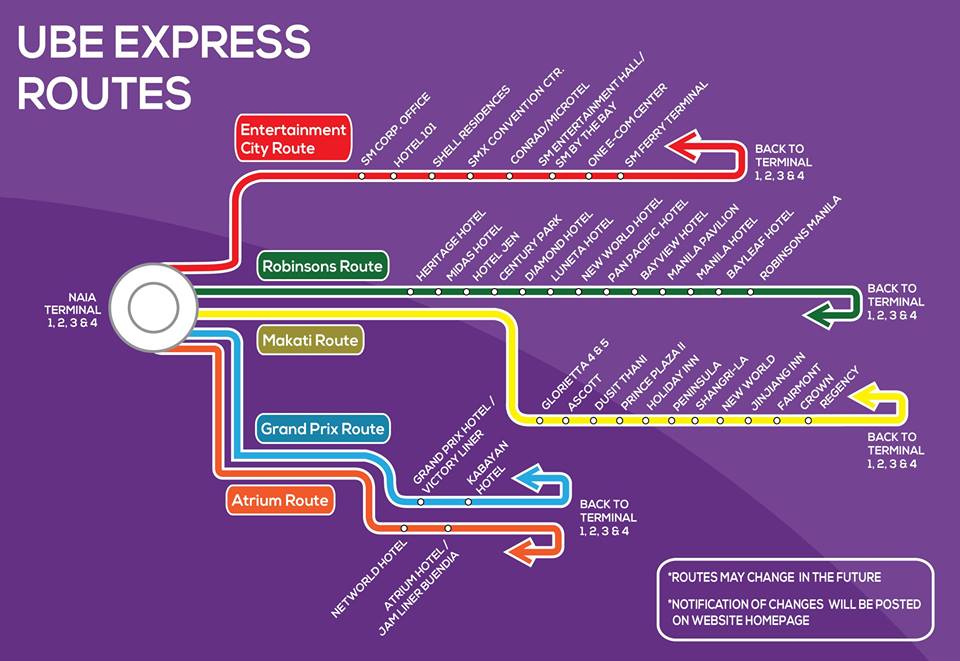
UBE Express is a recently introduced airport bus service for people traveling to and from the passenger terminals of the Ninoy Aquino International Airport (NAIA). Here are a couple of images describing the service that was shared by the Department of Transportation (DoTr) FB page:

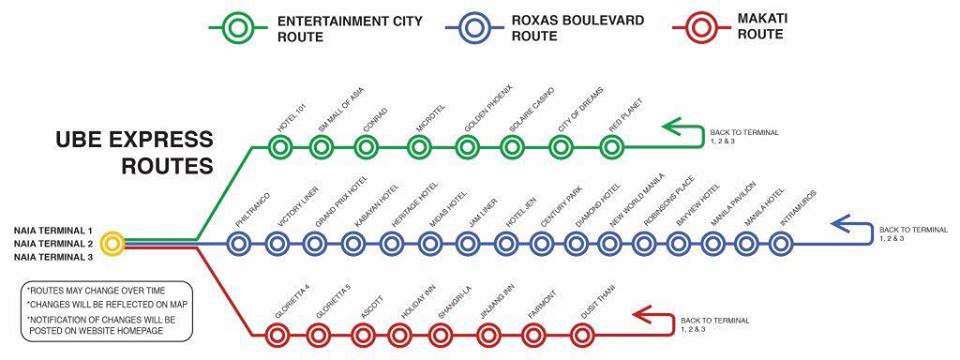
Their Facebook page states that they still charge a promotional fare of 150 Pesos (about 3 US Dollars) for a trip for this Christmas season. More information are available from their FB page and interested people can send them a message using this medium. It seems they reply immediately to comments and queries so that’s good for those who have questions about the service. Here are a couple more images from their FB page:

–
Skylab – motorcycle taxi
We are currently doing research on motorcycles and a major part of the research is on motorcycle taxis. Motorcycle taxis are popular in many areas in the Philippines despite national and local government agencies have not sanctioned or legalized their operations. There are two popular versions of the motorcycle taxis – the habal-habal and the Skylab. Both are basically motorcycles with some add-ons to increase passenger capacity or to be able to carry more goods or cargo.
The habal-habal is carries all passengers or cargo on the motorcycle with some variants having a plank for extension to the back or a customized seat over the gas tank that is usually for children. The Skylab owes its name from the US satellite that fell to the earth in the 1970s. The shape of the satellite inspired innovative extensions along each side of the motorcycle. This enabled riders to take in triple the number of passengers they could with the habal-habal set-up. Both have variants with roofs.
The following video shows a Skylab in Surigao Del Sur care of a very good friend, Dr. Alex Ladaga of Surigao Del Sur State University, whom we are collaborating with in this research:
More on these motorcycle taxis soon!
–
TSSP 2016 Conference: Tentative Program
I am sharing below the tentative program for the 23rd Annual Conference of the Transportation Science Society of the Philippines (TSSP):

Soon, I will post on the list of papers to be presented for the Technical Sessions to be held in the afternoon part of the one-day conference.
–
Evidence from Montreal: Building bike lanes to reduce car use
I just wanted to share this article showing evidence of car use reduction (and therefore, car traffic along roads) with the provision of bicycle lanes.
Building Bike Lanes Really Does Get More People Out of Their Cars
The article though cautions readers against generalising or assuming great improvements. Some figures mentioned in the article including the following (I took the liberty of copying and pasting):
- “A 10% increase in bike accessibility resulted in only a 3.7% increase in ridership.”
- “…cycling infrastructure also reduced greenhouse gas emissions from cars by 1.7%, a reduction equivalent to converting transit buses to hybrids and electrifying commuter trains.”
These numbers are for the case of Montreal, Canada. Not mentioned are the number of cyclists, vehicle traffic volumes and other pertinent data that are useful in analysis. The article correctly points out the importance of using science (e.g., sound analysis based on good data) in order to convince governments to put up bicycle infrastructure. I would even add that this approach should also be applicable to pedestrian facilities.
–
Mobility for persons with disabilities
I saw these two people traveling along Marcos Highway just after the intersection with Imelda Avenue. I think they came from Tahanang Walang Hagdanan in Cainta. The tricycle is actually modified to allow for a person with disability to operate the motor vehicle. The side car is also customized to carry a person on wheelchair. Note that back of the sidecar? It is actually a ramp that is locked when traveling but can be lowered for wheelchairs to roll-on or roll-off. Since there are two persons on the vehicle, the driver’s wheelchair is seen folded and loaded in front of the lady on her wheelchair.

Such vehicles allow PWDs to be more mobile. Unfortunately, most public utility vehicles do not have features to allow wheelchair-bound people to ride on them. Such features may be seen in city buses in more progressive cities including those in Japan, Europe and the US. Trains can easily accommodate PWDs including those on wheelchairs as their floors are the same level as the station platforms and there is space inside the cars for PWDs. While access for PWDs is already contained in Philippine laws, there is still much to be done in terms of implementing provisions of such laws especially with respect to road-based public transportation.
–
Some thoughts on Uber in Metro Manila
I had wanted to write something on Uber the past weeks but couldn’t because I wanted to have some visuals to go with the text. And so one time we decided to use Uber, I consciously took some screenshots for the photos that are shown in this post.
After opening your Uber app, you can indicate your pick-up point and you destination. You can see how many Uber drivers are nearby based on the map and the quick reference on screen. You can also check for a fare estimate as well as select the service you want. There are currently only two types of services available in Metro Manila – UberX and Uber Black. UberX is the default service and involves a regular car. Uber Black is a bigger and more ‘luxurious’ vehicle. Of course, you pay more for a better vehicle. Once you have inputted the necessary information for your itinerary, you can put in the request. Success in getting a ride is immediately shown on your phone.

The screen shows that the driver is en route to your pick-up point. Details on your ride are provided including the name of the driver, the vehicle make, model and plate number. The vehicles I have rode on so far are recent models and most have no license plates yet – an indication of how new these vehicles are. Uber is supposed to be screening both the drivers and vehicles being registered to provide their services. One criteria for vehicles is that these are supposed to be recent models and well maintained, what’s perceived to be the opposite of vehicles used as conventional taxis.
During the trip, you can get updates on your progress through the map onscreen. This includes the estimated time of travel until you reach your destination. Information on the driver is also shown including his average rating. Our driver in this example had a 4.6 star average rating. I guess this is good given the star rating scale of 1 to 5 with 5 being the highest rating.

At the end of the trip, you can receive a receipt on your email. The receipt includes details on your fare, the start and end times of your trip, the travel distance and the route taken in map form. Information on the driver and a note for rating your driver is at the bottom of the receipt. Of course, you can save this for future reference and perhaps print it out in case you will be reimbursing the cost of your trip.

After rating your driver, you will receive another message thanking you for rating your driver. Our driver that afternoon was good and drove safely. He wasn’t talkative but was polite and could strike up a conversation (My companion asked a few questions about his driving for Uber in an interview-like manner.).

What you don’t see is how your driver rated you. Uber also asks drivers to rate users and I would guess that this will have repercussions on passengers with bad attitudes. The ratings work both ways as Uber customers should be wary of their potential drivers as well as their own behavior. I suppose that drivers get information on whether a potential passengers is a rude one and may opt to avoid such passengers.
My take so far on Uber is that it is what conventional taxis are supposed to be. I find Uber drivers to be better in terms of politeness and safety in their driving habits. Fare-wise, Uber has been less expensive than Grab Taxi or conventional taxis as you don’t have to bid to get an Uber ride. The Grab Taxi app basically formalizes the bidding process as it asks you how much gratuity (tips) you are willing to give for a ride. I feel that this gratuity feature is a major determinant for taxi drivers choosing their fares and leads to more expensive fares. Of course, I haven’t experienced Uber’s surge pricing yet but friends who use Uber have informed me that this can be quite steep and can hurt your pocket or wallet. Still, I think Uber provides good service but it is not for everyone especially those on a budget or going to a place where roads are generally congested.
–
 Caught (up) in traffic