
Home » Travel (Page 10)
Category Archives: Travel
Looking forward to another long road trip
It has been a while since I had a long road trip. The last one was not particularly long as it was only until Lucena City in Quezon. Prior to that was a trip to Baguio City. And so I am looking forward to this trip to Bicol this week and I do hope to take a lot of photos along the way. That includes photos of arches that I have not had the chance of taking that I know I can get a lot of during this trip that will take us through several provinces in Southern Luzon. Those photos and the experiences from the trip will probably dominate the postings this February.
Grab a taxi
When we were residing in Singapore, it was so easy to book a taxi wherever we might be. Comfort Taxi’s booking system allowed us to get a taxi from our home to the airport or to avoid long queues at the mall by booking a taxi by phone and waiting for it at a designated stop nearby. With the arrival of GrabTaxi and EasyTaxi in the Philippines, getting a cab became a little easier and convenient though one friend opined that the app basically mainstreams the current practice of negotiating with the cab driver for the fees (usually higher than the meter fare for metered taxis) to be paid for a ride. Hindi pa kasama ang tip dito! This ‘negotiating’ is a ‘trial and error’ thing and in certain cases, there might not even be a negotiation for the fares as Metro Manila cab drivers are notorious for being choosy about their passengers and their destinations.
Here are a few screen grabs from a booking we made last month after having some difficulty getting a ride out of UP Diliman in Quezon City.
 Information about the booking fees in various Philippine cities. The booking fee in Manila is conspicuously and significantly higher than those in other major cities.
 Grab Taxi’s interface shows the number of taxis nearby, which is apparently the number within something like a 4 or 5-kilometer radius of our location (204 is a big number!). We were at Melchor Hall at the time and the most convenient pick-up location was at the National Center for Transportation Studies, which was behind Melchor Hall.
 You can also check out the availability of more exclusive (and expensive) Grab services such as GrabCar and GrabCar Premium. When you slide to GrabCar, the status bar will also show how many drivers of that service option are nearby (i.e., 20 drivers nearby for GrabCar). GrabCar would be similar to the basic service (and vehicle) provided by the more popular Uber.
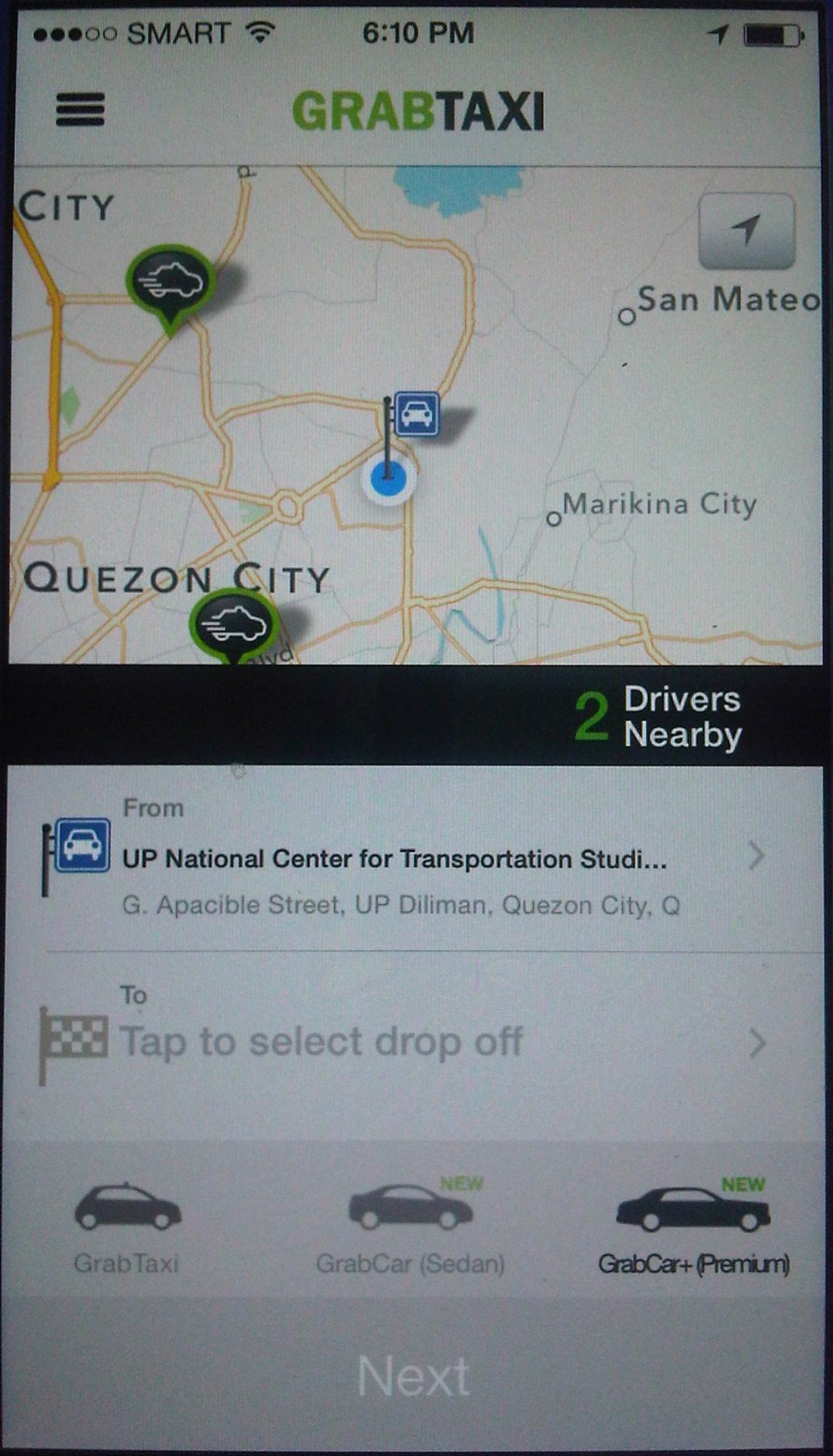 GrabCar Premium is probably the equivalent of the Uber Black Car service we have in Manila.
 Another view of the user interface showing some (or many) of the 204 taxis nearby.
 Here is an example of a message from GrabTaxi after it was unable to get a cab for us.
We were fortunate that the failed attempt at getting a cab was once only as we got a cab in our next try. This is despite all the cabs supposedly nearby. In reality only those who are willing to go to my destination from Quezon City will initially be interested in taking my request via the app. There is also a gratuity feature of GrabTaxi that allows the user to indicate how much he/she would be tipping the driver on top of the fare and booking fee. In the end, I guess my stating a very generous tip ensured my successfully getting a cab. For this, my friend’s opinion seems to be true that apps such as GrabTaxi mainstreams or makes the negotiations formal and a given when using the app. It, however, already eliminates the part where the prospective passenger gets turned down by the cab he/she hailed. When a cab responds to a request via GrabTaxi, EasyTaxi or even Uber, the driver already agrees to the terms of the deal regarding the ride. And it is a good thing that these apps now feature feedback mechanisms (e.g., rating the drivers) in order to weed out those that are still uncooperative, greedy or want to take advantage of the need for taxi service.
GrabTaxi now has a new service, Grab Express, which is an on-demand pick-up and delivery service. This is a service already provided by other companies in the US that are now giving traditional or conventional courier/logistic companies a lot of competition. I would think there is a demand for such services especially in cities where documents and other stuff still need to be submitted to offices like reports, manuscripts, letters and others that need to be delivered in “hard copy” format.
–
All roads lead to Antipolo: rerouting for the Alay Lakad
The Rizal Provincial Government and the Antipolo City Government recently posted traffic rerouting schemes on their Facebook pages. Lalawigan ng Rizal was the first to post schemes that affect traffic in at least 3 major local government jurisdictions – Antipolo, Cainta and Taytay. The schemes affect the two major corridors that basically lead to Antipolo’s National Shrine of Our Lady of Peace and Good Voyage (or Antipolo Cathedral to many) – the Ortigas Avenue corridor and the Marcos Highway-Sumulong Highway corridor. There are many major and minor routes connecting to these corridors and are clearly seen in the maps.
Within Antipolo, there are also re-routing schemes, which the Antipolo City Government posted along with a “clearer” re-posting of the maps from the Rizal FB page. The Antipolo FB page includes information/maps on the rerouting within the city center. These schemes will affect traffic circulation including public transport routes. Critical would be the permanent and temporary terminals and parking areas set-up around the city that should be able to accommodate the thousands of vehicles that are also expected to be used by people who won’t be walking or cycling.
What the maps basically say is that from 4:00 PM today, Maundy Thursday, to 6:00 AM tomorrow, Good Friday, the stretch from Cainta Junction to the Shrine will be closed to traffic. This is to allow the hundreds of thousands expected to make the trek to Antipolo to have the road for themselves. What the maps don’t say is that motorcycles and tricycles would likely be allowed, too. I can understand that motorcycles could easily squeeze into the throngs of people but then allowing tricycles to operate among the walkers and bikers would be risky given their drivers’ behavior. Add to this that they would be making a killing out of charging opportunistic fares.
Technically, the rerouting schemes don’t appear to be as well thought of as can be expected from the LGUs. Baka ito lang nakayanan ng staff o ng consultants nila, and surrender na agad ang Rizal and Antipolo with regards to the coming up with more options for people to travel to the Antipolo Shrine? Not all people can walk or cycle but are willing to an could take public transport for their pilgrimage. The maps themselves are a bit crude and the Province of Rizal and City of Antipolo could have done much better maps given the resources of these LGUs. There are open source tools now available as well as your basic software like PowerPoint or Photoshop (even Word!) that can be used to render good quality images to guide people making the Alay Lakad. This is a regular event and though it happens once a year then perhaps the LGUs could have better plans especially to transport people who cannot make the walk to Antipolo. The objective after all is to convey the masses to and from the shrine safely and efficiently – something a mass transport system can do whether via Marcos/Sumulong or Ortigas corridors.
One reminder to all doing the Alay Lakad: keep your garbage to yourselves if you cannot find a proper waste bin. Do not dispose of your waste along the route and make a dumpsite out of Ortigas Avenue, Marcos Highway, Sumulong Highway or whatever roads you are taking! Kasalanan din po ang irresponsableng pagtatapon ng basura. While you might be forgiven for these “sins” through the Sacrament of Reconciliation (which many will likely take at the Cathedral), nature will have a way of getting back at you for your environmental travesty. –
On delayed flights in the Philippines
I participated in a conference held in Puerto Princesa, Palawan last November and both my flights to and from Puerto Princesa were delayed. The first one was delayed by 1 hour. We boarded on time and there were no announcements of delays. However, we sat inside the plane for about an hour including taxiing towards the runway and then waiting in queue before we were cleared for take-off. The pilot was constantly on the PA system though, informing passengers about the cause of the delay, which was airport congestion. This was a reference to the many take-offs and landings (departing and arriving aircraft) being handled by the airport at the time. It seems air traffic control could not cope with the number of aircraft departing and arriving at NAIA even considering the airport had two runways that were operational (We took off using the secondary runway.).
 Aircraft taxiing towards NAIA’s main runway in preparation for take-off
I won’t mention specific airlines as I think domestic flights by all airlines have been incurring significant delays and not just recently but among the main possible reasons for delays that can be charged to the airline are the following:
1. Airport congestion – This can refer to either the runway or the passenger terminal. However, for the latter case you can have examples of very congested or crowded terminals of airports that have planes taking off and landing on time. Tagbilaran and Roxas Airports are like that, and Mactan (Cebu) and Bacolod-Silay have passenger terminals that are becoming if not already congested. Thus, airport congestion as a reason for delays must be due to runway operations. A single runway airport will handle fewer flights compared to those with multiple runways. Airport runway design and configuration are influenced by many factors but given any single runway in a major airport like NAIA it is already assumed that these factors are already considered in operation and on a typical day under normal or even favorable conditions, the only other significant factor for runway operations is air traffic control. Air traffic controllers would be responsible for guiding arriving flights and clearing planes for take-off. The number of take-offs and landings will also be significantly affected by how air traffic control “queues” planes in the air and on the ground.
2. Too many flights – Airlines tend to maximize the use of their aircraft and seem to be scheduling more flights that they can handle. This results in the very common “late arrival of turnaround aircraft” reason that airlines announce as the reason for delayed flights. Granted, in many cases this is ultimately due to reason #1, it seems that other airlines that have lesser flights also have less problems of this kind. In fact, I have observed that in many if not most instances, international carriers do not incur as much delays as local carriers and among local carriers there seem to be a unanimous observation on which “planes are always late” these days.
It seems at first that the main issue is not necessarily airlines overbooking their flights since air traffic control and the number of runways can be major factors influencing the number of aircraft that can take-off and land during a particular period. However, one particular airline has a knack for offering a lot of flights that they obviously cannot handle with all the delays and cancellations they have been incurring to the consternation of a lot of travelers. Though I myself use the airline often due to the convenience of their schedules and frequencies, I too have been victimized many times of these delays including one flight to Singapore a couple of years ago when, instead of arriving in time for dinner I ended up arriving home just after midnight.
Recently, there have been calls for the airline and others performing like it to be penalized in order for them to realize how much inconvenience they have brought on to their passengers. I think this is right in order to send a clear message to airlines that safety and service come first before profit. Too many flights, no matter how convenient to the passengers in terms of schedule, is not a substitute for good quality service. Being a budget airline also does not excuse it from what a lot of people have branded as crappy service. This mentality of airlines reminds me only of similar mentality among bus and jeepney operators (land transport) but that’s another story.
–
Travel the Philippines 2015: 20 Photos that will make you pack your bags and go – @Just1WayTicket
I saw this article being shared around social media about tourism spots in the Philippines. Given the push for more visitors, local and foreign, the government and its partners in the private sector have exerted a lot of effort and allocated much resources to improving the tourism in the country. This includes improvements to infrastructure as well as to the tourism industry itself. There are many nice places around the country including those off the beaten track. I think the following article does a great job of featuring a lot of the more popular spots as well as many that are not usually in the typical itinerary of travel agencies:
Travel the Philippines 2015: 20 Photos that will make you pack your bags and go – @Just1WayTicket.
No PAGASA? No problem!
- Weather Underground
- Joint Typhoon Warning Center of the US Navy
 JTWC’s latest information on Hagupit
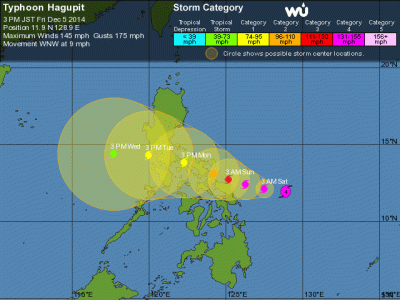 Wunderground’s latest 5-day forecast for Hagupit
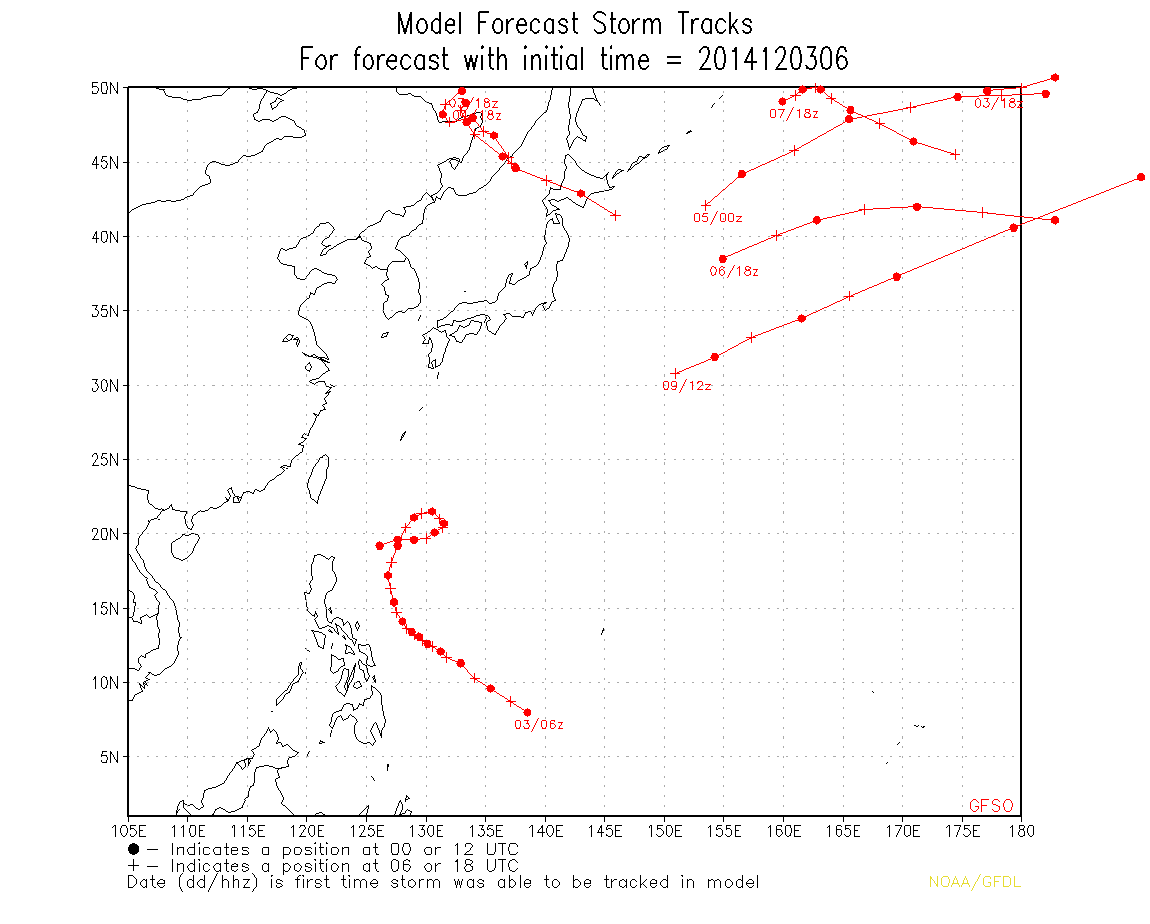 NOAA storm tracks showing current and potential weather systems in the Western Pacific
–
Luggage
We recently got the wife’s grandfather’s old steamer trunk. It is a metal trunk with a tray that served as storage for what we now term as personal effects. It has an old lock that’s now corrodedThe trunk has a lot of history associated with it. The original owner was probably among the first Overseas Foreign Workers (OFWs) after the Second World War. He worked in Guam for many years, establishing himself as an air-conditioning technician at a time when air-conditioning was not a household appliance. It was a skill he would later pass on to his sons, my uncles-in-law, who would put up their own air-conditioning shops.
 Grandfather’s old steamer trunk is made of steel and what looks to me like aluminum.
 There’s a plate bearing his name and the town and province he was from. Note the reference to the Philippines at the time as P.I. – Philippine Islands. This was a term used by the U.S. even after we gained independence after the war and became a republic.
Trunks were the luggage of yester-years. Old or period movies often show such trunks and other types of luggage in the old days when galleons, steam ships, locomotive-driven trains and carriages were the vehicles for long distance travel. These were heavy even without anything in them so those who could afford to, likely had porters to carry these containers. Nowadays, with baggage weight limits and faster travel with aircraft, lightweight luggage is the way to go especially when one plans to go on some shopping while away. Still, these steamer trunks are part of travel history and shows how far we’ve advanced in the way we travel.
–
 Caught (up) in traffic