
Home » Walking (Page 13)
Category Archives: Walking
But seriously…recognizing walking as a mode of transport
There is a general observation that urban planning in the Philippines, including planning and design for transport, revolves around motor vehicles. In fact, much of what we think are sound policies and guidelines, even rules of thumb, are car-oriented rather than people-oriented. Our love for the car is often traced to our being a colony of the United States and our orientation to cars have been reinforced over the years by policies, plans and projects that seem to be biased for car users while detrimental to commuters in general. In fact, we have been used to having roads built and widened that these types of projects seem automatic, no brainer solutions to the traffic problems we encounter everyday. Not that this is a bad thing, considering that we do have many missing links to complete and infrastructure to build where they are needed. Yet, for many of our highly urbanized cities, public transport infrastructure has been too slow to address the demand for movement.
Metro Manila is already choking in as far as traffic is concerned and our proposed solutions still are road widening and the call for elevated expressways. Meanwhile, we have poor road public transport services and a limited rail or mass transit network. It seems that most of the plans for trains and BRTs have never left the proverbial pipeline and as such, we continue to languish in I would like to think that a lot of people would want to take public transport if only the quality of service is similar to systems in Singapore, Hongkong, Kuala Lumpur or even Bangkok or Jakarta. We have to deliver on this end, which will also see our streets begin to become decongested as vehicles will naturally decrease with people choosing PT over their cars, especially in this period of increasing fuel prices.
Of course, these public transport infrastructure carry hefty price tags. And so to complete the picture and solve the puzzle of transport in cities like Metro Manila, Cebu and Davao, we would need to address what is perhaps the most basic for of transport that is often forgotten when talks center on highways and mass transit – walking. It is a fact that walking is the mode with the highest share for transport; dwarfing all other modes since we all walk at some point of our trips (e.g., Car users still have to walk to and from the parking spaces.) Unfortunately, we seem to have become lazy, preferring to ride than to walk and making so many excuses even when the facilities for walking are already provided and conditions favor walking over motorized transport. Of course, the main challenges for ensuring the safety and comfort of those who choose to walk remain and investments are required for more infrastructure to encourage walking. There are good practice examples like the walkways connecting buildings at the Makati CDB and the sidewalks of Quezon City. These are, however, more the exception than the rule and so there is still a need to actually “formalize” walking as a mode of transport and one that could probably save us a lot of fuel, reduce emissions and, most importantly, improve our health and well-being.
Following are excellent articles for reading, and for consideration when we re-think what we are doing to improve transport and mobility in our cities. A re-orientation is in order for us to address
(Note: the sources and links to the online articles are shown below and in the files. These are made downloadable here only to facilitate access to the articles. There is no intent for any copyright infringements.)
Why don’t Americans walk more? The crisis of pedestrianism:
What scientists know about how pedestrians really behave:
Walking_in_America__What_scientists_know_about_how_pedestrians_really_behave_
How walk score puts a number on walkability:
Walking_in_America__How_Walk_Score_puts_a_number_on_walkability_
With America and the rest of the world taking a second and perhaps critical look into how they are planning their transport systems and focusing on encouraging people to walk, we should perhaps take this as our cue to also re-think how we are planning and designing our systems. We should, and not be too dependent on the recommendations of studies past and present that seemingly try to simplify our plights as something that can be solved by roads and cars alone.
–
Pedestrianizing Session Road
When visiting Baguio City, one should never fail to go to Session Road whether to have a meal or just to take walk along the street. It is perhaps the city’s most famous street and a landmark itself where it used to be that a lot about Baguio is going about along Session Road. Here you will find shops, restaurants, bars and other establishments. Since my first time to go to Baguio in 1995, I have seen the city become more crowded and Session Road become more congested. There have been proposals for the street to be pedestrianized but I am unaware of any detailed study concerning pedestrianization and its implications on traffic and commerce in the area. This, I think, should now be among the things Baguio City should look into with more urgency and perhaps a study can be initiated among the universities there, together with the local chapters of planning, architecture and civil engineering societies.
The following article is from the Business Mirror entitled Road Revolution, which appeared in the newspaper’s February 4, 2012 issue:
BAGUIO CITY—Architect Joseph Alabanza keeps a long-held dream: to see Session Road pedestrianized.
As early as 1972, when Alabanza, former head of National Economic and Development Authoriy-Cordillera Administrative Region (Neda-CAR) was head of the city planning office, policies then had pointed out strongly that something had to be done about Session Road as it was predicted to soon become polluted and congested, and lose it aesthetic heritage, being at the heart of the city’s central business district.
A scene that is exactly what Session Road has become.
Then there were not too many cars and the population was much lower than the almost 400,000 mark today, and there was a lack of urgency to control the traffic situation in the city.
In more recent years, as lecturer and consultant of the architecture department of the St. Louis University, his class drafted, as their theses, a layout plan for the streets of the city. The central blueprint was that of Session Road pedestrianized.
Some consultations were made, but this was strongly opposed by business establishments around.
The yearly “Session Road in Bloom,” a market event for Panagbenga (meaning a season of blooming in the Igorot Kankanaey dialect) on Session Road, which stayed closed for a week, was used as a vehicle to test the plan. But it proved to be too hectic and the pedestrian is too heavy to be desirable for a longer period of time.
Even if it seemed that Alabanza’s dream was far from becoming a reality, the glimmer of hope remains as he continuously lamented the continuing deterioration of Session Road—the heavy pollution, the unkempt façades, the heavy traffic, crimes, the insane cat-and-dog chase of the police with sidewalk vendors. Life in the heart of the city was in shambles, but business thrived as usual.
Road Revo
THEN a group of environmental advocates heard of this dream. Something that was a success in Cebu. They came to tell the people of Baguio about their winning game plan in a forum on January 27.
It is called Road Revo—a revolution to change the way people think about the way they transport themselves.
Road Revo is a concept developed by lawyer and environmental activist, Antonio Oposa, a 2009 Ramon Magsaysay awardee in environment.
“We cannot have a Hollywood kind of transportation system, one of individual and expensive mobility. They have eight-lane highways and their roads are like moving parking lots,” he said.
Our insistence at individual mobility has resulted in serious collective mobility, he said.
“Kanya-kanyang galaw kaya lahat di makagalaw [Everybody wants his own way to move that’s why all could not move],” he said, referring to the traffic congestion that has also resulted in serious air and noise pollution.
The road is supposed to be for everyone, that is why Road Revo is for making road use fair. This would mean a turn-around in priorities.
“There’s a need to change mindsets. Road use and policies must have a bias for people, not for cars,” he said.
A World Bank study shows that only 300 out of a thousand own a car in the country. Oposa pointed out that only 3 percent own cars, and they occupy 97 percent of the road, while showing an image of a street jammed with cars in chaos, while people walked on narrow sidewalks.
He said Executive Order 774 specifically cites the new paradigm that the movement of men and cars must follow the principle that “those who have less in wheels must have more in roads,” and that the system must favor nonmotorized transportation and collective transportation.
EO 774 also ordered the Department of Transportation and Communications and the Department of Public Works and Highways to follow the same principle in transforming the road system.
Oposa said that ideally a good public transport system provides 30 percent for all-weather walkways, 30 percent for bicycle lanes, and 30 percent for a greenbelt and what remains would be for cars.
EO 774 also directs all public open spaces along sidewalks and roads no longer needed to be devoted to urban agriculture, something that has been done in Cebu.
“If we could do it in Cebu, so can you,” Oposa said.
Alabanza said that the city has lost its sense of space, referring to walking and open spaces.
“People used to have a sense of belonging here. Now we feel like strangers in our own place,” he said.
Session Road closed: Music, dining on road, sidewalks
AS an experiment, one side of Session Road was closed from 3 p.m. to midnight the day Oposa and his group of environmental activists were in the city on January 27.
And it did happen. Families dined on tables set on the road and sidewalks. Young people were seen just hanging out with one another. Lovers strolled leisurely. Musicians and poets drew a crowd as they beat on their percussions and read poems. Passersby even stopped to do a few dance steps.
For those few hours, the spirit of community was palpable, one of the aims for pedestrianizing Session Road.
Alabanza said that minimizing pollution was one of the first objectives of the proposed road closure as Session Road has become but a passageway for cars and people between the market and the SM Mall on opposite ends. The safety of pedestrians is also compromised as the sidewalks have become too narrow for the crowd who had to walk on parts of the road.
Oposa showed some examples of the ingenious Filipinos’ inventions of environment-friendly modes of transportation. There is the blueprint for a rail bus. There is already a carousel where people pedal to make it run. There is the idea of giving discounts to volunteers who pedal trolleys on train rails. A prototype for a wind-powered bamboo train is on the works, which can run both with an electric motor or the option for pedaling.
“We are a unique place and we cannot but just copy the transportation systems and models of other places,” Alabanza said. The transportation crisis can give rise to opportunities, something that will serve the city well, he said.
Change attitudes
OPOSA pointed out that the world is now experiencing so much disasters because of climate change and it becomes everybody’s responsibility to change attitudes about transportation systems, as this is the sector that emits one of the highest volume of carbon dioxide to the atmosphere.
He reminded that people need to think out of the box and to get out from the inertia of collective insanity, of doing the same thing because everybody else is doing it, no matter how senseless it has become. To illustrate, he said that the bicycle runs on fat and saves you money, while the car runs on money and makes you fat. But all the cars suffering the cost of insurance, stress and productivity lost to traffic jams, loss of a healthier lifestyle indicate that habits are hard to break.
Road Revo will help decrease man’s dependence on oil, restore sense of community, reduce criminality as this allows visibility of one another and, most of all, give people a sense of belonging and owning the space which is a secret tip to keeping it clean.
Oposa is on a nationwide campaign to promote Road Revo. Pasig City opened a road for a day on July 8 last year and Ongpin Street in Binondo became a festival road for the Chinese New Year celebration. After Baguio, Oposa will do the rounds in Subic, Dumaguete, Marikina, Davao and Puerto Princesa.
Alabanza’s dream may not even happen in his lifetime, but the wisdom of keeping the air clean, of enlivening the spirit of community and giving importance to people rather than cars has been sown in the few hours of not closing Session Road but opening it for people.
Perhaps pedestrianization will be more beneficial to the stakeholders of Session Road. It would not be an easy task to convince people that a car-free session road will be the way to go. There probably would also be other options, even a middle ground between status quo and pedestrianization. But doing nothing and letting Session deteriorate further is surely unacceptable to most people.
–
Pedestrian facilities around Saitama Shintoshin Station
I have found many examples of excellent pedestrian facilities during my visits to Japan. Among the best are those integrated with the Saitama Shintoshin Station along the JR Keihin Tohoku Line. I had the good fortune of staying at a hotel near the station, from where I could easily catch a train to go to Saitama University via Kita Urawa Station where I transfer for a short bus ride to the university. Following are photos taken in September 2008 showing the walkways connecting my hotel with the JR station. Along the way the walkway connects other buildings such as those hosting government offices and the Saitama Super Arena, a major venue for indoor sports events like the Asian basketball tournaments that determine the continent’s representatives to the Olympics and World Championships.
 Tiled walkways with provisions for the blind (the yellow tiles) and protection from the elements
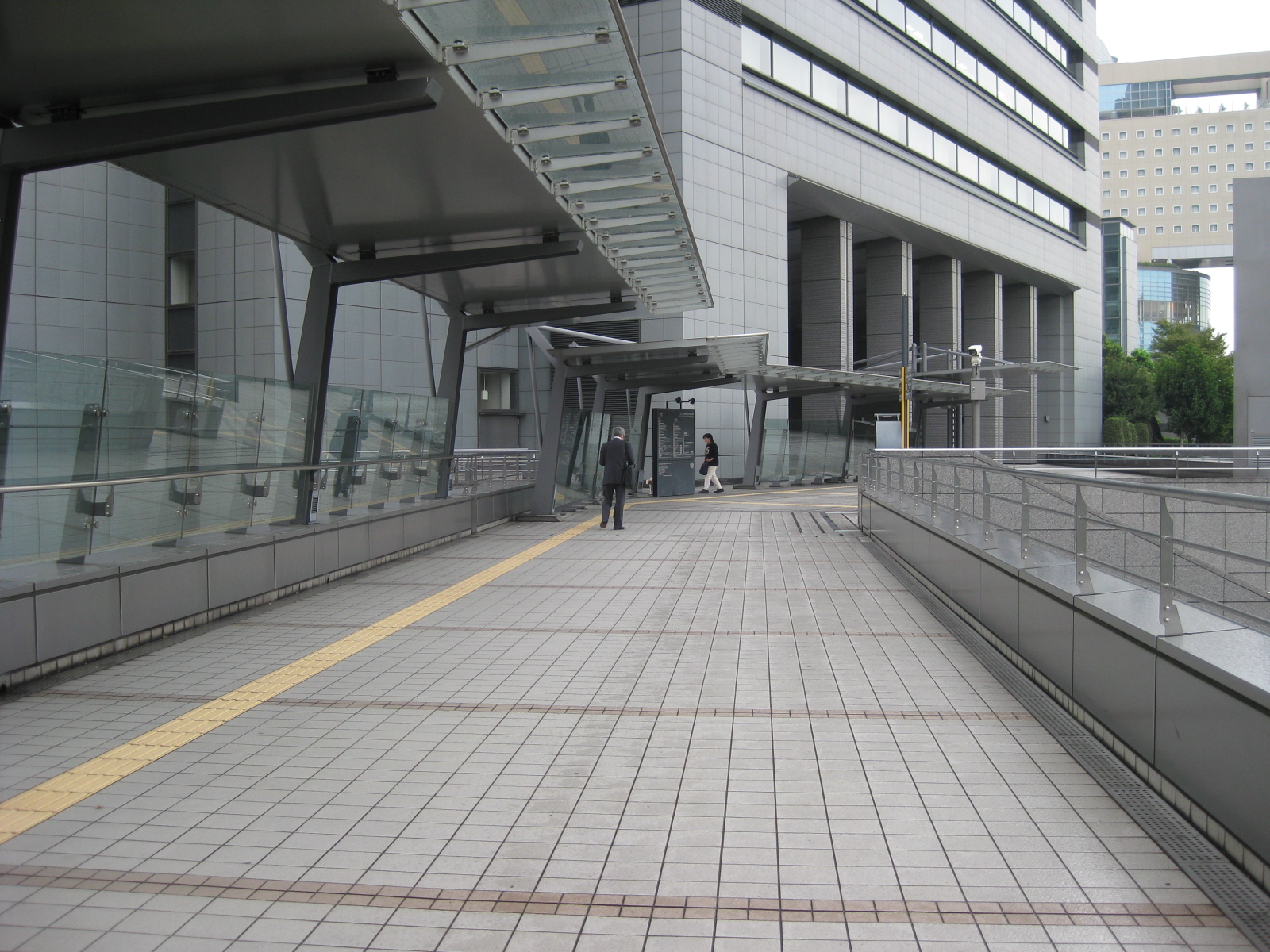 The walkways are wide and should be able to accommodate a high volume of pedestrian traffic. This section leads to the Saitama prefectural government offices located in the building on the background.
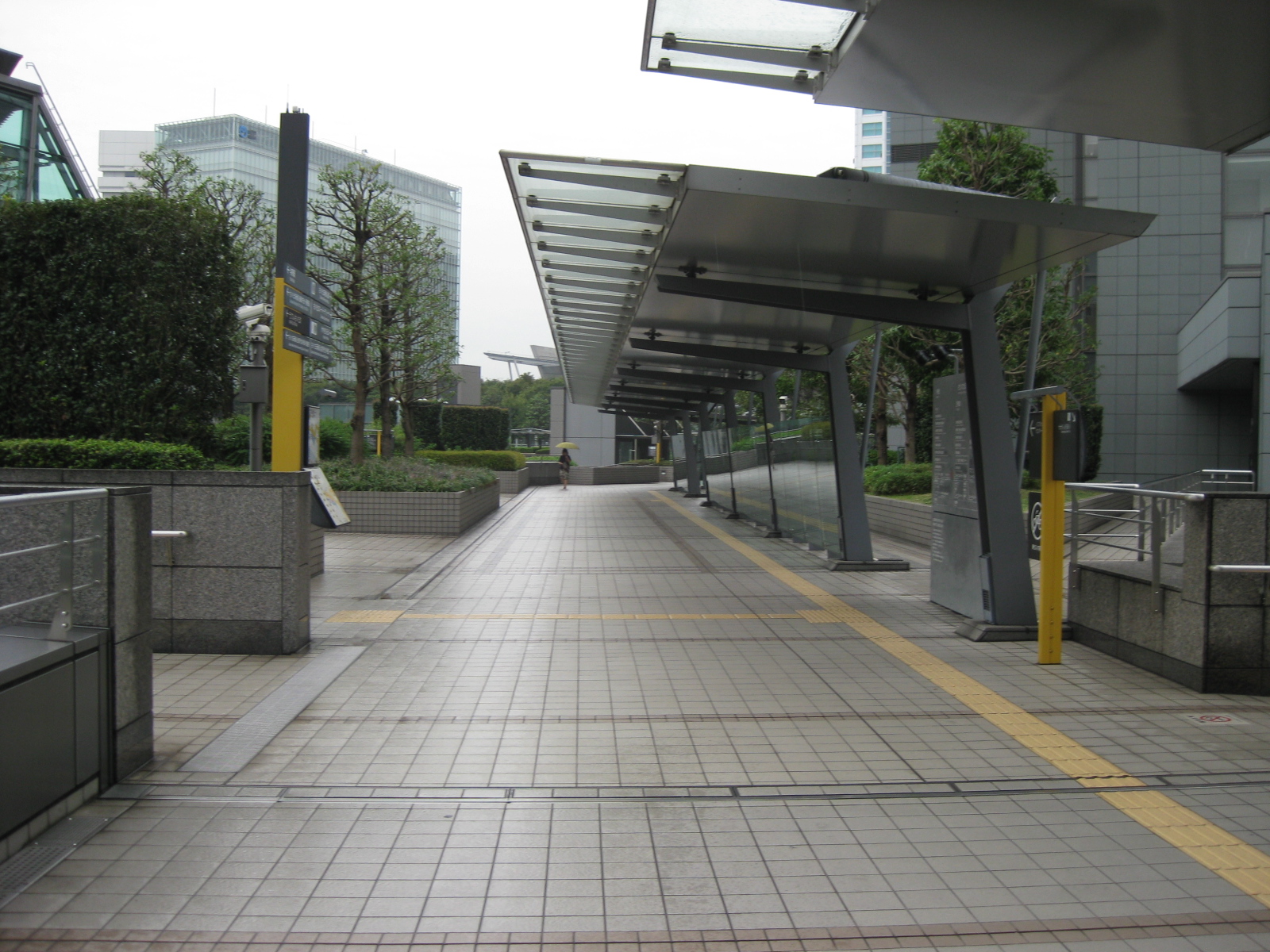 The yellow tiles forming the paths for blind pedestrians are designed to be under the shed and extends to the stairs from which the pedestrian could access the sidewalks and establishments at the ground level of the complex/area.
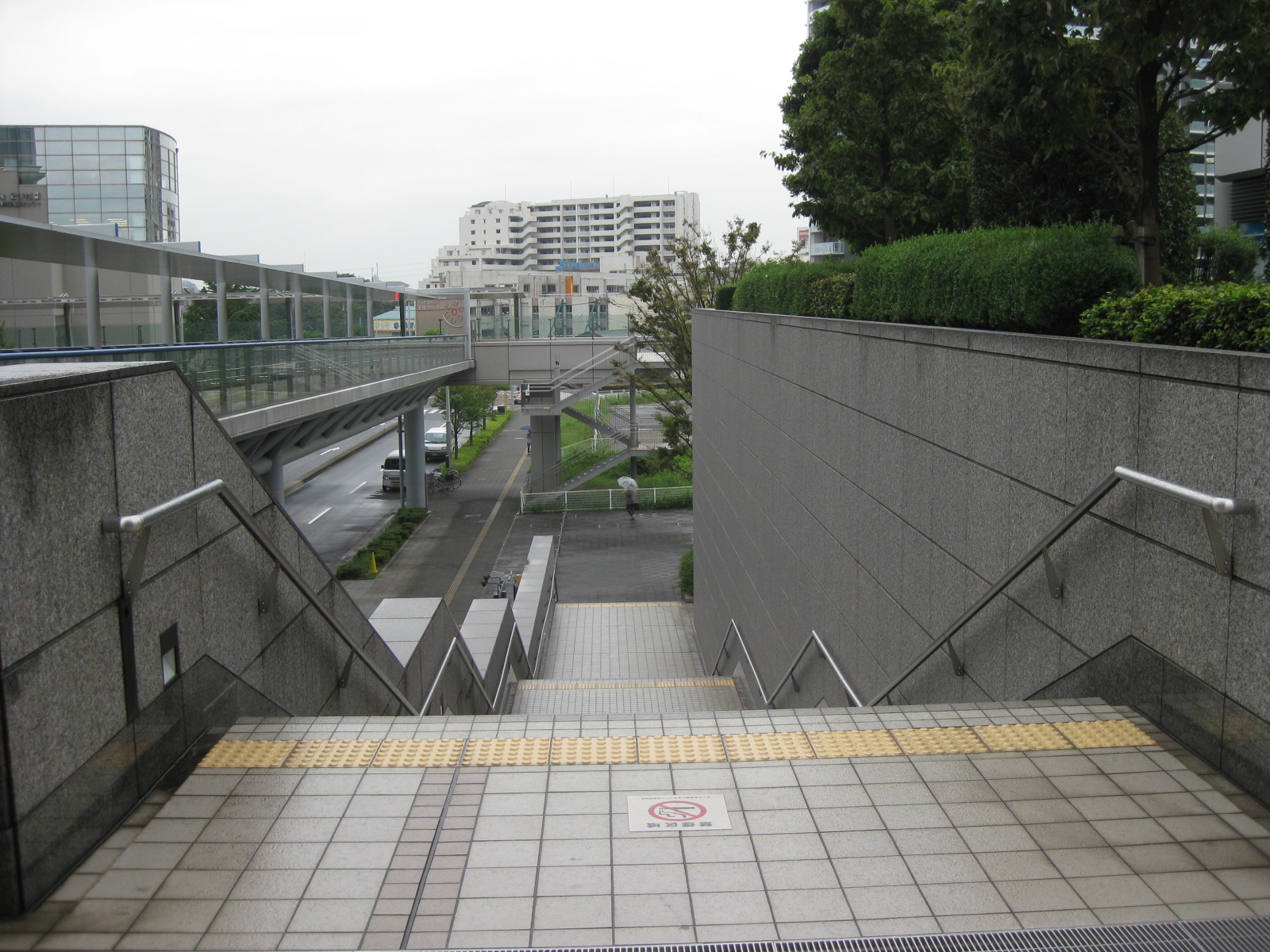 Stairs are designed with hand rails to support physically challenged people including the elderly. Note the yellow strips prior to the first step down the stairs.
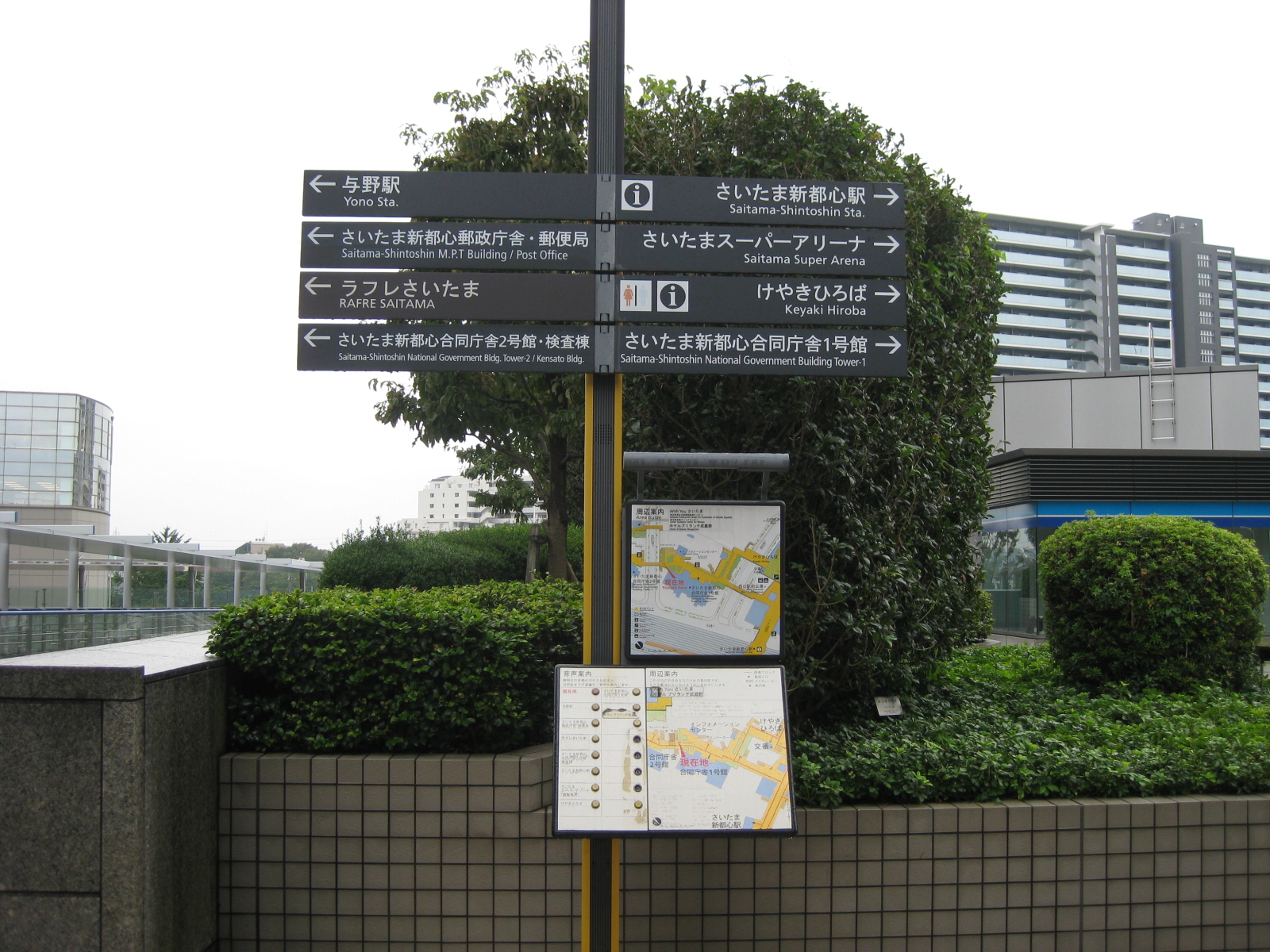 Pedestrian need to have access to information and maps and directional signs provide guidance for people especially those unfamiliar with the area (e.g., visitors or tourists). Most signs in the urban areas of Japan have English translations like what is shown beneath the Japanese in the signs above.
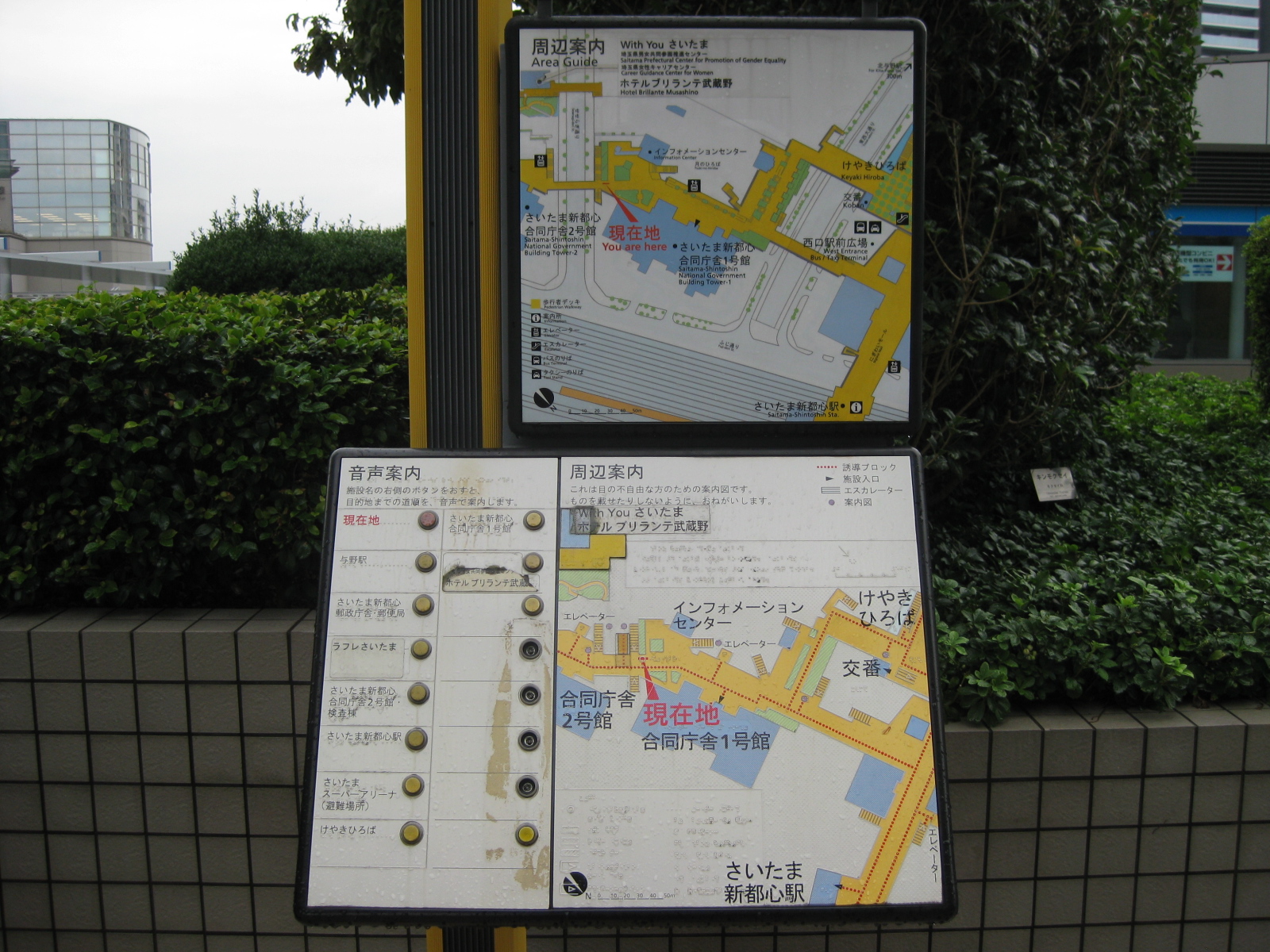 Some maps have interactive features. In this case, there are buttons that provide audio description of places of interest on the map. Today, there are already touchscreen maps in malls and there should be outdoor versions of such facilities.
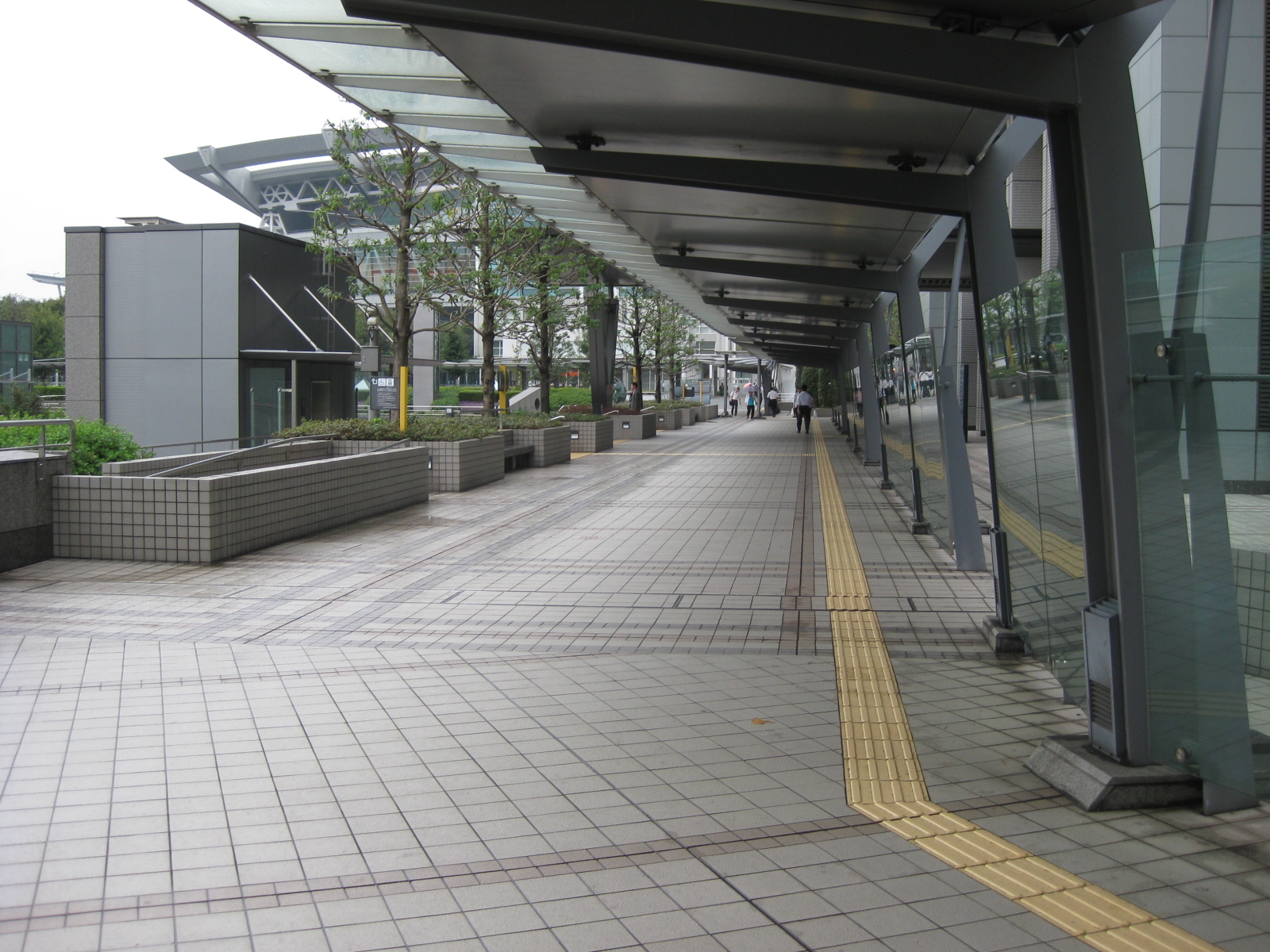 Another photo of the spacious walkways in the Saitama Shintoshin area. One could see the roof of the Saitama Super Arena on the upper left part of the photo and the building housing the elevators for those using wheelchairs or carrying heavy items.
 Closer to the station and the arena.
 There are plant boxes containing brushes and trees along the walkways, providing a more relaxing environment for pedestrians.
 The walkways eventually lead to the complex where located is the Super Arena on one side to the train station in the middle and the commercial complex on the other side.
 Walking from the station to the commercial establishments and office after the Super Arena (at right in the photo), there is a wide space for visitors (e.g., fans, spectators, etc.). There are many coffee shops and restaurants in the area where people could meet up for coffee or tea aside from grab a quick or leisurely meal.
 This the view of a pedestrian approaching the Saitama Shintoshin JR station. Shops are located along the right side of the promenade while the arches form the roof structure of the station, reflecting the modern architecture of the transit station.
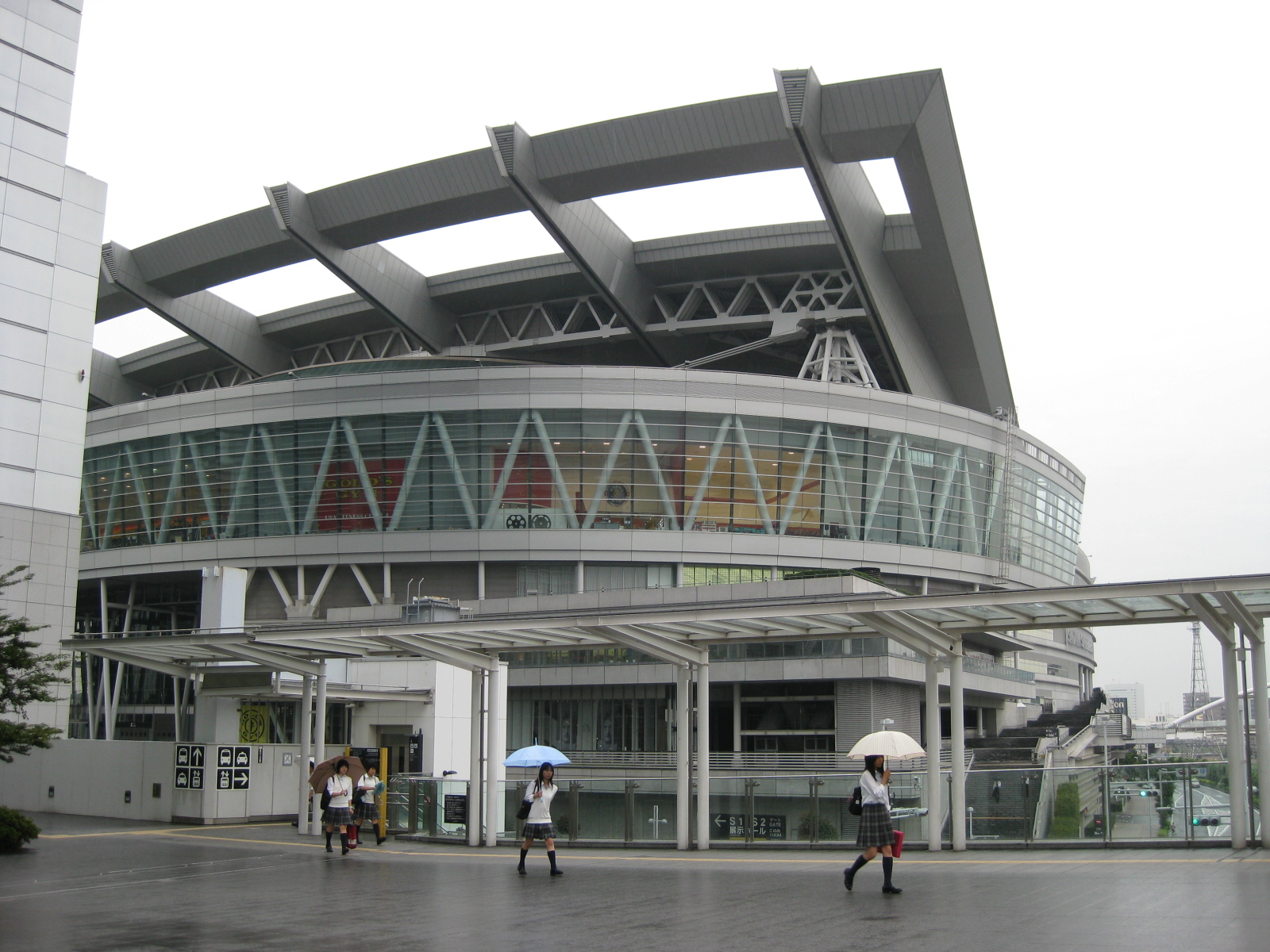 The Saitama Super Arena is also host to a museum dedicated to the late Beatle John Lennon.
 Inside the JR station plaza with kiosks on the left side and ticket machine to the right. Further on are more commercial establishments located in an upscale mall.
–
SM Marikina-Santolan Station pedestrian walkway
A good example of providing for pedestrian access for development is the walkway connecting LRT Line 2’s Santolan Station with SM City Marikina. Of course there’s an even better example in Makati City where the walkways at the Ayala CBD connect office buildings and the commercial center comprising Greenbelt and Glorietta. That system of walkways is probably the first of its kind in the country and has not been replicated elsewhere, at least as far as I know. The significance of the walkway that practically connects to points in two cities (SM is in Marikina while the LRT station is in Pasig) is that it is a good example of a facility that provides access to a transit station. Not too long ago and before Typhoon Ketsana laid waste to the area beneath the bridge and overpass, there was even a proposal for a public transport terminal to be developed here. If this was realized, then the area would have been a very busy hub similar to Crossing or Market!Market! but maybe not at the level of Cubao.
 The elevated walkway across the bridge along Marcos Highway is wide and obviously designed to be able to handle the potential number of people generated by the mall.
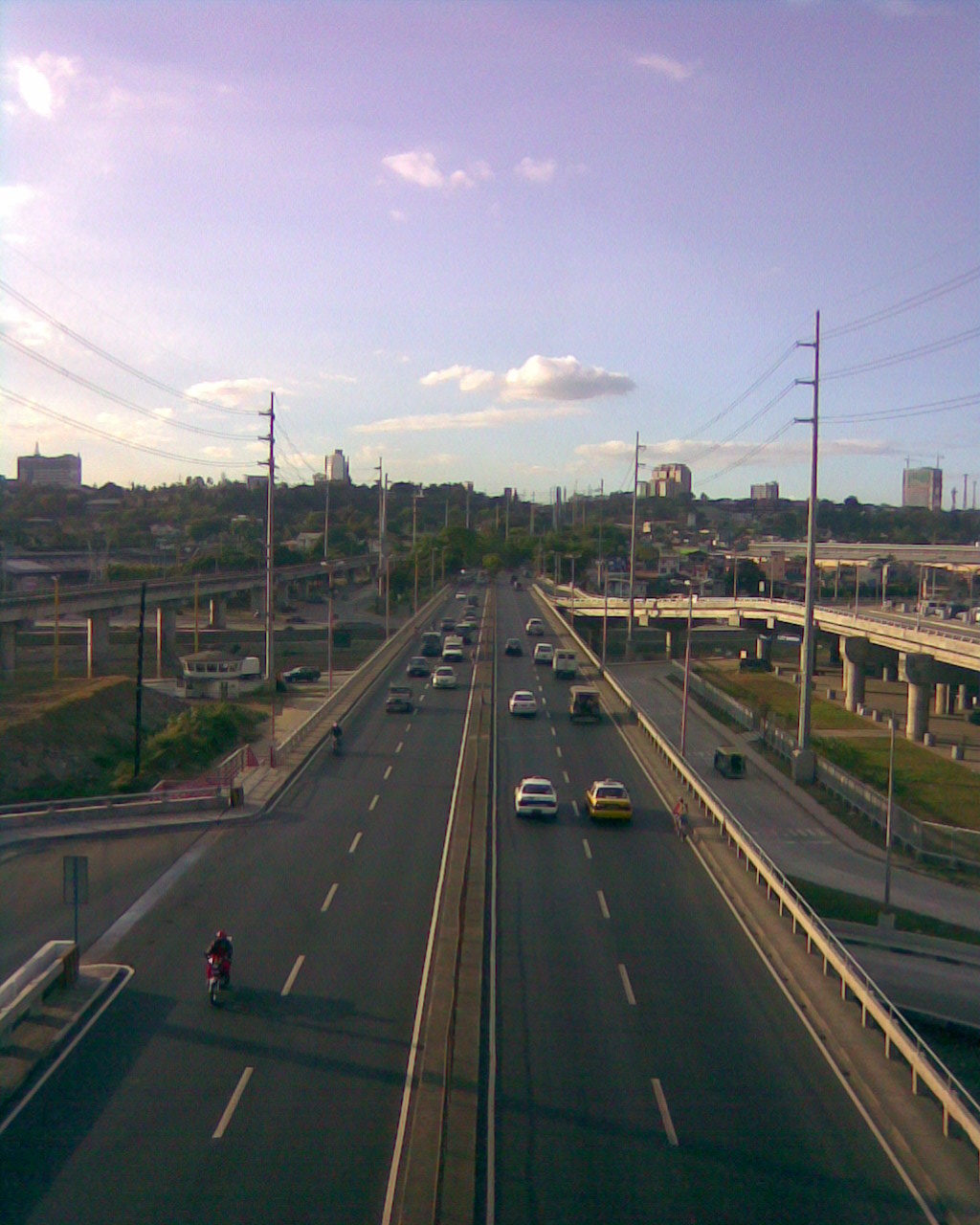 The walkway provides a perfect position for observing traffic along the bridge. This is probably an ideal location for a station for conducting screenline traffic counts for Metro Manila. The driveway on the left side of the photo is for public transport loading and unloading bays commonly used by jeepneys bound for the towns of Rizal Province.
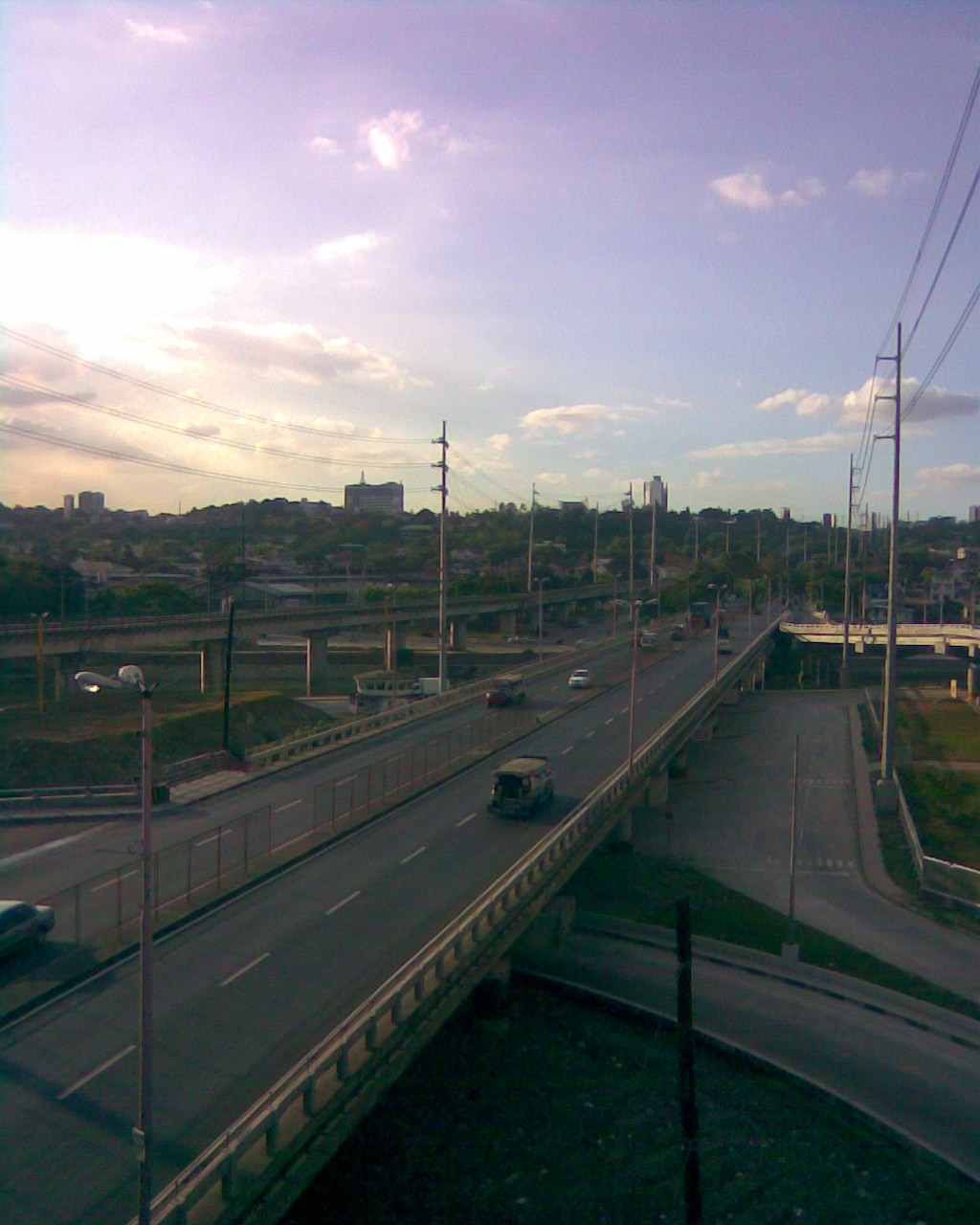 Another view from the walkway with a good perspective of the underpass connecting to a bridge to C5. Visible from this position is the area under the bridge that was proposed to be an eastern bus terminal during a previous dispensation at the MMDA.
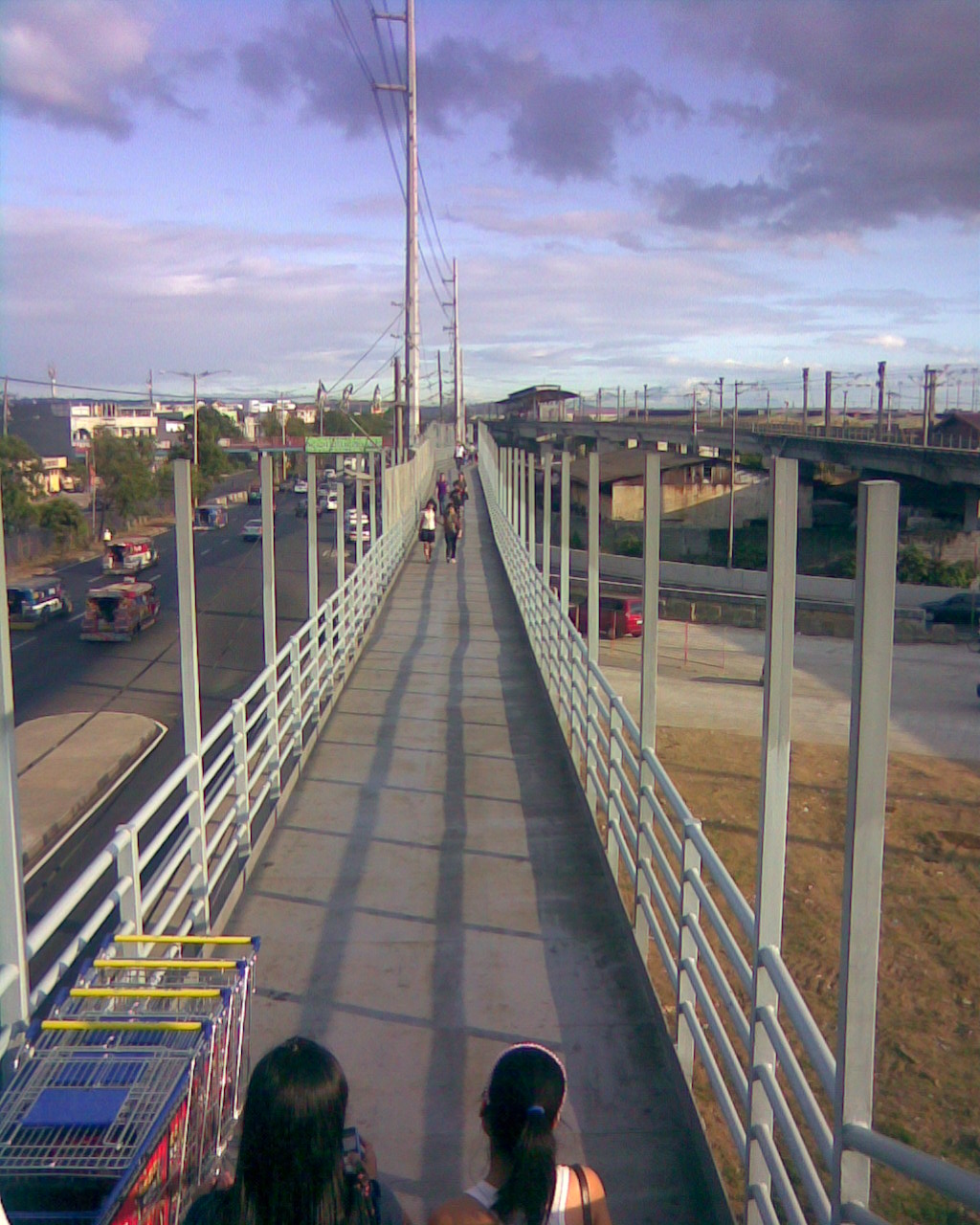 The long walk to the MRT station – from this perspective, it seems the walkway connects directly and almost level with the station platform. It is not at all connected directly with the station. Instead, one has to walk towards the end of this path and then down the stairs that end at the sidewalk near the PUV loading/unloading area. To get to the station, one has to walk some more. The posts appear to be provisions for the installation of a roof over the walkway to shield people from the elements.
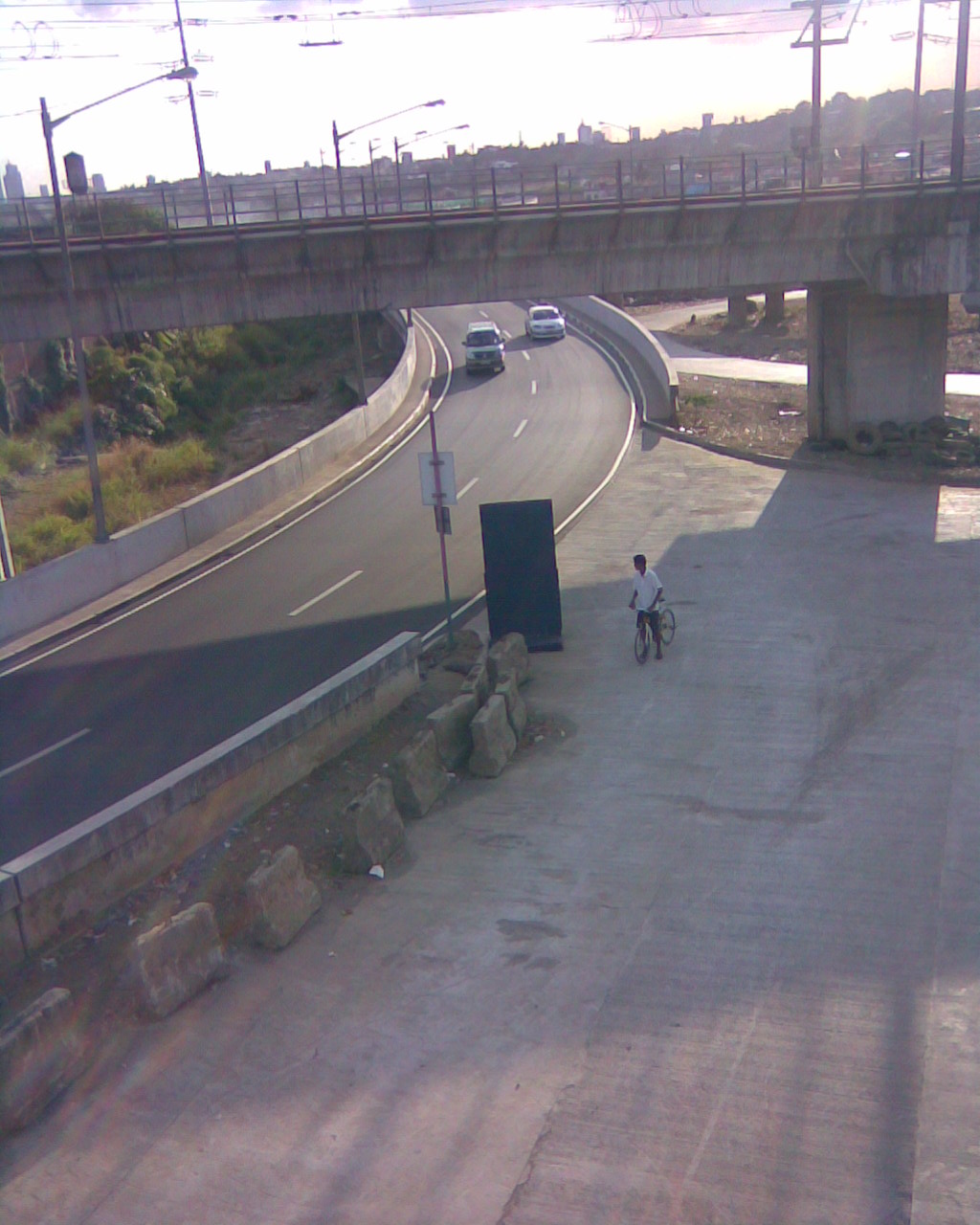 That’s the branch of the bridge emanating from C5 via the Riverbanks Road that was constructed on land expropriated from Camp Atienza, headquarters of the 51st Engineering Brigade of the Philippine Army. The curved section carries traffic from C5 that feeds into eastbound lanes of Marcos Highway.
–
Pedestrian overpasses along Ortigas Extension
This post is a continuation of recent ones featuring pedestrian overpasses along major roads. These past posts include facilities along Commonwealth Avenue and Espana Boulevard. This time we take a look at similar facilities along Ortigas Avenue Extension, which stretches from C5 to Kaytikling Junction in Taytay, Rizal. Following is a photo journal of overpasses from Rosario until Cainta Junction.
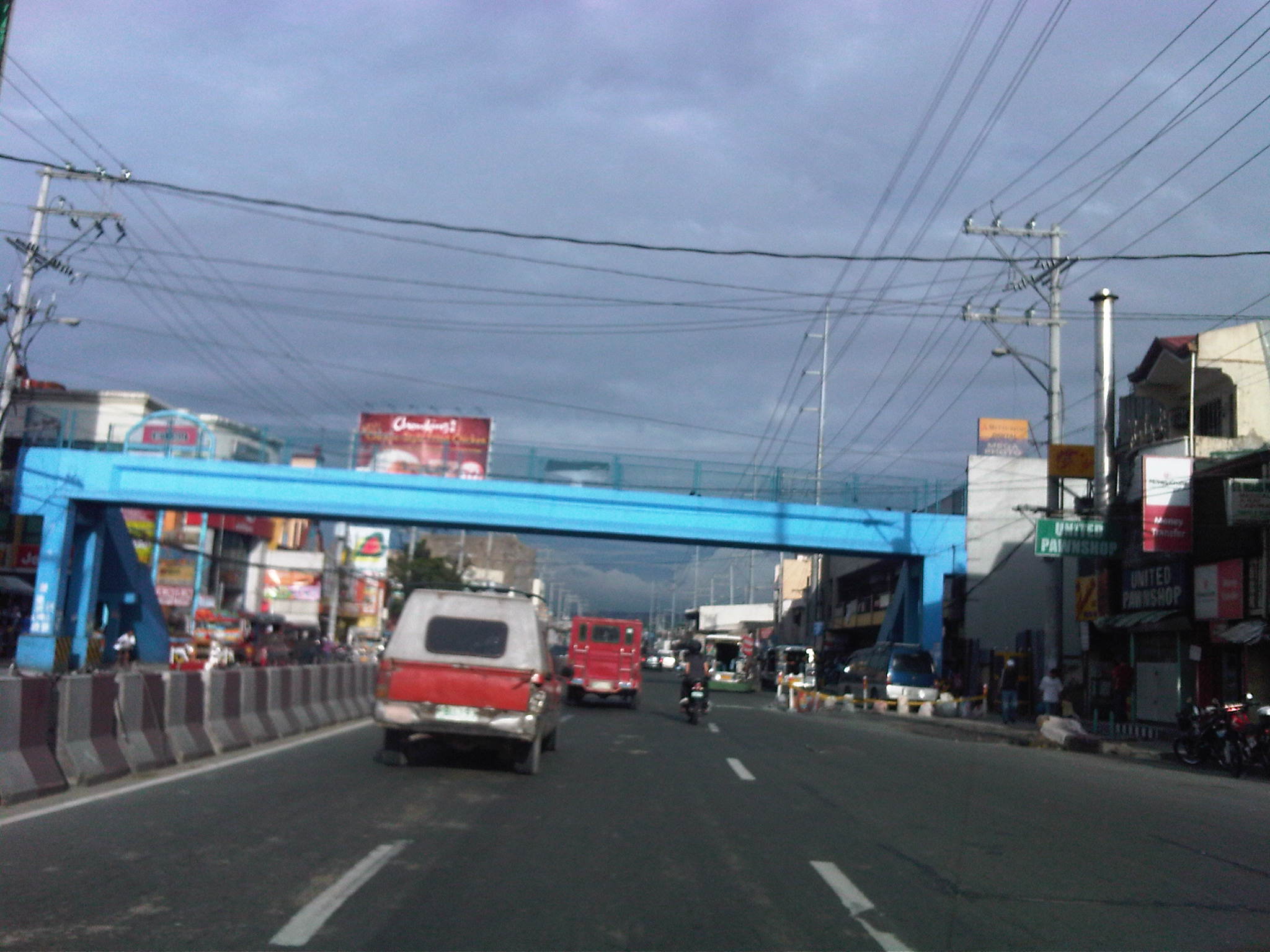 Concrete overpass at Rosario as viewed along Ortigas Ave. eastbound – it appears to be newly repainted but the design suggests it is an older structure of the more traditional design. There used to be no overpass here despite the volume of pedestrians crossing the street due in part to the Sto. Rosario Church on the left side of the road. At-grade crossings are still common with many jaywalkers hurdling/jumping over the concrete barriers.
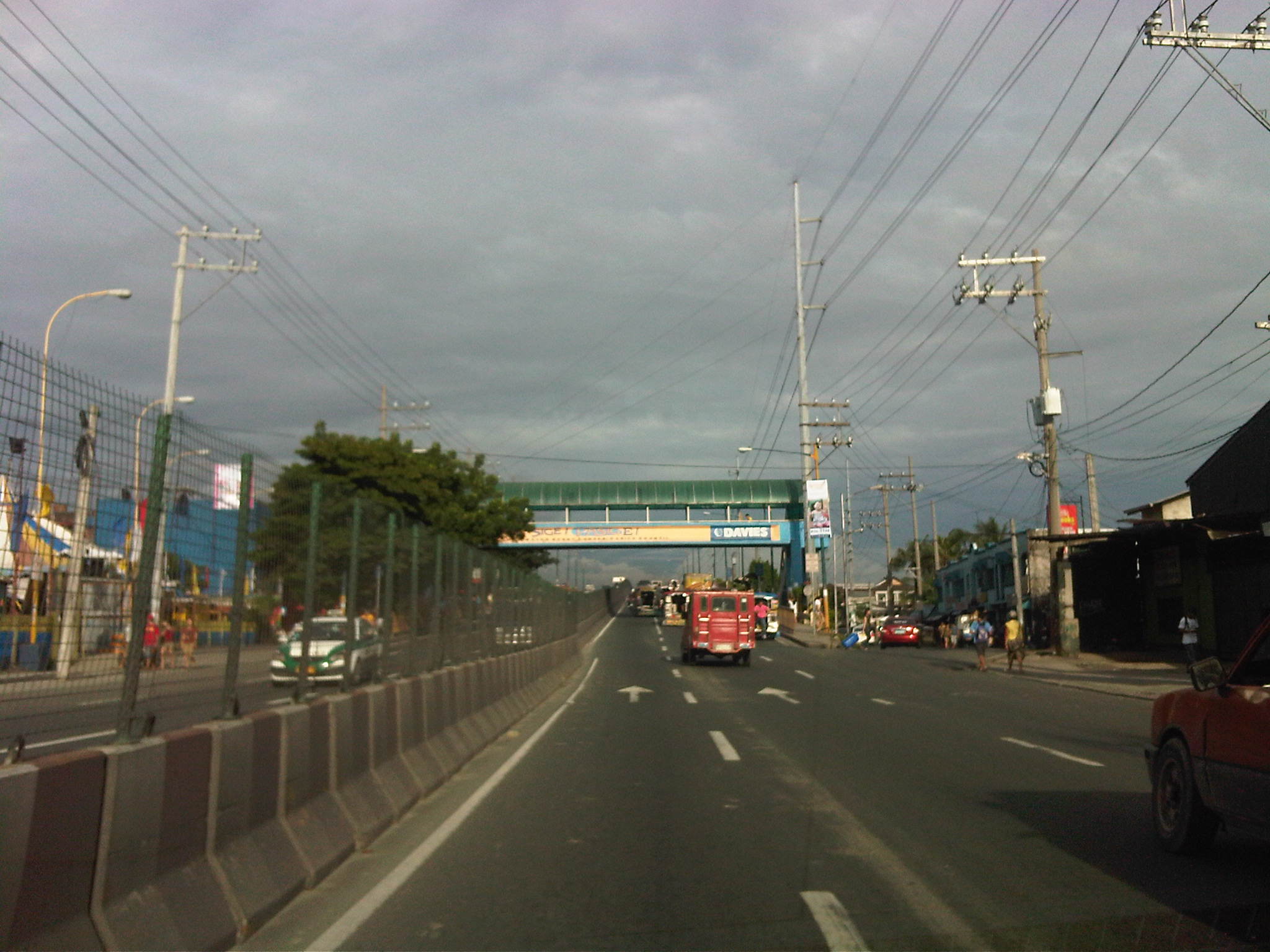 Overpass at the approach ramp to the Manggahan Bridge – seen from Ortigas eastbound, this is one of two overpasses found at either ends of the bridge crossing the Manggahan Floodway. There is a service road on either side Ortigas just beside the overpass that serves as access to the the West Service Road along the floodway.
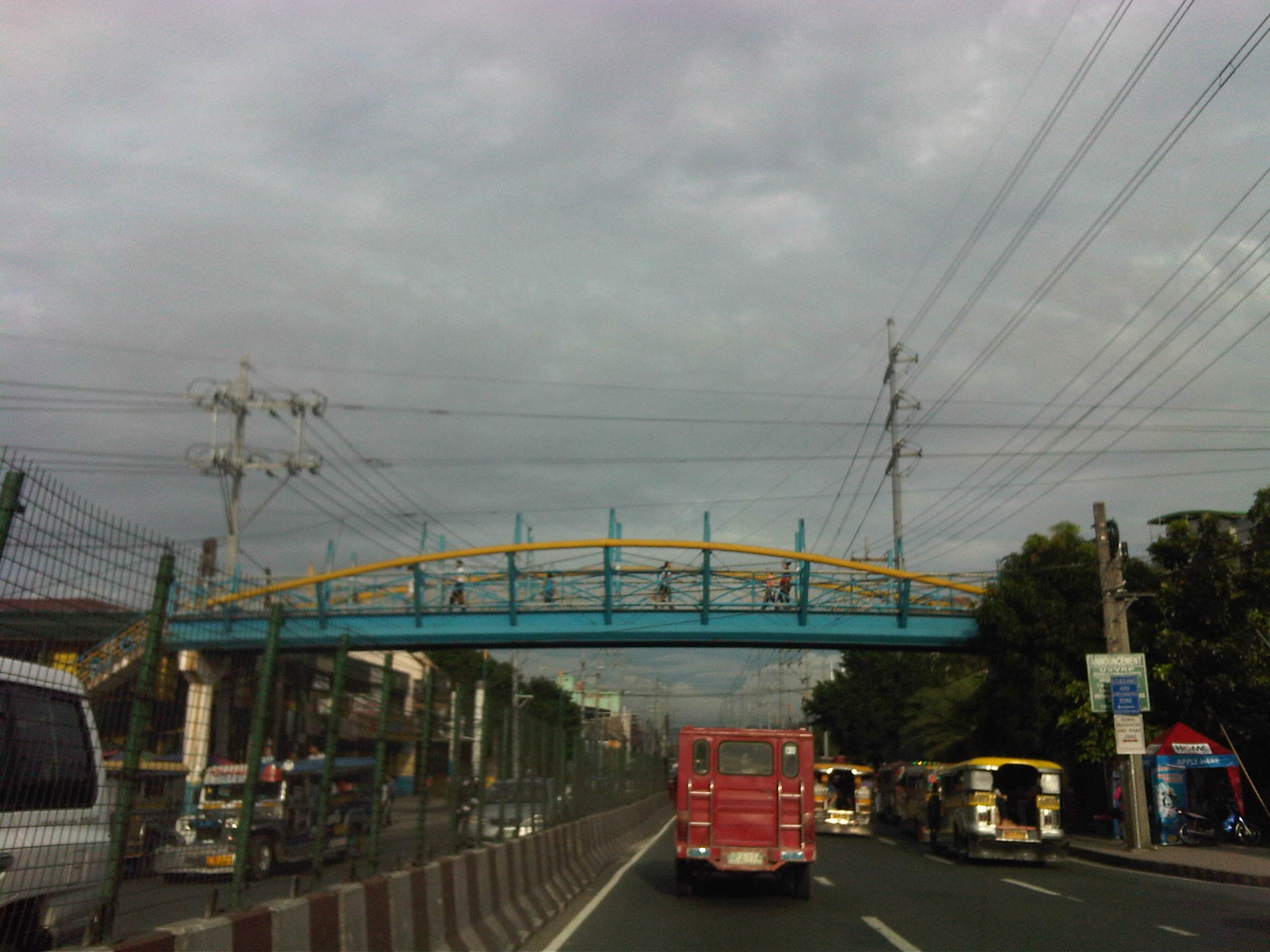 Second overpass at the exit ramp right after the Manggahan bridge – as viewed from Ortigas eastbound, the facility is similar to one found along C5. The steel structure comes across as a rather odd design that I’m sure my architect friends would have their own opinions about. As far as I am concerned, I think there’s just too much steel and is unnecessary though it can be claimed for aesthetics by the designer. Perhaps I am too concerned with functionality and safety rather than beauty?
 Overpass across Ever mall – the covered section of the overpass is concrete and similar to the Rosario overpass. The extension of the overpass is visible from this photo at the right side just above the minivan, and has the distinctive mark of the MMDA (the double M seen in the photo). The extension is a steel structure like most of the newer facilities constructed during the time of BF that allows pedestrians to walk overhead and straight to the mall. This section of Ortigas is quite unusual as outbound (MM-bound) traffic occupy all lanes of Ortigas at this area. Inbound (Rizal-bound) traffic are diverted towards a stretch fronting the mall that appears like a bypass road. Traffic eventually re-enters Ortigas right after the mall.
 Overpass across Cainta Public Market and Robinsons Cainta – this is a concrete structure that is covered and, surprisingly, is clear of vendors thanks to the efforts of Cainta enforcers and the mall security. The public market side (left side of the photo) is too crowded with the pedestrian immediately encountering informal vendors’ stalls upon descending the stairs. While there are no vendors atop the overpass, there are many tambays loitering about and the usual beggar sitting anywhere about the structure (usually at stairs along the public market side). The facility extends all the way towards the mall, which can be accessed via its second level.
Pedestrian overpasses along Espana Blvd., Manila
I took some photos of pedestrian overpasses along Espana Avenue in Manila while en route to a meeting in Malacanang. I was hoping to capture the conditions along such facilities and maybe compare them with my observations along Commonwealth Avenue. Following are photos taken from my trusty Blackberry. I ask my readers to excuse the reflections due to the sun bearing down on the windshield of our vehicle.
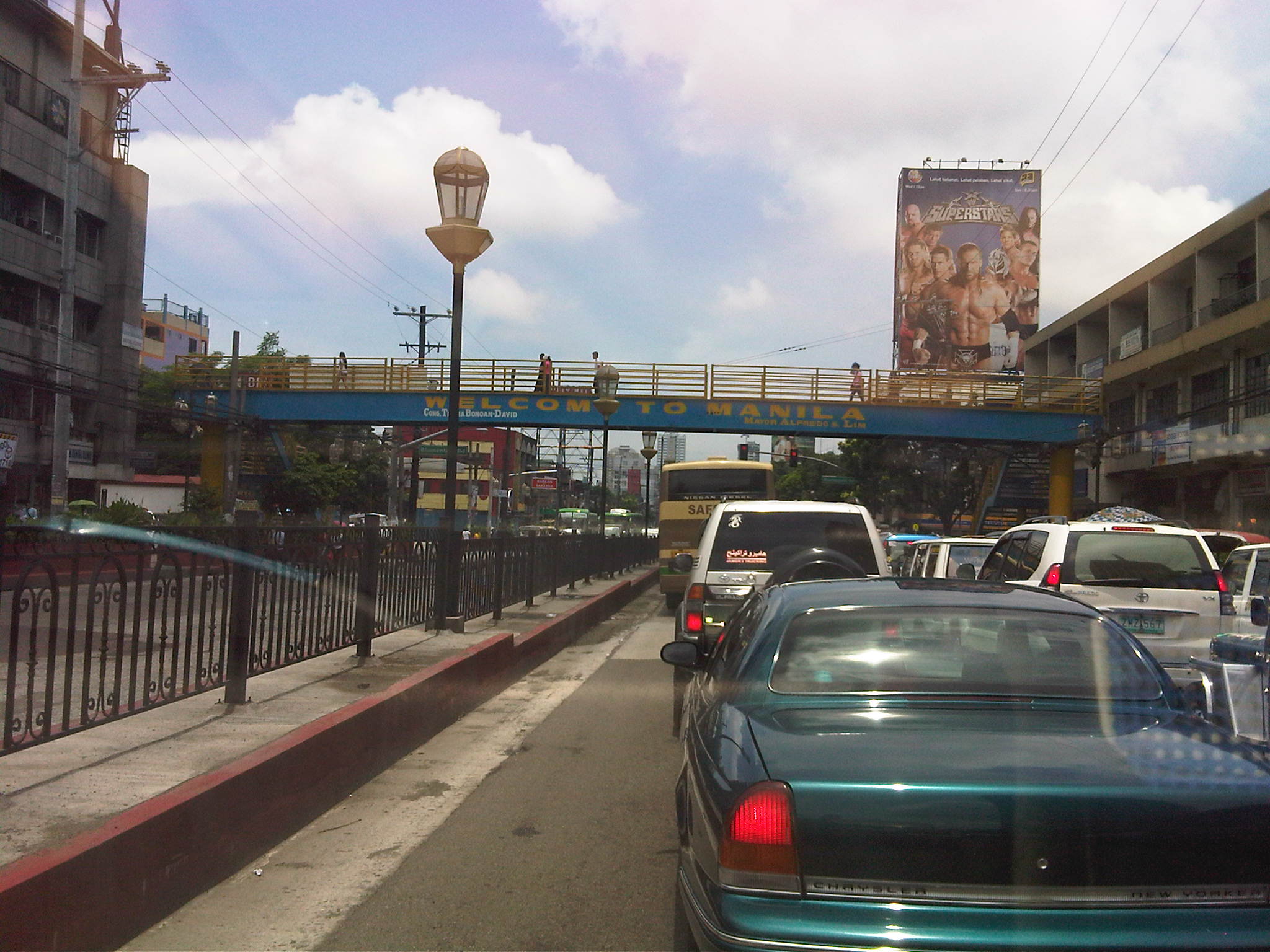 Steel overpass built during the last MMDA administration. Many pedestrian overpasses were constructed out of steel by the MMDA and this was attributed (allegedly) to the previous Chair having a construction and steel manufacturing outfit. True enough, many of these structures bear his initials that is also the name of his corporation. Many of these structures were criticized by the DPWH for not following standards (e.g., one can feel the deflection of the overpass while traversing its length) but the same agency seemed helpless in their case against such facilities.
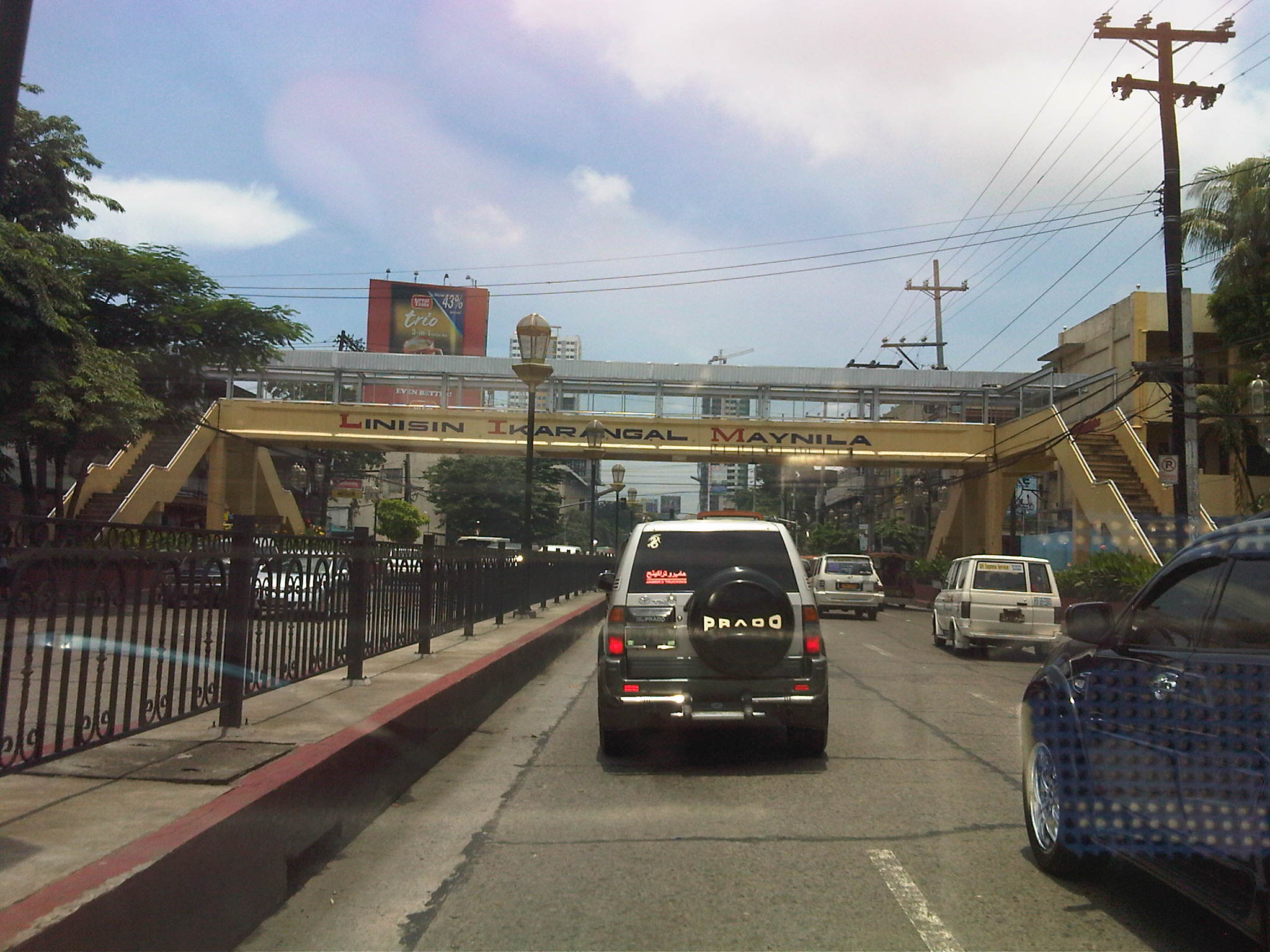 Older concrete overpass across Ramon Magsaysay School. This appeared to be clear of vendors while the roof structure is unfinished giving users no protection from the elements.
 Overpass across UST. This is one of the older and larger (widest?) pedestrian facilities along Espana considering it serves the students of one of the largest (in terms of population) universities in the country. There are vendors on this overpass but mostly those selling candies and cigarettes(!). I am not sure if UST has posted a guard along this overpass considering the safety and security interests of its constituents. Similarly situated overpasses along Katipunan Avenue are secured by personnel provided by Ateneo De Manila University and Miriam College. I would like to see this overpass retrofitted and re-designed to match UST’s heritage. The institution, after all, just celebrated its 400th anniversary.
 Overpass at P. Noval Street. It is not so clear from the photo but one can easily see vendors with their wares set-up along the overpass and clogging the flow of people. This is another relatively old structure as this is a major crossing point for people in studying or working in the University Belt.
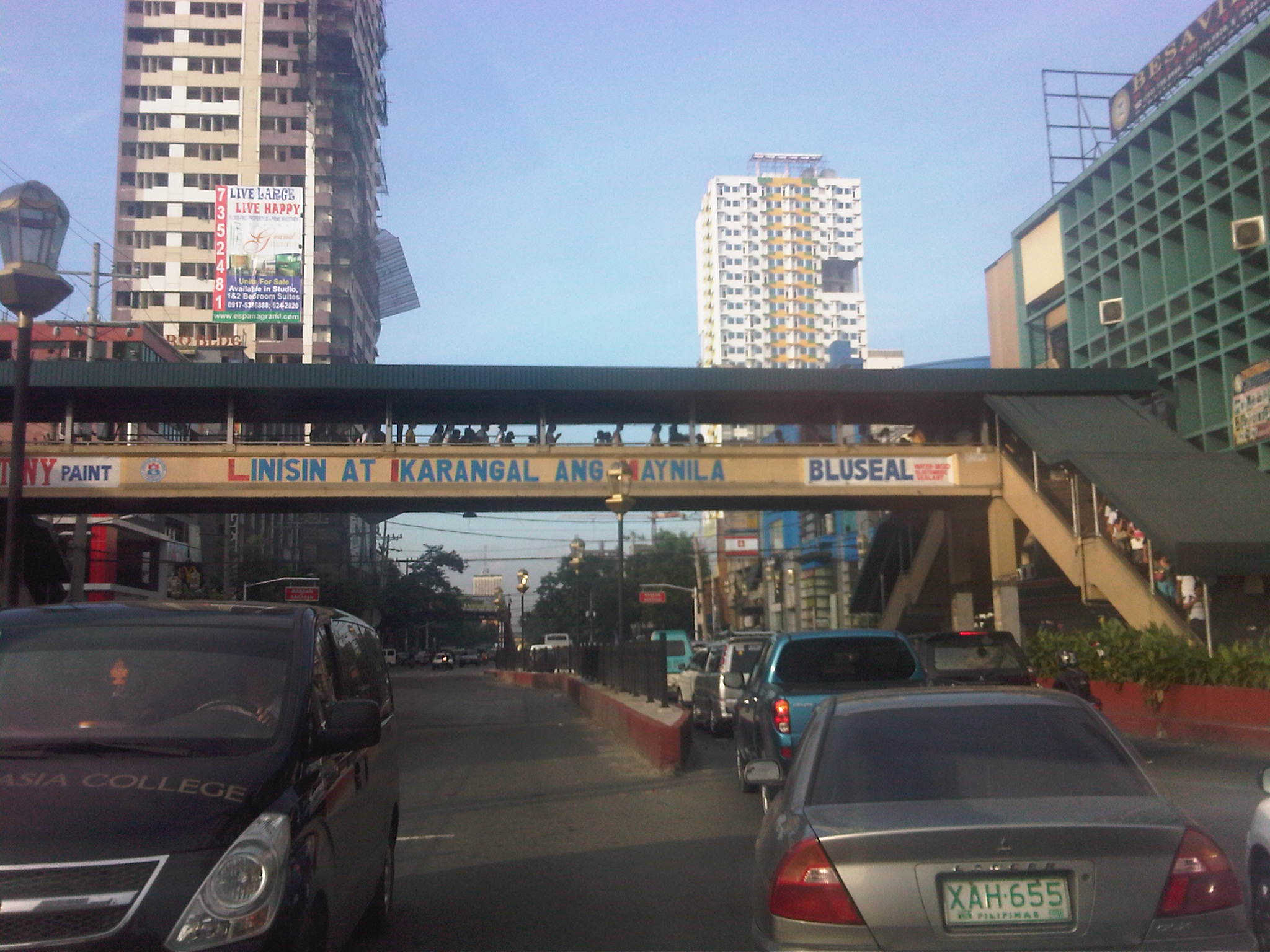 Another look at the P. Noval overpass from the Quezon City-bound side of Espana. Notice the high volume of pedestrians using the overpass? Most of these are students studying at one of the universities at U-belt or graduates reviewing for their respective licensure exams in one of the many review centers located in the area. There are many nursing and engineering review schools in the area.
If we are to encourage walking as a mode of transport and especially applicable to short distance trips, we would need to invest and build the necessary pedestrian facilities. Such facilities need to be structurally sound and therefore compliant with the standards set by the DPWH and properly located to encourage their use. Design, of course, includes capacity considerations since they should be able to accommodate volumes of pedestrians during peak periods. As such, overpasses would have to be clear of vendors or others that constrict flow. Ideally, pedestrian facilities should also be designed according to a criteria that includes aesthetics that adheres with the character of the area where it is located. It is understandable that construction of such facilities may have been rushed due to the urgency of the situation (i.e., like in the case of Commonwealth). Nevertheless, while the intent is good, the execution of the solution should still adhere with standards considering that these are often long-term investments for public infrastructure.
Pedestrian overpasses along Commonwealth Avenue
Commonwealth Avenue is still regarded as a “killer” highway despite the efforts to reduce road crash incidence along this thoroughfare. Many of these crashes involve pedestrians who continue to cross the highway on at-grade or on ground level at many points of the highway despite this being prohibited or discouraged. To cross the avenue, pedestrian overpasses have been constructed at strategic locations along the highway including those at Fairview Market, at Ever/Shopwise and at Tandang Sora, at U.P. (2 overpasses – one at AIT/CHK and another at Technohub), and at Philcoa. Despite these facilities being constructed and possibly with a few more to be constructed in the future, many people still choose to jaywalk. Among the reasons cited are stairs being too steep and the long distances they have to walk to and from the overpasses.
Following are photos taken on a Sunday drive from Novaliches to UP showing the conditions on and around overpasses along Commonwealth Avenue. Noticeable are overpasses across Fairview Market and Ever/Don Antonio where vendors have set up shop and impede the flow of pedestrian traffic.
 Pedestrian overpass across Commonwealth at Litex and before Fairview Market (section is at Commonwealth southbound) – the overpass is surprisingly free of vendors despite its being well within the influence area of the market.
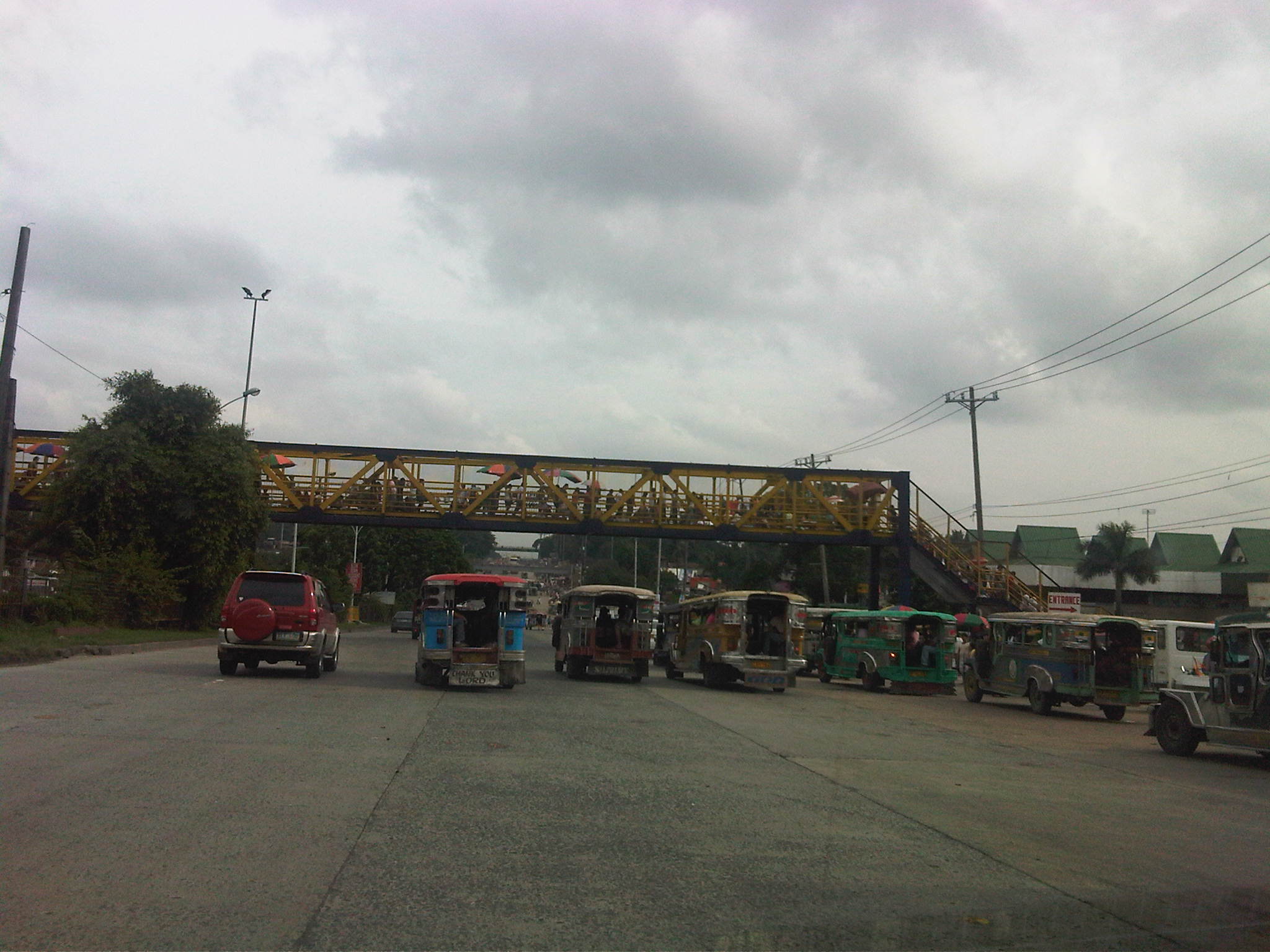 Overpass across Fairview Market (section is across Commonwealth southbound) where vendors have set up to sell various merchandise. Notice the umbrellas to shield vendors from the elements. Note, too, the jeepneys congregating under the overpass and taking up 2, 3 or even 4 lanes of road space and thereby causing congestion along the wide avenue.
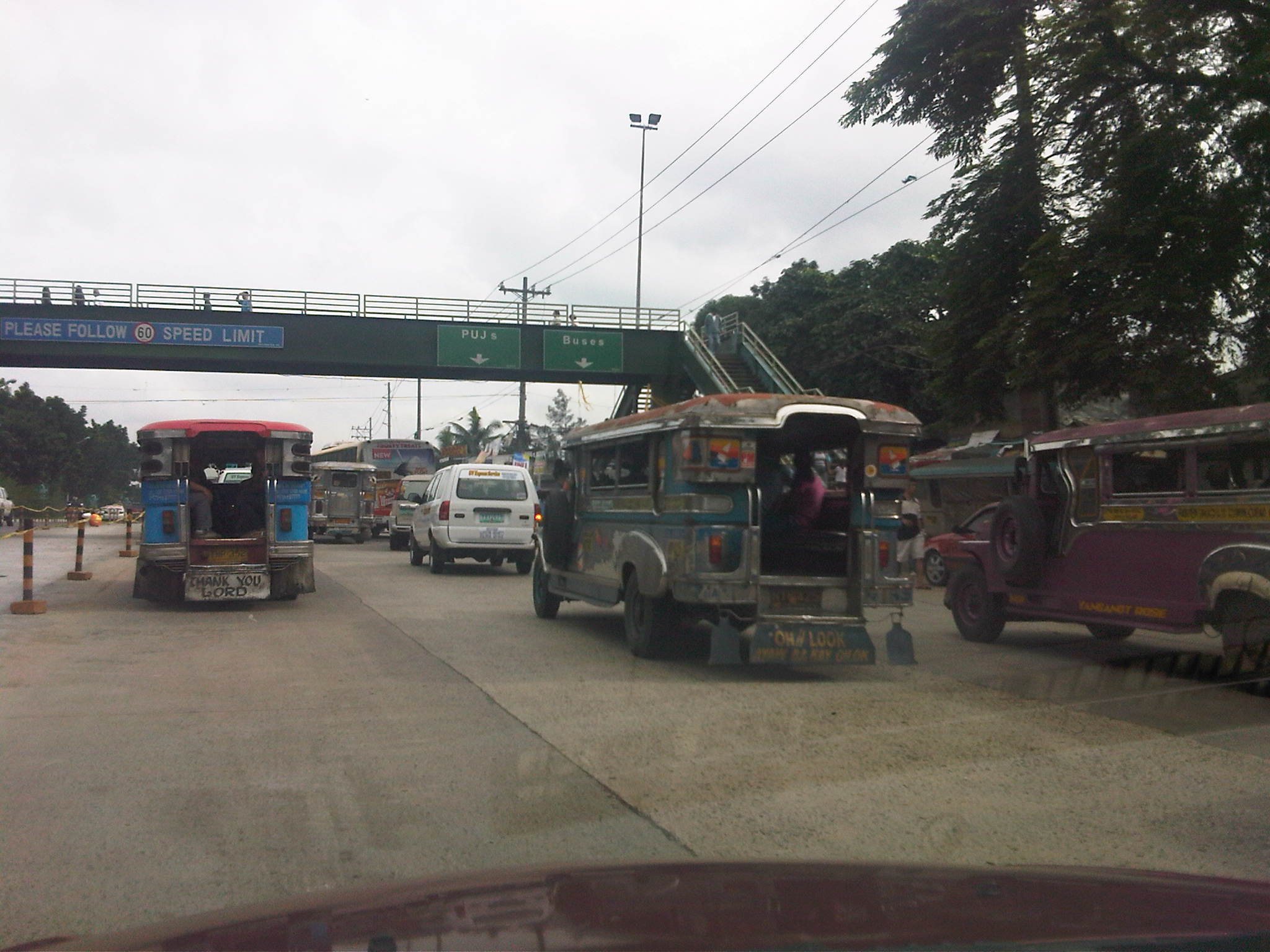 Overpass after Fairview Market and across densely populated areas that are mostly informal settlements. Jeepneys and buses usually congregate under this overpass and another downstream which is across from the Sandiganbayan. The bollards to the left are to segregate a lane with recently laid concrete (re-blocking of certain lanes along Commonwealth).
 Overpass across Ever Commonwealth where vendors have also set up to sell merchandise. The design evokes those of old steel truss bridges in Manila across the Pasig River like the Quezon and Ayala Bridges. Notice the congestion at the overpass at the left portion of the photo.
 Overpass across Tandang Sora where the middle portion descends under the T. Sora flyover in an unusual design that calls to mind the adjustments made for pedestrian facilities constructed across EDSA, and above or below the MRT3 alignment. Notice the countdown timer for the signals at this major intersection.
 Overpass across AIT and CHK of UP Diliman. The canopy is one of two set up atop the overpass for MMDA personnel taking random speed samples to enforce the 60 kph speed limits along Commonwealth. On most days I travel along Commonwealth, there is usually no one taking measuring speed along the NB direction of the highway.
The overpass across the UP Technohub is relatively new but it is free from vendors. In fact, the two overpasses across UP are free from vendors and are regarded as safe and secure because of guards (and even MMDA enforcers) posted at the overpasses to ensure the safety of users of the facilities, especially students and employees of UP and of the Technohub. However, the Philcoa overpass continues to be occupied by vendors despite its roof being removed by the MMDA a few years ago with reasoning that this would deter vendors from setting up atop the overpass.
The problem of vendors on the overpasses is an enduring issue and one that is quite easy to solve if authorities are serious about addressing it. In fact, it is so easy for enforcers or police to prevent or even apprehend/accost vendors as frequent as the latter attempt to set up on the overpass. The continued presence of vendors suggest that there is no sustained effort against these vendors. There are those who even suspect (and are perhaps correct in certain cases) that enforcers or police are being paid to turn a blind eye to these vendors. This is a story that is replicated in many parts of Metro Manila as well as in other cities across the country where overpasses become small time malls or shopping streets, thereby defeating the purpose of having these facilities in the first place. The challenge is for local government units to do what is right in such cases if only to ensure that facilities for pedestrians are safe, secure and unimpeded for efficient flow.
Some issues on walkability in the Philippines
I have written about walking in the past (No Car? No Problem!), and it was mainly about a personal experience I had commuting home one evening. At the time, I had already made the observation that we are generally lacking for pedestrian facilities. We do have sidewalks but most are too narrow for the typically high volume of pedestrian traffic. In cases where there are sufficient width or space, sidewalks are often occupied by vendors. In commercial areas, establishments also have a tendency to encroach on pedestrian space thereby constricting the walkways. This is the predicament in most, if not all, Philippine cities and the result is often that pedestrians are forced to walk along the carriageway, using space that is supposed to be for motor vehicles and effectively causing congestion due to the reduced road capacity. Such are issues pertaining to walkability that touches mainly on the safety, mobility and accessibility aspects of walking.
In rural areas and particularly along national highways, there are practically no pedestrian facilities unless one considers highway shoulders as appropriate for walking. As such, one will most likely find people walking along the shoulders or, should it be the wet season and these shoulders happen to be muddy, along the carriageway. It is not uncommon also to see children walking along the highways since many schools are located along the roads. Such situations often put children at risk, thereby magnifying their vulnerability to becoming victims of road crashes.
Another vulnerable group are senior citizens, who, despite their age, can still be very active and are entitled to mobility just like any person. They, too, deserve facilities that will keep them safe from risks such as wayward public transportation or reckless drivers and riders. Then there are also those who are physically-challenged, people with disabilities who, despite their physical limitations, also have the right to move about. In fact, there are laws with provisions requiring public facilities to be designed according to the needs of persons with disabilities (PWDs). Sadly, pedestrian facilities in Philippine cities generally do not incorporate ramps, guides and other devices that would allow for efficient movement of PWDs.
Crossings are also a big issue considering the statistics of pedestrian involvement in road crashes. Of course, there are two sides of the coin here where, on one hand, hard-headed people still cross at inappropriate locations or say at street-level when there is an overpass or underpass nearby. Such incidences of jaywalking are quite prevalent in urban areas, betraying a lack of discipline that is often in combination with weak traffic enforcement. On the other hand, there are pedestrians crossing along designated locations like zebra crossings but are placed in harm’s way as motorists do not give way.
Heading to the airport last Maundy Thursday to fetch my wife, I took Marcos Highway and saw the many people walking to Antipolo Church, a popular pilgrimage site for Filipino Roman Catholics during the Holy Week as well as the month of May when the feast of Our Lady of Peace and Good Voyage is celebrated. They came from all over Metro Manila but mostly from Pasig, Cainta, Marikina and Quezon City. It was around 10:00 PM and due to the Holy Week, there were very few public transport (and vehicles in general) along the highway, which is a major corridor to the east. Most of them had to walk along the carriageway considering the ongoing construction work along Marcos Highway for a major drainage and pavement project. Considering the volume of people, they has practically occupied one lane (the outermost) of the highway. Fortunately, because there were few vehicles, the people didn’t have to worry much about being sideswiped as they walked.
I could imagine a similar case along Ortigas Avenue, which is along the original way to Antipolo Church. Perhaps there were even more people walking along that road considering that it passes through densely populated areas of Mandaluyong, Pasig, Cainta and Antipolo as well as the avenue being most accessible to people coming from Taguig, Makati, San Juan and Manila. The Way of the Cross along Ortigas Avenue has been enhanced with the construction of stations along the route that can be used as guides, especially by those who are unfamiliar with the pilgrimage. That way is also wanting for pedestrian facilities and often sidewalks are ill-designed and may even have electric posts impeding the flow of traffic.
To me, the solution to such issues on walkability is quite clear and does not require more than common sense. Obstacles along walkways, for example, need to be removed to ensure that there will be space for walking and ensuring smooth traffic flow. The MMDA deserves a lot of credit for waging an aggressive campaign during the time of Bayani Fernando, when he implemented a “sidewalk clearing” program that effectively returned space to pedestrians that were taken from them by vendors and establishments. The latter mostly did so in violation of the building code that is quite common in most downtown areas. Electric posts also need to be relocated and such may be coordinated with power/utility companies who are responsible for their installation.
On the technical side, there is a need to revisit design guidelines, if any, pertaining to pedestrian facilities. The National Building Code actually has provisions for designing sidewalks but there are none, to my knowledge, about designing overpasses and underpasses. There are no criteria currently being used to determine, for example, the suitable locations for overpasses and to estimate their capacities based on the principles of traffic flow. This, considering that there are actually level of service (LOS) criteria for walkways and other facilities catering to pedestrians. These design guidelines should clearly incorporate safety and accessibility so that the resulting facilities will be for the inclusive use of all.
On the enforcement side, there is nothing new and no surprises that the recommendation would be to have firm, consistent and aggressive enforcement of traffic rules and regulations. For this I may sound like a broken record but it only goes to show that we have not progressed much in this aspect of traffic management. The ningas cogon approach must go and programs should also be directed against those impeding pedestrian flow (e.g., vendors setting up on overpasses) as well as those whose behavior endanger pedestrians (e.g., reckless, undisciplined drivers).
I am optimistic, though, that with the combined efforts of many advocates for road safety, we may eventually be able to improve walkability in most cities in this country. For one, there are already several LGUs who have programs with a vision for them to be a walkable city. Among these are Marikina and Makati in Metro Manila, and San Fernando in La Union. More will hopefully follow the examples of these cities and, who knows, one day perhaps we can walk safely wherever and whenever we wish to do so.
All roads lead to Antipolo
The title of this post is based on a saying referring to the Shrine of Our Lady of Peace and Good Voyage that is located in what is now the City of Antipolo in the Province of Rizal, to the east of Metro Manila. The saying is based on observations during May when the feast of Our Lady is celebrated the entire month. While people flock to the shrine throughout the year often to pray for safe travel, many devotees go up the city in the Sierra Madre range during Lent to pray the novena to Our Lady, hear Mass, or simply to partake of the other attractions of this city.
Antipolo has been a popular pilgrimage site since the Spanish Period ever since the reports of miracles performed through the image of Our Lady of Peace and Good Voyage. These include her image being reportedly found among the Antipolo tree that is the basis for the name of the town that now is a highly urbanized city and capital to the Province of Rizal. Rizal, of course, is the name of the province that once was generally called Morong. One town of the province still bears that name and it, too, has a beautiful, picturesque church. The Shrine is often visited by those seeking safe travel, perhaps these days it has even become more popular due to the tremendous numbers of overseas foreign workers (OFWs) employed abroad. Antipolo is also allegedly the richest among the most popular shrines or churches in the Philippines, supposedly ahead of Quiapo (Black Nazarene), Cebu (Sto. Nino), Baclaran (Our Lady of Perpetual Help), Naga (Penafrancia) and Manaoag (Our Lady of Manaoag), though not necessarily in that order. I think I read about this in one of Ambeth Ocampos’ columns from the Inquirer.
The popularity of the Shrine is so much so that a road was built to directly connect it with Manila, particularly to Intramuros where the seat of government was at the time. This road is most probably along the corridor that is now Ortigas Avenue. Of course, in the Spanish Period, this would be a more general route that would have likely included many rough trails considering that the Ortigas we know now was only developed in the 1970’s. I witnessed this when we moved from Mandaluyong to Cainta in 1976, often seeing huge machines work their way along what is now Valle Verde to carve out a wider right of way for Ortigas Avenue.
During the American Period, the trams operated by the Manila Electric Rail and Light Company (MERaLCo) included a line that went up to Antipolo. Those trams were the state of the art and representative of high technology in public transportation in those years after the turn of the century and a line to Antipolo reinforced the shrine’s importance to many people and the government’s recognition of this. The tram network, which was probably the most developed in Southeast Asia if not in Asia at the time, was destroyed during World War 2 and was never rebuilt for some reason. It is something that Metro Manila now continues to regret if only to postulate what might have beens and what could have beens if the network was revived after the war. Of course, this bit of history is related to the eventual rise of the jeepneys but that is another story for another post. Nevertheless, there still exists in Antipolo some remnants of the tram’s glory days and it is remembered as a road which is still called “daang bakal,” as the railways were fondly called then and now.
There are now many ways from Metro Manila and its neighboring provinces to Antipolo, although several of these eventually merge into three main roads en route to the Shrine. One is via the old route along Ortigas Avenue, a second is the route via Sumulong Highway, and the third is through a “back door” via the Antipolo-Teresa Road. Routes from the general areas of Manila, Makati, Pasig, Mandaluyong, Taguig and the southern cities of Metro Manila and towns from Laguna, Batangas and Cavite will most likely merge to Ortigas Avenue. Meanwhile, people coming from Quezon City, Caloocan, Marikina, Bulacan, Pampanga and the northern Rizal towns of San Mateo and Rodriguez (Montalban) will likely converge along Sumulong Highway. Meanwhile, those coming from the east including the Rizal towns like Tanay, Teresa, Morong, and Jala-jala, the Laguna towns like Paete, Pakil, Pangil, the Quezon towns of Luisiana, Lucban, Infanta and General Nakar, and others will most likely take the Antipolo-Teresa Road that climbs from the east of Antipolo. People from Marikina, Cainta and Pasig generally may take either the Ortigas or the Marcos Highway/Sumulong Highway route.
Public transport to Antipolo these days include mostly jeepneys as the city is the end point of many routes – a testament to its importance even as a reference point for public transportation. One can easily spot the Antipolo-Cubao jeepneys in the Araneta Center in the Cubao business district in Quezon City. There are two lines, one via Cainta Junction (where jeepneys eventually turn to Ortigas Avenue) and another via Marcos Highway, turning at the Masinag Junction towards Sumulong Highway). Another terminal is at the EDSA Central near the Ortigas Center in Mandaluyong where Antipolo-Crossing jeepneys are queued. And still there is another, albeit somewhat informal terminal near Jose Rizal University (JRU, which was formerly a college and hence the old JRC endpoint), which passes through Shaw Boulevard, Meralco Avenue and eventually turns towards Ortigas Avenue. Other jeepneys from the Rizal towns all have routes ending in Antipolo simbahan, referring to the shrine.
There are now also Filcabs or AUV Express, shuttles offering express trips between Antipolo and the same end points of Cubao or Crossing. Others go all the way to Makati in the Ayala financial district. These evolved out of the Tamaraw FX taxis that started charging fixed fares during the 1990’s and competed directly with the jeepneys. These are popular, however, with office employees and students during weekdays and the nature of their ownerships and operations do not make them serious competitors to the jeepneys during the merry month of May and the Lenten Holy Week.
There was an Antpolo Bus Line before. These were the red buses that plied routes between Antipolo and Divisoria in Manila. These died out sometime between the late 80’s and the early 90’s probably due to decreasing profitability and likely because of its competition with the jeepneys. That bus company, along with the green-colored G-Liners, the red EMBCs (Eastern Metropolitan Bus Co.) and CERTs, and the blue Metro Manila Transit Corp. buses used to form a formidable mass transport system for Rizal and the eastern towns of Metro Manila. There were even mini-buses (one I recall were the Antipolo “baby” buses and those that plied routes betwen Binangonan and Recto). Most of these, except the G-Liners eventually succumbed to the jeepneys.
In the future, perhaps the jeepneys should give way to buses as the latter will provide a higher level and quality of service along Ortigas Avenue and Marcos and Sumulong Highways. Already in the drawing boards is a plan to ultimately extend LRT Line 2, which currently terminates at Santolan, Pasig, to Masinag Junction and then have a branch climb along Sumulong Highway and terminate near the shrine. This will bring back the trains to Antipolo and would surely make the church and the city very accessible to people. I look forward to these developments both in my capacity as a transportation researcher-engineer and a Catholic who also visits the Shrine to pray for safe travel for loved ones and myself.
No Car? No Problem!
It’s been months now since I’ve had a car. Lost old reliable to Ondoy last year and decided to commute part-time (I still drive when I’m with the wife.) to work. Sometimes, I am able to get a ride from officemates to our subdivision’s gate but that doesn’t happen often considering my work hours.
One night, I decided to walk home from SM Marikina partly out of necessity and partly out of choice. Of course, it can be argued that I made the choice out of necessity or that it was a necessary choice given the circumstances but these are just semantics. The choice to walk and the choice to commute is something that was essential to re-establish a routine I came to know and appreciate when I was still a student both here and in Japan – but mostly in Japan where I lived for some time.
I used to walk a lot during my stays in Japan. It’s always a delight to take long walks as long as the environment is conducive. I started walking when I stayed in the University dormitory that was a kilometer away from my laboratory. I also walked when I got off the train station to get to the church. This was no easy task considering that Sacred Heart in Yamate was located atop a hill. I could tell then that I was healthy as I didn’t have to make stops as I negotiated the steps to the cathedral.
When I transferred to an apartment (or mansion as the Japanese called it), I walked more from the nearest train station to my laboratory. Again, since the university was essentially on top of a mountain, the walk to school was a workout of sorts. I usually covered the distance without any stops but aided apparently by a piece or two of candy that I consumed while trekking. At times, the candies would be replaced by cold drinks during the summer and hot chocolate during the winter. I remember the hot can turning cold even before I reached the comfortable warmth of my laboratory. Of course, the walks back to my homes away from home was always the easier, mainly downhill and usually with the company of friends who were similarly heading home and using the same train station.
I enjoyed my walks in Japan mainly because the environment was conducive to walking (and commuting). The design of the steps, the pedestrian crossing facilities and the sidewalks, not to mention the driver discipline and courtesy in that country allowed for safe walks. Proof of this, I believe, is seeing a lot of children and elderly people walking (and commuting).
In contrast, it was both smoggy and noisy along Marcos Highway. I always had to watch out for vehicles that might sideswipe me as I walked near the carriageway when I ran out of sidewalk or foot path. I was lucky that it didn’t rain that night. I can only imagine walking in the rain and most parts of the foot paths transformed into mud. If so, I could also imagine that people would have to walk on the carriageway, risking life and limb to speeding jeepneys and reckless trucks. And in Philippine streets, I know for a fact that private cars aren’t that good either. You just assume that they won’t be joyriding and looking for people to splash water from the puddles forming on the road.
People who are supposed to find solutions to our traffic problems should try walking and commuting to see how bad traffic and our transport systems are. People who walk would always be able to notice what facilities are needed to enhance the experience and to ensure that walking would be a safe, enjoyable and healthy activity. Road safety audits, after all, are not performed while riding a vehicle but while traversing the length of the road and making detailed observations of its features. Such details will allow the auditor(s) to recommend specific measures based on well-grounded assessment. It is a lesson I know from first-hand experience both as a pedestrian and a road auditor. Perhaps it is a lesson a lot of people would be better of learning and applying. It is a lesson that will probably make our lives better and our cities a nicer place to live in.
 Caught (up) in traffic