
Home » Walking (Page 2)
Category Archives: Walking
On the ‘silent walk’
My first post this May is an article share on what is referred to now as a ‘silent walk’. That means leaving your gadget at home or work to take walk whether in park, the city or your neighborhood. We all seem to be dependent on our gadgets these days, with many panicking when discovering they left their gadget. It’s as if their world has stopped without the gadget at hand.
Bull, M. (April 30, 2025) “The power of a “silent walk”,” Medium, https://blog.medium.com/the-power-of-a-silent-walk-93ffdd70dbcb [Last accessed: 02/05/2025]
To quote from the article:
“For many of us who rely on laptops, phones, and apps throughout the day, it can be easy to reach for those same devices when we need to relax — if they solve our productivity issues, the thinking goes, they must solve our stress, too. But just as spending the first hour of your day screen free will have an outsize effect on your inner peace, leaving the phone and headphone at home while you head out for a walk will return you to a saner place in record time.”
Granted that you bring your gadget for ’emergency purposes’, perhaps the key is not using it. Keep it in your pocket. Refrain from checking or glancing at the slightest temptation. It may be difficult at first but it will gradually build into your routine. And perhaps, too, you will feel a bit of liberation from these gadgets and reconnect with the world around you to help your well-being.
–
On step counts towards health and wellness
I’m sharing here an article about step counts. I guess the jury is still out there so to speak when it comes to the number of steps per day. The key is really to be active rather than just sit or lie down for most of the day. And there are many ways to be active and be able to measure it so you can monitor your movement.
Loudin, A. (February 28, 2025) “Why step count remains the most impactful fitness stat,” WebMD, https://www.webmd.com/fitness-exercise/news/20250228/why-step-count-remains-most-impactful-fitness-stat [Last accessed: 4/14/2025]
To quote from the article:
“For decades, the goal was 10,000 steps a day — but further research has shown that step counts as low as 2,500 still deliver long-term health benefits that increase as your step count rises — even past 10,000. The bottom line, however, is that more movement is better for you and serves as the best measurement of longevity.”
You can walk to start your day. You can walk in the middle of the day (say lunch time). And you can walk after dinner. And that’s just walking. Of course, you prefer to jog, run or bike, even swim, then that should do it for you in terms of being active. Walking though is really for most people who are physically able. And you can do it outdoors or indoors (yes, even in a building). So that’s where you should start in terms being more active towards health and welnness.
–
On walkable spaces for senior citizens
Here is a quick share of an article on walking and walkability, and the relation with dementia:
Steuteville, R. (March 10, 2025) “Living in a walkable place reduces dementia,” , https://www.cnu.org/publicsquare/2025/03/10/living-walkable-place-reduces-dementia [Last accessed: 3/29/2025]
To quote from the article:
“When we live in a walkable place, we move more, naturally. Unsurprisingly, exercise is linked to better cognitive health. Regular exercise increases memory, and boosts hippocampal volume by 2 percent.
Also, walkable neighborhoods are more stimulating. They are built on connected street networks, which give individuals more choices on how to get around and reward those choices with diverse physical paths linked to spatial memories. And they are mixed-use.
“Street layouts with better connectivity and walkability are associated with a reduced risk of cognitive impairment. Access to local amenities, such as food stores, community centers, and healthcare amenities, supports cognitive health,” the authors note.
Social connections also probably help. When you walk to a destination, you are more likely to have friendly interactions, which have been shown to reduce the risk of depression, and walkable places also boost the sense of community.”
As there are many senior citizens in our village, the topic is quite relevant. Most seniors probably won’t take a walk if they felt it was dangerous or risky even inside residential subdivisions. In our neighborhood, there are a few of them going around using their motorcycles or scooters. Most I see walking around perhaps for exercise or leisure rather than to go to a store or restaurant in the area. But increased traffic due to customers of restaurants that sprouted around the village has increased the risk for those who walk. Hopefully, the induced motor vehicle traffic generated by these establishments can be managed and regulated for the overall welfare of residents.
–
Tips for walking
I was at a clinic last week and found this special edition of a certain magazine that had meditation and mindfulness as the main themes. Walking was a topic of one article in the magazine and I got the following “tips” for walking:
- Walk when you wake up
- Walk to get lost
- Walk in the cold
- Walk in silence
- Walk after you eat
I will leave these tips as is for now and won’t be expounding on these. I will try to write about each in future posts. The reader is free to interpret or identify with these tips. I’m sure that many people will have experiences with at least one of the tips.
–
Happy New Year 2025!
Before I start writing again about transportation, traffic and related topics, I just want to greet everyone a Happy New Year!
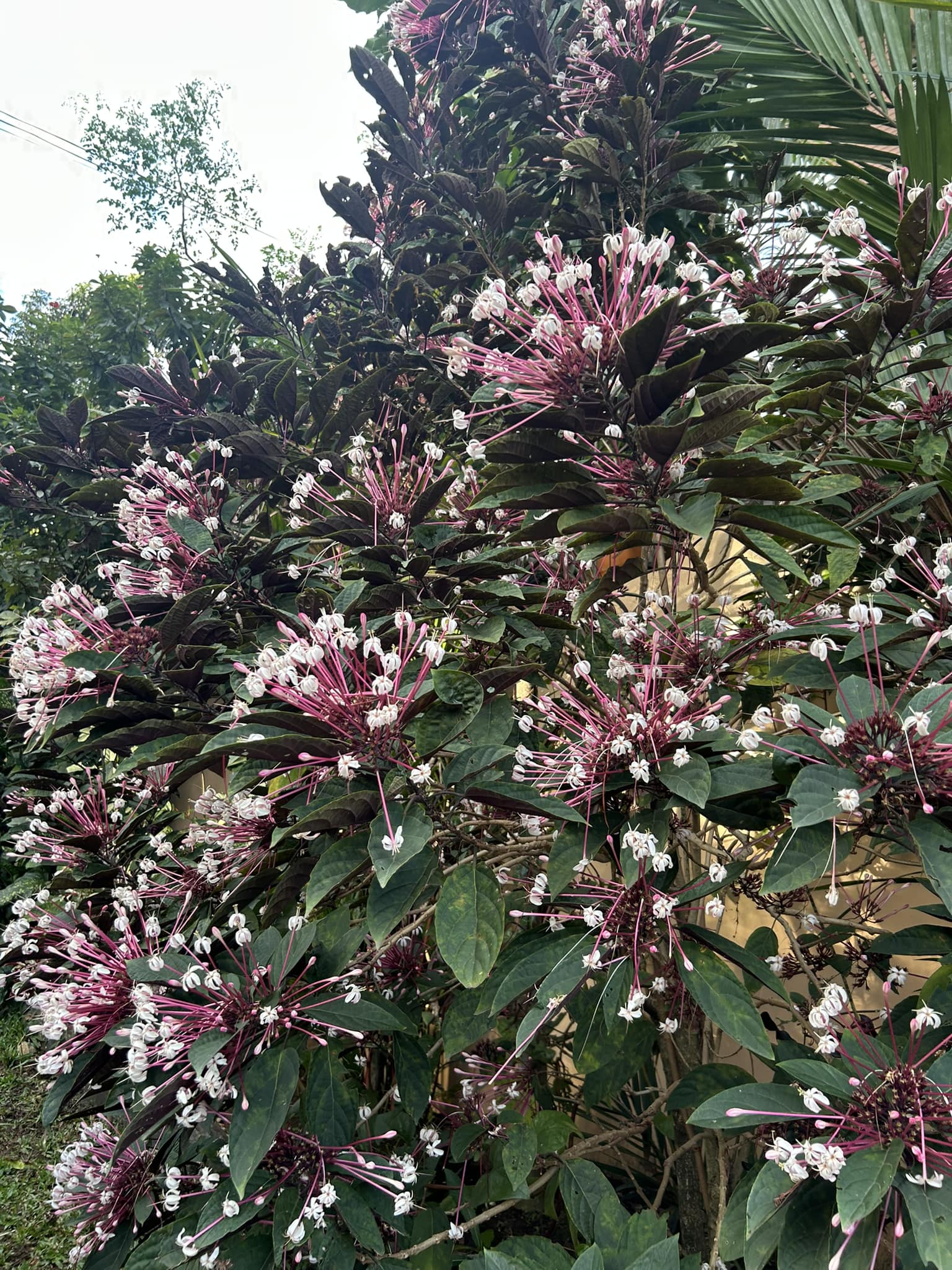
My walking route includes a street where one of the houses has this starburst plant. I always think of this as nature’s version of showing fireworks that don’t actually involve fire.
–
How the Built Environment Affects Your Mood
Here’s a nice read as we do our storm watch, and probably explains why when we reminisce about college or university as “the best years of our lives”.
Source: How the Built Environment Affects Your Mood
To quote from the article:
“It is not for nothing that older adults often regard college as “the best years of your life” because in some cases it truly is. College years serve as a gateway drug to all the amenities and benefits of urban-core living — until you graduate that is. Then you have to return to your parents’ suburban home (as many Americans do) and suddenly all the amenities you had disappear. Your newfound college friends might make up for the lack of a diverse built environment. Nope, they all have moved back to their sprawling neighborhoods too, probably dozens of miles if not hundreds of miles away from your town. You might get a new car to celebrate your graduation and your new 9 to 5 corporate job. Work will keep you busy! But you know what else? Driving. No more waking up 10 minutes before class and arriving just on time. You might now have to wake up a few hours early to drive to your job through rush hour morning traffic, and do it all again in the afternoon.
You might also gain weight — not because you are eating more, but because you are walking less. Various studies demonstrate the link between car usage and obesity, showing “greater levels of obesity in communities where the private automobile is the dominant means of transportation.” And let’s not forget that obesity leads to other health issues such as diabetes and hypertension, among others. Mental health conditions such as depression are more prevalent in adults with obesity. Hence once college ends, graduates stop socializing, stop enjoying public amenities every day, start driving everywhere, stop walking and hence gain a little more weight in the process. Then it is no surprise that young graduates feel unfulfilled, and sometimes even depressed after college — for them, it feels they were robbed of an integral part of their new lives.
Our surroundings impact our mental and physical health. Living in neighborhoods with negative qualities can increase the risk of mental health conditions such as depression. At the same time, the pandemic made us appreciate diversity in our lives and what happens when we are deprived of it. Walkable cities are not “just a preference”; they develop happiness by fostering community trust, promoting physical activity, and offering nearby amenities. As learned, these spaces encourage healthy behaviors, reduce car dependency, and create opportunities for social interaction — all things that are crucial for our well-being.”
Based on this, no wonder I love to stay at the University of the Philippines campus in Diliman. I’m sure my colleagues in UP Los Banos feel similarly.
–
International Shrine of Our Lady of Peace and Good Voyage
It’s Maundy Thursday today and there will be the Alay Lakad later this afternoon. Here are photos I took yesterday morning at the shrine including the road closures sign or tarp posted at the intersection of P. Oliveros Street, Ortigas Avenue Extension and L. Sumulong Circle near the provincial capitol site.
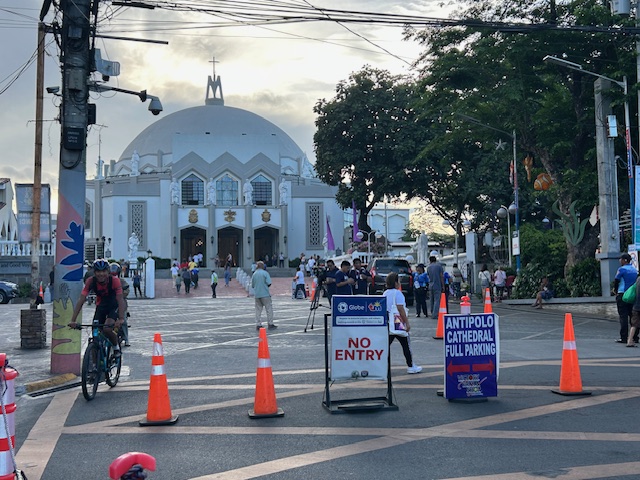 Access was already being limited as of yesterday morning. On regular days, there will be a queue of vehicles mostly new and to be blessed at the shrine. There’s limited parking at the shrine itself so visitors or pilgrims would have to find parking around the church including the nearby mall.
 View of the shrine from the entrance to the complex
 The main altar of the shrine
 Retablo to Our Lady of Guadalupe
 The main road to the shrine, P. Oliveros Street, is an extension of Ortigas Avenue Extension from the Provincial Capitol site. This will be the main route to the shrine and will be filled with people later this afternoon and overnight.
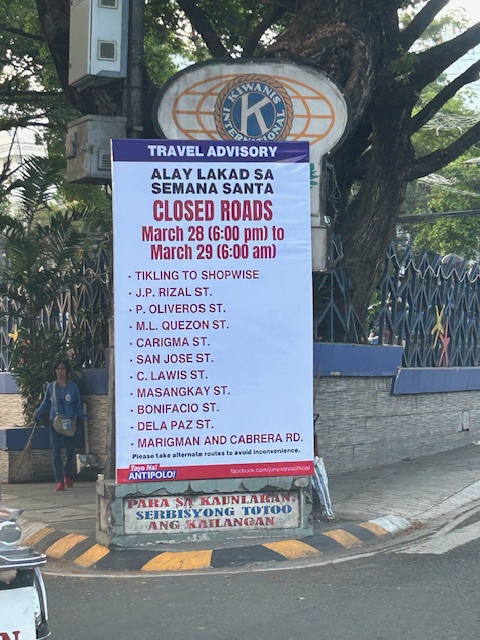 Road closures from 6:00 PM today until 6:00 AM tomorrow (Good Friday)
The Alay Lakad is a spectacle by itself and probably rivals if not exceeds the Traslacion of the Black Nazarene in Quiapo, Manila in terms of the number of participants.
–
On walking and running for health
Here is a quick share of an article on walking and running from the New York Times:
On walking and taking the stairs
With the increasing popularity of active transport, people still forget that biking is not the only mode being referred to by the term. Walking is the most basic form of transport for us and there are many creative ways to encourage walking even if it is indoors like in an office building, a school building or a shopping mall. Here is a photo of the stairs at one mall with encouraging words for those taking the stairs instead of the escalators or elevators. It only takes 30 minutes of walking everyday to gain the benefits of a more active lifestyle.

My daily walks take me up and down the hilly roads in our neighborhood. I attribute to these walks my relatively effortless climbs to the 4th floor of our school building where my office is. Our elevator has been out of commission for some time now so we are all forced to take the stairs to our lecture rooms and offices. These I refer to as ‘stairmaster’ exercises, which is included in my daily routine so it adds to my step count as well as being recorded for the flights of stairs I take each day. I attest to this routine to improving my health and well-being, and highly recommend this to those who are able to do so.
–
Incorporating bike lanes along local roads – an example in Taguig City
I have not used an old route that we usually take to go to BGC from our place in Antipolo. This is via the Manila East Road, Highway 2000, Barkadahan Bridge and C6. From C6, we usually take Ruhale instead of Seagull Avenue as the former provided a shorter route towards Levi Mariano Avenue and C5. So it was only last weekend that I was able to see the improvements along Ruhale Street and how bike lanes were incorporated along this road. I am sharing the following photos showing a two lane road and Class 2 bike lanes.
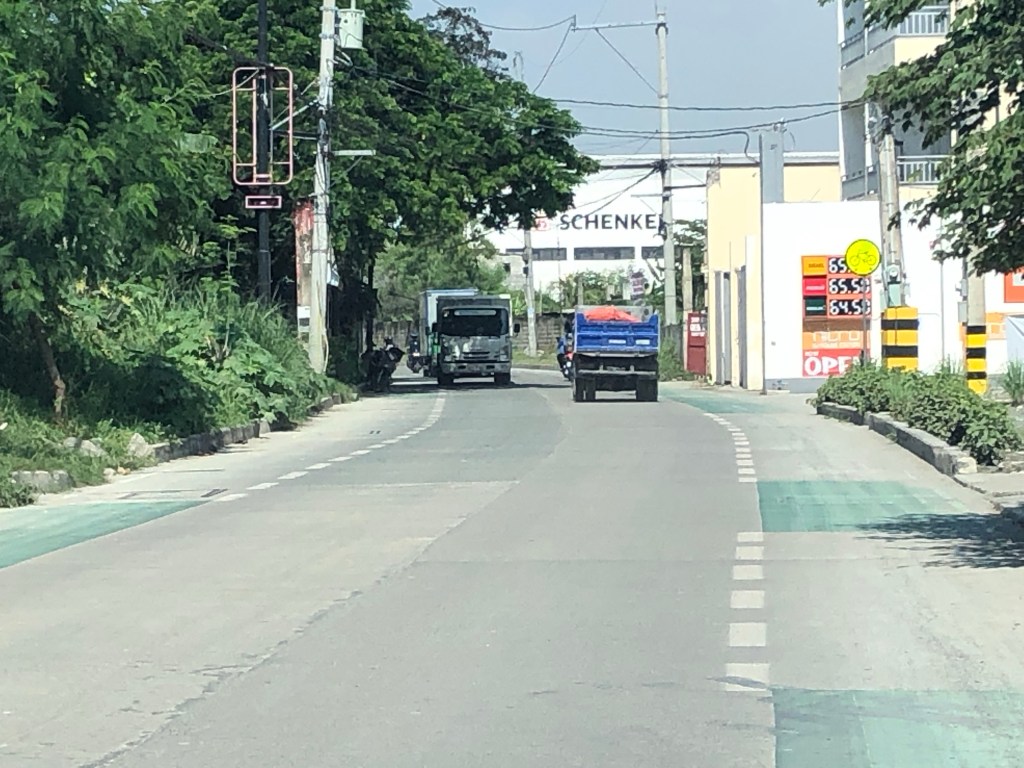 The green pavement markings indicate an intersection or driveway.
 Noticeable are the electric posts that remain along the bike lanes. These need to be transferred so they will not pose danger to all road users.
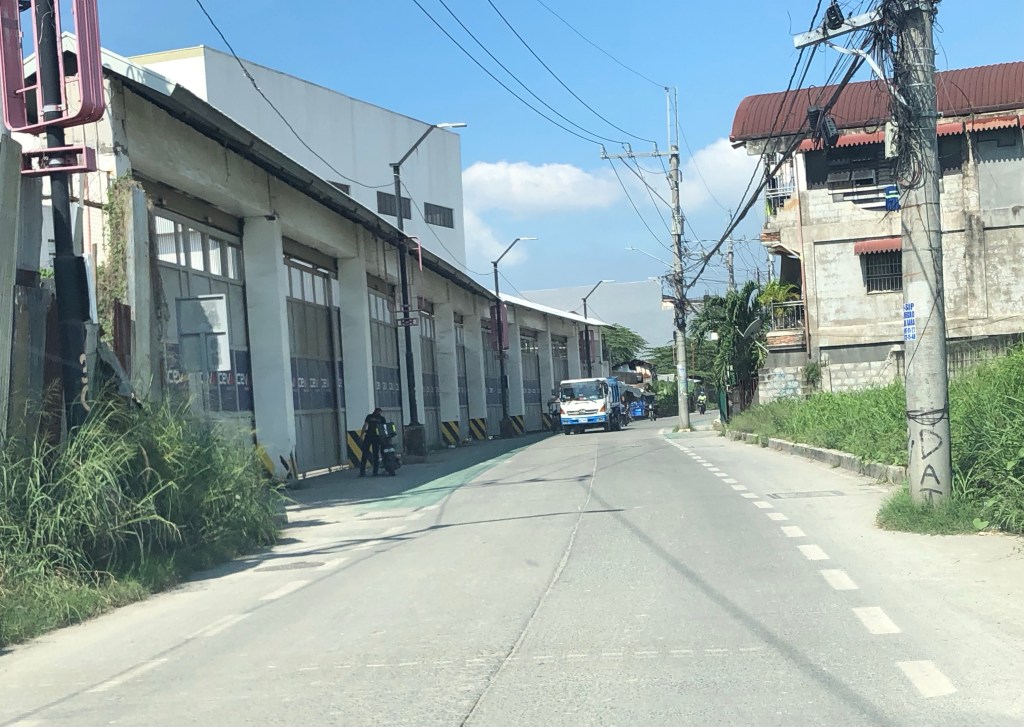 More electric posts along the bike lanes
 Bike lanes in front of an industrial establishment
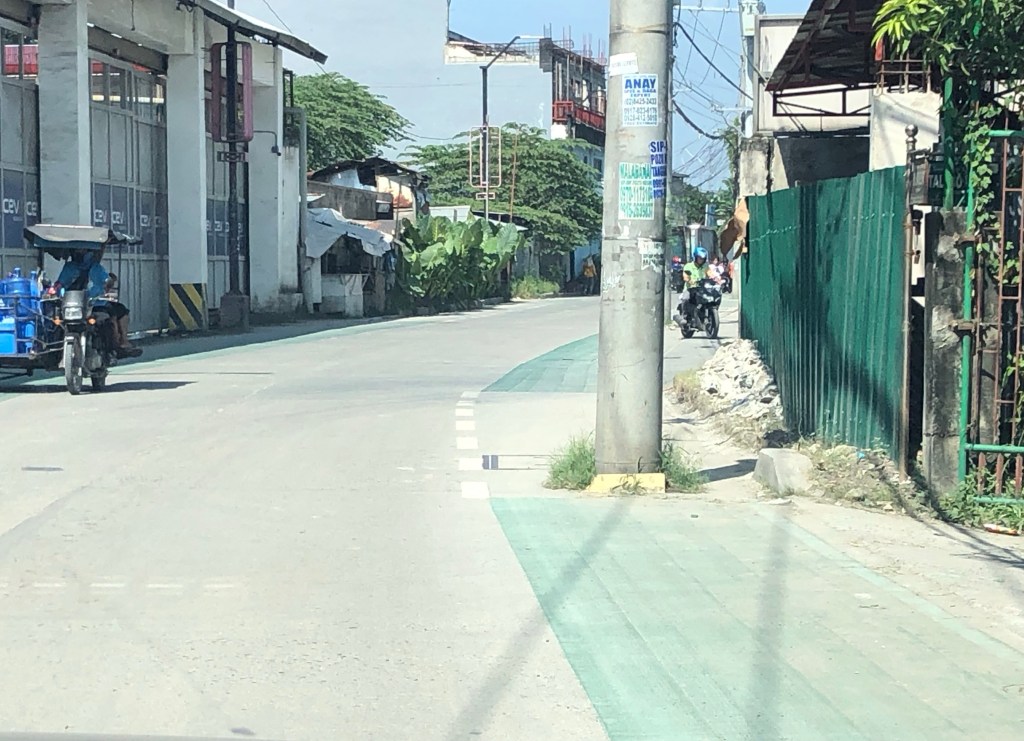 Close-up of a post in the middle of the bike lane.
 Bike lane across another industrial establishment. Again, note the green pavement marking across the driveway of the establishment.
 Bike lanes along a predominantly residential area along Ruhale.
I would consider this as a good practice example that can be replicated elsewhere. Of course, it is not perfect and as shown in the photos, there is much room for improvement including the transfer of electric posts that pose as hazards to all road users. The bike lanes are wide enough that installing bollards for the perception of physical protection vs. motor vehicles can be considered. Ruhale is generally a low speed, low volume road so perhaps the current state with no barriers would be enough for now. Also, we need to appreciate that these are already gains or wins in as far as active transport is concerned. A few years ago, this would not have been implemented by national or local governments.
–
 Caught (up) in traffic