
Home » Posts tagged 'Grab'
Tag Archives: Grab
Grab carpool?
I saw this sign at Ayala30 earlier today.
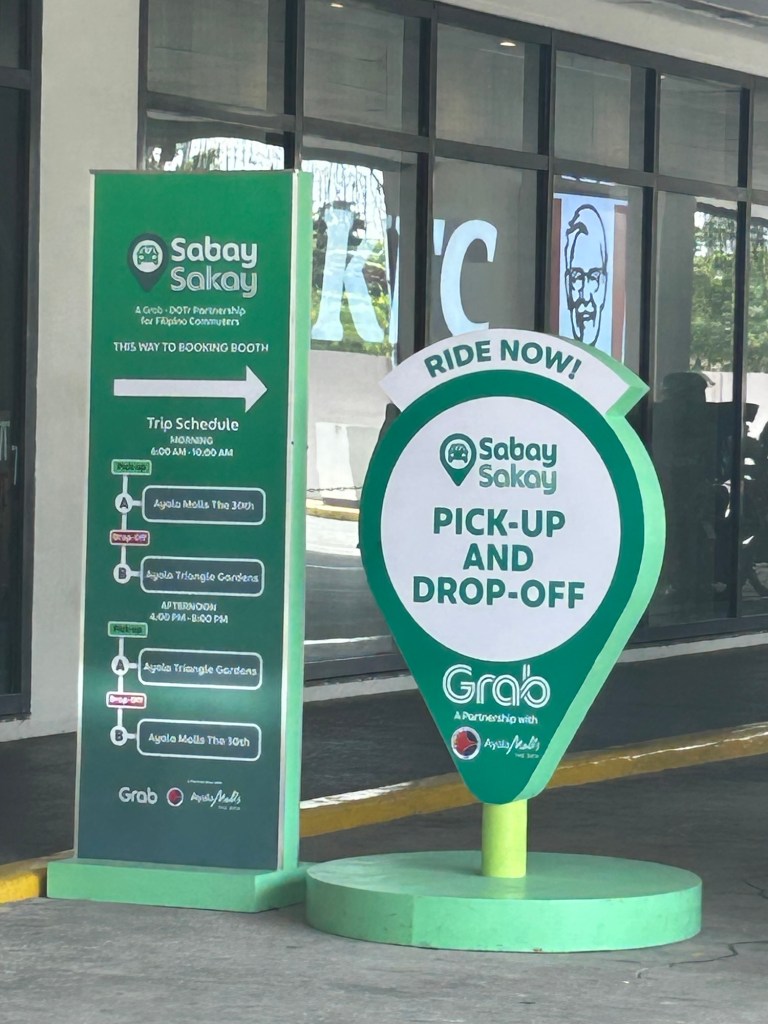
Is Grab going into carpooling? This certainly is not new as at I recall at least one company, Wunder, that tried to make a foothold in Metro Manila back in 2017. It folded after an unsuccessful run that a friend described as dating app masquerading as a TNVS. Seriously though, facilitating carpooling is not an easy task as there are security, safety and trust concerns here that need to be overcome. Perhaps it can be successful with office mates or schoolmates?
–
Competition for Grab?
Friends have been talking about the two new options that they say should rival and compete with Grab. These are another ride hail company and, interestingly, a taxi company. That ride hail company is In Drive and the taxi company is Green GSM.
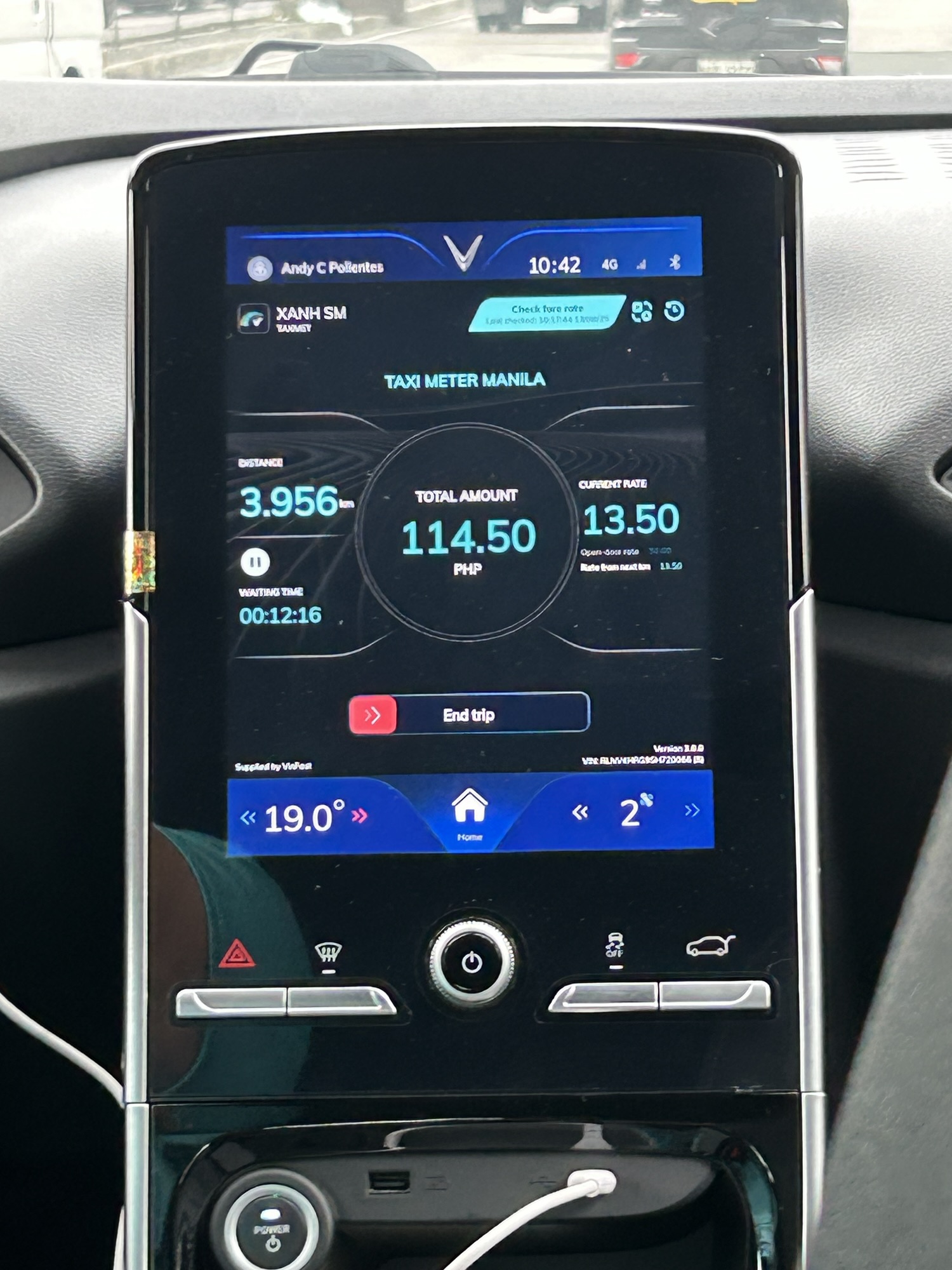 Green GSM vehicle dashboard showing the taxi meter details
The observation and consensus are that either is cheaper than Grab. My personal experience is that they are cheaper than Grab and substantially so. What does this mean? Probably that more people will eventually discover and experience the same and Grab’s ridership will decline. By how much? We don’t know that yet. What we know is that Grab’s most significant competition now are the motorcycle taxis like Angkas and Joyride. Move It is Grab’s response to the other two after it was prevented by government to compete directly with the two. More details in future posts this September.
–
Taxi services at NAIA Terminal 2
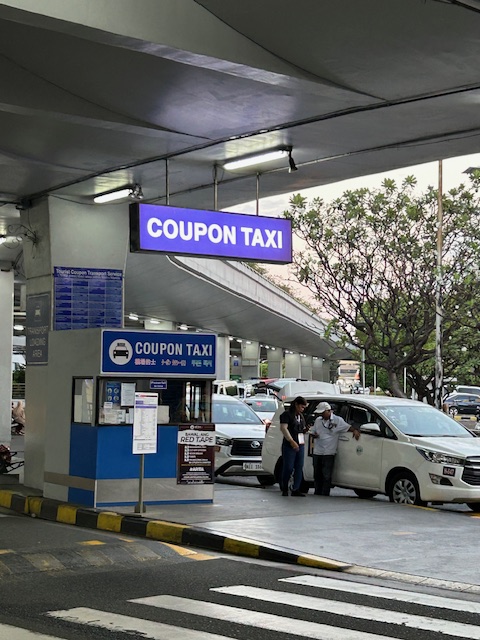
The previous post on NAIA Terminal 2 featured photos of taxi or ride share services at the airport. Coupon Taxis are the most expensive option for travelers as they have the highest rates. Often, these are even higher than vehicle rental rates. These rates are shown to prospective customers though so I can’t really understand why people go for this option and then slam it for being expensive. The information is provided there so accepting the terms means you understand and accept the rates. Perhaps they didn’t have other options?
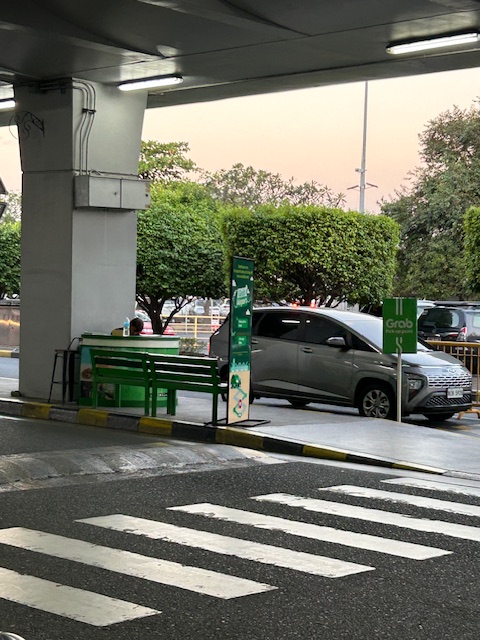
There is a Grab stand at the terminal. I assume that since Grab is quite popular at least in Southeast Asia (even taking over Uber’s share), then travelers who likely have smart phones should have the app and be able to book a ride using it. This might be the best option for those on the go.
There is also a regular taxi stand at the airport terminal so that is another option. Unfortunately, one will likely have to haggle with the drivers for the fare. Other drivers might use their meters but will suggest or solicit tips from their passengers.
There is no rail service for the NAIA Terminals but there is an airport bus, UBE Express, that travelers can take to go to major CBDs like Cubao, Ortigas and Manila or perhaps to major terminals like PITX or the Victory Liner Terminal in Pasay City.
–
Shared rides, anyone?
Would you share your ride with other people? This is not the conventional ride-sharing where you drive for someone else (i.e., Grab, Uber, etc.) but refers to a passenger sharing the vehicle he/she booked with another passenger or passengers. This is supposed to reduce the cost of the ride but can lead to more distance traveled as the matching of passengers has not been perfected. That is, it is likely to share a ride with a person heading to a destination that is out of the way of the passenger (in as far as typical routes are concerned).
Walker, J. (May 26, 2023) “Lyft: The End of Shared Rides,” Human Transit, https://humantransit.org/2023/05/lyft-the-end-of-shared-rides.html [Last accessed: 6/12/2023]
To quote from the article:
“I used this service once. On a departure from the airport, it paired my trip with one in a substantially different direction. The other trip was to a point further from the airport than my destination, and yet it served that trip first. I ended up with a travel time about twice what my direct travel time would have been, and much more than the app had estimated. I never used this option again. My impression was that they were overselling the product in contexts where it wasn’t appropriate, and they were offering the same discount to the person dropped off first — whose trip is exactly what it would have been if traveling alone — as to the person whose trip was being made much longer.”
We actually already have shared rides in the Philippines. This is in the form of UV Express (formerly and popularly referred to as FX after the Toyota vehicle model that became popular from the 1990s), which continue to be a popular mode of public transport. Shared rides evolved from a group of people negotiating with FX taxi drivers to take them to a common point or destination (not to their final destinations). At the common destination, the passengers will eventually part ways for their last mile trips. Here is the article on a taxi service that eventually became a shared service I wrote a while back:
That was before there were apps to facilitate the sharing. I think this also showed how people will find ways to overcome problems like a lack of public transportation for their commutes.
–
Grab tours?
One of my former students who did research on ridesharing showed me a new feature on the Grab app. There is a vehicle for rent option now in the app as shown in the screen capture below:
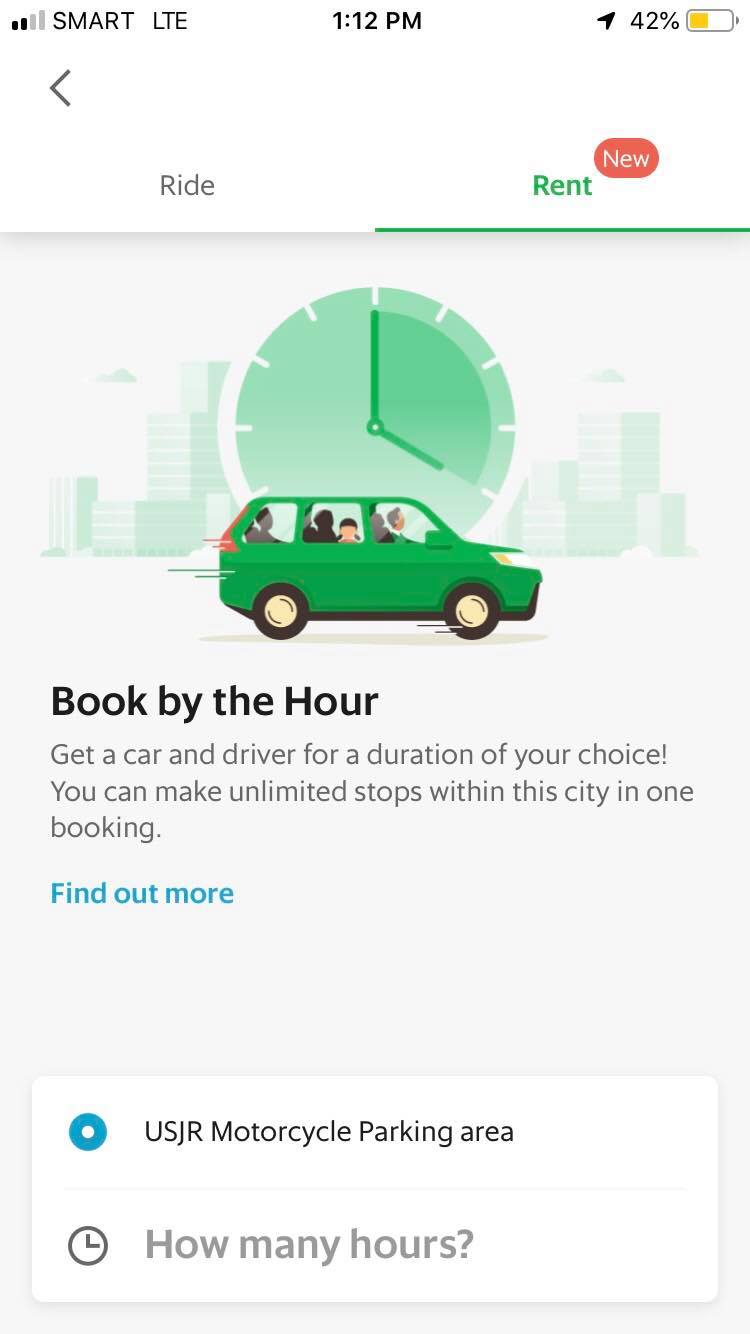 Booking by the hour means you get to set the duration of service. The conventional service is point-to-point (i.e., taxi).
 Choosing “booking by the hour” will lead to a selection of vehicles and the number of hours corresponding to a type of rental.
We showed these to our suking van rental in Cebu and our driver commented that these were expensive. Still, we thought this was a good way to go around the province (not just Cebu City). Of course, such rentals may be more applicable for those who like set pieces when they travel or go on tour. If you’re the more adventurous type, then perhaps you will consider public transportation and walking. It will certainly be less expensive and give a more memorable experience however it goes.
–
Are ridesharing services paratransit modes?
Vuchic (Urban Transit Systems & Technology, 2007) defines paratransit as an “urban passenger transportation service mostly in vehicles operated on public streets and roads in mixed traffic; it is provided by private or public operators and it is available to certain groups of users or to the general public, but it is adaptable in its routing and scheduling to individual user’s desires in varying degrees.”
Based on the definition and how paratransit modes have evolved over many years, then we could say that the current ridesharing or car sharing services like Uber and Grab are essentially paratransit modes. They definitely fit the definition as do conventional taxis.
–
On the Uber and Grab predicament
A lot has been said and written for or against Uber and Grab. Social media made sure the more popular but not necessarily the truthful ones are spread. One popular personality associated with motoring has even led an online petition against the rulings by the Land Transportation Franchising and Regulatory Board (LTFRB). An objective check of the facts reveal that LTFRB is not solely at fault here. Uber and Grab should not have promoted themselves and took in additional drivers (nagpaasa ng mga drivers) after the agency issued a moratorium last year. Estimates vary but it seems they have taken in tens of thousands of drivers (20.000? 30,000? 40,000?) and earned revenues along the way to what is now an historic penalty levied upon Uber and Grab by the LTFRB.
Perhaps the most level-headed article I’ve seen online is the following:
The thing about Grab, Uber and the LTFRB [by Vince Pornelos, July 18, 2017, https://www.autoindustriya.com/editors-note/the-thing-about-grab-uber-and-the-ltfrb.html]
It seems all is well, for now, as meetings were held between the DOTr, LTFRB and the concerned parties (Uber and Grab). In one of the meetings, a couple of Senators seem to have brokered a deal to resolve what appeared to be an impasse that a lot of people on social media reacted to. There are definitely a lot of vested (and veiled) interests involved here including those by various “operators” in the transport sector on both the sides of government and private sector. One takeaway though that I observed is that many appear to be against LTFRB even though the agency was truthful about their statements regarding the illegally operating transport vehicles. They seem to have made up their minds about the LTFRB and this is not surprising as transport problems have been festering for decades with little progress in terms of improving transport, conventional or innovative. Most people seem to have lost their patience about transport services and regulation, and perhaps this is a good thing if it translated to demanding for mass transit, too.
–
Some issues abroad on car sharing/ride sharing companies
There are two articles recently that are worth reading for those who are into ride-sharing/car-sharing. And I am not necessarily referring to those who regularly take Uber or Grab, or those who opt to use these whenever they need a taxi ride. There are many who are already studying these services being provided not by your traditional or conventional taxi companies or rental vehicle companies but by supposedly private individuals who supposedly have the spare time and spare vehicle that they can use to provide transport for other people. I use the word “supposedly” here because this is a big assumption and the premise by which transport network companies like Uber, Grab and Lyft have been able to go around the bureaucratic processes that taxi and other companies have to go through as formal public transport (i.e., public utility vehicles). These articles are along the lines of the discussions in previous articles I have posted here about ride-sharing/car-sharing, and are mostly based on the experiences in countries who have more developed and presumably better transport than us in the Philippines.
Denton, J. (2017) Two Federal Lawsuits Could Spell Big Trouble for Uber, Pacific Standard, http://www.psmag.com, April 10, 2017.
McGraw, D.J. (2016) How Lyft and Uber are Ignoring the Poor, Pacific Standard, http://www.psmag.com, May 12, 2016.
I leave it up to my readers (any researchers out there?) to pick-up the main points and perhaps look at the issues from different perspectives. I have pointed out before that the situation in Metro Manila could be very different from the situations in other major cities like Cebu, Davao and Iloilo. And so transport network companies may not necessarily succeed in cities where taxi services, for example, are significantly better than what we have in Metro Manila.
–
Grab at NAIA Terminal 2
Here is another useful post for travelers especially during this Holy Week and the summer holiday season in the Philippines. Many people usually look for a ride heading out from the airport. Not everyone would have someone to fetch them. There are several options now for those wanting to take public transport. Aside from the conventional taxis, there are also airport taxis, vans and the more recent airport bus service provided by UBE Express. Ridesharing or car sharing services are also available and the most visible will be Grab with options for either car or taxi available via you own app or through their booths located at the NAIA airport terminals. There should be a Grab booth located at the arrival areas of NAIA’s terminals. They also have a booth at the Mactan Cebu International Airport terminal.
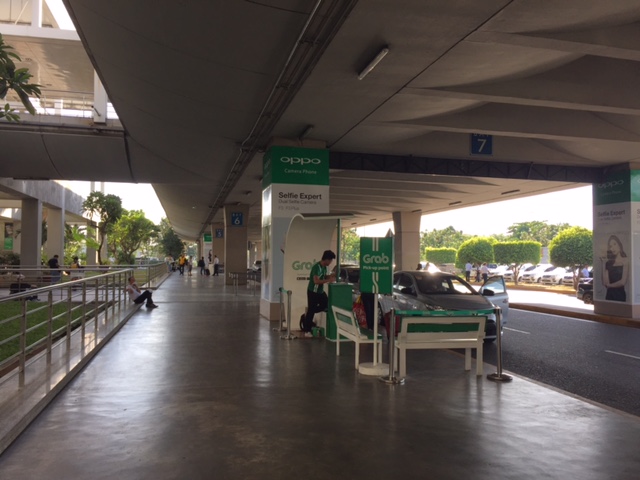 You can easily spot the Grab booth and pick-up area as you exit the terminal’s arrival lounge.
 You can book a ride with the grab staff at the booth if you don’t have a smart phone and the Grab app. You can also just call for a car or taxi using the app. This is the pick-up point for Grab Cars. Grab Taxis would have to use the driveways for taxis parallel and just to the left of this driveway.
Grab has become a game changer for taxis out of the airport. In fact, my own father found them to be a convenient and safe option for a recent trip from Terminal 2 to our home in Cainta. He didn’t have to negotiate fares and he paid a very reasonable fare while enjoying his ride on a recent model car.
–
Some views on Uber and Grab
I took screenshots of a DOTr social media post on Transport Network Companies (TNCs) and the comments made on the post. If the post is an accurate quote of the current LTFRB Chair, then it reveals how a top official of the LTFRB (and at the same time DOTr) thinks about such services and perhaps shows a lack of understanding for what these “innovative” companies are all about. I purposely put the word innovative in quotation marks because there are also challenges that Uber is currently facing.
But then can we blame the official and others of how they understand the business models of TNCs like Uber and Grab? Can we blame them when these companies’ models’ seem to be quite different from their original set-up that made them the popular modes that they are now in many countries? At the same time that they have become the bane of conventional taxis, it seems they are also killing off the good ones, too. In my opinion, Uber and Grab are treading a fine line between ridesharing/carsharing (their original model) and taxi services.
Here are some social media posts not too long ago regarding fare regulation being applied to TNCs:


There are healthy (as well as inane) discussions online about TNCs. More recently, there were reactions when Uber appeared to take advantage of a nationwide jeepney strike. I guess people should take in different perspectives about TNCs and in the end, it is the commuters’ welfare that is important regardless of what modes of transport are available them. That welfare should be the priority of government and we should not blame the latter when they are actually doing their jobs.
–
 Caught (up) in traffic