
Home » Posts tagged 'Public Transport' (Page 10)
Tag Archives: Public Transport
Transport in times of rains and insensitive statements
How important is a good public transport system? Part of the definition of a good public transport system is that it should be an all-weather system. This means that even if there is inclement weather, the system would still be functioning and able to ferry people between their homes, workplaces, schools and other destinations. Of course, the exception here would be the times when there are extreme weather conditions like typhoons passing through cities. The rains today and past other days reminds us how difficult it is to commute even when you have your own vehicle. Those who opt to use their own cars now encounter severe traffic congestion with increasing frequencies while those with only public transport as their choice usually have difficulty getting a ride home.
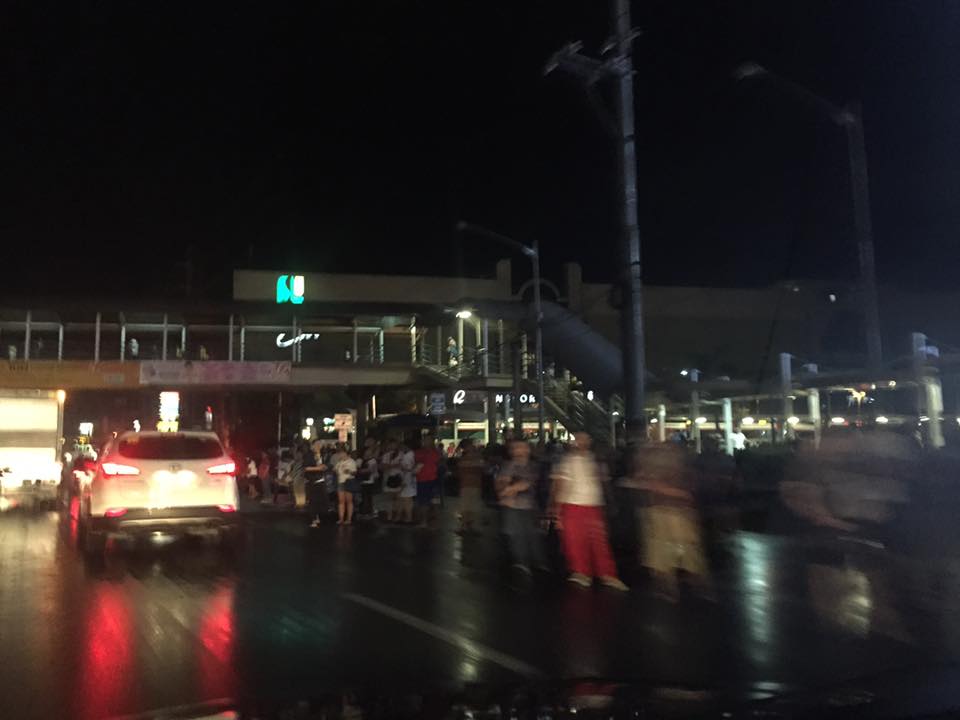 Commuters on the carriageway trying to get a ride home – many brave the strong rains to get ahead of others
It is not just unfortunate but rather depressing that Metro Manila and other major Philippine cities have no efficient public transport systems. The current modes of transport are road-based and dominated by paratransit including jeepneys, multicabs and tricycles. The state of disrepair of the PNR and MRT3, the much-delayed extensions of LRT1 and LRT2, and the much-delayed construction of MRT7 and BRT lines all contribute to the hellish commutes people experience everyday. Combine these with what experts regard as deficient station plaza designs that have led to inefficient transfers between the trains and road-based transport. It is no wonder that a person on bicycle can beat a commuter on a trip between Trinoma in Quezon City and a university in Manila considering the state of MRT3 and the poor transfer conditions between MRT3 and LRT1. This won’t likely be the case in Singapore or Tokyo where the proper hierarchies of transport are well established and with the necessary facilities to support their people-friendly systems.
What’s more depressing, frustrating and disappointing (if its possible to feel all three simultaneously) is how transport officials, including and especially the top official of the Department of Transportation and Communications (DOTC), apparently see our transport woes as “not fatal”. Is it really “not fatal”? Increases in the incidence of respiratory diseases due to the increased emissions are attributable to mobile sources (vehicles) and the long hours of road traffic congestion. The increase in the number of fatal road crashes as reported by the Metropolitan Manila Development Authority (MMDA) is also attributable to a significant increase in traffic volumes. One comment on social media was right on the dot on emergency cases ending up dying due to the ambulances being unable to make it to the hospitals in time for their passengers’ treatments.
And so, there were renewed calls for transport officials to get out of their chauffeured cars and take regular public transport between their homes and offices. The dares include riding the MRT3 during the peak periods and actually experiencing the queues and the crowded platforms and trains. It is no wonder that the image of the Dutch ambassador riding his bicycle to his office has been a popular share in social media because a lot of people feel that leaders should be examples themselves on how each one of us can pitch in to solve transport and traffic problems. Attempts by some government officials (including the top official of the transport department) to ride the MRT3, for example, are met with much criticism because they are given special treatment – they skip the lines and have bodyguards escorting them and clearing the way and space for them to ride comfortably. Clearly, this is not what the common commuter experiences everyday when he or she would have to use something short of MMA skills to get a ride.
Are we helpless against such insensitivity of our officials, many of whom are politicians and professionals associated with oligarchs? Not totally. And next year’s elections offer the commuting public a chance to express what they think about transport in this country and in their cities and municipalities by making transport and traffic urgent issues that need to be addressed and prioritized. Will you vote for candidates who had a hand in the continuing deterioration of transport in the Philippines and who consistently dismiss transport and traffic issues as secondary and just a by-product of non-inclusive economic growth? I surely won’t and will be very critical of candidates’ platforms and proposed programs should they win and become the leaders of this land. A big part of those programs should be how to address transport and traffic issues especially the deficiencies in infrastructure. Addressing these pressing issues on transport and traffic will go a long way in improving the quality of life of Filipinos and ensure a sustainable and inclusive growth for the country.
–
Some updates on DOST’s AGT
Passing by the DOST compound last week, I saw that the newer of the two AGT prototypes the Department of Science and Technology (DOST) has funded through the Metals Industry Research and Development Centre (MIRDC) is already atop the test track along Gen. Santos Ave. in Bicutan, Taguig City.
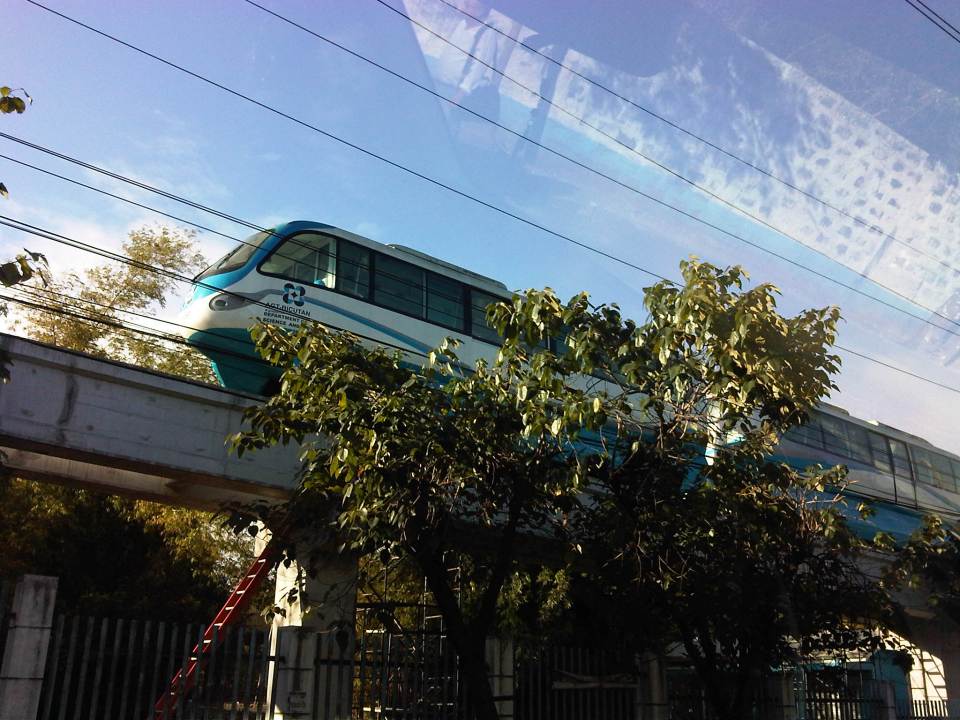 The Bicutan AGT is larger than the prototype in UP. The former is a 120-passenger capacity train while the latter is a 6-passenger vehicle.
There are four on-going pre-feasibility studies on proposed AGT lines – UP Diliman in Quezon City, Litex in Quezon City, Gen. Santos Ave., Bicutan in Taguig City, and Baguio City. I am familiar with the first three, which is being implemented by UP but know little about the 4th, which is being implemented by a private consulting firm. The transport aspects (i.e., ridership estimates) of the Litex and Bicutan AGTs are almost complete and the estimated riderships are not encouraging considering the competition from road-based public transport comprised of jeepneys and tricycles along the proposed alignments.
There is a similar dilemma for the loop option proposed for UP Diliman that will be competing with the jeepneys operating in the campus. That is why another option is currently being studied, i.e., a line connecting Philcoa – the UP Town Center and Aurora Boulevard via UP, C.P. Garcia Ave. and Katipunan Ave. This line presumably would have significant ridership as it passes through major traffic generators in 3 major schools (UP, Ateneo and Miriam) and a commercial area (UP Town Center). It will likely become the mode of choice for people usually passing through the UP campus from Aurora Blvd. to get to Philcoa and beyond, and vice versa. And with the traffic congestion along Katipunan, a transit system with its own right-of-way should have better travel times compared with road-based transport.
A big issue about the AGT vehicles is the certification required before these are allowed to carry passengers in a real system. The current vehicles are prototypes so these will be subject to more refinements towards the model that would actually go into service in the foreseeable future. There is no update on this and the MIRDC and DOST don’t seem to be seeking more rigid and independent tests to certify the safety and integrity of this Philippine-made system. Perhaps the DOTC can help them on this through the LRTA or the PNR?
–
Comet – rare sightings
A colleague was saying that he has not seen the Comet, a jitney-type vehicle currently plying the SM North – Katipunan route via Mindanao Avenue and Commonwealth Avenue, for quite some time. I shared the same observation and this is based on my regular commute that includes travel along Katipunan Avenue. The Comet is becoming, if it is not yet, a rare sighting even considering its relatively long and apparently convenient route. The route passes through residential and commercial areas and would be a direct, single ride for students in particular of three major schools in the Katipunan area – UP, Ateneo and Miriam. It also connects to 2 large malls, SM North and Trinoma, and 2 rail stations, LRT 2 Katipunan Sta. and MRT 3 North EDSA Sta. Despite these traffic generators along its route, it seems that the Comet still has less than the desired ridership. I say ‘seems’ because I currently don’t have the hard statistics on ridership but only observations from those who have seen the vehicle along its route.
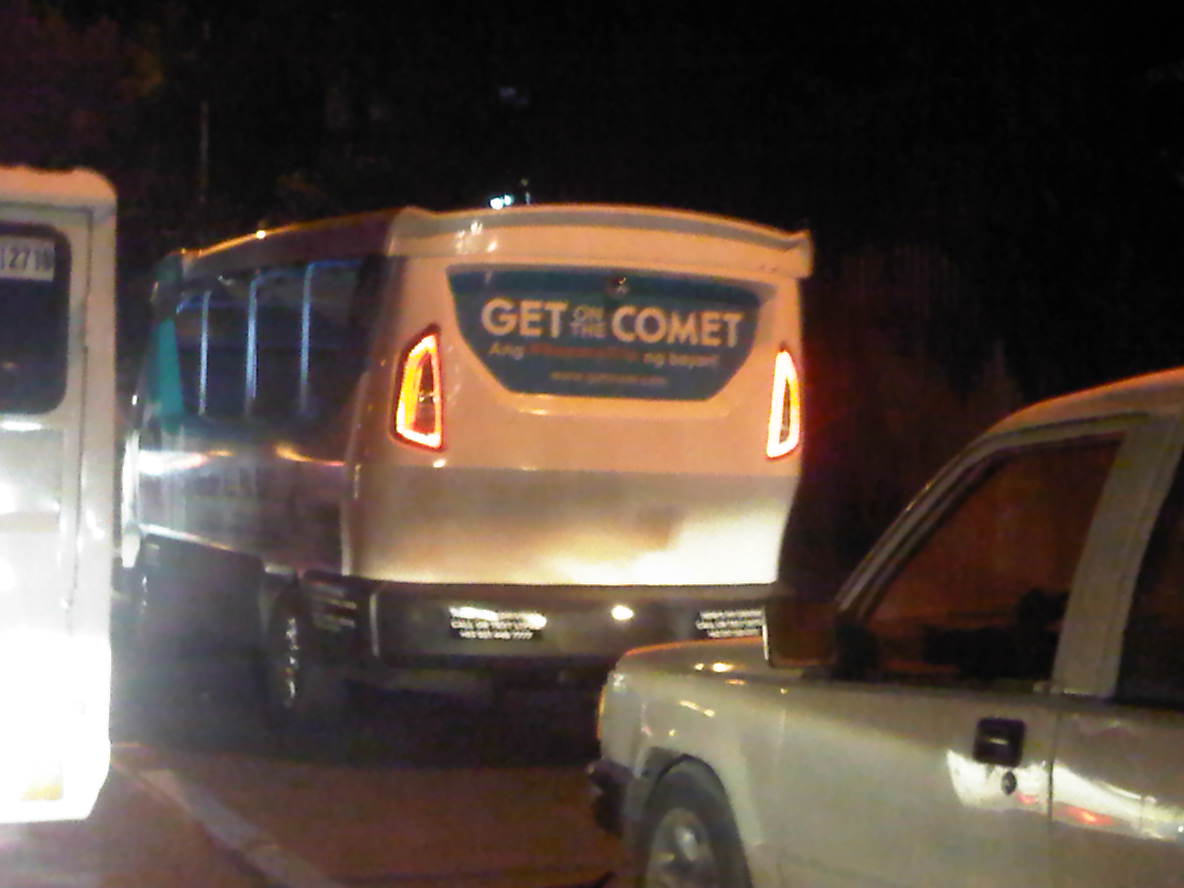 I saw this one on my way home last December in heavy traffic as our jeepney approached the Katipunan – C.P. Garcia intersection. It had few passengers considering its long route from SM North EDSA to Aurora Boulevard via Katipunan Ave.
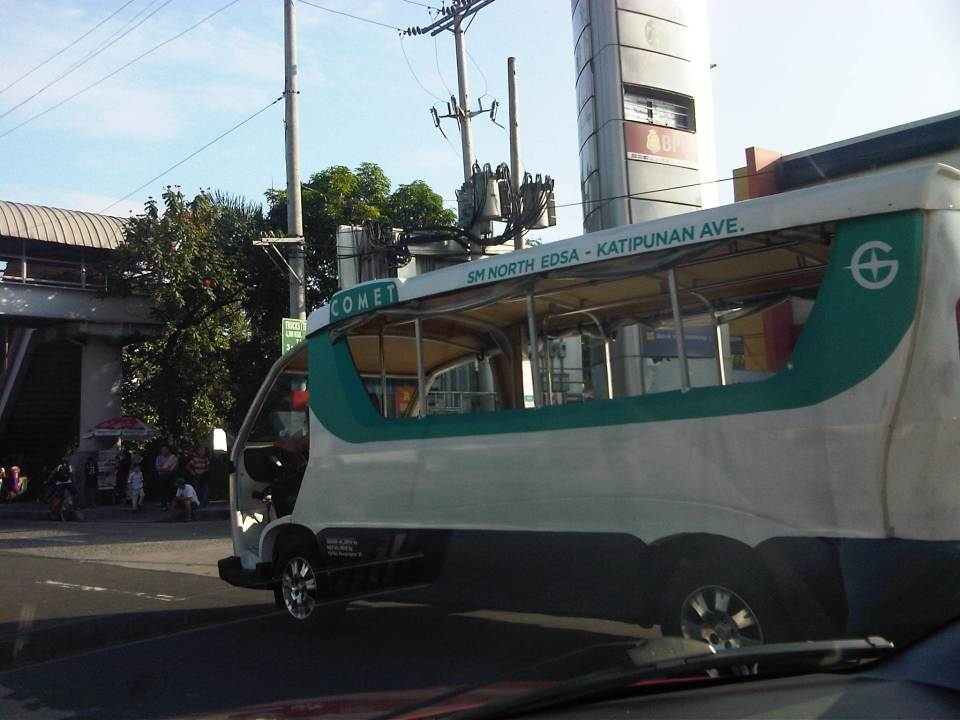 An almost empty Comet spotted one morning this January along Katipunan
What is the future for the Comet? It is unclear so far despite the hype and claims that this is supposed to be the vehicle to replace the conventional jeepney. (To be fair, this is what was also said of the e-jeepney that precluded the Comet.) The DOTC does not have a clear and firm policy or commitment to making this work. Its pronouncements have so far been towards deploying the Comet along new routes instead of replacing existing jeepneys on existing routes with this low emission vehicle. I believe that the only way for the Comet to work is for it to be mainstreamed as a replacement for the jeepney and along suitable routes, of course. The DOTC could and should review jeepney franchises to determine how the Comet and other similar low emission vehicles can be phased in over a realistic period in order to modernize public transportation currently being supplied by conventional jeepneys.
I recently noticed that there are jeepneys along Katipunan bearing tarps on their sides stating “No to additional jeepneys.” Underneath are the names of three jeepney groups supporting this call but with the exception of a major jeepney group that’s supposed to be supportive (even owning several units) of the Comet. Are the signs a form of resistance to change? Do the groups know or understand what they are saying and what they stand for? Or are these indicative of disagreements among jeepney groups, operators and drivers regarding the future of their operations using conventional jeepneys?
There will surely be resistance from these sectors if there are changes to be made that will affect their sources of income. It is a very daunting and sensitive task to decouple transport and livelihood in the Philippines. However, the issues coming out of such changes to improve public transport services should be met head on rather than skirt them, particularly in the case of the agencies responsible for these services – the DOTC and the LTFRB. Only then can we have the transformation we need for road-based public transport in this country.
–
Updates on the DOST’s AGT project
It’s been a while since I’ve written about the Automated Guideway Transit (AGT) system being developed by the Department of Science and Technology (DOST) through its Metals Industry Research and Development Center (MIRDC). Instead of “reinventing the wheel” in writing an update article, I will just point my readers to the “official” item from the DOST’s Philippine Council for Industry, Energy and Emerging Technology Research and Development (PCIEERD). The following link provides a very detailed update on the AGT project including the pre-feasibility studies being undertaken for where the system might be deployed:
Filipino-made Automated Guide-way Transit System (AGT) Eyes to Curb Air Pollution and Traffic
Unfortunately, there is no information on the locally-developed AGT undergoing rigorous testing towards certifying its being safe for public use (i.e., as public transport). There are few testing facilities for such vehicles including those in the US, Japan, Korea and Europe. The DOST needs to collaborate or engage a legitimate testing center that will objectively conduct the strict tests required to ensure the AGT is technically sound and therefore safe for use. Leap-frogging for these technologies does not mean one also can bypass certain requirements for standards and the DOST owes it to the people who will ride this transit system to have it certified – validating its motto “proudly Philippine-made.”
–
Required reading on sprawl, transit and the poor
A friend recently posted an article on Facebook that I thought should be required reading for urban and transport planners in the Philippines whether they be with government or the private sector. There is a strong link between land use and transport, we need to be able to understand the complexities and subtleties in order to maximize the benefits to society. It is not a coincidence that the article specifically mentions the poor as it discusses opportunities lost due to flaws or inefficiencies in land use and transport. The article is found in the following link:
Suburban sprawl and bad transit can crush opportunity for the poor
I hope that this will be read and understood by officials at DOTC, LTFRB, LRTA and PNR, as well as those of the Housing and Urban Development Coordinating Council (HUDCC) and the Housing and Land Use Regulatory Board (HLURB). These agencies are responsible for planning and regulating transport and housing in the country. Of course, it is also important for local government units to be able to understand these challenges especially since they will be in the forefront of addressing issues on sprawl and the provision of suitable transport systems. Here’s a related article that I posted earlier this year on New Year’s Day:
Opportunities with the MRT-7 and LRT-1 Extension
–
Seminar on urban transport systems in the Philippines
The University of the Philippines Diliman, through its Institute of Civil Engineering and National Center for Transportation Studies, recently held a seminar on urban transport systems. The seminar was held last May 26, 2014 and presentations included one on urban transport in the Philippines by Dr. Cresencio M. Montalbo, Jr., an Associate Professor of the School of Urban and Regional Planning of UP Diliman and another on international best practices by Prof. Fumihiko Nakamura, Dean of the Institute of Urban Innovation of the Yokohama National University in Japan.
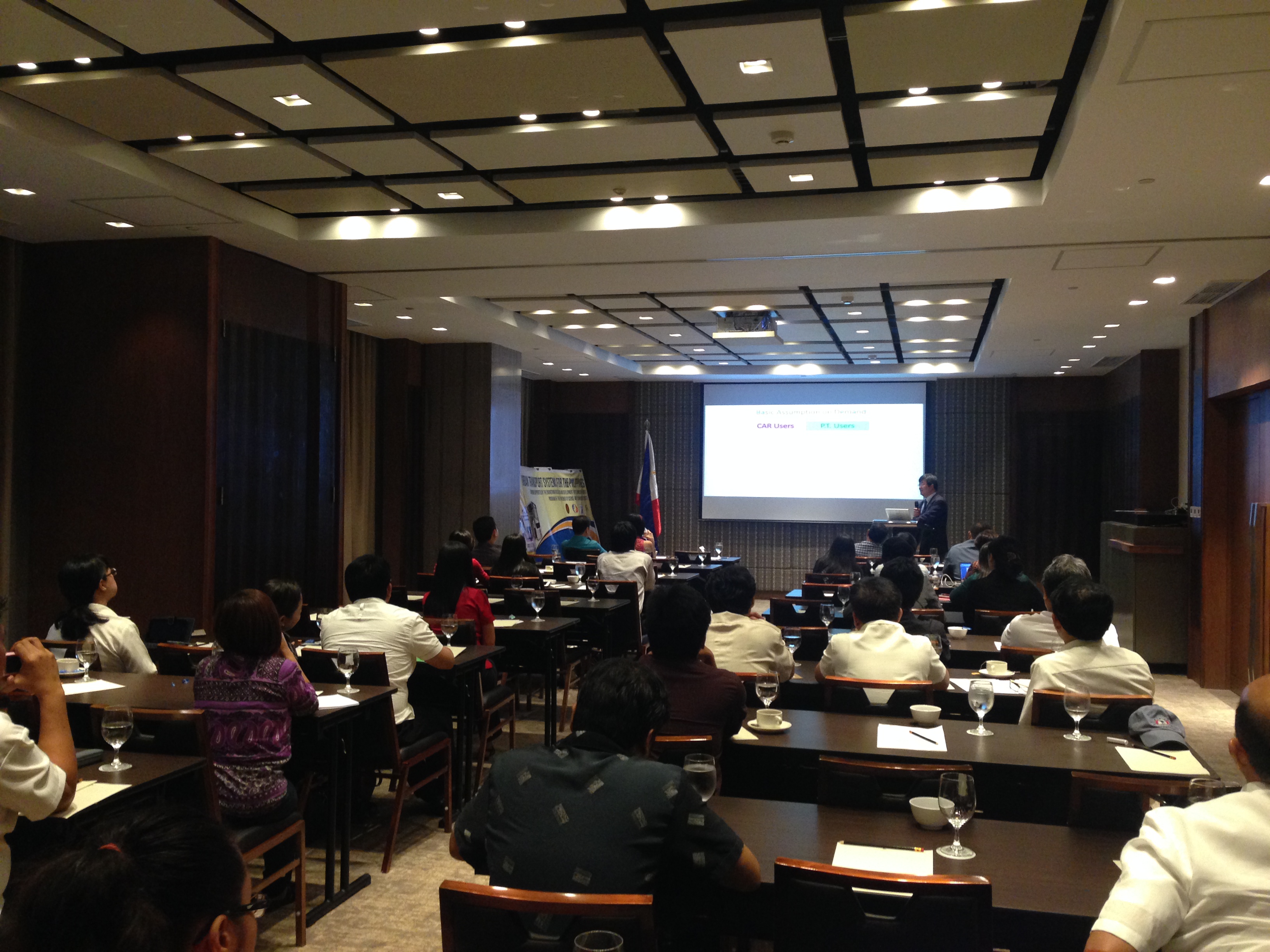 The seminar was held at the Aloe Room of the new Marco Polo Hotel at the Ortigas Center in Pasig City.
 Dr. Montalbo talking about the concept of “dignity of travel.”
 Prof. Nakamura discussing the concepts of “park & ride” and “kiss & ride” with respect to transit systems.
The presentations during the seminar may be downloaded from the NCTS website. The seminar was supported by the Engineering Research and Development for Technology (ERDT) program of the Department of Science and Technology (DOST).
–
120-passenger capacity AGT prototype
The DOST-MIRDC has built another prototype vehicle for its Automated Guideway Transit (AGT) project. The vehicle is larger than the one at the University of the Philippines Diliman as each vehicle would have a capacity of 120 passengers (seated and standing). They are also building another elevated test track at the MIRDC compound across from the main DOST compound in Bicutan, Taguig City, and along Gen. Santos Avenue. This is a significant upgrade from the 30-passenger capacity vehicles at UP Diliman (60 for a 2-car train) as a 2-car train with 240 passengers means much more capacity for a real line using such vehicles. To compare, 5-minute headways along one direction could carry 720 passengers per hour for the UP Diliman prototype while the Bicutan model can carry 2,880 passengers per hour.
 Two prototype AGT vehicles with maximum capacity of 120 passengers at the MIRDC compound in Bicutan, Taguig City.
 The design is very much the same as the first prototype vehicle, with its distinctive look including the snout, headlights and skirt.
 The vehicle looks like it was inspired by the large provincial buses that, if seats are configured as benches and the body is stretched to be longer, can accommodate more passengers.
 The MIRDC is also building a test track in Bicutan within their compound and parallel to Gen. Santos Avenue.
I don’t know how long this elevated test track will be but to be able to have substantial tests for the new vehicles this should be longer and would need to be extended beyond the MIRDC compound. That means the tracks would pass through land occupied by the Polytechnical University of the Philippines (PUP), which is a state university, and Camp Bagong Diwa, which is under the Philippine National Police. Can this line serve the areas along Gen. Santos Avenue? I think so but it will be competing with tricycles and jeepneys. Tricycles are the dominant public transport mode here despite Gen. Santos being a national road. Taguig City would have to find a way to address issues pertaining to a reduction or phase-out of tricycles as the communities in the area might be dependent (unfortunately) on these for their livelihood.
–
To commute or not to commute
To commute or not to commute? That seems to be the question many people would like our political leaders and government officials to ponder the answer to. Of course, the word “commute” itself refers to traveling whether by public or private transport. However, in the Philippines we have equated “commuting” with taking public transportation. Anyhow, the reality is that most of our top officials, elected or appointed are car owners and are most likely to drive or be driven between their homes, offices and appointments. This is what is perceived by many people as “The Reason” why public officials have little or no appreciation of the difficulties experienced by the commuting public.
While sympathy is usually assumed or claimed by responsible persons, it is empathy that is most desirable from our public officials as they should feel how most people feel when they commute every working day. But how can you empathize if you have not experienced the difficulties of commuting in Metro Manila or other city? How can you say you understand the plight of pedestrians, cyclists and those taking public transport if you prefer or opt to drive or be driven in your car or SUV to and from your office? Did you really commute when you were in high school or college? Or maybe you were one of those cool guys or gals driving their own cars?
Almost every week, I have left my car at the office to commute or hitch a ride with my wife where our routes overlap. I have used public transportation since I was in high school so I am quite familiar with taking pedicabs, tricycles, jeepneys, buses and trains. I have also commuted whenever I am on trips to other cities including those abroad. Public transport is part of the experience whenever I am on trips and when I am in a new place, I make it a point to take long walks first to explore the surrounding area. It is a familiarization of sorts and makes me comfortable with the area. I remember that when I was a student in Japan, I would try to look for the nearest church to where I was staying, especially if I was there over the weekend.
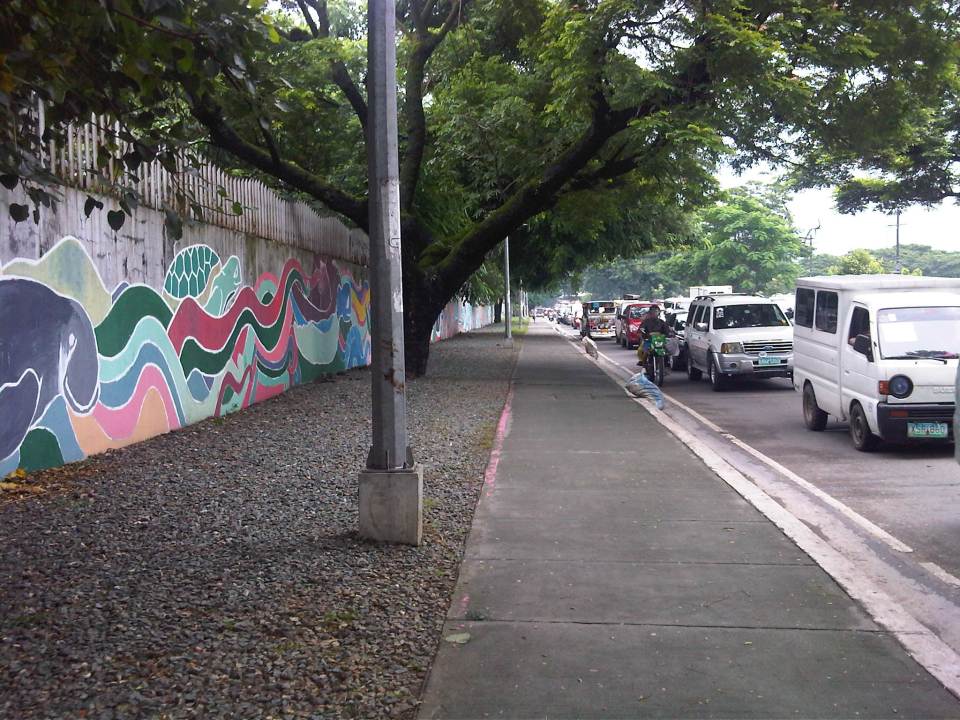 Walking is part of commuting and I am thankful that where I work, the surroundings are basically pedestrian-friendly. The photo above shows the sidewalk along Katipunan Avenue on the side of the university.
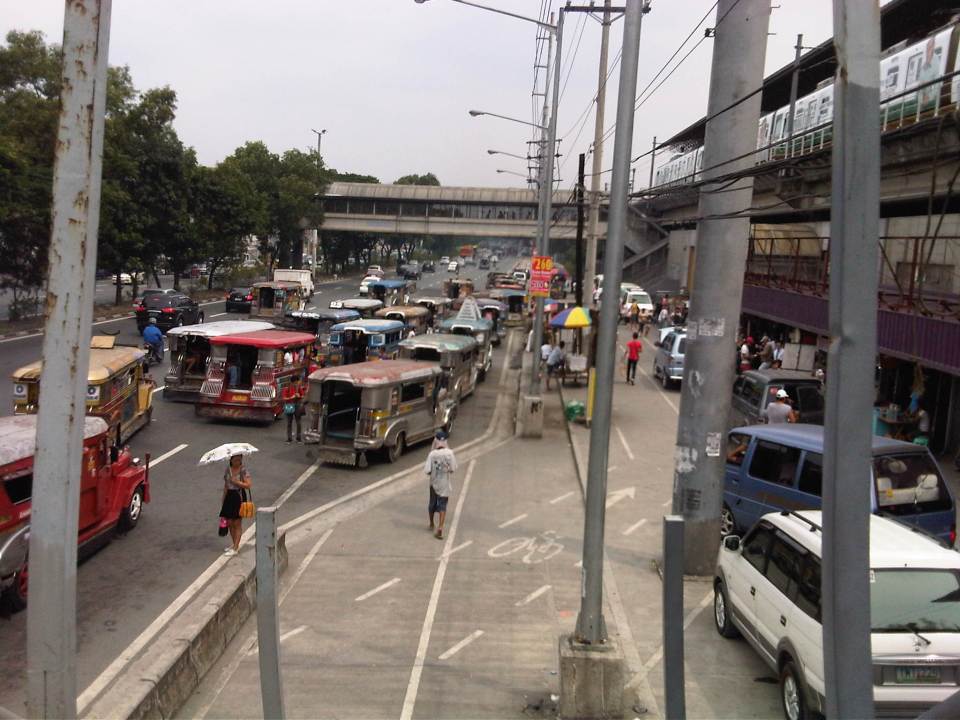 Seamless transfers are not yet quite the norm in the Philippines. The photo shows one of the better examples where transfers between modes are more convenient. This is at the LRT 2 Santolan Station. Note the markings for the bicycle path. I took this as I was descending from the pedestrian overpass that connected with a nearby mall by the Marikina River.
While traveling within other cities, whether in the Philippines or abroad, the first option for many if not most people would be to take public transportation. Taking out a rental vehicle is not common and taxis are considered as part of the public transport system. As such, we try to get information on how to get to places of interest from relatives, friends, hosts or staff of the hotel we are staying at. These include maps like the old fashioned ones we can get at airports, train stations and tourist booths. Nowadays, there’s a wealth of information available online and apps that can help us navigate around cities.
We tend to comment on how good the public transportation is in the places we’ve visited or how easy it was to commute in these cities. And upon returning to our country we are quick to criticize our public transport, pedestrian and cycling facilities. The irony, of course, is that many of those who are quick to criticize don’t even use public transport, walk or cycle. Even more tragic (for lack of a better word, I think) is that we don’t demand for better public transport, pedestrian or cycling facilities. Perhaps that should change and in this New Year, we should resolve to push the government and its partners for better transit, pedestrian and cycling infrastructure for our cities. And part of that push is by getting involved in advocacies, including projects, for these causes on transport. We should not forget that though we need and seek champions for public transport, walking and cycling among our leaders, we should also be champions in our own ways.
–
Commuting on the EDSA MRT 3
There’s a lot of buzz these days about the challenge posed to government officials responsible for our transport and traffic in Metro Manila and the rest of the country. I must admit I regularly drive between home and my workplace but I often commute to meetings and will usually leave my car at the office when I don’t feel like driving. While its often perceived as difficult to take public transport, it is really quite easy as long as you plan your trip. That is, familiarize in advance with what jeepneys, buses, UV express or rail lines your going to take. I’m sure there are so many tools available to those with smart phones or internet access but then nothing beats asking for directions from those familiar with the commute. Following are photos I took en route to a meeting at Bonifacio Global City (BGC) from UP Diliman. I took a jeepney from UP until the EDSA MRT Quezon Avenue Station where I took a train to Ayala Station. From Ayala Station, I walked towards the Fort Bus Terminal at the corner of EDSA and McKinley where I purchased a ticket at the Fort Bus booth beside the Shell gas station.
 Passengers queuing at the platform at Quezon Avenue Station – there is some semblance of discipline but not like what we saw in Japan, Singapore or Bangkok where people do step aside for alighting passengers before entering the train.
 A crowded platform vs. a congested EDSA – commuting is often perceived as a hassle for many in Metro Manila partly because of crowded public transport and the inefficiencies including poor transfers and low quality of service. Many who could afford to own cars or motorcycles take private vehicles instead.
 Passengers on a crowded platform form lines directly in front of the train doors instead of allowing for space for disembarking passengers. While there are markings on the platform to guide passengers where to position with respect to the door, these are not followed and there are no MRT staff to guide people to do so.
 Passengers lined up for an arriving train can be too close to the train, risking accidents where a simple nudge from behind could get a passenger killed by an oncoming train.
 The photo clearly shows the narrow platform of the EDSA MRT station and the markings to guide people where to position with respect to the train doors. This contributes to the congestion on the platform and perhaps is a reason why people can’t line up properly. I’ve observed many people getting stressed out simply because of the undisciplined mix-up during the unloading/loading process whenever a train arrives at the platform. Note also from the photo the sign on top of the guard post informing people of the segregation being implemented in favor of women, children, PWDs and senior citizens. The latter have some cars reserved for them so they won’t have to wrestle it out with other passengers to get in a train.
 A Taft-bound train arrives at the Quezon Ave. Station. On a way to increase the MRT-3’s capacity is to have shorter headways between trains. However, this can’t be done without additional trains.
 A train is not full as it leaves Quezon Ave. but more passengers board at subsequent stations at GMA Kamuning and Cubao. The train cars are eventually crowded and I stopped taking photos in case someone fancies my phone or gets offended by my taking photos inside the train.
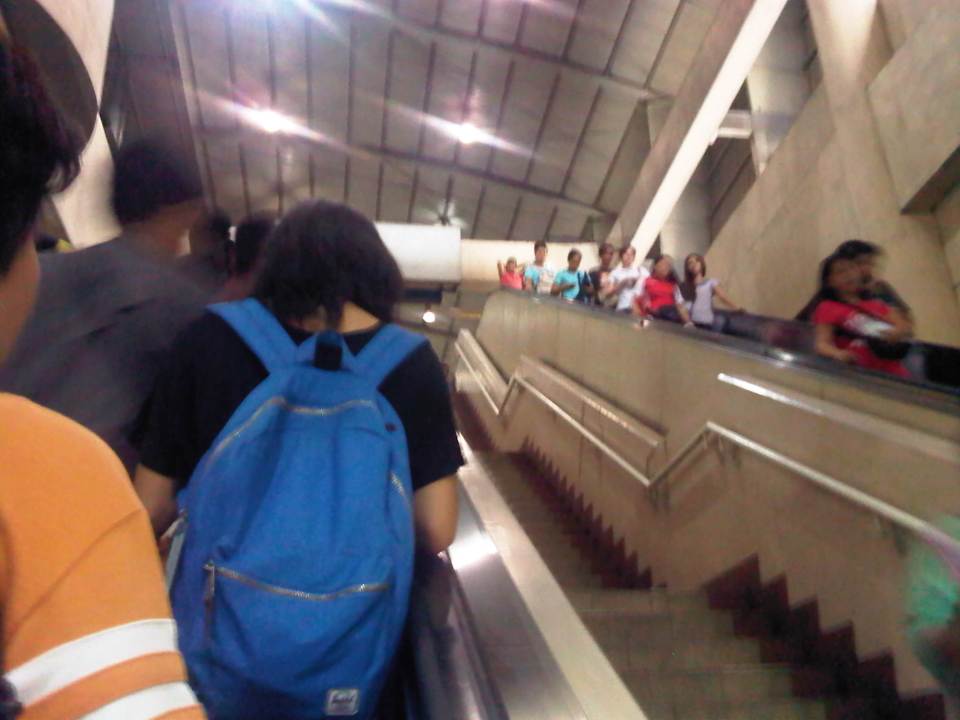 Escalators at the Ayala Station where the platform is practically underground.
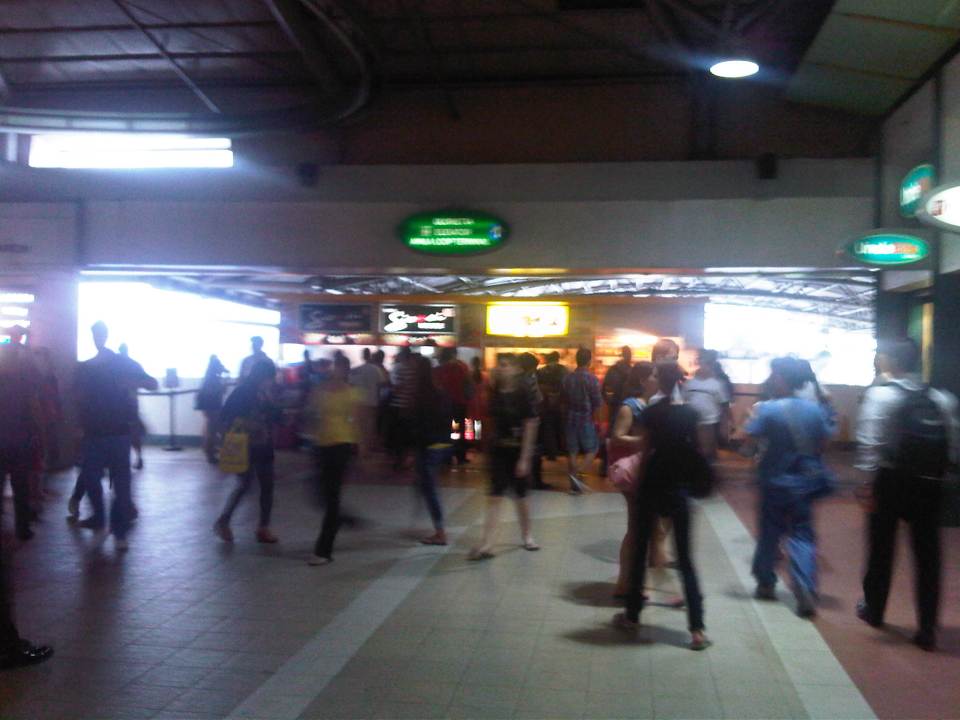 Small shops and stalls at the Ayala Station. There is a direct access to SM Makati, which a lot of people take to also have a more comfortable walk through the malls nearby.
 Ayala Station is one of the larger and more developed stations along EDSA-MRT and among the busiest given its location.
 Among the shops and stores at the station is a local courier service and a license renewal center of the Land Transportation Office (LTO). These cater to people on the go and quite convenient to commuters.
 Direction signs to guide passengers transferring to the Fort Bus of Bonifacio Global City (BGC).
 MRT stored value card – these along with the single journey cards may be pruchased at the stations. A stored value card is worth PhP 100 with the last journey assured regardless of the remaining balance in the card. As can be seen, the card has seen better days. However, the long-delayed common ticketing system for rail transit in Metro Manila should be implemented soon (crossing my fingers). Perhaps other ways can be explored like commuter passes for regulars including discounted ones for students and senior citizens. In Japan, for example, one can get such passes for 1 month, 3 months, 6 months or even a year, paid in advance for unlimited trips between one’s “home” station and “work” or “school” station.
I think our government owes it to the more than 80% of travelers who take public transport to improve our transport system. There’s a lot of room for improvement in terms of the quality of service including comfort, convenience and reliability that can be addressed only if we invest in public transport infra and introduce reforms that have long been recommended but not implemented (for many reasons). Let’s take it from Enrique Penalosa, who was mayor of Bogota and a leading proponent of the Bus Rapid Transit (BRT) was quoted as saying “a developed country is not a place where the poor have cars. It’s where the rich use public transport.”
–
Airport limousine bus at Narita
There are several options for passengers to travel between Narita Airport and their destinations in the Kanto area. There are many train services connecting the airport to Tokyo, Yokohama, Chiba or other destinations. These include the Narita Express (N’EX), the Airport Narita trains of the JR Yokosuka-Sobu Line, and the Keisei Skyliner. Another option is to take limousine buses from the airport, which includes the Airport Limousine bus from Narita. Information on fares and schedules are available from the internet links I provided.
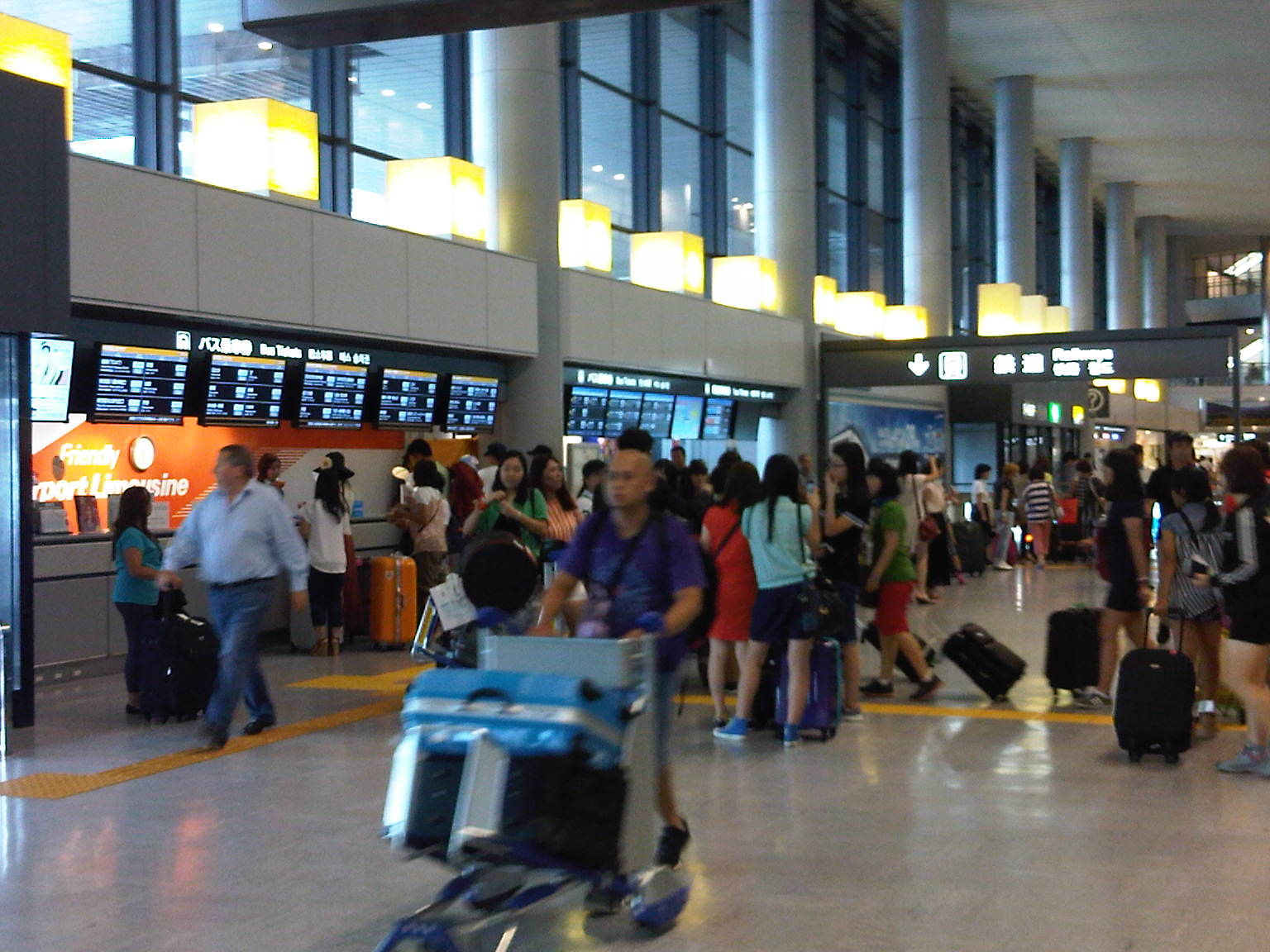 The Airport Limousine counter at the arrival area where passengers may inquire about services and purchase tickets.
 Bus stops are located just outside Narita Terminal 1
 The information boards on Airport Limousine stops provide information for the next bus for a particular destination in both Japanese and English.
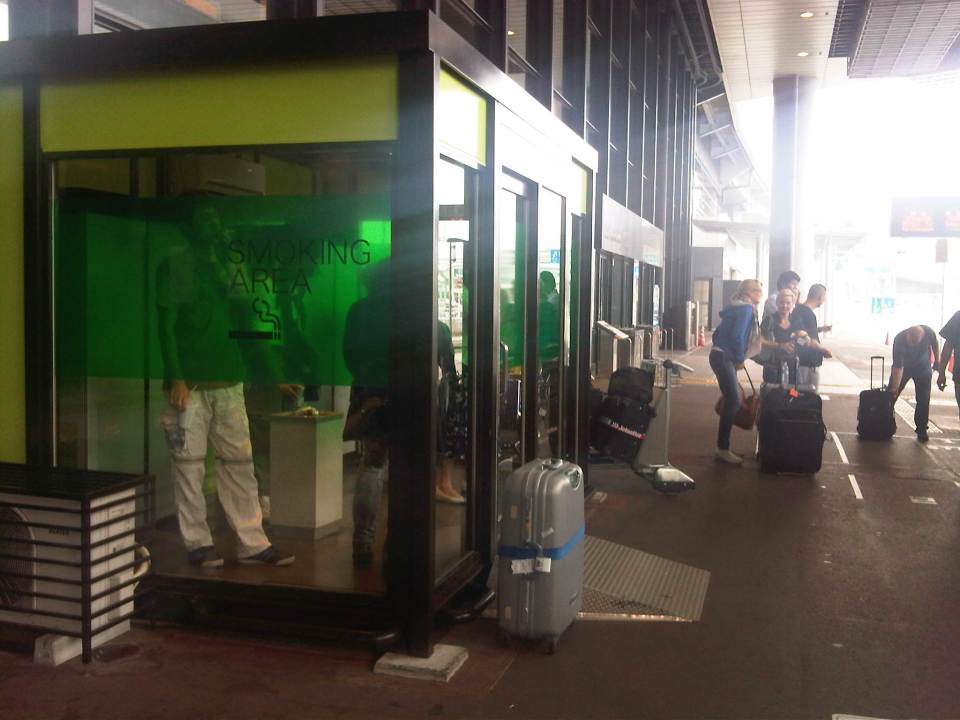 Smoking areas are located outside the airport and are enclosed. There is air-conditioning for ventilation.
 A Limousine Bus bound for the Yokohama City Air Terminal (YCAT) is shown loading passengers. I used to take this bus as an alternate for going to Yokohama. My other option was the Airport Narita trains of the JR Yokosuka-Sobu Line.
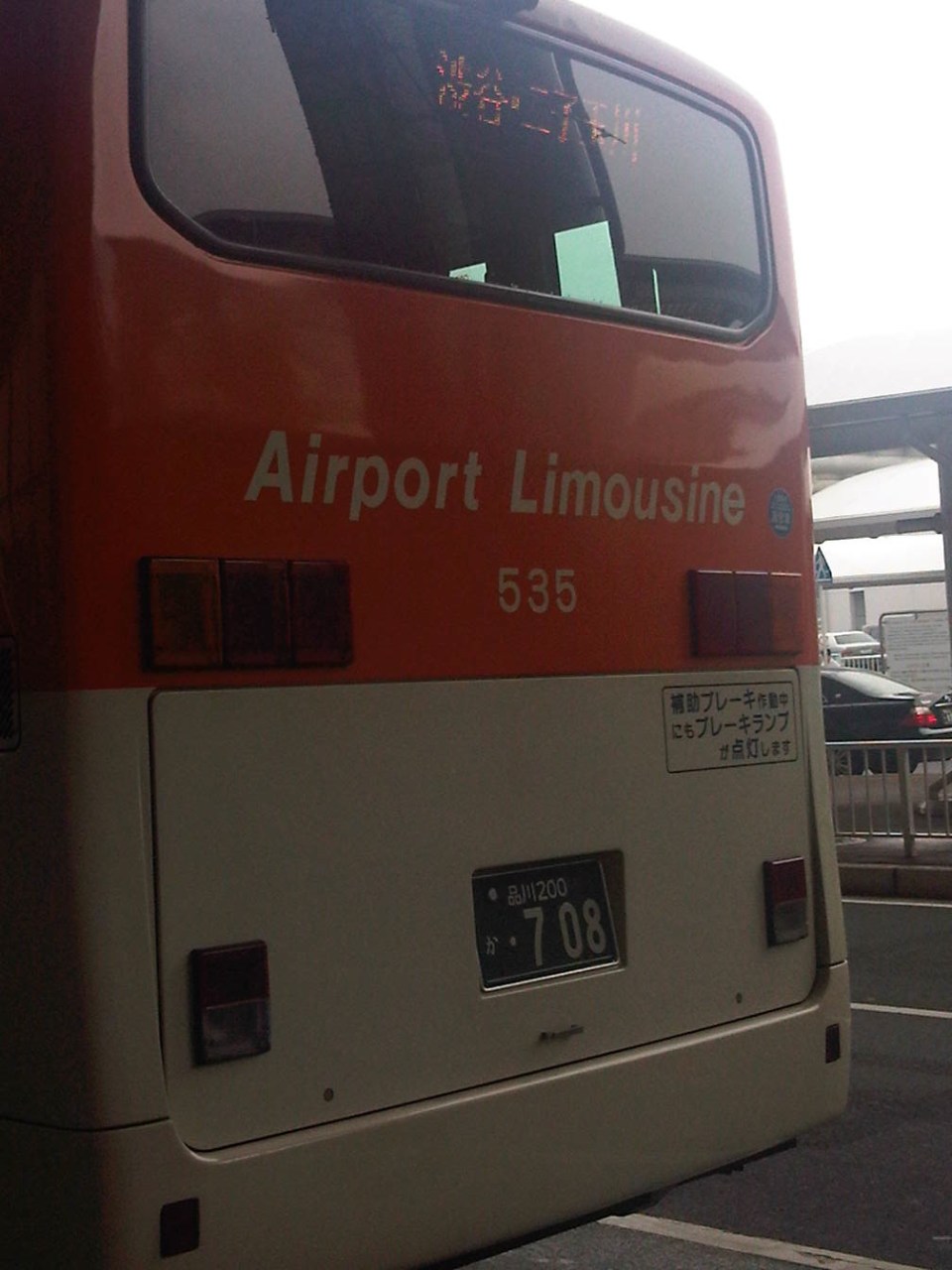 Back of a bus bound for Shibuya and Futako Tamagawa in western Tokyo.
 Airport Limousine Bus ticket from Narita to Akasaka
 Baggage claim stub
When I was still residing in Yokohama, I usually took the train to Narita and the bus when returning from the airport and via YCAT. This was because I usually travelled lighter when going to Manila than when I was returning since I brought back some food items for times when I was feeling homesick and longed for something familiar to eat. Cost-wise, the airport limousine bus service cost a bit more but was more convenient for my return trips. Later, in my stays at Saitama, the obvious choice was the bus to and from Narita through Omiya Station as traveling by rail was more complicated due to the transfers. The additional cost is easily justified by the convenience and comfort provided by the bus service.
–
 Caught (up) in traffic