
Home » Posts tagged 'Public Transport' (Page 11)
Tag Archives: Public Transport
Commuting on the EDSA MRT 3
There’s a lot of buzz these days about the challenge posed to government officials responsible for our transport and traffic in Metro Manila and the rest of the country. I must admit I regularly drive between home and my workplace but I often commute to meetings and will usually leave my car at the office when I don’t feel like driving. While its often perceived as difficult to take public transport, it is really quite easy as long as you plan your trip. That is, familiarize in advance with what jeepneys, buses, UV express or rail lines your going to take. I’m sure there are so many tools available to those with smart phones or internet access but then nothing beats asking for directions from those familiar with the commute. Following are photos I took en route to a meeting at Bonifacio Global City (BGC) from UP Diliman. I took a jeepney from UP until the EDSA MRT Quezon Avenue Station where I took a train to Ayala Station. From Ayala Station, I walked towards the Fort Bus Terminal at the corner of EDSA and McKinley where I purchased a ticket at the Fort Bus booth beside the Shell gas station.
 Passengers queuing at the platform at Quezon Avenue Station – there is some semblance of discipline but not like what we saw in Japan, Singapore or Bangkok where people do step aside for alighting passengers before entering the train.
 A crowded platform vs. a congested EDSA – commuting is often perceived as a hassle for many in Metro Manila partly because of crowded public transport and the inefficiencies including poor transfers and low quality of service. Many who could afford to own cars or motorcycles take private vehicles instead.
 Passengers on a crowded platform form lines directly in front of the train doors instead of allowing for space for disembarking passengers. While there are markings on the platform to guide passengers where to position with respect to the door, these are not followed and there are no MRT staff to guide people to do so.
 Passengers lined up for an arriving train can be too close to the train, risking accidents where a simple nudge from behind could get a passenger killed by an oncoming train.
 The photo clearly shows the narrow platform of the EDSA MRT station and the markings to guide people where to position with respect to the train doors. This contributes to the congestion on the platform and perhaps is a reason why people can’t line up properly. I’ve observed many people getting stressed out simply because of the undisciplined mix-up during the unloading/loading process whenever a train arrives at the platform. Note also from the photo the sign on top of the guard post informing people of the segregation being implemented in favor of women, children, PWDs and senior citizens. The latter have some cars reserved for them so they won’t have to wrestle it out with other passengers to get in a train.
 A Taft-bound train arrives at the Quezon Ave. Station. On a way to increase the MRT-3’s capacity is to have shorter headways between trains. However, this can’t be done without additional trains.
 A train is not full as it leaves Quezon Ave. but more passengers board at subsequent stations at GMA Kamuning and Cubao. The train cars are eventually crowded and I stopped taking photos in case someone fancies my phone or gets offended by my taking photos inside the train.
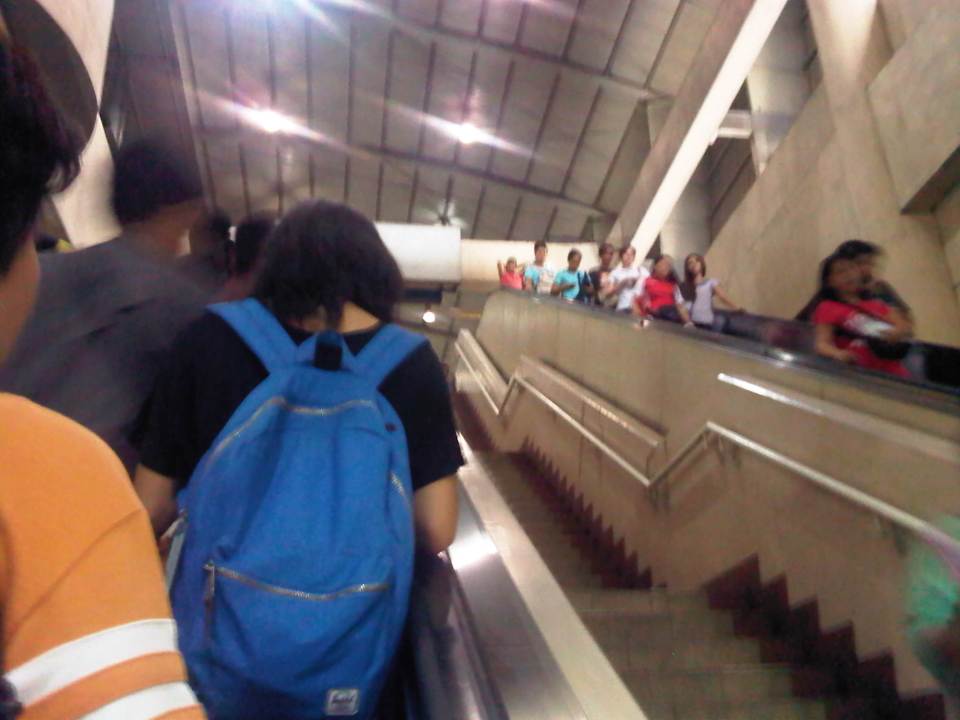 Escalators at the Ayala Station where the platform is practically underground.
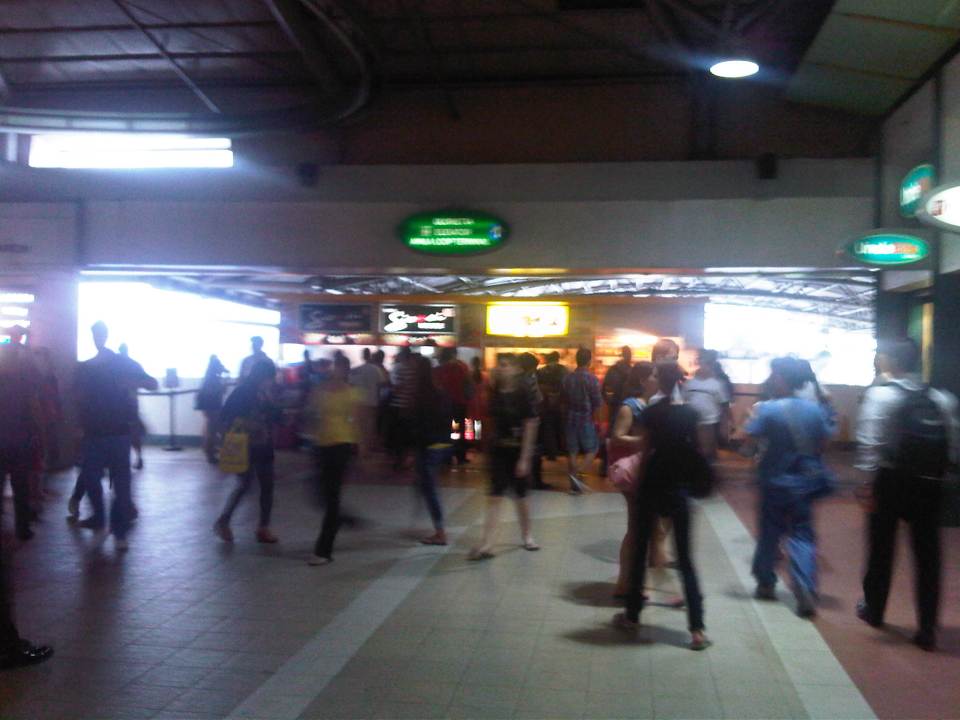 Small shops and stalls at the Ayala Station. There is a direct access to SM Makati, which a lot of people take to also have a more comfortable walk through the malls nearby.
 Ayala Station is one of the larger and more developed stations along EDSA-MRT and among the busiest given its location.
 Among the shops and stores at the station is a local courier service and a license renewal center of the Land Transportation Office (LTO). These cater to people on the go and quite convenient to commuters.
 Direction signs to guide passengers transferring to the Fort Bus of Bonifacio Global City (BGC).
 MRT stored value card – these along with the single journey cards may be pruchased at the stations. A stored value card is worth PhP 100 with the last journey assured regardless of the remaining balance in the card. As can be seen, the card has seen better days. However, the long-delayed common ticketing system for rail transit in Metro Manila should be implemented soon (crossing my fingers). Perhaps other ways can be explored like commuter passes for regulars including discounted ones for students and senior citizens. In Japan, for example, one can get such passes for 1 month, 3 months, 6 months or even a year, paid in advance for unlimited trips between one’s “home” station and “work” or “school” station.
I think our government owes it to the more than 80% of travelers who take public transport to improve our transport system. There’s a lot of room for improvement in terms of the quality of service including comfort, convenience and reliability that can be addressed only if we invest in public transport infra and introduce reforms that have long been recommended but not implemented (for many reasons). Let’s take it from Enrique Penalosa, who was mayor of Bogota and a leading proponent of the Bus Rapid Transit (BRT) was quoted as saying “a developed country is not a place where the poor have cars. It’s where the rich use public transport.”
–
Airport limousine bus at Narita
There are several options for passengers to travel between Narita Airport and their destinations in the Kanto area. There are many train services connecting the airport to Tokyo, Yokohama, Chiba or other destinations. These include the Narita Express (N’EX), the Airport Narita trains of the JR Yokosuka-Sobu Line, and the Keisei Skyliner. Another option is to take limousine buses from the airport, which includes the Airport Limousine bus from Narita. Information on fares and schedules are available from the internet links I provided.
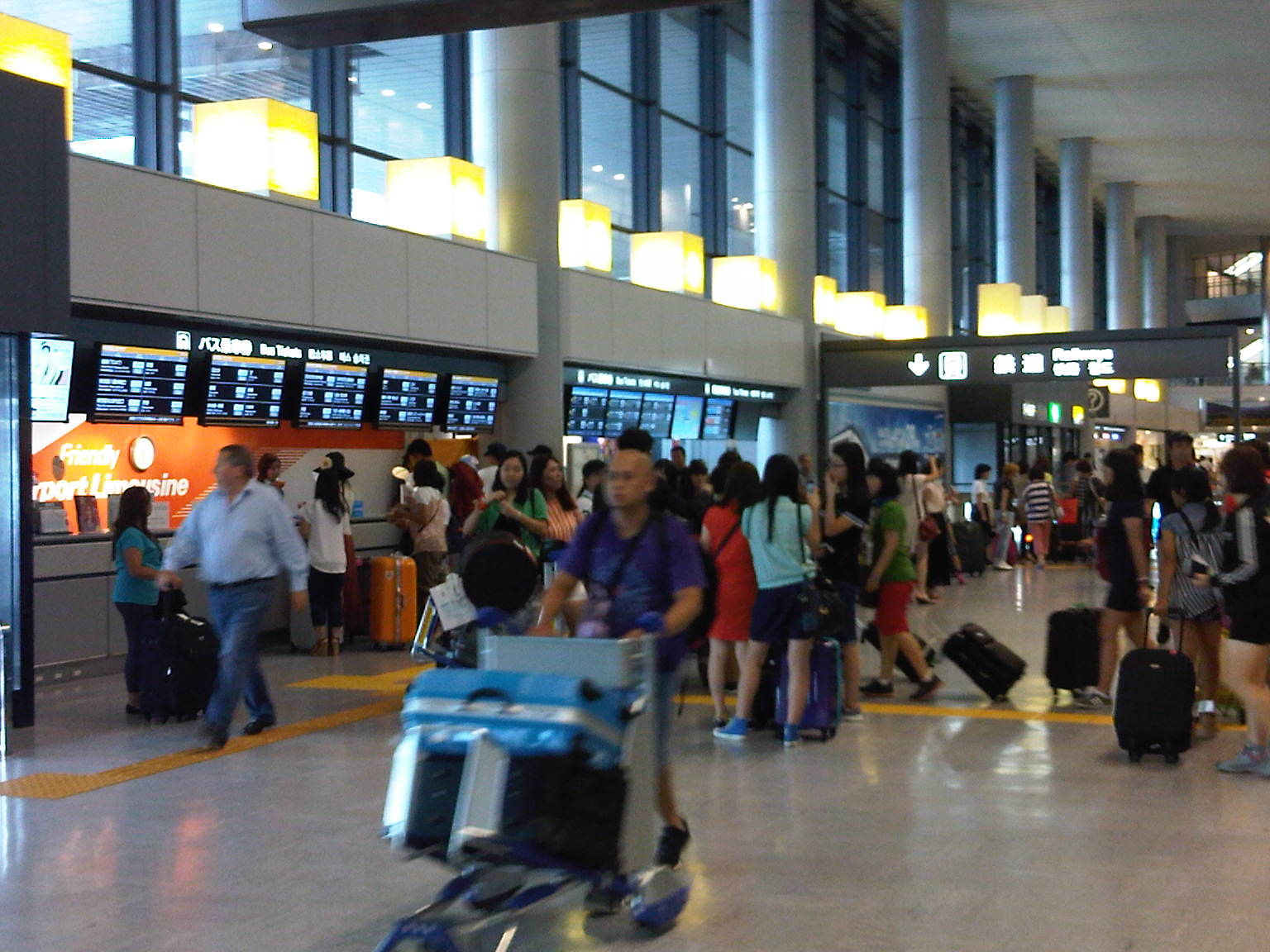 The Airport Limousine counter at the arrival area where passengers may inquire about services and purchase tickets.
 Bus stops are located just outside Narita Terminal 1
 The information boards on Airport Limousine stops provide information for the next bus for a particular destination in both Japanese and English.
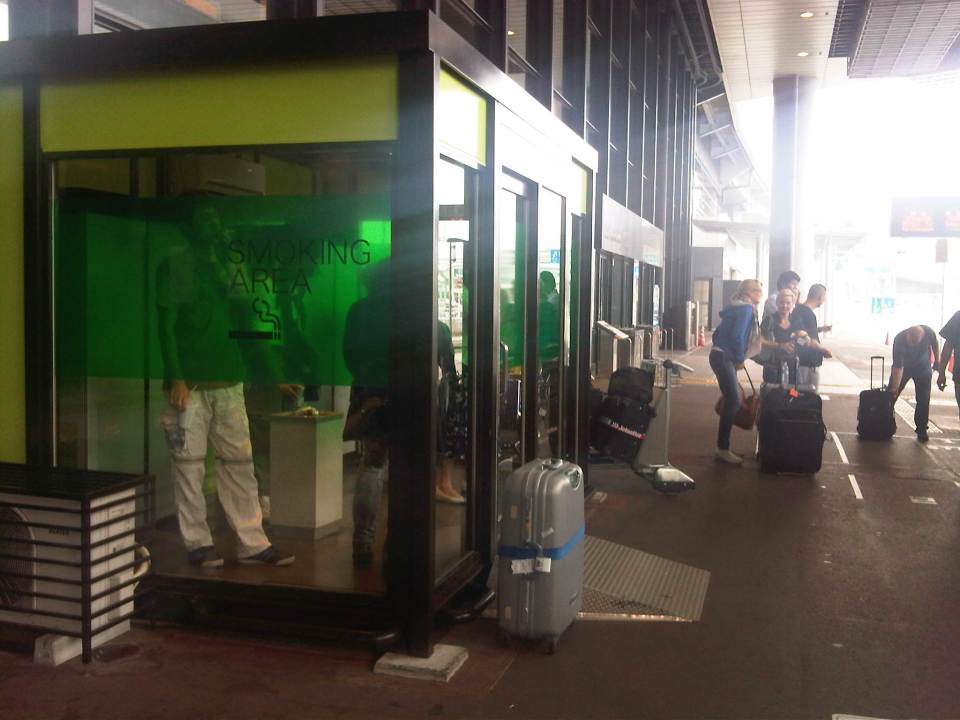 Smoking areas are located outside the airport and are enclosed. There is air-conditioning for ventilation.
 A Limousine Bus bound for the Yokohama City Air Terminal (YCAT) is shown loading passengers. I used to take this bus as an alternate for going to Yokohama. My other option was the Airport Narita trains of the JR Yokosuka-Sobu Line.
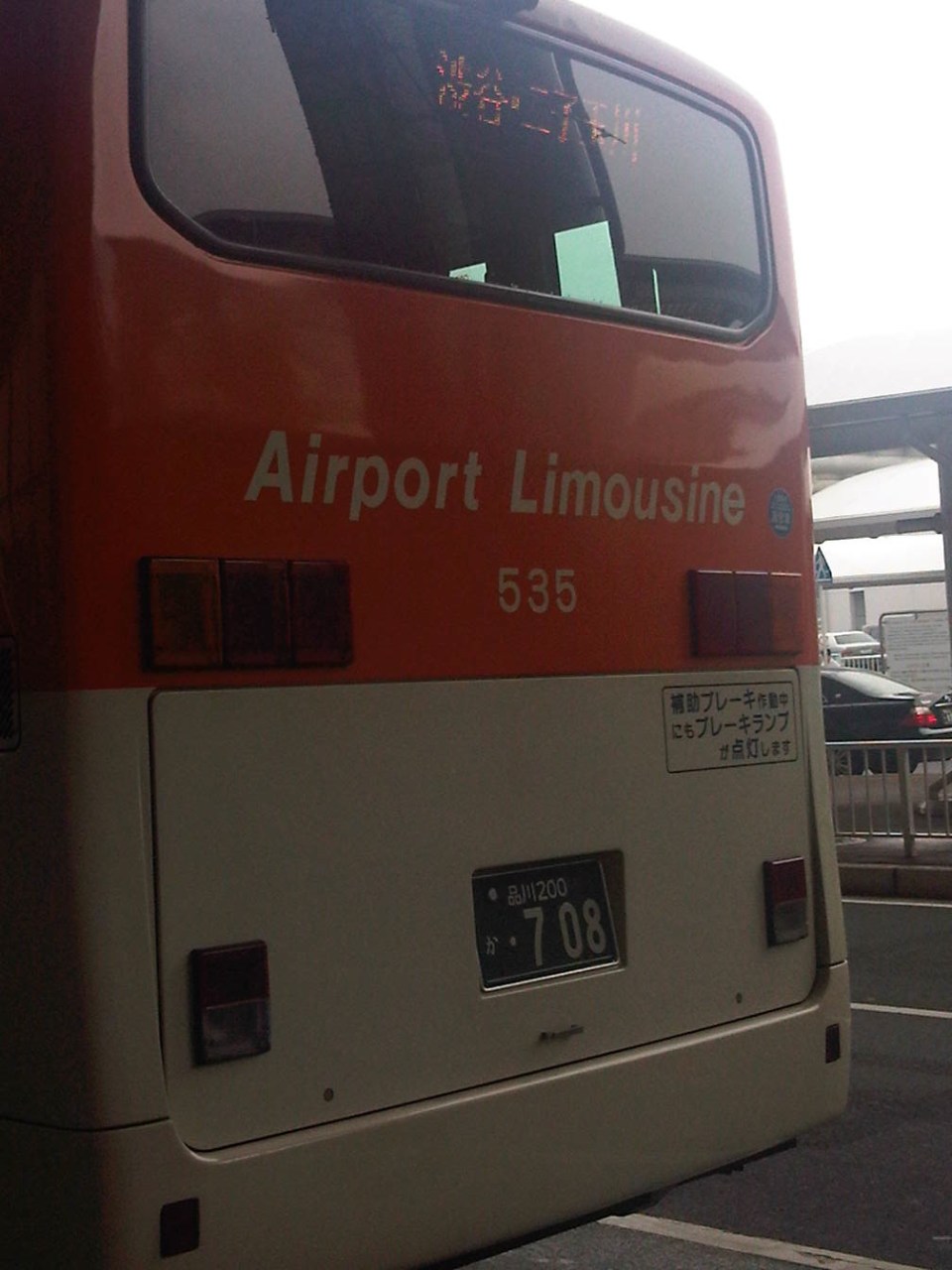 Back of a bus bound for Shibuya and Futako Tamagawa in western Tokyo.
 Airport Limousine Bus ticket from Narita to Akasaka
 Baggage claim stub
When I was still residing in Yokohama, I usually took the train to Narita and the bus when returning from the airport and via YCAT. This was because I usually travelled lighter when going to Manila than when I was returning since I brought back some food items for times when I was feeling homesick and longed for something familiar to eat. Cost-wise, the airport limousine bus service cost a bit more but was more convenient for my return trips. Later, in my stays at Saitama, the obvious choice was the bus to and from Narita through Omiya Station as traveling by rail was more complicated due to the transfers. The additional cost is easily justified by the convenience and comfort provided by the bus service.
–
Manila’s bus experiment
Manila recently banned provincial and city buses from entering the city stating this is because many of them do not have franchises and/or terminals in the city. Those without franchises are the ones labeled as “colorum” or illegally operating public transport vehicles, which really don’t have a right to convey people in the first place. It’s become difficult to catch them because many carry well-made falsified documents. But it’s not really an issue if the LTFRB, LTO and LGUs would just cooperate to apprehend these colorum drivers. The LTFRB and LTO are under the DOTC, and so the agency is also responsible for policies and guidelines to be followed by the two under it. LGUs (and the MMDA in the case of MM) are tasked with traffic enforcement and so they can apprehend vehicles and act on traffic violations including operating without a franchise.
Those without terminals are both city and provincial buses. For city buses, this can be because they “turnaround” in Manila and operators do not feel the need to have a formal terminal. For example, G-Liner buses plying the Cainta-Quiapo route will stop at Quiapo only to unload Quiapo-bound passengers, and then switch signboards and proceed to load Cainta-bound passengers as they head back to Rizal. There is very little time spent as the bus makes the turnaround. It’s a different case for provincial buses, whose drivers should have the benefit of rest (same as their vehicles, which also need regularly maintenance checks) after driving long hours. Thus, if only for this reason they need to have formal, off-street terminals in the city. Following are photos I took near the Welcome Rotunda en route to a forum last Friday.
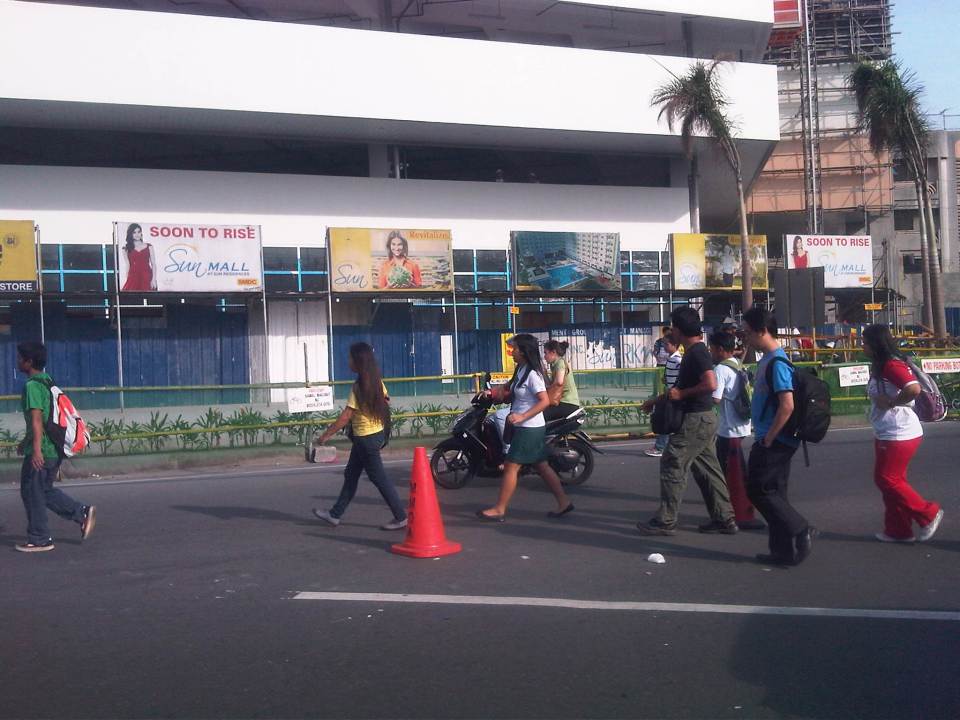 Commuters walking to cross the street at the Welcome Rotunda to transfer to jeepneys waiting for passengers to ferry to Manila.
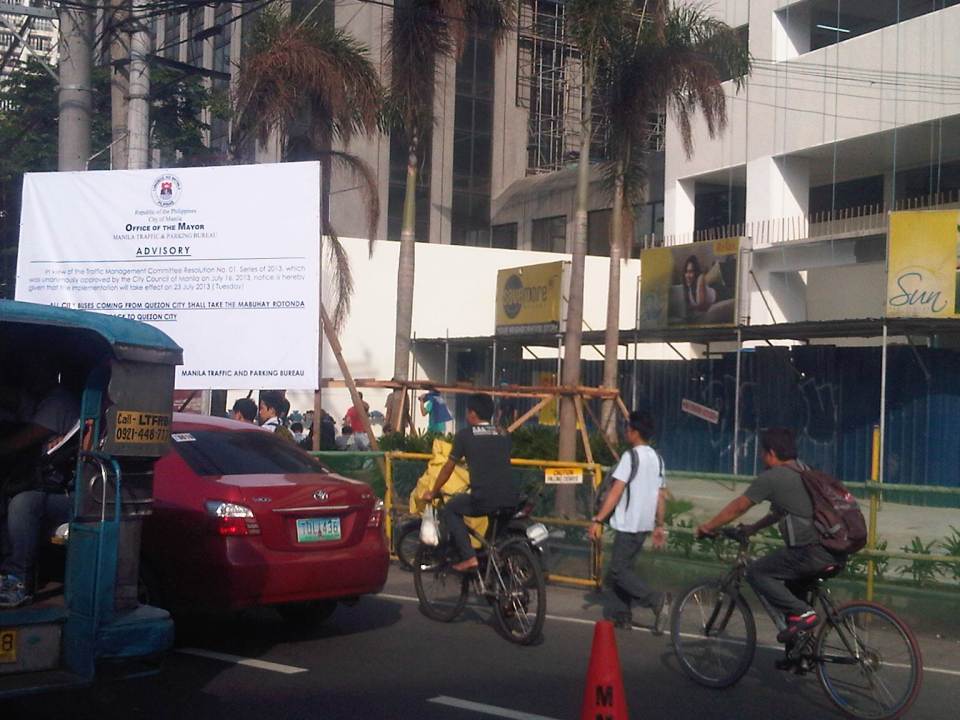 Commuters and cyclists moving along the carriageway as there are no pedestrian or cycling facilities in front of a construction site at the corner of Espana and Mayon Ave.
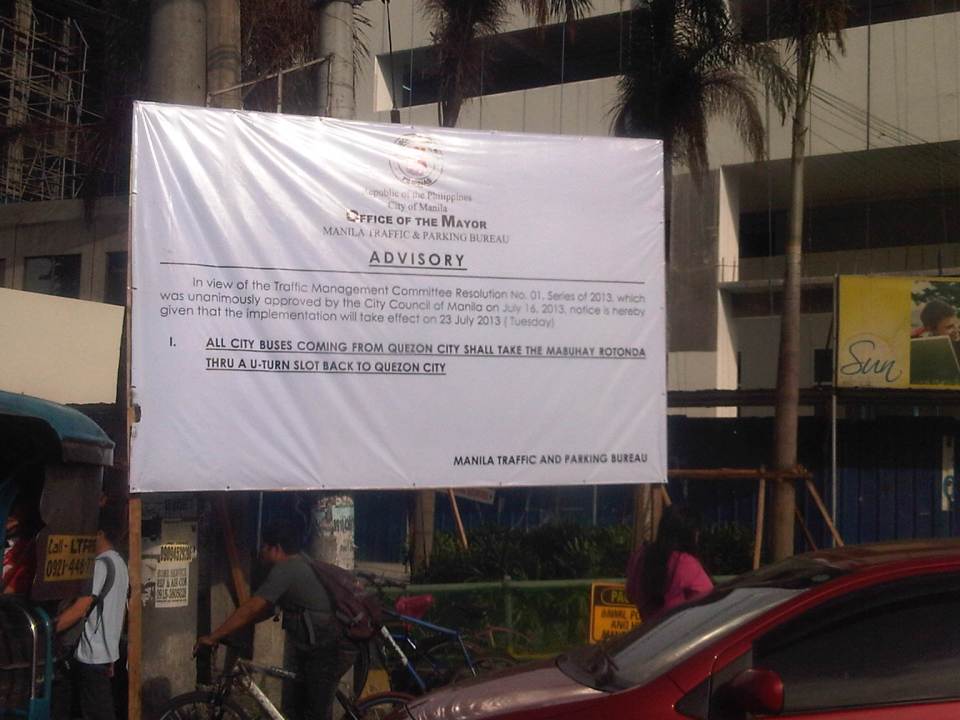 Advisory for buses coming from Quezon City
 Commuters waiting for a jeepney ride along Espana just after the Welcome Rotunda
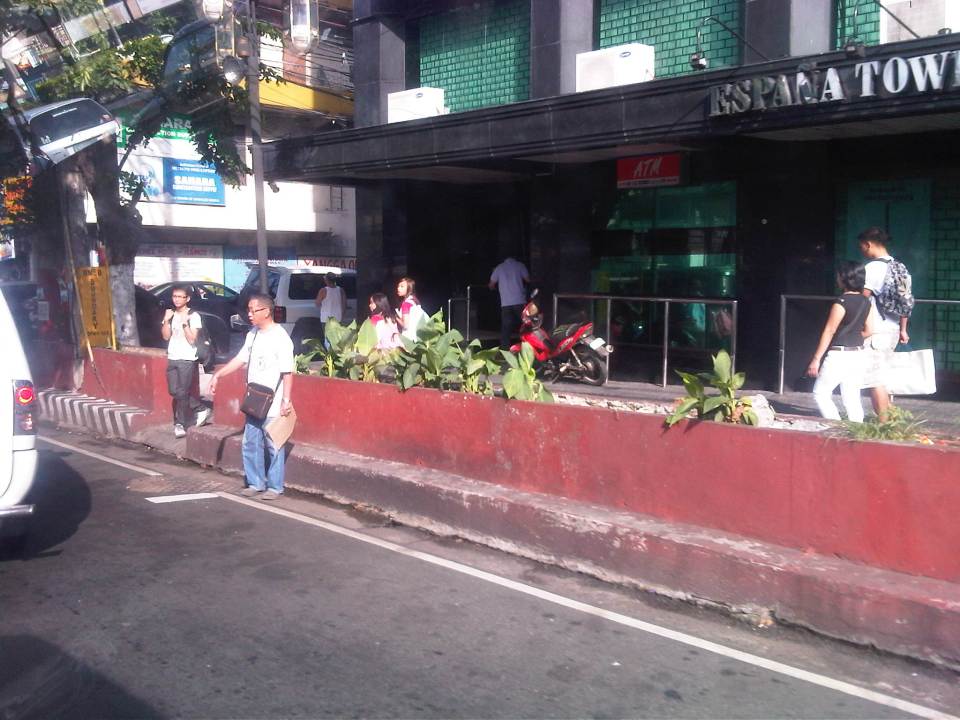 Some pedestrians opt to walk on instead of waiting for a ride. Manila used to be a walkable city but it is not one at present. Many streets have narrow sidewalks and many pedestrian facilities are obstructed by vendors and other obstacles.
So, is it really a move towards better transport systems and services in Manila or is it just a publicity stunt? If it is to send a message to public transport (not just bus) operators and drivers that they should clean up their acts and improve the services including practicing safe driving, then I’m all for it and I believe Manila should be supported and lauded for its efforts. Unfortunately, it is unclear if this is really the objective behind the resolution. Also, whether it is a resolution or an ordinance, it is a fact that the move violates the franchises granted to the buses. These franchises define their routes and specify the streets to be plied by buses. Many LGUs in the past have executed their traffic schemes and other measures intended to address traffic congestion, without engaging the LTFRB or at least ask for the agency’s guidance in re-routing public transport. Of course, the LTFRB is also partly to blame as they have not been pro-active in reviewing and optimizing PT routes.
One opinion made by a former government transport official is that this is just a ploy by the city to force bus companies to establish formal terminals in the city. This will require operators to secure permits, purchase or lease land and build terminals. And so that means revenues for the city and perhaps more traffic problems in the vicinity of the terminals just like what’s happening in Quezon City (Cubao) and Pasay City (Tramo).
Transport planning is a big part of the DOTC’s mandate and both the LTO (in charge of vehicle registration and driver’s licenses) and LTFRB (in charge of franchising of buses, jeepneys and taxis) look to the agency for guidelines and policy statements they are to implement. Meanwhile, LGUs have jurisdiction over paratransit like tricycles and pedicabs. In the case of Manila, these paratransit also include the “kuligligs,” 3-wheeler pedicabs that were fitted with engines and have been allowed (franchised?) by the city to provide transport services in many streets. Unfortunately, most LGUs do not have capacity nor capability for transport planning and so are limited or handicapped in the way they deal with transport (and traffic) issues in their jurisdictions. We have always maintained and promoted the stand that the DOTC should extend assistance and expertise to LGUs and the LGUs should also actively seek DOTC’s guidance in matters pertaining to transport. There needs to be constant communication between the national and local entities with cooperation leading to better, more suitable policies being formulated and implemented at the local level.
–
Too late?
A friend posted her disappointment over what she regularly observed through her condominium window overlooking EDSA Guadalupe. The traffic jams along EDSA seemed to be a 24-hour thing and she lamented about whether Metro Manila could solve this problem on congestion. She continues to be an active advocate for the environment and we have worked together on the electric jeepney that is now operating a 3rd route in the City of Makati and is also found operating elsewhere in other cities where its applications, to be fair, is still quite limited.
My response to her is something I have also mentioned in other venues including previous posts on this blog and interviews granted to major media networks that have asked me what’s wrong about transport and traffic in our country. It’s really simple – we have failed to build the necessary infrastructure when they needed to be constructed. And we continue to NOT build the infrastructure that could have saved us much in terms of fuel costs alone and perhaps contributed much more to our economy, and definitely outweighing the costs that have often been cited as if it were a deterrent to the realization of a mass transit network for Metro Manila.
Being one who has lived in both Tokyo and Singapore where they have good public transportation systems, I could not help but become excited when, returning from Japan before the turn of the century I came upon plans for Metro Manila’s rail network. I was excited because the decade before I was first exposed to similar plans for MM at a time when other capital cities in Southeast Asia like Bangkok, Jakarta and Kuala Lumpur where also planning for their own mass transit systems. In fact, they were also planning expressways in their respective metropolitan areas (i.e., Bangkok Metropolitan Area or BMA and Jakarta-Bogor-Depok-Tangerang-Bekasi or Jabodetabek/Greater Jakarta). Flash forward to the present, it is frustrating, if not depressing, to see that Bangkok and Jakarta were able to implement many of their plans that were critical for the growth of these metropolitan areas and definitely contributed to the overall sustainable development in those countries. Granted, Bangkok and Jakarta still experiences congestion like the legendary jams along urban highways in Bangkok. But which city around the world does not experience congestion? The key is to provide a viable and more efficient (also convenient and comfortable) alternative to taking one’s car. That should be in the form of a mass transport system that is comprehensive enough that it will allow for both mobility and accessibility to the traveler/commuter. The following figure from the 2005 World Transit Maps envisioned a network that is still now unrealized and, for the existing lines, have become the subject of controversy and other issues that include the absence of a single ticketing system similar to the smart and octopus cards found in other countries.

Can we imagine what could have been the experience of commuting in a Metro Manila where such a rail system would have been in place? My former students have related to me about how it was so convenient to move about in Singapore, Tokyo and Hongkong where the mass transit systems where comprehensive and integrated such that rail and bus systems could provide for the transport needs of commuters. I would like to believe that we have all the plans with us by this time and that the construction of transport infrastructure has long been delayed for our cities (not just Metro Manila but also other metros such as Cebu and Davao) so much so that we continue to suffer from the lack of critical systems that could definitely alleviate congestion and improve the plight of the general public. Perhaps people taking their cars and motorcycles will be convinced to shift to public transport if they see the benefits of doing so. For others who are still captives of our inefficient public transport systems, I am sure that the experience of having improved systems (and an expanded network) will be liberating considering their daily sacrifices just to make ends meet while losing much quality time, productive time stranded in traffic.
Locally made AGT
I got my first look at the vehicle currently being developed by the DOST-MIRDC at the DOST complex in Bicutan. This was the same vehicle that was shown on some news programs a couple of days ago when there was some buzz about a MOA being signed between UP and DOST for the development of an automated guideway transit (AGT) prototype and test track at UP Diliman. The DOST Secretary was supposed to have said that it would cost somewhere between a fourth or a fifth of those developed elsewhere (read: other cities abroad) and that it would have a capacity of 60 passengers. The Secretary also was reported to have said that the AGT would eventually be travelling at 100 – 120 kilometers per hour! That’s quite fast for something that’s being packaged as an urban mass transit system.
Together with the reports, both on TV and print (I haven’t heard anything from radio.), were images of a transit vehicle used by DOST in publicizing the project. What appeared was an artist’s impression (or so it seems) of what looked more like a monorail than an AGT. But coming to Taguig for a meeting, I made it a point to ask our friends at DOST to give us a brief tour of the test track they constructed at the complex where the MIRDC with a little help from another agency involved in rail transit was testing a prototype vehicle that was shown on TV. I wasn’t able to catch those news reports so I was a little excited to see the vehicle being developed and by local engineers and scientists. Below are a few of photos of the vehicle together with the test track.
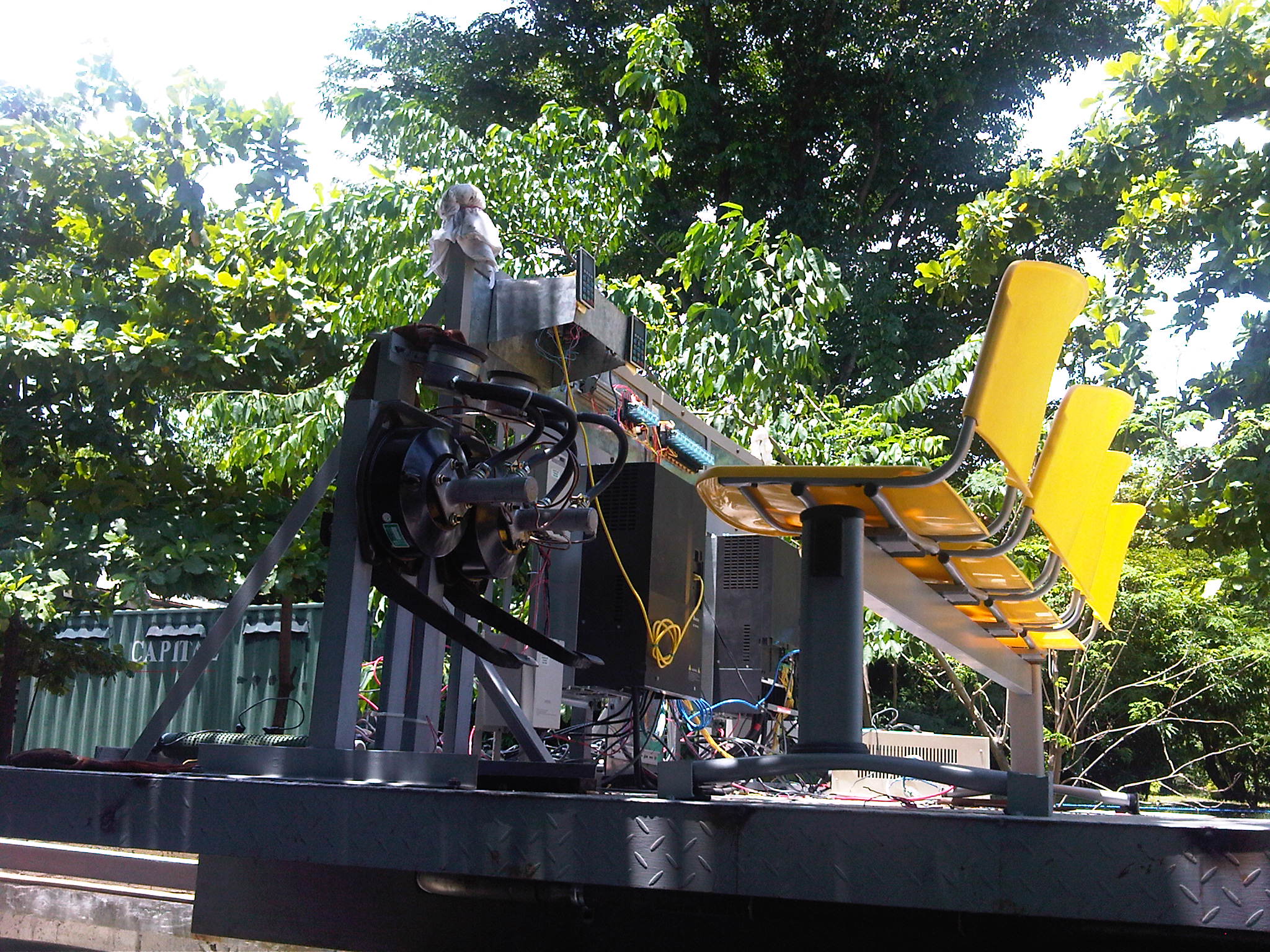
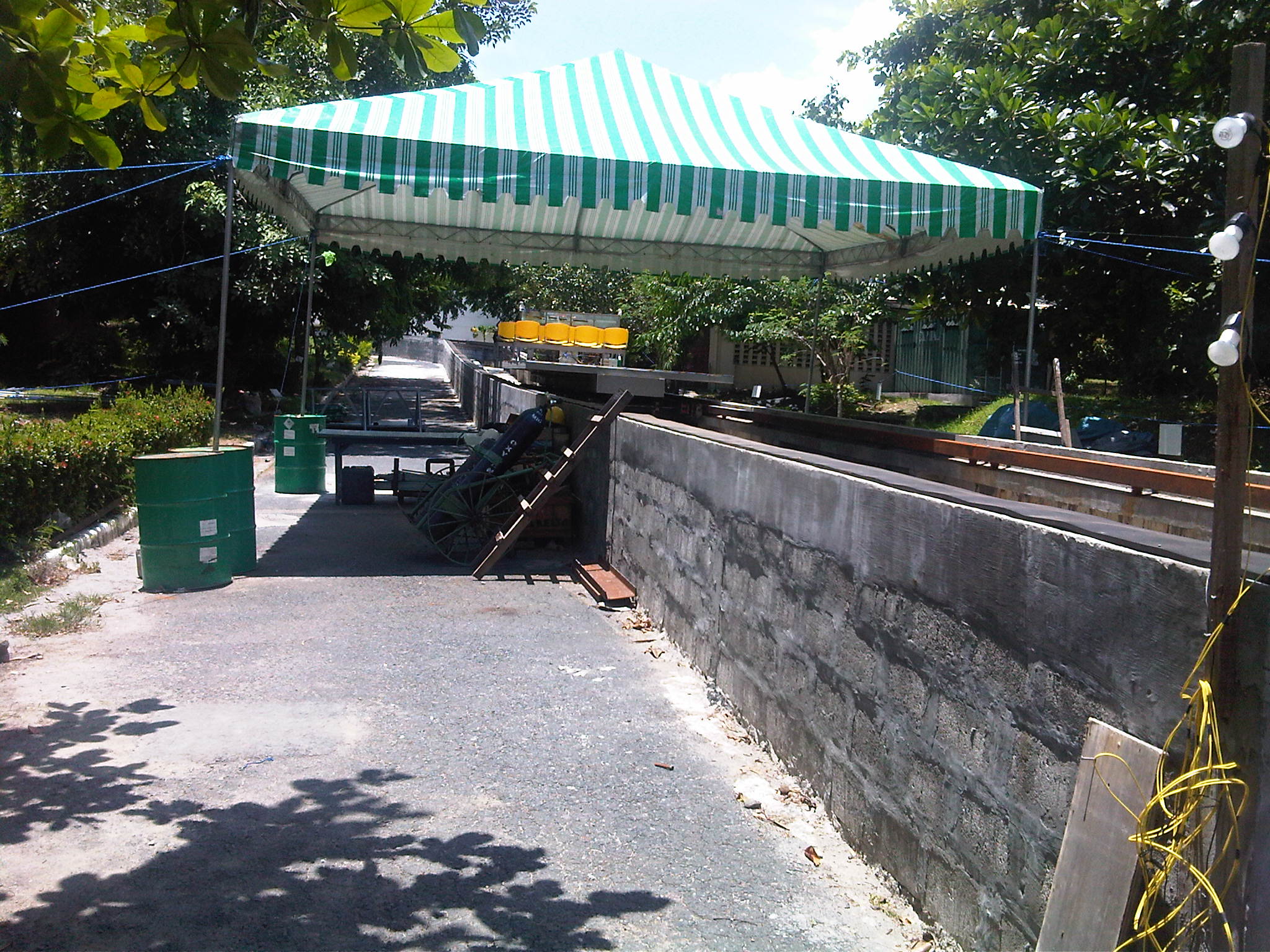
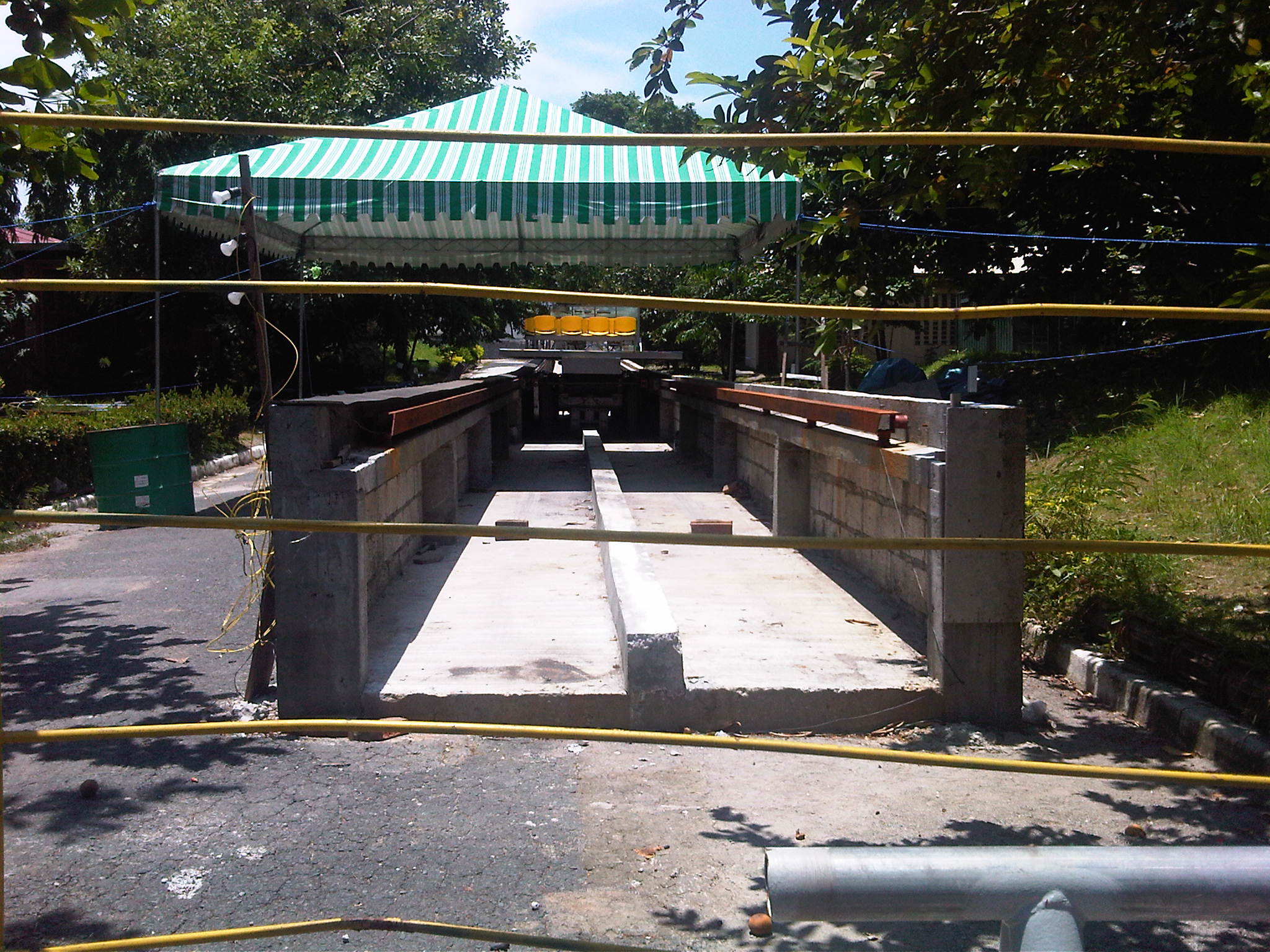
I’m sure a lot of pundits out there were disappointed with what they saw after getting all the hype about the UP AGT. However, it turns out that this won’t even be what will run along the test track to be constructed at UP Diliman. Our friends at the DOST say that this was just a practice vehicle of sorts that DOST staff experimented on just to prove that we (Filipinos) are capable of developing a transit vehicle and the track that will carry it. Of course, the future track and the proposed loop in UP Diliman will be overhead. Also, there will be other challenges pertaining to the superstructure (foundations, columns, girders, stations, etc.). Then there is the vehicle itself that should be safe and comfortable with designs adhering to ergonomic standards, an efficient motor and controller (it will be electric), and a suspension system that should give a smooth ride. Needless to say, the vehicle should also look good to be able to attract people and for it to be marketable. These are tremendous expectations indeed and it could really use all-out support from the government and maybe the private sector. I would not be talking about the funds and other resources required for this undertaking. Info on these are already available from the DOST and UP, and there are already initiatives to attract the private sector into having a look at the project and perhaps provide support in whatever way they can.
I can’t help but be proud of what has been accomplished and what is still to come in as far as the project is concerned. I believe we should be eager to pitch in what we can in order to ensure the success of this collaboration between UP and DOST. Who would not want to be involved in a project where Filipino engineers and scientists will come together to come up with a product we can not only showcase as home-grown but something that would have a significant impact on public transportation in this country.
Meanwhile, it would be better for DOST and UP to temper expectations so as not to put undue pressure on those who will be involved in the project. Pronouncements claiming that the system will replace the IKOT jeepneys are at this stage premature and only raises flags that would not be in the interest of the project. Claims, too, that the vehicle will run at 100 kph is unfounded and unnecessary considering, for one, that the average running speeds of such systems would be between 30 and 40 kph and probably top at 60 kph if there were sufficient distance between stations. I understand that the statements made were probably words of encouragement but I guess we have our work cut out before us and the challenges have been revealed on the way to the development of a home-grown AGT.
Technology-driven transit system development
The proposed UP transit system, whether it will be an AGT or a monorail, is a technology-driven project. As such, it can be argued that it does not need hard studies to establish the need for the system. Indeed, it is packaged as a prototype and one which, if implemented properly, will hopefully be a good example that can be deployed elsewhere where such a system is necessary. Such places may include CBDs like the rapidly emerging one in Bonifacio Global City or in small cities where there is a need for a more efficient form of mass transportation but could not afford the conventional MRTs or LRTs that have been constructed in Metro Manila. Also, a significant part of the initiative is the development of the vehicle, which is being undertaken by the DOST’s MIRDC. Their design and their production process should be replicable and they should have been able to bring down the costs according to the marching orders of their Secretary. After all, this system is being touted as something that would cost a fifth of a conventional system.
The conventional way of planning, designing and building transit systems require a lot of studies including the so-called ridership studies that would establish the demand for the system. Of course, there are also considerations pertaining to the stations and analysis of the superstructure that will also cost something. It is no joke that the best examples of AGTs or monorails in other countries are priced so because of all the effort and expertise that went into their developments. We should not kid ourselves by claiming this will cost much less because we did not take into consideration just compensation to people who will be devoting their time and expertise to develop a “home-grown” version of what has been built in other cities. We shouldn’t also sacrifice the quality of the superstructure that includes the stations just because we want to reduce costs. We have to keep in mind that the infrastructure should be able to resist typhoons and the possibility of earthquakes. The foundations for the columns, in fact, should be designed well considering UP’s soil characteristics.
On Wednesday I might just get my first look at the prototype vehicle when I visit the DOST for a meeting not quite related to the proposed transit system although it would be about customized vehicles. The vehicle that is the rolling stock for the proposed system is supposed to have already been built and being tested on a very limited basis at the DOST compound. Perhaps I can see for myself if it is something that will eventually be an impressive piece or something that will need much work once it is brought to UP.
An AGT at UP
The signing of a Memorandum of Agreement (MOA) and groundbreaking for a proposed prototype transit system at the University of the Philippines Diliman campus is scheduled for the morning of July 18, 2011, Monday. The site will be at the open lot near the corner of Lakandula and Jacinto Streets just across from the College of Fine Arts and near UP Diliman’s Campus Maintenance Office (CMO). The prototype system is a pet project of the DOST Secretary and was originally billed as the system to replace the IKOT jeepneys of UP Diliman. It will be a major undertaking for the university considering that its expertise (i.e., faculty, staff and students) will be tapped to undertake the studies and designs for the system. It will be a multi-disciplinary project that would involve architects, engineers and planners as well as social scientists who will be assigned with the unenviable task of securing social acceptability of the project.
The prototype system will have several phases in order to complete a loop. It is to be designed as a one-track, and therefore likely a one-way system. The “rolling stock” of modified buses each with a capacity of 60 passengers are supposed to have already been finished and are being tested at the DOST compound in Bicutan. It is still not known what the capacity of the system will be since there have been no studies to support demand (i.e., ridership), which will be affected by factors such as the route, direction and headways. among others. The project is one that is technology-driven rather than demand-driven. It is going to be an experimental system and one that will probably have to be tweaked from time to time given that it will be “home-grown” and attempting to reduce costs commonly associated with existing systems in other countries. Below is one of the proposed alignments for the system showing the initial phase from Philcoa (in yellow). The circles indicate the 2-minute walking distance radius although this is a crude concept considering people will be walking along the roads or sidewalks and not necessarily along a straight line leading to the proposed stations.

Whether it will eventually replace the jeepneys is still up in the air but the stakes are high considering that a locally made AGT may be transferable or feasible in other settings. Perhaps areas such as Bonifacio Global City, the reclamation areas along Macapagal Boulevard and even the Batasan can have their own AGTs in the future. My only hesitation for the prototype at UP Diliman is that it is still unclear who will be shouldering the operations and maintenance costs of a system that is sure to have revenues that won’t be able to cover such. Then there is the issue of aesthetics that cannot really be addressed now considering most plans are still in the minds of the proponents and have not been transferred unto the drawing boards or computers. We hope to be able to answer these questions and answer them correctly and appropriately. Otherwise, our legacy for the campus would be a white elephant that nobody would have wanted in the first place.
Traffic Congestion in Metro Manila: Is the UVVRP Still Effective? -Conclusion
The MMDA always reports what it claims as improvements of travel speeds along EDSA that past years. They have pointed to this as evidence that traffic congestion is being addressed and that programs like the UVVRP are effective in curbing congestion. However, many traffic experts have cautioned against making sweeping generalizations pertaining to the effectiveness of schemes especially if the evidence put forward is limited and where data seems to have been collected under undesirable (read: unscientific) circumstances.
The MMDA also has been using and to some extent overextending its use of a micro-simulation software that is employs to demonstrate the potential effectiveness of its proposed traffic schemes. The software has an excellent animation feature that can make the untrained eye believe in what is being shown as The problem here is when one realizes that computer software will only show what the programmer/operator wants, and is perhaps an example where the term “garbage in, garbage out” is very much applicable. And this is especially true should the computer model be uncalibrated and unvalidated according to guidelines that are well established, and extensively discussed and deliberated in a wealth of academic references. The fallacy of employing advanced tools to demonstrate how one’s proposal is better than another was highlighted when the DPWH acquired the same tool and came up with an entirely different result for an analysis being made for the same project by that agency and the MMDA. Surely this resulted in confusion as the outcomes of the simulation efforts of both agencies practically negated each other.
It should be pointed out that such micro-simulation software is unsuitable for the task of determining whether metro-wide schemes such as the UVVRP is still effective given the actions of those affected by the scheme. What is required is a macroscopic model that would take into account the travel characteristics of populations in Metro Manila and its surrounding areas (cities and towns in the provinces of Rizal, Bulacan, Cavite, Laguna). There are quite a few of these models available but most if not all were derived from the one developed under the Metro Manila Urban Transport Integration Study (MMUTIS) that was completed in 1999. The main beneficiary from the outcomes of MMUTIS happens to be the MMDA but for some reason, that agency failed to build capacity for maintaining and updating/upgrading the model. As such, the agency missed a great opportunity to invest in something that they could have used to develop and evaluate traffic schemes to address congestion and other traffic issues in Metro Manila, as well as to assess the impacts of new developments.
Metro Manila has come to a point where its options for alleviating congestion are becoming more and more limited. The combination of a still increasing rate of motorization and private vehicle use have definitely contributed to congestion while there are also perceptions of a decline in public transport use in the metropolis. The share of public transport users in most Philippine cities and municipalities range from 80 – 90 %, while in many highly urbanized cities the tendency seems to be a decline for this share as more people are choosing to purchase motorcycles to enhance their mobility and as a substitute to cars. This trend towards motorcycle use cannot be denied based on the steep increase in ownership and the sheer number of motorcycles we observe in traffic everyday.
Metro Manila needs to retain the substantial public transport share while accepting that motorcycle ownership will continue to chip off commuters. The latter phenomenon can be slowed down should authorities strictly enforce traffic rules and regulations on motorcyclists, effectively erasing the notion that the latter group is “exempted” from such. The bigger and more urgent issue is how to put up long overdue mass transport infrastructure that is direly needed in order to create another opportunity for rationalization transport services. We seem to like that word “rationalization” without really understanding and acting on what is required to once and for all address transport problems in the metropolis. We are not lacking for examples of good practices that are both effective and sustainable including those in the capital cities of our ASEAN neighbors. However, we seem to be unable to deliver on the infrastructure part that we have tended to over-rely on a TDM scheme that has long lost much of its effectiveness. The evidence is quite strong for this conclusion and perhaps we should stop being in denial in as far as the UVVRP’s effectiveness is concerned. Efforts should be turned towards building the necessary infrastructure and making public transport attractive so that private car and motorcycle users will be left with no excuse to shift to public transport use. It is inevitable that at some time they will understand the cost of congestion and that they will have to pay for their part in congestion like what is being done along tollways or, in the more sophisticated and mature example, Singapore. But this cannot be realized if we continue to fail in putting up the infrastructure Metro Manila so direly requires.
Regular salary or commission?
Still related to the topic of the road crash that claimed the life of a UP Professor last week are current discussions on the compensation of public utility vehicle drivers – particularly drivers of buses. The boundary system is the one that is predominantly employed by many operators or companies with their drivers. It is quite a simple system where the driver practically rents the vehicle from the operator for a certain amount that is related to the characteristics of the route that he or she will be plying. Thus, the longer routes with the higher passenger demands typically pay more than shorter ones or those with less demand.
What a driver would earn during his shift (in a day) would include the amount he would be spending for fuel and maintenance costs. This means that the driver would have to earn significantly more than what he plans to take home because from the gross income for a day’s work he would have to subtract the boundary (vehicle rental) fee, fuel costs and maintenance costs. Should he be apprehended for any traffic violation, he may also have to shell out more money for fines or, in certain cases, bribes to crooked traffic enforcers. Theoretically, however, if a driver is able to cover more round trips in a day he has the potential earn more in terms of net income. Thus, it can be inferred that traffic congestion would be among his main problems if he is to reach his goal of a decent take home pay. As such, the objective for any driver is to maximize his passengers for every trip that he makes and maximize the number of trips that he makes in order to maximize his income.
Meanwhile, the salary type of compensation involves a fixed payment for services rendered by a driver regardless of the number of passengers he is able to pick up or of even maybe the number of round trips per day that he is able to make. The latter parts of that last sentence is probably the most significant difference in the characteristics of the two compensation schemes that we are now attempting to compare. These are the characteristics that are often mentioned whenever inefficiencies and inconveniences in road public transport services are discussed since it is argued that scheduled services and behavior change, ergo better public transport services, will be possible if drivers won’t have to compete against each other for passengers or recklessly speed up in order to cut travel and turnaround times.
But can a fixed salary or a system much like those in most conventional or regular companies be acceptable in the first place to both driver and operator? What are the views from the drivers and operators themselves? What would be the implications and impacts of having salaried drivers much like employees of a conventional company?
The theoretical answer to the first question, and one that would most likely be provided by proponents of regular salaries, is a resounding yes. However, the response to the second question would be problematic once one realizes that the answers to number three seem to be unfavorable to both driver and operator while appearing to be beneficial for commuters. For the first question, a fixed salary may not necessarily be acceptable to drivers since it is not necessarily advantageous to them. A fixed salary means they will lose the potential of earning more income that is possible from the current practices of driving aggressively and pursuing as many passengers as possible.
The idea of putting a cap on their income is one thing, the prospect of having a paper trail for a regular salary is another. If, as proposed, drivers would have regular salaries like most employees working in offices, then companies may have to employ a system similar to that in other business where they will now be withholding taxes and other dues for benefits like social security and healthcare. While the BIR might end up happier with this set-up, surely the drivers who until now perhaps do not even pay their taxes at all will oppose a system where they will end up with potentially less net income.
On the part of the operator or company, having drivers with fixed salaries would also mean less potential income at the end of the day as revenues may be reduced. The reduction would be mainly due to less passengers as drivers are no longer pressured to take as many passengers as they can. They are, after all, assured of a fixed salary and do not have to stay longer at stops just to maximize the number of passengers they could pick up. Such result would definitely be welcome to passengers who would benefit from shorter dwell times (delays) and faster travel speeds. But from the perspective of operators or companies, it is bad business and they may end up being exposed for their financial incapacity.
This perspective of the operators and drivers is validated by the recent interviews by news crews of the former group where they practically opposed regular salaries for drivers. Operators reasoned that drivers would be on the losing end of the deal while not discussing how it would affect them and how the prospect of salaried drivers may lead to increased efficiencies of public transport services and even alleviate traffic congestion. On the part of the drivers, there are basically mixed views on regular salaries with one group saying it is acceptable to them and another saying it is disadvantageous in their cases. The impression for both groups, however, is that they are basically ill-informed and do not fully understand the implications of having regular wages. Perhaps their understanding is limited also by the fact that many of these drivers might feel beholden if not loyal to their operators/companies.
While the jury is still out on salary vs. commission, it should be noted further that salaries may only be applicable to companies or operators with several units of PUVs (perhaps something that resembles a fleet). As such, the preceding discussions and arguments may not be applicable to drivers of jeepneys or AUVs and perhaps even tricycles and pedicabs, most of which are individually owned. This becomes a weakness of the proposal for regular salaries as it becomes clear that only buses will be affected and their operations influences. In Metro Manila, perhaps the impacts would be marginal since jeepneys comprise much of the public transport supply and would pose more unique problems pertaining to driver compensation.
Some opinions on safety and public transport
I’m re-posting below some opinions I’ve stated on Facebook reflecting things coming to mind since Friday’s tragic incident along Commonwealth. A lot of the ideas I posted and the comments made by friends are actually old ones that have yet to be realized given the apprehensions of those who have the power or authority to once and for all bring order to traffic along our highways and streets.
– Perhaps we should cap bus and jeepney speeds along Commonwealth to 40kph. These should also be limited along the 2 outermost lanes and not allowed to race or overtake each other. The MMDA and HPG /QCPD should work 24 hours to ensure speed limits and other rules are strictly enforced and violators should be penalized immediately. PUV drivers involved in crashes should have their professional licenses revoked. They are engaged in a public service, and safety is non-negotiable!
– I think it’s time to hit where it hurts to send a clear message that authorities are serious about the matter of public safety. Revoke the franchise when an operator’s unit is involved in a fatal crash 3 times. Suspensions seem to be only a slap on the wrist.
– Simplify is a word that needs to be appreciated in as far as public transport in the Philippines is concerned. The routes are too complex and the service sucks. It seems that while there are calls for fare increases all the time, there are no calls from people to have safe efficient service in return.

