
Home » Posts tagged 'Public Transport' (Page 12)
Tag Archives: Public Transport
All roads lead to Antipolo
The title of this post is based on a saying referring to the Shrine of Our Lady of Peace and Good Voyage that is located in what is now the City of Antipolo in the Province of Rizal, to the east of Metro Manila. The saying is based on observations during May when the feast of Our Lady is celebrated the entire month. While people flock to the shrine throughout the year often to pray for safe travel, many devotees go up the city in the Sierra Madre range during Lent to pray the novena to Our Lady, hear Mass, or simply to partake of the other attractions of this city.
Antipolo has been a popular pilgrimage site since the Spanish Period ever since the reports of miracles performed through the image of Our Lady of Peace and Good Voyage. These include her image being reportedly found among the Antipolo tree that is the basis for the name of the town that now is a highly urbanized city and capital to the Province of Rizal. Rizal, of course, is the name of the province that once was generally called Morong. One town of the province still bears that name and it, too, has a beautiful, picturesque church. The Shrine is often visited by those seeking safe travel, perhaps these days it has even become more popular due to the tremendous numbers of overseas foreign workers (OFWs) employed abroad. Antipolo is also allegedly the richest among the most popular shrines or churches in the Philippines, supposedly ahead of Quiapo (Black Nazarene), Cebu (Sto. Nino), Baclaran (Our Lady of Perpetual Help), Naga (Penafrancia) and Manaoag (Our Lady of Manaoag), though not necessarily in that order. I think I read about this in one of Ambeth Ocampos’ columns from the Inquirer.
The popularity of the Shrine is so much so that a road was built to directly connect it with Manila, particularly to Intramuros where the seat of government was at the time. This road is most probably along the corridor that is now Ortigas Avenue. Of course, in the Spanish Period, this would be a more general route that would have likely included many rough trails considering that the Ortigas we know now was only developed in the 1970’s. I witnessed this when we moved from Mandaluyong to Cainta in 1976, often seeing huge machines work their way along what is now Valle Verde to carve out a wider right of way for Ortigas Avenue.
During the American Period, the trams operated by the Manila Electric Rail and Light Company (MERaLCo) included a line that went up to Antipolo. Those trams were the state of the art and representative of high technology in public transportation in those years after the turn of the century and a line to Antipolo reinforced the shrine’s importance to many people and the government’s recognition of this. The tram network, which was probably the most developed in Southeast Asia if not in Asia at the time, was destroyed during World War 2 and was never rebuilt for some reason. It is something that Metro Manila now continues to regret if only to postulate what might have beens and what could have beens if the network was revived after the war. Of course, this bit of history is related to the eventual rise of the jeepneys but that is another story for another post. Nevertheless, there still exists in Antipolo some remnants of the tram’s glory days and it is remembered as a road which is still called “daang bakal,” as the railways were fondly called then and now.
There are now many ways from Metro Manila and its neighboring provinces to Antipolo, although several of these eventually merge into three main roads en route to the Shrine. One is via the old route along Ortigas Avenue, a second is the route via Sumulong Highway, and the third is through a “back door” via the Antipolo-Teresa Road. Routes from the general areas of Manila, Makati, Pasig, Mandaluyong, Taguig and the southern cities of Metro Manila and towns from Laguna, Batangas and Cavite will most likely merge to Ortigas Avenue. Meanwhile, people coming from Quezon City, Caloocan, Marikina, Bulacan, Pampanga and the northern Rizal towns of San Mateo and Rodriguez (Montalban) will likely converge along Sumulong Highway. Meanwhile, those coming from the east including the Rizal towns like Tanay, Teresa, Morong, and Jala-jala, the Laguna towns like Paete, Pakil, Pangil, the Quezon towns of Luisiana, Lucban, Infanta and General Nakar, and others will most likely take the Antipolo-Teresa Road that climbs from the east of Antipolo. People from Marikina, Cainta and Pasig generally may take either the Ortigas or the Marcos Highway/Sumulong Highway route.
Public transport to Antipolo these days include mostly jeepneys as the city is the end point of many routes – a testament to its importance even as a reference point for public transportation. One can easily spot the Antipolo-Cubao jeepneys in the Araneta Center in the Cubao business district in Quezon City. There are two lines, one via Cainta Junction (where jeepneys eventually turn to Ortigas Avenue) and another via Marcos Highway, turning at the Masinag Junction towards Sumulong Highway). Another terminal is at the EDSA Central near the Ortigas Center in Mandaluyong where Antipolo-Crossing jeepneys are queued. And still there is another, albeit somewhat informal terminal near Jose Rizal University (JRU, which was formerly a college and hence the old JRC endpoint), which passes through Shaw Boulevard, Meralco Avenue and eventually turns towards Ortigas Avenue. Other jeepneys from the Rizal towns all have routes ending in Antipolo simbahan, referring to the shrine.
There are now also Filcabs or AUV Express, shuttles offering express trips between Antipolo and the same end points of Cubao or Crossing. Others go all the way to Makati in the Ayala financial district. These evolved out of the Tamaraw FX taxis that started charging fixed fares during the 1990’s and competed directly with the jeepneys. These are popular, however, with office employees and students during weekdays and the nature of their ownerships and operations do not make them serious competitors to the jeepneys during the merry month of May and the Lenten Holy Week.
There was an Antpolo Bus Line before. These were the red buses that plied routes between Antipolo and Divisoria in Manila. These died out sometime between the late 80’s and the early 90’s probably due to decreasing profitability and likely because of its competition with the jeepneys. That bus company, along with the green-colored G-Liners, the red EMBCs (Eastern Metropolitan Bus Co.) and CERTs, and the blue Metro Manila Transit Corp. buses used to form a formidable mass transport system for Rizal and the eastern towns of Metro Manila. There were even mini-buses (one I recall were the Antipolo “baby” buses and those that plied routes betwen Binangonan and Recto). Most of these, except the G-Liners eventually succumbed to the jeepneys.
In the future, perhaps the jeepneys should give way to buses as the latter will provide a higher level and quality of service along Ortigas Avenue and Marcos and Sumulong Highways. Already in the drawing boards is a plan to ultimately extend LRT Line 2, which currently terminates at Santolan, Pasig, to Masinag Junction and then have a branch climb along Sumulong Highway and terminate near the shrine. This will bring back the trains to Antipolo and would surely make the church and the city very accessible to people. I look forward to these developments both in my capacity as a transportation researcher-engineer and a Catholic who also visits the Shrine to pray for safe travel for loved ones and myself.
Moving about in Singapore
I’m back in Singapore and enjoying going around the city using its efficient public transportation system and pedestrian facilities. I am quite at home with the system considering I lived in Japan for quite some time and commuted daily using the rail and bus systems there. It was in Japan where I had a first hand experience of what an efficient public transport system should be whether for long distance commuting (i.e., I knew some supercommuters in Japan who used the shinkansen to go to the office or laboratory every weekday although using the Tokaido Line to commute between Kanagawa to Tokyo qualifies as supercommuting.) or for short distance trips.
I was able to appreciate mobility in Japan considering the interconnectivity of transport modes and the ease by which one can use the system. Even the payment of fares was efficient as one had many options for paying fares and could use various cards including using either the Pasmo card issued by private railway companies or the Suica card issued by Japan Railways (JR). One only needed to load the cards with enough credits to be able to use the cards for not only transport fares but even for paying for items such as food and drinks. One can even personalize the card and it can be reloaded after a period of not being able to use the card.
Singapore is not so much different from Japan in terms of transport systems and if one considers the electronic road pricing (ERP) being applied throughout the state, may even be more advanced in applications of Intelligent Transport Systems (ITS). Moving around in Singapore is so easy considering its rail and bus systems. There are even a number of bus types plying routes around the system including articulated buses much like those used by Bus Rapid Transit (BRT) systems and double deckers like the ones in Hongkong and London. I haven’t noticed and am not aware if there are paratransit systems outside the human powered rickshaws I found near Bugis but which appears only during night-time, considering the city-state being compact and there seems no need for paratransit like the jeepneys, multicabs and tricycles in the Philippines, or the tuktuks in Thailand. There should be no need considering the strategic placing of bus stops and train stations throughout the city and the well planned pedestrian facilities that complement these mass transit modes.
I have always looked forward to having such a system realized in the Philippines whether its going to be in Metro Manila or another city. It is still a vision that has often been derailed what with the systems that have been constructed so far and the weak handling of issues pertaining to bus, jeepney and tricycle services in the Philippines. And some people even argue that “service” shouldn’t be a word to be used to describe public transport in the Philippines. Rationalization of public transport systems back home seems a distant vision considering the chaos surrounding the matter. We can only hope that our efforts will not go to naught and that we can realize an efficient system within our lifespans. Perhaps that will be our legacy for the coming generations, for them to have system that they can be proud of and not drool over when they experience such in other countries such as Singapore.
Upgrades: the Ayala BRT
The Ayala Land Inc. (ALI) has been issuing press releases about their plan to put up a Bus Rapid Transit (BRT) system for the Makati CBD and the Bonifacio Global City. The system will serve both the old financial center in Makati and the rapidly emerging one in Taguig, connecting the two via Ayala Avenue-McKinley Road and Gil Puyat (Buendia) Avenue-Kalayaan Avenue corridors. It is a project that is long overdue although the buses serving the Fort have shown us at least what a higher capacity mode of transport can do if managed properly.
The Fort Buses load and unload passengers at designated stops. They follow traffic rules and regulations enforced more strictly inside the Global City. Many of the newer bus units also happen to have layouts that are more appropriate for city operations. The Mercedes Benz coaches are designed such that they can accommodate more passengers as they have ample standing space and there are only enough seats for passengers who may actually need them like the elderly, pregnant women, persons with disabilities, and perhaps those who are burdened with heavy bags or packages. The doors of these units are also designed for more efficient fare collection and discharging of passengers, with the narrower front door accommodating boarding commuters who are already queued at bus stops and the wide two door rear egress allowing for efficient alighting. Surely, an automated fare collection system such as those using smart cards or other machines will be in place in the near future and greatly improve the operations of these buses. But the most significant feature, it seems, of the Fort Bus is the compensation scheme for its employees, particularly its drivers. Unlike most bus companies, Fort Bus drivers are given a regular monthly salary and reportedly enjoy benefits much like regular employees in typical companies or offices. This feature, I believe, is what makes it work in the first place and what is required for a transformation in public transport services as it does away with the rabid competition that is the derivative of a commission-based or “boundary” system compensation scheme that is used for both buses and jeepneys.
Considering the calls for more efficient as well as more safer public transport systems, let this Ayala BRT be a test case for what to do with transport systems that should have been phased out a long time ago (jeepneys) along corridors or routes that demand higher capacity vehicles. Public utility vehicles with low capacities and perhaps low quality of service should be replaced by more efficient modes especially along arterials. Also, all the elements are there for a potentially successful PPP in transport. You have a major player from the private sector (Ayala) offering to put up a system that it has studied and designed over the past few years. You have two CBDs in Makati and Taguig that currently serve as the present and future financial centers. And you have the challenge of doing away with an inefficient transport system. Though there sure will be compromises that are not necessarily palatable (e.g., re-routing PUJ and PUB lines) the government should start realizing that it should be more deliberate and even unforgiving when it deals with the issue on PUJ and PUB franchises here.
The local governments of Makati and Taguig should cooperate with Ayala to make this work for these LGUS should put aside certain interests including those pertaining to PUJ and PUB operators and drivers, many of whom may be their constituents and comprise a significant part of their voting populations. The LGUs should facilitate discussions including those dealing with livelihood and othe social issues that are the province of local governments. The Land Transport Franchising and Regulatory Board (LTFRB) should get out of its shell and make a stand now considering the opportunity for public transport transformation. And its mother agency, the Department of Transportation and Communications (DOTC) should support this stand, all out, if only to show that it is indeed committed to reforming and modernizing public transport systems in this country.
A BRT finally being realized for Makati and Global City will indeed be a showcase. We just hope that it will be a showcase of an efficient transformation of a public transport system from an outdated to a modern and efficient one rather than a showcase of futility and ineptness on the side of those in government. As they say, something has to start somewhere. A modern, efficient public transport system that is deserved by Filipinos may just start in Makati and Taguig, and with a BRT that may actually mean “better rapid transit.”
Ortigas traffic
Ortigas Avenue traffic is very familiar to me. For one, I have used the road since childhood because it was the most direct route to and from school. We lived in Cainta and I went to school for 11 years in Mandaluyong. Before that, I even have memories of the section of Ortigas Avenue where Valle Verde phases are now located being carved quite literally from the adobe mountain that it was back in the mid 1970’s. Ortigas was the only access for those living in the east, particularly the Antipolo-Cainta-Taytay-Binangonan-Angono towsn of Rizal Province, for quite some time. Marcos Highway was still a dirt road and Marikina and Cogeo were somewhat out of the way. Meanwhile, Ortigas was already an important corridor as it led to Antipolo, an important religious and popular recreational site.
As the populations of the Rizal towns I mentioned increased, mostly due to their proximity to Metro Manila and being popular for residential developments then as now, Ortigas became congested. The avenue itself was widened but as any traffic engineering textbook will tell us, the bottlenecks were really the bridges. And I also remember the Rosario Bridge across the Pasig River being widened twice, both before the Manggahan Floodway was constructed. I experienced the impacts of both widening endeavors and did not enjoy having to wake up earlier than when I usually did because of the horrific traffic. It was worse, I guess, when the Manggahan Floodway was being constructed and there were too few options as to alternative routes. In fact, there were too few bridges across the floodway and Pasig River.
Nowadays, traffic congestion along Ortigas Avenue seem much worse than before. This I get from my siblings who still use the corridor as part of their routes to their workplaces. I trust in their assessment considering that my brother went to the same Mandaluyong school I attended and my sister attended another exclusive school in Pasig. My sister’s husband attests to the worsening traffic as he’s also lived at a residential area along Ortigas. From firsthand observation, I can also validate that Ortigas is worse these days than say 10 and 20 years ago.
The counterflow scheme along Ortigas is not new. In fact, my father and our school service drivers knew about this and would often time their trips to coincide with the scheme so that they can drive almost continuously to their destinations in the morning. Back then, I remember that the counterflow scheme was in effect for 10 to 15 minutes at the 0630, 0700, 0730 and 0800 times. It was also actually a regulated one-way scheme and was called thus since it benefited vehicles traveling along the outbound (from Rizal) direction. Inbound traffic were stopped at strategic points along the avenue including Rosario Bridge.
Such schemes are possible only when there is a dominant direction during the peak hours. In the case of Ortigas the directional distribution before was practically 90% outbound in the morning peak. A one-way, counterflow scheme was possible and practical for an undivided road. There were no medians or island to prevent vehicles from moving over to the opposing lane and back. That was then and at a time when I suppose that there were less friction along the avenue. Road friction, particularly those caused by public utility vehicles stopping for passengers, is more serious these days as the number of PUVs have also dramatically increased to address the demand for travel. Only now, there seem to be more informal terminals and longer dwell times at strategic points along Ortigas. These cause the bottlenecks that are also complicated by Ortigas now having median barriers along its length.
I believe congestion can be significantly alleviated by developing and implementing a simple dispatching system for PUVs along strategic points like the designated loading and unloading zones at either ends of the Manggahan and Rosario bridges. The dispatching system should be implemented along with a strict enforcement regime to ensure quick boarding and alighting times and prohibiting PUVs from spilling over and occupying other lanes, that often results in blockage of general traffic. Perhaps, a counter-flow scheme may be re-evaluated and become unnecessary. This recommendation comes in the heels of a survey we conducted along Ortigas only yesterday, February 10 in Manila, where I personally experienced PUVs making a terminal out of the outbound lanes before the Manggahan bridge and effectively blocking outbound traffic along the avenue. I can imagine the frustration of those caught in traffic along Ortigas and its implications along the extension and the Imelda and Bonifacio Avenues from Cainta Junction. The result of that blockage and the implementation of a counterflow around 0715 is shown in the following two photos I took.
 Figure A: Image downstream along Ortigas Avenue (to Rosario Bridge and C5)
 Figure B: Image upstream along Ortigas Avenue (from Cainta Junction)
It is clear from the photos that private vehicles were the ones who benefited from the counterflow. However, it is interesting to see that the outbound lanes were practically empty especially along the Manggahan Bridge. This clearly shows that there is actually enough road capacity but that it is not utilized (and counterflows were required) because of the blockage caused by PUVs upstream of our position. This is another strong case for going back to the basics in as far as traffic engineering and management is concerned. It does not take a PhD degree to see what’s wrong in the photos and certainly an advanced degree is not required for a solution to the problem.
Suwapang
The Filipino or Tagalog translation of the words greedy or selfish seems much more appropriate to use as a term to describe what is arguably the most basic reason why our country is in a rut. It can also be used to describe why our transport systems and traffic is what it is at present. The term suwapang easily and comprehensively defines the way we drive vehicles, ride motorcycles, commute, operate transport services, and enforce or manage traffic. It is also applicable to the way we plan and build infrastructure.
Public utility vehicle drivers are suwapang when they cheat on fares for students and senior citizens, refusing to give the discounts mandated by law. The are suwapang when they race to overtake fellow drivers in order to get to passengers waiting along the roadside. They never mind the safety of their passengers or those in other vehicles around them. To them, the most important thing is to get ahead of everyone else even if in the end those waiting along the roadside or the stop weren’t even heading their way. PUV drivers are suwapang, too, when they cut trips, making it difficult for passengers to get a ride home, to school or to their workplace. Suwapang is also the word appropriate for those refusing passengers for one reason or another. Public transport is, after all and definitely above its business aspect, a service.
Motorcycle riders are suwapang when they disregard traffic rules and regulations and weave in traffic, placing themselves and others at risk of getting involved in a road crash. They are suwapang when they carry more than one other rider (angkas) as what we commonly observe along many roads and with children sandwiched between their parents who seem to not understand the risk they are exposing their children and themselves to.
Tricycle drivers are suwapang when they travel along national roads or highways, fully aware that they are prohibited from doing so. They are suwapang when they charge exorbitant fare for “special” rides. The word also applies when they clog streets due to their numbers, many probably even illegal or colorum units. There are actually too many of them in many areas but they are still steadily increasing as newer tricycles are accommodated or tolerated by the ones supposed to be regulating them.
Transport operators are suwapang when they cheat on vehicle maintenance and place passengers at risk of being involved in a road crash. Poorly maintained vehicles also lead to higher fuel consumption and would definitely have a significant impact on operational costs that is part of the basis for setting fare rates. Suwapang is the word for those who operate gas guzzlers while claiming that it is wholly the rising fuel prices that are to blame for their rising fuel costs. These operators unfairly lobby for increasing fare rates while not doing their part on maintaining their vehicles, effectively imposing the fuel inefficiencies of the vehicles on the riding public.
Commuters are suwapang when they pressure drivers to stop where public transport are restricted from loading and unloading passengers. They do not care about the driver being apprehended and probably paying up for the violation. Commuters are also suwapang when cheating the driver for fares like when they choose or insist to hang on to jeepneys and not pay fares or pretend that they have paid when they have not. They are also suwapang for waiting on the road rather than the road side. They cause congestion because they occupy space intended for vehicles and in effect reduce the capacity of these roads.
Private vehicle drivers are suwapang when they overspeed and weave aggressively in traffic. They do not care about the safety of others nor about rules and regulations that are in place for everyone’s well-being. They are suwapang for demanding more road space when the collective volume of private vehicles are the real cause of congestion, especially when one realizes most vehicles carry only 1 or 2 passengers including the driver. It is inefficient use of road space at best aside from being a waste of fuel and unfriendly to the environment due to the emissions they produce. They are also suwapang when they do not have off-street parking where they reside and leave their vehicles to occupy precious road space, reducing capacity and contributing to traffic congestion in the process. One is also suwapang if they still have sirens (wang-wang) installed on their vehicles for their convenient use, despite the no wang-wang policy being implemented.
Traffic enforcers are suwapang when they extort money from drivers instead of issuing them the traffic ticket for legitimate violations of traffic rules. They are more suwapang when they unscrupulously apprehend motorists for what the former claim were violations by the latter but are actually not, in order to eventually extort money from them. These are quite awkward situations since either or both parties may not even be knowledgeable of the rule or rules that were violated in the first place, if any. Enforcers are also suwapang for extorting money or tong from drivers of goods or freight vehicles. Their activities only lead to an increase in the prices of commodities such as rice and vegetables.
Our government leaders, planners and engineers are suwapang for poorly planned, designed and prioritized infrastructure. Perhaps some are more concerned with their cuts in the budget for transport infrastructure than the quality of a project and its overall benefit to the public. They are suwapang because they choose to benefit themselves (sarili) over the good of their country (bayan), securing their pockets and their own futures when they should be securing the future of the nation as is required of those in public service. They are suwapang because they hinder the nation’s development and deprive people of an efficient transport system for both mobility and accessibility.
Some in the private sector are considered suwapang for collaborating with politicians, planners and engineers described previously. They can also be considered suwapang for pushing for projects that should not be prioritized but are assessed to be so due to their connections with people in power. They, too, hinder this country’s development and deprive people of the efficient system they deserve.
So the inevitable question is – Are you swapang?
Simplify
I still remember what our calculus teacher told us while discussing a problem in integration. At the time, I believe he was setting up the working equation for a problem involving trajectories. He was reminding us that in problem solving it was very important to remember how to “kiss.” As we were practically in awe of him, he followed up by asking us what “kiss” meant. He called on one of our classmates and then another, all the while smirking like a child who thought he alone knew the answer to his question. “Kiss,” he said, meant – keep it simple, stupid. Of course, the last word was intended to drive home the point with a little sarcastic humor to a class of sophomores, most of whom were engineering students. Years later, perhaps its time we realize and accept that we do indeed need to “kiss.” This time, we need to apply the same principle to public transport.
In the past few weeks as I and my colleagues pondered the development of public transport planning support system that would include, among others, a franchising module specifically for Mega Manila and generally for other Philippine cities, I came to the obvious conclusion – “kiss.” It seems that based on the secondary data we got from the LTFRB and the DOTC, and the primary data derived from field surveys validating routes and allowing us to estimate both supply and demand that Mega Manila public transport has become so complicated due to the overlaps and tangles that are the bus, jeepney and AUV routes in this mega city. Through the years and despite opportunities to untangle the mess of routes, there was no strong effort to do so and today, there seems to be little interest in rocking the boat that is the current state of public transport in this country.
It is often asked why, despite having EDSA-MRT, have the numbers of buses along EDSA seemed to have increased instead of the logical decrease as the rail system covered much of the demand along its corridor of operation. One answer seems to be related to provincial buses since continuously increasing populations outside Metro Manila coupled with better roads have led to more economic activity that translates into more travel (and person trips).
The same is true for origins and destinations within the National Capital Region and thereby affects the supply side for buses for city operation. Yet, there is always the specter of colorums or illegally operating buses that are often difficult to catch and to distinguish from the legitimate units. There are even allegations that some unscrupulous operators allow colorums among their ranks in order to generate more revenue.
However, such situations are not exclusive to EDSA. There are the similar questions pertaining primarily to jeepneys along corridors already served by LRT 1 (since 1984) and LRT 2 (since 2004). Why have authorities allowed most jeepneys to continue plying routes along these two lines? Why are there no strong efforts to rationalize (a word very much abused when referring to public transport in Philippines) routes to complement established mass transport systems rather than to compete with them? Is it really a matter of political will among our leaders especially those in-charge of our transport agencies? Are there conflicting interests, some probably vested, among politicians, transport groups and operators themselves? And are we dead serious about addressing, once and for all, the challenges of putting in place a public transport system that is both modern and sustainable?
Why is it that transport systems in cities such as Tokyo, Singapore, Hongkong and those in Europe and the US appeal to us? What is different about the transport systems in these countries especially those cities that have similar if not larger populations and sprawl? Is it their high tech attributes? Is it their fare systems? Or, if we look close enough, is it their simplicity? It should be noted and emphasized that these cities follow closely the ideal hierarchy of public transport services. In a nutshell, this is where high capacity modes form the backbone of the transport system while lower modes complement these, acting as feeders from the main lines. This is simplicity as applied to public transportation.
Mathematicians, scientists and chess grandmasters then and now have often invoked the principle of simplification to solve problems of different magnitudes. It is quite a common approach for the most complex predicaments since it is also believed that a system that is too complex and requiring so many inputs is impractical and unmanageable – precisely the descriptions for public transport systems in this country. Perhaps one city should show the way in coming up with a proof of concept for simplicity. Maybe that will be Cebu once it builds what is touted as the country’s first BRT line. Maybe that will be Davao should it implement possible recommendations pertaining to sustainable transport from an ongoing study. But I hope it will be Metro Manila, not necessarily at a grand scale but something that will show signs of life in an otherwise deteriorating system.
Sustainable Paratransit
Environmentally sustainable transport (EST) includes the provision of sustainable public transportation. Such public transport is premised on other aspects of EST such as emission reduction, green fuels or sustainable energy sources, noise, and inclusive services and safe vehicle design. Most paratransit modes found in the developing countries are customized vehicles of 2 to 4 wheels. Customized vehicles are often lacking in safety features and produce greenhouse gases at a significantly higher rate than conventional vehicles. As such, the former are perceived to be unfriendly to people and the environment, and therefore, unsustainable.
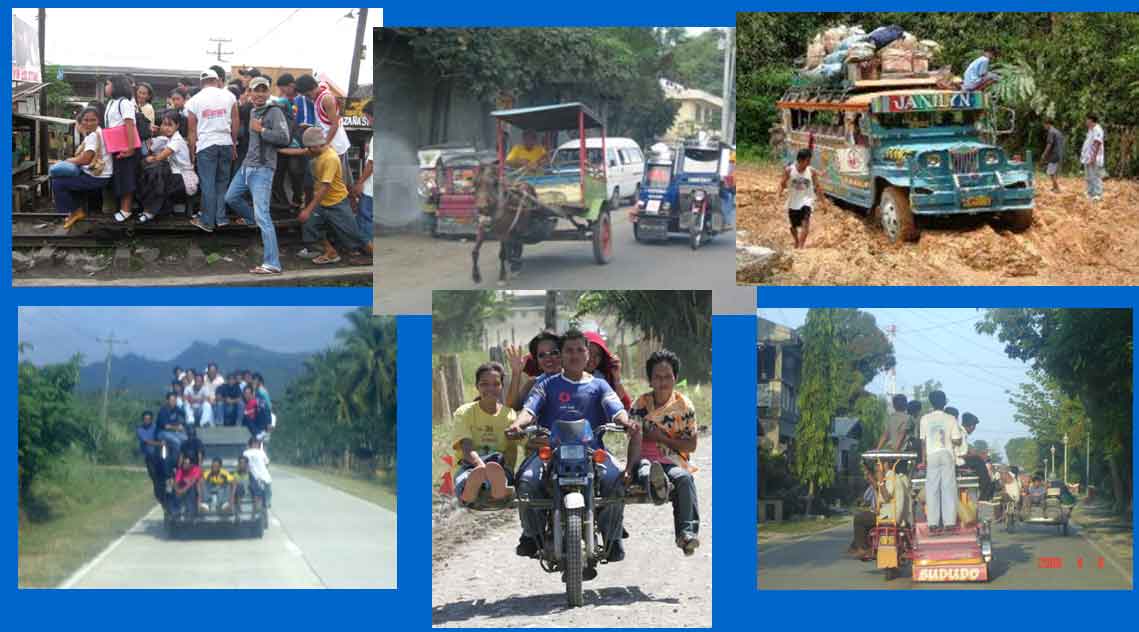
In the Philippines, for example, paratransit includes motorcycle taxis, tricycles, Asian utility vehicles (AUV), vans, and the jeepneys. With the exception of motorcycles, AUVs and vans, the two most dominant transport – the tricycle and the jeepney – are customized vehicles.
Jeepneys
The jeepney is the most popular mode of transport in the Philippines especially in cities because of its cheap fare and the convenience afforded to passengers to board and alight almost anywhere they want. In many parts of the Philippines, jeepneys provide long-distance transport services (rather than the bus) and may carry cargo, goods or freight in addition to passengers. Jeepneys in the provinces have also evolved to become significantly larger and tougher than those in the cities and are built to take on bad roads in all weather conditions. Jeepneys are locally manufactured and utilize surplus or second-hand diesel engines.
Tricycles and pedicabs
A tricycle is a motorcycle with a sidecar, while a pedicab is a bicycle with a sidecar and is classified as a non-motorized transport mode. These modes are 3-wheelers and are very convenient for passengers on short distance trip and feeder trip between residential area and arterial roads. Especially in the provinces, these modes play an important role because of insufficient bus and jeepney services. In Metro Manila the operation of tricycles is restricted partly because they cause traffic congestion. Franchising and supervision of tricycles including pedicabs have been devolved to the local government units.
AUVs
Asian utility vehicles (AUVs) refer to a variety of models designed according to the road and passenger characteristics of Asian countries particularly those in the Southeast Asian region. Vans include vehicle models produced by major Asian automakers like Toyota, Mitsubishi and Hyundai. AUVs and vans are four-wheeled vehicles with a seating capacity of seven to eleven persons including the driver. They provide services within a zone or fixed route of not more than 15 km. Fares may be set on a zonal asis or based on distance. FX services (so called FX because of the Toyota Tamaraw FX AUV that was very popular with those providing the service) evolved from the taxi as demand for a faster alternative to jeepneys arose in the 1990’s. Fares were higher than those for jeepneys but were eventually considered acceptable as longer travel times when using jeepneys became a major consideration for passengers, especially those who have constraints in their schedules like students and typical office workers (i.e., those who do not have the luxury of flexi-time). In 2003, the LTFRB issued a moratorium on the issuance of AUV franchises and pursued conversion and regulation of services into the Garage-to-Terminal Express (GTExpress). However, there is still a proliferation of vans for hire services, particularly those plying long distance routes in the rural areas. Meanwhile FX services remain in other cities in the Philippines.
Motorcycle taxis
Motorcycle taxis are also popular in the less urbanized areas including the small towns throughout the Philippines. These include the “habal-habal,” which are not regulated but have similar operations as their relatives in other countries like Thailand and Indonesia. Then there is the “skylab,” which is also a motorcycle taxi but with a wooden plank perpendicular to the motorcycle that allows for additional passengers balanced by the driver. Hence, the vehicle is made to appear like the fallen satellite of which it is named after.
Multicabs
Multicabs are similar to jeepneys but with most vehicles having about half the capacity of current jeepneys. However, their configurations are also evolving like the jeepneys, being customized vehicles like the latter. The resulting capacity has enabled these to have seating capacities equivalent to small or old model jeepneys. Multicabs are based on the Daihatsu or Suzuki mini-vans in terms of engine specifications and most came into being after the Philippines was flooded with second-hand or surplus vehicles. Their small bodies made them popular and they are now found in many cities, often competing with jeepneys and tricycles for passengers.
Other paratransit modes
Other paratransit modes are used in the Philippines in both urban and rural settings. There is the “kuliglig,” which uses a farm tractor to pull a wagon that is customized for passengers. These are mostly found in the country side where formal transport is lacking and even tricycles are unable to satisfy the demand for transport. Another paratransit mode is the “motorela,” which is a four-wheeler version of the motor tricycle. However, it is configured with the motorcycle in the front and middle instead of a one side such that it appears like the Thai “tuktuk.” These operate in cities and have capacities that are typically higher than the tricycles but significantly less than those for jeepneys.
Future of paratransit in the Philippines
The idea of environment and people friendly paratransit is always an attractive proposition. Given the current perceptions that paratransit like jeepneys and tricycles, there are many initiatives that are now being seriously considered if not yet engaged by both the government and the private sector. Some have been proposed for quite some time such as engine replacement and although financial schemes have also been proposed there have been very few takers for the program. Then there are those proposals for devices that have not been tested or validated but offer quick fixes to the emission problem, particularly claiming significant carbon reduction for a small price. Such are to be viewed as doubtful solutions that should not be pursued unless there is strong proof of their effectiveness.
Many taxis in Philippine cities have been converted to use LPG. Electric and LPG powered tricycles are now also being promoted in the Philippines. In fact, Quezon City, the biggest city in Metro Manila, only recently enacted an ordinance requiring all tricycles to convert to clean fuels or energy sources within 3 years. Such local legislation probably marks the beginning of a genuine and, perhaps, sustained effort towards making paratransit environment friendly. In the national context, a national EST strategy is currently being formulated (NCTS, 2009) and will ultimately recommend for actions to improve public transport in general.
An assessment of the jeepneys and tricycles as main public transport modes is necessary while at the same time it must be realized that jitney sized transport is necessary where passenger demand cannot justify mass transit modes including bus and rail transport. The World Bank (A Strategic Approach to Climate Change in the Philippines: An Assessment of Low-Carbon Interventions in the Transport and Power Sectors,2009) proposed medium and aggressive scenarios for the reduction of carbon in the transport sector. Among these scenarios are interventions for public transport particularly mentioning the conversion of jeepneys to CNG and assessing recent developments including options with high potential for carbon reduction, and technologies under testing such as CNG, LPG and electric powered vehicles. These are proof that the transformation of paratransit, in this case the jeepney, is essential and should be under way. Hopefully, it will be a matter of time when these popular modes of transport will gain the adjective “environment friendly.”
 Caught (up) in traffic
