
Home » Posts tagged 'Public Transport' (Page 9)
Tag Archives: Public Transport
Straddling bus prototype?
What was peddled as a unique public transport mode concept in social media is now a reality. Check out the article and video here:
China’s Futuristic Straddling Bus Is Finally Here
This is a welcome development for public transportation. However, some issues need to be addressed, particularly regarding road safety. Motorists traveling under the straddling bus may have reactions to the vehicle as it passes above them and such may lead to road crashes. Of course, with the advent of driverless vehicles such incidents may be minimised if not altogether eliminated.
–
On cable cars as a solution to Metro Manila transportation problems
I was asked about my take on the pronouncement about cable cars being a potential solution to Metro Manila’s traffic woes. I say pronouncement because careful qualification of the news articles on this clearly show that this is not yet a proposal. I leave it to the reader to Google these articles on cable cars for Metro Manila.
The first thing that came to my mind are capacity and demand. What would be the capacity for such a system and what could be the demand given that you would have to determine where stations would be. There’s also the fear factor as many people would not be comfortable riding a vehicle so high up in the air and then of course, there’s the wind that will obviously have to be factored in the operation of such cable cars. Suitability is very much an issue here. Perhaps cable cars like the one featured in the news articles are more appropriate for cities like Baguio, Antipolo and Tagaytay? There are very limited applications for Metro Manila even including perhaps possibilities for Ortigas and perhaps Loyola Heights.
I like what my friend, Rene Santiago, said about the cable being one possible answer but not The Answer to Metro Manila’s traffic problems. I am aware of and quite amused by the comments posted on social media about the so-called ‘cable car solution’ as it is definitely not going to make a big impact on Metro Manila transport. I like comments proposing instead improved river transport as well as protected bicycle lanes around the metropolis. These are well-grounded proposals that have been proven elsewhere to be very effective in reducing congestion while mass transit projects are under construction and to be operational in 2 to 3 years time. I think it would be wiser to put your money on bike lanes and even bike bridges than in cable cars.
I was also asked about what should be the first project the new Department of Transportation Secretary Art Tugade should take on. Metro Manila is still very much a “battleground” for transport and traffic, and there are already projects lined up for implementation like the much delayed MRT 7 and the extension of LRT1. The new administration should strongly support such efforts, whether its via Public Private Partnership (PPP) or public funded. That said, I think the incoming Department of Transportation Secretary should work on an urban mass transport project in one of our major cities. Either Cebu or Davao come to mind as these cities are already also congested and would need to have an urban transit system (rail?) very soon in order to avoid becoming another Metro Manila. There are low-hanging fruits in these cities, for example, with the Cebu BRT ready to be taken on by the new administration for full implementation and Davao already being the subject of public transport studies pointing to it being ripe for a rail transit system.
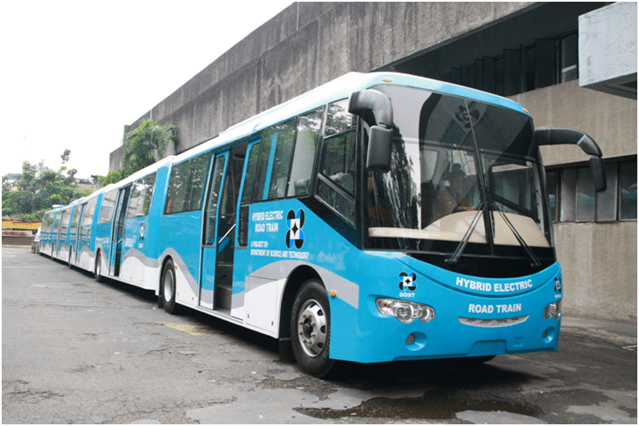
Finally, there are also the outcomes of research & development work by the Department of Science and Technology (DOST). I am referring to the DOST-MIRDC’s road train, AGT and hybrid train projects. The road trains, for example, may be used for Bus Rapid Transit (BRT) lines that are proposed for C5 and Quezon Avenue. I also think it is worth considering for EDSA. BRT is not technology-specific as far as buses go so why not use Philippine-made buses for this? While these are still subject to third party safety and technical certifications, the Transportation Department could lend a helpful hand towards this certification and this could perhaps ultimately lead to building an industry out of these buses and trains.
–
Latest model electric jeepney
In case my readers missed my feature on the recent electric vehicle summit hosted by Meralco, here are a few photos of the latest model of the electric jeepney. Note the passenger door is no longer at the rear but at the side across from the driver. They have also added a distinctive snout to the vehicle. This model is the latest from PhUV, which also manufactures electric tricycles.
 Profile of the electric jeepney currently in use for a Department of Energy-funded project being undertaken jointly by the National Engineering Center (NEC), the National Center for Transportation Studies (NCTS) and the Vehicle Research and Testing Laboratory (VRTL) of the Department of Mechanical Engineering; all of the University of the Philippines Diliman.
 A peak at the interior shows the passenger seats in bench layout and a more generous headroom for passengers.
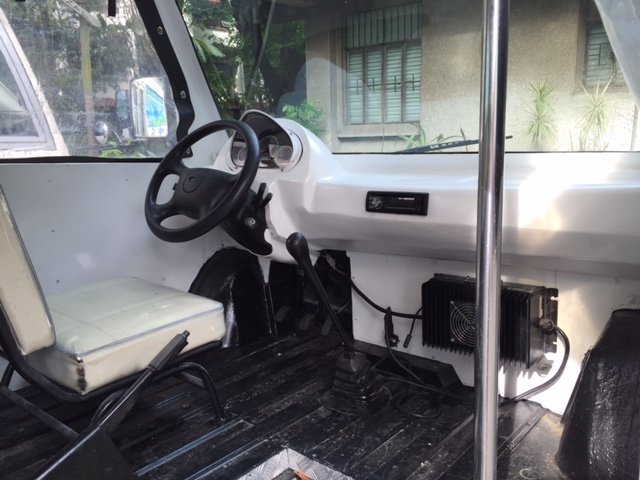 Driver’s seat and panel. There is space to install fare collection machines like the ones that can enable the use of BEEP cards by passengers.
 E-jeepney front showing the distinctive face from its conventional ‘ancestors/predecessors’. A colleague noted that perhaps the manufacturer should add some accessories like horses or airplanes on the hood.
This model is already similar in size with the big COMET electric jitneys. They also run on a more powerful electric motor that will enable these vehicles, according to the maker, to climb slopes like those along the route of Antipolo jeepneys. We hope that this design gets mainstreamed (read: replace conventional jeepneys) along the many existing jeepney routes not just in Metro Manila but in other cities as well.
–
On a proposal to redesign bus stops and signs in Metro Manila
Here’s another quick post but it is something that should be picked up by government agencies particularly the Metro Manila Development Authority (MMDA). The following link is from Sakay.ph, which conducted a study on their own and came up with this:
A Redesign of Bus Stops and Signage in Metro Manila
The idea is not at all a new one considering you will see such appropriate stop designs and signs abroad. These are good designs that make a lot of sense (See the visuals in the article for you to be convinced). Only, the MMDA and other agencies including local government units are notoriously stubborn when it comes to innovative ideas that challenge the templates that they are used to. Perhaps the Land Transportation Franchising and Regulatory Board (LTFRB) and the Department of Public Works and Highways (DPWH) can also take a look at these ideas considering public transport is regulated by LTFRB and the agency can take a progressive stance in ruling for more uniform bus body designs. Meanwhile, the DPWH is in-charge of most road signs along national roads like EDSA and should also be proactive in the design of signage while also keeping in mind the international standards that we need to conform with. As for the buses themselves, the recommendations underline the need to streamline (read: reduce) the number of buses and players and the rationalization (read: simplify) routes in Metro Manila. Maybe they can start doing the livery for the P2P buses to show how the concept works?
–
Electric vehicle models at the 5th Electric Vehicle Summit – Part 1
The 5th Electric Vehicle Summit was held last April 14-15, 2016 at the Meralco Multi-Purpose Hall. Following are photos I took at the summit where many current electric vehicle models were on display and demonstration. Many of the photos show variants of the electric tricycle designs from various manufacturers that conform with the design promoted by the Asian Development Bank (ADB). These are basically in the form of the Thai tuktuk and similar to Cagayan De Oro’s motorella.
 Go Electric e-trike by ToJo Motors
 E-trike model by Clean Air Transport Solutions, Inc.
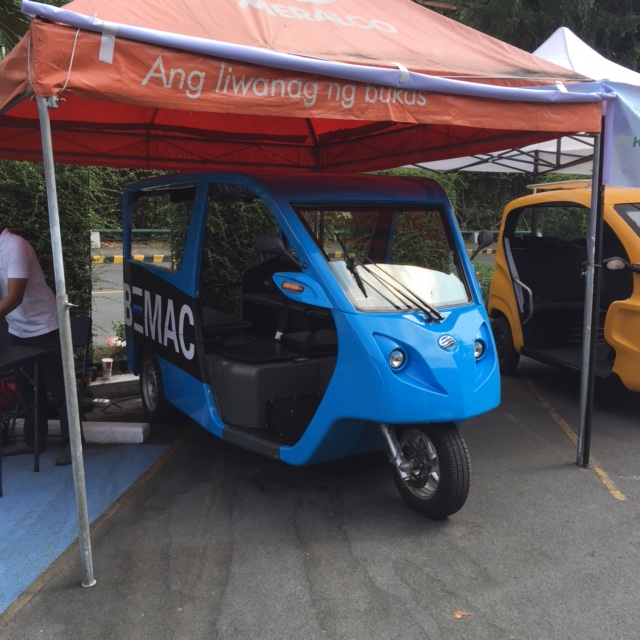 BEMAC e-trike model – the company recently landed a big contract to produce e-trikes.
 E-trike by Kyto Green Technologies Co., Ltd.
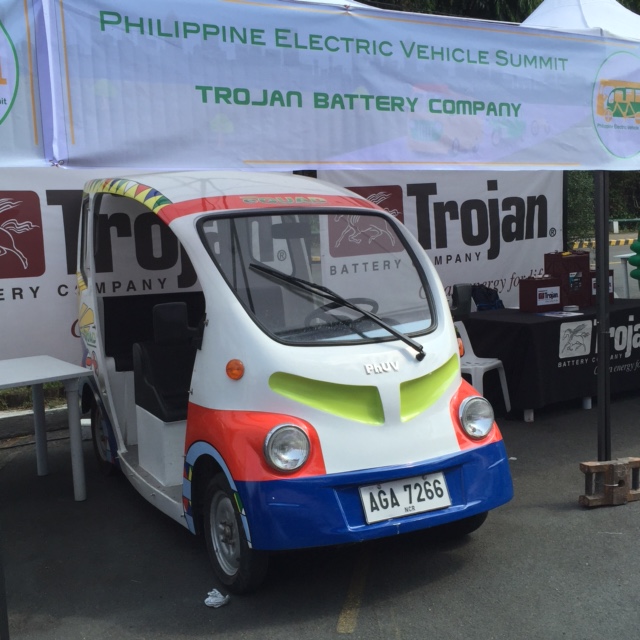 Electric car (4-wheeler) by PhUV powered by Trojan batteries
 E-trike model by Green Mobility Service
 PhUV’s e-trike variants
 E-trike and charging station by KEA
 Exhibitors setting up their booths and electric vehicles
 Conventional vehicle converted into electric by Le Guider International
 E-trikes by Guider Power
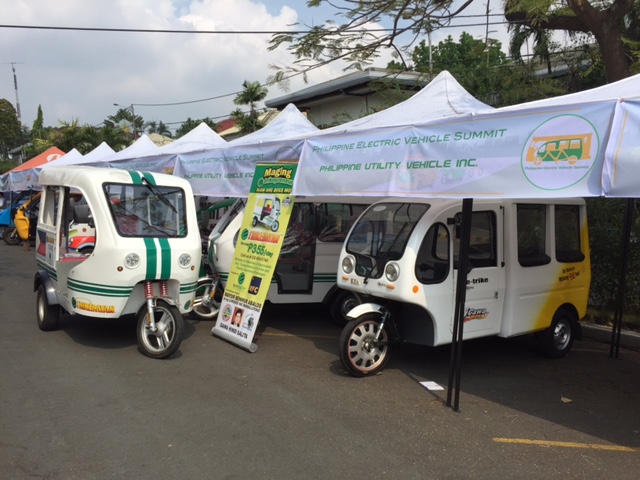 Another look at PhUV’s e-trikes
 Electric motorcycles by Alternative Energy Trailblazer, Inc.
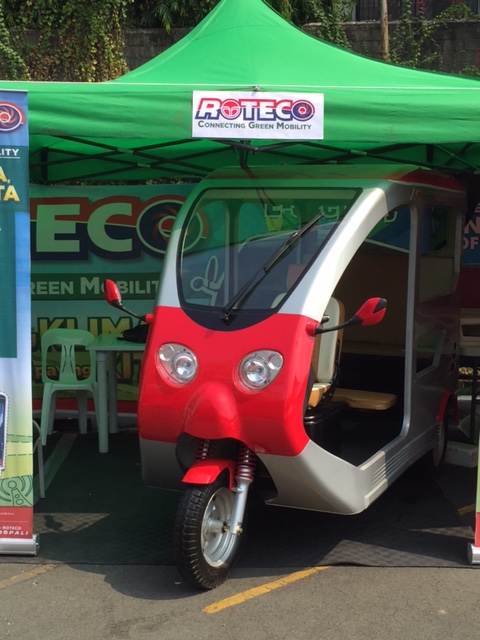 E-trike by Roteco
 SunE-trike and Roteco booths at the summit exhibition area
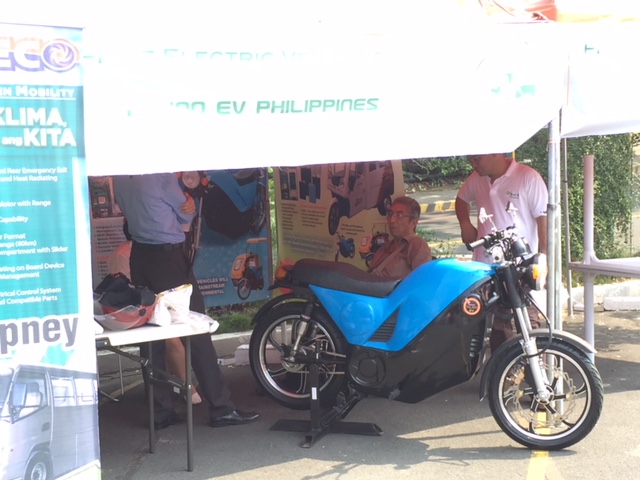 Sporty electric motorcycle model by Talino EV – this can be paired with a sidecar to serve as an e-trike.
 The ToJo Motors booth
 Electric vehicles powered by solar energy by Star8
 E-vehicle models by Clean Air Transport Solutions, Inc.
 Latest model e-jeepney by PhUV featuring side door and a higher ceiling
To be continued…
–
Are Filipinos willing to pay for good public transportation?
There is a nice article that appeared last April 1, 2016. I hope it is not an April Fool’s type of an article.
Why is the U.S. unwilling to pay for good public transportation?
Reading the article reminded me of a lot of similar concerns surrounding public transport projects currently being constructed and those in the proposal and pipeline stages in Philippine cities. It seems though that there are still many people who have little appreciation of the benefits of modern public transport systems. Aside from Metro Manila and perhaps Cebu City, there is little clamor for modern mass transit systems. People tend to take commuting for granted with modes that they have grown up with like buses, jeepneys and tricycles until they start to experience first-hand the pains of traveling using inferior transport on severely congested roads. But even then, most seem to take it in stride and carry on, carrying their crosses in a state of purgatory that seems to have no end in sight.
–
Candidates for national positions in the Philippines using public transportation
There was a clamour for public officials to take public transportation in order for them to experience what commuters regularly go through when taking public transport. This was especially the challenge to officials of the Department of Transportation and Communications (DOTC) after what seemed to be an endless sequence of breakdowns involving trains in Metro Manila. While some officials and politicians were quick to respond, most if not all were only for photo opportunities (masabi lang na nag-MRT or nag-jeepney or nag-bus). The DOTC Secretary himself also rode the train but with many alalays and was apparently given special treatment judging by the conditions when he rode the train. I remember one senator who was presidential-candidate-to-be at the time fall in line (a very long line at that) at an MRT3 station in Quezon City to experience it herself and declared it was so the experience could help her frame legislation to improve public transport in the country. That was rare and apparently never repeated by the politician despite the praises she received for her doing so without any bodyguards or alalays (assistants).
Some people have been saying that one Vice Presidential candidate is so desperate that she’s taking public transport and having herself photographed doing so. I happen to know for a fact that the said VP hopeful takes public transportation regularly and even from the time when she was not yet congressman. She almost always takes the bus between her hometown in Bicol and Metro Manila. That is not a desperate act but a natural thing for her that few if any of our national officials, elected or appointed, can claim they also practice. This is the VP-candidate in her natural self with no pretensions and no sense of self-entitlement (compared with others who ride their chauffeured vehicles complete with escort vehicles). We need more people like her if we are to address transport and traffic issues cities and the entire country is now facing. These problems hinder development and is something experienced by most people including those who can afford to have their own vehicles for their commutes. We need leaders with first-hand knowledge and experience of how it is to be someone who takes public transport regularly.
–
On e-trikes again
I saw this electric tricycle while traveling along Marcos Highway in Antipolo City. There are already a number of e-trikes operating in many cities around the country including several in Metro Manila but this one seems to be the inferior to the designs I have features in previous articles in this site (Note: Refer to the post on Vehicles at the 3rd Electric Vehicle Summit for a sampling of e-trike designs). Those designs were mostly inspired by the Asian Development Bank (ADB)’s concept electric tricycle design for their project that sought to replace conventional tricycles with electric ones.
 Antipolo e-trike along Marcos Highway
This e-trike appears to be a clumsy design and I have questions regarding its stability and operating characteristics, which have implications on road safety. Note that the e-trike in the photo above is not registered. Otherwise, it should bear an orange plate from the Land Transportation Office (LTO), which incidentally classifies e-vehicles as low-speed vehicles. This classification basically restricts most e-vehicles from traveling along national roads such as Marcos Highway. Did Antipolo secure an exception or exemption for these vehicles? Are traffic law enforcement personnel turning blind eye to the operation of these vehicles along busy highways like Marcos Highway and Sumulong Highway? How safe are these vehicle designs?
–
Curiosities of transport services in Metro Manila
There are a few interesting observations we can make out of transport services in Metro Manila and chief among them is the poor quality of service that we can generalize among most if not all modes of public transport available to commuters. This poor quality of service of public transport is what drives many people to aspire to own and drive or ride their own vehicle. Already there has been a surge in motorcycle ownership in Metro Manila and its neighboring towns and cities (collectively Mega Manila) and car ownership is also on the rise. These trends have led to increased congestion along many roads. And we will probably not see a significant improvement until the mass transit projects have all been completed. These include the Line 2 Extension to Masinag, the MRT 7 along Commonwealth, the Line 1 Extension to Cavite, and yes, the capacity improvement of MRT 3. Hopefully, there will also be BRT lines along C-5 and Quezon Avenue to complement the rail transport projects.
The UV Express is actually a response to poor public transport services as it evolved out of the FX taxi services of the 1990s that later mixed with informal van and AUV services. These are actually a precursor of today’s ride sharing modes. Only, in those days when the FX service was born, you didn’t have tools like apps to facilitate your ride. People had to agree about the fares and the destinations from terminals like those in Cubao (Quezon City) and Crossing (Pasig/Mandaluyong).
But let us focus on three services that would not have been attractive if only services by their conventional counterparts were (very) satisfactory and if there was a comprehensive and efficient mass transit network in the metropolis. These are Uber, P2P buses and airport express buses.
Uber offers services much like that of the conventional taxi. Its advantages are mainly having recent model vehicles (not dilapidated ones), a better driver (this attribute is quite subjective), and an app-based system for availing services. Fares are generally more expensive than those for regular taxis. And there is a surge pricing for when congestion is really bad. It has a very good feedback mechanism that allows passengers to evaluate their drivers. However, this wouldn’t have been necessary if taxi drivers in general were more disciplined and courteous to their passengers.
P2P buses operated by Froehlich Tours offers services much like that of conventional buses. Its current advantages over conventional buses are that it operates express services, buses are new, well-maintained, and with drivers that appear to be more disciplined than the typical public utility bus driver. A friend’s take is that P2P’s are the bus equivalent of UV Express. It is not at all necessary if the quality of service of regular buses were much better than it is right now. And I am referring to the practically stop anywhere, recklessly driven and poorly maintained regular buses.
Premium airport buses have recently been introduced and these are operated by Air21, which is a freight forwarding company. It is a service that’s long overdue given the many difficult experiences of people to and from NAIA’s passenger terminals. While an airport limousine bus service should have been provided many, many years ago it also is a reflection of the poor quality of airport taxi services. Airport taxis are expensive and according to many stories circulating can be predatory.
What I am driving at, if it is not yet so obvious, is that many ‘new’ services are actually borne out of crappy services of conventional modes. There are many lessons to be learned here in and lest I be accused of neglecting other Philippine cities, I should mention that Metro Manila presents so many lessons to be learned by other rapidly growing and urbanizing areas in the country. At this time we can mention Cebu, Davao, Iloilo, Cagayan de Oro and perhaps Clark/Angeles as metropolitan areas to watch in terms of transport system development. Hopefully, there’s a kind of reverse psychology in their approaches to address their transport needs in that they avoid what has been done in Metro Manila. Surely, transport services in these other cities can do better than Metro Manila’s.
–
Future of jeepneys?
I spotted a jeepney on my way home with a message (or tagline, depending on how you see it) printed on its side. It says BEEP, which was supposed to stand for Bagong Jeep (translated as New Jeep). From the looks of the vehicle, there was nothing new about it, except maybe this sign that was painted over an older design on the vehicle’s body. Apparently, the tagline does not refer to the vehicle itself but to the image of the jeepney. “Bago” or “New” here refers to a new image for jeepneys. Long regarded as the “King of the Road,” the jeepneys have become synonymous to reckless driving, uncomfortable rides and unreliable services. They have also come to represent unsustainable transport what with most jeepneys being fuel guzzlers and smoke belchers.
 I already spotted several jeepneys plying the Cogeo-Cubao route sporting this sign that’s apparently a campaign to uplift the image of jeepneys. It seems really a stretch to call these ‘bago’ as the vehicles I’ve seen are the same customized bodies with second hand engines running them.
There is a campaign to rehabilitate the image of the jeepneys and perhaps it should start with driver behavior and not necessarily the vehicle. Many jeepney drivers (as well as drivers of other public utility vehicles) have attitudes leaning on the rude side. You see many of them driving recklessly along our roads and stopping just about anywhere (e.g., in the middle of the road). Such behaviour is due to many factors including the way these people learned to drive and their motivations for their means of earning a living. Much can also be said about their education both formal and regarding their driving.
There are also many vehicles vying to be the replacement for the jeepneys and among these are electric vehicles including the electric jitneys that I have featured in past articles on this blog. Incidentally, one of those electric jitneys is actually a more recent model of the electric jeepneys that’re currently in operation in Makati and Alabang, and it happens to be called the Beep. Operating in Filinvest City, the e-jeepneys there have been lauded as a viable option for replacing the conventional jeepneys. So far, so good and time will tell if indeed, conventional jeepneys will be phased out in favor of e-jeepneys. The jury is still out there in terms of the e-jeepney’s reliability and durability.
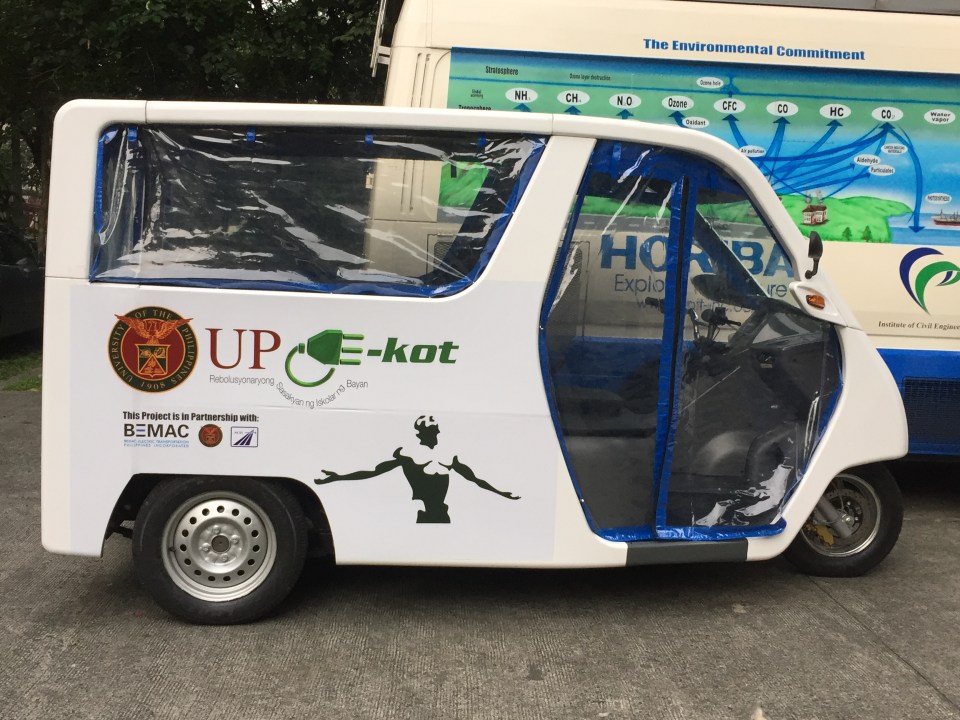 An electric tricycle currently undergoing experimental operations at the University of the Philippines Diliman campus is more a replacement for tricycles and multicabs than for jeepneys.
–
 Caught (up) in traffic