
Home » Posts tagged 'railways' (Page 7)
Tag Archives: railways
On Antipolo’s railway heritage – Antipolo Station
I open 2017 with a post on history and rails. A reader of one of my previous posts on Antipolo and its railway heritage was very generous to include some photos of what remains of the Antipolo Station of the old (shall I say ancient), defunct railway line that traversed what is now still called Daang Bakal. Those comments and links to photos may be found under the post on old railway lines here.
Here is a photo I found in the Kalye ng Antipolo Facebook page:
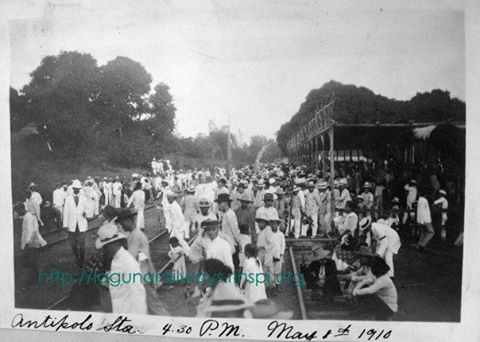
From what I see in the photo, this is a photo of the end station of the railway line that stretched from Manila to Antipolo via Pasig and Cainta through what is now Valley Golf and not via Ortigas Avenue as what some people are claiming. The last two stations were at Antipolo at Hinulugang Taktak, where the remains of the old station are well preserved and there is a historical marker, and at the area that is basically at the intersection of the Circumferential Road and San Jose Street, where the end station would have been closest to the shrine. I am also basing my assessment from the topographic features shown in the photo and the fact that there are three sets of railway tracks shown, indicating that this is also probably a depot for trains. Unfortunately, as mentioned by one of my readers, is in a state where it might soon be demolished due to the road widening project for the circumferential road. I hope the Antipolo government recognizes this important part of its history, its railway heritage, and perhaps help preserve what remains of the Antipolo Station and place a marker there for future generations to appreciate.
–
Antipolo Station of the old railway line
For readers who are interested in the old railway line to Antipolo, please look at the comments section of this old post from November 2012:
What if Manila retained its old railway lines?
Someone (Thank You!) posted about the Antipolo Station, which is the last one along the line and the station closest to Antipolo Church. While the remnants of the old station at Hinulugang Taktak is well preserved and safe (for now) from any future developments, what remains of the old Antipolo Station is now in danger of being demolished. Antipolo and the DPWH are widening the circumferential road located in the area and based on the dimensions of the sections already completed at Siete Media beside the Robinsons mall, the remains of the old station structure may be lost as well.
In my opinion, the city should preserve this part of its history that is also a part of our railway heritage. While such road widening projects may be important, retaining this piece of history is equally relevant as it provides us with a perspective of the past (i.e., how people travelled, what were their destinations of interest, etc.) and learn some lessons about this (e.g., why we should not have wholly abandoned rail for road transport).
–
Straddling bus prototype?
What was peddled as a unique public transport mode concept in social media is now a reality. Check out the article and video here:
China’s Futuristic Straddling Bus Is Finally Here
This is a welcome development for public transportation. However, some issues need to be addressed, particularly regarding road safety. Motorists traveling under the straddling bus may have reactions to the vehicle as it passes above them and such may lead to road crashes. Of course, with the advent of driverless vehicles such incidents may be minimised if not altogether eliminated.
–
Standards for integrated railways in the Philippines
With the recent pronouncements about railway projects in Metro Manila including the ongoing Line 2 Extension to Masinag, the impending construction of Line 7 (i.e., along Commonwealth and Regalado Avenues and Quirino Highway) and the proposal for a Line 4 (Diliman, Quezon City to Lerma, Manila), it becomes more imperative to have integrated railway infrastructure including and especially common stations where lines intersect and common specifications guided by standards or guidelines. Do we have such or has there been work towards their formulation in the past? The simple answer to that question is yes. But then we have to qualify that affirmative response because while there was a study a decade and a half ago, the outcomes of that study, which is a comprehensive take on all aspects of railway systems was never formally adopted (again?) by the Philippines.
The following link is for the Executive Summary of the “Study on Integrated Railway Network for Metro Manila (SIRNMM) completed in 2001.
Perhaps there is a need to revisit the outcomes of this study? This can serve as a good platform from which updated guidelines and standards can be developed for a more harmonious development of railways systems not just for Metro Manila but for other cities as well.
–
Line 2 Extension construction at full swing
The construction of the LRT Line 2 Extension from Santolan, Pasig City to Masinag, Antipolo City is now in full swing. The contractor, DM Consunji, Inc., has occupied several lanes of Marcos Highway and the reduced capacity of the highway has led to moderate to severe congestion along sections from Ligaya to Masinag. At certain times, construction work required more space than the 2 lanes usually occupied by construction equipment and materials. Following are a few photos of the project showing various stages in the construction of the Line 2 extension.
 Section in front of SM Masinag also showing the pedestrian overpass across Marcos Highway
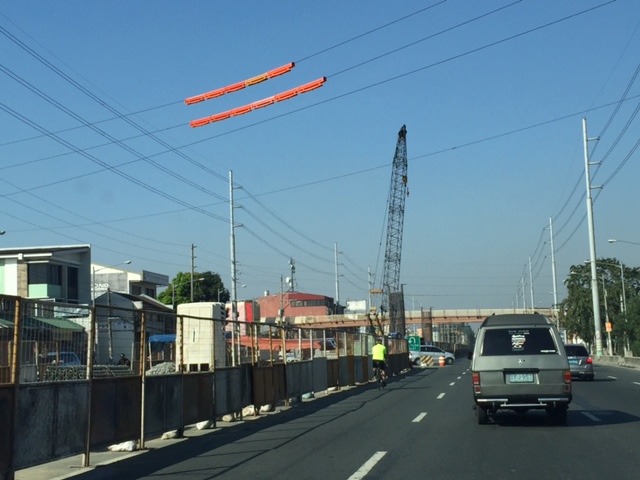 Section in front of Vermont Royal Executive Village also showing a newly constructed pedestrian overpass that looks like it will be cleared by the elevated tracks.
 Columns under construction along Marcos Highway across from Golden Meadows Subdivision.
 Columns completed and under construction across Town & Country Executive Village – the photo also shows another pedestrian overpass but from the completed column its clear that modifications aren’t needed for the overpass.
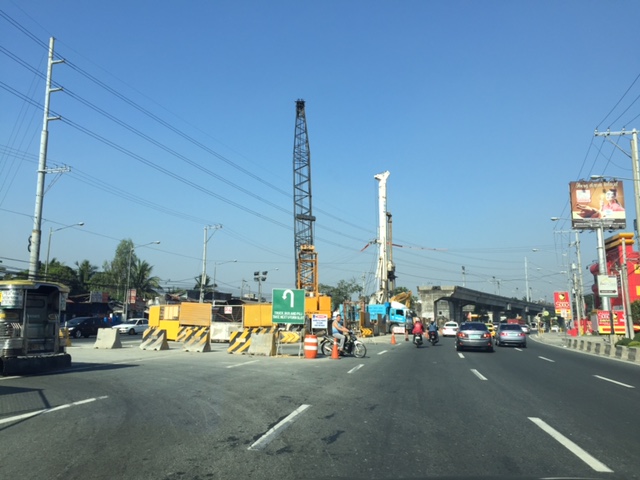 Construction at the current end of the elevated tracks at Santolan, Pasig City
Construction works are expected to go on for at least a year before the trains can start test runs along the new tracks. This is definitely going to be a game changer in terms of commuting along this corridor once the extension becomes operational and hopefully DOTC is already planning an extension further towards Cogeo or perhaps branch out to Marikina via Sumulong Highway.
–
Some advantages of rail over road transport
In my previous article, I mentioned how rail transport is important as part of a country’s transport system, particularly on land. I also mentioned a study conducted by our undergraduate students that was completed back in April 2012.
Our students conducted a simple survey, as part of their research, to determine the travel times and costs for public transportation between several origin-destination pairs. These O-D pairs were selected to simulate costs and travel times of commutes using either primarily rail or all road transport. Note the choices of either ‘school’ or ‘office’ paired with ‘home’ somewhere in the south of Metro Manila.
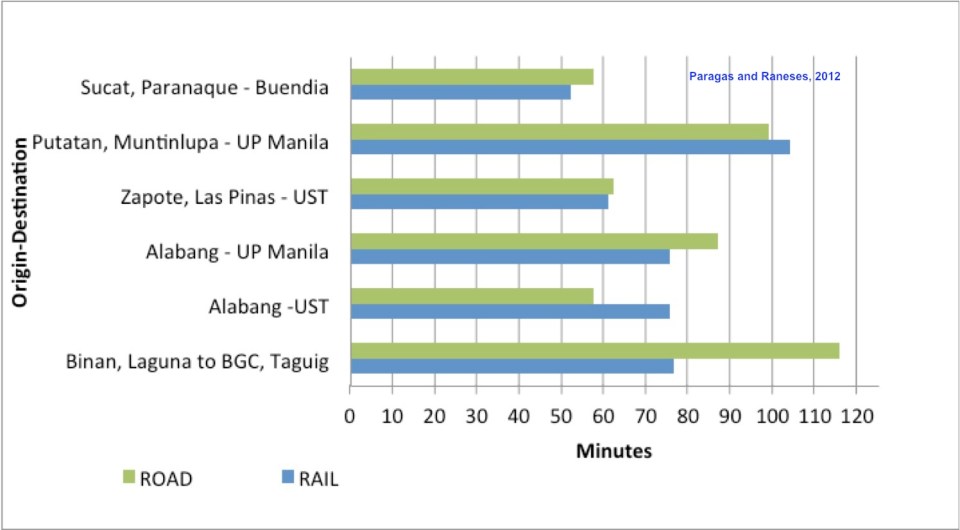 Travel time comparisons for commutes using road and rail public transportation – ‘Road’ refers to the entire commute using road-based transport (i.e., buses and jeepneys) while ‘Rail’ refers to commutes utilizing mainly the PNR but with road transport used in the end parts of the journeys (e.g., jeepney ride from near the PNR Espana Station to UST).
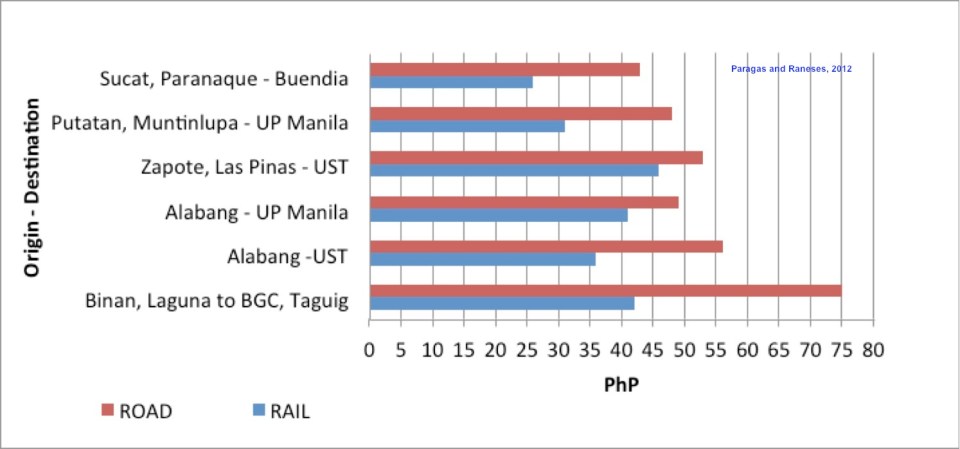 Travel cost comparisons for commutes using road and rail public transportation
Relevant to understanding the above are the following
- Fare rates have changed since 2012. However, this presents a constant change over the fares that are being compared so the basic differences will remain the same across origin-destination pairs.
- PNR services had to be discontinued for some time due to derailments because of poor conditions of tracks.
- Road traffic has worsened since 2012 with several “carmaggedon” episodes showing how vulnerable commuters are when using solely road transport.
- Road public transport services are frequent and practically 24/7. PNR services are of very limited frequency. Waiting times for the trains typically add to travel times in the form of delays, which make commuting by rail an unattractive option due to their unreliability of service.
–
Railway network for the Philippines?
We start November with an article about railways. There seems to be a lot of buzz about rail these days including talks about the prospects of a subway line in Metro Manila and long distance north-south lines for Luzon Island. These projects, though, will take a lot of time to be constructed and operational, even if these projects started immediately (i.e., next year). That is perhaps one reason why these projects need to be implemented sooner rather than later. And the more these projects are delayed, they become more expensive and also difficult to build (e.g., there are other developments such as roads that may hamper rail and other mass transit projects).
I had a couple of students who did research a little over three years ago on the state and operations of the Philippine National Railways (PNR). Aside from the research manuscript, their work has not been published. The results, however, seems quite appropriate these days as the country and Metro Manila in particular grapples with problems pertaining to commuting that is dominated by road-based transport. I will write about their results here but only show some excerpts as we intend to have part of their work published.
As a first salvo, here’s a map that they were able to get from the Philippine National Railways (PNR). The map shows current and proposed railway lines throughout the country. These include the PNR Main Line South (MLS), which extended to Laguna, Batangas, Quezon, Camarines Norte, Camarines Sur and Albay. There is also what used to be the PNR Main Line North (MLN) that extended to Bulacan, Pampanga, Tarlac, Pangasinan and La Union. Panay Railways, the only other long distance railway system aside from the PNR as late as the late 1970s, is also in the map along with the proposed Mindanao Railways.
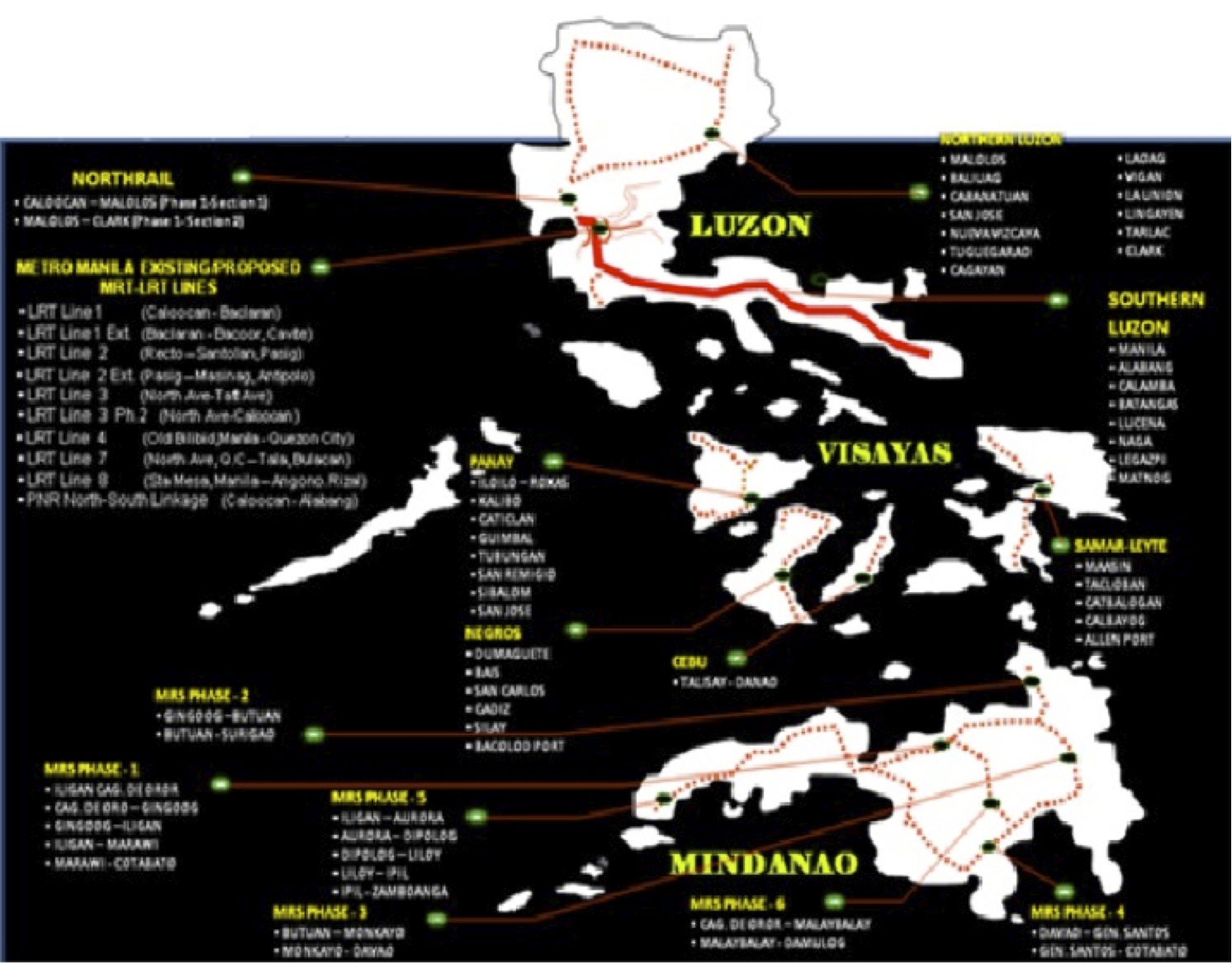
This map was provided by the PNR and likely includes data coming from the Rail Transport Planning Division of the Department of Transportation and Communications (DOTC). Contrary to the perception of many in the current administration, a lot of railway planning was conducted by past administration and many were sound ideas that justified feasibility studies. As usual, the main obstacle for railways would be the competition with road transport. It was road transport and the construction of expressways and other highways, after all, that dealt the PNR its decline (and death in the case of the MLN) to what remains today.
[Reference: Paragas, L.K.B. and Rañeses, M.K.Q. (2012) Assessment of the Philippine National Railways Commuter Line System, Undergraduate Research Final Report, April 2012.]
–
Finally, the LRT Line 2 Extension begins construction
The groundbreaking ceremony for the extension of the LRT Line 2 from Santolan, Pasig City to Masinag Junction in Antipolo City was held last June 9, 2015. This marks the beginning of the construction of the much anticipated and much delayed extension of the line to what was supposed to be part of the first phase of Line 2. I say supposed because most experts believe the current line should have terminated at Masinag from the start instead of at Santolan where the depot is located. Masinag had much more sense many years ago as it was a good staging point for possible extensions to Cogeo, Antipolo City proper or Marikina City. The areas along the Marcos Highway corridor beyond Masinag alone have experienced tremendous growth especially after the floods of Ondoy (Typhoon Ketsana), which submerged much of the Marikina Valley including Pasig, Cainta and lower Antipolo.
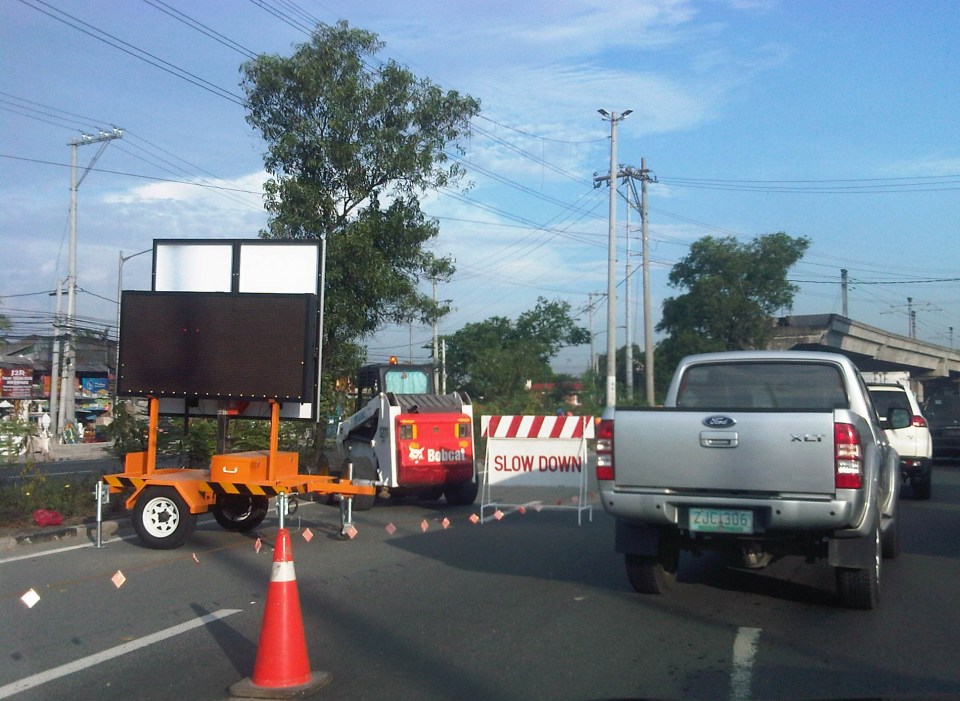 Traffic cones and signs guide motorists away from the inner lanes of Marcos Highway.
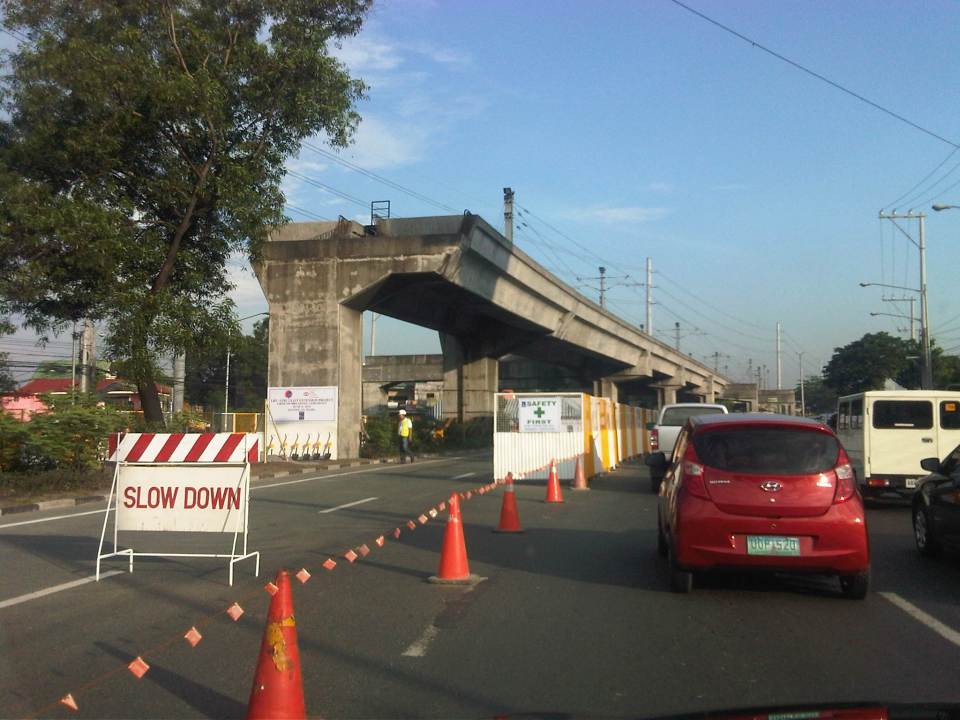 Two lanes from each side of Marcos Highway at the current end of the Line 2 were appropriated in addition to the median for the groundbreaking ceremony.
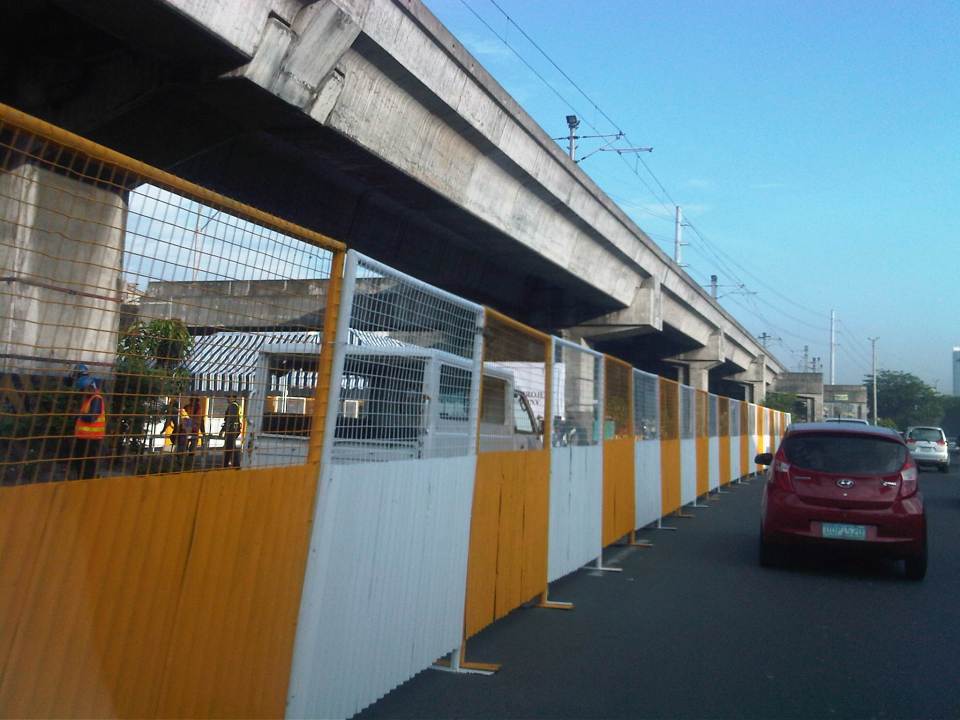 The stage is set – the stage for the ceremony is set under the viaduct with these barriers practically shielding the participants from curious passers-by (usyoso). Regardless, the event cause congestion along the highway.
Of course, that was the groundbreaking ceremony. As of today, there’s no sign yet of the contractor, DMCI, fully mobilizing and already reserving the inner lanes of Marcos Highway for the construction of the viaduct and stations. If the current works for the NAIA Expressway in the airport area is to be a reference, then severe traffic congestion is to be expected along the highway and this will extend beyond the actual construction site from Santolan to Masinag. As such, the public will experience inconvenience for the next so many months or perhaps couple of years (or more if there were delays). However, I believe that once the line is operating all the way to Masinag, it will help to ultimately decongest Marcos Highway and Aurora Boulevard and a lot of people will benefit from the improved travel times.
Incidentally, the term LRT is actually a misnomer here because among the 3 operational rail mass transit lines (I am excepting the PNR Commuter Line here.) in Metro Manila, Line 2 is actually a heavy rail system. Perhaps the government should already correct this by simply referring to Line 2 as ‘LRTA Line 2’ or renaming LRTA to reflect its nature as a transit authority that should not be limited to light rail only.
–
The old railway station at Hinulugang Taktak
The Antipolo City Government recently re-opened the Hinulugang Taktak park to the general public. The National Park and its famous waterfalls have seen better days and is part of Antipolo lore, immortalized in songs and stories about the pilgrimage city. It has been rehabilitated with various initiatives the past few years and with the water again flowing strongly compared to the trickles of dirty water over a decade ago.
Somewhat lost in the promotion of Hinulugang Taktak is a piece of transport history. I am referring to the old railway station located near the gate to the national park. The most convenient and probably most comfortable way to Antipolo and its two main attractions, the Shrine of Our Lady of Peace and Good Voyage and Hinulugang Taktak, many decades ago was by railway. Roads and road transport was not as good as today’s. There were no highways like Ortigas or Sumulong. There were no aircon buses, no jeepneys (yet) and cars and motorcycles were not affordable to most people.
 Old sign? There is no formal historical marker for the former railway station at Hinulugang Taktak. I think the National Historical Commission of the Philippines should recognize this as a local if not national heritage site.
 Trees notwithstanding, this is the view from what used to be the platform of the railway station.
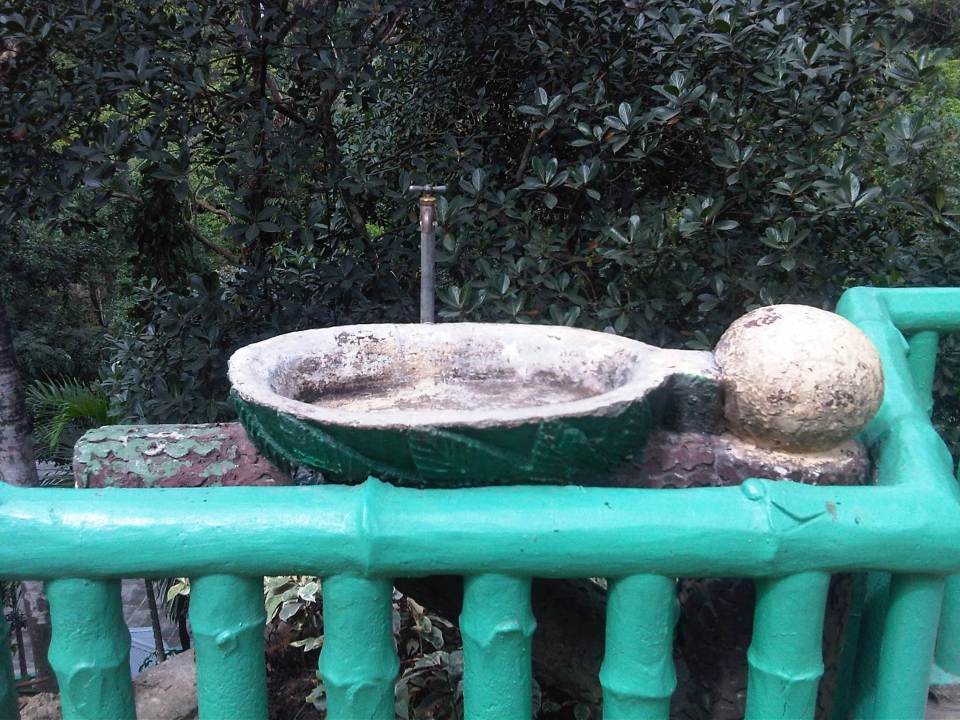 An old drinking fountain that’s probably survived the passing of time and witnessed a lot about the old railway station and Hinulugang Taktak.
 What’s left of the former railway station structure are the platform and columns.
 Taktak Road was the old Daang Bakal or railroad. Much have changed since the glory days of rail with a line that connected Antipolo with Manila.
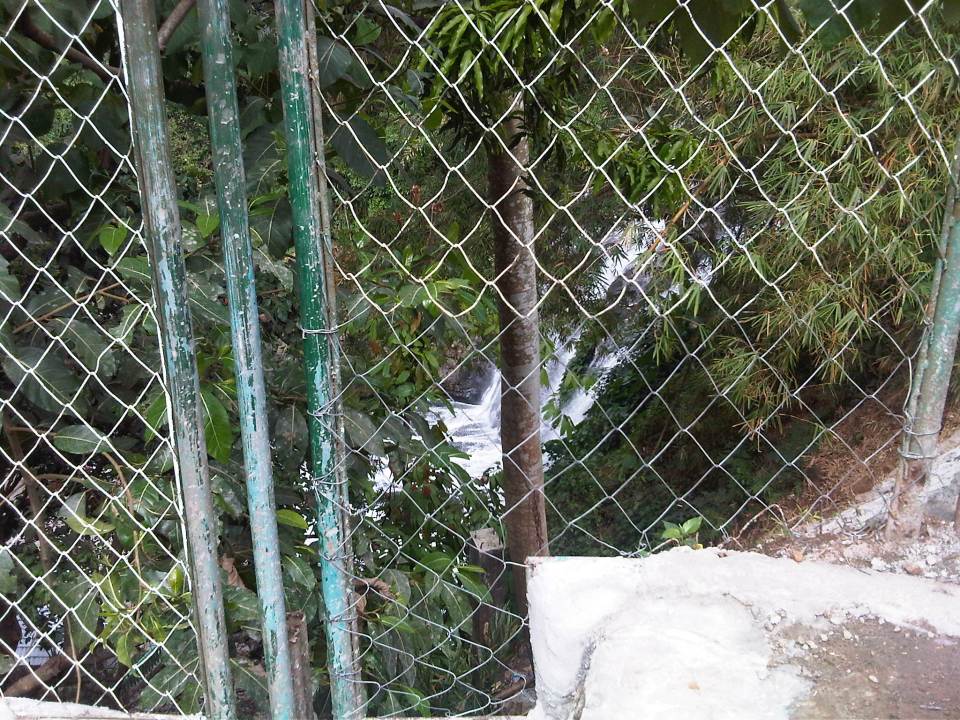 The view from the old entrance to Hinulugang Taktak in what also looked like the old railway station’s ticket office gives people (passengers?) a glimpse of the waterfalls.
 The old entrance to Hinulugang Taktak.
Someone asked me before if I thought it was possible for old railway lines to be revived. I replied honestly that I thought it was possible but immensely difficult. For one, a lot has changed in the lands on and along which the old railways used to be. The old Daang Bakal, for one, now passes through private residential subdivisions and industries and is now comprised of busy roads. While nothing is impossible, to rehabilitate the old railways will be a great challenge in the financial and social sense. It would be nice to see realized but requires so much from so many people, agencies and local governments who need to commit to such a project. And it requires leadership and a talent for convincing people that it is the right thing to do and that it needs to be done.
–
 Caught (up) in traffic