
Home » Posts tagged 'road safety' (Page 13)
Tag Archives: road safety
Safe and healthy journeys to school
I recently attended a workshop organised by UNICEF in cooperation with UN Environment and the WHO. The main topic was about road safety, particularly for children and focusing on their journeys between homes and schools. This is definitely a big issue and the concern is not without basis. Take the example shown in the photo below where two motorcycles are carrying more passengers than what they are designed for.
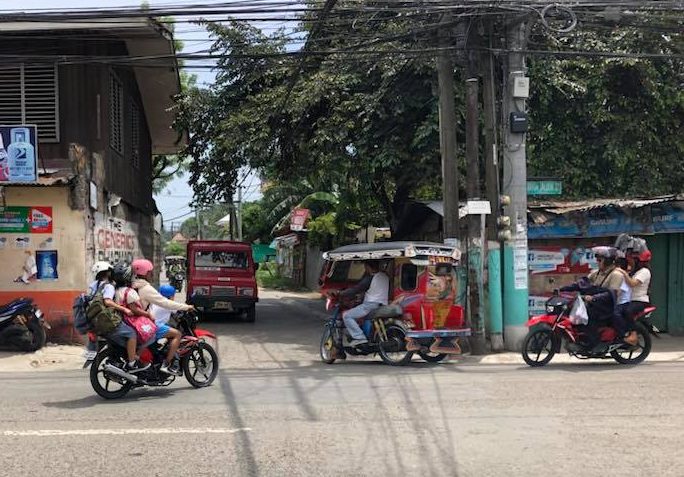 Children on-board motorcycles bound for a school in Zamboanga City
The passengers are children being taken by what looks like a parent or parents driving the motorcycles. Such are common scenes in Philippine roads and in many cases, the children are at risk of being involved in a crash. Most will have no protection and will likely be seriously injured or be killed in case of a crash. Then there are the cases of children walking between their homes and schools and are exposed to the dangers brought about mainly by motor vehicle traffic along the roads they travel on. It is a wonder how there are few crashes occurring despite these conditions (or is it because few are reported and recorded?)!
I will be pursuing research topics related to safe journeys to schools more than other road safety topics that the staff and students I supervise are usually taking on. Hopefully, too, my new advisees this coming semester will be interested in related topics particularly graduate students who work for the Department of Public Works and Highways (DPWH).
–
School is back and so are safety issues for schoolchildren
It’s school time once again in most parts of the Philippines. Public and private schools including most colleges and universities have resumed classes this month of June while others start this July and August. But with the resumption of classes, there is also the re-emergence of issues pertaining to the safety of these children. Students are exposed to the hazards of commuting. These include the likelihood of being injured or killed by vehicles running along the roads the students use to get to school.
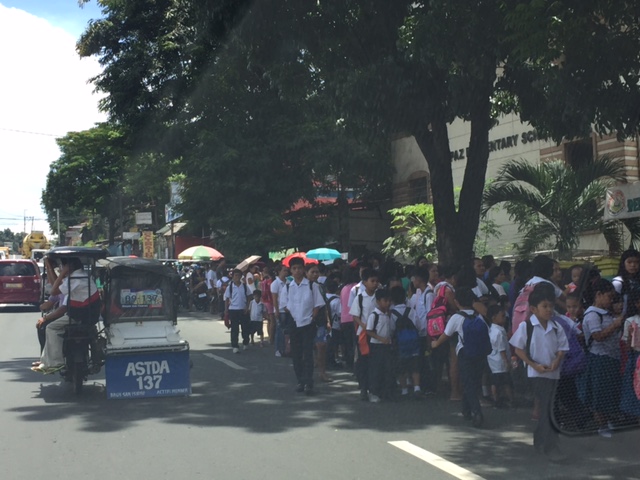 The photo above is a typical scene in front and around many public schools in the country. Schools are located along national roads and often lack spaces for students and their guardians. Many end up occupying the roads and causing congestion. Of course, that congestion is secondary to the safety of these children. Nevertheless, such issues need to be addressed in a more holistic manner rather than attempt to solve one as if they could be isolated.
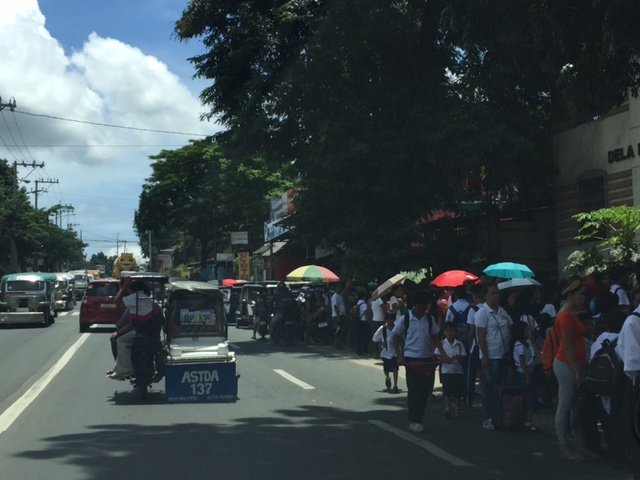 Most students of grade schools and high schools around the country either walk or take public transportation in their commutes. They are exposed almost daily to motor vehicle traffic along the roads and risk being sideswiped or run over by vehicles. In certain cases, small children walk significant distances thereby increasing the likelihood and risk of being harmed by traffic.
Traffic is particularly bad along most roads leading to schools mainly during the morning, mid-day and afternoon periods when students arrive or leave their schools. In Metro Manila, for example, the worst congestion are experienced along major roads like Katipunan Avenue (due to traffic generated by Ateneo, Miriam and UP) and Ortigas Avenue (due to La Salle Greenhills). That means a lot of time and fuel are wasted and more emissions are released into the air that we breathe. However, one can argue that in terms of road safety, this is better since gridlocks mean slow moving vehicles that make it safer for walking or cycling. This is not the same in the provinces or rural areas where there is less congestion and vehicles travel at faster speeds.
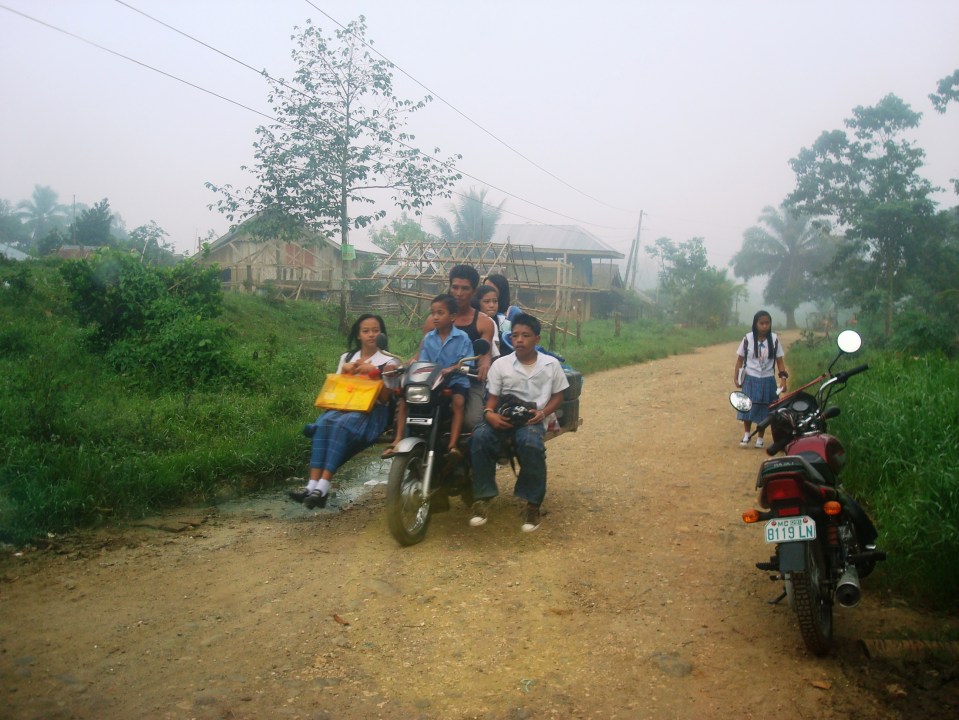 Children heading to school on a ‘skylab’ version of the motorcycle taxi
While there are initiatives pertaining to revisions in speed limits, such are limited (pun not intended) by how much action can be done in order to enforce these regulations. Add to this the requirement of having the instruments to measure and record speeds in aid of enforcement. This was what MMDA did along Commonwealth Ave. and Macapagal Blvd. with the acquisition of two speed guns. I don’t see them using these anymore and wonder if the instruments are still working. Meanwhile, expressway authorities are using these as they continue their enforcement of speed limits along tollways. [I am aware of NLEX and SCTEX enforcement units employing speed guns along those tollways.]
The DPWH is also doing its part by doing road safety audits and identifying measures to reduce the likelihood of crashes involving these students. Among these are rumbles strips and, in some cases, the construction of sidewalks but these are not enough. There were recommendations from an iRAP project many years ago but the agency was resistant to what they thought were new and innovative ideas that were actually already being implemented in other countries. Perhaps these recommendations and that iRAP study could be revisited and solutions drawn from there?
–
On the future of city streets
Here is another article, this time on the future of city streets. I had been sharing many of the ideas related in the article in the Transportation Engineering courses that I handle including those pertaining to the Complete Streets concept and road diets. The article is good reading material for my students who need to get out of the box (so to speak) of traditional civil engineering thinking regarding highways and streets. That is, we need to do more people-centred rather than car-centric designs.
Davidson, J. (2018) “What Is a City Street? And What Will It Become?”. New York Magazine. http://nymag.com/daily/intelligencer/2018/01/what-is-a-city-street-and-what-will-it-become.html [Last accessed: 2/2/2018].
Here is a photo I took in Iloilo City a couple of years ago showing the bikeway along the Diversion Road. The facility then was underutilized but was supposed to represent, along with the Promenade along the river and the redevelopment of the old airport site in Mandurriao, the revitalisation of the city. Meanwhile, there have been little done for the downtown streets.

Iloilo City provides a good example of the need to have a more holistic transformation rather than have some exhibition or demonstration pieces for inclusive transport here and there.
–
Another crash along NLEX – losing control?
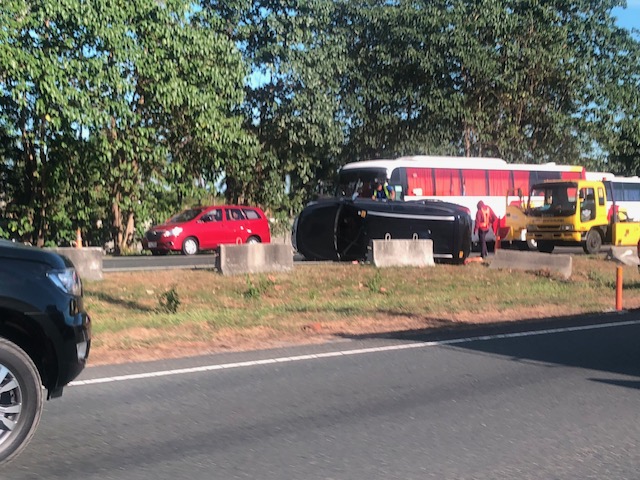
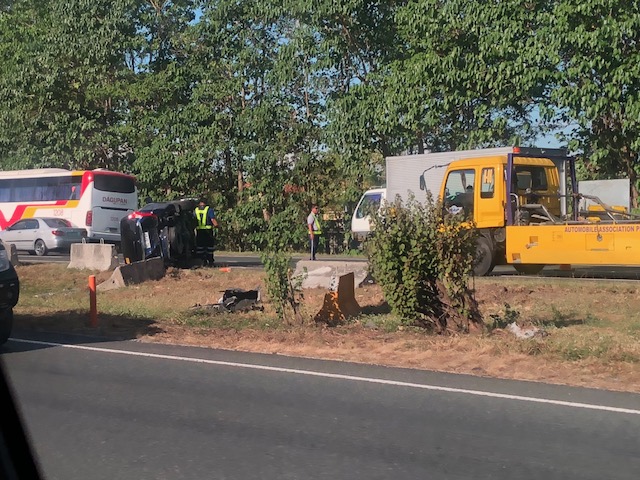
We were returning from Clark last week when we chanced upon a crash site along the North Luzon Expressway (NLEX). We already suspected this as we approached a build-up of traffic along the southbound direction where there is usually free-flowing traffic. Here are some photos of an overturned vehicle on the median. It seems like it is the only vehicle involved as there were no other vehicle in the vicinity that could have been involved. However, it is possible that there was another vehicle involved in a situation where the overturned vehicle’s driver lost control after interacting with the other vehicle. Obviously both vehicles could have been traveling at high speeds (they are on an expressway) so this could have been an example where the combination of speeding and weaving in traffic led to an overturned vehicle (i.e., one lost control).

–
Emphasising safety during these holidays
Here are a couple of articles that I thought should reiterate the importance of safety whenever we travel. This is especially true during this holiday season when a lot of people are going around – shopping, heading to their hometowns or simply vacationing.
Rey, A. (2017) “Holiday rush can lead to road crashes – expert”. Rappler.com. December 28, 2017. https://www.rappler.com/move-ph/issues/road-safety/192411-holiday-rush-road-crash-incident-expert?utm_source=facebook&utm_medium=social&utm_campaign=move-ph (Last accessed: 12/29/2017).
Merez, A. (2017) “Holidays heighten road accident risks: analysts”. ABS CBN News. December 28, 2017. http://news.abs-cbn.com/focus/12/28/17/holidays-heighten-road-accident-risks-analysts (Last accessed: 12/29/2017).
–
Transport safety during the holidays
I was having a late morning haircut when I overheard from the TV news reports of many road crashes occurring over the last 3 days including Christmas Day. One incident involved a jeepney that apparently veered away from its lane and crashed head-on to a provincial bus. It was ironic that the passengers of the jeepney were bound for the town of Manaoag in Pangasinan province, likely to give thanks for blessings they received in 2017 and pay homage to the Blessed Virgin whose image in Manaoag is regarded as miraculous. Not reported were the many other crashes that probably occurred all over the country over the same period but were considered minor incidents as no one perished and likely only involved property damage.
There was also an incident a few days ago involving a ferry traveling between Infanta, Quezon and Polilio Island.The ferry was carrying 251 passengers, of whom at least 5 reportedly perished. The incident again raised old but lingering issues on maritime safety including those pertaining to seaworthiness of vessels especially those plying the regular, frequent routes connecting the many islands in the country.
A lot of people travel during this season in the Philippines. Many travel to their hometowns for the typical homecomings, reunions people have during Christmas and New Year. Most trips are on the road (the mode share is dominant even considering the popularity of air travel and the sizeable number of trips on maritime transport) and the combination of road conditions, driver behaviour and other factors often lead to situations that may result in road crashes. We cannot overemphasise the importance of taking extra care when we travel, whether as a driver, a passenger or even a pedestrian walking along the road. A friend who is also an official of the transport department once gave passengers of buses advice to tell their drivers to slow down and drive more safely if and when they feel they are driving recklessly. You don’t lose lives by slowing down and driving more carefully (probably with the exception of drivers of emergency vehicles like ambulances), and this applies, too, to passengers of private vehicles who need to tell their drivers (likely relatives) to slow down or drive more safely. One does not want some joyride transform almost immediately into a nightmare much less a last trip for everyone.
Keep safe everyone!
–
The need for speed (limits)?
My social media newsfeed regularly contains updates being posted by various entities about transport and traffic in Metro Manila and across the Philippines. Among those I regularly see are posts on road safety and interesting to me are the frequent posts on legislating speed limits at the local level. These are in the form of city or municipal ordinances that are supposed to strengthen, supplement and/or clarify speed limits that are actually already stated in the road design guidelines of the Department of Public Works and Highways (DPWH). These limits apply not only to national roads but to local ones as well. However, their effectiveness may be limited or reduced by the absence or lack of signs, markings and, most importantly, traffic law enforcers who are supposed to monitor traffic and apprehend those violating rules and regulations.
While there is a need for defining and clarifying speed limits perhaps in the form of local legislation, I believe the more urgent matter is the implementation and enforcement of laws. It has often been mentioned that we already have so many laws, rules, regulations and the truth is we do, and may not need more. One really has to go back to the basics in terms of enforcing these laws and that means enforcers need the knowledge and tools to be effective in their work. There is an opinion that many enforcers are not knowledgeable about many rules and regulations and therefore are prone to just focus on a few including violations of the number coding scheme, truck bans and the much maligned “swerving”. You do not often seen apprehensions for beating the red light, beating the green light (yes, there is such a violation), speeding, or “counter-flowing” (or using the opposing lane to get ahead of traffic in the correct lanes). There are also turning violations as well as those involving vehicle (busted tail lights, busted headlights, busted signal lights, obscured license plates, etc.). More recently, there are anti-drunk-driving laws that also urgently need proper implementation.
I think the current work that includes sidewalk clearing operations and anti-illegal on street parking of the Metropolitan Manila Development Authority (MMDA) is one good example of going back to the basics. These address the necessity of clearing space for both pedestrians and vehicles; space that have been constrained by obstacles that should not be there in the first place but so often have gotten the blind eye treatment. Going to the “next level” though requires tools such as speed guns, high speed cameras at intersections, and instruments for measuring blood alcohol levels in the field (breath analyzers). And these require resources for acquisitions as well as capability building in the form of training personnel to handle equipment. No, I don’t think we need more laws, rules and regulations. What we urgently if not direly need is their proper implementation to effect behavior change that will improve both safety and the flow of traffic.
–
Recommended reading: “A New Traffic Safety Paradigm”
I begin December by sharing another paper from the highly respected Todd Litman:
Litman, T. (2017) “A New Traffic Safety Paradigm,” Victoria Transport Policy Institute, http://www.vtpi.org/ntsp.pdf (Last accessed: 12/2/2017).
I believe that this should be recommended reading for those doing work traffic safety.
–
On “phone zombies” and road safety
You see a lot of people these days who are always on their smart phones. Many are walking while doing something with their phones whether making a call, typing away, listening to music or perhaps attending to social media. Many are not aware of what are happening around them and this puts them in a situation where that increases their vulnerability. There are those who cross streets without checking for oncoming traffic. There are those walking along the roadside who are not mindful of the likelihood of being sideswiped by vehicles. As such, there is a need to address this behavioral concern to reduce the occurrence of incidents that could lead to deaths if not injuries.
There is a nice article I read recently about an initiative in the Netherlands where they installed pavement traffic lights:
Scott, G.L. (2017) “Dutch City Installs Pavement Traffic Lights to Help ‘Phone Zombies’,” Inverse, https://www.inverse.com/article/38472-dutch-city-installs-pavement-traffic-lights-to-help-phone-zombies?utm_source=newsletter&utm_medium=culture&utm_campaign=photo, (Last accessed 11/19/2017).
The assessment for this initiative is quite limited – one day as mentioned in the article – but is promising especially from the perspective of innovation. We need such innovative thinking in order to address the issues about safety. This is but one example of many aimed at curbing road crashes that lead to injuries and deaths particularly with respect to the most vulnerable among us.
–
In memoriam of road crash victims
I wrote earlier this year about a beloved aunt who was involved in a road crash. She was hit by a jeepney driven recklessly as she was walking; on her way to church one early morning. She was in the hospital for weeks before she finally passed away. It was painful to see her in her hospital bed, unconscious but fighting for her life.
No, I don’t feel anger anymore whenever I recall the incident and note that if the driver were just careful then she would still have been alive today. I feel sad. I feel sad and frustrated that despite all the efforts a lot of people have put into road safety programs and projects, there seems to be little in terms of the reduction of recklessness on the roads. The recent weeks, for example, are full of reports of crashes that claimed the lives of many and injured more. These often involved trucks that mowed down everyone in their paths. Then, you see a lot of motorcycles weaving in and out of traffic, many ride like stuntmen and without regard for life, limb or property as long as they can get away with it.
Additional laws in the form of local ordinances or Republic Acts will not be effective in reducing road crashes and the death toll it has brought upon us. It is the enforcement, the implementation of these rules and regulations. Rules and regulations are just words that, if not acted upon, do not have any effectiveness. And so we get to the root of the problem and that is enforcement; the lacking if not missing ingredient in the road safety broth that is necessary to save lives and create a safer environment for all. Does it deserve more attention and resources from our national government and local authorities who are in-charge of most of the enforce aspects of road safety? I do think so. Statistics on traffic-related deaths, injuries and damage to property compare strongly with if not exceed those attributed to drug abuse. When you purposely drive recklessly and crash into another vehicle or person, one is practically murderous. You also destroy the lives of people related to the person you kill or injure (e.g., that person could be the sole breadwinner of a family). The comparisons and examples are plenty and I am sure a lot of people have their own personal experiences about this as well as their opinions. For now though, let us reflect on those who perished from road crashes and perhaps think not about “what could have been” but instead of “what can be done.”
–
 Caught (up) in traffic