
Home » Posts tagged 'road safety' (Page 8)
Tag Archives: road safety
On phasing out cars in cities
I’m sharing another article on reducing car dependence. The article was referred to by the previous series that I shared recently.
Nicholas, K. (April 14, 2022) “12 best ways to get cars out of cities – ranked by new research,” The Conversation, https://theconversation.com/12-best-ways-to-get-cars-out-of-cities-ranked-by-new-research-180642 [Last accessed: 5/20/2022]
Here are a few excerpts from the article:
“Question: what do the following statistics have in common?
The second-largest (and growing) source of climate pollution in Europe.
The leading killer of children in both the US and Europe.
A principal cause of stress-inducing noise pollution and life-shortening air pollution in European cities.
A leading driver of the widening gap between rich and poor urban residents.Answer: the vehicles on our streets, primarily the not-so-humble passenger car.”
also this:
“The research is clear: to improve health outcomes, meet climate targets and create more liveable cities, reducing car use should be an urgent priority.”
and this:
“To meet the planet’s health and climate goals, city governments need to make the necessary transitions for sustainable mobility by, first, avoiding the need for mobility (see Paris’s 15-minute city); second, shifting remaining mobility needs from cars to active and public transport wherever possible; and finally, improving the cars that remain to be zero-emission.”
You can also listen instead of reading it as it is a narrated article.
–
Join the campaign: UN Global Road Safety Week 2022
Next week will be the UN Global Road Safety Week. Many organizations will be holding activities or events to promote road safety. In our case, we are part of a National Coalition promoting child road traffic injury prevention (CRTIP) in the Philippines with the support of UNICEF.
Here is the link to the UN’s page promoting road safety:
https://www.unroadsafetyweek.org/en/home
The theme touches on the campaign to reduce speeds to 30 kph. This is particularly important in the vicinity of schools or school zones where children are at a high risk of being involved in crashes. Their safety is of utmost concern and requires interventions to improve conditions. We have done assessments using iRAP’s Star Ratings for Schools (SR4S) tool and recommended interventions for many schools in Valenzuela City and Zamboanga City. This year, we hope to do the assessments in Angeles City and Cagayan de Oro City as well for Phase 2 of our project with UNICEF as we continue to help improve road safety for our children. After all, roads that are safe for children are safe for everyone else.
–
On walkability and walkability scores
I’m sharing a couple of articles on walkability and walkability scores. The first one actually points to the second but provides brief insights about the concept of walkability while the second is a more detailed article on the findings of a study on walkability.
Ionesco, D. (May 4, 2022) “Walkability Scores Don’t Tell the Whole Story,” Planetizen, https://www.planetizen.com/news/2022/05/117075-walkability-scores-dont-tell-whole-story?utm_source=newswire&utm_medium=email&utm_campaign=news-05052022&mc_cid=c04e3e4dc0&mc_eid=9ccfe464b1 [Last accessed: 5/7/2022]
To quote from the article:
“if cities truly want to be pedestrian-friendly, they need to think beyond the sidewalk…”
The second article is from late April:
Gwam, P., Noble, E. and Freemark, Y. (April 28, 2022) “Redefining Walkability,” urban.org, https://www.urban.org/features/redefining-walkability [Last accessed: 5/7/2022]
To quote from the article:
“To create a more comfortable walking experience, our research points to a few steps DC planners and policymakers can take to increase racially equitable walkability across the city:
-
expand tree cover in the densest parts of the city,
-
increase nonautomotive modes of transportation in central areas,
-
reduce noise pollution,
-
support more equitable access to key resources, and
-
prioritize road design that limits the need for police traffic enforcement.”
While the article puts emphasis on the topic of racial equity, such concept can easily be adapted and adopted for our purposes. For one, it could be interpreted as being inclusive if one is not comfortable with the term “race”.
Don’t miss downloading the technical appendix of their report. This will be very useful to researchers, practitioners and advocates of active transport.
–
On trucks and road safety again
The past days saw many trucks being involved in crashes along my commuting route. My social media feed also gives me updates on the traffic situation in my home city. And there are many reports of the same – trucks involved in road crashes or stalled due to a variety of reasons (engine problems, flat tires, etc.) . It is not an understatement to say that such incidents are a matter of concern especially since these may have been fatal (i.e., deaths due to road crashes). Here are a couple of photos we took as we passed a truck on its side along Ortigas Avenue Extension along one of my usual commuting routes.
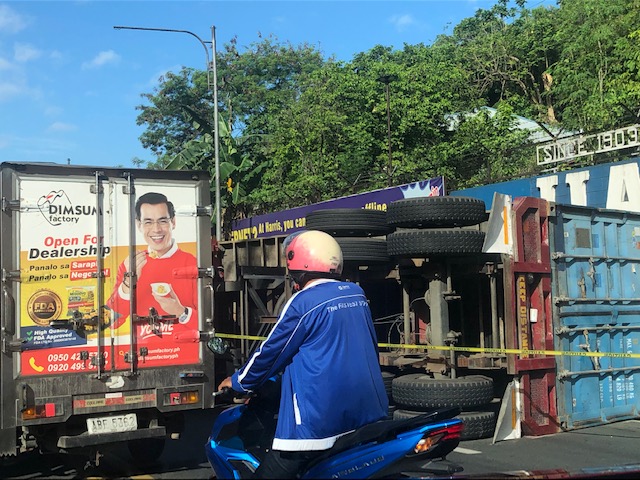
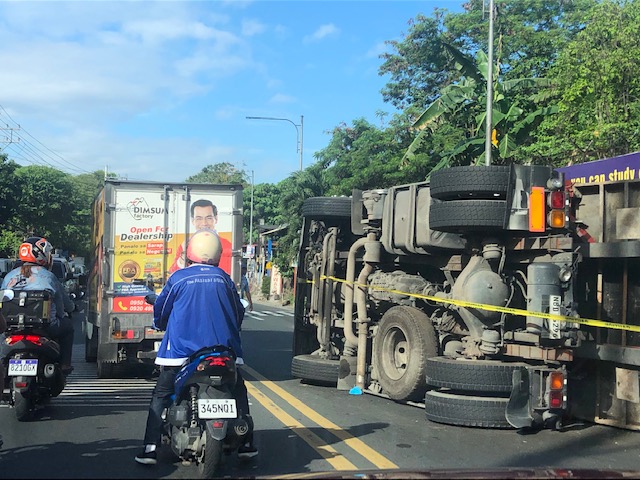
It is fortunate that this did not result in any fatality but from the photos one can surmise the potential or likelihood of serious injuries if not death/s. Such underlines the importance of both proper maintenance and operations of these vehicles including how they are loaded. Shifting or unbalanced loads on moving trucks negotiating turns or maneuvering, for example, will result in loss of control and overturning that also leads to traffic congestion. Are the drivers competent, awake, alert? Or are they sleep or perhaps driving under the influence of alcohol or other substances?
–
On ways to make streets safer
Here’s a quick share of an article suggesting a simple way to make streets safer:
Berg, N. (April 27, 2022) “The ridiculously simple way to make streets safer for pedestrians,” Fast Company, https://www.fastcompany.com/90745296/the-ridiculously-simple-way-to-make-streets-safer-for-pedestrians [Last accessed 5/1/2022]
To quote from the article: “Art projects painted onto streets and intersections significantly improve safety, reducing the rate of crashes involving cars and pedestrians by up to 50% and all crashes by 17%, according to the study.”
The article’s sub title states that you only need a bucket of paint rather than expensive new traffic signals or road blocks to keep pedestrians safe. I remember there were similar attempts to do the same in Antipolo prior to the pandemic. A group painted on the pedestrian crossings along major roads in the city. These, however, appeared to be somewhat invisible to most motorists and did not succeed to slow down traffic. Perhaps, as the article states, the artwork needs to be more visible or conspicuous in addition to its being comprehensive for intersections as the examples in the article show. These cannot be piecemeal or appear as publicity stunts for them to influence driver behavior and help improve safety.
–
Road safety history – first fatality and crash
Have you ever wondered when the first road crash involving a motor vehicle occurred? Or who was the first person to die (i.e., fatality) in a car crash? Here’s a brief but informative article on this topic:
Sal (April 15, 2022) “Who Was the First Person Ever to Die in a Car Crash?” Medium.com, https://sal.medium.com/who-was-the-first-person-ever-to-die-in-a-car-crash-8385add6cbcb [Last accessed: 4/20/2022]
Were you surprised about the 3 mph speed of the car that ran over the first fatality involving a car? That’s really slow considering the speeds of vehicles these days and how high speed limits are along streets where there are many pedestrians. Meanwhile, the circumstances about the first crash appears to be similar to what we still have now. That is, reckless driving, increasing speed limits and (truth be told) pedestrians not being aware of their surroundings (say what you will but the car was traveling at 4 mph and there was a claim that the driver tried to get the attention of the victim to no avail). I agree though with the author that this was a portent of worse things to come as road crashes has become a top killer and health concern.
–
Trivia: Why are school buses yellow?
Have you every wondered why are school buses yellow? Of course, the main reason is safety related. Here is a short article on why the color was chosen for school buses:
Ganninger, D. (August 20, 2020) “Why are school buses yellow?” Medium.com, https://medium.com/knowledge-stew/why-are-school-buses-yellow-2f2b063739d4 [Last accessed: 3/20/2022]
To quote from the article:
“The original color was called National School Bus Chrome but has since changed since school bus chrome contained lead in the pigment. The color was adopted because black lettering was easy to see in the early morning hours and during the late afternoon. Another reason it was chosen was because the color yellow is seen quickly in someone’s peripheral vision.”
–
More frequent road crashes?
My personal observations during my commutes lead to a conclusion that there is indeed an increase in the number of road crashes and perhaps this is attributable to the conditions during this pandemic. During my almost daily trips the past weeks, I have witnessed or passed by road crash incidents. These mostly involved motorcycles but last Friday, there was severe congestion along Ortigas Avenue due to a large truck that slammed into a post and ended up blocking most of the westbound lanes of the road. Yesterday, my wife sent me photos of a truck on its side after also being involved in a crash where it was reported that the driver lost control of the vehicle. Also involved, based on the Taytay report posted on their social media page, was a tricycle whose passengers sustained minor injuries. The incident could easily have been fatal to those involved considering the truck hitting the tricycle.


So are these incidents to be called accidents like how media and local governments still label them? These appear to be preventable. For one, vehicle-related problems could have been addressed by proper maintenance of the vehicle. But then there is also the question of whether the drivers or riders involved in these crashes were practicing safe driving or riding. Were they speeding or doing any risky maneuver? Were they aggressive or reckless? These are but a few factors that come into play and that led to a crash such as the one shown in the preceding photos.
–
On the increase of road crash fatalities during the pandemic
The general observation has been that roads have become less safe as drivers and riders have tended to speed up their vehicles during this pandemic. Speeding up apparently is just part of a bigger picture and even bigger concern considering what is perhaps also an issue related to mental health. We’ve read, heard or watched something about people’s transformation once they are behind the wheel or riding their motorcycles. I remember a Disney cartoon showing how Goofy transforms from being mild-mannered to somewhat demonic once behind the wheel of the car. The article below reinforces that and relates this behavior with the pandemic.
To quote from the article:
Art Markman, a cognitive scientist at the University of Texas at Austin, said that such emotions partly reflected “two years of having to stop ourselves from doing things that we’d like to do.”
“We’re all a bit at the end of our rope on things,” Dr. Markman said. “When you get angry in the car, it generates energy — and how do you dissipate that energy? Well, one way is to put your foot down a little bit more on the accelerator.”
Some thoughts on mobility in Metro Manila
I spotted these two riding what appears as monocycles in Bonifacio Global City (BGC). I was taking a walk between our our building to get to another when I saw them crossing the intersection ahead of me.
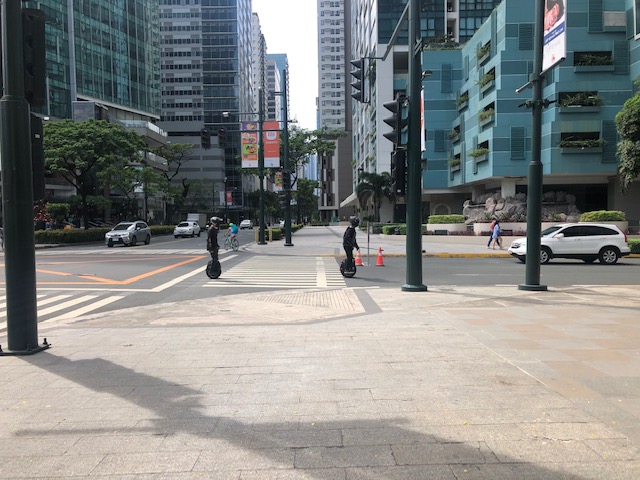
I thought these were cool modes of transport but I am unsure I can balance myself on these. I would more likely use a bicycle like the other guy in the photo (far side of the intersection crossing). I would also most likely use a bike on the sidewalk if this were allowed and also considering how wide the sidewalks there are. BGC also has protected bike lanes along certain roads so that’s another option if its prohibited to use your bike on sidewalks.
I keep mentioning sidewalks and how wide they are (at least in the photo) because we do need wide sidewalks that we can use for walking or cycling (basically moving about). It is always mentioned in various threads that we should plan and build our cities for the most vulnerable among us. That means a shift from the current car-centric set-up to a more people-oriented system. The latter requires more infrastructure for walking and cycling that includes wide sidewalks and protected bike lanes and paths. This also means more effort and resources will be required to improve public transport services since these have the most synergy and impact.
–
 Caught (up) in traffic