
Home » Posts tagged 'taxis' (Page 4)
Tag Archives: taxis
Grab a taxi
When we were residing in Singapore, it was so easy to book a taxi wherever we might be. Comfort Taxi’s booking system allowed us to get a taxi from our home to the airport or to avoid long queues at the mall by booking a taxi by phone and waiting for it at a designated stop nearby. With the arrival of GrabTaxi and EasyTaxi in the Philippines, getting a cab became a little easier and convenient though one friend opined that the app basically mainstreams the current practice of negotiating with the cab driver for the fees (usually higher than the meter fare for metered taxis) to be paid for a ride. Hindi pa kasama ang tip dito! This ‘negotiating’ is a ‘trial and error’ thing and in certain cases, there might not even be a negotiation for the fares as Metro Manila cab drivers are notorious for being choosy about their passengers and their destinations.
Here are a few screen grabs from a booking we made last month after having some difficulty getting a ride out of UP Diliman in Quezon City.
 Information about the booking fees in various Philippine cities. The booking fee in Manila is conspicuously and significantly higher than those in other major cities.
 Grab Taxi’s interface shows the number of taxis nearby, which is apparently the number within something like a 4 or 5-kilometer radius of our location (204 is a big number!). We were at Melchor Hall at the time and the most convenient pick-up location was at the National Center for Transportation Studies, which was behind Melchor Hall.
 You can also check out the availability of more exclusive (and expensive) Grab services such as GrabCar and GrabCar Premium. When you slide to GrabCar, the status bar will also show how many drivers of that service option are nearby (i.e., 20 drivers nearby for GrabCar). GrabCar would be similar to the basic service (and vehicle) provided by the more popular Uber.
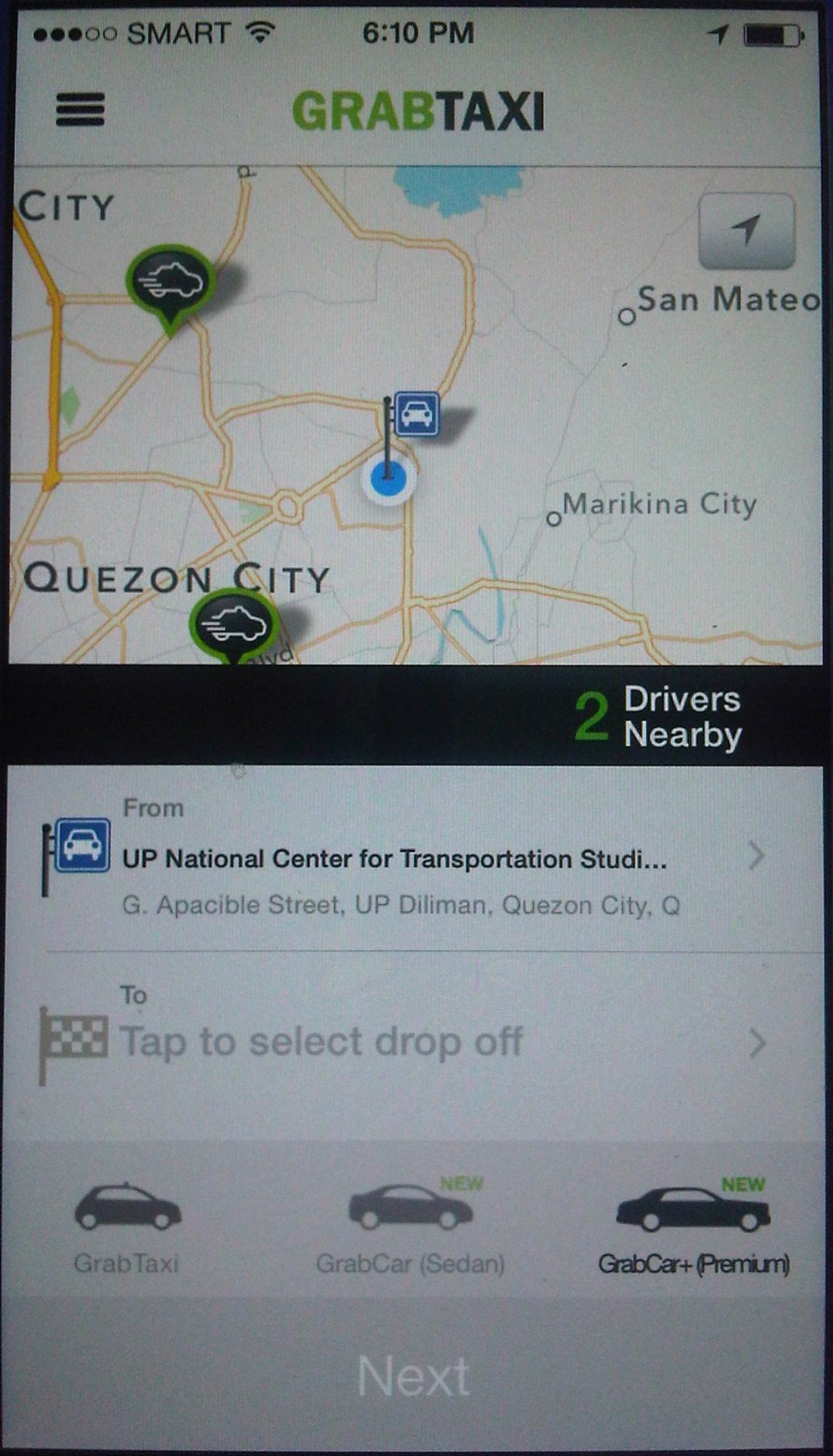 GrabCar Premium is probably the equivalent of the Uber Black Car service we have in Manila.
 Another view of the user interface showing some (or many) of the 204 taxis nearby.
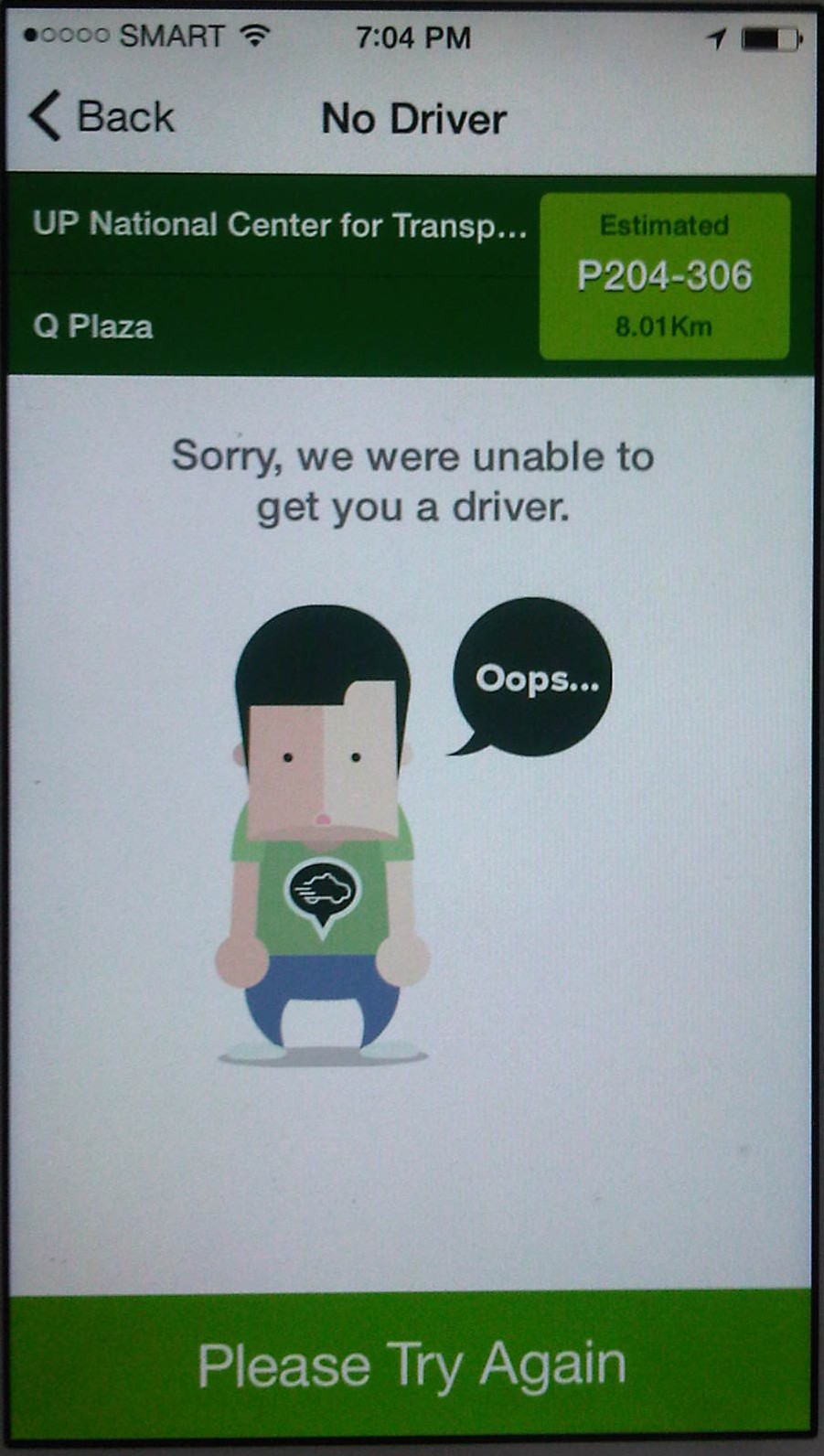 Here is an example of a message from GrabTaxi after it was unable to get a cab for us.
We were fortunate that the failed attempt at getting a cab was once only as we got a cab in our next try. This is despite all the cabs supposedly nearby. In reality only those who are willing to go to my destination from Quezon City will initially be interested in taking my request via the app. There is also a gratuity feature of GrabTaxi that allows the user to indicate how much he/she would be tipping the driver on top of the fare and booking fee. In the end, I guess my stating a very generous tip ensured my successfully getting a cab. For this, my friend’s opinion seems to be true that apps such as GrabTaxi mainstreams or makes the negotiations formal and a given when using the app. It, however, already eliminates the part where the prospective passenger gets turned down by the cab he/she hailed. When a cab responds to a request via GrabTaxi, EasyTaxi or even Uber, the driver already agrees to the terms of the deal regarding the ride. And it is a good thing that these apps now feature feedback mechanisms (e.g., rating the drivers) in order to weed out those that are still uncooperative, greedy or want to take advantage of the need for taxi service.
GrabTaxi now has a new service, Grab Express, which is an on-demand pick-up and delivery service. This is a service already provided by other companies in the US that are now giving traditional or conventional courier/logistic companies a lot of competition. I would think there is a demand for such services especially in cities where documents and other stuff still need to be submitted to offices like reports, manuscripts, letters and others that need to be delivered in “hard copy” format.
–
On the new transport categories by the DOTC
An article came out recently about the four new transport categories introduced by the Department of Transportation and Communications (DOTC).
These are:
- Transportation Network Vehicle Service (TNVS),
- Premium Taxi,
- Airport Bus, and
- Bus Rapid Transit
To quote from the article from Rappler, TNVS are:
“Vehicles of application-based, ride-sharing service providers, like Uber, GrabTaxi, Tripda, and EasyTaxi, will now fall under the category TNVS.
TNVS will cover vehicles that provide pre-arranged transportation services for compensation, using an online-enabled application or platform technology to connect passengers with drivers using their personal vehicles, Abaya said.
These new rules will also allow ride-sharing service providers to accept regular passengers heading to any point of destination in the country, Abaya added.
Operators of TNVS, called Transportation Network Companies, are also required to screen and accredit drivers and register them with the Land Transportation Franchising and Regulatory Board (LTFRB).
All TNVS vehicles will also be required to install and use global positioning system (GPS) tracking and navigation devices. Only sedans, Asian Utility Vehicles, Sports Utility Vehicles, vans, or similar vehicles will be allowed, and these should not be older than 7 years.
The new framework makes the Philippines the first country to have nationwide rules on ride-sharing, according to both the Philippine transport department and Uber. Previously, only local and city governments have regulated the services…”
Premium Taxis are described as:
“…vehicles with a 7-year age limit under this new category will be equipped with GPS, online and smartphone booking capability, and cashless transactions through credit or debit card payments.
Like TNVS, premium taxis will be allowed to accept regular passengers heading to any point of destination in the country…”
And Airport Buses are:
“…should have fixed schedules and off-street stops, low-floor height and adequate luggage space, CCTV cameras, GPS device, free WiFi, and must run on Euro V or clean alternative fuel.”
Abaya pointed out that Green Frog has expressed interest in the airport bus service that would ply three areas including Makati City, Mall of Asia (MOA) as well as Bonifacio Global City (BGC) or Ortigas business centre…”
I won’t mention the BRT anymore. It deserves its own feature (as if the previous ones on it are not enough to describe the system), and is the only mass transit among the 4 categories “introduced” by the DOTC.
These new transport categories are obviously a step in the right direction. These are not new ideas and the institution of these categories by the DOTC is long overdue considering that the agency had to go through this process in order to address legal issues pertaining to such services. In the case of TNVS and Uber, for example, much has been mentioned about franchise issues and how Uber was illegal under the prevailing set-up. It is good to have another option to the regular taxis but then weren’t GrabTaxi and EasyTaxi were supposed to have enhanced services?
As for airport buses, such limousine services have been in operation in many other countries. Unfortunately, in Metro Manila’s case, these buses would have to contend with worsening traffic conditions along most major roads connecting the airport terminals to the various points of interest mentioned in the article (e.g., Makati CBD, BGC, Ortigas CBD, etc.). It is good though that Green Frog was mentioned in the article as the new category provides an opportunity for cleaner and more efficient technologies to be applied to transport services. Still, if these services will be operated by reckless drivers then they won’t be much better than what we already have at present.
–
On airport taxis at NAIA-Manila
Arriving at the Ninoy Aquino International Airport Terminal 3 from a domestic trip, we noticed the long lines of people needing to get a taxi to get to their homes or other destinations. NAIA has accredited a taxi company or companies as official airport taxis and travelers have a choice between metered and fixed rate taxis. Regular taxis were generally prohibited from picking up passengers at the airport terminals though they bring in passengers and could take passengers from the departure areas of the terminals; a common practice in other airports. I say ‘were’ because recently, in what seemed to be an effort to address the taxi supply issue, NAIA has allowed regular taxis to pick up passengers during ‘peak hours’. I say they should just assign a place for people to get regular taxis just like in Mactan Cebu and Davao.
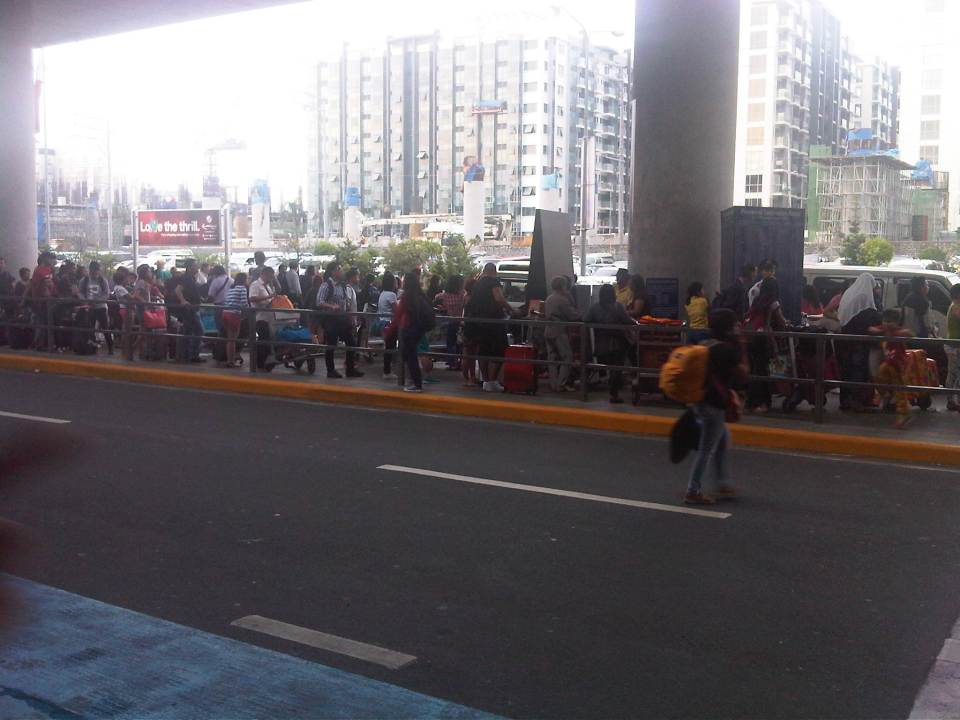 Long lines for the metered airport taxi cabs
 Long lines for the fixed rate taxis
 Another looks at the long lines – not exactly the greeting you’d like when arriving in a city
–
Getting a taxi at Mactan Cebu International Airport
It is easy to get a taxi in many airports in the Philippines not named NAIA. The list includes, of course, Mactan Cebu International Airport. There is a regular taxi stand just a few meters walk from the arrival area. You have to cross the driveway and there are directional signs to guide travelers towards the taxi stand that is just a short flight of stairs from the corridor across the arrival area.
 Directional sign to the taxi stand – definitely not international standard but is clear and sufficient for its purpose.
 Queue for taxis – there has been an improvement here as there is now a tent for passengers’ shelter and a driveway for taxis. It used to be an open area along the MCIA driveway where taxis are lined up.
 The stand is manned by airport security and staff who also issue information on the taxi on a piece of paper containing a phone number of the MCIA for complaints. I don’t know if they get a lot of complaints and if the airport acts on these if and when there are complaints from passengers.
 Passengers loading luggage in the trunk of a taxi – there are many LPG-fueled taxis in Cebu and if you have many pieces or large luggage it would be better to select a taxi with more trunk space. LPG taxis have their tanks inside the trunk, limiting space for luggage.
 Some workers are busy doing the lane markings for the driveway. We thought that these probably being undertaken in preparation for the APEC meetings that several Philippine cities will be hosting.
–
The curious case of Uber in the Philippines
Before anything else, I must first state that I have not used Uber in the Philippines nor have I used it elsewhere. Its probably because I have not found a use for it…yet. In cities in other countries that I have traveled to, I often use public transport and cities with good mass transit systems have very high marks for me. There are taxi services in these cities and I have had mixed experiences with taxis in Bangkok and even Singapore. I think Japan’s taxis are excellent and locally, Iloilo’s taxis particularly that of one company should be the model for city taxi services in the country.
The services offered by Uber reminds me of the evolution of UV Express or FX services. Back in the 1990s, private vehicle owners/drivers saw an opportunity to “earn a few pesos” by offering a ride to people waiting along the road. An AUV driver, for example, bound for Makati from Quezon City would take in a few passengers for an agreed fee and the collection would help him defray costs of fuel as well as of maintenance for a trip that he would likely make alone if he didn’t offer rides to others. He had no coverage for his passengers should they be involved in a crash and they even conspired to claim they were carpooling or were friends if accosted by authorities (i.e., when suspected to be running a colorum vehicle). This is practically the same service offered through Uber. The only difference being that Uber employs an app to facilitate “service contract” between driver and passenger. The app basically makes the agreement discrete and unknown to regulators of transport services.
Like the predecessors of UV Express services, Uber service providers serve a segment of commuters who have difficulties getting a public transport ride and are likely also to be frustrated or disgruntled about the poor quality of public transport services. This is not limited to taxi services but encompass bus, jeepney, UV Express, tricycle and rail transport that a majority of commuters regularly take to go to their offices, schools or other destinations. I purposely omitted walking and cycling here as everybody essentially walks and cycling is not really a transport service along the lines of public utility vehicles.
Very recently, the Land Transport Franchising and Regulatory Board (LTFRB) ruled that Uber is illegal, basically classifying it as colorum – terminology for vehicles illegally operating as public transport. Is the agency totally wrong about their ruling against Uber? While I haven’t seen the decision or read any memos regarding this, I would assume that the board had its reasons and some of these are reasonable, sound bases for such a memo. For one, regular public transport services require insurance for carrying passengers. Regular insurance taken by private car owners covers the driver and the passengers who ride for free but public transport carry passengers for a fee (fares) and thus drivers and the operators have a bigger responsibility particularly with regard to safety. This question on liability is perhaps the biggest question for Uber and the people behind it. I think this will be a good topic for law schools to take up and perhaps a good subject for debates for and against the service.
However, the bigger question perhaps, and especially to netizens who vented their anger at the LTFRB for the decision against Uber, is: Are you really angry because of the LTFRB decision against Uber or because you are unhappy about transport services in Metro Manila (and elsewhere in the country general)? Online articles have become a feast for trolls as they typed in their scorchers for the agency but I am willing to bet most of these haven’t even taken an Uber vehicle prior to their posting their opinions online. Most know about Uber as a concept or as an app but haven’t read or learned about experiences elsewhere and why it has become popular or notorious depending on the conditions where it is operating. While people I know have used it and benefited from the service, there should still be safeguards for users who essentially do not know who will drive up to pick them up for their trip. Definitely, there are security and safety concerns that need to be clarified here. Also, would this lead to people who would take this up as a full-time job rather than as something more like a “for-hire” car or van-pool? And lastly, we should not be distracted and lose sight of the ultimate goal. That is, we should push for better transport systems and services so that Uber and other similar services would not be essential for our commutes. –
Airport taxi at NAIA?
I have been hearing and reading a lot about horrible experiences of various people including friends on airport taxis. All the stories seem to be about getting a taxi at NAIA where airport management has “accredited” one or a few companies to provide airport taxi services. This exclusiveness has clearly become disadvantageous to many passengers who have not previously arranged for someone to pick them up at the airport (e.g., a relative, a friend, his/her company vehicle, or maybe transport service from the hotel where they will be staying). The coupon taxi services, however, is usually the safer bet for those unfamiliar with Metro Manila as regular meter taxis often “prey” on travellers who are not knowledgeable about fares and traffic conditions. Often, one would have to negotiate for fares though there are honest cab drivers who would do their jobs without haggling or demanding for tips.
Allow me to cite a number of examples in international airport terminals abroad and in other Philippine cities where getting a taxi at the airport is relatively straightforward and stress-free:
1. In Singapore’s Changi Airport, you can easily get a cab at any of the terminals. You just get into the queue (if there is any) and get the next available taxi. The drivers do not discriminate among potential passengers and the only question asked is about the destination of the passenger. Sometimes, the driver will ask about a passenger’s preferred route as there are toll roads between Changi and the destination. There are bus and rail services connecting the airport to the rest of the city-state and many passengers also choose these options.
2. In Bangkok’s Suvarnabhumi Airport, you can also get a taxi at the queue at the basement level. There are airport taxi counters at the lobby as passengers come out of the arrivals but these are the more “exclusive” companies and charge more per vehicle. However, if you are a group comprised of at least 4 people, then it would be cost effective to engage these companies as they can provide a larger vehicle (e.g., van) that can be more comfortable than a regular taxi. This is particularly recommended for people who have a lot of luggage like families. Otherwise, you can take a regular cab at the basement level queue. These are metered taxi but some may negotiate a fixed (and therefore higher) rate. Transfer to another if you don’t agree with the driver.
3. In Cebu’s Mactan Airport, the taxi bay is a just a few minutes walk from the arrival area. There is a queue and a security guard issues a ticket with information on the taxi (license plate number and company) that he gives to the passengers as reference should there be complaints on the driver as well as in cases where some belongings are left in the taxi.
4. In Iloilo, there are many taxis to choose from once you get out of the airport terminal. There are many taxi service counters just outside the arrival area and passengers can engage any of these companies for a ride to the city or other destinations. My Ilonggo friends will definitely recommend Light of Glory as their taxi company of choice. This company is highly regarded for their quality of service that includes honesty among its drivers. You can also contact them to make arrangements for transport between your hotel/accommodations and the airport.
5. In Davao, there is a regular taxis queue just outside the terminal building and the city has a transport enforcement unit that is stricter than most LGUs. This ensures that taxis will likely comply with traffic rules and regulations including the safe conveyance of passengers to/from the airport. These are metered taxis though there will always be taxi drivers who will attempt to negotiate fares or tips with the passengers. This will not be done at the airport as airport or city staff will be on watch at the terminal. Instead, the negotiations are done once the passenger is inside the taxi and leaving the airport.
Of course, in the international airports I mentioned, there is the option of taking the airport express train instead of taking a cab. Both Changi and Suvarnabhumi, for example, have excellent rail connections, and more experienced travelers would probably take these train services over taxis as they are less expensive and allow for shorter travel times (i.e., taxis can be caught in congested roads especially during peak periods).
NAIA desperately needs good options for public transport such as airport limousines or more dependable taxi services. Sadly, getting a taxi in Metro Manila is basically a “hit or miss” affair. There is a 50/50 chance that you will get a good taxi driver so there is an equal chance that you will get a bad one. At the airport, there might be a higher likelihood that one can get a bad taxi if we assume that taxi drivers might be deliberately taking advantage of potential passengers who are not familiar with Metro Manila and its taxis. As mentioned earlier, more experienced travellers would likely have pre-arranged transport between the airport and their destinations. So the coupon taxis would have to do for now and until there are better options for transport including more reliable regular metered taxi services.
–
Another look at the Iloilo airport – arrival
I have not been to Iloilo in a while despite having our ancestral home there on my father’s side of the family. It used to be that I was in Iloilo at least once a year and usually during the Holy Week when we had family reunions on Easter Sunday. Perhaps the last time was in 2010 when I gave a keynote lecture to the Metro Iloilo, Guimaras Economic Development Council (MIGEDC) during one of their last seminars under a JICA-assisted project to improve transportation in the area. And so I was quite happy to have an opportunity to travel to Iloilo even for a short stay to have a meeting and do some field work. I was also happy to have an opportunity to take some new photos of the airport, which is now serving as an international airport with regular flights to and from Hong Kong and Singapore.
 Arriving passengers pass through a corridor after disembarking through one of the three tubes at the terminal.
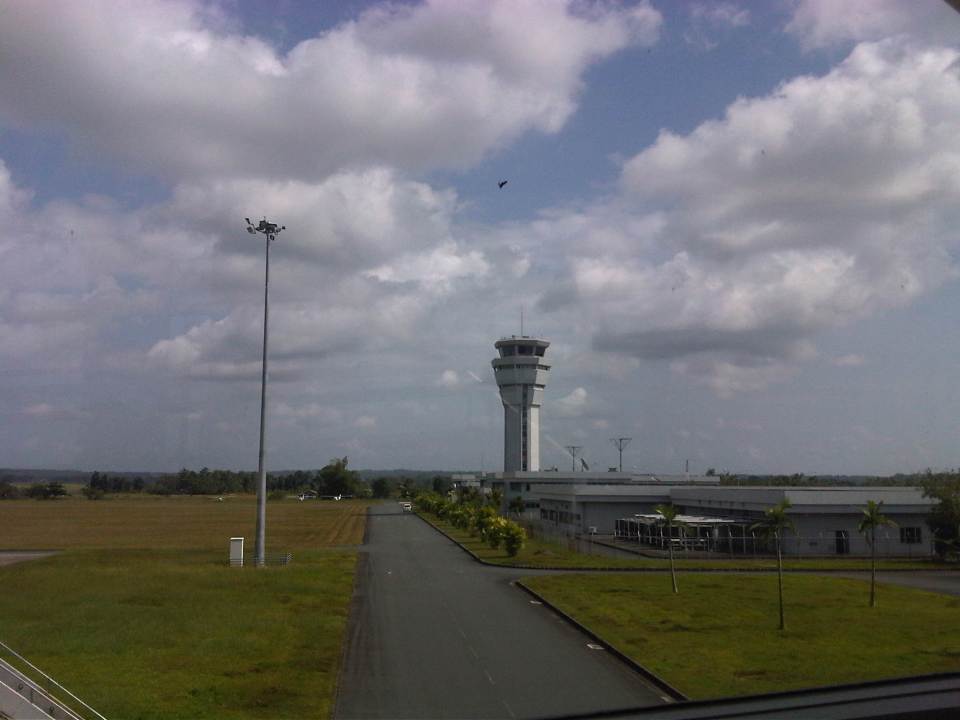 The Iloilo International Airport’s control tower as seen from the terminal building.
 Direction to the baggage claim area.
 Quarantine section along the way to baggage claim.
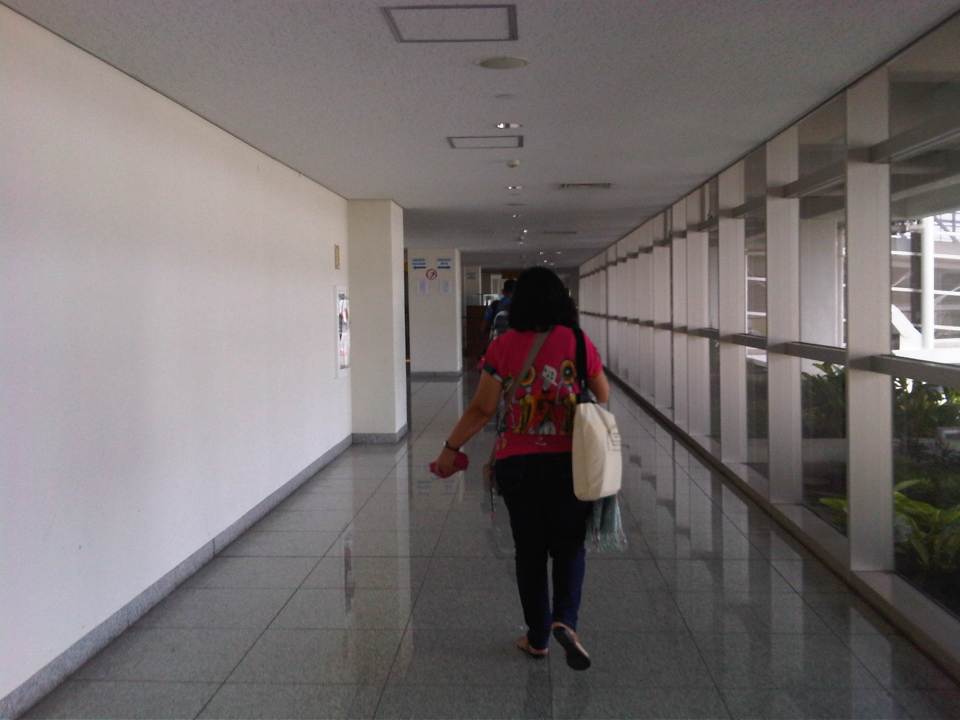 The corridor leads to a section allocated for immigration for international arrivals.
 The immigration booths are manned only when there are international arrivals. Most of the time, these are unmanned as most flights throughout the day are domestic.
 The booths look like they were set up only recently when the airport started catering to international flights. There were only two stations, each with a capacity for 2 immigration officials for a total of 4 officers to process international arrivals. I hope they are able to do their jobs efficiently (i.e., quickly but correctly) as the space for queuing is quite limited. There are few international flights, however, and one A319 or A320 planeload would probably not overwhelm 4 officers. Of course, I am assuming there would be that many officers to handle the arrivals.
 After going through the immigration area, one proceeds towards the baggage claim area via a staircase, which leads passengers to the ground level of the airport terminal.
 There are 2 baggage carousels where arriving passengers can get their checked-in luggage. Carts are provided free for use of passengers.
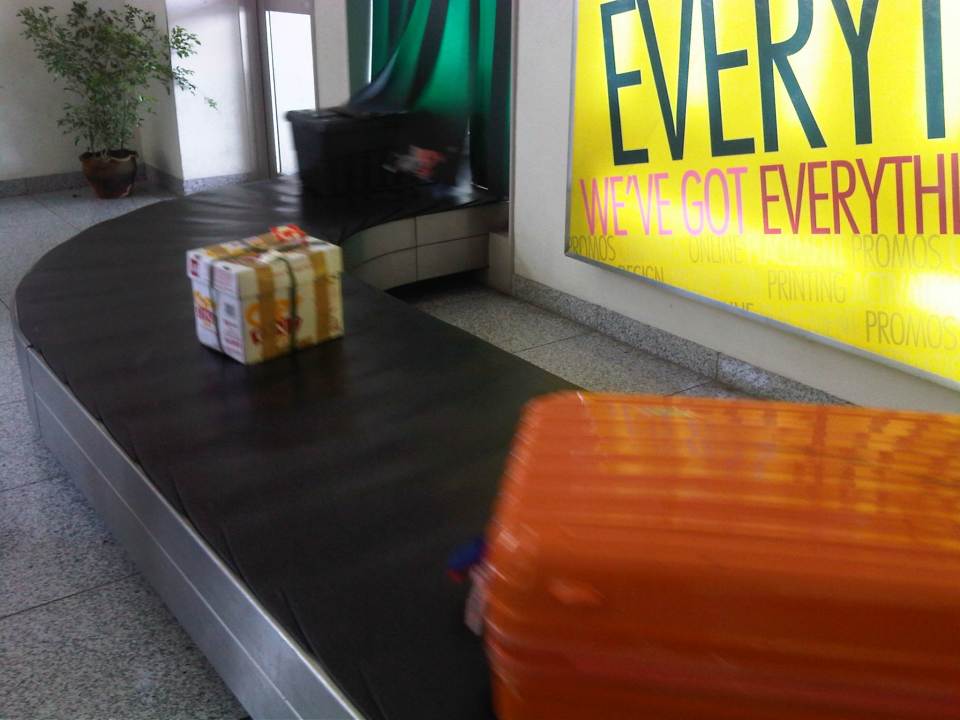 Luggage of all shapes and sizes are loaded unto the carousel and circulate for passengers to sort through and pick up.
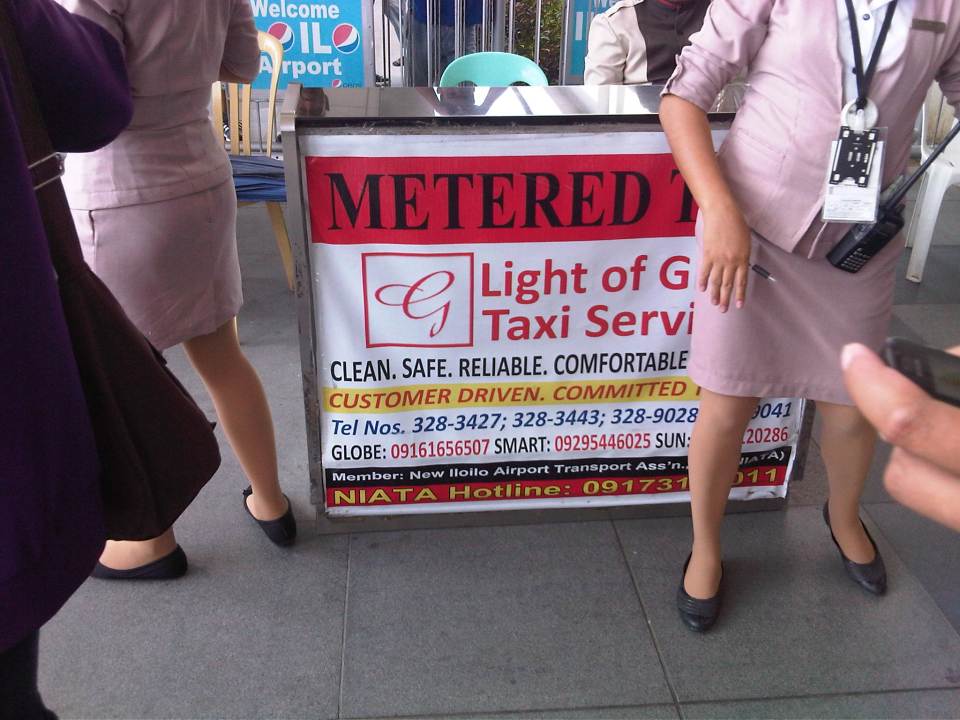 When in need of trustworthy and reliable transport in Iloilo, contact Light of Glory taxi service. Their metered taxi services are the best in the city and the province it is easy to arrange for a vehicle to fetch you at the hotel to any destination within the island. Their drivers practice safe driving so that’s always a plus for those who prefer to take the taxi over the jeepney when in Iloilo. I also noticed that they have a good dispatching system at the airport and at SM City Iloilo – definitely something that we should be replicating in Metro Manila and other cities.
–
 Caught (up) in traffic