
Home » 2015 (Page 11)
Yearly Archives: 2015
Future jeepney: COMET
Another vehicle being considered for the study on the comparison of customised vehicles being used for public transport is the COMET (City Optimised Managed Electric Transport). This is a 20-seater vehicle that we have written about in previous posts and was touted by its makers and supporters as the best and most suitable replacement for the conventional jeepney. Unlike the BEEP that was featured in the previous post, it is currently operating along a route with trip ends at North Avenue and Aurora Boulevard via Mindanao Avenue, Congressional Avenue, Luzon Avenue and Katipunan Avenue. This route overlaps in operation with established jeepney routes in those areas and thus competes directly with these jeepneys.

Notice that both the COMET and the BEEP have seating capacities of 20 passengers (except the driver). However, the COMET is the larger vehicle as it is both wider, longer and higher than the BEEP. In fact, a passenger can stand inside the COMET without having to bow his/her head so as not to bump against the ceiling. Perhaps the more significant difference with current operations is that COMET drivers have been trained to drive more responsibly (i.e., less aggressively) than the typical jeepney driver. So far they do not weave in traffic and stop only at designated points along their route. Future jeepneys should have drivers like these but they should also be compensated according to the requirements of their jobs as drivers. Such compensation schemes are among the biggest factors for the way jeepney drivers behave in traffic. Technology-wise, current and subsequent developments in motors, batteries and other components of the vehicle itself should make electric and other environment-friendly vehicles more attractive as replacements (successors?) to jeepneys.
–
Future jeepney: BEEP
The National Center for Transportation Studies (NCTS) of the University of the Philippines Diliman (UPD) is part of the Phase II of a research comparing the performances of customized local road vehicles (CLRV) for use in public transport. This project is being conducted together with the Vehicle Research and Testing Laboratory (VRTL) of UPD’s Department of Mechanical Engineering (DME), Electrical and Electronics Engineering Institute (EEEI) and the National Engineering Center (NEC) with funding from the Department of Energy (DOE). Phase II considers a longer route for the comparison of vehicles. In the previous Phase I, the route was UP Diliman-North EDSA while in this phase, the route will be Lagro-Cubao, which is significantly longer in distance compared to the previous study route.
Here are the specs for the BEEP, which features some significant design changes from the earlier versions of the e-jeepney:
 It is worth noting the following for the BEEP:
1. The door is already located on the side of the vehicle instead of at the back.
2. The motor is rated at 30kW, a significant upgrade from the 15- and 20kW motors in previous e-jeepneys.
3. The seating capacity is for 20 passengers (excluding the driver) by about 2 to 4 people from previous e-jeepney models.
These are the most obvious changes in the BEEP and would be factors that could affect its performance and acceptability. Most jeepneys these days are “siyaman” meaning they seat 9 passengers on each of the bench seats plus 2 on the front seat for a total of 20 passengers. Also, jeepneys should be able to negotiate steeper slopes that have been among the problems for e-jeepneys. Not mentioned are the specs of the batteries and the charging time although the range claimed for a full charge is 85 km. This study will hopefully validate these claims and show us if the BEEP will be up to the challenge of replacing the conventional jeepneys on long routes.
–
On school trip generation and exclusive villages
In the news weeks ago is the coding scheme for vehicles that Ayala Alabang, a posh residential subdivision in Muntinlupa City, imposed on vehicles coming in and out of the village. According to media reports, affected are vehicles bound for and coming out of De La Salle Zobel (DLSZ), which is an exclusive school located inside the subdivision. There is another exclusive school inside the village but they don’t seem to be in the news regarding this issue on car stickers and access through the subdivision roads. Perhaps they generate a lot less cars from outside the village?
I lived in villages where there are exclusive schools also located inside the villages. They are smaller compared to DLSZ and likely generate significantly less vehicles than the latter. Also, the numbers of vehicles they generated from outside the subdivisions are not enough to cause traffic congestion along the main roads to and from the schools and the village gates.
For the school in the former subdivision we used to reside in, I noticed that most students arrived via school service. School service vehicles carry more passengers than private cars and so help reduce the number of vehicles generated by the school. These were mostly vans or AUVs and not the mini-buses, coasters or regular buses of when I was in grade school and high school myself. Though lower in capacity compared to buses, AUVs and vans could take in 10 to 12 students comfortably and perhaps max out at 14 to 16 people depending on the sizes of the children the ferry between school and their homes.
In the current subdivision where I live, most students go by car and the wider main road that they use translated to faster cars running between the village gate and the school. I have observed many instances when speeding vehicles do not slow down at intersections or when there are people about to cross the street. There are no humps along the main road like those in the previous village. Humps or speed bumps can be very effective in reducing speeds but improperly designed humps can eventually damage your car’s suspension. The rolling terrain of our village does not seem to be a deterrent against speeding and limited sight distances along the main road presents a significant likelihood that a crash can occur involving speeding vehicles. Thus, some traffic calming measures need to be formulated and implemented before tragedy strikes.
Now that school is almost out for most schools (including the ones inside subdivisions) I think the attention the issue has been getting will steadily die down. But that will be until schools open again in June and residents again feel the impacts of traffic generated by the schools from without the subdivision whether its traffic congestion or road safety that is the more pressing issue in residential subdivisions hosting schools. Perhaps a sticker system and the restriction of the number of vehicles of outsiders is one way to reduce the negative impacts of traffic generated and then there is also the option of not allowing a major school to be located inside a residential subdivision in the first place.
–
The Philippines Anti-Drunk Driving Law
It’s a Friday and another weekend is here. It’s also payday weekend and so it’s expected that restaurants, cafes and bars will be full tonight and the weekends with people dining, lunching, having coffee, and likely for many – drinking. For many years, the latter has resulted in too many road crashes, a significant number of which have had fatal outcomes – usually cars or motorcycles crashing into one another or by themselves. It’s even more dangerous (and highly likely to be fatal) for motorcycle riders who need to balance themselves on two wheels after getting inebriated. Meanwhile, a lot of driving under the influence (DUI) that in many other countries including the US and Japan don’t get apprehended primarily due to the absence of laws and guidelines for their capture and evaluation. There was no way to test their blood alcohol content (BAC) in the field and traffic personnel couldn’t force people to go to hospitals to be tested.
There’s good new, however, especially for road safety advocates. The Philippines is finally implementing Republic Act No. 10586 – An Act Penalizing Persons Driving Under the Influence of Alcohol, Dangerous Drugs, and Similar Substances, and for other Purposes, which was signed into law in May 27, 2013. Under the law, private vehicle drivers can be arrested and penalized for BAC of more than 0.05% while truck and public transport drivers and motorcycle riders can be apprehended for a BAC of more than 0.0%. For comparison, Japan requires a BAC of 0.0% for ALL motorists.
The Implementing Rules and Regulations for the law may be found here: PH Anti Drunk Driving Law2013 Rules. The Land Transportation Office (LTO) and the Metro Manila Development Authority (MMDA) have already acquired equipment to help them evaluate apprehended persons. These include breath analyzers and staffs of both agencies have already undergone training to be able to implement the law. Unfortunately, traffic enforcers cannot randomly test people on the road but would have to apprehend them first for violating other traffic rules and regulations. But I am sure our traffic law enforcers can be quite creative in how to catch these people who pose dangers to all other road users by their being irresponsible for driving or riding under the influence of alcohol or dangerous drugs. And with the national elections coming up next year, there will be a lot of checkpoints sprouting up along major roads that will also open opportunities for testing and apprehensions.
–
Swapang drivers
Intersections, especially those with traffic signals, typically have road markings indicating the stop line for vehicles as well as the designated pedestrian right of way for crossing at the intersection. Most intersections also have a typical “yellow box” that is supposed to mark the area that is to be clear of any obstructions (including vehicles and pedestrians) in order for traffic to flow efficiently at the intersection. Despite these and the clear policy on where to stop at intersections based on traffic rules and regulations, many motorists choose to violate these rules and encroach or occupy space that is for pedestrians and cyclists. In the process, these motorists endanger the lives or limbs of people that they might hit as they attempt to get ahead of others. This propensity to “get ahead” or panggugulang in street lingo is widespread and indicative of how the poor discipline among motorists.
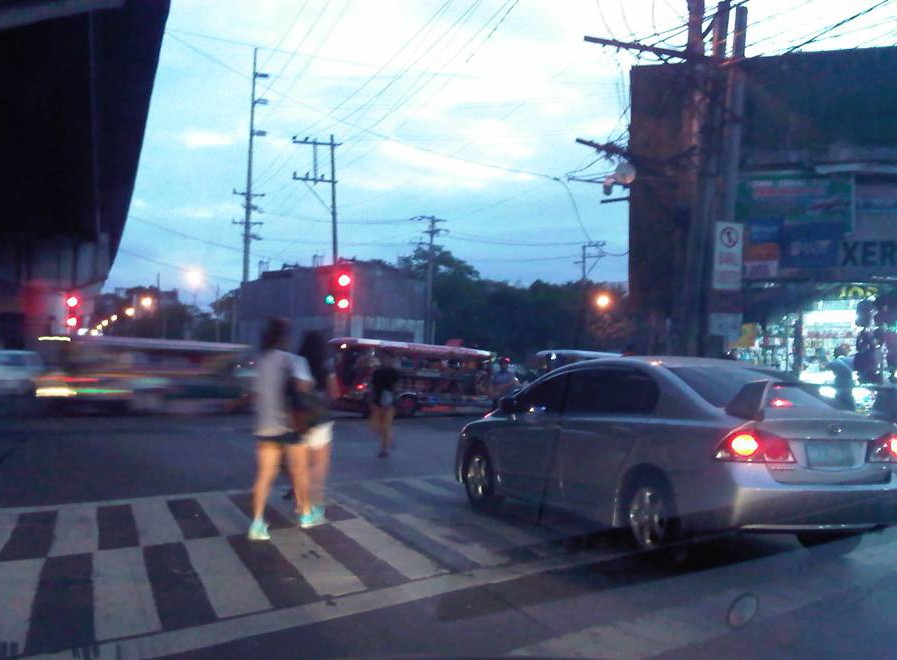 The driver of this car seems to think he could get ahead of everyone else by stopping on top of the pedestrian crossing, which in this case is clearly marked.
There are many cases like this and in some there are traffic enforcers that quickly approach the vehicle to accost the driver. In Makati, erring drivers immediately get a ticket or are fined for such transgressions. The photo taken above was in Quezon City at the intersection of Aurora Boulevard and Katipunan Avenue. There were a lot of enforcers there and very visible but they were only watching traffic and did not mind such cases. I think that if an enforcer was not deputised (i.e., not authorised to give a traffic ticket) then the least he/she could do was to approach the driver, inform him/her of the transgression and then direct the driver to clear the area (basically back up behind the crosswalk).
If and where the enforcer is deputised, then I think they should issue tickets or fine violators to send a clear message that such actions will be penalised immediately and firmly. Word of such actions and their outcomes usually travel fast among motorists especially with social media these days expediting such information dissemination regarding transport and traffic in various areas in the metro. This would be a good way to influence people to improve their behaviour on the roads.
–
If you build it, will they come?
There seems to be a belief among the more zealous advocates of sustainable transport that if “you build it, they will come.” It seems cliche but this saying is not necessarily applicable to many things especially when referring to transport infrastructure. There are examples of roads, terminals and other transport facilities that have been built but sadly are underutilized mainly due to the demand just not being there and taking much time to attain. The last is usually due to the fact that certain conditions or prerequisites have not been satisfied. One such example of this is the case of the Subic-Clark-Tarlac Expressway (SCTEX), whose payment for the loan that covered the construction costs was premised on a very high traffic demand forecast. It took some time for more people to use the expressway as the traffic from the major developments (Clark, Subic, Tarlac and Bataan industrial and commercial developments) just didn’t happen as immediately as assumed in the forecast. Still, there is a strategic value to such major infrastructure considering it as an investment and something that will cost a lot more in the future if not built today.
In Metro Manila, the MMDA has allocated or designated lanes for cycling along several major roads. These included the lanes they created out of painting existing pedestrian sidewalks and marking these as bikeways. One section is between Magallanes and Ayala while another is from Ortigas to White Plains. These are poorly designed, “pwede na yan” types of bikeways that people on bicycles would find very difficult to use because the course is full of obstacles. And how about the plight of pedestrians who would have to share these narrow paths with cyclists? Such mixed signals on providing for the needs of pedestrians and cyclists are not necessary unless of course the main objective of this exercise is just to get the attention of a wider audience that is the general public, which I would strongly agree is needed to advocate for sustainable transport. Focus on the ultimate goal, however, should not be lost for what appears as small victories. Perhaps an even stronger initiative should be towards having the DPWH revise road design guidelines to incorporate walking and cycling requirement especially for national roads.
 Bicycle lane along Julia Vargas Ave. in Pasig City
Cebu City enacted an ordinance essentially promoting cycling through the planning and implementation of bikeways, bike lanes or shared lanes. However, initial efforts seem to be following the MMDA’s “pwede na yan” approach. I think Cebu could do better and come up with a better plan for integrating and mainstreaming bikeways into the transport network. But of course, a lot still needs to be done for pedestrian facilities.
In conclusion, building transport infrastructure is not an assurance that it will generate its intended benefits at once. However, some infrastructure are more strategic than others as perhaps they form part of a network. Expressways in Luzon are among these strategic investments. High standard highways in Mindanao are also essential. Rail rehab and building in Luzon is strategic. The same in Mindanao perhaps is not. Mass transit systems in highly urbanized cities are required but perhaps many should start with buses rather than rail. Bridges across islands are not urgent. International-standard airports in major cities are necessary but not all provinces require such airports. Its not a simple task to determine what will work and what wouldn’t. While it is easy to attribute so many benefits in order to justify a project, such practice would usually result in white elephants that few people benefit from.
–
Some updates on DOST’s AGT
Passing by the DOST compound last week, I saw that the newer of the two AGT prototypes the Department of Science and Technology (DOST) has funded through the Metals Industry Research and Development Centre (MIRDC) is already atop the test track along Gen. Santos Ave. in Bicutan, Taguig City.
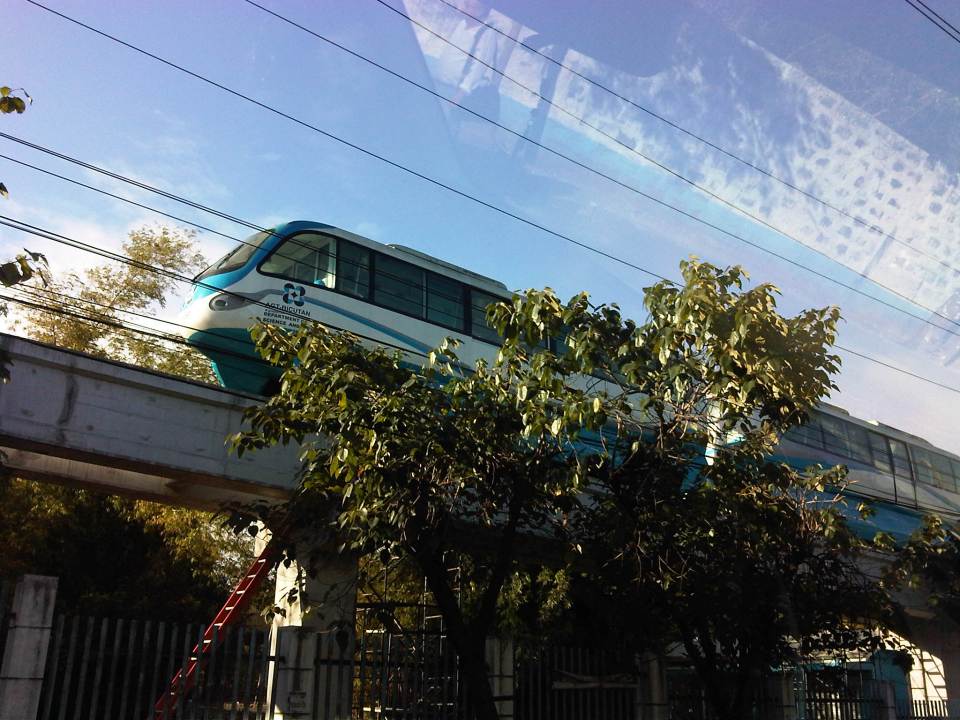 The Bicutan AGT is larger than the prototype in UP. The former is a 120-passenger capacity train while the latter is a 6-passenger vehicle.
There are four on-going pre-feasibility studies on proposed AGT lines – UP Diliman in Quezon City, Litex in Quezon City, Gen. Santos Ave., Bicutan in Taguig City, and Baguio City. I am familiar with the first three, which is being implemented by UP but know little about the 4th, which is being implemented by a private consulting firm. The transport aspects (i.e., ridership estimates) of the Litex and Bicutan AGTs are almost complete and the estimated riderships are not encouraging considering the competition from road-based public transport comprised of jeepneys and tricycles along the proposed alignments.
There is a similar dilemma for the loop option proposed for UP Diliman that will be competing with the jeepneys operating in the campus. That is why another option is currently being studied, i.e., a line connecting Philcoa – the UP Town Center and Aurora Boulevard via UP, C.P. Garcia Ave. and Katipunan Ave. This line presumably would have significant ridership as it passes through major traffic generators in 3 major schools (UP, Ateneo and Miriam) and a commercial area (UP Town Center). It will likely become the mode of choice for people usually passing through the UP campus from Aurora Blvd. to get to Philcoa and beyond, and vice versa. And with the traffic congestion along Katipunan, a transit system with its own right-of-way should have better travel times compared with road-based transport.
A big issue about the AGT vehicles is the certification required before these are allowed to carry passengers in a real system. The current vehicles are prototypes so these will be subject to more refinements towards the model that would actually go into service in the foreseeable future. There is no update on this and the MIRDC and DOST don’t seem to be seeking more rigid and independent tests to certify the safety and integrity of this Philippine-made system. Perhaps the DOTC can help them on this through the LRTA or the PNR?
–
“No” to additional jeepneys?
I finally got a photo of a banner that I’ve seen on many jeepneys plying the Katipunan route. This appeared on jeepneys a couple of weeks ago and the message on it is clear: “No to more jeeps, to more traffic in Katipunan.” I became curious about this as I noticed that list of transport groups that had their names printed at the bottom of the tarpaulin. Noticeable is the absence of one group, Pasang Masda, among the list that includes, among others, LTOP, ALTODAP and the party list group 1-Utak, which used to have a seat in the Philippines House of Representatives.
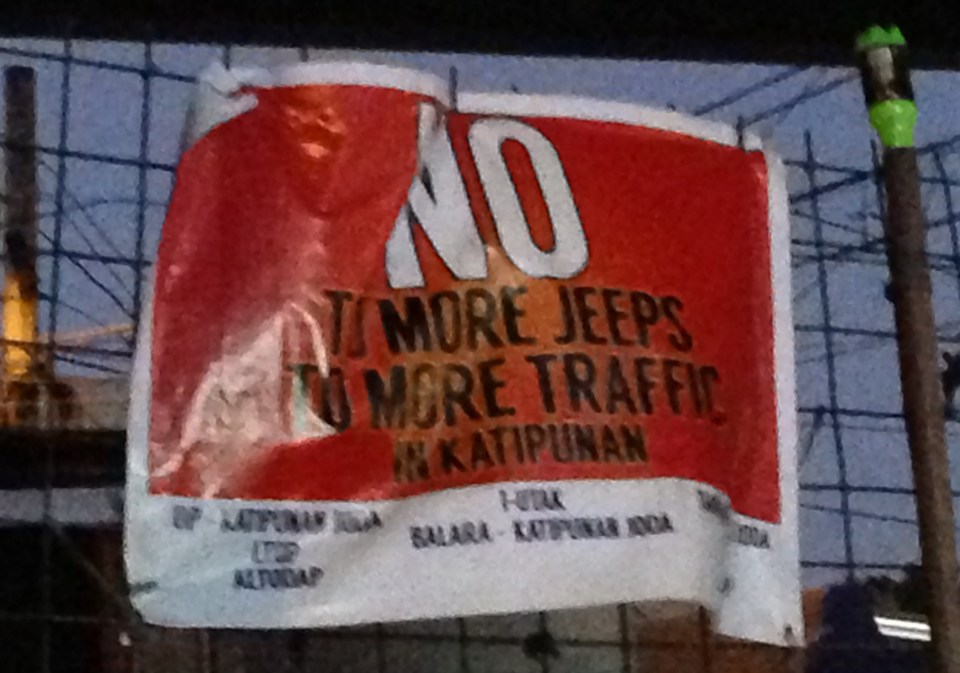 Tarpaulin sign hanging at a wire fence at the Katipunan jeepney terminal under the Aurora Blvd. flyover.
Pasang Masda is supporting the Comet jitneys currently plying the North EDSA-Aurora Boulevard route (via Mindanao Ave., Congressional Ave., Luzon Ave. and Katipunan Ave.). In fact, the head of the group is reported to have bought a few units, likely convinced of it as a good investment. Is it? Only time will tell considering its route is not necessarily the best for it, overlapping with several jeepney routes including the UP-Katipunan route. Is the Comet a game changer? So far, it isn’t and that’s mainly because of its single roue that’s not exactly favorable for a demonstration of the vehicle’s capability and claimed advantage over the conventional jeepneys. A colleague even says that it seems the route approved for it doomed its operation in the first place. But that’s an entirely different story from the opposition to it that’s stated in the tarps at the Katipunan jeepney terminal and some of the jeepneys plying the route.
So, is it a “no” to more jeepneys because their numbers are really already excessive OR is it a “no” because the additional jeepneys are from other groups or those not affiliated or in league with the undersigned? It seems that the latter case applies here and this should be taken as an example of what to expect along the way as initiatives to phaseout or replace conventional jeepneys get going. It is a bit complicated due to mainly to the social aspects of a phaseout or replacement but it gets more complex with the personalities involved including and especially the leaderships of various transport groups.
–
Bullish about electric vehicles in the Philippines
We were invited to the opening of an electric vehicle assembly plant in Cavite recently. BEMAC Electric Transportation Philippines, Inc. formally opened their plant last February 11 at the Almazora compound at the Golden Mile Business Park in Carmona, Cavite. We were very impressed at the plant and learned that BEMAC is partnering with Almazora, a local company specialised and experienced in vehicle body assembly. I am sharing photos I took of the plant so readers can have an appreciation of what an assembly plant looks like.
 BEMAC’s e-tricycle model, the 68VM, has a comfortable seating capacity for 6 passengers at the back with the driver the sole occupant of the front seat.
 Batteries by Toshiba Japan
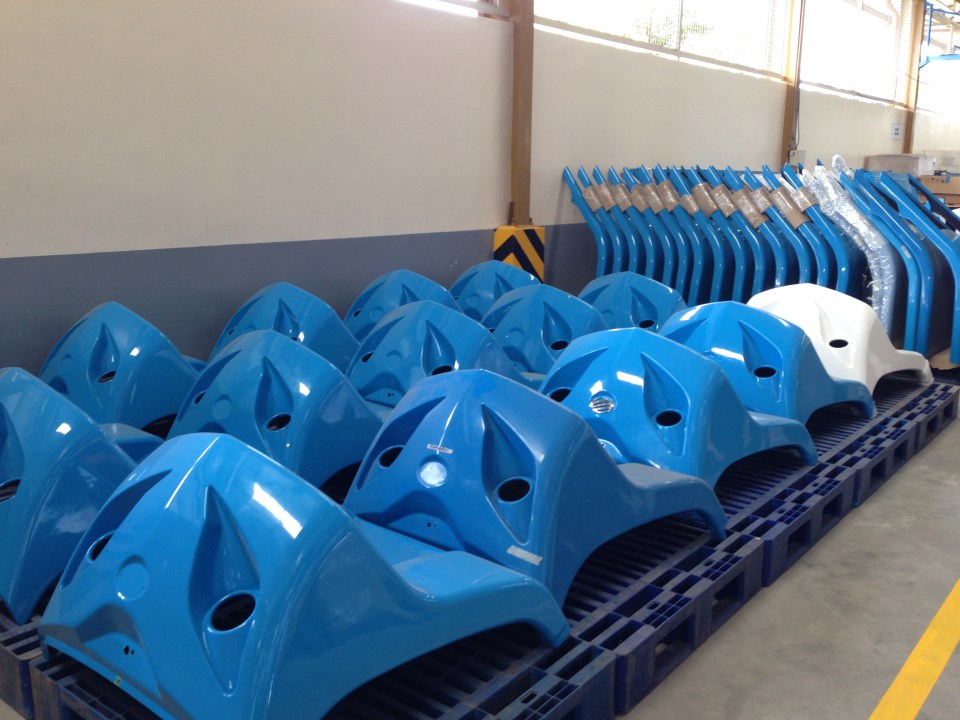 E-trike body parts
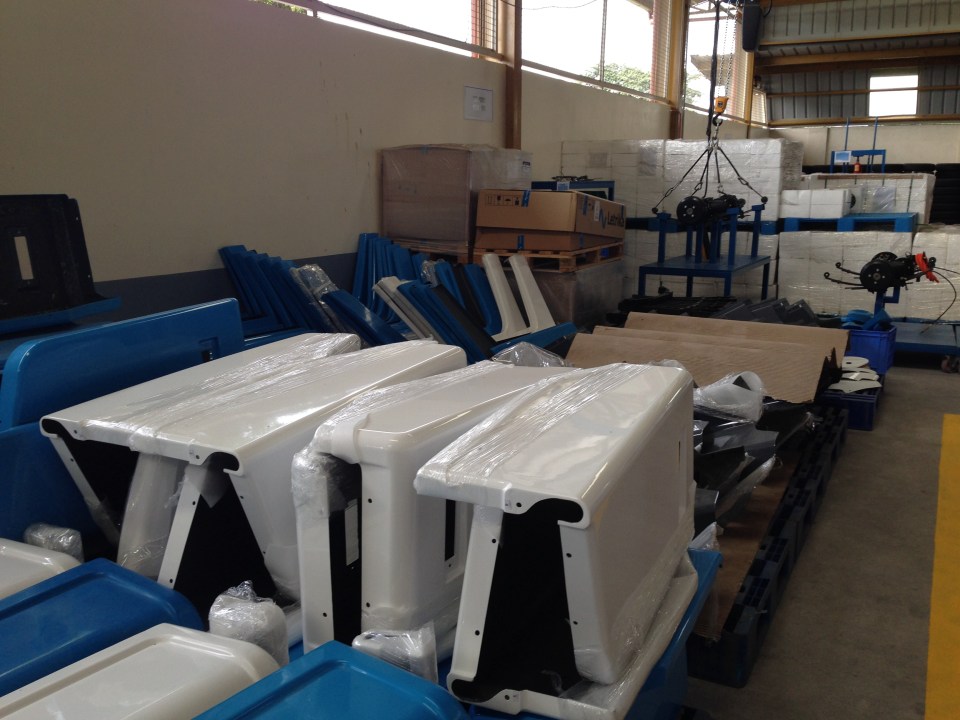 More parts
 Assembly area for the drives
 Axles stacked and waiting for assembly
 A closer look at the drive assembly
 Assembly line showing e-trikes in various stages of assembly
 Another look at the assembly line
 Assembly line showing the chassis of the e-trike and the body being assembled.
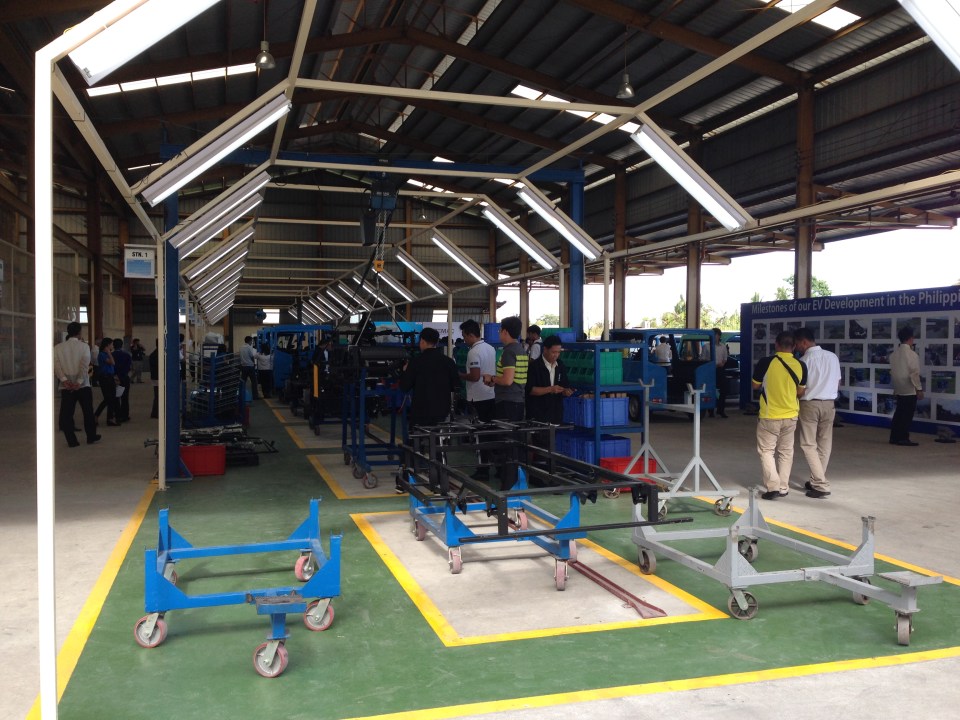 A view of the assembly line from the rear
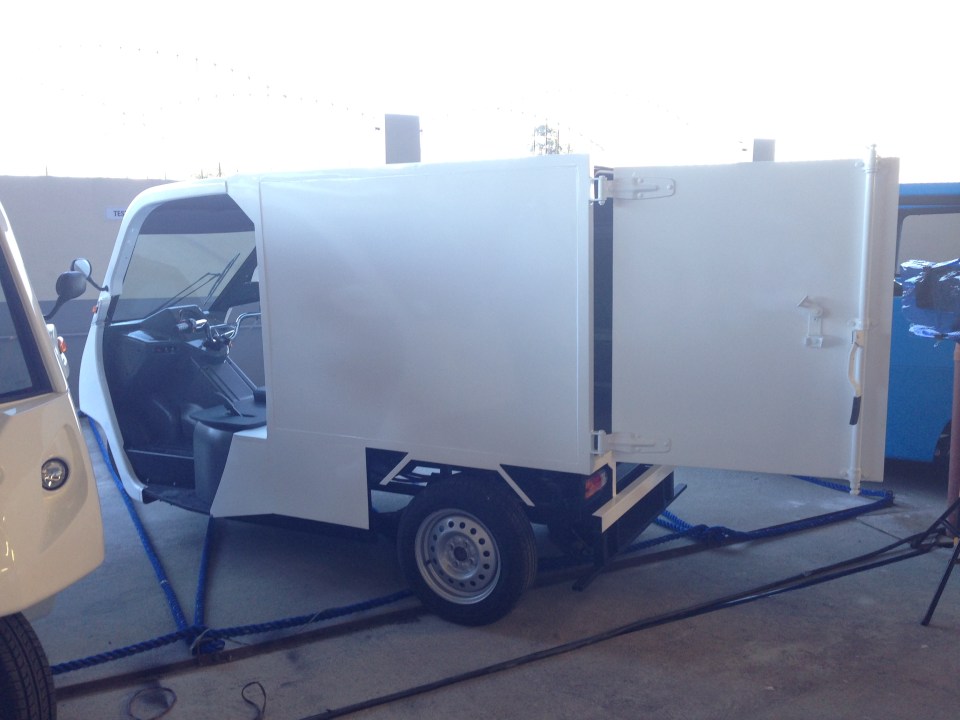 E-vehicle intended for goods transport
 A closer look at the initial stages of assembly showing the e-trike chassis and body frame
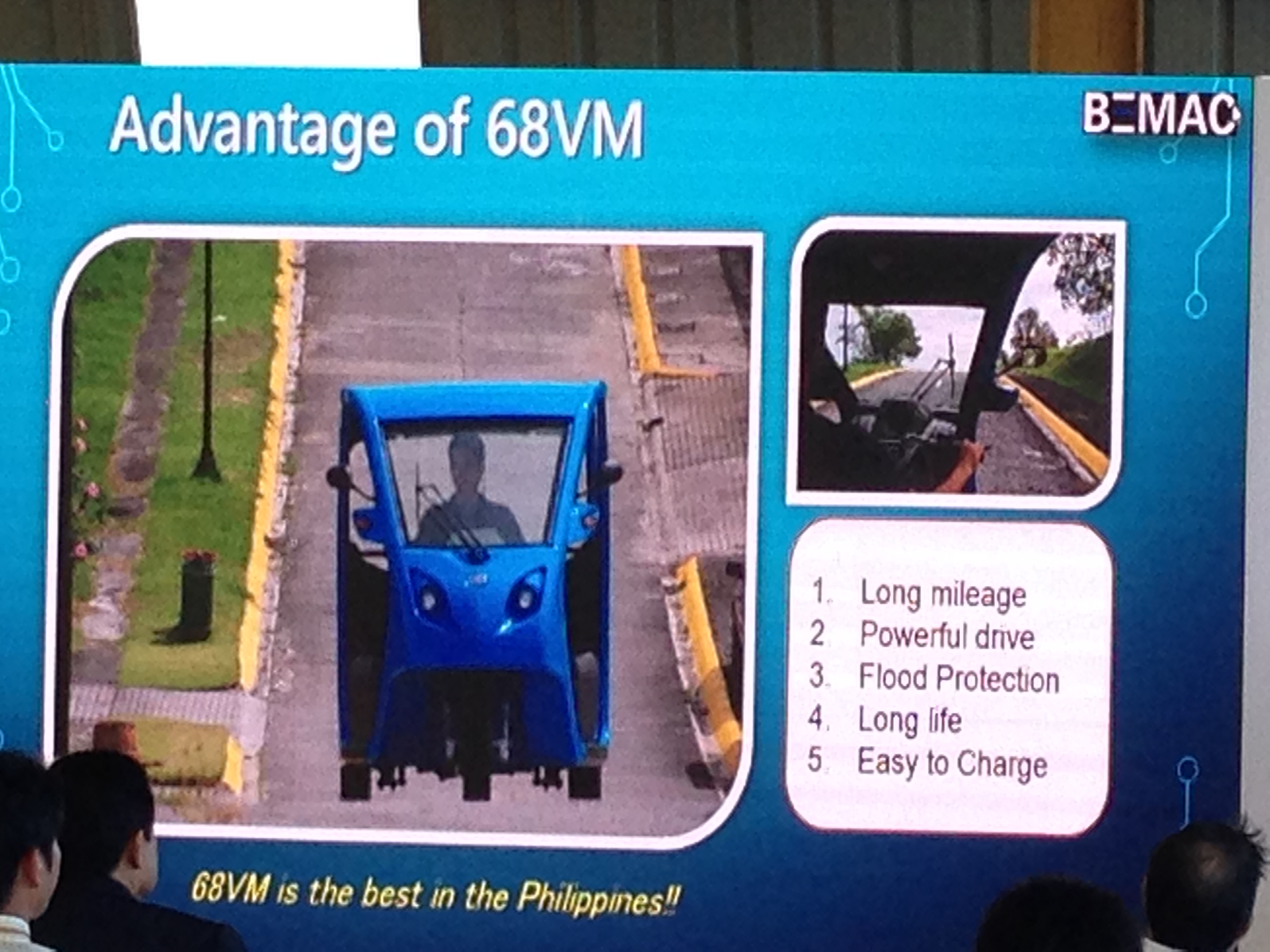 A slide in BEMAC’s presentation shows its 68VM
BEMAC’s e-trike model is the best we’ve seen so far among e-trike models in the Philippines. It is supposed to have been tested under various conditions except actual (or simulated) operations that are closer to real-world conditions (i.e., operation as conventional tricycles in the country). It is claimed to be capable of running at a top speed of 80 kph and its motor can power the vehicle up steep slopes, which is a typical feature in many municipalities and cities in the Philippines. Details for BEMAC Philippines may be found in their website.
There will be an Electric Vehicle Summit on February 26-27, 2015. The 4th Philippine EV Summit will again be held at the Meralco Multi-Purpose Hall in Ortigas, Pasig City. The two-day summit organised by the Electric Vehicle Association of the Philippines (EVAP) in partnership with Meralco and the Partnership for Clean Air (PCA) will feature an exhibit on the current electric vehicle models available in the Philippines, which I think is among if not the main highlight of the summit. There will also be several talks and panel discussions on e-vehicles including those on technology/R&D, industry, incentives and green communities. The program also mentions a lot about sustainable mobility, a term prolifically used by advocacy groups but not really one I’d attribute to e-vehicle proponents (One colleague made the observation before that not everyone is really into e-vehicles because of its environmental aspects.). I’m not sure all the top officials they invited will show up or give good talks. Past summits had good potentials as venues for serious discussions that could have led to fruitful outcomes. However, it seems that they fell short of these objectives and ended up with boring talks that to me often were reduced to lip service from government agencies especially on topics like incentives that will pave the way for the turning point for e-vehicles.
Hopefully, this year’s talks would be more interesting and engaging considering the plenary set-up where people farther from the front tend to have meetings and discussions of their own. E-vehicles have a great potential in improving air quality in a country like the Philippines. There is also the promise of less noise and, more important to many especially operators and drivers, better revenues than translate to increased incomes to those dependent on it for their livelihood. We look forward especially to the transformation of the tricycle sector from the current conventional trikes to the more modern and environment-friendly models such as those by BEMAC.
–
The old railway station at Hinulugang Taktak
The Antipolo City Government recently re-opened the Hinulugang Taktak park to the general public. The National Park and its famous waterfalls have seen better days and is part of Antipolo lore, immortalized in songs and stories about the pilgrimage city. It has been rehabilitated with various initiatives the past few years and with the water again flowing strongly compared to the trickles of dirty water over a decade ago.
Somewhat lost in the promotion of Hinulugang Taktak is a piece of transport history. I am referring to the old railway station located near the gate to the national park. The most convenient and probably most comfortable way to Antipolo and its two main attractions, the Shrine of Our Lady of Peace and Good Voyage and Hinulugang Taktak, many decades ago was by railway. Roads and road transport was not as good as today’s. There were no highways like Ortigas or Sumulong. There were no aircon buses, no jeepneys (yet) and cars and motorcycles were not affordable to most people.
 Old sign? There is no formal historical marker for the former railway station at Hinulugang Taktak. I think the National Historical Commission of the Philippines should recognize this as a local if not national heritage site.
 Trees notwithstanding, this is the view from what used to be the platform of the railway station.
 An old drinking fountain that’s probably survived the passing of time and witnessed a lot about the old railway station and Hinulugang Taktak.
 What’s left of the former railway station structure are the platform and columns.
 Taktak Road was the old Daang Bakal or railroad. Much have changed since the glory days of rail with a line that connected Antipolo with Manila.
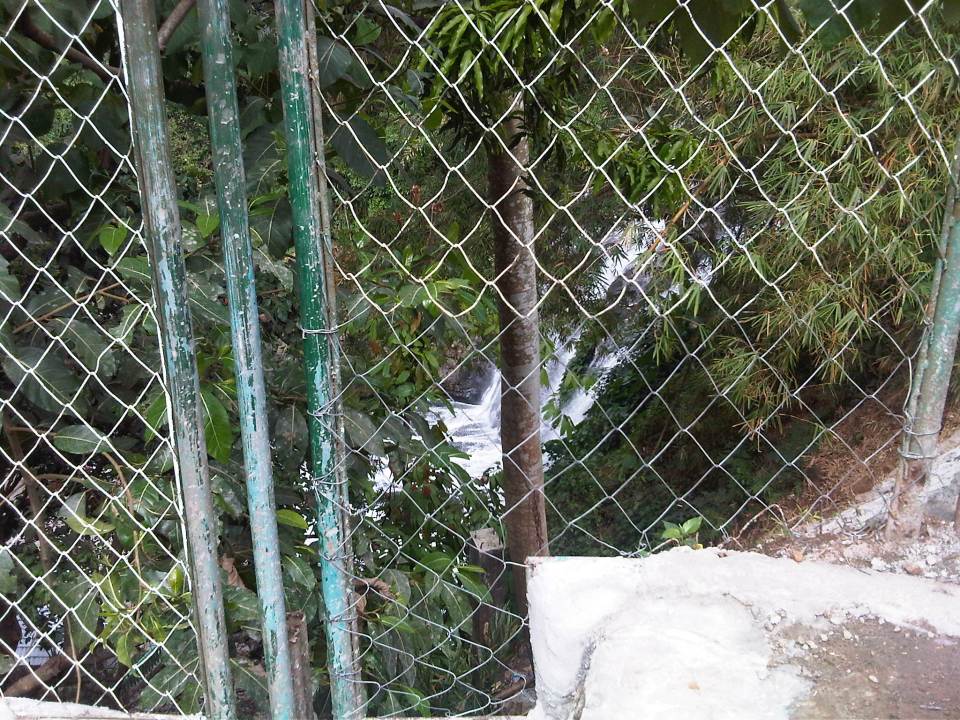 The view from the old entrance to Hinulugang Taktak in what also looked like the old railway station’s ticket office gives people (passengers?) a glimpse of the waterfalls.
 The old entrance to Hinulugang Taktak.
Someone asked me before if I thought it was possible for old railway lines to be revived. I replied honestly that I thought it was possible but immensely difficult. For one, a lot has changed in the lands on and along which the old railways used to be. The old Daang Bakal, for one, now passes through private residential subdivisions and industries and is now comprised of busy roads. While nothing is impossible, to rehabilitate the old railways will be a great challenge in the financial and social sense. It would be nice to see realized but requires so much from so many people, agencies and local governments who need to commit to such a project. And it requires leadership and a talent for convincing people that it is the right thing to do and that it needs to be done.
–
 Caught (up) in traffic