
The newly opened 2nd Barkadahan Bridge
A new bridge had been under construction beside the older Barkadahan Bridge. Instead of expanding the existing bridge, the proponents decided to build another bridge likely so as to reduce disturbance of traffic along the already congested first bridge. This is the same strategy for the bridge across the Pasig River in Nagpayong/Napindan that will reduce the potential bottleneck for when C-6’s expansion is completed. Unfortunately, the bridges don’t seem to include provisions for exclusive bicycle lanes that are clearly incorporated along much of C-6.
 I took this photo as we were in queue at the approach to the intersection of Highway 2000 and the Manggagan Floodway’s East Bank Road. The new bridge can be seen here bearing eastbound traffic. The alignment at the intersection has not been addressed and so requires through traffic to basically swerve towards the entry to Highway 2000.
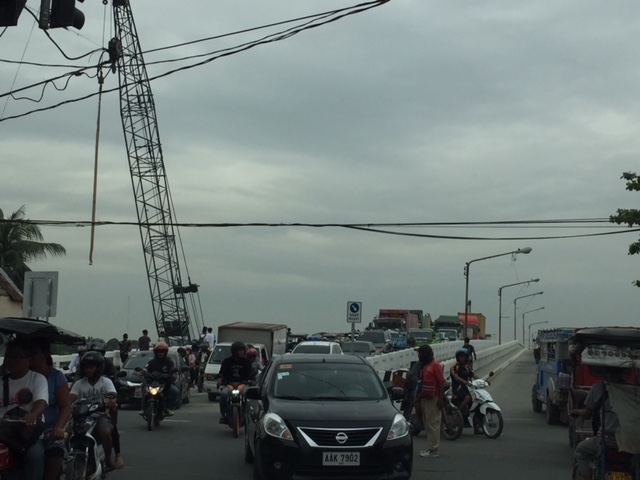 Here’s the intersection and the newly opened bridge. Note the vehicles coming towards my position as they follow a trajectory from the bridge to the narrow exit leg of Highway 2000.
 Instead of a single lane along each direction, the two bridges now allow for at least 2 lanes of traffic either way. I say at least because a case can be made for 3 lanes to be indicated (there are no lane markings yet). The issue here though is that there is significant truck traffic crossing the bridge and two trucks traveling beside each other easily occupies the entire bridge. Thus, maybe a wide two lanes can be designated for both bridges with an opportunistic third lane forming depending on the traffic.
–
On car following
We teach our students about car-following theory and applications in our transportation engineering courses at the undergraduate, graduate and post-graduate levels. This is an important part of traffic flow theory and essential in understanding and modelling traffic flow/ behaviour. Among its applications is in the development of simulation models such as those that are now commercially available like VISSIM and CUBE-DynaSim and the older but still very useful TRAF-NetSim. Car-following theory allows for a more accurate simulation of real-world traffic behaviour considering the many parameters describing traffic flow as well as the assumptions that need to be in place for various scenarios.
Here’s an interesting article that’s basically about car-following, specifically mentioning the proper (ideal?) spacing between vehicles and how such discipline can lead to less congestion along our roads.
Simon, M. (2017) Math says you’re driving wrong and it’s slowing us all down, Wired, https://www.wired.com/story/math-says-youre-driving-wrong-and-its-slowing-us-all-down/?CNDID=37243643&mbid=nl_121517_daily_list3_p4 (Last accessed: 12/17/2017).
–
The need for speed (limits)?
My social media newsfeed regularly contains updates being posted by various entities about transport and traffic in Metro Manila and across the Philippines. Among those I regularly see are posts on road safety and interesting to me are the frequent posts on legislating speed limits at the local level. These are in the form of city or municipal ordinances that are supposed to strengthen, supplement and/or clarify speed limits that are actually already stated in the road design guidelines of the Department of Public Works and Highways (DPWH). These limits apply not only to national roads but to local ones as well. However, their effectiveness may be limited or reduced by the absence or lack of signs, markings and, most importantly, traffic law enforcers who are supposed to monitor traffic and apprehend those violating rules and regulations.
While there is a need for defining and clarifying speed limits perhaps in the form of local legislation, I believe the more urgent matter is the implementation and enforcement of laws. It has often been mentioned that we already have so many laws, rules, regulations and the truth is we do, and may not need more. One really has to go back to the basics in terms of enforcing these laws and that means enforcers need the knowledge and tools to be effective in their work. There is an opinion that many enforcers are not knowledgeable about many rules and regulations and therefore are prone to just focus on a few including violations of the number coding scheme, truck bans and the much maligned “swerving”. You do not often seen apprehensions for beating the red light, beating the green light (yes, there is such a violation), speeding, or “counter-flowing” (or using the opposing lane to get ahead of traffic in the correct lanes). There are also turning violations as well as those involving vehicle (busted tail lights, busted headlights, busted signal lights, obscured license plates, etc.). More recently, there are anti-drunk-driving laws that also urgently need proper implementation.
I think the current work that includes sidewalk clearing operations and anti-illegal on street parking of the Metropolitan Manila Development Authority (MMDA) is one good example of going back to the basics. These address the necessity of clearing space for both pedestrians and vehicles; space that have been constrained by obstacles that should not be there in the first place but so often have gotten the blind eye treatment. Going to the “next level” though requires tools such as speed guns, high speed cameras at intersections, and instruments for measuring blood alcohol levels in the field (breath analyzers). And these require resources for acquisitions as well as capability building in the form of training personnel to handle equipment. No, I don’t think we need more laws, rules and regulations. What we urgently if not direly need is their proper implementation to effect behavior change that will improve both safety and the flow of traffic.
–
Railway Heritage: the Old Meycauayan Station of the Main Line North
I accompanied a visiting professor from Tokyo last November as he went around to conduct interviews with local government officials and representativea of private firms. The interviews were part of the study we are doing together relating to the JICA Dream Plan, which now seems to be part of the basis for many of the projects included in the current administration’s Build, Build, Build program.
After our appointment at Meycauayan City Hall (Bulacan), we proceeded to the old PNR station near MacArthur Highway at the old center of the town. Following are some photos I took around the station including those of the former station building.
 There’s a dirt road leading to the station building along the alignment of the railway tracks. The area is clear of any structures and this clearing began under the administration of Gloria Macapagal-Arroyo with then Vice President Noli De Castro in-charge of clearing the PNR ROW.

It’s quite obvious that the station building is in a very bad state. At some time there probably were informal settlers residing in the building. Such is common for many of the old, abandoned station buildings along both the PNR’s north and south lines and their branches.

The first level is of red brick while the second level, which looks like it was added much later than the red brick structure, is of wood with Capiz windows.
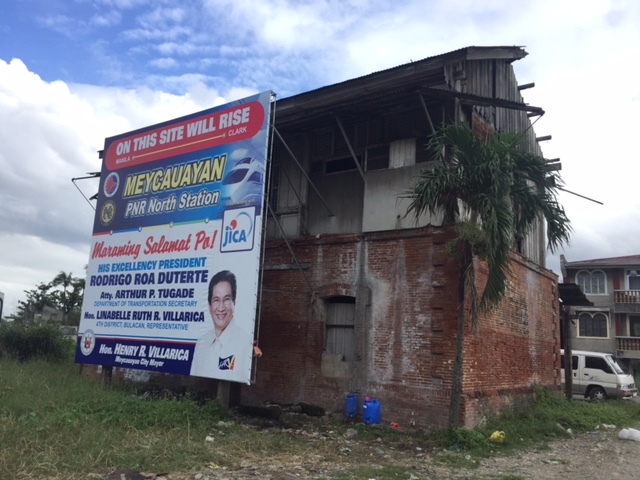
There is a sign informing the public about the JICA-supported project to rehabilitate the north line between Manila and Clark. The politician pictured in the tarp is the Mayor of Meycauayan City.

A closer look at the building shows some items here and there indicating people are still using it for shelter if not still residing there. I assume the guards use the building for shelter.

Another close look at the building’s red brick facade and the dilapidated 2nd floor and roof.
We learned from Meycauayan that there are plans for the station to become a museum. I agree with such plans as a modern station can be constructed for the revitalised line, and the building can be transformed into a museum not just for railways but for Meycauayan as well, which has a major part in Philippine history especially during the revolution for independence from Spain in the later 1800s. We look forward to the rehabilitation of the railway system to the north of Metro Manila and connecting not just to Clark but perhaps extending again all the way to Dagupan in Pangasinan if not until San Fernando, La Union when it was at the height of operations.
–
On inflight meals
I remember having full meals during domestic flights I took with my family back in the 1970s and 1980s. Morning flights provided for a good enough breakfast, noon had a good enough lunch, and evenings had good enough dinners. I say “good enough” because there seems to be a general aversion to airline food among passengers. To be fair, the meals served on Philippine Airlines (PAL) domestic flights in the 1970s and 1980s were okay. They were not gourmet or what you’d expect at good restaurants but the meals are not garbage or awful as some people would state. I think many people expected too much from airline food. Perhaps they want the food served on First Class or Business Class to be the same served on Economy?
I enjoyed my meals on Economy Class on Singapore Airlines, Japan Airlines and Thai Airways. And recently, I also enjoyed the meals served on my Qantas flights between Manila, Sydney and Melbourne. Here are some photos from those flights:
 Healthy snack on my Melbourne to Sydney flight with Qantas
 Beef and steamed vegetables on my flight back to Manila
 Ice cream bar for dessert
 Afternoon snack – the noodles were good
–
Ho Chi Minh City’s (Saigon’s) Tan Son Nhat International Airport departure
This is a late post about Ho Chi Minh City’s international airport – the Tan Son That International Airport. I meant to post it weeks ago but then other more interesting topics came by including those about articles that I could quickly share. So here it goes and with some photos I took at the terminal:
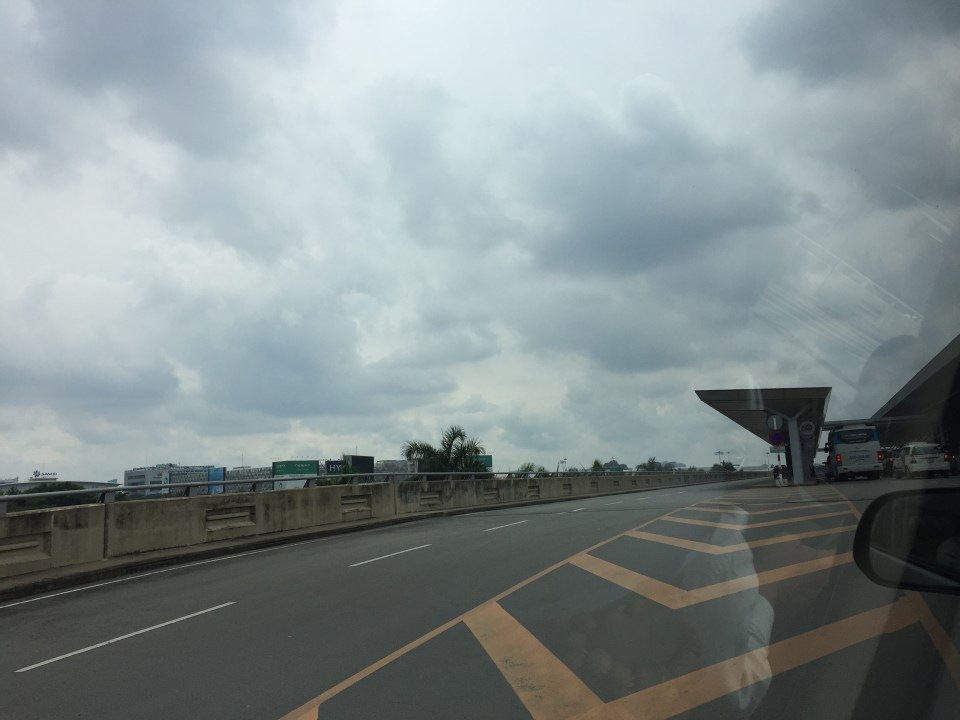 Airport terminal driveway
 The driveway at the departure level actually reminded me of NAIA Terminal 3’s own driveway. The resemblance is uncanny.
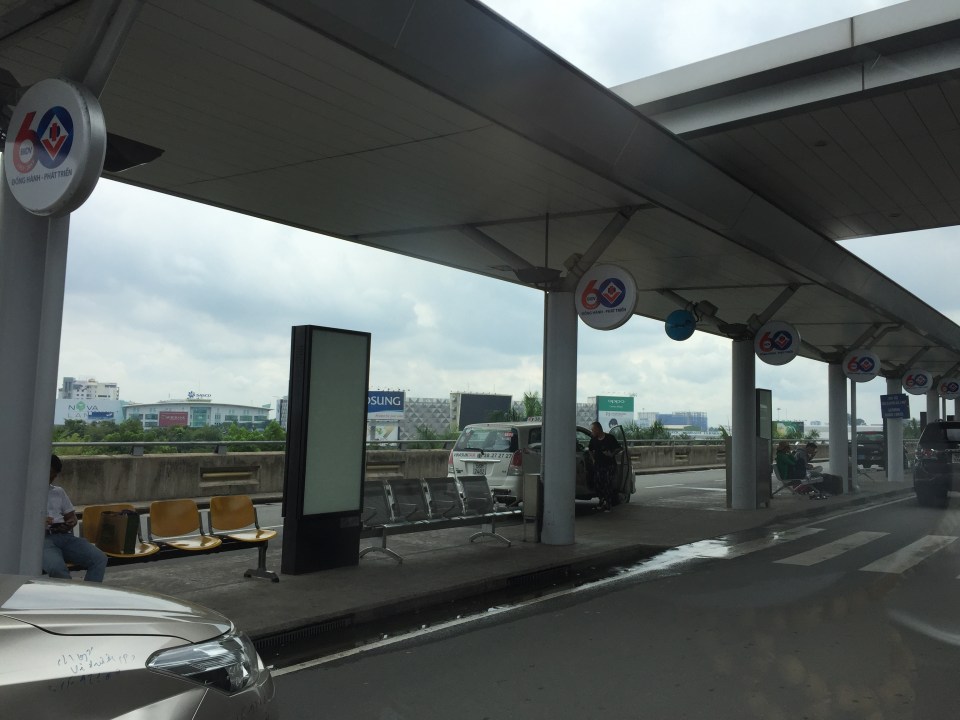 Taxi stand at the departure level driveway?
 Unloading luggage from the taxi
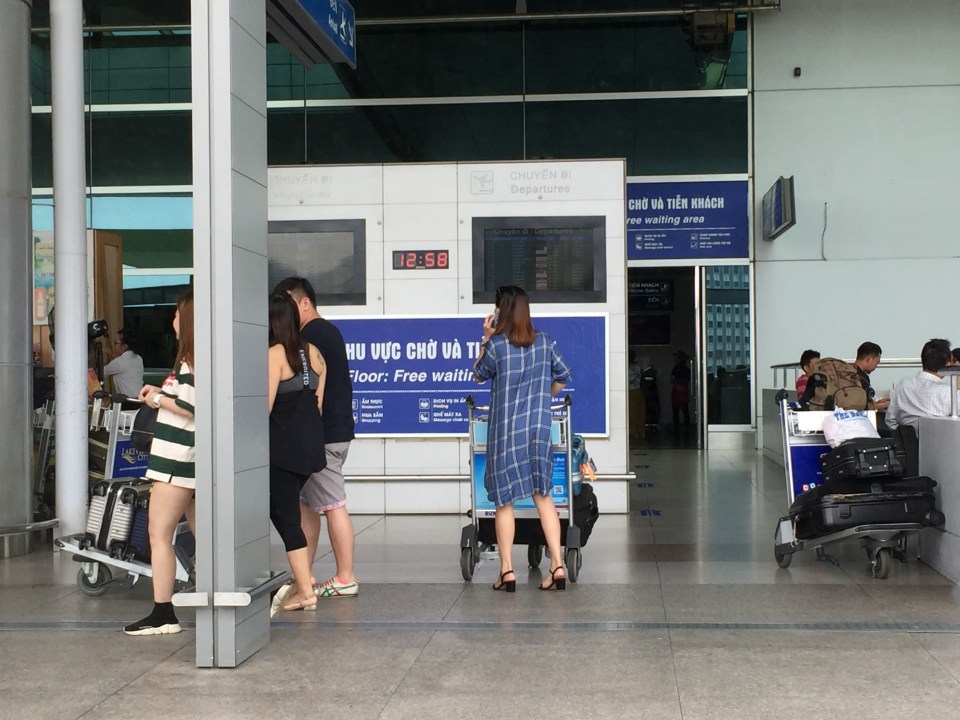 Passengers may get carts to help them carry their luggage
 Spacious check-in lobby
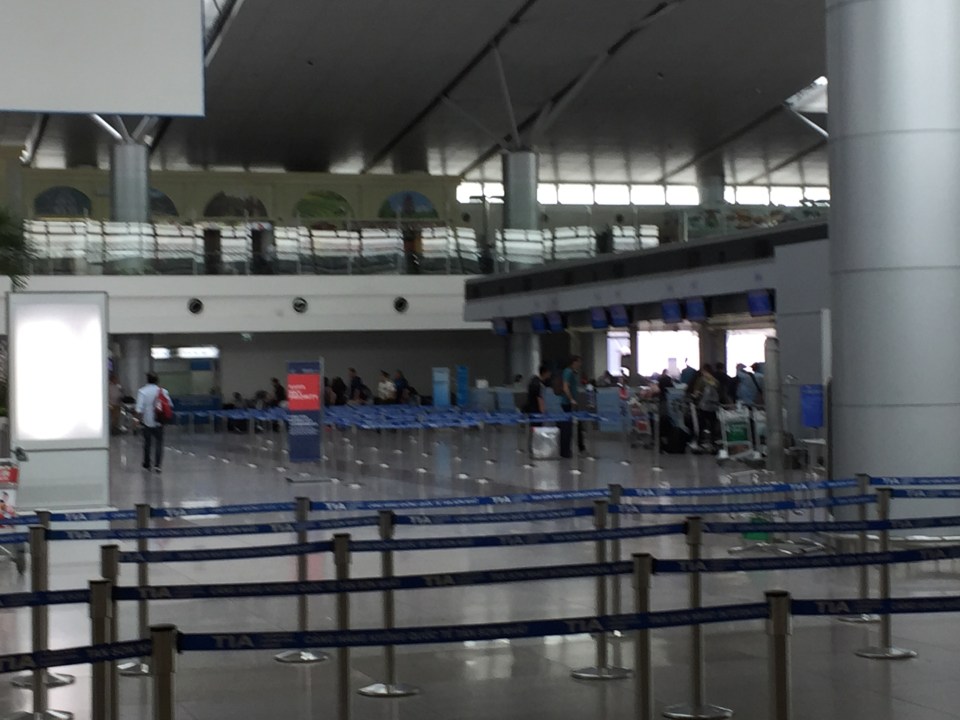 The layout of the lobby also reminded me of the NAIA Terminal 3
 Duty free shops inside the airport terminal
 Many terminal spaces have yet to be occupied
 More shops inside the terminal
 This large shop sells local items and I discovered that it is cheaper to get your coffee, chocolates and other souvenirs.
 Vietnam manufactures many name brand items including leather goods, shoes, bags and clothes. You can get these legitimate ‘Made in Vietnam’ goods at the airport a bit lower prices because they are sold duty free. Of course, they will not be as cheap compared to the high quality knock-offs you can buy downtown.

The corridor to the pre-departure areas is lined up with seats and, of course, more shops
 The pre-departure areas also have shops for the last minute shopper. I still had a few hundred thousand dongs on me so I ended up buying more coffee.
 Korean Air plane being towed to the terminal
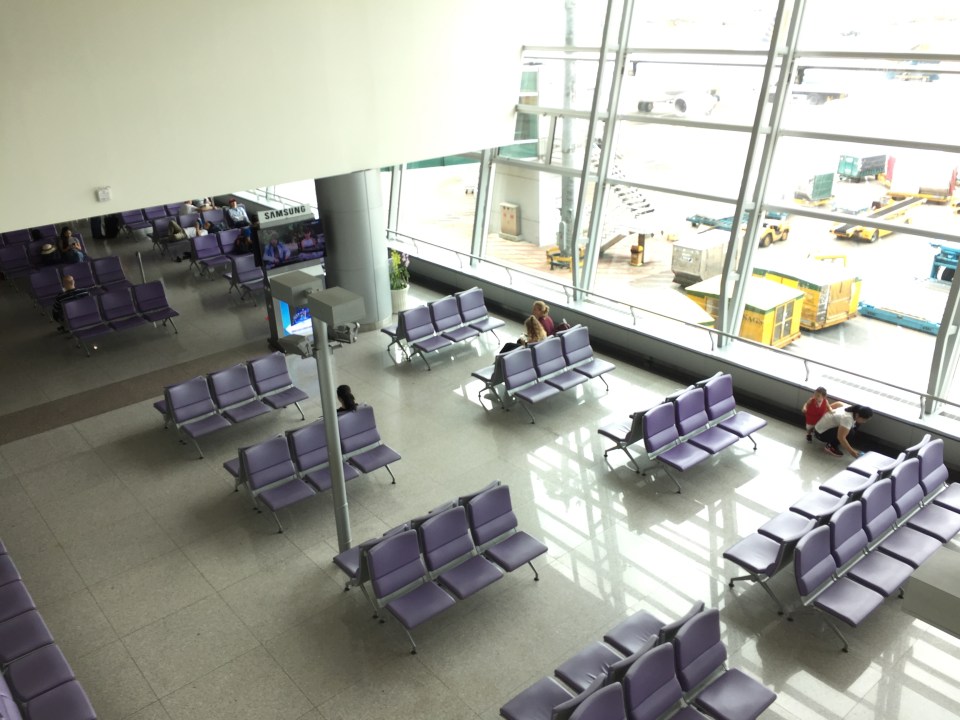 Passengers waiting for their boarding call may just opt to take a seat as others circulate among shops and cafes
 Tiger Air plane berthed at the terminal
 Spacious pre-departure area for our gate
 The bridge to our plane back to Manila
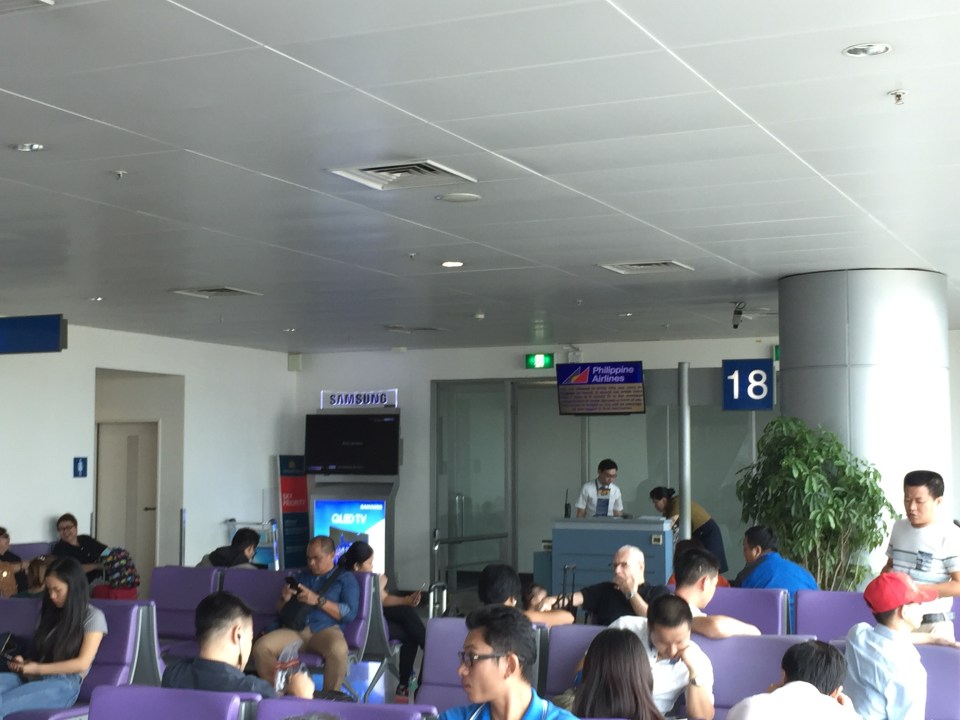 Our boarding gate
Overall, I think the airport terminal was well-maintained and the procedures were quite efficient. It was not crowded despite the many flights handled by the airport.
–
A new transport planning process?
December’s already “Chrismassy” in our part of the world and so in keeping with the spirit of Christmas, here is another article I am sharing:
Polzin, S. (2017) “All I Want for Christmas is a New Transport Planning Process,” Planetizen.com, https://www.planetizen.com/node/96036?utm_source=newswire&utm_medium=email&utm_campaign=news-12042017&mc_cid=e64f0c0c60&mc_eid=9ccfe464b1 (Last accessed: 12/6/2017)
In school, we’ve been taught and are still teaching many of the old concepts of transportation planning. I believe these are still important and relevant especially since the fundamentals, or the basics if I may say, are still needed in many situations around the country (i.e., the Philippines). The article above is relevant to our case because it helps build awareness of what is now being discussed and what the future will bring to us. That future for transport is not necessarily immediate although there are already pressures coming from various sectors and technology has been key to the disruptions and the leapfrogging we are experiencing. I like what a friend opines overtime he gets the chance. That is, that the technology-push is not the solution to a lot of our problems because we cannot ignore the basic deficiencies in our transportation system that technology alone cannot overcome.
–
Recommended reading: “A New Traffic Safety Paradigm”
I begin December by sharing another paper from the highly respected Todd Litman:
Litman, T. (2017) “A New Traffic Safety Paradigm,” Victoria Transport Policy Institute, http://www.vtpi.org/ntsp.pdf (Last accessed: 12/2/2017).
I believe that this should be recommended reading for those doing work traffic safety.
–
New guidelines for bikeways
I want to share an article discussing new guidelines for bikeways released in the US.
Andersen, M. (2017) “Which Bike Lanes Should Be Protected? New Guide Offers Specifics,” Streets Blog USA, https://usa.streetsblog.org/2017/11/01/which-bike-lanes-should-be-protected-new-guide-offers-specifics/ (Last accessed 11/16/2017)
This is useful not only for practitioners or planners but also for academic purposes such as in transportation planning or engineering courses where future planners and engineers are molded.
–
On “phone zombies” and road safety
You see a lot of people these days who are always on their smart phones. Many are walking while doing something with their phones whether making a call, typing away, listening to music or perhaps attending to social media. Many are not aware of what are happening around them and this puts them in a situation where that increases their vulnerability. There are those who cross streets without checking for oncoming traffic. There are those walking along the roadside who are not mindful of the likelihood of being sideswiped by vehicles. As such, there is a need to address this behavioral concern to reduce the occurrence of incidents that could lead to deaths if not injuries.
There is a nice article I read recently about an initiative in the Netherlands where they installed pavement traffic lights:
Scott, G.L. (2017) “Dutch City Installs Pavement Traffic Lights to Help ‘Phone Zombies’,” Inverse, https://www.inverse.com/article/38472-dutch-city-installs-pavement-traffic-lights-to-help-phone-zombies?utm_source=newsletter&utm_medium=culture&utm_campaign=photo, (Last accessed 11/19/2017).
The assessment for this initiative is quite limited – one day as mentioned in the article – but is promising especially from the perspective of innovation. We need such innovative thinking in order to address the issues about safety. This is but one example of many aimed at curbing road crashes that lead to injuries and deaths particularly with respect to the most vulnerable among us.
–
 Caught (up) in traffic