
Home » EST (Page 21)
Category Archives: EST
On the need for more facilities for cycling and ensuring they will be used for cycling
I read and hear a lot of comments about two particular items: pedestrian overpasses and bike lanes. Most of the comments call for pedestrians and cyclists to have priority over cars and for the latter to give way to pedestrians and cyclists every time. The hardline stance for some is for the pedestrians to be allowed to cross anywhere and for cyclists to be able to bike on any lane they choose to. Of course, the concerns about these are quite obvious and safety still calls for people, no matter what mode they choose, to use the appropriate spaces. What few actually discuss and delve into are design solutions to these problems. Many cite good practices elsewhere but stop at sharing these and not really going into in-depth and constructive discussions on how to implement these good designs here. Most of the time its just “the government must do this” and “the government must do like what (insert city or country) is doing”. Worse are those who tend to simplify it as an “architect vs. civil engineer vs. planner” kind of conflict. Playing the blame game doesn’t get us anywhere if we wanted the planning and design of transportation infrastructure improved.
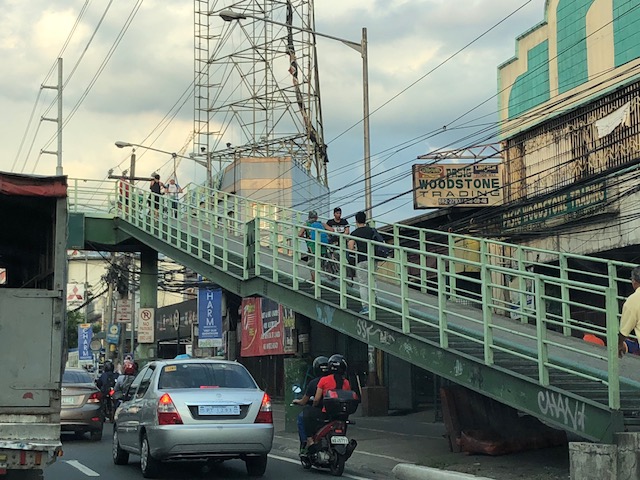 Cyclists use the overpasses to cross the wide Marcos Highway between Pasig and Marikina. There are only 2 ramps, one each on either side of the highway and it partly occupies the sidewalk beneath. Could there be a better design for such overpasses?
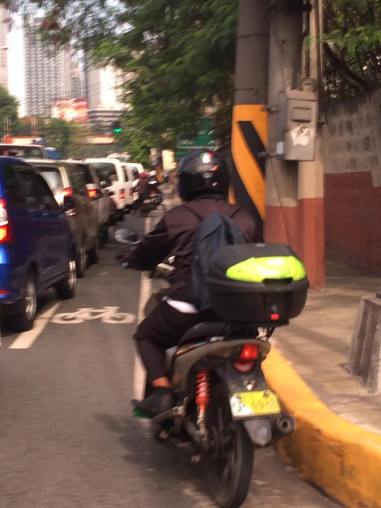 Motorcycles using the bike lanes along Ortigas Avenue. How do we make sure that spaces are utilised according to their intended users? How do we design these spaces to include elements that will deter such incursions?
There are many references out there showing us what good design should be from the technical and social perspectives. Surely these can be taken up not only at the workplace for architects, engineers and planners but in schools where such principles are supposed to be learned and inculcated into the minds of future architects, engineers and planners.
–
About the weather and other thoughts this weekend
We interrupt our regular posts with an article on the current state of the weather and some thoughts while a super typhoon (Mangkut) was devastating the northern and central Philippines. First the article from Wired:
Rogers, A. (2018) An Equator Full of Hurricanes Shows a Preview of End Times, http://www.wired.com, https://www.wired.com/story/an-equator-full-of-hurricanes-shows-a-preview-of-end-times/?CNDID=37243643&mbid=nl_091418_daily_list1_p4 [Last accessed: 9/15/2018]
I am not into doomsday articles and thinking but am always fascinated by it if has foundations in science and fact rather than of religion or the “prepper” type of thinking. This one is based on fact and should not be dismissed as “fake new” – an excuse many use if the information presented to them offers an inconvenient truth about our state of affairs or, in this case, state of the earth.
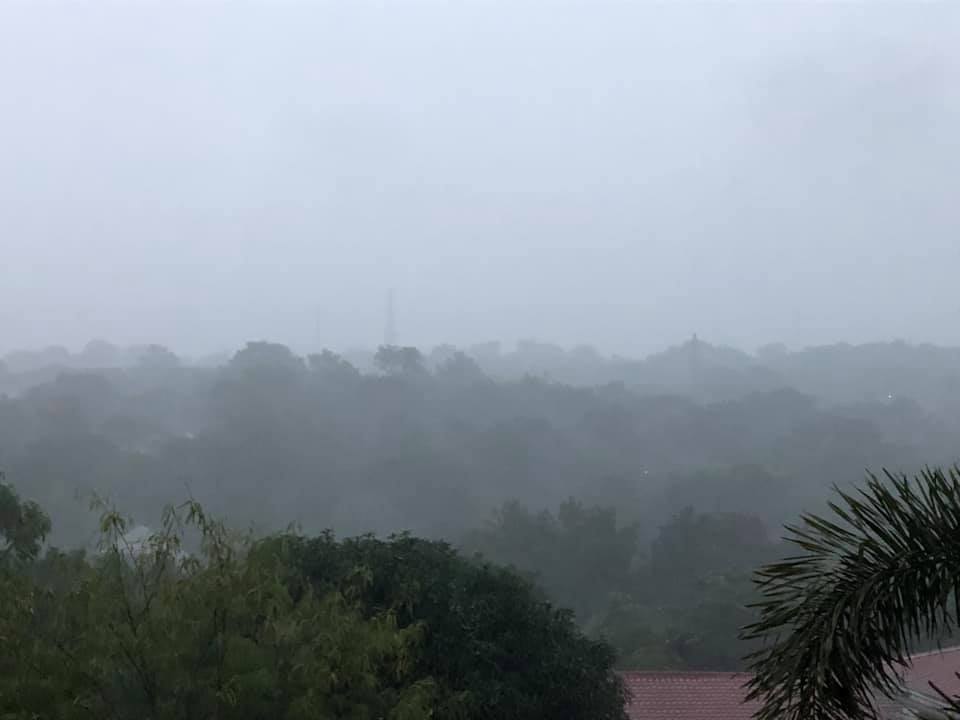 Gloomy weather brought about by Typhoon Mangkut
I was thinking about the bad weather and what previous strong typhoons have brought about early this morning as I was awaken by the sound of the strong winds and the heavy rains that followed. I easily come awake and cannot sleep whenever we have inclement weather. Its been like this since my childhood as our home was in a flood prone area.
The last times there were typhoons comparable in perceived and actual physical impacts, the socio-political impacts also eventually manifested. Typhoon Ketsana (Ondoy) in 2009 dumped record rainfall across a wide area that included Metro Manila, Central Luzon (Region 3) and Southern Luzon (Region 4A). The government’s response then and the issues that came about afterwards essentially contributed much to the doom for many of the administration’s candidates in the 2010 elections including its standard bearer who was Defense Secretary at the time. The follies of many politicians and government agencies were also exposed and most people judged them for that in the elections.
Come 2013, another typhoon, Haiyan (Yolanda), laid waste to much of the central Philippines. It was a super typhoon that again caught most, especially government, unprepared for the devastation that was its outcome. It spelled disaster, too, to many political aspirations with the then Interior Secretary becoming the poster boy somewhat for the government’s failures. Apparently, many of the lessons of Ondoy were not heeded despite gains here and there in weather forecasting and disaster preparedness. But then these were perceived to be more on the side of politicians. There were no lack in politicking, self promotion and grandstanding. And there was even more drama among rival sides in Philippine politics. There was enough material for fodder come 2016.
The current administration is much aware of the issues and the dangers of playing into the same script. After all, they created much of the political storm that led to an almost complete defeat of the previous admin’s ticket (the current VP survived that and hopefully gets to finish her term instead of being replaced by the ambitious son of a former dictator). But the present set of leaders and wannabees are not lacking for distasteful maneuvers as relief goods are being prepared by government agencies and local government units bearing the name (and sometimes even face) of aspirants for electoral posts in the 2019 elections. Among these are a Presidential “alalay” who is somewhat desperate for a senate post if only to protect himself from charges once his sponsor(s) bow down from power.
Will Mangkut/Ompong effect positive change in the country? Perhaps so and we can only hope it will be for the better. And that we, as a people, learn from mistakes we have made including electing certain people who are not fit or qualified to lead us.
–
On the need to increase NMT and public transport use
A recent report reinforces what many of us already probably know or are aware of – that we need to shift away from dependence on car use to more sustainable modes of transport in the form of non-motorised transport (NMT) and public transportation. Here is the article from the AASHTO Journal:
Global Climate Report Calls For Expansion Of ‘Non-Motorized’ Transport And Public Transit (2018)
There is a link to the report in the journal article. The report is conveniently available in PDF form and is very readable (i.e., not overly technical).
Incidentally, I was involved some time ago in a project led by the group Clean Air Asia (CAA), which involved several experts from across ASEAN as well as Japan that attempted to determine the necessary transport programs and projects in the region to stave off the projected increase in global temperatures. In all the scenarios evaluated, non-motorised transport (NMT) and a rationalised public transportation system By the term ‘rationalised’ I am referring to the use of higher capacity vehicles as against the taxis and tricycles that typically carry few if not one passenger. Here is a link to the final symposium for that study that has links to the materials presented:
The Final Symposium on the “Study on Long Term Transport Action Plan for ASEAN”
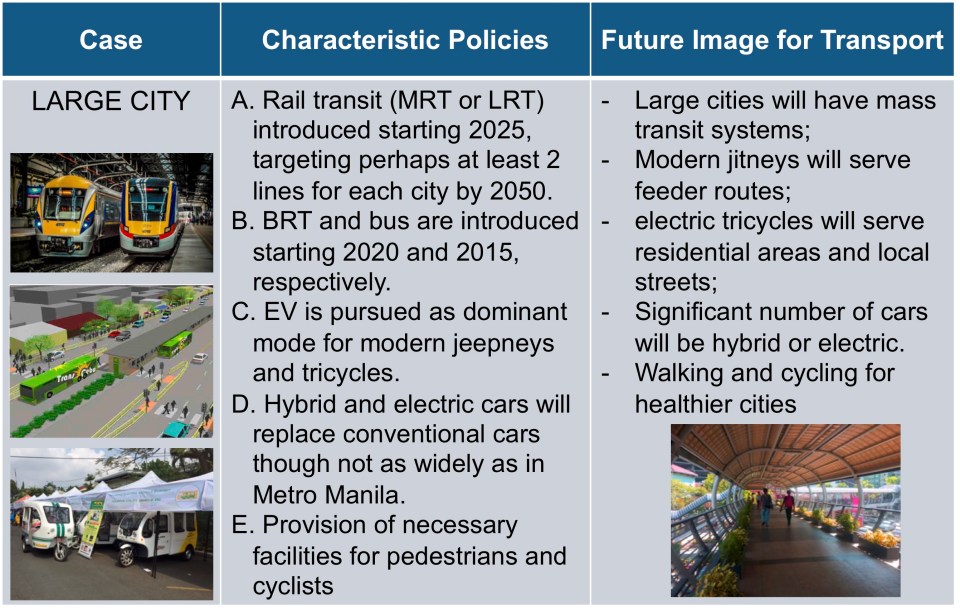
Here’s a slightly updated slide on the future image for a large city in the Philippines:
–
Article on housing and transportation
Here’s another excellent piece from Todd Litman about the dynamics of housing and transportation. This is a very relevant topic in many cities today and especially so for those like Metro Manila, which is struggling with issues pertaining to affordable housing and transportation infrastructure and services. Arguably, a lot of households are spending more than the 45% threshold of incomes mentioned in the article but people continue to get homes away from the city as these are relatively cheaper than those closer to their workplaces and schools. Unfortunately, transportation costs are on the rise and congestion and a lack of an efficient transport system are among the culprits for what many have already labelled as undignified and atrocious costs of commuting.
Litman, T. (2018) “Affordability Trade-Offs,” planetizen.com, https://www.planetizen.com/node/99920?utm_source=newswire&utm_medium=email&utm_campaign=news-08092018&mc_cid=e2a69b6eb4&mc_eid=9ccfe464b1 [Last accessed: 8/9/2018]
I envy the guy for being able to present these topics clearly. It is a complex subject and one that isn’t understood by many in government who are supposed to be responsible for crafting and implementing policies and programs to address issues pertaining to affordable housing and commutes. I wonder if Todd is coming over for the ADB Transport Forum. He’s make for a good resource person in some of the sessions there and perhaps can also be invited to speak about this and other relevant and urgent topics in a separate forum. Anyone out there care to sponsor him?
–
On EDSA transport and traffic, again
There’s a recent decision by the Metro Manila Council (MMC) comprised of the mayors of the cities and municipality of Metro Manila and chaired by the Metro Manila Development Authority (MMDA) Chair that vehicles bearing only one passenger (the driver) will be banned from travelling along EDSA. The problem with this is that by banning cars with one passenger from EDSA, you only succeed in making other roads like C5 more congested. It’s a simple case of transferring traffic and worsening it elsewhere since you’re not doing anything to alleviate congestion along those roads. Did MMDA run this and other scenarios using analytical or simulation tools at their disposal? If so, can these be shown and used to explain the soundness of this policy approved by the MMC? I suspect they didn’t and likely depended more on gut feel based on the data they have including what is often reported as 70% of vehicles traveling along EDSA having only one passenger. Meanwhile, the state of mass transit along EDSA still sucks.
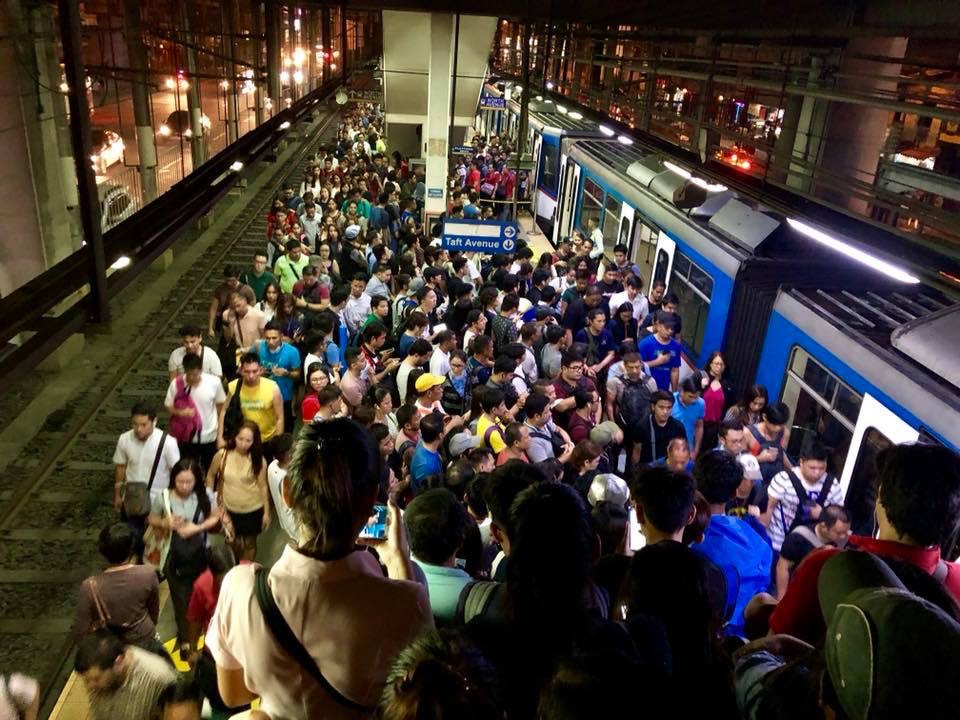 A very crowded Boni Avenue Station platform (photo courtesy of Mr. Raul Vibal)
Of course, the pronouncement from the MMDA launched quite a lot of memes on social media. Some people shared the typical quotes on planning (you know, like the ones about planning for people vs. planning for cars). Some offered their own ideas about how to “solve” traffic along EDSA. And so on…that only succeeded in showing how everyone had an opinion about transport and traffic. Everyone is an expert, so it seems.
Some thoughts and not in any order:
- The government can initially dedicate a lane each for express buses (a la Bus Rapid Transit or BRT). This idea has been circulating for quite some time now and has a good chance of succeeding. The DOTr is already deploying buses that they say are supplementing the MRT 3 trains (i.e., there aren’t enough trains running so passengers have the option of taking a bus instead). Running along the inner lanes of EDSA would mean, however, that they would have to find a way for passengers to cross the road and one idea would be for the stations to be retrofitted for this purpose.
- Those cars along EDSA are not necessarily for short trips so walking and cycling while needing space may have less impact in the immediate term for such a corridor. In the meantime, serious consideration should be made for bike lanes whether on the ground or elevated and improvements to walking spaces.
- But these efforts to improve passenger (and freight) flows should be a network-wide thing and not just along EDSA.
- It’s time to have serious discussions and perhaps simulations (even a dry run) of congestion pricing in Metro Manila. Congestion pricing for all major roads and not just one or two. Funds collected goes to mass transit, walkways and bikeways development. DOTr was supposed to have already discussed an Electronic Road Pricing (ERP) system like Singapore’s with the company and people behind the same in the city-state. That doesn’t seem to be moving along.
- Working and studying from home might work in terms of reducing vehicular traffic but then we generally have lousy internet services so that’s a barrier that needs to be broken down.
- How about legalizing, once and for all, motorcycle taxis? Many are opposed to this citing safety concerns but then we are running out of options outside the usual motherhood statements pertaining to building transport infrastructure. Think about it. Give it a chance. These motorcycles might just surprise us in a nice way; that is, helping alleviate congestion.
- Carpooling and lanes dedicated to High Occupancy Vehicles (HOV) would be good but the LTFRB made a pronouncement about these being illegal as they would be considered ‘colorum’. Such statements do not make the situation any easier and sends mixed signals as to the government’s being serious in considering all possible angles to improve transport and traffic particularly for commuting.
Do you have other ideas to share?
–
On healthier cities and encouraging walking
It’s a Sunday and the sun is up after days of rain so it would be a good time to be outdoors. Here is a nice article for the fitness buffs out there. Many of us have sedentary lifestyles and this has come as no surprise with the how we work and study as well as the influence of tech in our everyday activities. Even as I write this, I am sitting in front of my desk and have only my fingers and hands working. The rest of me is inactive except perhaps my senses and my brain. 🙂
Merle, A. (2018) “The Healthiest People in the World Don’t Go to the Gym,” medium.com, https://medium.com/s/story/the-healthiest-people-in-the-world-dont-go-to-the-gym-d3eb6bb1e7d0 [Last accessed: 8/1/2018].
I miss the times when I was living in Japan and when we were living in Singapore mainly because I was able to have a more active lifestyle in the cities where I lived. I walked and biked a lot when I was in Yokohama, Tokyo and Saitama, and later walked a lot around Singapore. I/we didn’t need a car as the public transportation was excellent and so were the pedestrian infrastructure. I recall walking between our laboratory at Yokohama National University and the dormitory, and later the Sotetsu Line Kami-Hoshikawa Station almost everyday. And then climbing up and down the hills of Yamate on Sundays. I can walk around Tokyo on my own and finding my way through shopping streets especially in Akihabara and Ueno. Of course, my favourite places would always include Kamakura, which can be reached via a train ride from Yokohama Station. The wife and I loved walking around Singapore and exploring places on foot. Indeed, you can be healthy and have a workout everyday without being too conscious about it!
–
Increasing the number of TNVS units? Not so fast!
The Land Transportation Franchising and Regulatory Board (LTFRB) is planning to increase the number of TNVS units (i.e., rideshare vehicles) in Metro Manila to meet what is perceived as the demand for them based on the numbers provided by TNCs like Grab. The problem with this number they want to eventually achieve, 65,000 units supposedly, is that this is based on current transport conditions in the metropolis. Also, this is based on data that is biased for the interests of TNCs, which obviously want to increase their driver and vehicle base in order to maximise profits. Here is a nice article that should provide some context from abroad where rideshare vehicles are actually generating more car traffic and taking people away from public transport.
Fried, B. (2018) “Uber and Lyft Are Overwhelming Urban Streets, and Cities Need to Act Fast,” Streetsblog, https://nyc.streetsblog.org/2018/07/25/uber-and-lyft-are-overwhelming-urban-streets-and-cities-need-to-act-fast/ [Last accessed: 7/26/2018]
Currently under construction are the Line 7 and Line 2 Extension projects and soon there will also be the Line 1 Extension. Also, in the pipeline are the proposed subway and rehabilitation of PNR that is supposed to revitalise its commuter line. These are examples of projects that will likely be game changers in terms of commuting with the objective of drawing people away from car use. In the bigger scheme of things, perhaps there is a need to rethink numbers for TNVS and instead focus on improving taxi services in Metro Manila. The same can be said for other cities as well where there is already a need for better public transport services to avert a transport future similar to what Metro Manila is already experiencing now.
–
On the matter of parking
Here’s another nice read that I’m sure is worth the while particularly if you are interested in parking
Litman, T. (2018) Parking Planning Paradigm Shift, planetizen.com, https://www.planetizen.com/blogs/99462-parking-planning-paradigm-shift [Accessed: 7/7/2018].
An acquaintance recently forwarded to me a position paper of sorts calling for the removal of parking minimums in the Philippines. The document constantly dropped the name of UC Irvine Professor Donald Shoup and others in order to justify his proposal. This was supposed to be addressed to those who are doing the revisions of the National Building Code (NBC) of the Philippines. First off – I didn’t know that the minimum parking requirements are being reviewed now and that there is another revision project that is ongoing. The last revisions I was aware of was the project that sought to include resilience items in the NBC. That was done through the University of the Philippines Diliman with UP’s Building Research Service (BRS) as lead and involving, among others, its Colleges of Architecture and Engineering.
–
A compilation of studies on walkability in the Philippines
My students have been engaged in studies on walkability (and related topics) the past few years. These have been a mix of published and unpublished work that I have compiled at list below:
Unpublished works:
- Capalar, M.A.M. and Garma, F.A.A. (2018) Assessment of Walkability Along Taft Avenue, Unpublished Research Report, Institute of Civil Engineering, University of the Philippines, Diliman
- Pajarin, J.B., Soriano, C.M. and Regidor, J.R.F. (2017) Assessment of Mobility of Persons with Disabilities (PWDs) in Cainta, Rizal, Unpublished Research Report, Institute of Civil Engineering, University of the Philippines, Diliman.
- Cortez, E.H.D. and Razon, J.V.DV. (2017) Assessment of Walkability Along Katipunan Avenue, Unpublished Research Report, Institute of Civil Engineering, University of the Philippines, Diliman.
- Marcelo, K.R.S. and Salvador, J.P.B. (2015) Assessment of Pedestrian Facilities Along Marcos Highway, Unpublished Research Report, Institute of Civil Engineering, University of the Philippines, Diliman.
Published works:
• Pajarin, J.B., Soriano, C.M. and Regidor, J.R.F. (2018) “Assessment of Mobility of Persons with Disabilities (PWDs) in Cainta, Rizal,” Philippines Transportation Journal, Vol. 1, No. 1, pp. 60-80.
• Pajarin, J.B., Soriano, C.M. and Regidor, J.R.F. (2017) “Assessment of Mobility of Persons with Disabilities (PWDs) in Cainta, Rizal,” Proceedings of the 24th Annual Conference of the Transportation Science Society of the Philippines, Quezon City, July 21, 2017.
• Regidor, J.R.F., Marcelo, K.R.S. and Salvador, J.P.B. (2016) “Assessment of Pedestrian Facilities Along Marcos Highway,” Proceedings of the DPWH Research Symposium 2016, Quezon City, September 2016.
Here’s a paper based on a comprehensive study our centre conducted for the City of Olongapo in the Province of Zambales:
• Palmiano, H.S.O., Javier, S.F.D. and Regidor, J.R.F. (2015) “An Assessment of Walkability in a Medium-Sized Philippine City,” Proceedings of the Eastern Asia Society for Transportation Studies, Vol. 10, December 2015.
We hope to continue such studies with future advisees who perhaps can tackle other corridors or even areas. Among those on my Wishlist would be Espana Avenue, Ortigas Avenue, Intramuros, Recto Avenue, and even EDSA or Circumferential Road 5.
–
Park and ride near the Line 2 Santolan Station?
These days when there are heavy rains and the threat of flooding, the Marikina river and its riverbanks come to mind. In the Santolan area, where a former Mayor of Marikina has invested a lot in developing a bus terminal, he seems to be stretching it in terms of trying to make the area a major intermodal terminal and maximising utility of the land. The latest venture is described by the sign below:
 “Park and ride” sign along the Marcos Highway Bridge crossing the Marikina River
A closer look at the sign shows what’s written at the lower part. That is, that the parking spaces are “walking distance” from the Line 2 Santolan Station. I’m not sure if they measured the actual walking distance and what it would take to walk that distance between this parking area for the “park and ride” and the Line 2 Santolan Station. A quick measurement using Google Maps indicate that the distance between these two are more than 400m, and this is not an ‘easy’ walk considering that you would have to ascend from or descend to the riverbanks level and there is no shelter from the elements for what would be regular walks if one is to commit to this “park and ride” arrangement. If I were to walk such a distance, then I would likely choose to park at the mall and use the long footbridge connecting it to the station.
I still maintain that the best location for a “park and ride” would be one near the station similar to the Trinoma mall parking lot being practically adjacent to the Line 3 North EDSA station. And that is what LGUs, the railway authorities or the private sector should look into for projects like the Line 2 Extension and Line 7. The area around the future Line 2 Masinag Station presents a lot of possibilities in terms of parking facilities including perhaps a redevelopment of the existing SM City Masinag to be integrated with the station. As for Line 7, the areas around another SM City (Fairview) also presents opportunities for “park and ride” facilities.
–
 Caught (up) in traffic