
Home » EST (Page 26)
Category Archives: EST
Mainstreaming e-trikes?
The big news on electric vehicles in the Philippines today is about what the City of Manila has announced as a phaseout of tricycles and pedicabs (i.e., motorized and non-motorized three-wheelers):
Manila will say goodbye to old school tricycles and pedicabs on October 15
According to the article, these will include conventional tricycles, kuligligs (bicycles fitted out with motors or generators + sidecar), and pedicabs. Manila has thousands (about 25,000 according to the article) of these plying roads where they are not supposed to be (tricycles and pedicabs are prohibited by law from traveling along national roads especially as public transportation). From the article, it seems to me that the date mentioned will be the start for a pilot in the Binondo area. No details are given as to how exactly the local government of Manila will be going about replacing 25,000 tricycles, kuligligs and pedicabs with 10,000 e-trikes, including how the e-trikes will be financed and what will happen to the phased out tricycles and pedicabs. We are, however, hopeful that Manila will be successful and perhaps be a model for other LGUs to emulate.
–
Is Antipolo ripe for high capacity and premium transit services?
About 5 years ago, I wrote about transport in Antipolo in another blog. The article was more about this old city being a major destination attracting people for pilgrimage (Shrine of Our Lady of Peace and Good Voyage) and tourism (e.g., Hinulugang Taktak). I am quoting from that article from 5 years ago and adding a few comments here and there. Note that for most of the article, nothing much has changed except perhaps that the Line 2 extension from Santolan to Masinag is now underway.
“There are now many ways from Metro Manila and its neighboring provinces to Antipolo, although several of these eventually merge into three main roads en route to the Shrine. One is via the old route along Ortigas Avenue, a second is the route via Sumulong Highway, and the third is through a “back door” via the Antipolo-Teresa Road. Routes from the general areas of Manila, Makati, Pasig, Mandaluyong, Taguig and the southern cities of Metro Manila and towns from Laguna, Batangas and Cavite will most likely merge to Ortigas Avenue. Meanwhile, people coming from Quezon City, Caloocan, Marikina, Bulacan, Pampanga and the northern Rizal towns of San Mateo and Rodriguez (Montalban) will likely converge along Sumulong Highway. Meanwhile, those coming from the east including the Rizal towns like Tanay, Teresa, Morong, and Jala-jala, the Laguna towns like Paete, Pakil, Pangil, the Quezon towns of Luisiana, Lucban, Infanta and General Nakar, and others will most likely take the Antipolo-Teresa Road that climbs from the east of Antipolo. People from Marikina, Cainta and Pasig generally may take either the Ortigas or the Marcos Highway/Sumulong Highway route.”
I didn’t mention there that another backdoor was via Marcos Highway if one were coming directly from Tanay instead of through Teresa. This route is now popular and traffic has been steadily increasing due in part to some additional attractions in that part of Antipolo and Tanay.
“Public transport to Antipolo these days include mostly jeepneys as the city is the end point of many routes – a testament to its importance even as a reference point for public transportation. One can easily spot the Antipolo-Cubao jeepneys in the Araneta Center in the Cubao business district in Quezon City. There are two lines, one via Cainta Junction (where jeepneys eventually turn to Ortigas Avenue) and another via Marcos Highway, turning at the Masinag Junction towards Sumulong Highway). Another terminal is at the EDSA Central near the Ortigas Center in Mandaluyong where Antipolo-Crossing jeepneys are queued. And still there is another, albeit somewhat informal terminal near Jose Rizal University (JRU, which was formerly a college and hence the old JRC endpoint), which passes through Shaw Boulevard, Meralco Avenue and eventually turns towards Ortigas Avenue. Other jeepneys from the Rizal towns all have routes ending in Antipolo Simbahan, referring to the shrine.”
There are also UV Express and shuttle vans (legitimate vans for hire or colorum operations) offering express trips between Antipolo and the same end points of Cubao or Crossing. Others go all the way to Makati in the Ayala financial district. These evolved out of the Tamaraw FX taxis that started charging fixed fares during the 1990’s and competed directly with the jeepneys. These are popular, however, with office employees and students during weekdays and the nature of their ownership and operations do make them serious competitors to the jeepneys even during the merry month of May (fiesta period) and the Lenten Holy Week.
“There was an Antipolo Bus Line before. These were the red buses that plied routes between Antipolo and Divisoria in Manila. These died out sometime between the late 80’s and the early 90’s probably due to decreasing profitability and likely because of its competition with the jeepneys. That bus company, along with the green-colored G-Liners, the red EMBCs (Eastern Metropolitan Bus Co.) and CERTs, and the blue Metro Manila Transit Corp. buses used to form a formidable mass transport system for Rizal and the eastern towns of Metro Manila. There were even mini-buses (one I recall were the Antipolo “baby” buses and those that plied routes betwen Binangonan and Recto with the cassette tapes stacked along the bus dashboard). Most of these, except the G-Liners eventually succumbed to the jeepneys.”
At present, there is another bus company operating along Ortigas Ave and the Manila East Road – RRCG. There is also a revival of the EMBC with buses providing transport services between Quiapo and Tanay. The only other bus is the inter-provincial Raymond Transit, which operates between Crossing, Mandaluyong and Infanta, Quezon via Antipolo, Teresa, Morong and Tanay.
“In the future, perhaps the jeepneys should give way to buses as the latter will provide a higher level and quality of service along Ortigas Avenue and Marcos and Sumulong Highways. Already in the drawing boards is a plan to ultimately extend LRT Line 2, which currently terminates at Santolan, Pasig, to Masinag Junction and then have a branch climb along Sumulong Highway and terminate near the shrine. This will bring back the trains to Antipolo and would surely make the church and the city very accessible to people. I look forward to these developments both in my capacity as a transportation researcher-engineer and a Catholic who also visits the Shrine to pray for safe travel for loved ones and myself.”
This proposition for rationalizing public transport to/from Antipolo and other towns of Rizal plus Marikina is all the more important as the Line 2 extension from Santolan, Pasig to Masinag, Antipolo is currently underway. There is an opportunity here to upgrade public transport following the hierarchy of transport modes. I have noticed, for example, electric and conventional tricycles providing what are basically feeder services but along Marcos Highway between Cogeo and Masinag. And a lot of people have been stranded or have difficulty getting a jeepney or UV express ride along the Marcos Highway corridor. I am aware that the DOTC in the previous administration was mulling an express bus service through Marcos and Sumulong Highways terminating and turning around at Robinsons Place Antipolo. That, of course, never happened but is something that I think is worthwhile and would be beneficial to a lot of commuters.
–
Emergency powers to solve PH transport problems? – A long list of projects
I am sharing the long list of projects submitted by the Department of Transportation (DoTr) to the Senate Committee on Public Services chaired by Sen. Grace Poe. This is a public document and I think should be circulated for transparency and so people will know what projects are proposed to be covered
List of sectoral projects that the Department of Transportation intends to implement and draft bill for emergency powers: dotr-list-of-projects-and-draft-bill
I leave it up to my readers to determine which among the projects listed really require emergency powers. Many I think do not require emergency powers especially since the period requested for such powers is 2 years and not the duration of the current administration’s term. Perhaps those requiring emergency powers would be programs and projects aiming to overhaul our public transport system, which is currently much dependent on road-based modes. Public transportation services do not follow the suitable hierarchy as seen along major corridors served by low capacity modes. An overhaul (i.e., rationalisation) will touch the very sensitive nerves of bus, jeepney, UV express and tricycle operators and drivers and could trigger an avalanche of TROs to prevent or discourage government from doing what should have been done decades ago to bring order to our chaotic transport. I believe emergency powers coupled with the current admin’s political capital (and the “action man” image of Pres. Duterte) can help bring about genuine reform (and change!) to transport in our cities.
–
Walking is good for you!
I found the following graphic on social media (Facebook). It shows the benefits of walking, particularly 30 minutes of walking per day. There are many studies that have established the benefits of what is now termed as ‘active transport’ that includes walking and cycling to promote healthy communities and cities. If only our communities and cities are more walkable then perhaps more people can be encouraged to walk more and there will be a reduction of motor vehicle traffic. The latter will be those vehicles used for short distance trips that are typically associated with distances suitable for walking rather than riding or using a motor vehicle.

–
Addressing congestion due to school traffic congestion
There are two important traffic news stories yesterday:
- MMDA successfully clears parked vehicles outside La Salle Greenhills
- MMDA sets drop off, pick-up points for Ateneo students
For some reason that’s a bit surprising for many, the MMDA seems to have solved two of the most enduring issues on traffic congestion along two major thoroughfares. LSGH is along Ortigas Avenue while Ateneo is along Katipunan Avenue (C-5). Both have high trip generation rates and a significant percentage of their trip gen is comprised of private vehicles. While, Ateneo’s trip generation has led to traffic congestion due to the sheer number of trips the university attracts, the congestion due to La Salle is due to the poor traffic management and lack of parking spaces for vehicles attracted by the school.
I only wonder why it took so much time to address these problems considering the solutions mentioned in the articles are basically ones that could have been implemented years ago. In the case of La Salle, good old fashioned traffic enforcement apparently did the trick. But then, the MMDA even with the LGU constraint could have been stricter before whether when they were under Bayani Fernando (BF) or any of his successors as MMDA Chair. With Ateneo, the scheme is very similar if not the same as what BF proposed over a decade ago when he was MMDA Chair. At that time though a touchy issue was the U-turn scheme he installed along Katipunan that cost trees and the former service road on the west side of the avenue. We can only hope that these claimed ‘successes’ will be sustained and ensure smoother flow of traffic along the major roads they directly affect.
–
Better indicators than GDP
A friend shared this article on social media:
Five measures of growth that are better than GDP
The article explains in clear and simple terms five better indicators of growth and development than what is regarded as the conventional and traditional measure that is gross domestic product (GDP). There is an analogy in the article using speed, a parameter in traffic, to explain how GDP is insufficient in describing growth in a more complete manner. For example, in the Philippines, the significant increase in GDP over the last 6 years has been mentioned as proof of economic growth. While this is true, many people could not appreciate this growth since there is the perception is that it is not inclusive. That is, economic development is not felt by many who are in the lower income classes.
Speed, indeed, is not enough to describe the transport situation along a road considering that there are other metrics needed to have a more complete picture of transport and traffic conditions. I will talk about this in another posting soon.
–
Electric vehicle deployment in the Philippines
Electric vehicles have been around in the Philippines for quite some time now. Most of these have been electric 2- and 3-wheelers with electric tricycles or e-trikes being the most visible. Of course, there are also electric 4-wheelers in the form of jitneys or e-jeeps. The electric vehicle wave has not caught on with private transport with the exception of those who bought electric scooters or motorcycles (but these are few and are not in significant numbers compared to those using conventional motorcycles).
The following map from the Electric Vehicle Association of the Philippines (EVAP), the organization of e-vehicle manufacturers, importers and advocates in the country. It shows where electric vehicles are operating, what kind of vehicles and the manufacturer for the model in use in those places.

This is not a comprehensive rendering of the presence of e-vehicles throughout the country as there are also e-trikes and e-jeepneys in many other cities and towns as well. Perhaps EVAP only illustrated where e-vehicles have made significant strides or presence. I believe that with the right conditions including policies, incentives and infrastructure, e-vehicles will continue their rise among transport in the Philippines. Energy mix aside, e-vehicles have a great potential to reduce air pollution and noise, reduce fossil fuel consumption, and also has a potential to reduce road crashes. Cheaper operating costs from e-vehicles can also help increase income (i.e., take home pay) of public transport drivers and operators. It would be nice to find champions for electric vehicles in the incoming government especially from the heads of agencies like the Department of Transportation and Communications (DOTC), the Department of Interior and Local Government, the Department of Trade and Industry (DTI), the Department of Environment and Natural Resources (DENR), and the Department of Energy (DOE), among others that have a direct hand in transforming our fossil fuel dependent transport sector to an environment-friendly one.
–
Progress in promoting and realizing sustainable transport in the Philippines
There is a very good article that came out of Rappler last March 28, 2016:
Creating sustainable transport systems: PH’s progress so far
The article caught my attention as I have lost track of what should be the monitoring of sustainable transport initiatives anchored on the pillars of EST as described in the National EST Strategy and the article. The formulation of the national EST strategy started under the administration of President Gloria Macapagal-Arroyo (DOTC Secretary Leandro Mendoza) and was completed under President Benigno C. Aquino III (DOTC Secretary Jose Dela Cruz). The formulation was initiated and supported by the United Nations Centre for Regional Development (UNCRD) and is unique partly because it is the only one to be completed among similar projects across ASEAN. The other countries like Indonesia, Vietnam and Cambodia were only able to get to the baseline and consultations stages of their own national EST strategy formulations. The Philippines National EST Strategy document eventually became an input for the formulation of the National Transport Policy Framework (supported by AusAID) as well as the National Transport Infrastructure Framework (supported by the WB).
–
Electric vehicle models at the 5th Electric Vehicle Summit – Part 2
I already featured a lot of the electric vehicle models that were on display at the 5th EV Summit and this second part adds to those in the Part 1. There are some new models in the following photos including a mini-bus model that features a lot of doors and a similarly-designed jitney model. I took photos of the interiors as well to give the reader an idea of the layout of these models and perhaps imagine how they could fit as potential public utility vehicles.
 Electric minibus model
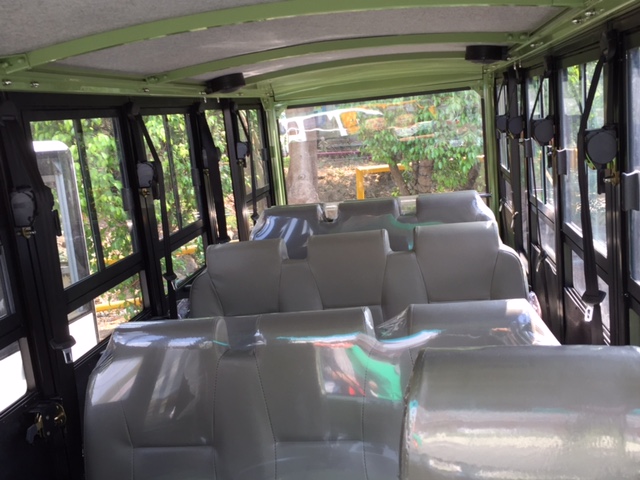 Interior of the minibus showing rows of seats
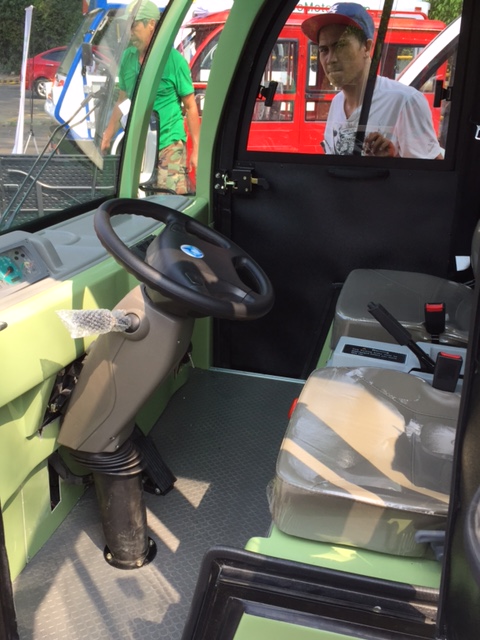 Driver and front seats
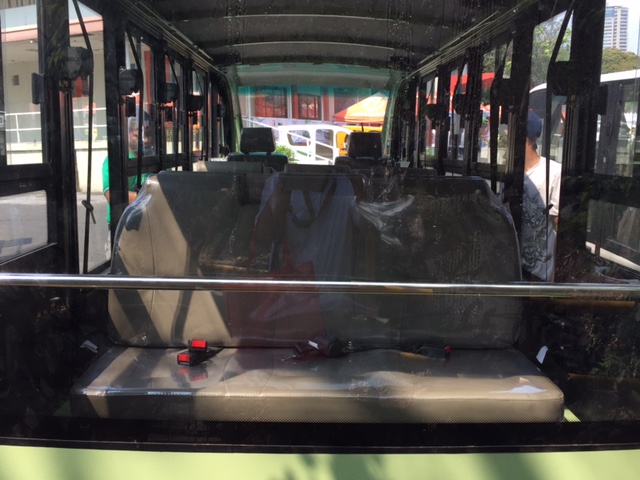 Rear seats facing the back instead of the front – the large window gives passengers a nice clear view of following vehicles, among others.
 The minibus had many doors (8 total) to allow passengers to board and alight from each row.
 Front of the mini-bus featuring a single large wiper
 Jeepney-sized version of the minibus also featured multiple side doors (6 of them for this vehicle).
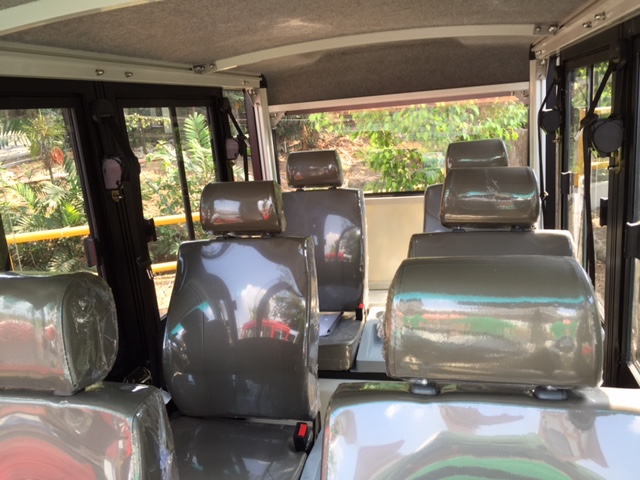 Seats inside the jitney
 Dashboard and steering wheel of the electric jitney
 Another look at the latest model of the electric jeepney
 The door is at the curbside
 Driver’s seat
 Bench seat layout for the e-jeepney
 Front view of the e-jeepney featuring a pronounced and familiar snout
 Setting up for display and demo
 Star8’s e-trike model featuring a side door instead of one at the rear
 Bench seat layout for Star8’s e-trike
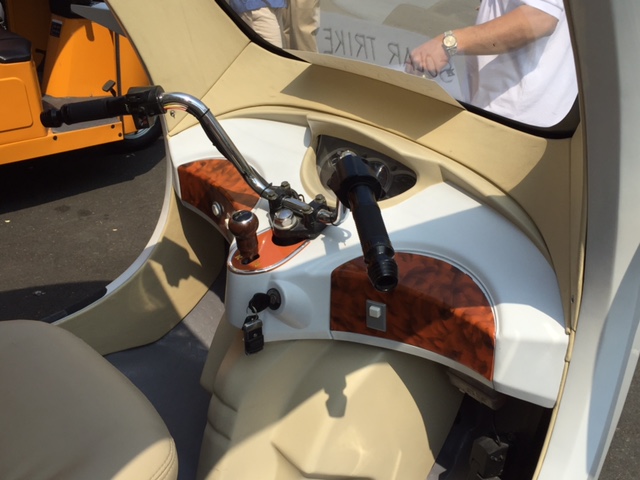 Dashboard and driver seat for the Star8 e-trike
 Star8’s tuktuk design for the e-trike
The variety of electric vehicle models and the increase in the number of industry players is encouraging. Interest in electric vehicles have steadily increased over the past half decade. Perhaps the government should have a stronger role as catalyst or enabler for this industry to flourish and perhaps transform not only the public transport scene but also for people to adopt e-vehicles for private use. This can only be done if the proper incentives are in place that include policy, fiscal and financial instruments favoring electric vehicles as well as their hybrid relatives. These will go a long way towards a low carbon transport future for the country.
–
Electric vehicle models at the 5th Electric Vehicle Summit – Part 1
The 5th Electric Vehicle Summit was held last April 14-15, 2016 at the Meralco Multi-Purpose Hall. Following are photos I took at the summit where many current electric vehicle models were on display and demonstration. Many of the photos show variants of the electric tricycle designs from various manufacturers that conform with the design promoted by the Asian Development Bank (ADB). These are basically in the form of the Thai tuktuk and similar to Cagayan De Oro’s motorella.
 Go Electric e-trike by ToJo Motors
 E-trike model by Clean Air Transport Solutions, Inc.
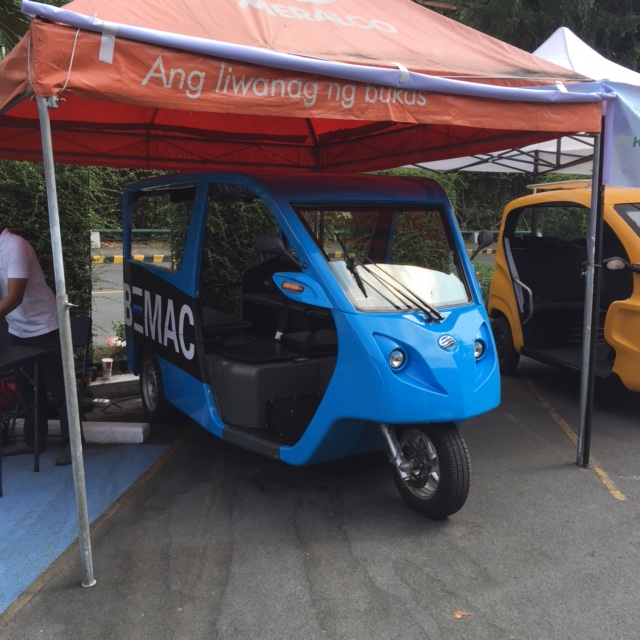 BEMAC e-trike model – the company recently landed a big contract to produce e-trikes.
 E-trike by Kyto Green Technologies Co., Ltd.
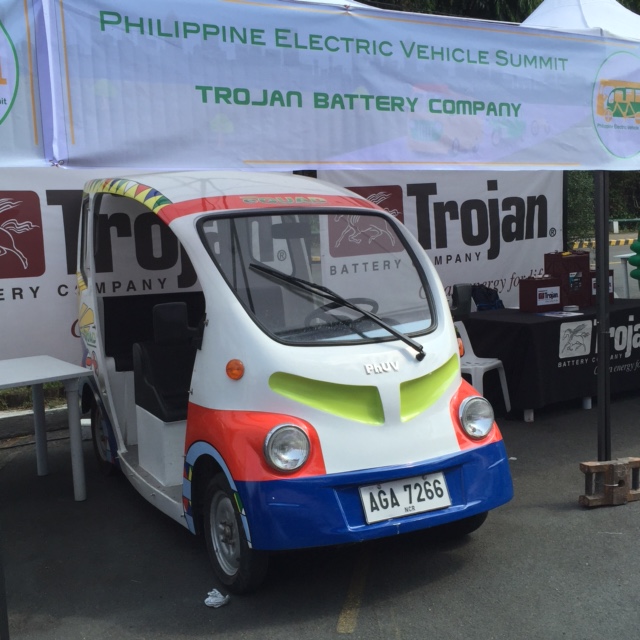 Electric car (4-wheeler) by PhUV powered by Trojan batteries
 E-trike model by Green Mobility Service
 PhUV’s e-trike variants
 E-trike and charging station by KEA
 Exhibitors setting up their booths and electric vehicles
 Conventional vehicle converted into electric by Le Guider International
 E-trikes by Guider Power
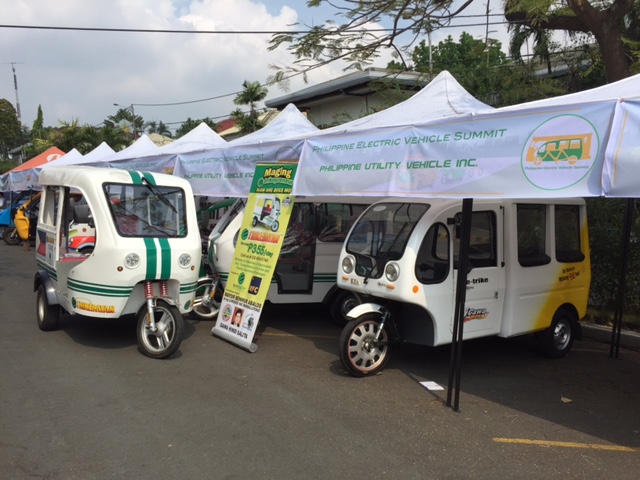 Another look at PhUV’s e-trikes
 Electric motorcycles by Alternative Energy Trailblazer, Inc.
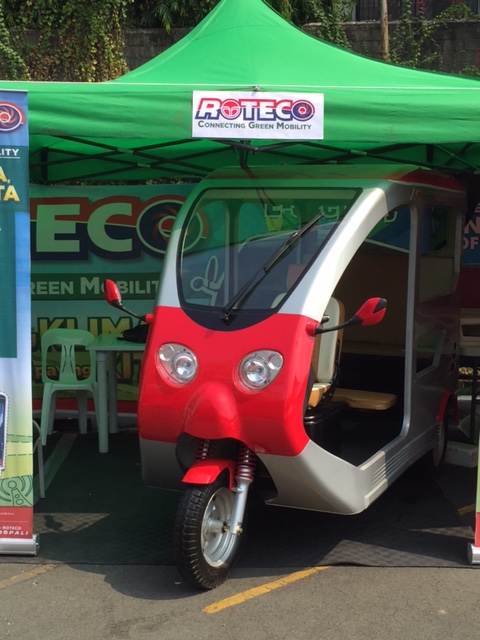 E-trike by Roteco
 SunE-trike and Roteco booths at the summit exhibition area
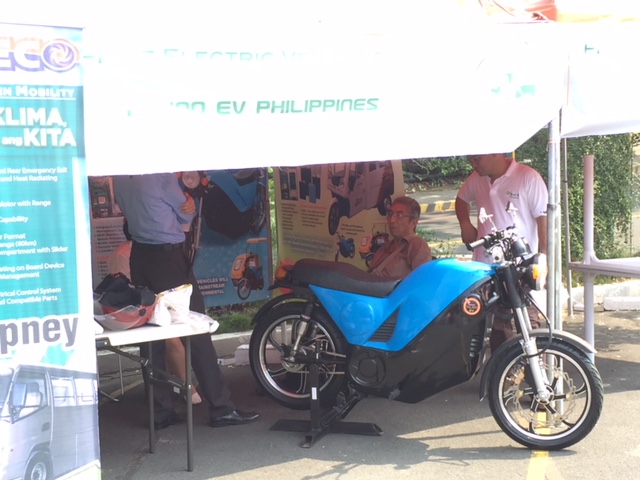 Sporty electric motorcycle model by Talino EV – this can be paired with a sidecar to serve as an e-trike.
 The ToJo Motors booth
 Electric vehicles powered by solar energy by Star8
 E-vehicle models by Clean Air Transport Solutions, Inc.
 Latest model e-jeepney by PhUV featuring side door and a higher ceiling
To be continued…
–
 Caught (up) in traffic