
Home » EST (Page 31)
Category Archives: EST
Vehicles at the 3rd Electric Vehicle Summit
The 3rd Electric Vehicle Summit was held last February 27-28, 2014. It was hosted by Meralco and featured presentations and discussion on the many issues regarding electric vehicle promotion and deployment in the Philippines. Outside the venue of the more formal presentations was an exhibit of the various electric vehicles that are currently available and being promoted by various proponents and companies. These include 2, 3 and 4-wheelers that can be used for either private or public transport.
I observed that there are definitely a lot of improvements since the last exhibition in the previous EV Summit in 2012. Vehicle designs have evolved and for the better. Local manufacturers or companies have partnered with foreign companies who have more experience in EVs so its a good thing. They will definitely learn a lot from their partners and we cannot over-emphasize the importance of technology transfer particularly in areas or aspects where local manufacturers are weak like the controller and the motor.
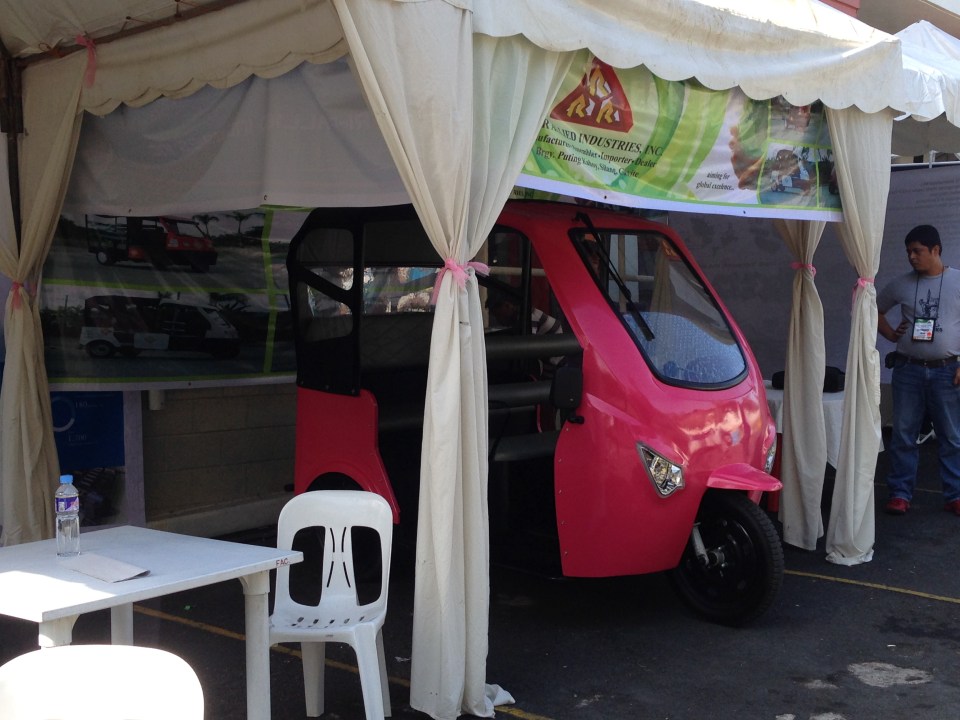 3-wheeler tuktuk design
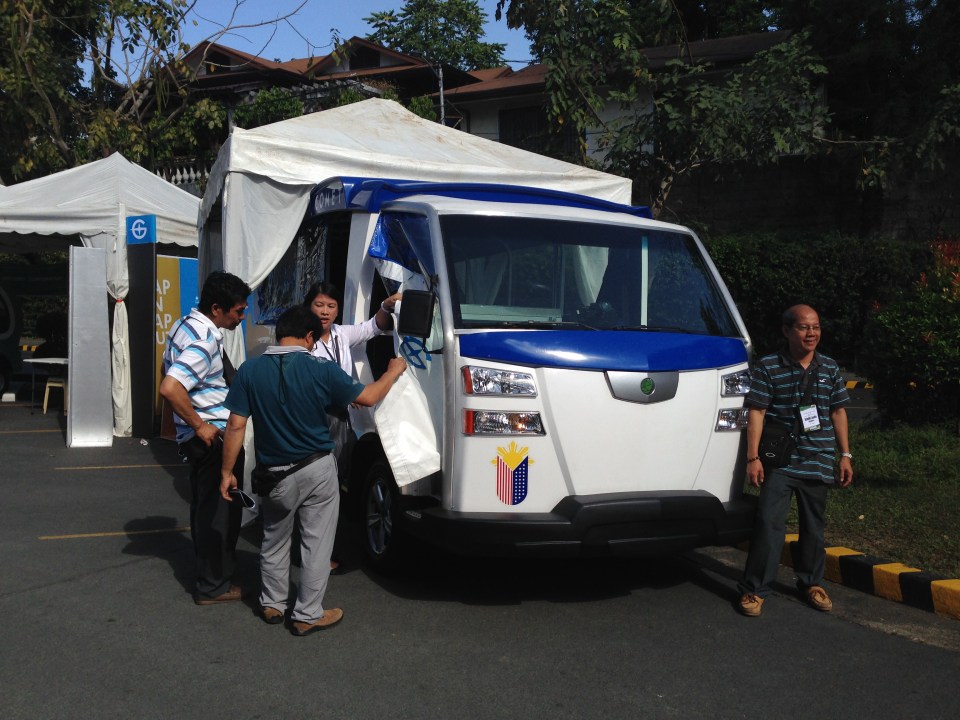 The COMET, which is being proposed as a replacement for the conventional jeepneys.
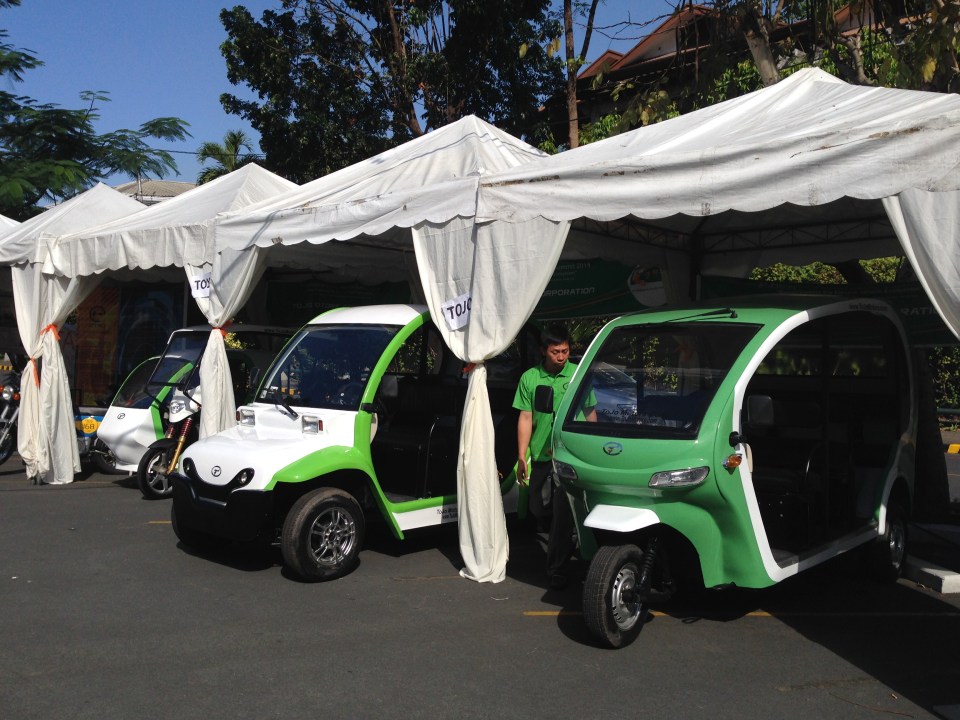 More 3-wheelers and an electric car from the same company that brought us the EVs at Bonifacio Global City that are nearing extinction.
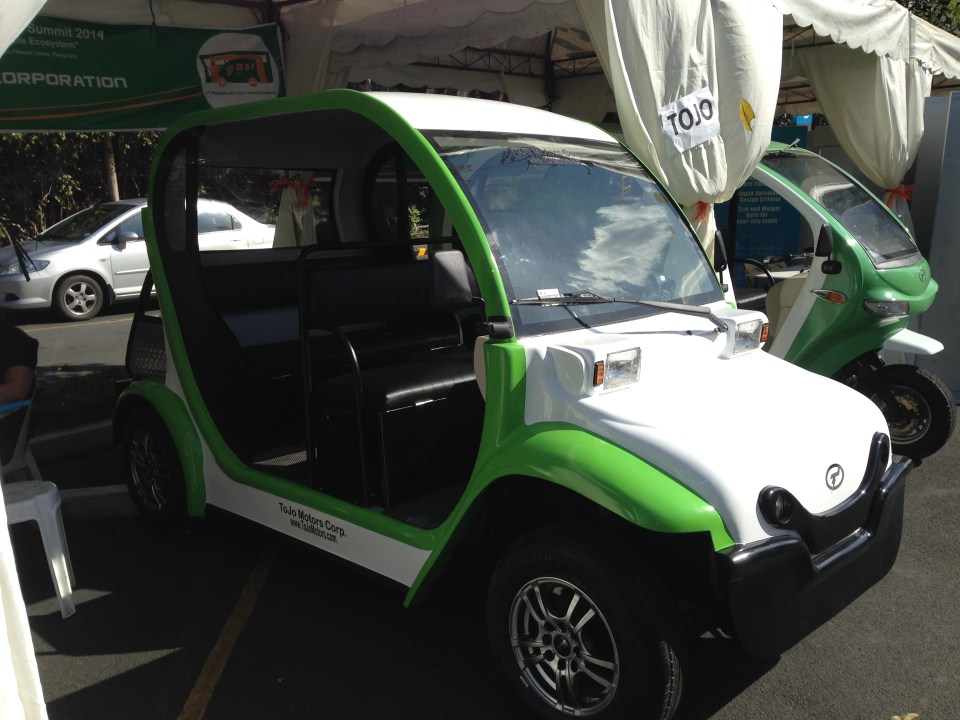 Electric mini car
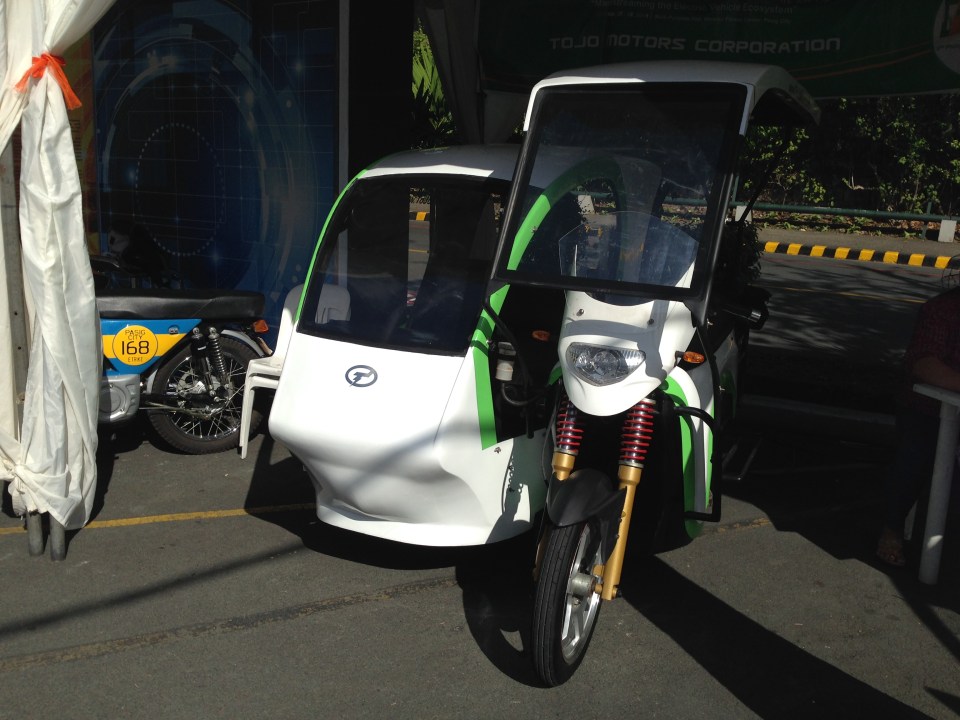 Traditional design of tricycle – electric motorcycle with side car
 Electric motorcycle with a more sporty design
 Same model electric motorcycle fitted with a conventional sidecar
 Another tuktuk design 3-wheeler – this one looks very much like the EVs in operation at BGC in Taguig.
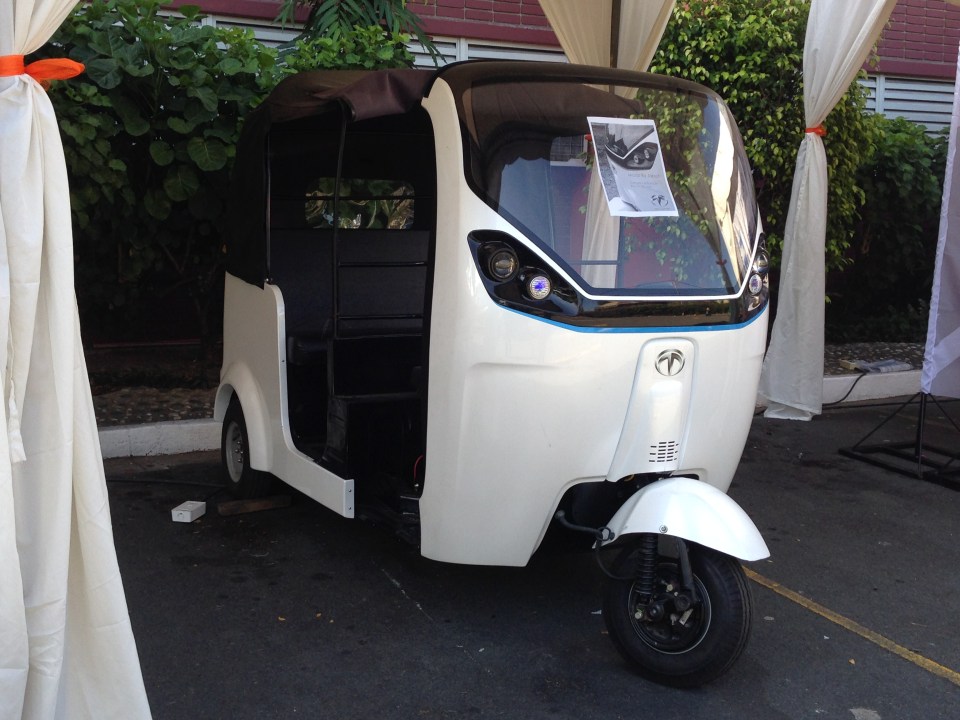 Many companies were supposed to have submitted bids to the DOE-ADB initiative to push for electric tricycles. There are still no assurances whether these e-trikes will replace conventional ones currently dominating transport in many cities and municipalities around the country.
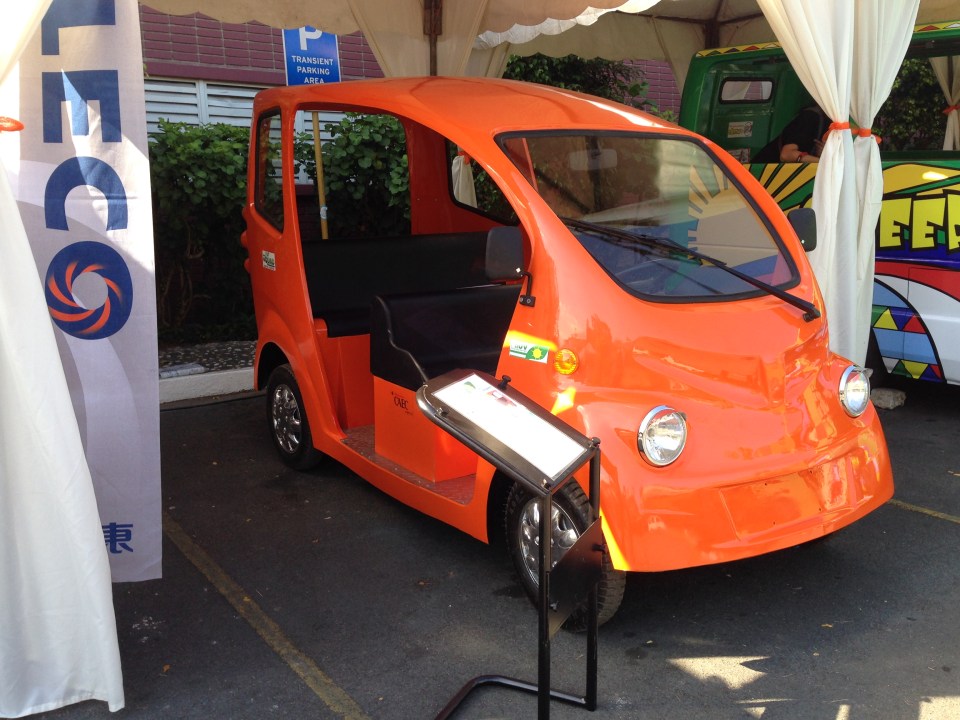 Another electric 4-wheeler. These still look more like glamorized golf carts than the sleek electric cars currently in the market that includes the popular but expensive Tesla.
 The newest model of the e-jeepney from PhUV, the first to manufacture local electric jeepneys including the models now running in Makati, Pasig and Quezon City. I learned that they have partnered with TECO, a Taiwanese company that has extensive experience in EVs. Notice the passenger door is already at the right side of the vehicle instead of the rear.
 Participants to the EV summit tried out the different EVs on display and for demo rides. The latest model e-jeepney was quite popular especially to foreign participants.
 3-wheeler and mini-bus designs from KEA Industrial
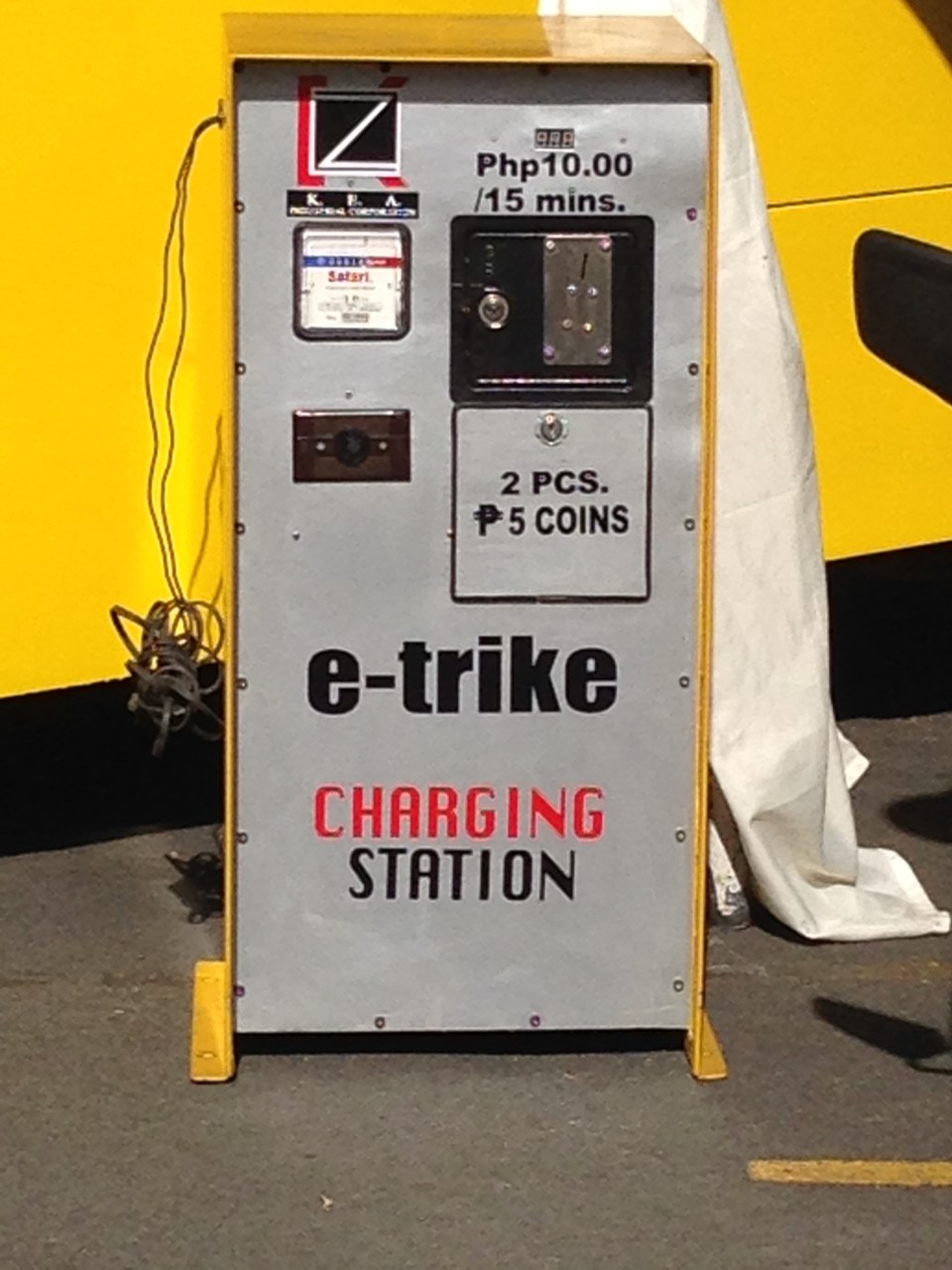 Charging station developed by the same company – I think they’re trying to appeal to the “tingi” mentality of Filipinos by indicating PhP 10/15 minutes of charge.
 Perhaps one of if not the best e-trike that was on display was this model by Japanese manufacturers. They were supposed to have been selected by DOE and ADB for the first phase of the e-trike project that will see the deployment of 5,000+ e-trikes in different Philippine cities.
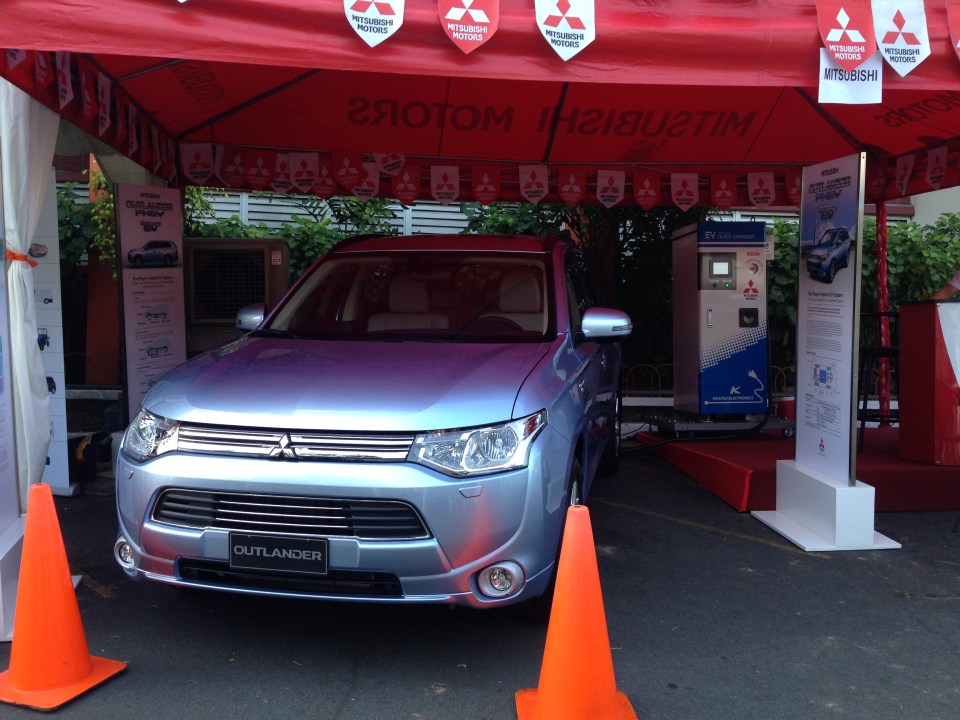 Mitsubishi featured its elective Outlander, which, I observed, got more attention from the well-heeled participants. Students on field trips for the exhibit were not into this example of the more refined EV models.
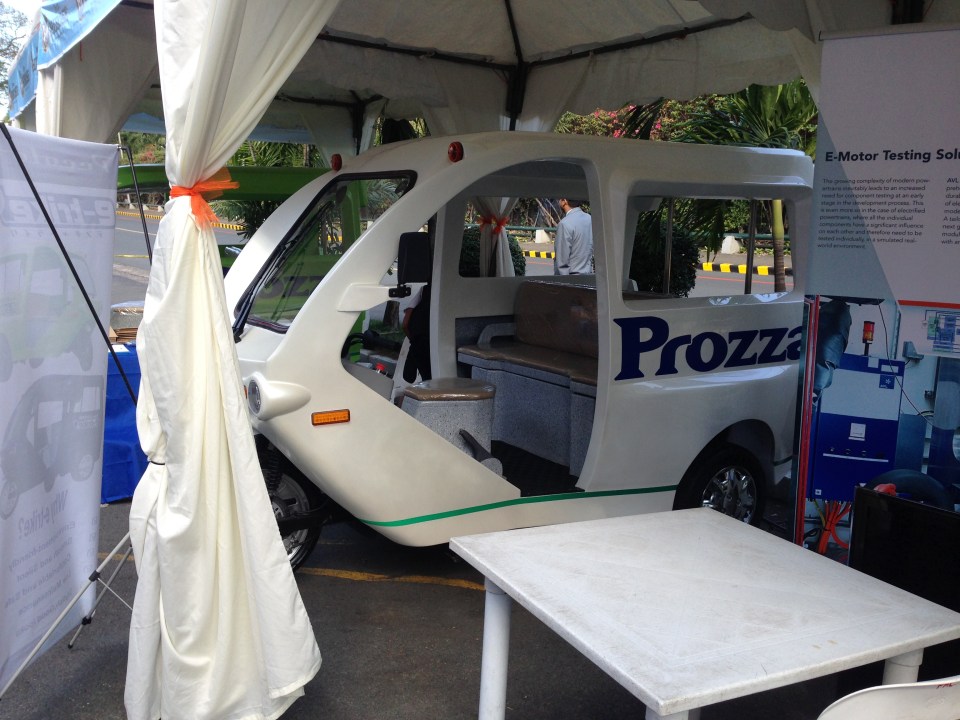 Another tuktuk 3-wheeler design from Prozza. I don’t really remember all the participating exhibitors but most of them bid for the e-trike project of the DOE-ADB.
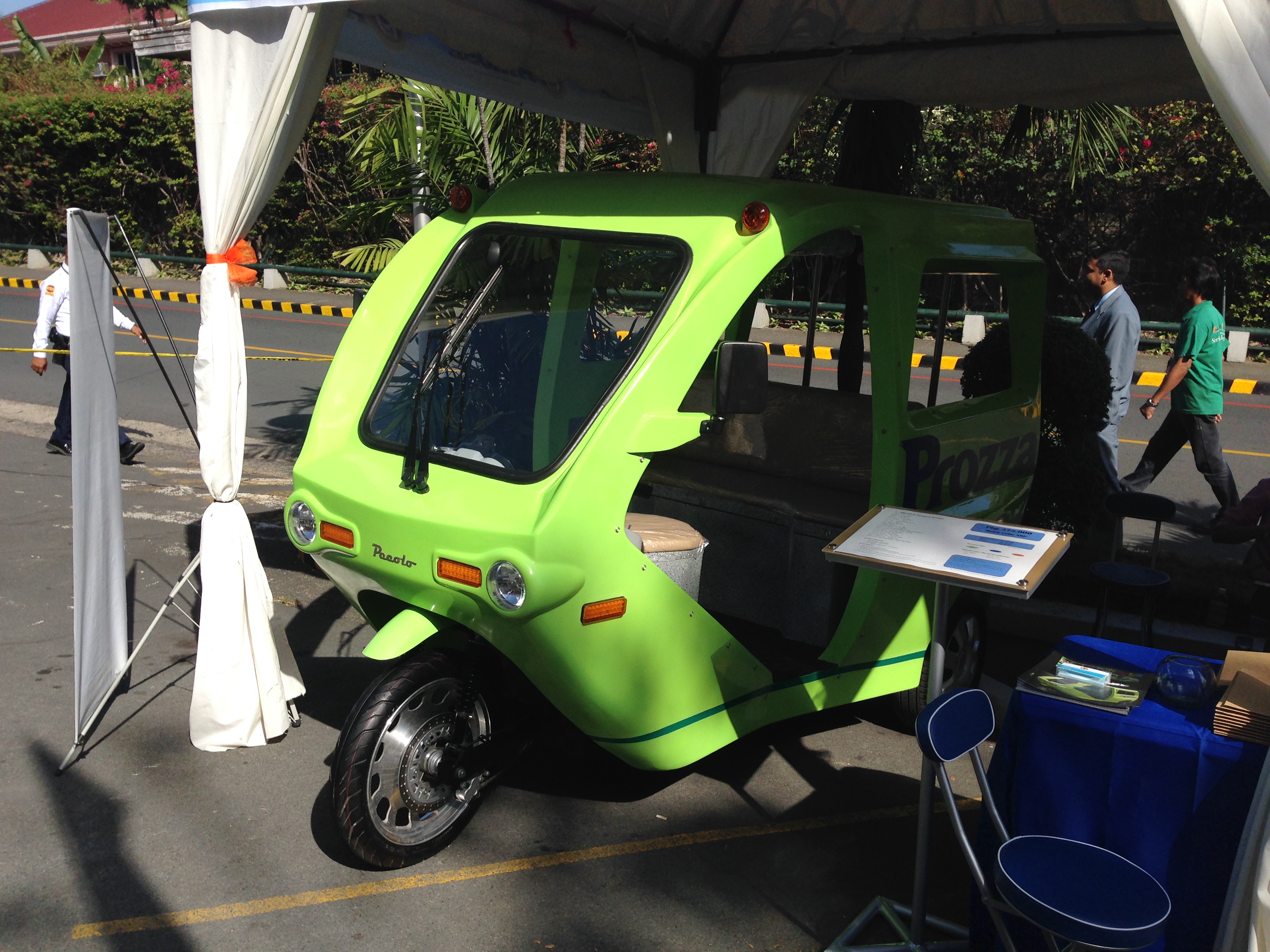 The same 6-seater e-trike from Prozza in green body color.
I would defer from a quick assessment of these EVs to another post. For now, I just like to show the models that were shown in the recent summit. Suffice it to say that I have high hopes for EVs in the Philippines but then we need to really look into the context for these vehicles as well as the sustainability given the challenges of power generation for many areas in the country.
–
Transport and traffic purgatory, paradise and inferno
A lot of people have been referring to the traffic congestion and other derivative issues that will be the result of the construction of several transport projects around Metro Manila as “traffic armageddon.” Some friend have appropriately (I think) referred to it more as “car-mageddon.” This seems to be the case since it is perceived to have the most impact on car users than public transport users, cyclists or pedestrians. This is far from the truth as there are more people taking public transport, cycling or walking than those driving their own cars. In fact, estimates for Metro Manila indicate that 70-80% of travelers take public transport while 20-30% take private vehicles. These mode splits do not include bicycles or walking, which obviously will further decrease private car shares.
I would rather refer to this period of construction as a sort of “purgatory” though it has nothing to do with the cleansing that’s associated with it. There is still the suffering involved while improvements are being implemented. But, most importantly, there is hope at the end of this process. This “hope” is not necessarily the “light at the end of a dark tunnel” kind of thing as surely population and the number of vehicles will surely increase over time even as the transport projects are being implemented. By the time these are completed, there are sure to be more people, more vehicles, as well as more of other developments that will put our transport system to a stress test. We can only hope that the designs of these infrastructure we are building now are based on honest to goodness trip or traffic forecasts. Otherwise, we’ll end up with congested or saturated systems by the time they start operating.
Unfortunately, most projects mentioned and those we know have the green light and would likely be proceeding with construction in the near future are basically road projects. It’s ironic considering that what Metro Manila urgently, and maybe desperately, needs now are public transport systems including the much delayed MRT 7, LRT 2 Extension and LRT 1 Extension. The proposals for Bus Rapid Transit (BRT) seem to be in a limbo, too, despite extensive studies and surveys to support BRT along corridors such as Ortigas Avenue and Circumferential Road 5. These are blamed on institutional and legal impediments including allegations of shortcomings among officials of agencies responsible for these infrastructure.
I am aware of an initiative led by an environmental lawyer seeking to effect the redistribution of road space in favor of public transport users, cyclists and pedestrians. I think such actions are useful from the perspective of getting the attention necessary to push government and private sector players to have a sense of urgency not just in words but also in actions in as far as transport infrastructure programs and projects are concerned. We are already lagging behind our ASEAN neighbors with regards to infrastructure and at this pace, it is likely that less developed countries like Cambodia and Myanmar might just overtake us in the foreseeable future. From another perspective, it is hard to push for sharing the road when people really don’t have better options for commuting. Walking and cycling are not for everyone and many people have turned to the motorcycle to solve their transport woes. In the latter case, motorcycles are perceived as a vehicle that’s fuel efficient and allows the users to zip through congested streets often at high risks of being involved in a crash or spill.
We can only achieve “paradise” in our highly urbanized cities if we build these mass transit systems along with the pedestrian and cycling facilities that will complement each other. Those for whom car travel is a necessity would also benefit from reduced road congestion so it will eventually (hopefully) play out well for most people. Meanwhile, we would have to endure transport and traffic hell (some more and longer than others) as the government and private sector embark on this round of infrastructure projects implementation. It helps to look back at our experiences with the last major batch of projects in the latter part of the 1990’s when the number coding scheme was first implemented. At the time, it was implemented as a temporary measure to alleviate congestion while projects where being implemented. What was a temporary measure is now still being implemented along with a truck ban that has also been evolving the past years with the latest being the one implemented by the City of Manila starting last February 24. Will these vehicle restraint schemes be modified to cope with the traffic congestion expected from projects like the Skyway connector? Will these be relaxed or removed after all these projects have been completed? Your guess is as good as mine.
–
Off-street parking along Tomas Morato
Not too long ago, the Quezon City government constructed off-street parking slots throughout the city. These included spaces along major roads such as Visayas Avenue, Mindanao Avenue, Quezon Avenue, West Avenue and Timog Avenue. Tomas Morato as well as the streets connecting to it were also included in the project, which benefited many people, whether they be car-users or taking public transport. I took a couple of photos last week as the wife picked up some food at a panciteria along Morato. It was early an early afternoon so traffic was free-flowing and many parking spaces are available along the avenue. Morato is well known for having many restaurants and cafes lined up along either side of the street and during their off-periods, Morato would usually be an easy drive.
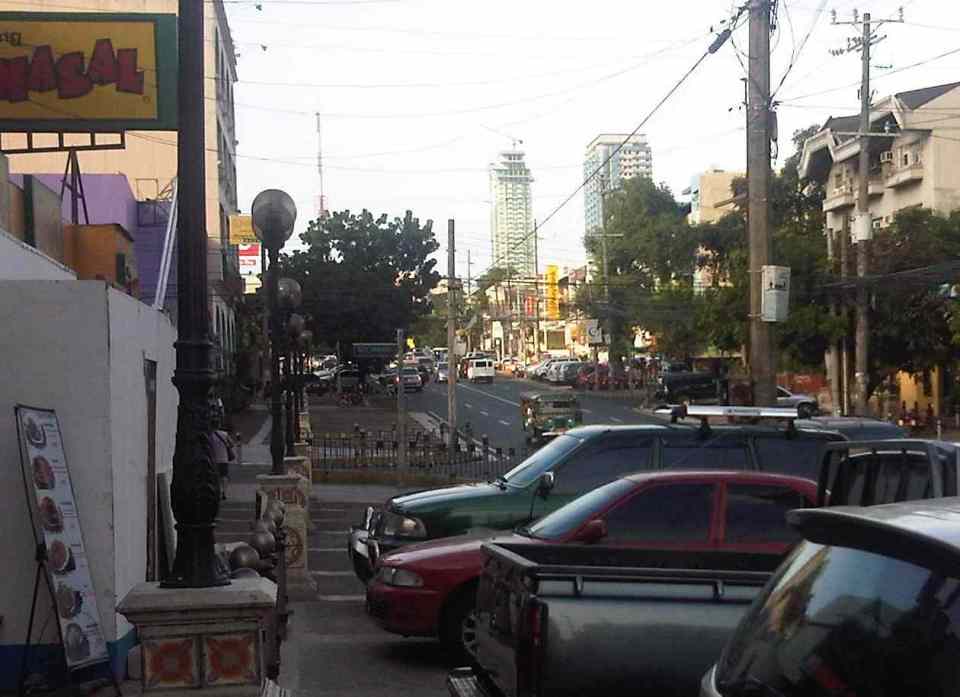 The off-street parking spaces along Tomas Morato are free and are not allocated for any specific establishment. In practice though, the spaces in front of certain restaurants, shops, banks, etc. are “reserved” by their staff for their customers/clients.
 Many newer establishments along Tomas Morato have no provisions for off-street parking for their clients. This means the burden for parking continues in being passed on to the local government and, likely, at the expense of taxpayers.
I still believe that establishments that are required under law to provide at least the minimum number of parking spaces as per national building code should be made to compensate for the city’s construction of parking spaces to solve on-street parking issues along streets like Morato. I understand that they pay local taxes but that is an entirely different requirement that is not related to their being required to provide parking spaces for their customers/clients. It’s really a matter of doing the right thing for both city and these establishments but such cases are often muddled and are not tackled as the general public is usually not interested in these somewhat unpopular topic of parking.
–
New parking rates at NAIA
Here’s something for those who are parking at any of the Ninoy Aquino International Airport’s parking facilities. Here are a few photos showing the new parking rates at NAIA, effective December 1, 2013. Gone are the flat rates of old for those picking-up relatives or friends so it actually discourages people from camping out at the parking lots. Gone, too, are the low overnight parking fees of PhP 50 per night that a lot of people enjoyed for short trips on business or as tourists in local destinations or abroad.
 Information on new parking rates at NAIA effective December 1, 2013 found along the left side of the approach to the parking lot entrance.
 Announcement on the new NAIA parking rates just before the entrance booths of the lot
 Information on the new parking rates at the exit of the lot and just before the payment booths.
It goes without saying that with the increased parking fees at the NAIA, people would expect more in terms of the quality of these facilities particularly pertaining to security and cleanliness. One cannot expect to pay for PhP 300 per night for an open parking space where one’s vehicle is exposed to the environment as well as to possible criminal elements lurking about. Of course, there is practically no competition for these parking facilities so there is a sizable captive market for NAIA parking. In my experience, and in fairness to airport management, I have not had any untoward incidents when I did leave our vehicle at the parking lots of Terminals 2 and 3. And I have done so many times before on trips to the Visayas and Mindanao, and a couple of times on trips abroad. I hope others, too, won’t have any problems with parking at the airport.
–
On the increase in overnight parking fees at NAIA
I’ve been reading some posts on social media complaining about the increase in the overnight parking rates at the Ninoy Aquino International Airport (NAIA). This seems to be a recent development considering the last time we used any of the parking facilities of NAIA was last November 23 when the wife parked to wait for my arrival at Terminal 2. It wasn’t overnight parking but then she said she doesn’t recall seeing any signs announcing changes in the parking rates. The posts I saw through Facebook are for overnight parking at Terminal 3 where the old charges were 50 PHP (about 1.14 USD) per day. This is actually very cheap even considering that parking is on an open lot with marginal security. Even parking lots in Makati, Taguig and Ortigas charge more for overnight parking on open lots.
The new rate is basically 300 PHP per day including taxes, which apparently surprised a lot of people after everybody got used to the 50 PHP/day rate of old. That meant that for a 3 night trip to Bangkok or Singapore, for example, where people left their cars at the airport, they had to fork over 900 PHP instead of the 150 PHP they used to pay for parking. Indeed, that’s a big jump in parking fees!
NAIA’s parking rates can be compared to the parking rates at the Los Angeles International Airport (LAX) is provided in their website. 30 USD (about 1,315 PHP) is charged for 24 hours for use of the multi-level/covered parking structures at the airport. Meanwhile, open lot parking charges 12 USD (about 526 PHP) per day. Suddenly, NAIA’s parking charges don’t seem to be expensive beside the 526 PHP/day charge at LAX. However, these rates are arguably in a country where there are higher wages and standards of living and so perhaps a fairer comparison would be for parking in a major airport in ASEAN. Doing a bit of research online, I found that Bangkok’s Suvarnabhumi International Airport charges the equivalent of about 341 PHP per day for parking. Singapore’s Changi charges the equivalent of around 701 PHP per day. And Kuala Lumpur International charges the equivalent of about 575 PHP per day for parking. [Note: Rates from the link may not be updated.] These are generally for multi-level parking buildings where vehicles are practically protected against the environment (e.g., rain, sun, etc.).
A comparison is also made for the nearby Park n’ Fly facility, which also publishes their parking rates in their website. The site of the private parking provider states a rate of 340 PHP + EVAT (taxes) per day. And this is for a multi-level, covered parking structure near NAIA Terminals 1 and 2. An argument can be made here for the location and proximity of NAIA parking spaces compared to Park n’ Fly but note that the fee for the private entity includes airport transfers with their own vehicle. Compared to this, the NAIA rates are quite expensive considering that it is for open lot parking and for what is perceived as marginal security. In fairness to airport parking security, I have not heard or read about incidents of burglary or stolen vehicles in relation to NAIA parking areas.
And so there are many questions that need to be answered in as far as the sudden and steep increase in parking rates at NAIA. The most important question here is what is the basis for the parking rate increase? It is assumed that the additional monies generated will cover certain expenses like security and maintenance. So there needs to be transparency in where the additional funds will go or how it will be allocated (e.g., repair works towards ultimately opening the multi level facility at T3). Also, perhaps the information dissemination for this rate increase was lacking and therefore ineffective in advising the public about the change. But then there was generally no major uproar over the increase so perhaps those complaining weren’t paying attention or were caught in the transition to the new parking rates. One can even say that certain posts in social media can be qualified as rants rather than objective takes on parking rates.
I would like to think that parking as an amenity should not generally be a revenue generating scheme for the airport. Collected fees should cover operating expenses and excesses can be used to build a trust fund, for example, for future expansion of the facility, but the latter should be clearly spelled out in a plan for the airport. After all, it is in the best interest of the public, the users of the airport, if improvements can justify what they are paying for and how much they are paying.
–
Motomachi
It’s December again and during this month I like to reminisce about favorite places I went to or still go to here and abroad. One of my favorite haunts during the time I called Yokohama my home city was the Yamate area. I went to Mass every Sunday at Yamate Catholic Church. After church, friends and I descend towards the Motomachi shopping street to take strolls, window shop or have lunch in one of the many restaurants along the street. I think it is a good example of a shopping street that’s also found in many other places particularly in Europe and the US. It provides a better environment compared to the large malls we often find in many cities including Metro Manila.
 On-street parking spaces are provided along one side of several sections of along the street. There are parking meters at these spaces.
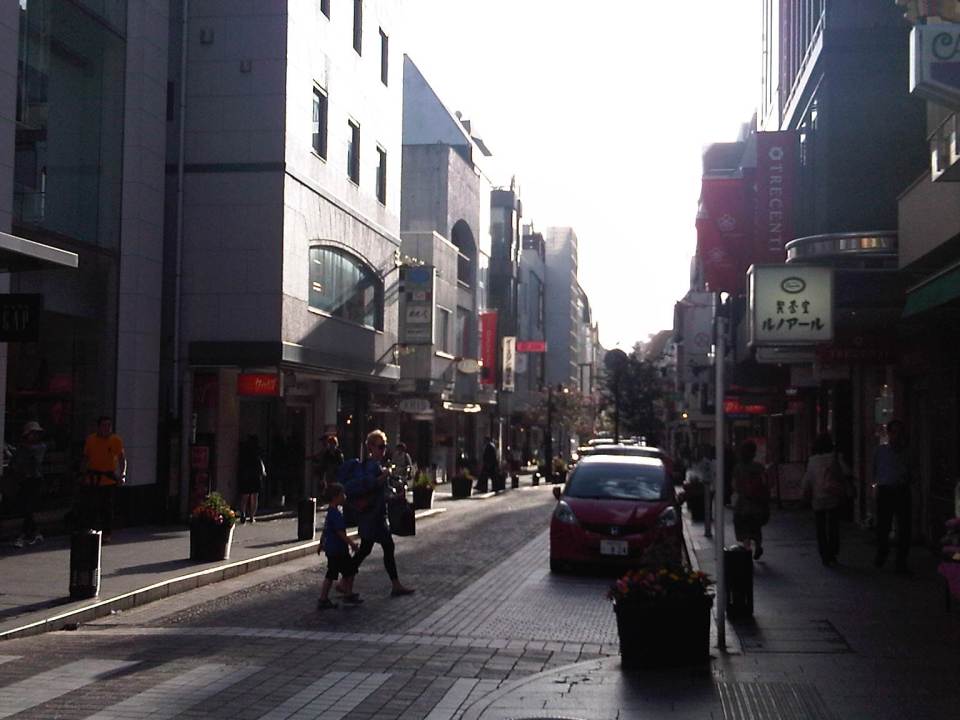 It is a nice place to take a walk whether doing actual shopping, window shopping or just a simple stroll to while away the time.
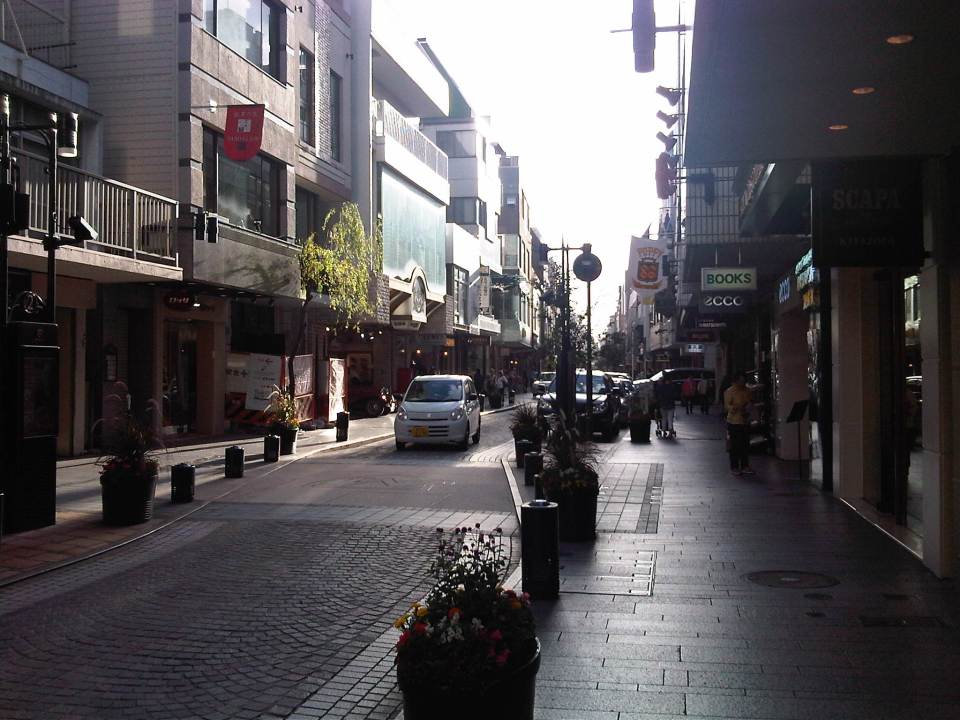 I like the brick road of Motomachi and the restaurants and shops lining the street.
 Benches where people can sit down, take a short rest or wait for their companions who are shopping at a nearby store.
 Motomachi Union where I used to do some groceries whenever I’m in the area (usually Sundays after Mass at Yamate Church).
 A look back to Motomachi as I approached the JR Ishikawacho Station.
There used to be a Indian restaurant at one of the side streets of Motomachi. The chef of the restaurant was a Sri Lankan Catholic who was a church mate at Yamate. We often went to eat there after Mass or on occasion. He would usually adjust the ingredients of our favorite curry and tandoori dishes so they weren’t too hot or spicy for our palates. I wonder where he is now with his family and hope they are doing very well.
There also used to be some clubs or pubs at the end of Motomachi. These included one that was operated by Filipinos that had the Philippine flag displayed. Those establishments are long gone, replaced by newer restaurants and shops as well as a building leading to the underground station of the Tokyu Minato Mirai Line. I know there are also a lot of new, still undiscovered shops and restaurants in the side streets to Motomachi. I look forward to going around the area again soon to check out these places.
–
U.P. Town Center
Passing along the University of the Philippines’ part of Katipunan, one will see a new development at the area where the UP Integrated School (UPIS) is currently located. The UP Town Center is being promoted as part of a university town center concept and is the second major Ayala development on UP land after the Technohub in the north side of the 493-hectare campus. The surrounding area to the newly built Town Center will most likely host business process outsourcing (BPO) including call centers that currently populate Technohub.
I learned that the development’s design was reviewed on the UP side by a team that included faculty members from UP Diliman’s College of Architecture and School of Urban and Regional Planning. I assume that they were able to cover most if not all the aspects of the design for this particular development and the rest that will follow once UPIS moves to the main campus and the entire lot is developed much like into what Technohub is at present. I would assume that they provided recommendations to Ayala and that these recommendations were used to improve on potential issues with the development. However, my worry is that the transport or traffic component of the design (i.e., transport impact assessment) was not sufficient for the traffic that will be generated by the development. While Technohub had no serious problems regarding traffic as it was along the wide Commonwealth Avenue, the Town Center was located in the narrower C-5 that is the route for much private traffic as well as trucks.
Let us look at the potential problems for the UP Town Center in relation to transport and traffic. For one, the development is close to a major intersection, the junction of Katipunan-CP Garcia. The current traffic signal cycle for the intersection allows for continuous through traffic for the northbound side of Katipunan. Thus, traffic in front of the development, which is along this same northbound side of C-5 will be continuous. Vehicles slowing down to enter the parking lots at either end of the building will likely slow down traffic along C-5. Meanwhile, there are no driveways or bays for transport to load/unload passengers in front of the building. Instead, the driveway is right after Katipunan-C.P. Garcia intersection and does not appear to be designed for jeepneys, taxis and cars will, instead, likely stop on the road and such will mean one lane of C-5 will be occupied, contributing to a decrease in the capacity of the roadway.
Another thing is the parking. Currently, there are limited spaces as understandably the area is still being developed and the lots are temporary facilities. I presume that there will be more spaces available soon considering the parking generation characteristics of such types of developments that tend to attract car-owning people though perhaps the target is a broader range of customers.
And then there are the issues regarding walking and cycling. One friend was asking if there were bicycle racks at the Town Center. I saw none (yet?) but perhaps there will be facilities for cyclists. As for walking, this section of Katipunan is more walkable compared to the segments in front of Ateneo and Miriam where cars seemed to be parked or standing everywhere and pedestrians are forced to walk on the road. Along the side of the U.P. Diliman campus, there are sidewalks where pedestrians can safely walk. On the Town Center’s side, there are also sidewalks and we hope these can still be improved once construction is at full swing. Perhaps what requires attention for both pedestrians and cyclists are crossings. With the increased traffic along C-5 due to the opening of the Luzon Avenue overpass crossing Commonwealth, it has become more dangerous to cross C-5. As such, there is a need to address such issues as surely there will be significant pedestrian traffic crossing to and from the Town Center.
 No driveways or bays for public transport? Construction work continues for the soon to open UP Town Center even as the fences are taken down to reveal a modern building that will host restaurants and shops.
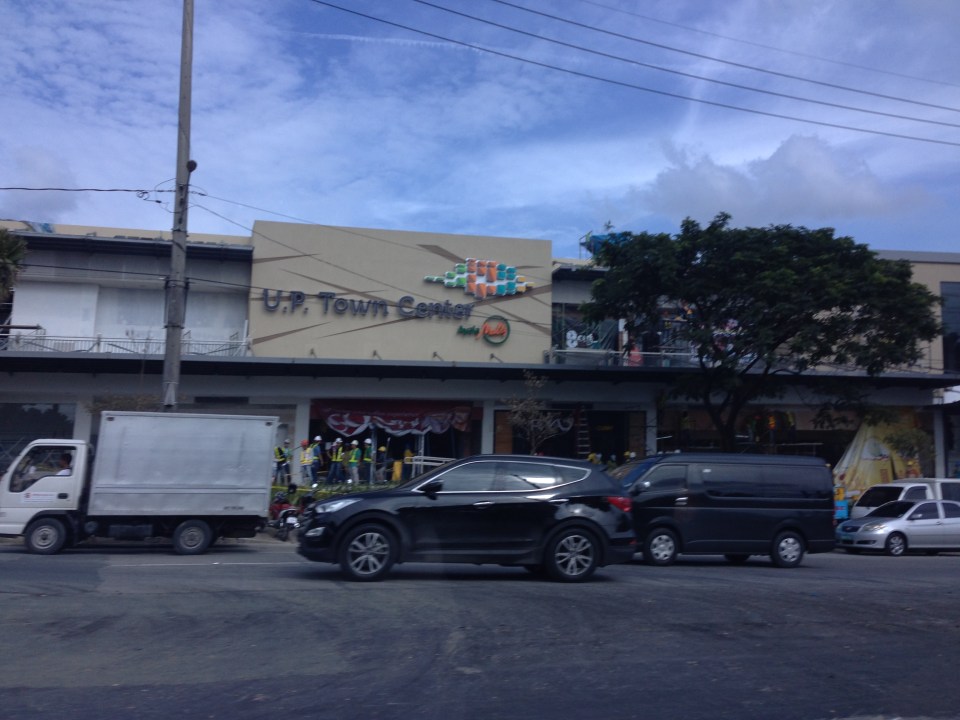 The UP Town Center is already attracting traffic as some restaurants and shops have already made “soft” openings.
A colleague once made the comment that the Town Center was not really for UP but, like the Alabang Town Center, was for the posh residential subdivisions in the area. These include nearby La Vista, Loyola Grand Villas and Ayala Heights subdivisions. Also, it will likely attract more car users than public transport users as locator restaurants and shops are mainly upper-middle to upper class. There are no Jollibees, Chowkings or McDos here. For now, the developer and UP Diliman deserves to be given the benefit of the doubt in as far as the development’s design is concerned. Perhaps the issues I mentioned above will be addressed once the entire area leased to Ayala would have been fully developed. And until then, there would be opportunities to check and ascertain if the development is indeed people friendly and something that can be called a university town center and not just another commercial development that attracts traffic.
–
Establishing an ITS society in the Philippines
The establishment of an ITS society in the Philippines is an idea that’s almost 2 decades old. I first learned about Intelligent Transportation Systems (ITS) while I was a graduate student at UP Diliman taking up transportation engineering in 1994. The interest was stoked by more exposure to ITS when I studied in Japan later and participated in the ITS World Congress held in Seoul, Korea in 1998. I presented a paper at the congress and was able to go around to look at the cutting edge in technology at the time that was applied to transportation. I also learned that there were three big ITS organizations at the time – one in the US (ITS America), in Europe (ERTICO) and in Asia (VERTIS).
I recall attending one meeting in 2002 when Dr. Ricardo Sigua, then on his second stint as Director of the National Center for Transportation Studies of the University of the Philippines Diliman presented the idea to a group that included then Department of Electrical and Electronics Engineering Chair Rowena Guevarra. The latter is now Executive Director of the Department of Science and Technology’s Philippine Council for Industry, Energy and Emerging Technology Research & Development (PCIEERD). At the time, the conclusion was that it was still premature for the Philippines to establish a formal ITS society considering that there were few who were actively involved in ITS research. I thought privately that people still had little understanding or appreciation of ITS and, at UP at least, we were not yet in an environment that enabled collaborative work among departments who are supposed to have the expertise to undertake ITS related research and perhaps be the core group for a society.
Flash forward to the present, there is an ITS program currently being funded by the DOST-PCIEERD and under it are several research projects. One project is already underway and is being implemented through a collaboration among civil engineering (transport), electrical and electronics engineering and computer science faculty and students of UP Diliman. There are also several projects in the pipeline from Ateneo, DLSU and Mapua. These researches combined with various ITS applications with the private sector (e.g., electronic toll collection, variable messages, apps for commuting, etc.) means there is much more awareness nowadays for ITS and its benefits. This may also mean that the time is right and ripe for an ITS society to be established to further its applications.
 Dr. Ricardo Sigua of the UP College of Engineering presenting on the proposal for the establishment of ITS Philippines.
On the forefront of the establishment of an ITS society in the Philippines is Dr. Ric Sigua, Professor at UP Diliman’s Institute of Civil Engineering and Fellow at the NCTS. He has been very active in ITS research and is currently project leader of the Philippines Manila Advanced Traffic Information System (PhilMATIS) project that is funded by the PCIEERD. Dr. Sigua has strong links with ITS Japan and is representing the country as observer in the regular ITS Congresses including the one to be held in Tokyo in October. During the ITS forum hosted by the NCTS in September 4, it was agreed that a core group will be established that will work towards forming a formal society. This will be led by the academe but will have the support of the private and government sectors. We look forward to what may be called ITS Pilipinas or ITS Philippines in the near future.
–
What is the context for electric tricycles in the Philippines?
The NEDA Board recently approved six projects that included one that will be promoting electric vehicles throughout the country. Entitled “Market Transformation through Introduction of Energy Efficient Electric Vehicles Project” (formerly Market Transformation through Introduction of Energy Efficient Electric Tricycle (E-Trike) Project), the endeavor seeks to replace thousands of existing conventional motorized 3-wheelers (tricycles) with e-trikes and to develop and deploy charging stations for these vehicles. While I have nothing against electric vehicles and have supported their promotion for use in public transport, I am a bit worried about the context by which electric tricycles are being peddled especially the part about equating “transformation” with “replacement.”
First, it is a technology push for an innovation that has not been fully and satisfactorily tested in Philippine conditions. The deployment of e-trikes in Bonifacio Global City is practically a failure and a mode that was not suitable from the start for the area it was supposed to serve (i.e., while there were already jeepneys serving the area, there were also the Fort Bus services and plans for a BRT linking the Ayala CBD and BGC. There are now few (rare sightings) of these e-trikes remaining at the Fort, as most of these vehicles are no longer functioning due to problems regarding the batteries, motors, and issues regarding maintenance. Meanwhile, the e-trikes in Mandaluyong, a more recent model, have also been difficult to maintain with one case reportedly needing the unit to be sent back to China for repairs.
Second, the e-trikes are a whole new animal (or mode of transport). I have pointed out in the past including in one ADB forum that the 6 to 8 seater e-trike model is basically a new type of paratransit. Their larger capacities mean one unit is not equivalent to one of the current models of conventional tricycles (i.e., the ones you find in most city and municipality around the country). Thus, replacement should not be “1 e-trike : 1 tricycle” but perhaps “1:2” (or even “1:3” in some cases). This issue has not been resolved as the e-trike units continue to be marketed as a one to one replacement for conventional trikes. There should be guidelines on this that local government units can use, particularly for adjusting the number of franchises or authorized tricycles in their respective jurisdictions. Will such come from the Department of Energy (DOE)? Or is this something that should emanate from Department of Transportation and Communications (DOTC)? Obviously, the last thing we like to see would be cities like Cabanatuan, Tarlac or Dagupan having so many e-trikes running around after they have replaced the conventional ones, and causing congestion in the cities. Emissions from the tricycle may have been reduced but emissions from other vehicles should be significant due to the congestion.
Third, the proliferation of e-trikes will tie our cities and municipalities to tricycles. Many cities already and definitely need to upgrade their public transport systems (e.g., tricycles to jeepneys or jeepneys to buses, and so on). Simply replacing tricycles with electric powered ones does not effect “true” transformation from the transport perspective. Is the objective of transformation mainly from the standpoint of energy? If so, then there is something amiss with the project as it does not and cannot address the transport, traffic and social aspects of the service provided by tricycles (and other modes of transport).
So what is the context for the e-trikes or conventional tricycles? They are not even under the purview of the Land Transportation Franchising and Regulatory Board (LTFRB) as they are regulated by LGUs. Shouldn’t the DOTC or the LTFRB be involved in this endeavor? Shouldn’t these agencies be consulted with the formulation of a framework or guidelines for rationalizing and optimizing transport in our cities? These are questions that should be answered by the proponents of this project and questions that should not be left to chance or uncertainty in so far as the ultimate objective is supposed to be to improve transport in the country. I have no doubt that the e-trikes have the potential to improve air quality and perhaps the also the commuting experience for many people. I have worries, however, that its promise will not be kept especially in light of energy supply issues that our country is still struggling with and deserves the attention of the DOE more than the e-trikes they are peddling.
–
Here’s to walking!
I was lucky to be able to take a couple of photos as our vehicle passed along Marcos Highway to be able to capture images of people walking along the sidewalks between Ligaya and De la Paz. The driver maintained his position along the right side of the road so I had a good view of the pedestrians and cyclists making their way from Ligaya in the general direction of De la Paz and the two shopping malls downstream (the signs of one mall are visible in the photo).
Ligaya is a transfer point for people traveling to and from Pasig, Pateros and Marikina who use the jeepneys connecting these towns. They typically get off at the junction of Marcos Highway and Amang Rodriguez. From here, one can take a jeepney to the towns of Rizal or perhaps to Quezon City (Cubao). These days, however, it is not so easy to get a ride at Ligaya and one cause of congestion emanating from the junction are people taking two lanes of the road as they position themselves to board stopping jeepneys. Instead of waiting for the jeepneys and whatever limited seats are available, many people have decided to walk towards the junction with Imelda Avenue. There located are commercial establishments including two shopping malls and the terminals of public transport whose routes terminate at the area. There, it is relatively easier to get a ride home though during the early evenings it can also be difficult to get a ride to the Masinag and Cogeo districts of Antipolo (And that’s part of the reasons why the LRT Line 2 extension is necessary!).
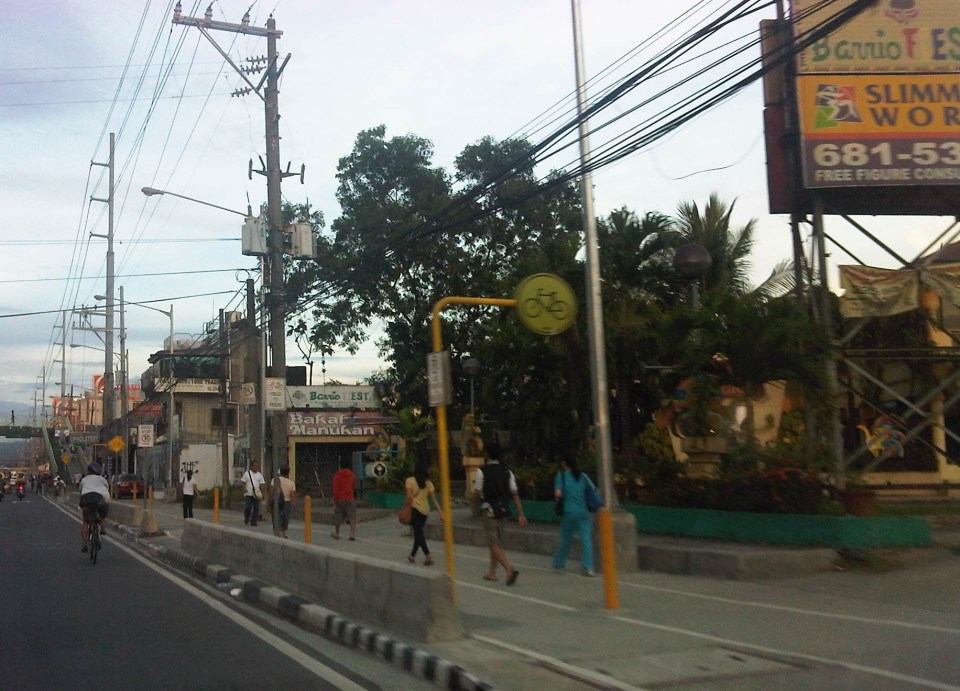 Pedestrians walking towards De la Paz or the shopping malls a little further on. There is actually a bicycle lane beside the pedestrian walk similar to how the Marikina Bikeways were designed but most cyclists opt to use the curbside lane of Marcos Highway.
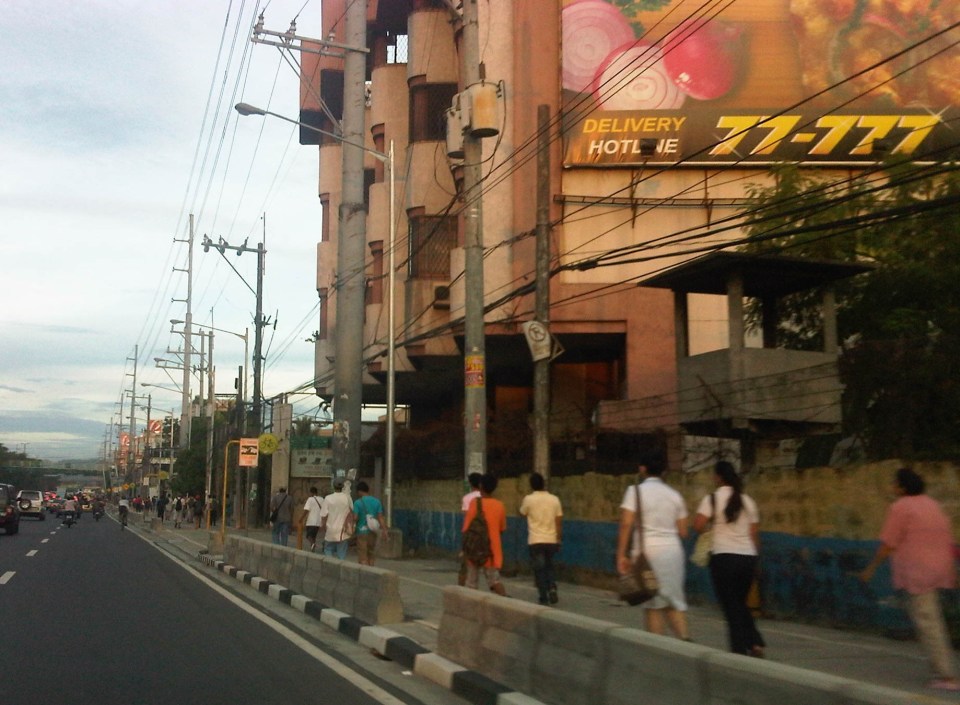 Pedestrians walking from Ligaya include workers and students.
The walkways are generally clean and well-lit during the night time, though I think portions are still quite dark. I also think the more people opting to walk means it can be safer to walk (strength in numbers?). The observation that many people walk encourages other people to do so, and is a deterrent for unlawful elements of society. Perhaps to further reinforce the safety and security aspect of walking, Pasig Police or the MMDA could have some of their personnel walk along this path. Police visibility here, especially at night, would help deter muggers and hold-uppers who might see the pedestrians as potential victims.
–
 Caught (up) in traffic