
Home » Governance (Page 25)
Category Archives: Governance
Reference on bike-focused street transformations
There’s an update to the “Rethinking Streets” guide with one that is focused on street transformation for bicycles. Here is the link to their site where they now have 2 guidebooks:
http://www.rethinkingstreets.com
You will have to click one of the guides to register (if you haven’t done so before) and download them.
–
Lessons to be learned from experiences on public transport abroad
There’s this “old” article that came out last year that is very much relevant as it is timeless for its topic. The title is intriguing as the many if not most US cities are known to be car-dependent. Few have good public transportation in terms of the efficiencies or qualities we see in Singapore, Hong Kong, Seoul or Tokyo (just to mention Asian examples). Clearly, quality of service is the main reason why people are apprehensive about using public transportation. In fact, the attraction of ride shares, for example, are precisely because people want to have what they perceive as safe, comfortable and convenient modes of transport for their regular commutes. Only, for many people, their choice is also limited by the affordability of such modes of transport. Perhaps the same is applicable if you extend the discussion to include active transport. Cities and municipalities would need to provide the right infrastructure and environment for people to opt out of cars, take public transport, walk or cycle.
English, J. (2018) Why did America give up on mass transit? , http://www.medium.com/citylab, https://medium.com/citylab/why-did-america-give-up-on-mass-transit-dont-blame-cars-d637536e9a95 [Last accessed: 08 March 2019]
–
References linking transportation and health
The Institute of Transportation Engineers (ITE) features several resources discussing the linkage between transportation and health. Here is the link to the page where they list references like reports from various sources as well as tools.
This is definitely a topic that needs more attention and studies in the Philippines in order to have local evidence (there are already strong evidence abroad) supporting active transportation and how it helps make citizens healthier. Of course, that goes without saying that active transport should be integrated with an efficient public transport system. That is so that the increasing share of private transport can be checked (no thanks to Grab and Uber) and we can either retain or increase public and active transport shares.
–
Simulating cities?
I found this nice article about some of the most popular simulation games; especially SimCity:
Baker, K.T. (201 ) Model Metropolis, Logic, https://logicmag.io/06-model-metropolis/?mbid=nl_021119_transportation_list_p [Last accessed: 2/13/2019]
While there are still those who dismiss these as merely games, they fail to appreciate the really complex algorithms and processes that could now mimic real world situations. That includes governance of cities that is a very important factor to its development. Land use planning or transport planning alone cannot provide the solutions for a city’s problems associated with, among others, its growth. The success reflects on the administration and leadership that should be able to anticipate and respond to issues while consolidating and rationalising resources, which are often limited.
–
On re-designing or re-imagining our transportation system for people
Here is another good read especially for those who advocate or even just beginning to appreciate the concept of people-oriented transportation:
VannPashak, J. (2018) “Design for humans as they are, not as you want them to be,” http://www.medium.com, https://medium.com/@jvannpashak/design-for-humans-as-they-are-not-as-you-want-them-to-be-ef95076c0988 [Last accessed: 11/23/2018].
In a recent symposium where I made a presentation about low carbon transport and visioning and re-imagining transport, I was asked how we can re-design our transportation to be more people-oriented than car-oriented. I replied that we have to do a lot of unlearning. That is, many planners and engineers would need to unlearn many things they’ve learned in school and those they got from their workplace. One convenient excuse for not coming up with a better design, for example, is that certain planners or engineers just followed what their offices or agencies have been doing. What if what their offices and agencies (and consequently their seniors at work) where wrong all these years and what was “ginagawa na” or “nakasanayan” have led to deficient outcomes? I even joked about whether these offices or agencies were “open minded” referring to a favourite by-line by networking companies. Being open-minded in the context of having people-oriented transport solutions would be difficult if everything was “nakakahon” because these were what you learned from school and/or the workplace. It is difficult to admit that something was and is wrong.
–
What the DPWH says about the installation of ads including those masquerading as signs
So what does the DPWH say about signs and their installation? The DPWH in their Highway Safety Design Standards (Part 2: Road Signs and Pavement Markings Manual) states the following:


It’s plain and simple and yet we find a proliferation of ads masquerading as signs and entities such as the MMDA and LGUs not properly (or strictly) implementing the provisions of the DPWH manual. It is also sad to see practitioners actively trying (and succeeding) to circumvent this provision in the DPWH manual.
–
More on ads masquerading as signs
I recently wrote about what I thought were ads masquerading as signs. It turns out a friend also took notice of similar signs along Katipunan and decided to make this a topic of his vlog. I learned that he has corresponded with the MMDA regarding this matter and even contacted the company behind these ads (I would prefer to call them what they really are.) to get their take on the matter. It turns out that the company is quite aware that what they are doing are basically not according to DPWH guidelines pertaining to signage. I wouldn’t and couldn’t say it is illegal since the MMDA and LGUs gave their approvals for these ads to be installed.
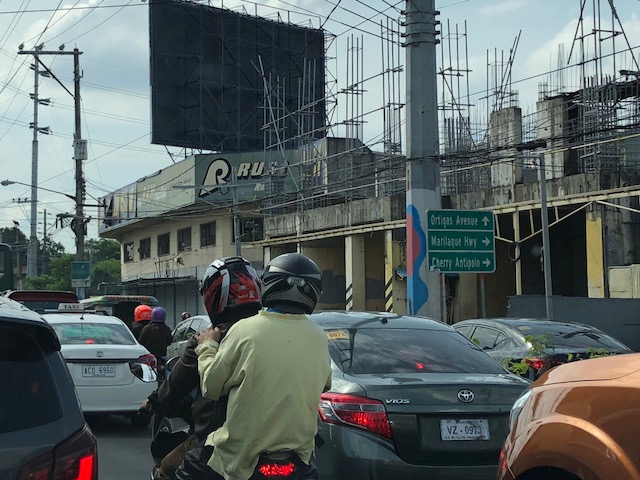 Approaching Cainta Junction from Antipolo, there is a sign that advertises Cherry Antipolo, which is all the way back and past Masinag Junction along Marcos Highway.
 Less than a kilometre away from Masinag Junction along Sumulong Highway, there’s another ad posing as a road sign and from a certain angle it covers a more important traffic advisory concerning the construction of the Line 2 Extension.
 This ad doesn’t even pretend anymore since all directions point to an Ayala Mall!
Following are examples of what may be tolerated and what must be disapproved and therefore removed. Guidelines are important so that the criteria for signs including ads masquerading as such will be clearly spelled out and approval/disapproval will not be
Logical: The photo below shows a sign installed by the DPWH showing the general directions for towns (Cainta, Taytay, Antipolo) or major thoroughfares (EDSA). The smaller sign is actually an ad for a mall but is located near a major junction (Cainta Junction – intersection of Ortigas Avenue Extension and Felix Avenue/A. Bonifacio Avenue) and may perhaps be tolerated as the mall is close by. Such a sign can be justified to assure or validate the direction to be taken by a traveler headed for this mall.

Not logical: The sign below is meters away from Masinag Junction in Antipol but advertises the same mall as the previous sign. It is not logical and should not have been approved since it is far from the destination mall and does not offer a validation or assurance for direction like the previous sign. In fact, the same mall chain has a branch nearby in the Masinag area and another one further on along the Marikina River. This sign should be removed as it adds to the clutter, the visual noise that makes people blind or numb to the actual road signs that require their attention.

[Disclaimer: For purposes of transparency, my colleagues and I also have worked as consultants for projects such as malls but never have we recommended for signs like these.]
–
On the need to increase NMT and public transport use
A recent report reinforces what many of us already probably know or are aware of – that we need to shift away from dependence on car use to more sustainable modes of transport in the form of non-motorised transport (NMT) and public transportation. Here is the article from the AASHTO Journal:
Global Climate Report Calls For Expansion Of ‘Non-Motorized’ Transport And Public Transit (2018)
There is a link to the report in the journal article. The report is conveniently available in PDF form and is very readable (i.e., not overly technical).
Incidentally, I was involved some time ago in a project led by the group Clean Air Asia (CAA), which involved several experts from across ASEAN as well as Japan that attempted to determine the necessary transport programs and projects in the region to stave off the projected increase in global temperatures. In all the scenarios evaluated, non-motorised transport (NMT) and a rationalised public transportation system By the term ‘rationalised’ I am referring to the use of higher capacity vehicles as against the taxis and tricycles that typically carry few if not one passenger. Here is a link to the final symposium for that study that has links to the materials presented:
The Final Symposium on the “Study on Long Term Transport Action Plan for ASEAN”
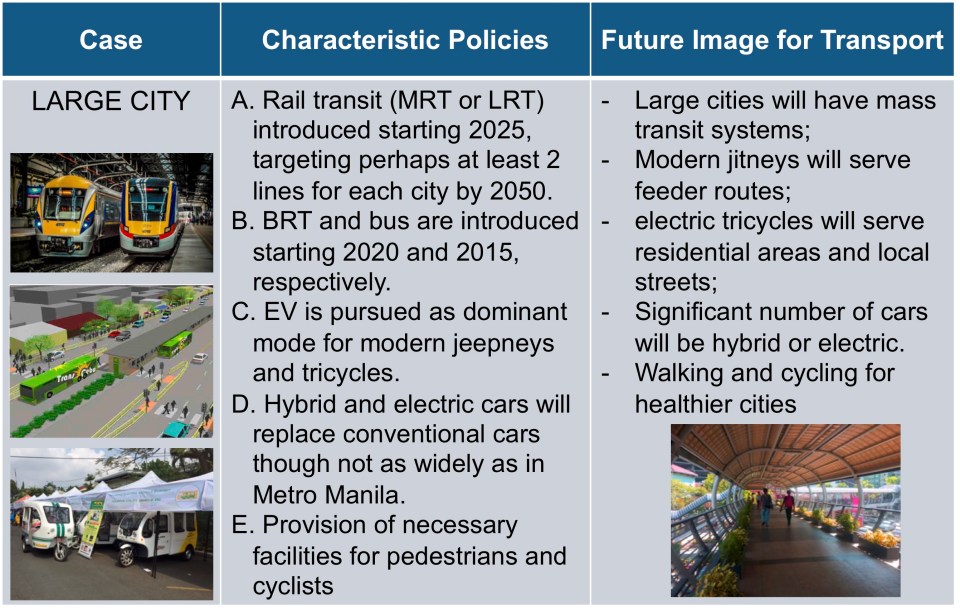
Here’s a slightly updated slide on the future image for a large city in the Philippines:
–
On lack of funding for government institutions
The recent brouhaha over a popular (some may say infamous) media personality’s criticism of the Philippine General Hospital’s (PGH) Emergency Room (ER) and its protocols bring to mind the state of that hospital’s resources especially as it is expected to cater to the needs of so many (too many perhaps?) people. The PGH is arguably the premier government hospital and is also a teaching one with the University of the Philippines Manila’s students in their Colleges of Medicine and Allied Medical Professions providing a significant part of the manpower for the hospital. The PGH like many other institutions like it lacks the funding it needs to provide the services expected of it. The millions it received as part of the UP budget is not just for patients but also covers salaries and operating costs for the hospital. And yet it is able to deliver much more than what it is given in terms of resources.
I suddenly recall the many occasions when the National Center for Transportation Studies (NCTS) was called upon by national agencies and both legislative houses to comment on national and local transportation issues. In many cases, the Center was asked if it can develop models and other tools to aid agencies and congress in decision-making. The Center’s response has always been positive but with the condition for it to be given the resources it needs to do the tasks expected of it. It is not possible to come up with detailed, realistic transport simulation models for cities, for example, without the sophisticated, industry-grade software and the data required to calibrate it. The agencies and congress can only promise to provide the necessary resources and so far we these have yet to translate into something tangible.
So I find it sad for people to be bashing the hospital and others like it for what they think is poor performance for such institutions. Private hospitals like St. Luke’s and Medical City, mind you, deliver similar services but for many times the cost. You expect hotel-grade rooms and atmosphere, then you should expect to pay for those. You expect a world class research centre, you need to provide for its resources including funding for research. Lip service or “laway” doesn’t give you much in terms of the desired outcomes. Mabuti pa yung micro-satellite malaki ang pondo! And with all due respect to my friends who are involved in that program, they have shown what full funding support can do in terms of accomplishments.
–
Article on housing and transportation
Here’s another excellent piece from Todd Litman about the dynamics of housing and transportation. This is a very relevant topic in many cities today and especially so for those like Metro Manila, which is struggling with issues pertaining to affordable housing and transportation infrastructure and services. Arguably, a lot of households are spending more than the 45% threshold of incomes mentioned in the article but people continue to get homes away from the city as these are relatively cheaper than those closer to their workplaces and schools. Unfortunately, transportation costs are on the rise and congestion and a lack of an efficient transport system are among the culprits for what many have already labelled as undignified and atrocious costs of commuting.
Litman, T. (2018) “Affordability Trade-Offs,” planetizen.com, https://www.planetizen.com/node/99920?utm_source=newswire&utm_medium=email&utm_campaign=news-08092018&mc_cid=e2a69b6eb4&mc_eid=9ccfe464b1 [Last accessed: 8/9/2018]
I envy the guy for being able to present these topics clearly. It is a complex subject and one that isn’t understood by many in government who are supposed to be responsible for crafting and implementing policies and programs to address issues pertaining to affordable housing and commutes. I wonder if Todd is coming over for the ADB Transport Forum. He’s make for a good resource person in some of the sessions there and perhaps can also be invited to speak about this and other relevant and urgent topics in a separate forum. Anyone out there care to sponsor him?
–
 Caught (up) in traffic