
Home » Governance (Page 31)
Category Archives: Governance
Road crashes in Antipolo
I open June with a post on road safety. Last week, I passed by many road crash scenes along my route between my home in Antipolo and my office in Quezon City. Many were the now common crashes involving motorcycles. And there were those involving vehicles that got too close to each other in heavy traffic (e.g., tailgating vehicles eventually bumping the vehicle ahead of them). I was able to get photos of the site of the more serious crashes.
 Head on collision of a car and owner-type jeepney along Marcos Highway near the junction with Amb. Neri Road. These crashes are largely preventable if drivers kept to their lanes and refrained from violating the rule of the double yellow line separating opposing flows of traffic. I’ve written about counter flowing before but focused on it leading to traffic congestion. A more serious repercussion would be crashes like this.
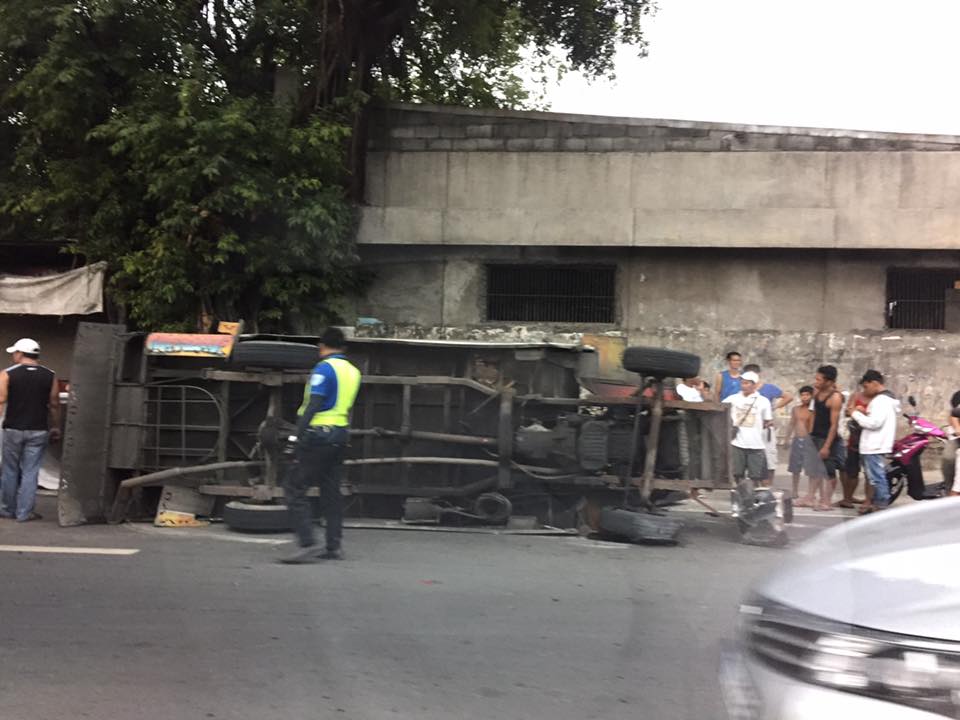 Overturned passenger jeepney along Marcos Highway in Mambugan, Antipolo. Speeding and unnecessary manoeuvres along this highway often has led to drivers losing control of their vehicles and, in this case, the vehicle turning over and likely hurting (hopefully not killing) passengers. This is again a very preventable crash considering it can be addressed by proper (read: safe) driving as well as enforcement.
 Final ‘resting place’ of a truck that apparently lost control along the Tikling bound side of Ortigas Ave. Extension in Barangay Dolores, Taytay. I’ve noticed many breakdowns and crashes involving trucks along this highway as well as Sumulong Highway and Marcos Highway. Many, it seems, involve poor maintenance of these vehicles as well as overloading. Poorly maintained vehicles may lose control with or without their loads and lead to such crashes that in many cases are fatal to innocent bystanders.
With the onset of the rainy season, many roads will be slippery and this will tend to make them more dangerous. In the cases I mentioned above, most crashes are not the fault of the roads or the infrastructure but of the drivers and/or operators of the vehicles. Most crashes are preventable and are caused by driver error, negligence or aggressive behaviour. It is often the nut behind the wheel who is responsible for such crashes rather than the vehicle or the road.
–
Better indicators than GDP
A friend shared this article on social media:
Five measures of growth that are better than GDP
The article explains in clear and simple terms five better indicators of growth and development than what is regarded as the conventional and traditional measure that is gross domestic product (GDP). There is an analogy in the article using speed, a parameter in traffic, to explain how GDP is insufficient in describing growth in a more complete manner. For example, in the Philippines, the significant increase in GDP over the last 6 years has been mentioned as proof of economic growth. While this is true, many people could not appreciate this growth since there is the perception is that it is not inclusive. That is, economic development is not felt by many who are in the lower income classes.
Speed, indeed, is not enough to describe the transport situation along a road considering that there are other metrics needed to have a more complete picture of transport and traffic conditions. I will talk about this in another posting soon.
–
A new Department of Information
The big news today is the creation of a new Department by virtue of a new law signed by the outgoing President. The news article describing this new Department may be found in the following link:
Department of Information and Communications Technology created
This is a significant development as the next President of the Philippines already named his man for the Department of Transportation and Communications (DOTC) and now he has to deal with a new Department and more appointments.
With the DOTC (or DOT?) now reduced to dealing only with transportation, perhaps it can be more focused on the issues it needs to address immediately, over the next 6 years and beyond (i.e., from a strategic perspective). Also, perhaps the next administration can take a look at the possibility of having a merger of the transportation department and DPWH. Of course, such a merger would require a really good person on top to lead. This person should not only be an excellent manager but also a master strategist, with a clear and progressive vision for a modern, efficient transportation system for this country.
–
Questionable choice for DPWH Secretary?
I had only recently written about appointments to top government posts when I learned about the offer of the DPWH top position to a politician who is also the son of power couple of former and present senators. Their core business is real estate development so there is definitely going to be conflicts of interest whenever certain infrastructure are built that will favour the development of their lands. This is basically the issue for the controversy regarding the Circumferential Road 5 Extension more than 6 years ago, which alleged that former Sen. Manny Villar (then running for President) influenced the DPWH to construct the highway that mainly benefited lands his company developed.
Having a politician at the helm of the DPWH is not a good idea. While apologists for the President-elect want us to give the guy a chance and explain that the soon-to-be-President probably saw something in the congressman that makes him qualified for the job, I must disagree with them given what I’ve seen up close with the DPWH. Here are a few arguments against a politician being DPWH Secretary:
- A politician as head of the DPWH will be more likely to give in to politicians (e.g., congressmen) requesting the appointments of ‘more favourable’ District Engineers (i.e., those who will do their bidding). This is basically going back to the ‘padrino’ system that is undesirable for such posts as they become prone to abuse and anomalies particularly in contracting.
- The DPWH Secretary chairs the Road Board, which is in-charge of funds collected from Motor Vehicle Users Charge (MVUC). This means the Secretary will have a say on how funds will be allocated and disbursed under the difference special funds (e.g., Special Road Safety Fund and Special Vehicle Pollution Control Fund). A politician will have no qualms approving requests for projects proposed by his allies or party-mates regardless of the merits or justification (weak?) of a program or project. This position requires objectivity and insulation against political pressure that may lead to questionable decisions.
- Governance-wise, the DPWH Secretary is expected to have a clear vision for the agency and must be an imposing figure to an organization where everyone under him including Undersecretaries and Assistant Secretaries will be organic staff. This is unlike other agencies where the Secretary gets to bring in his/her own people to appoint as senior officials (e.g., DOTC). And DPWH will only perform as good as its head. Outgoing Sec. Singson has shown how good and efficient DPWH can be under an excellent Secretary. Past heads have already shown how bad DPWH can be.
A couple of friends also mentioned that the DPWH Secretary sits on the National Water Resources Board (NWRB) and the Metropolitan Waterworks and Sewerage System (MWSS) is basically under the DPWH. There is conflict of interest here because the Villars own a water concessionaire in Primewater. The DPWH Secretary will also sit on the Infrastructure Committee (Infracom) that screens and approves major infrastructure projects around the country.
Since the next President has already decided on his choice for DPWH Secretary and the nominee has already accepted this, then we can only cross our fingers and hope that his appointee will be doing a good job and will uphold the current mantra of the DPWH: right projects, right cost, right quality, right on time and right people.
–
On critical government posts related to transportation
The camp of President-elect Duterte has been busy the past week trying to determine, among others, who will be secretary of which agency. As far as I am concerned, my interest is in who will be assigned to agencies that have a lot to do about transportation. Thee include the Department of Transportation and Communications (DOTC), Department of Public Works and Highways (DPWH), National Economic Development Authority (NEDA) Department of Environment and Natural Resources (DENR), Department of Energy (DOE) and the Metropolitan Manila Development Authority (MMDA). DOTC, of course, is the main agency and has under it several front line agencies like the Land Transportation Office (LTO), the Land Transportation Franchising and Regulatory Board (LTFRB), the Philippine Ports Authority (PPA), the Maritime Industry Authority (MARINA), the Civil Aviation Authority of the Philippines (CAAP), the Light Rail Transit Authority (LRTA) and the Philippine National Railways (PNR).
So far, what we know is that the DOTC portfolio will be given to Arthur Tugade, the former head of the Clark Development Corporation (CDC). Tugade has the confidence of Duterte as they are good friends and were classmates at the San Beda Law School. I’ve met Tugade once when we presented the outcomes and recommendations of a traffic study for a project at the Clark Freeport only a few months ago. The National Center for Transportation Studies (NCTS) of the University of the Philippines Diliman has had a productive relationship with Clark from the time the Center came up with a comprehensive transport and traffic master plan for the free port back in 2010. Tugade has been very productive in expanding businesses at Clark and has been quite an astute figure in his dealings with various political leaders in the region especially with respect to the local governments of Angeles City and Mabalacat. I wish him well at DOTC and hopefully, he can harness its much maligned organic staff like what he has done at CDC. There are so many challenges at DOTC including assigning good people at the LTO and LTFRB.
I hope Duterte retains Sec. Rogelio Singson as head of the DPWH . I had made the observation before that the DPWH is only as good as its head and Singson has been an excellent DPWH Secretary, introducing and institutionalizing many reforms to the agency so much so that it has been performing way above expectations and corruption has been curbed in many areas. In terms of e-governance and open data, the DPWH has been a bright spot in the past administration so much so that its performance in implementing infrastructure projects including those convergence programs with other agencies has made the DOTC look really bad.
As for the other agencies, I can’t think of any names yet as I am not very familiar with Duterte’s inner circle but based on what his camp has already announced, there will be people from the administrations of former Presidents Ramos and Arroyo, a throwback perhaps to the once powerful Lakas party than Duterte’s PDP-Laban. I am anxious to know who will be the next NEDA Director General. NEDA has a big role being the agency consolidating infrastructure plans and projects and the convenor of the very influential Infrastructure Committe (InfraCom) that approves projects for implementation. Very interesting, too, would be the appointee to the position of MMDA Chair. The nation’s capital needs a good administrator with an excellent vision for the megalopolis and the skill set to get things done. Hopefully, we will know who these people will be in the next few days.
–
Some thoughts on transport for President-elect Duterte
My colleagues and I were talking about the not so surprising results of the recent national elections in the Philippines. I say not so surprising because people have been clamouring for change for quite some time now. It did not help the current administration and its standard bearer were hounded by the transport and traffic problems experienced by the country especially in Metro Manila. Here are some thoughts for the President-elect and whoever will be part of his transportation team:
- Come up with a framework for developing transportation in the country. The framework should contain both soft and hard measures. On the soft side would be strategies and policies like those promoting sustainable transport especially low carbon transport systems. This many include promoting walking, cycling and public transport at the local level. Hard measures would include infrastructure for all modes of transport including railways, airports and ports. Local roads development might be something President-elect Duterte’s team should look into as local roads basically provide accessibility for rural areas and contribute to development. The framework will serve as a guide for the next 6 years for whoever will be in-charge of transport-related agencies. He should have a sound game plan so as to be systematic in the approach to address transport and traffic issues.
- Watch out for and appreciate low hanging fruits. I think the current administration has already initiated solutions to pressing problems but mostly in Metro Manila in the form of the LRT Line 2 Extension and the MRT Line 7. There is also the new rolling stock for MRT Line 3. Pres.-elect Duterte’s team should already look into the mass transit needs of other highly urbanized cities such as Cebu, Iloilo and his hometown of Davao. Whether these will be road or rail-based systems should be the subject of studies to determine what can be completed immediately and within the term of the President and which need substantial investments and perhaps engagement with the private sector. The mention of “paralysis by analysis” by critics of the outgoing administration can be traced to the latter’s seeming disregard of the accomplishments of its predecessor, which could have been implemented early on during the term. The next administration should not make the same mistake.
- Just do it. That was the mantra of the late Sen. and former DOH Sec. Juan Flavier, which he got from Nike. Transport and traffic problems in this country has worsened over the years due to the slow development of infrastructure coupled with issues on land use planning. These two actually go hand-in-hand. Metro Manila is already at a stage where indeed it will take long-term planning and infra development to solve (i.e., significantly reduce) congestion (note: You cannot eliminate congestion for a megalopolis like the NCR). Meanwhile, it is not too late for other major cities so investments and infra development should start under his watch. For starters, completing the proposed Cebu BRT and building a mass transit system for Davao should serve as inspiration for other cities to follow. Already there is a need for sophisticated public transport in emerging metropolitan areas like Iloilo, Bacolod, CDO and Angeles-Clark-Mabalacat. These do not require 12 years but perhaps with urgent action be addressed within 6 years. This, of course, should go together with the building infrastructure for walking and cycling where applicable and in relation to transit development.
–
How did Mar Roxas lose? Top 10 transport-related reasons
I started writing this days before the national elections and if we are to base our forecast of Monday’s results on surveys and what’s circulating in mainstream and social media, then “change” will most likely be coming. Whether this change is a breath of fresh air or something that stinks and is just being masked by people around and behind him we will only know once he and his team starts working on rebuilding this country from what seems to be a most tumultuous and divisive campaign.
While it is possible to list down a lot of reasons from different aspects of his campaign, I would like to think that the administration’s standard bearer lost in large part because of his and the administration’s failures in transportation. Here’s my top ten transport-related reasons for why the Liberal Party’s presidential bet lost his bid to become the Philippines’ President:
- MRT-3 mess – the new coaches of the EDSA MRT-3 went into service today. People associate the current administration’s failures with images of long lines at MRT-3 stations and people walking as they leave stalled or defective trains. These are powerful images even as government claimed they were working on solutions to acquire new rolling stock and provide the maintenance the line needed.
- Paralysis by analysis – despite having many “low-hanging fruits” (i.e., projects ready to be implemented) from the previous administration and his predecessor at DOTC, Roxas and his people embarked on their own studies that seemed to take forever to finish. Many of these were with the PPP Center and it seemed that the government didn’t want to have any part in infrastructure development but passed this responsibility to the private sector.
- LRT-1 Cavite extension – this is a PPP project that also until now has not been implemented. Add to that the alleged circumstances for this project and the privatization of Line 1 where one company was most favored over others. Incidentally, the same company seems to have bagged a lot of projects under the current administration.
- BRT – Bus Rapid Transit (BRT) projects in Cebu City and Metro Manila are examples of projects that were developed by the previous administration and were ripe for implementation but are yet to take off.
- NAIA controversies – “tanim bala,” “malas,” delayed flights, blackouts, dirty toilets, the list goes on…you name it and they have it at the NAIA terminals.
- DOTC Sec. EA Abaya – the face of DOTC after Roxas and one who has come to be associated with what is perceived as a poorly performing agency. He should have been fired from the job years ago but for one reason or another he has stayed on at the agency and brought much damage unto the Roxas campaign. One has to wonder why Roxas refused to do some self examination and call for Abaya’s resignation. Hindi ba siya nakahalata na yung mga taong dapat sana ay kakampi ay nakasira ng husto sa chances niya maging Pangulo?
- NAIA Manager Honrado – the capital airport manager’s boo-boos including the “tanim bala” controversies and the bungled renovation of Terminal 1 easily put the manager as a symbol of ineptness. His being associated to the President as a former classmate did not help his cause as “classmate” had become synonymous with being “favored” despite failures.
- PNR – the only remaining long distance railway line in the country is still in a state of disrepair. There have been opinions that this was to government could sell it cheap to the private sector.
- North EDSA common station – the most appropriate location for the common station or grand terminal for LRT-1, MRT-3 and the future MRT-7 is in front of the SM City North EDSA Annex. Elsewhere would not be optimal and yet that is what Roxas started at DOTC, after reneging on an agreement with SM pertaining to the design of the station.
- Transport planning and infrastructure framework – few people seem to know that prior to 2010, there have been studies that led to a proposed National Transport Plan and Policy but this was not adopted by the Roxas DOTC with one Assistant Secretary even claiming that there was no framework. Fortunately, NEDA took the responsibility to develop one with little help coming from the DOTC.
–
Progress in promoting and realizing sustainable transport in the Philippines
There is a very good article that came out of Rappler last March 28, 2016:
Creating sustainable transport systems: PH’s progress so far
The article caught my attention as I have lost track of what should be the monitoring of sustainable transport initiatives anchored on the pillars of EST as described in the National EST Strategy and the article. The formulation of the national EST strategy started under the administration of President Gloria Macapagal-Arroyo (DOTC Secretary Leandro Mendoza) and was completed under President Benigno C. Aquino III (DOTC Secretary Jose Dela Cruz). The formulation was initiated and supported by the United Nations Centre for Regional Development (UNCRD) and is unique partly because it is the only one to be completed among similar projects across ASEAN. The other countries like Indonesia, Vietnam and Cambodia were only able to get to the baseline and consultations stages of their own national EST strategy formulations. The Philippines National EST Strategy document eventually became an input for the formulation of the National Transport Policy Framework (supported by AusAID) as well as the National Transport Infrastructure Framework (supported by the WB).
–
Candidates for national positions in the Philippines using public transportation
There was a clamour for public officials to take public transportation in order for them to experience what commuters regularly go through when taking public transport. This was especially the challenge to officials of the Department of Transportation and Communications (DOTC) after what seemed to be an endless sequence of breakdowns involving trains in Metro Manila. While some officials and politicians were quick to respond, most if not all were only for photo opportunities (masabi lang na nag-MRT or nag-jeepney or nag-bus). The DOTC Secretary himself also rode the train but with many alalays and was apparently given special treatment judging by the conditions when he rode the train. I remember one senator who was presidential-candidate-to-be at the time fall in line (a very long line at that) at an MRT3 station in Quezon City to experience it herself and declared it was so the experience could help her frame legislation to improve public transport in the country. That was rare and apparently never repeated by the politician despite the praises she received for her doing so without any bodyguards or alalays (assistants).
Some people have been saying that one Vice Presidential candidate is so desperate that she’s taking public transport and having herself photographed doing so. I happen to know for a fact that the said VP hopeful takes public transportation regularly and even from the time when she was not yet congressman. She almost always takes the bus between her hometown in Bicol and Metro Manila. That is not a desperate act but a natural thing for her that few if any of our national officials, elected or appointed, can claim they also practice. This is the VP-candidate in her natural self with no pretensions and no sense of self-entitlement (compared with others who ride their chauffeured vehicles complete with escort vehicles). We need more people like her if we are to address transport and traffic issues cities and the entire country is now facing. These problems hinder development and is something experienced by most people including those who can afford to have their own vehicles for their commutes. We need leaders with first-hand knowledge and experience of how it is to be someone who takes public transport regularly.
–
Bus fixation and quick fixes
The mainstream news and social media have featured a lot about buses recently. These were mostly government initiatives:
- P2P bus services – are operated by a tourist transport company (and now also by a large bus company that operates some routes for Bonifacio Global City). P2P stands for ‘point-to-point’, referring to the end points of a fixed route. For example, buses run non-stop between Trinoma in Quezon City and Glorietta in Makati. These are express buses that offering services that regular bus companies should be providing their passengers in the first place. Since these are non-stop (no pick-ups or drop-offs in between origin and destination, the main advantage is of course reduced travel times. They still operate in mixed traffic so travel times can still be reduced significantly if they had their exclusive ROW. That would make them operate like a BRT.
- Airport premium bus services – are offered by a logistics company owned by a controversial government official heading a sensitive post. At 300 PhP per passenger, a close friend made the observation that you can get a decent enough taxi for that price. And if you were part of a group, then you can probably pool your money to get Uber instead.
There is also the Department of Science and Technology’s (DOST) Road Train, which is an exaggeration of sorts for a multi-articulated vehicle. Typical ‘stretched’ vehicles are the articulated and bi-articulated buses commonly used in BRT systems. The DOST’s Road Train prototype seems to be a combination of 5 buses. Thus, there is the allusion to a train.
The fixation on special buses seems like a stop gap measure (and some state they are), an attempt to address problems due to the government’s failure to deliver any major mass transit projects during its 6-year term. The LRT Line 2 extension doesn’t count as it only began construction a few months ago and won’t be operational until more than a year from now when there is already a new administration in power. The MRT-7 also doesn’t count as an accomplishment of this administration as it is a project that’s been in limbo for over a decade and only has also started work the past two weeks. Actually, these two rail projects were part of the list of low hanging fruits transport consultants and development agencies have identified at the start of the current administration. Hopefully, there are no major snags towards their completion in the next 2 years or so in order to open up opportunities to rationalize road public transport especially along Commonwealth Avenue and Marcos Highway where the impact of high capacity, quality mass transport will be felt once the Line 2 Extension and Line 7 are operational.
–
 Caught (up) in traffic