
Home » Highways and Streets (Page 24)
Category Archives: Highways and Streets
Dike roads and other local roads along the Tarlac River
While doing recon for a project in Tarlac, we inspected several areas where local roads were being used as alternate routes to national highways. Many of the local roads where categorized under Provincial or City Roads but were usually and obviously lower in quality when compared with their national counterparts. In many cases, the asphalt or cement concrete surface has been badly weathered and motorists won’t be able to avoid one pothole after the other.
The following photos were taken along the east dike road of the Tarlac River. The dike is not so conspicuous when seen from the main road during summers. This is in part due to the river usually having little water flowing due to the lahar that accumulated there from Mt. Pinatubo’s destructive eruptions in 1991. It’s a different case during the wet season when the river can overflow due to the amount of rainfall usually brought about by typhoons.
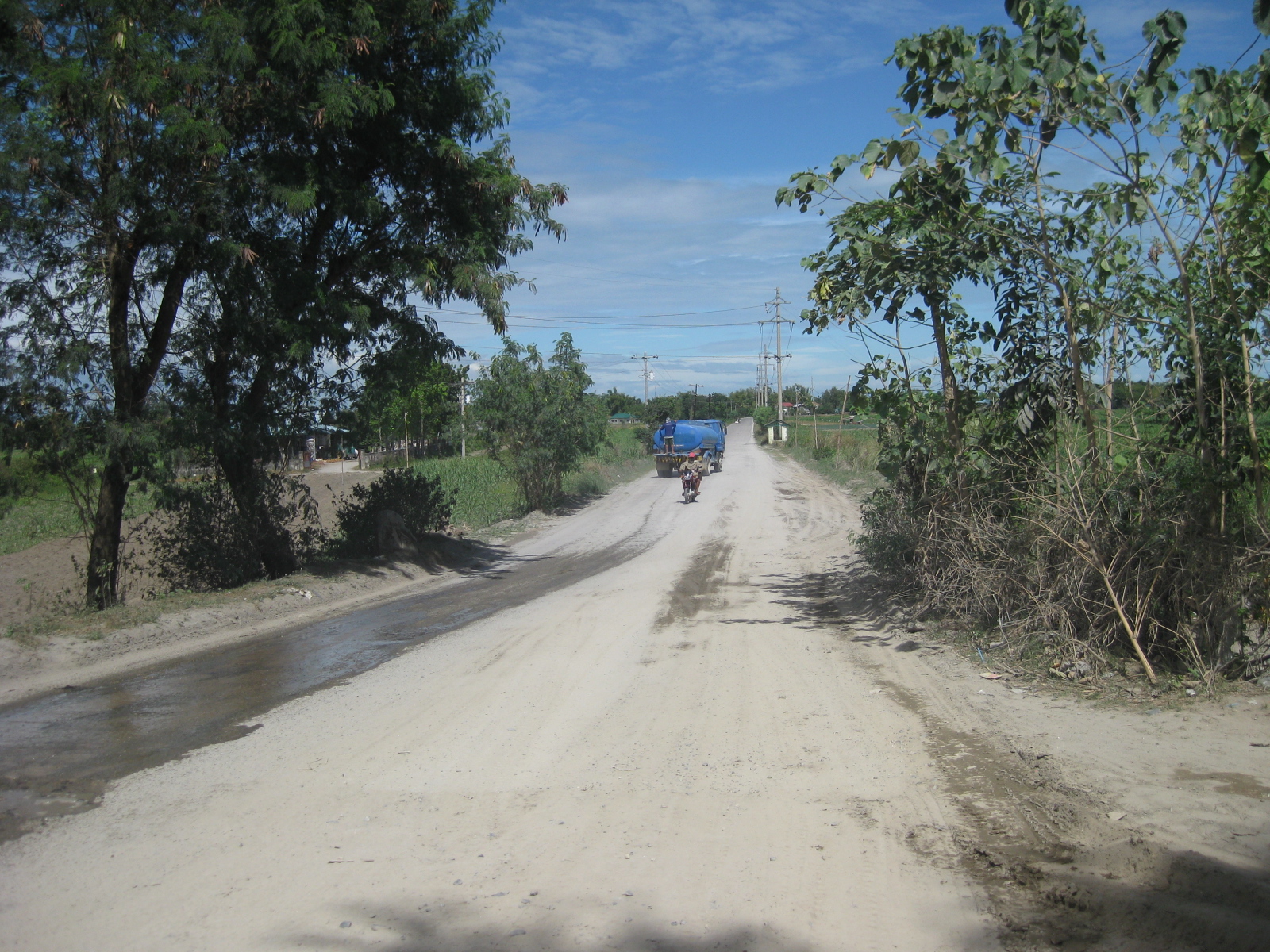 Dirt road from the town of Gerona, Tarlac
 Trucks hauling sand from the riverbed a few hundred meters from our location
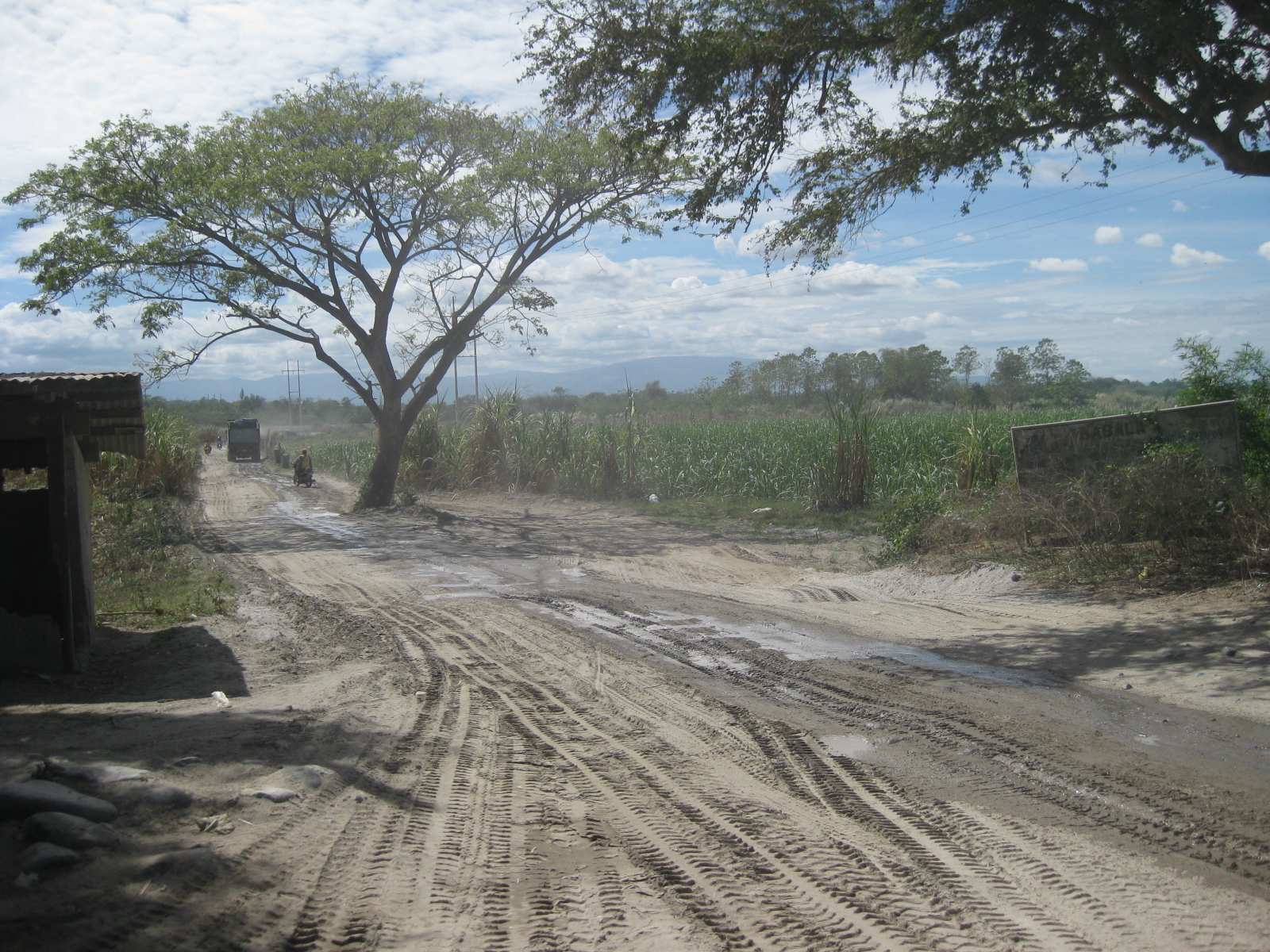 Dirt road access to the riverbed where sand for construction is extracted
 A preview of the dike road on the eastern flank of the Tarlac River
 Mad rush? – a truck overtakes another to get to the sand quarry site first
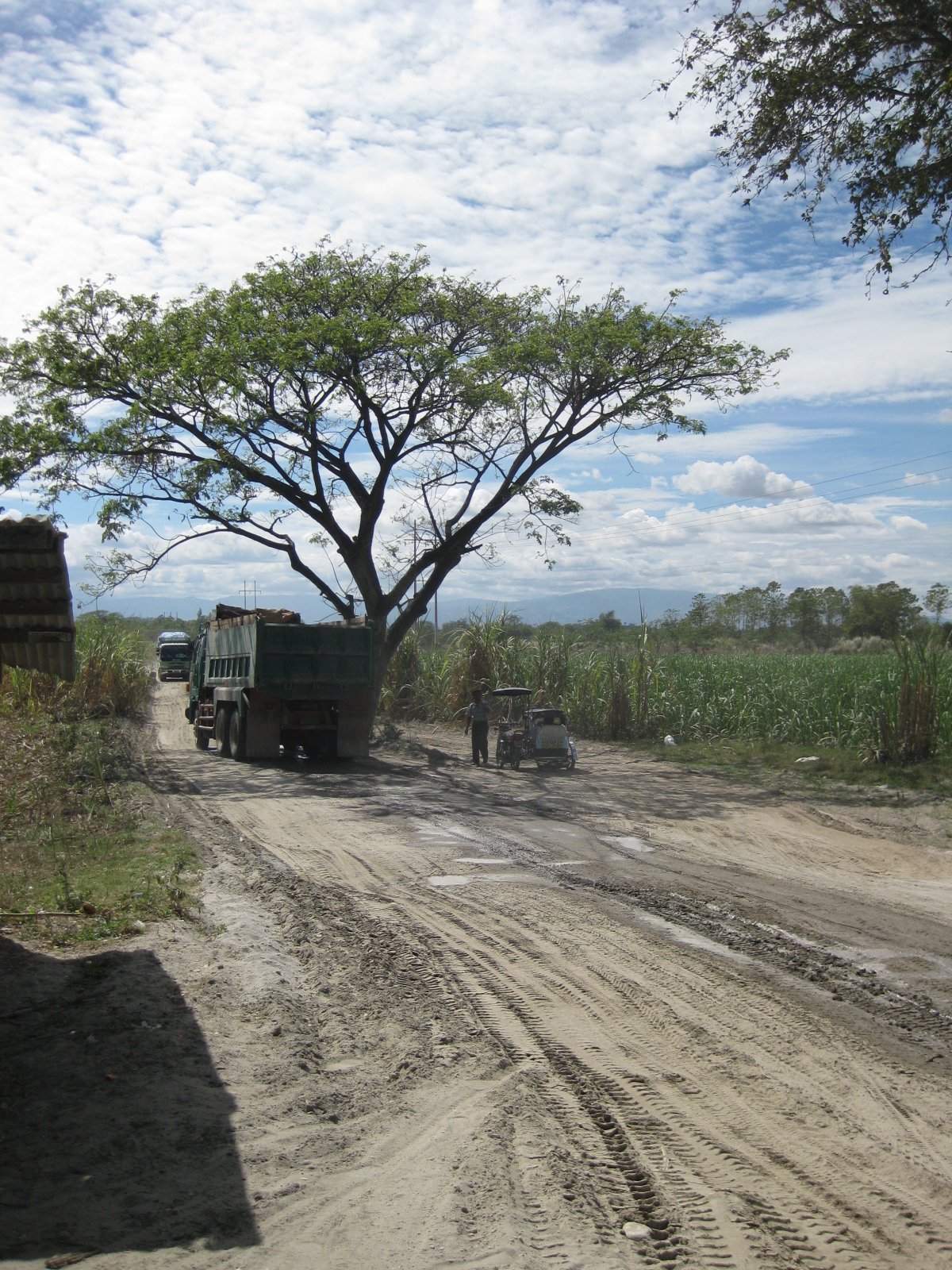 Truck counter-flowing at the tree that serves as a median island of sorts. It’s likely the truck driver made the decision to bypass what looked like a stalled tricycle beneath the shady tree.
 Typical light traffic to the sand quarry
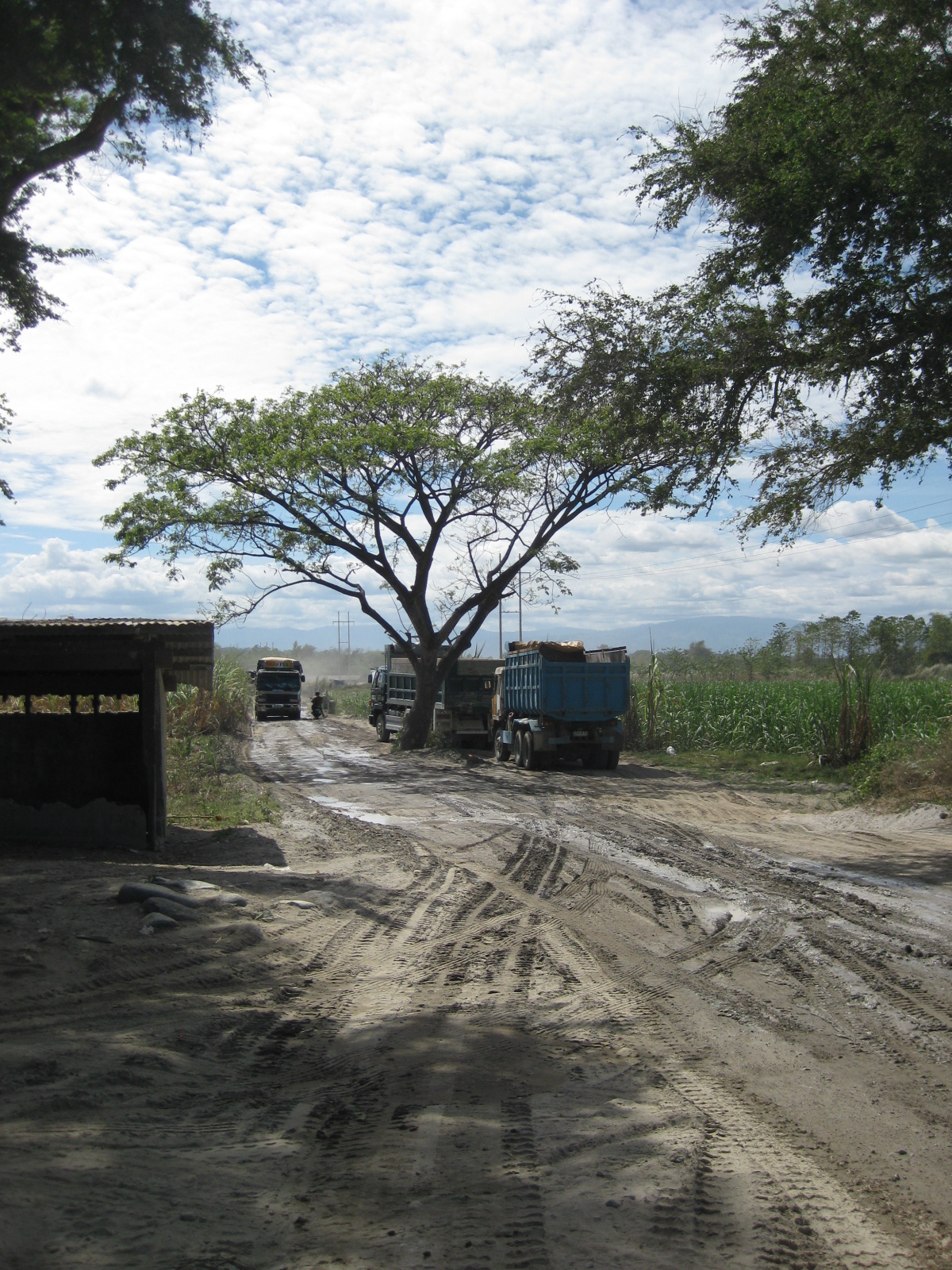 Two-way traffic along the dirt road with the tree serving as a sentinel of sorts.
 Local roads in a community along the westbound extension of the Gerona-Guimba Road (west of Gerona town proper from the junction with McArthur Highway) – the photo shows the extension as seen from a diversion road that leads travelers north towards the bridge to the town of Camiling from Paniqui.
 Concrete roads are used as solar driers for palay and other items (e.g., coconut husks, barbecue sticks, tingting, etc.) can occupy much of the road in areas where there is very low traffic during the mid-day.
 In such cases as above, motorists have no choice but to drive over the palay.
 Local roads are paved and conditions are excellent but have practically no shoulders all throughout their lengths.
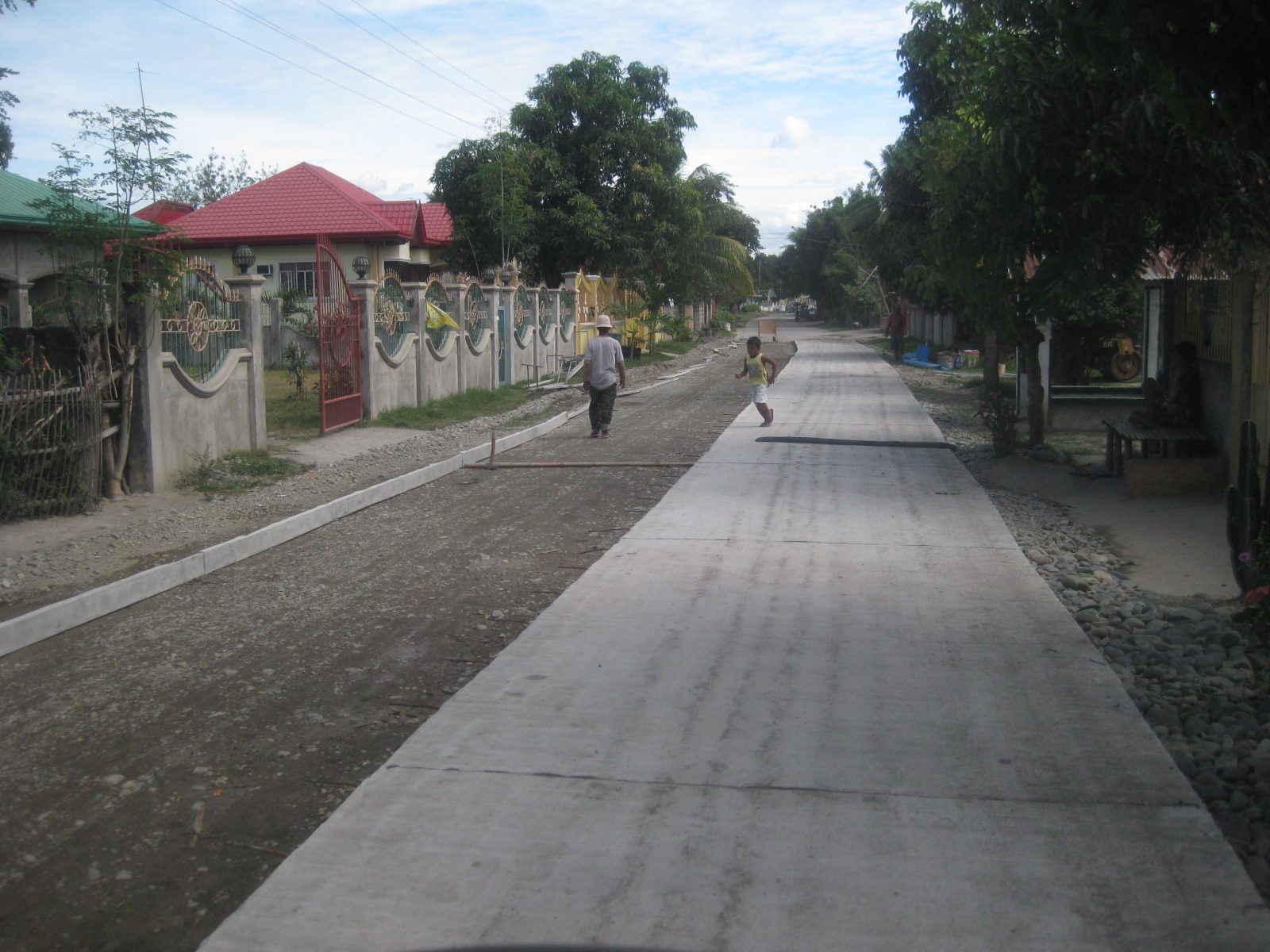 These used to be dirt roads but the local governments, likely with the assistance of the local congressman, seem committed to having them concreted.
 Some sections are a bit narrow and could fit two tricycles passing each other but could be a challenge with larger vehicles. Such widths though are good enough for such low traffic volume roads.
 Both sides of the road are inhabited and have been planted with flowering plants (e.g., bougainvillas, santan, gumamela, etc.). Bananas are quite easy to grow and bear fruits almost immediately and productively.
 End of the paved part of the dike road – from this point, its a dirt road until just before the junction with the Paniqui-Camiling Road.
 The face of the dike is visible on the right side in the photo. I like this photo and the previous one because they show the vastness of the Tarlac River that have been covered with lahar.
 I got curious about the cultivation along the riverbed and our driver told us these were onions that were able to grow on the thin soil.
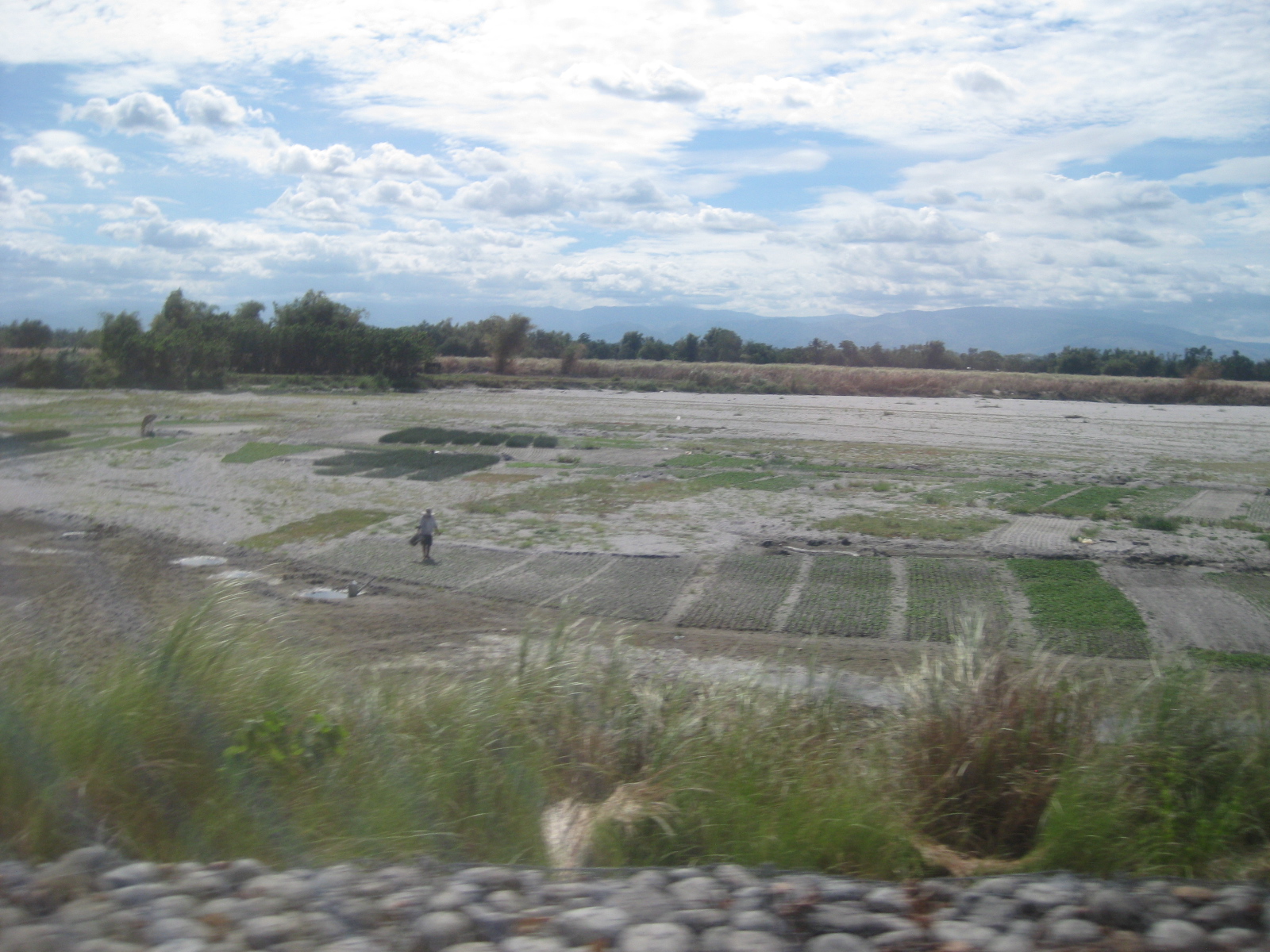 Another look at the onion plantations along the Tarlac Riverbed
 The Paniqui-Camiling Road at the north end of the dike road
–
Streetlights along Roxas Boulevard
Me and some colleagues decided to have an early lunch after a meeting in Manila one morning and ended up at a fried chicken restaurant at Malate along Roxas Boulevard. As it was still early, we were able to get choice seats with a window from across Roxas Blvd. and had a clear view of the road also known as R-1 and the service road between it and the restaurant. As we were exchanging stories and making observations of traffic during a summer morning we noticed the streetlights along Roxas Blvd. and casually exchanged remarks (and laughs) for what seemed like a “showcase” for different light posts along a road that is traversed not just by citizens of this country but also visitors (i.e., tourists).
 That’s the 4-lane service road along Roxas Blvd. just across from the restaurant. Roxas Blvd. itself is on the other side of the island with the electric post at the center of the photo.
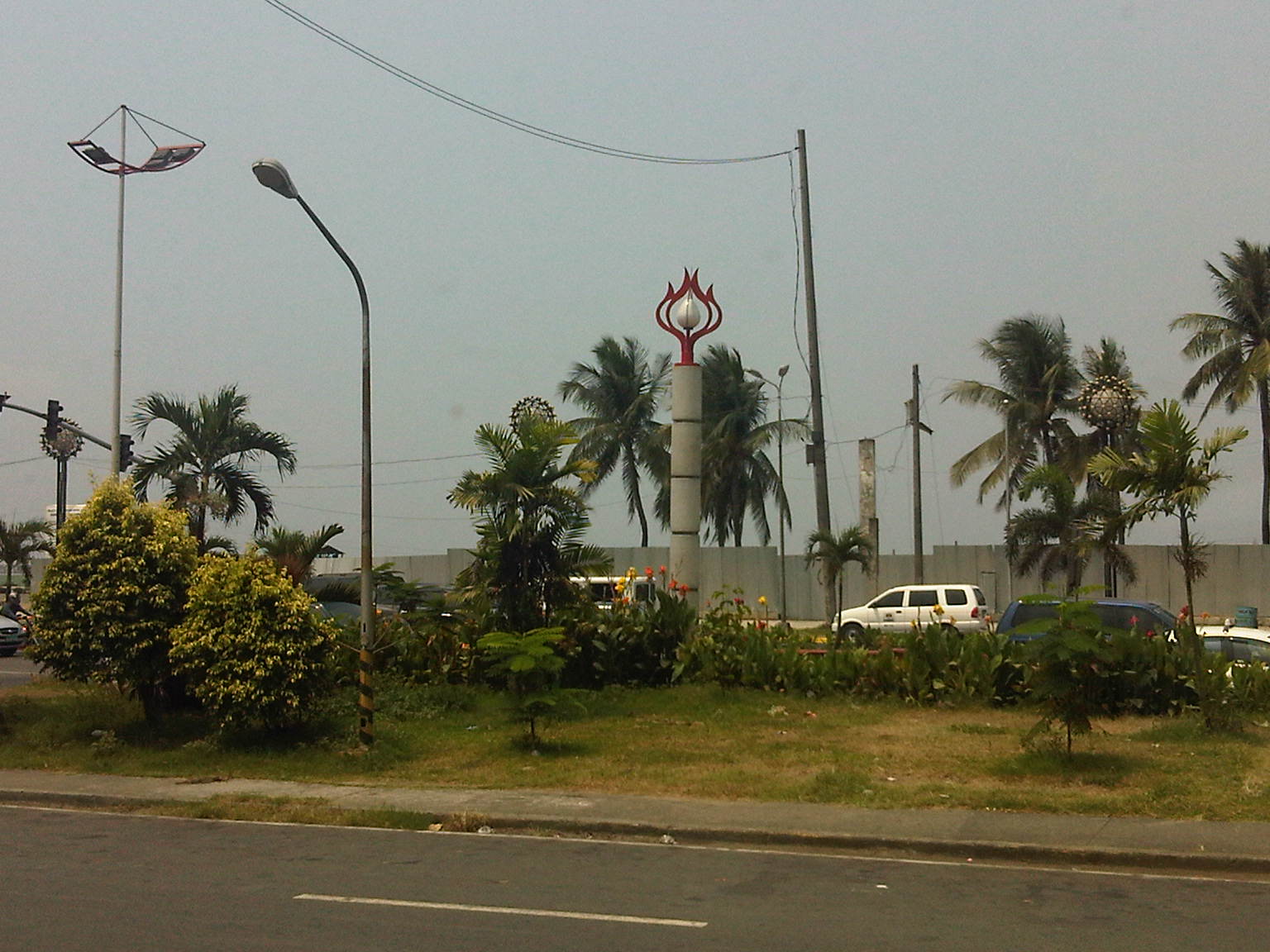 There are three streetlight designs along Roxas Boulevard, at least along the section in the City of Manila. The first one the right in the photo seems to have the atom as an inspiration. The second, at the center of the photo, looks like a torch with the flames shaped in red-colored steel. The third, on the left of the photo, looks like a swing or a hammock and is similar to the much-maligned lamps in Cebu City.
These different streetlights along Roxas Boulevard are definitely examples of folly. They are a waste of public funds and sadly has not led to the proverbial heads rolling as a result of the obvious waste of money. Moreover, there might also be a likelihood of money being pocketed by corrupt persons as is likely the case for such situations in the Philippines.
–
Circumferential Road-4: R-10 to Monumento
Circumferential Road 4 or C-4 is perhaps the busiest among the major arterials of Metro Manila. It is usually associated with its longest segment named Epifanio De los Santos Avenue or EDSA, which stretches from the SM Mall of Asia in Pasay City to Monumento in Caloocan City. There are two other segments of C-4: C-4 Road (R-10 to Letre/Samson Road), Letre Road (Malabon City Hall to Samson Road), and Samson Road (Letre/C-4 to Monumento). All in all, the road cuts across eight cities in Metro Manila: Navotas, Malabon, Caloocan, Quezon City, Mandaluyong, Pasig, Makati and Pasay.
 After turning from R-10, one is greeted with a 4-lane road that at the time didn’t have pavement markings to distinguish the lanes.
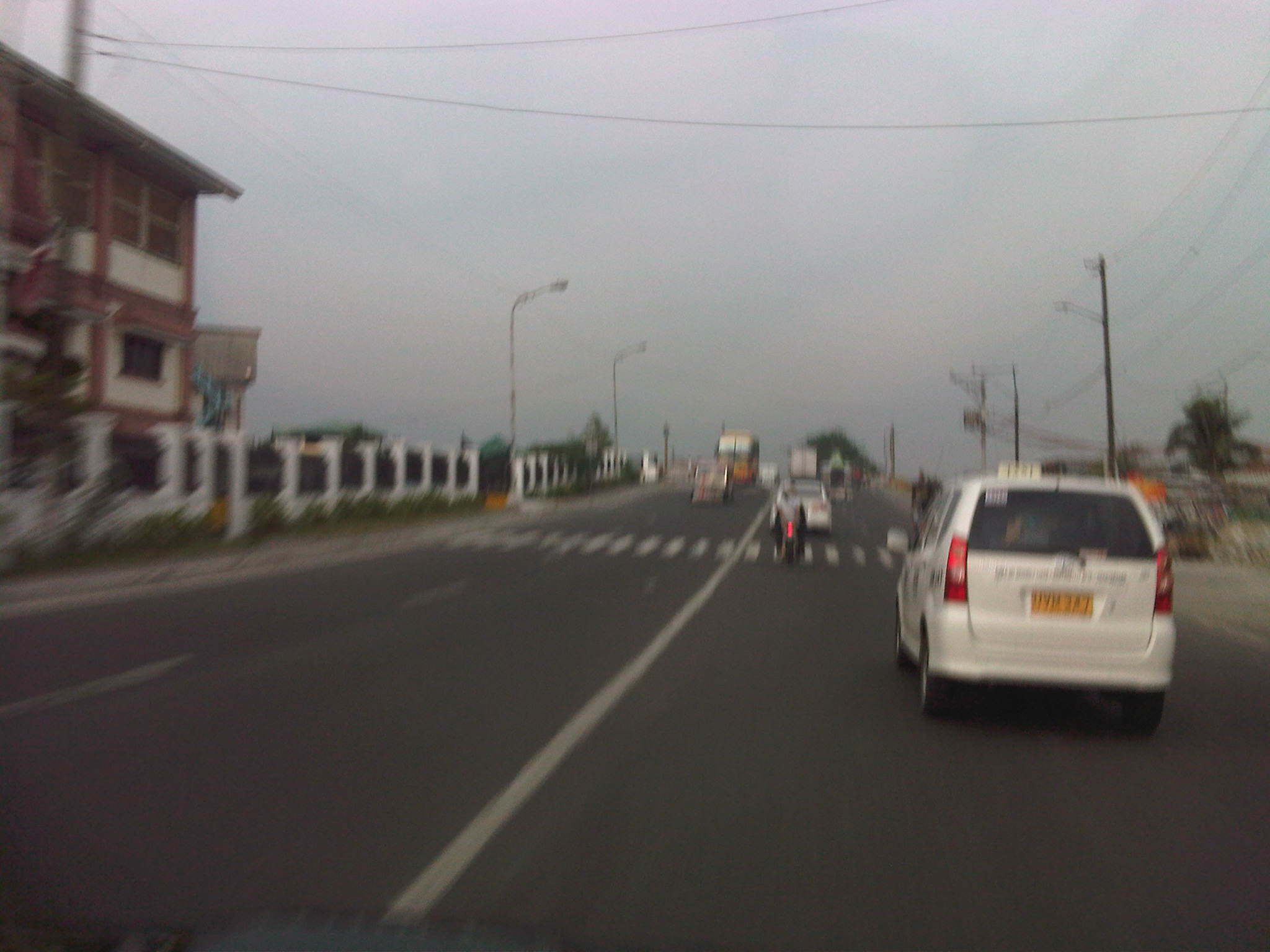 After covering some distance, pavement markings appear before reaching the bridge that connected the Navotas part of C-4 with Malabon.
 The bridge spans the Navotas-Malabon River, which goes around this point and meanders back to Malabon and Caloocan.
 Between the first bridge and the next along the way to Monumento, travelers have a view of the section of Navotas-Malabon River meander on the right side. Garbage floating on the river are quite noticeable but not as many as in the past.
 The 4-lane undivided road eventually becomes a divided road with a median island separating opposing flows of traffic.
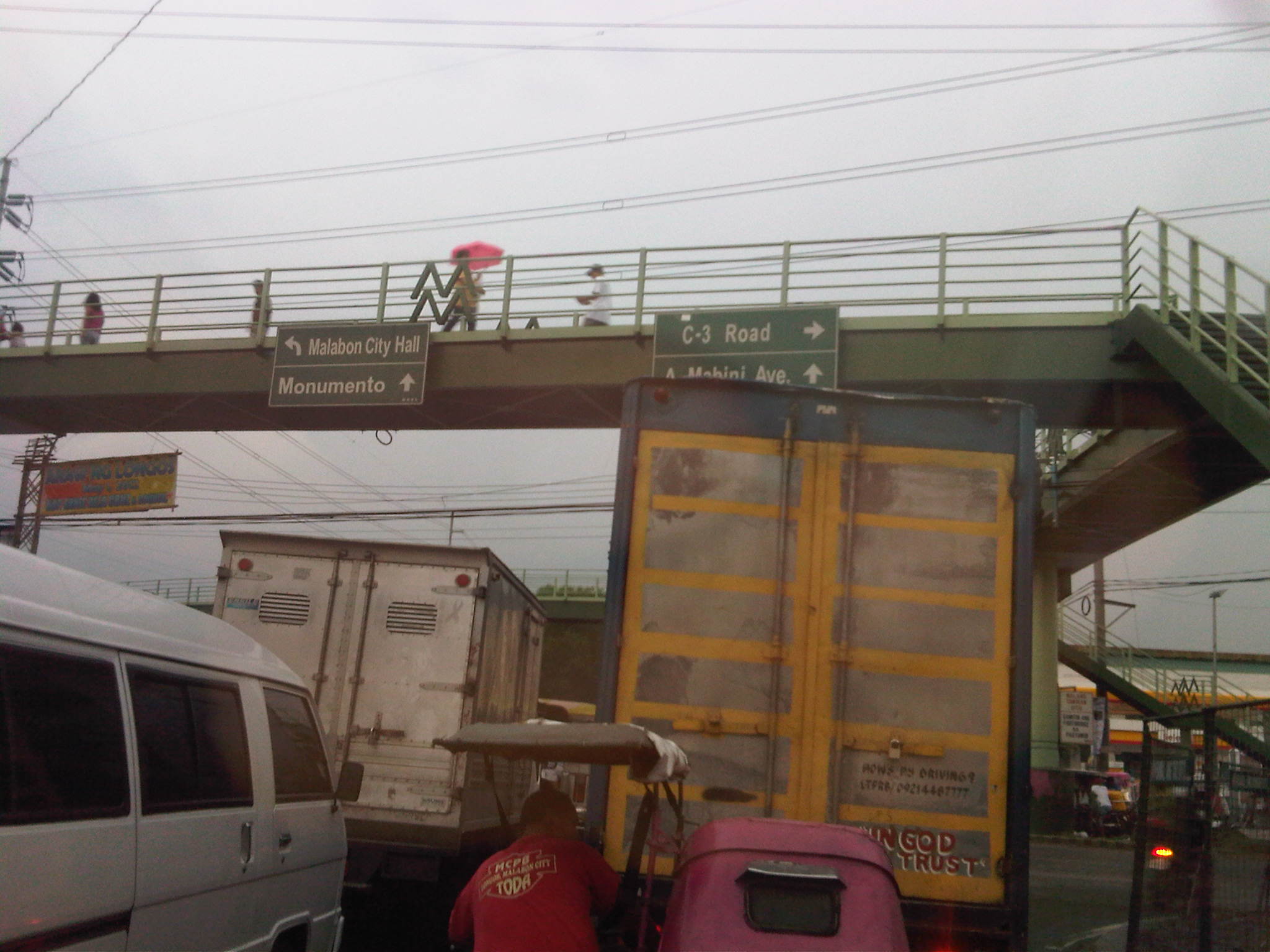 Pedestrian overpass with directional signs before the intersection with Dagat-dagatan Avenue.
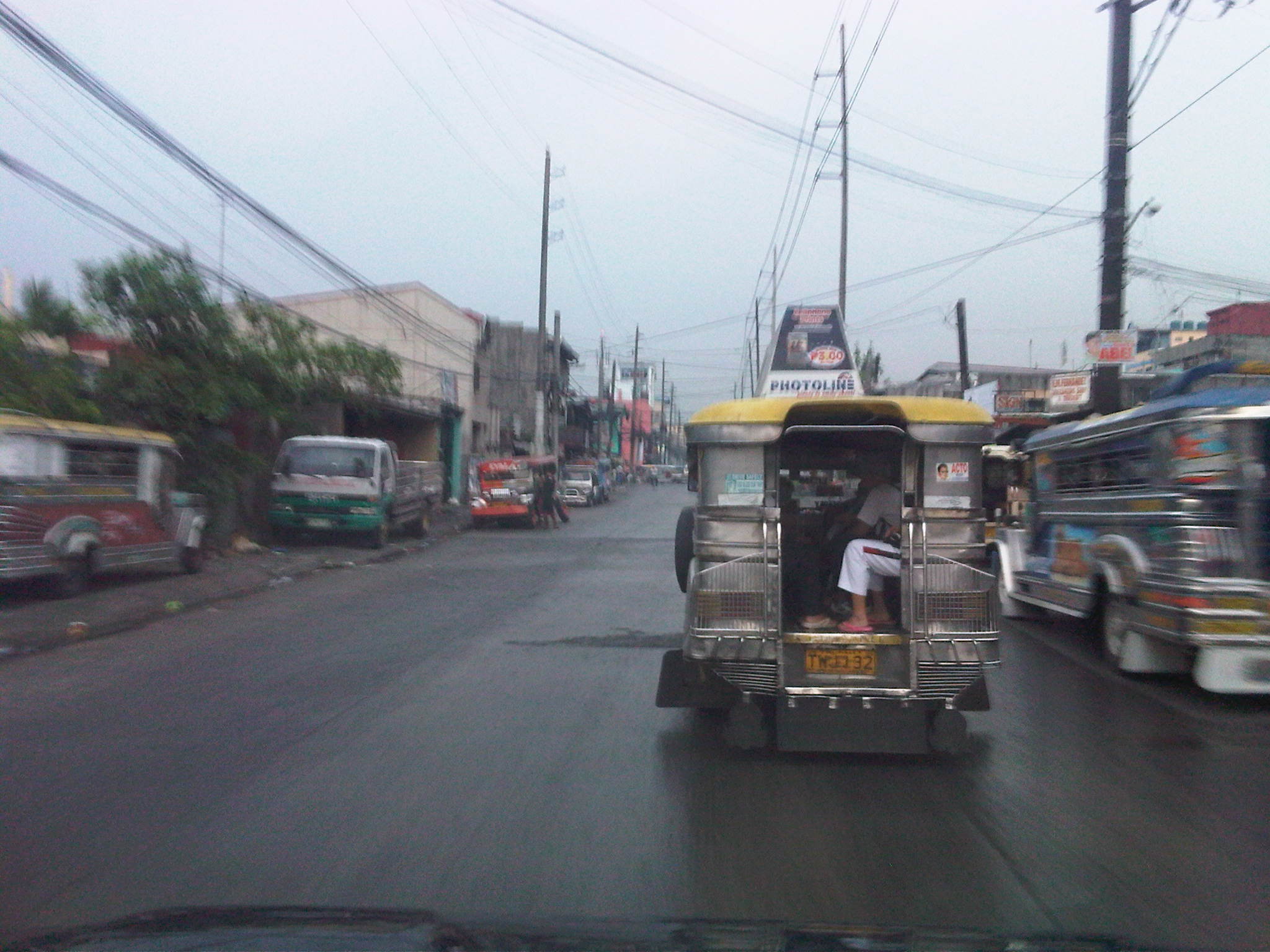 This is supposed to be a 4-lane section but it seems the roadside friction, driver behavior and the lack of pavement/lane markings contribute to the perception of limited space along C-4. Pedestrian sidewalks are also used as parking space by jeepneys and trucks as shown in the photo.
 Roadworks at the approach to the intersection with A. Mabini/M.H. Del Pilar from where C-4 is known as Samson Road.
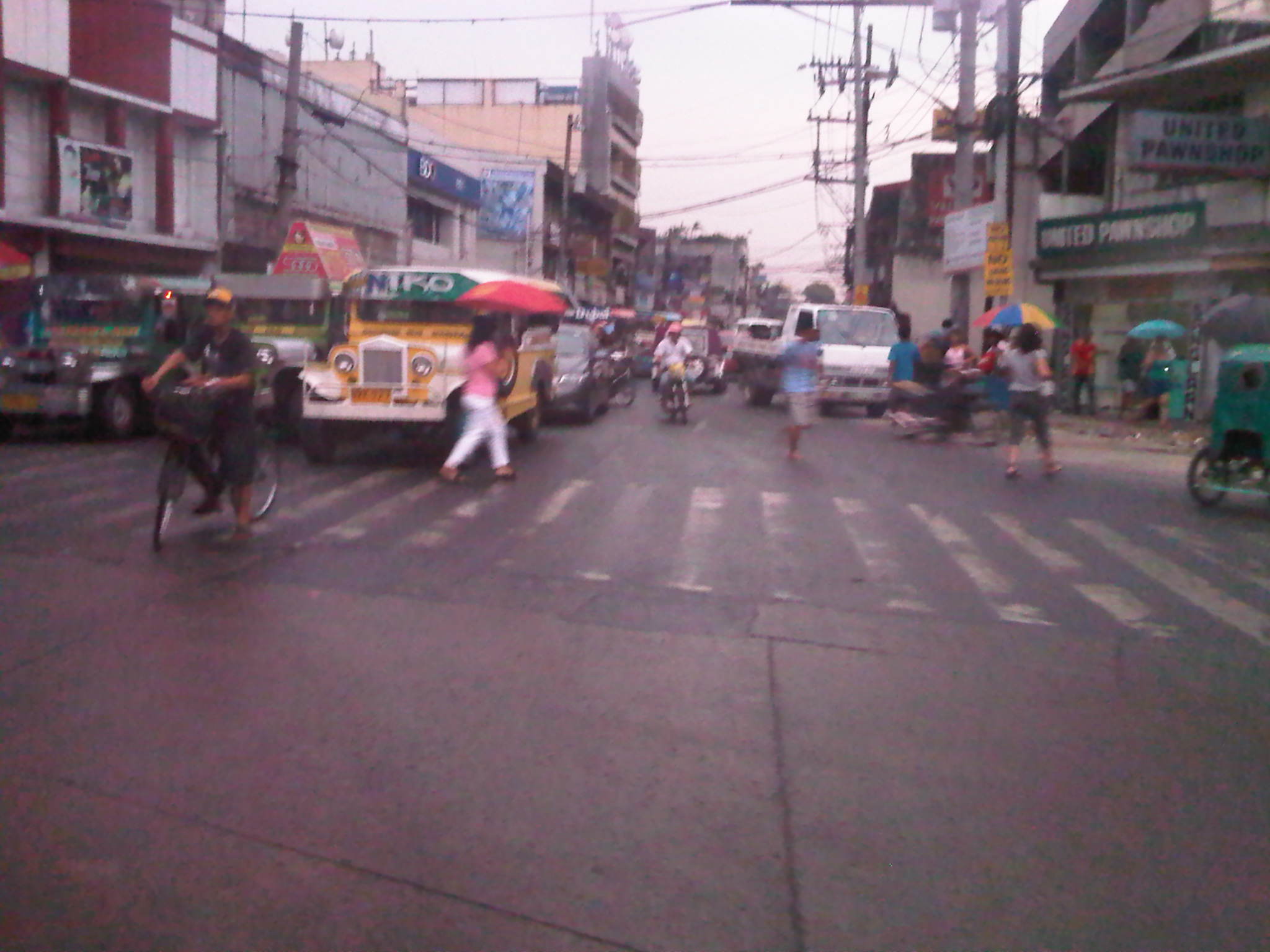 Intersection with Torres Bugallon – jeepneys crowd at the intersection and this often leads to congestion. Pedestrians cross anywhere and there are also pedicabs (non-motorized three-wheelers) roaming around that also contribute to the chaotic traffic.
 Roadworks along C-4 – also shown in the photo are shanties of informal settlers along the PNR right of way, which crosses C-4 at this point.
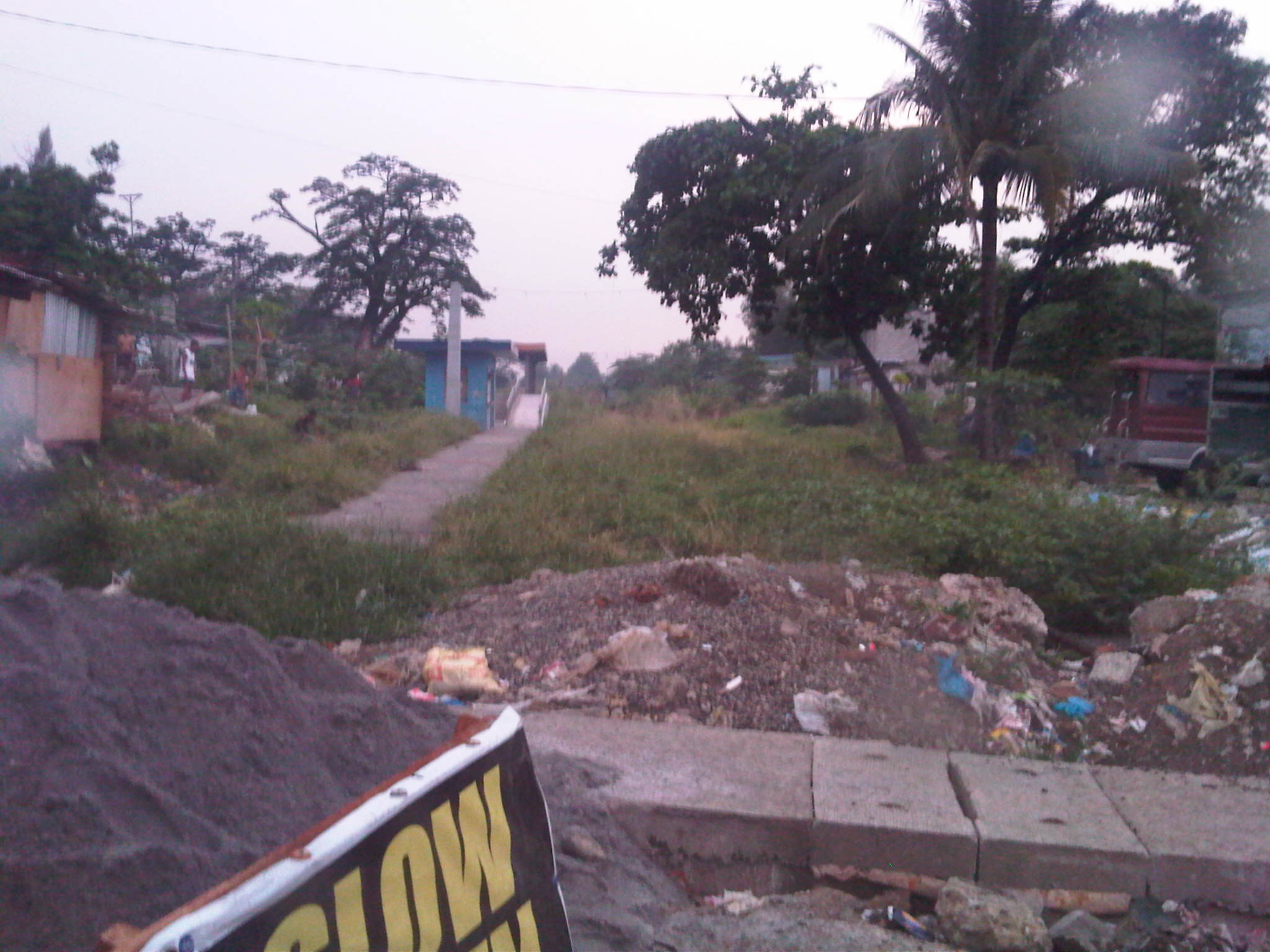 Remnants of the PNR’s Main Line North with a station a few meters from C-4. This should have been part of the proposed Northrail line connecting Metro Manila to Clark, Pampanga.
 Samson Road stretches along a very busy, much built-up district of Caloocan. Near Monumento, there are many big commercial centers including shopping malls around the rotonda known for a memorial for Andres Bonifacio, a national hero who led the revolution for independence from Spain in 1896.
 Samson Road is obviously a national road but tricycles are allowed to operate here; just one of the traffic/transport policies that accommodate such paratransit modes along roads where they are inappropriate.
 In order to address the vehicles counter-flowing or encroaching on the opposing traffic lanes and jaywalking problem, steel barriers were put up in the middle of the road. Overpasses like the one in the photo were constructed to enable people to cross the road. Notice the vehicles parked or standing along the road and on the sidewalks?
 Approach to Monumento with the obelisk at the center island of the rotonda visible at the center of the photo. Also shown in the photo at the roadside is a traffic sign informing travelers that they are approaching a rotonda.
–
Romulo Highway: San Clemente – Lingayen
Romulo Highway originates from Tarlac City and passes through the towns of Sta. Ignacia, Camiling and San Clemente in Tarlac, and then the towns of Mangatarem, Aguilar, Bugallon and in Pangasinan. It ends at Lingayen, Pangasinan, in essence connecting the capitols of two major provinces in Central Luzon (Region 3/Tarlac) and the Ilocos (Region 1/Pangasinan).
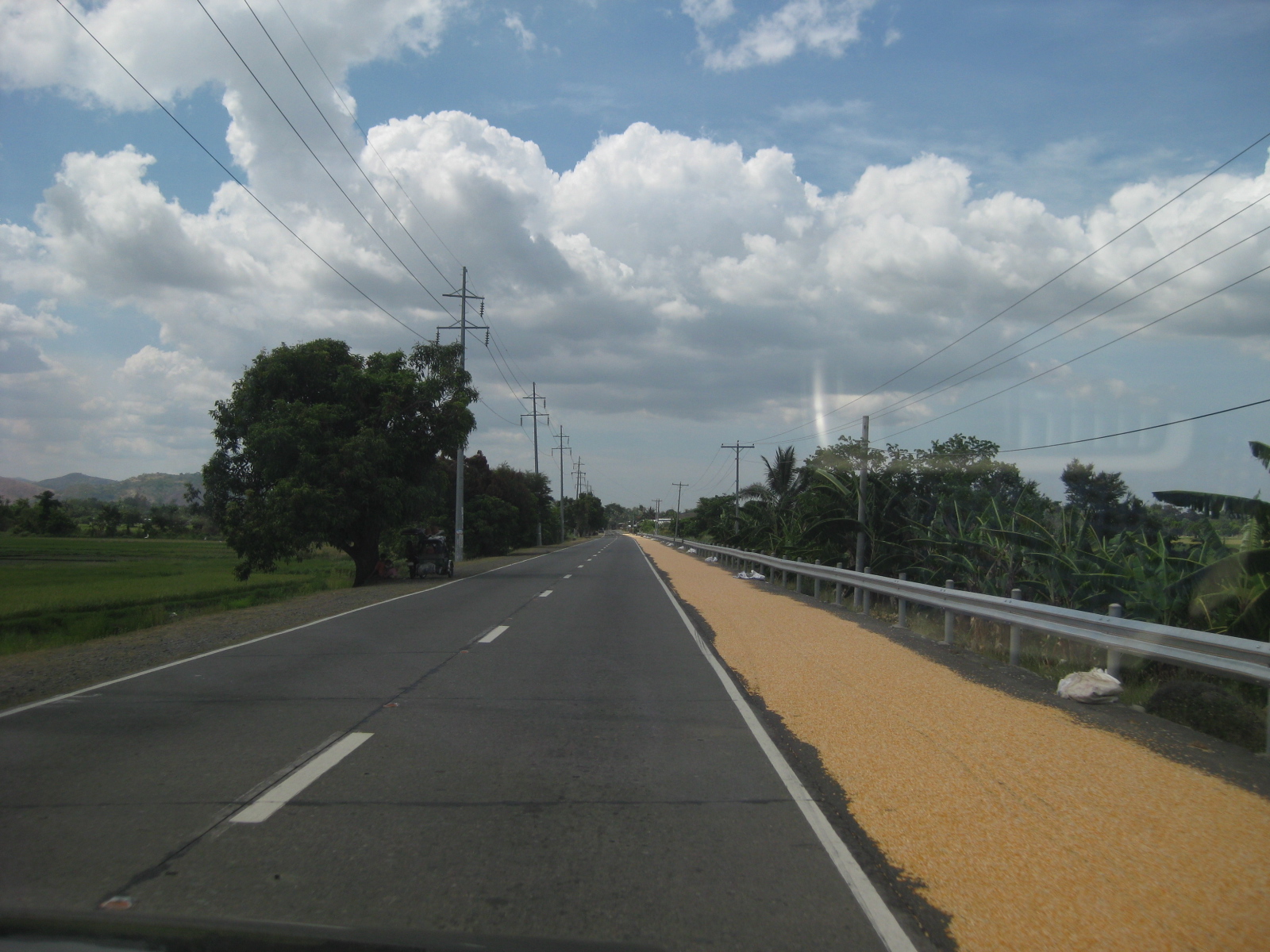 Solar dryers – a common sight along Philippine highways is palay spread out along the shoulders to dry naturally under the sun
 Good condition – pavements along sections of the Romulo Highway between San Clemente and Lingayen are generally well-maintained
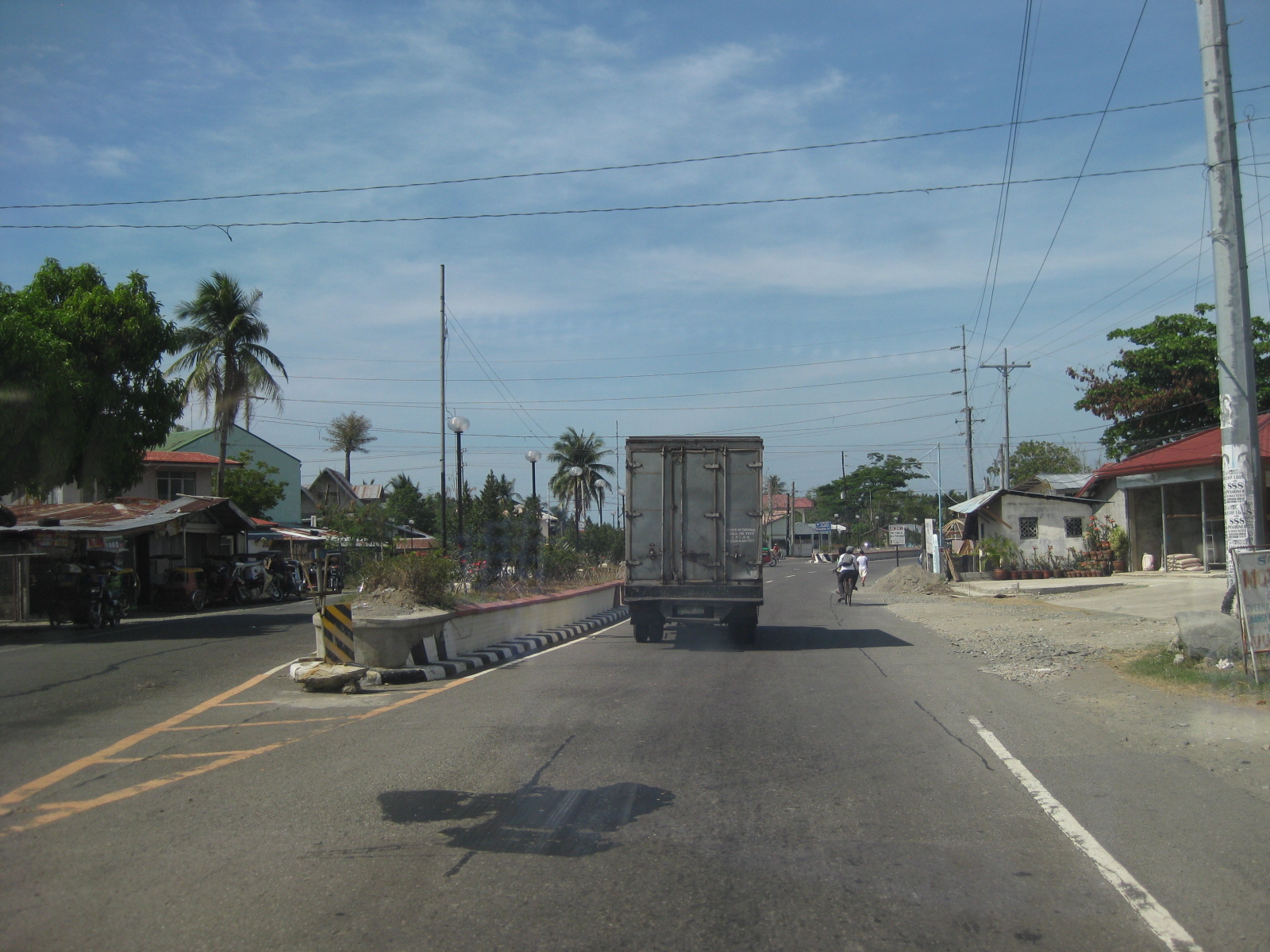 Approach to intersection – the island is part of the channelization at the junction to physically separate vehicles approaching the junction.
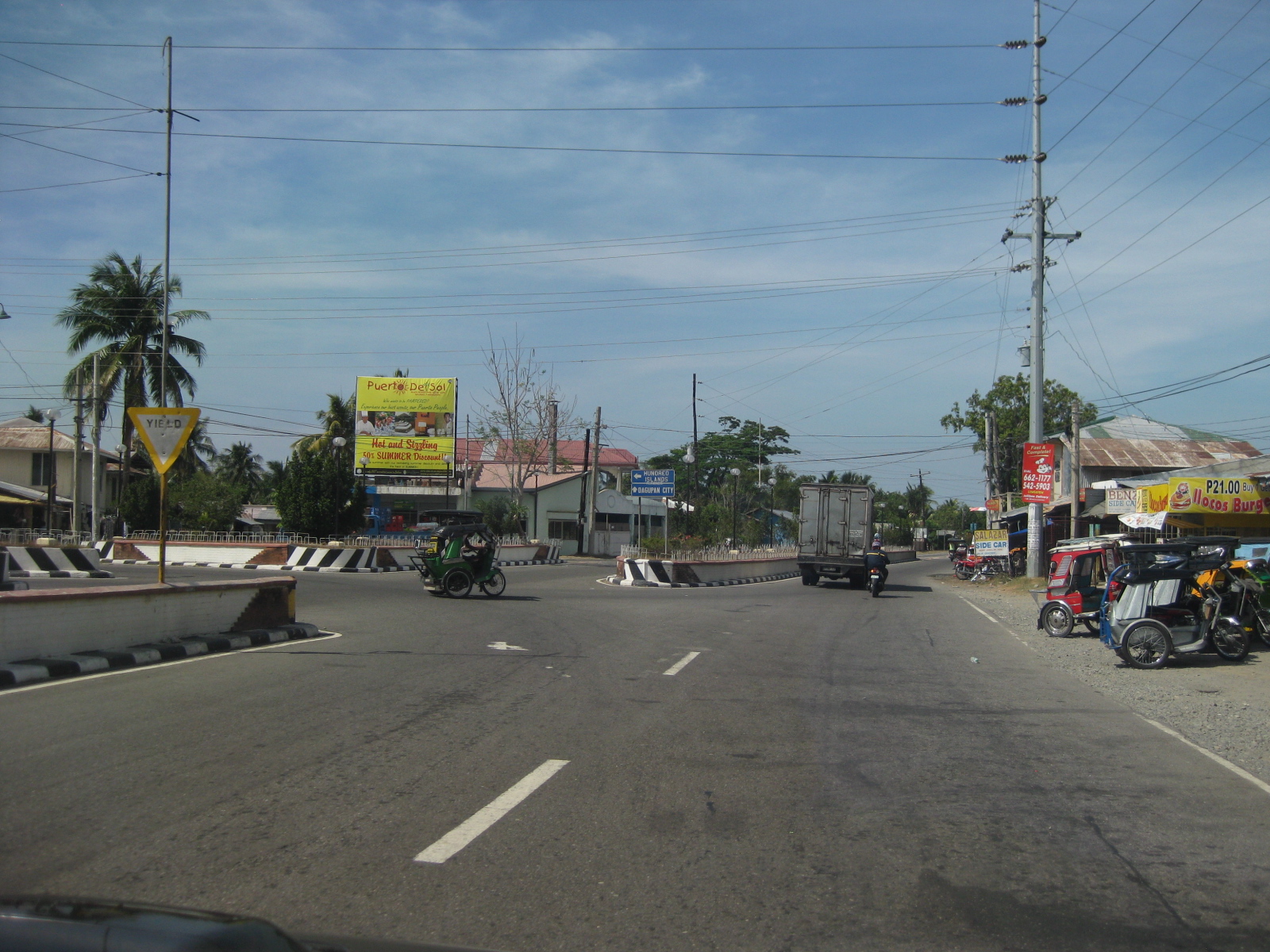 Channelization – the islands along with directional signs help guide motorists at the junction.
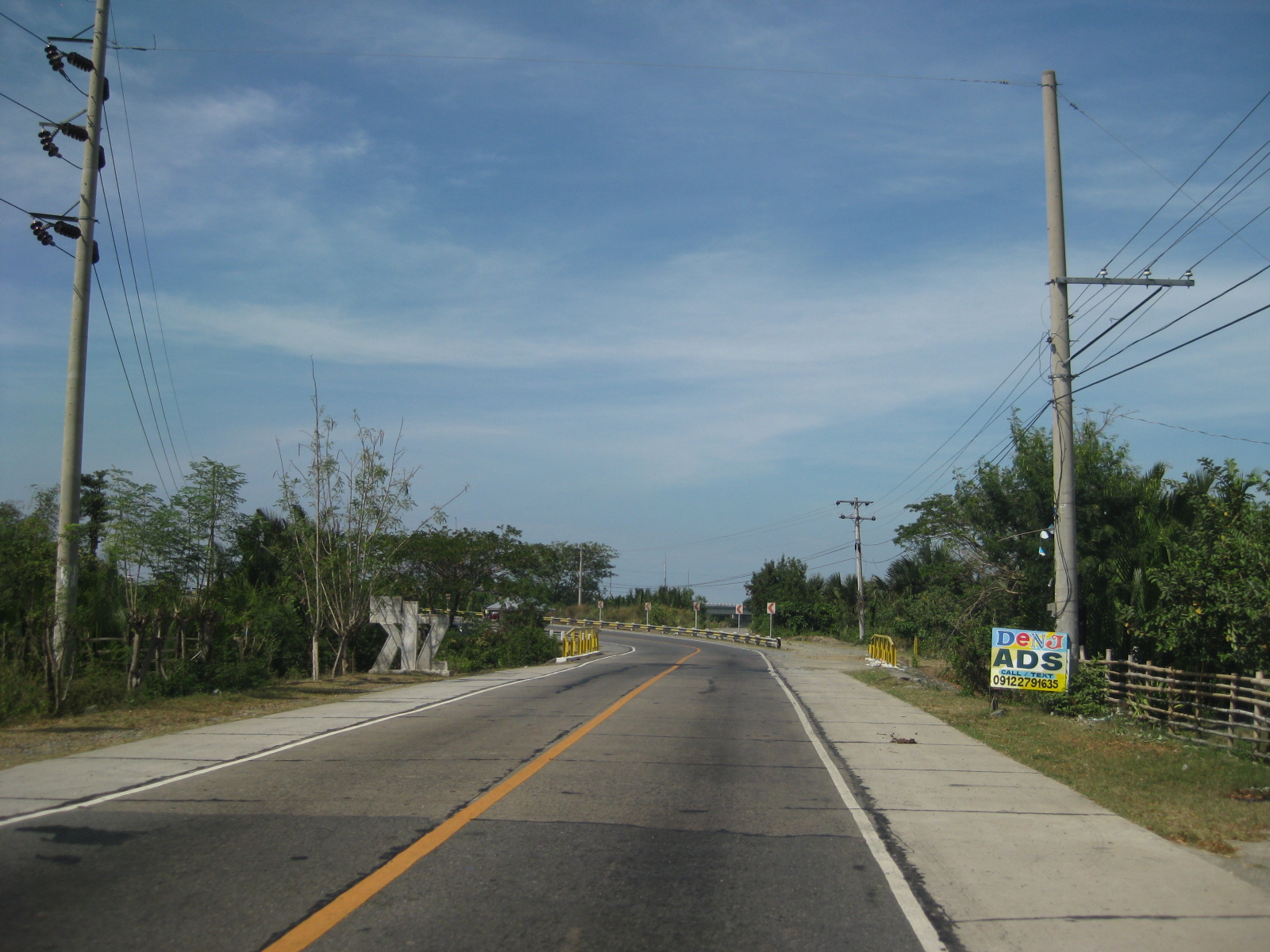 Approaching a curve – this section can be a little tricky with a climb towards a horizontal curve.
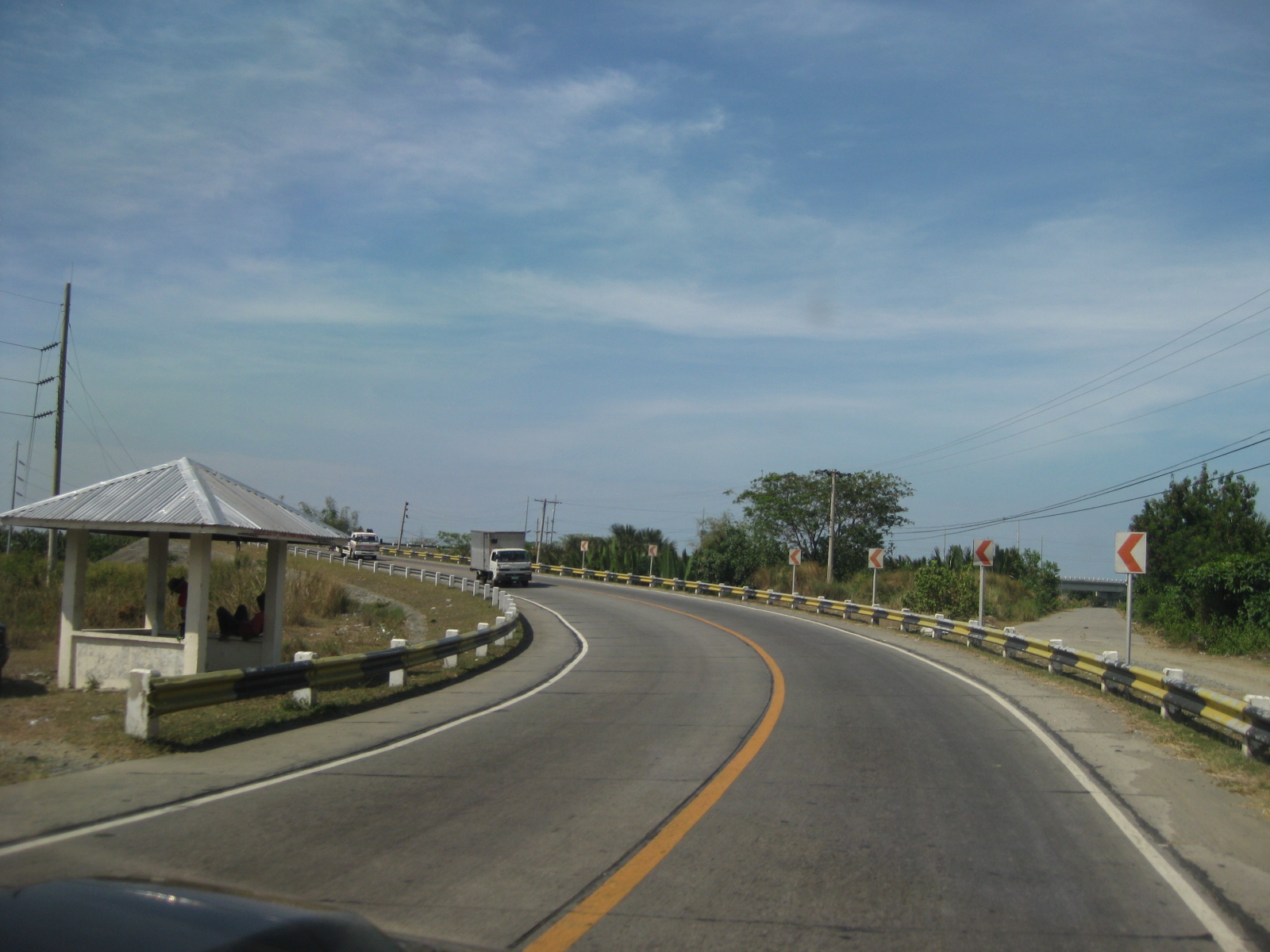 Sharp curve – the curve is sharp enough to necessitate the installation of chevrons. This is combined with a climb or descent.
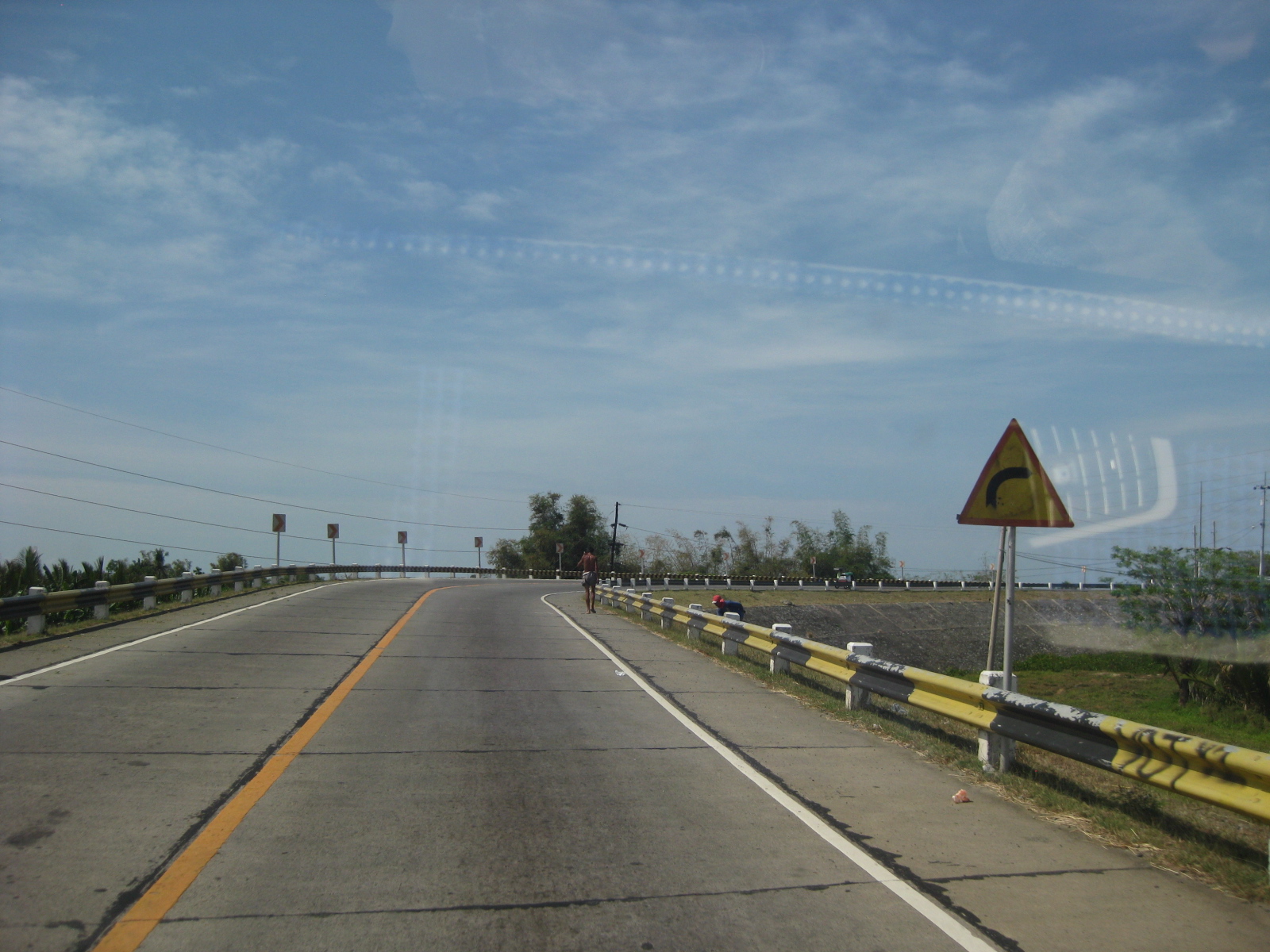 Reverse – it turns out that this section is actually a reverse curve, which increases the complexity of the section for drivers and riders.
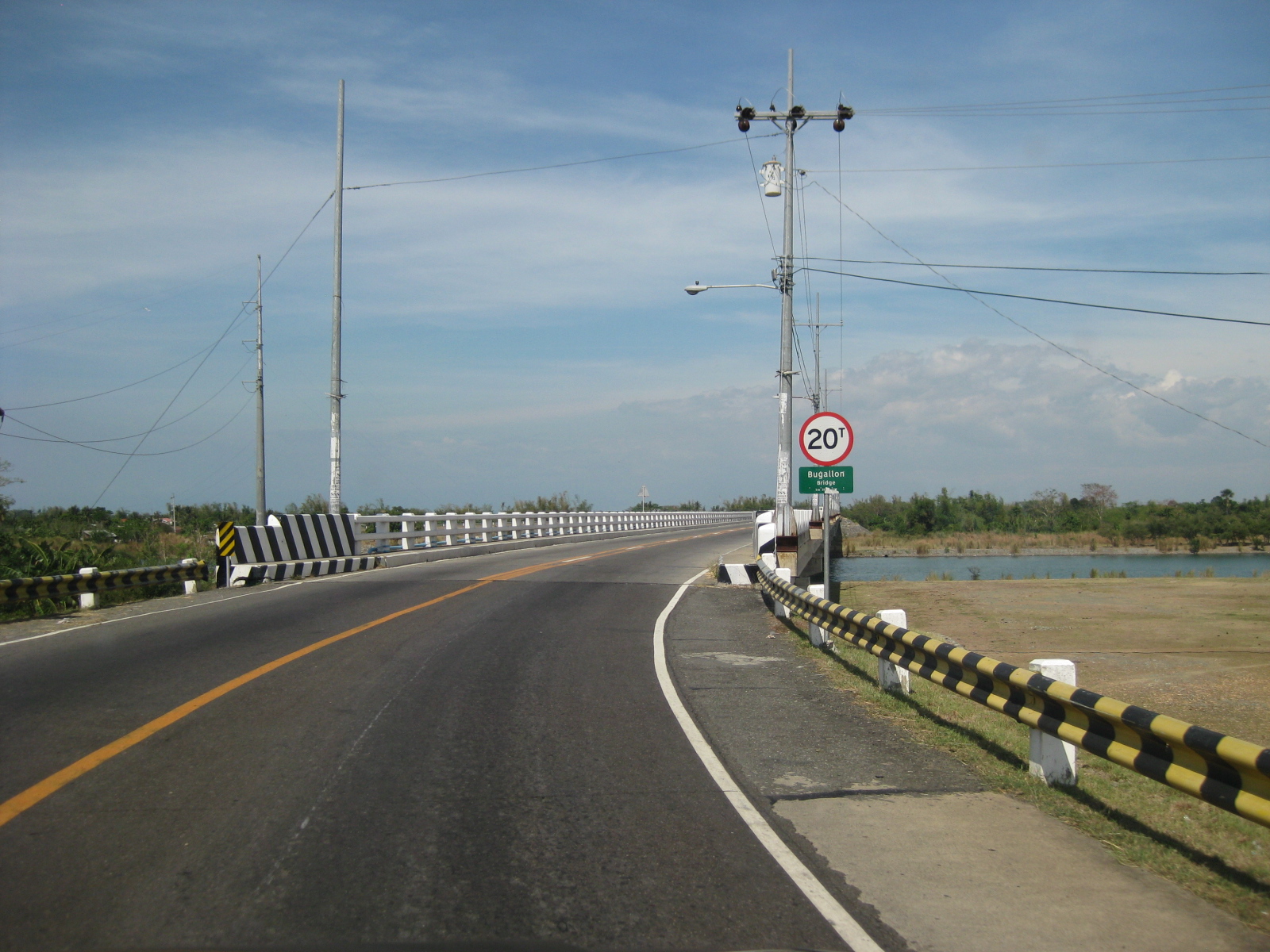 Transition to a bridge – the reverse curve leads travelers to the Bugallon Bridge across the Agno River (direction towards Lingayen). Note the 20-ton limit of the bridge indicating that it is a relatively new bridge applying the DPWH standards for load limits.
 Bugallon Bridge – is typical concrete bridge structure without an arch. Barriers are concrete and should be able to withstand collisions with most type of vehicles.
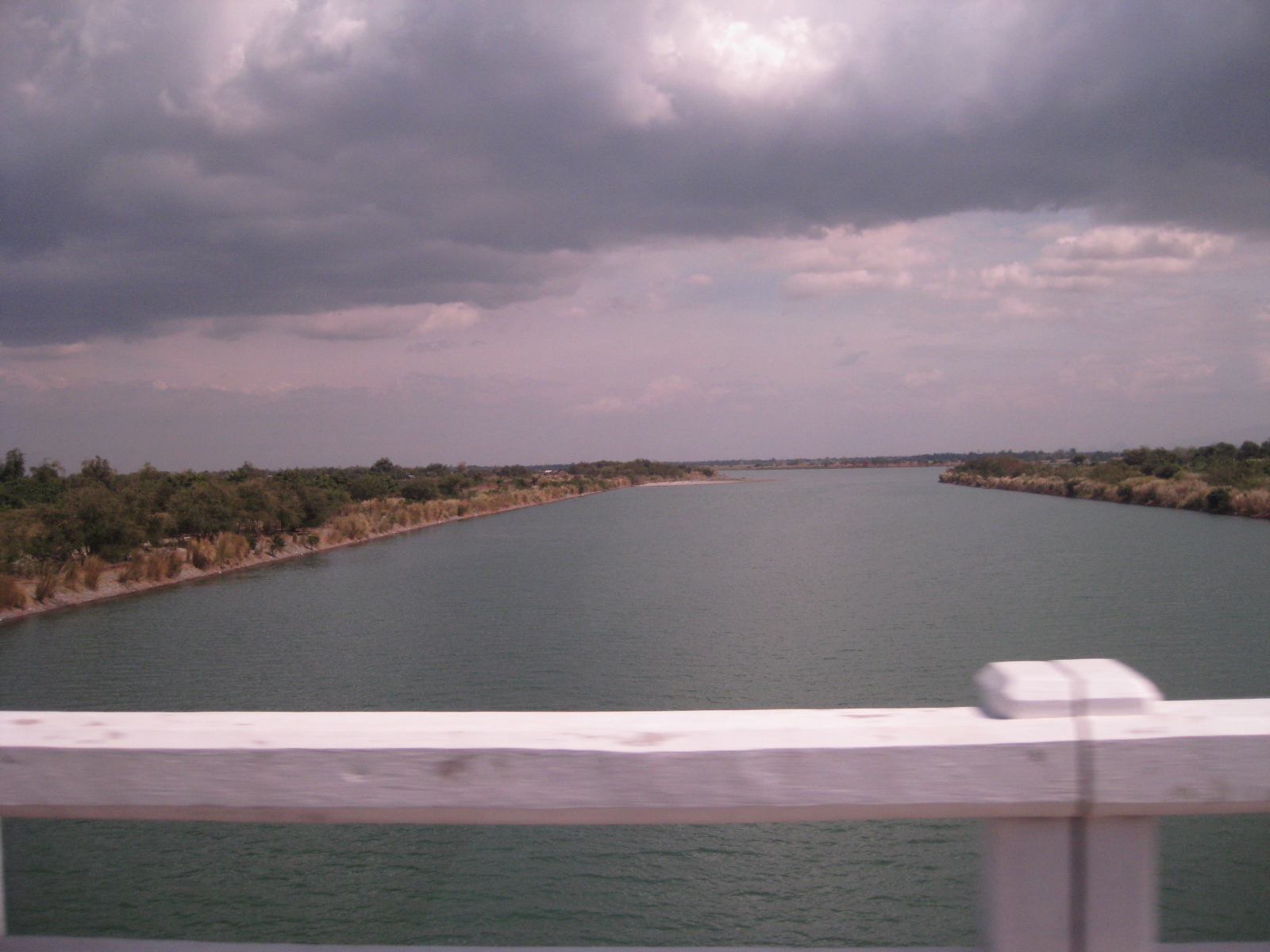 Agno River – is part of one of the larger river systems in Luzon Island and the country. The river becomes the Tarlac River when it branches out to Tarlac Province.
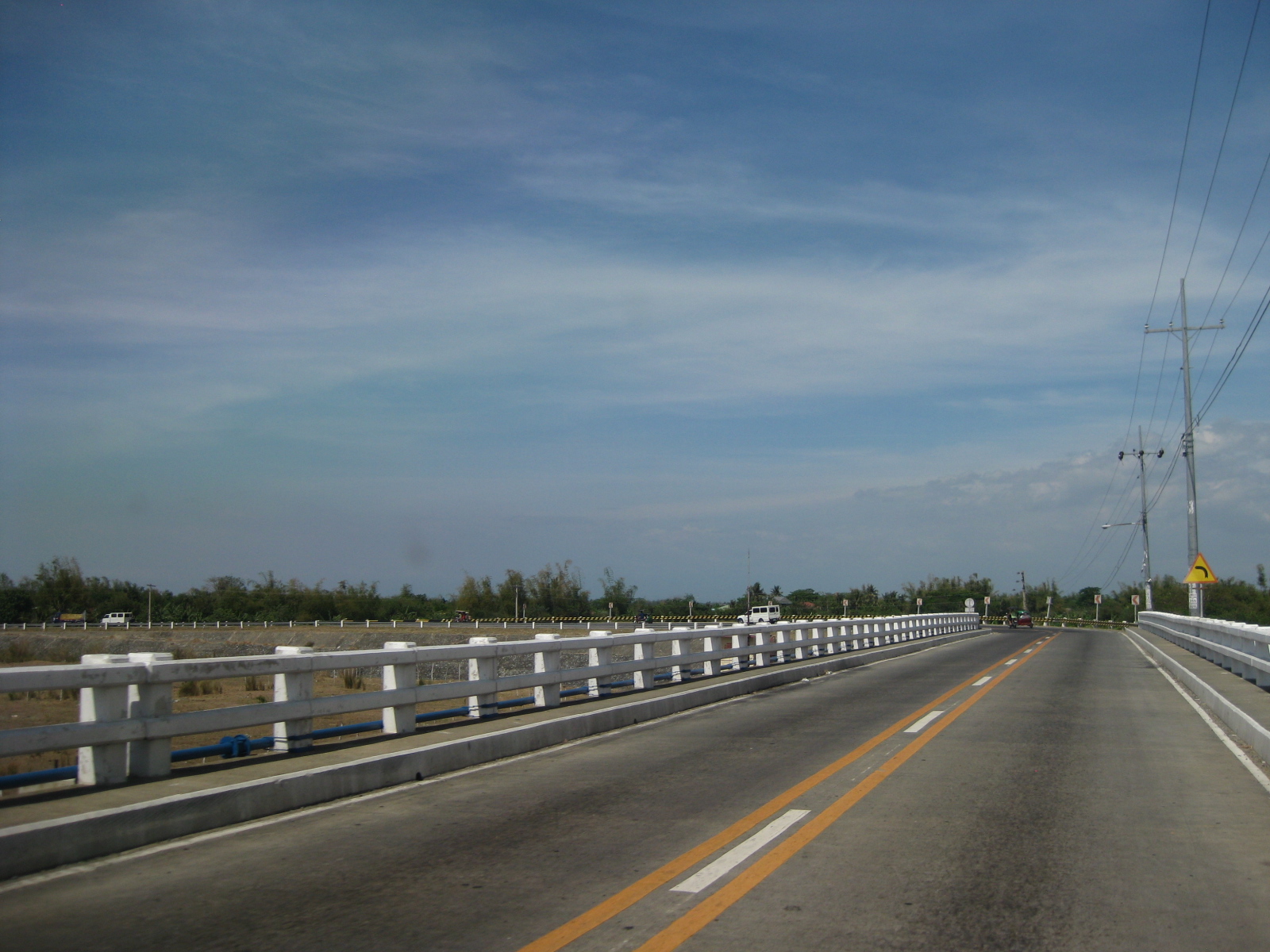 Bugallon Bridge – continuation of the long bridge terminating at an embankment that leads to another bridge towards Lingayen.
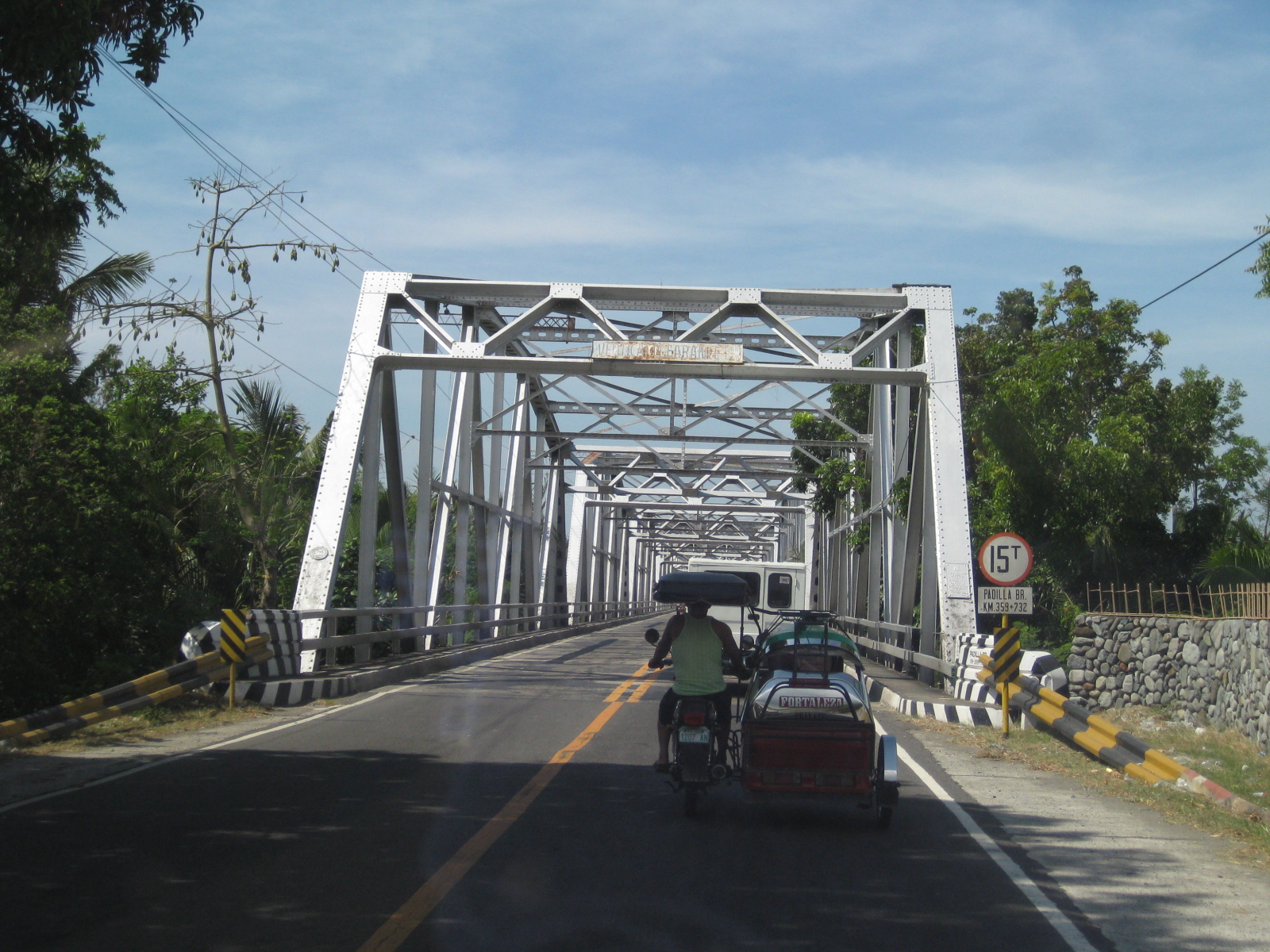 Padilla Bridge – is a steel truss bridge that is older than the Bugallon Bridge not only based on the form (many old bridges along national highways are steel truss bridges) but also on the load limit of 15 tons. The lane widths are also narrower than that of the Bugallon Bridge.
 Padilla Bridge – is longer than the Bugallon Bridge as it crosses a wider branch of the Agno River system.
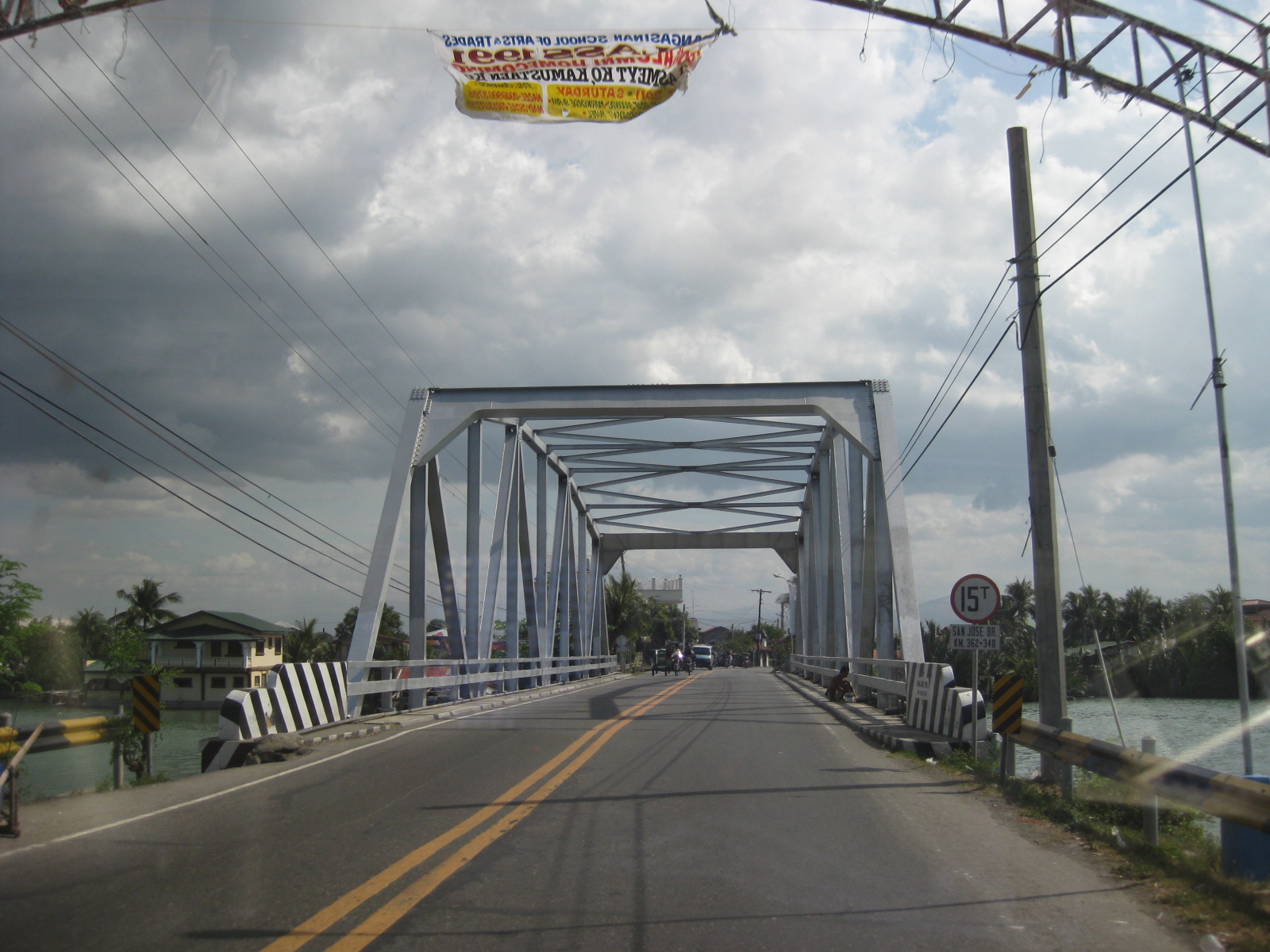
 San Jose Bridge – viewed towards Lingayen from Bugallon is a relatively short steel truss bridge.
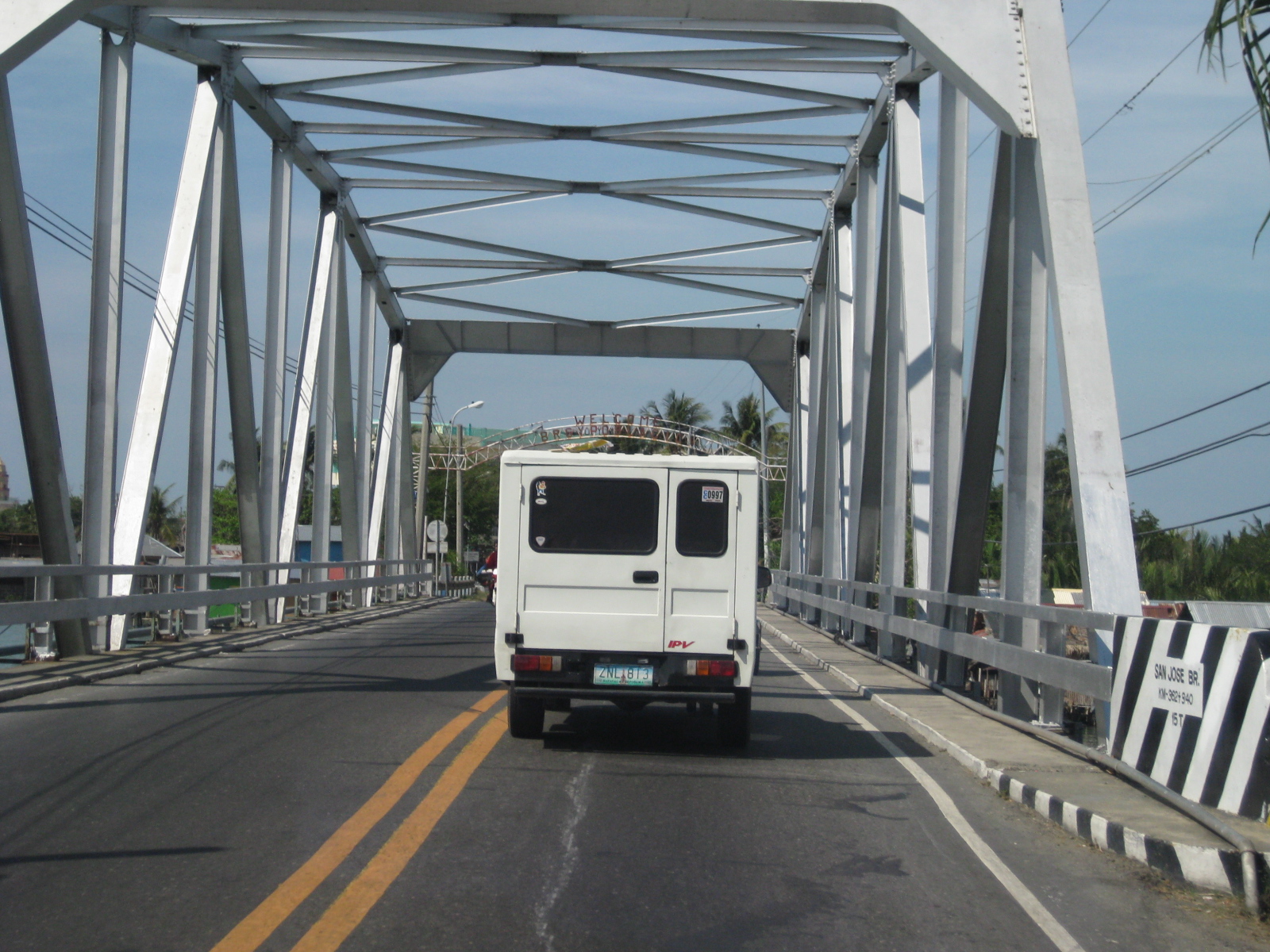
 San Jose Bridge – view towards Bugallon from Lingayen is probably the same age as the Padilla Bridge. This bridge also has a 15-ton load limit.
 Crossroads – vehicles turning to the left will be headed back towards Tarlac through Bugallon and Mangatarem. Going straight will take the traveler to the towns of Labrador, Sual and the general direction of Alaminos and Bolinao. The SUV on the left is headed for Lingayen and Dagupan.
 Provincial boundary – a simple arch marks the boundary between Pangasinan and Tarlac. A little further downstream is another arch formalizing the boundary for the Municipality of San Clemente in Tarlac.
 First town after the border – San Clemente is the first Tarlac town along the Romulo Highway upon crossing from Mangatarem, Pangasinan.
–
Olongapo-Castillejos Road: Castillejos
The name of the town Castillejos translates to “little castle.” Such names are part of our Spanish or Castillan legacy, being under Spain for more than 300 years until 1898. Following are photos showing segments of the Olongapo-Castillejos Road within the Municipality of Castillejos.
 Double yellow – the twin solid lines emphasize the “no overtaking” rule for both directions of flow. Often disregarded in the Philippines, crossing over a double yellow will result in an apprehension and a ticket when driving in the US or Canada.
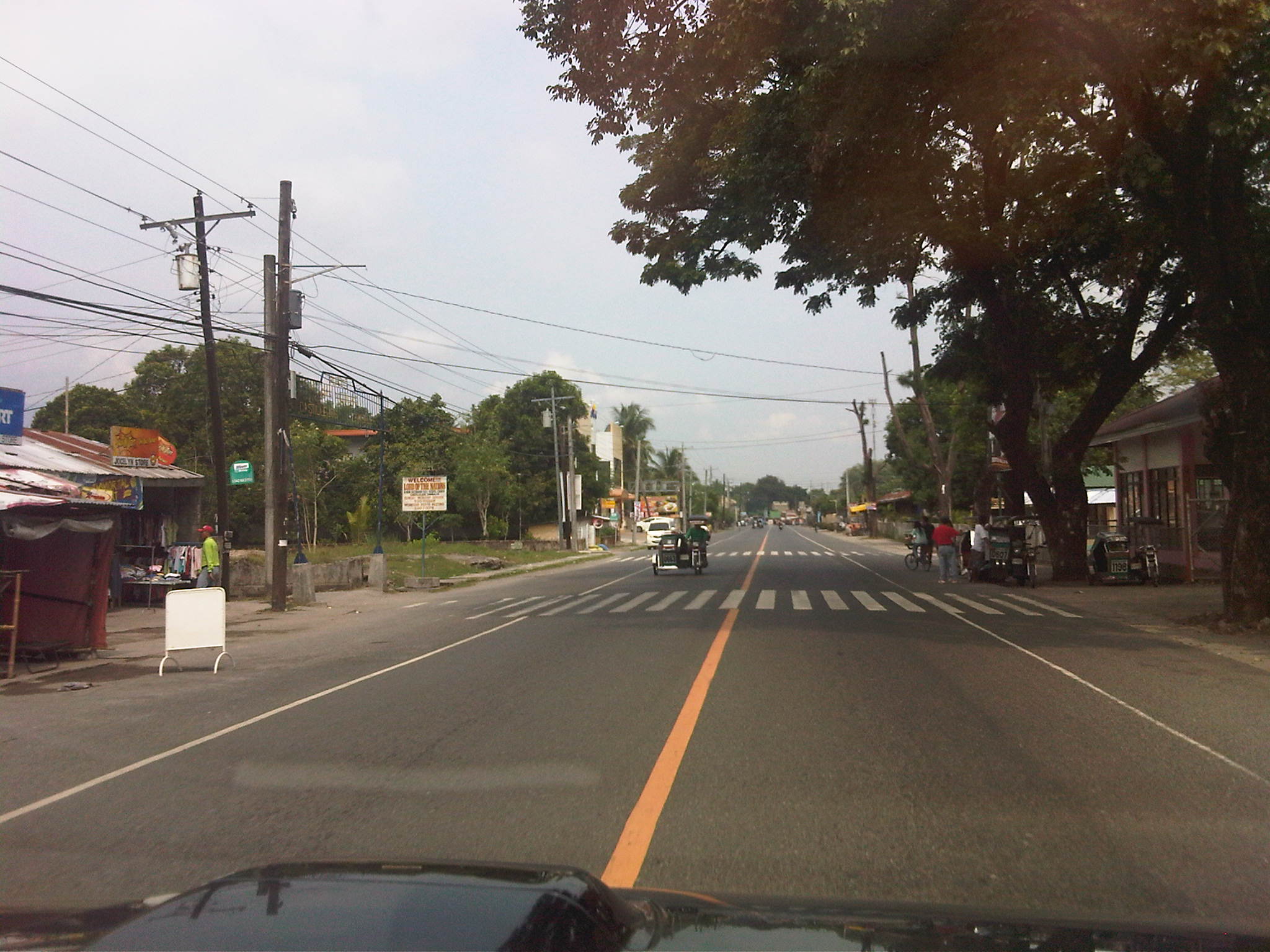 Single yellow on a straight section? – the single yellow line also means “no overtaking”
 Obstacle course – among the things people should expect or anticipate when traveling along Philippine roads are various checkpoints that tend to slow down traffic. Some are operated by the PNP or the Army as part of their security measures. There are also those by the DENR to check the transport of restricted items such as logs, corals, exotic animals, etc. Also, there are those set-up to slow down traffic due to the presence of schools or pedestrian crossings like the one shown in the photo.
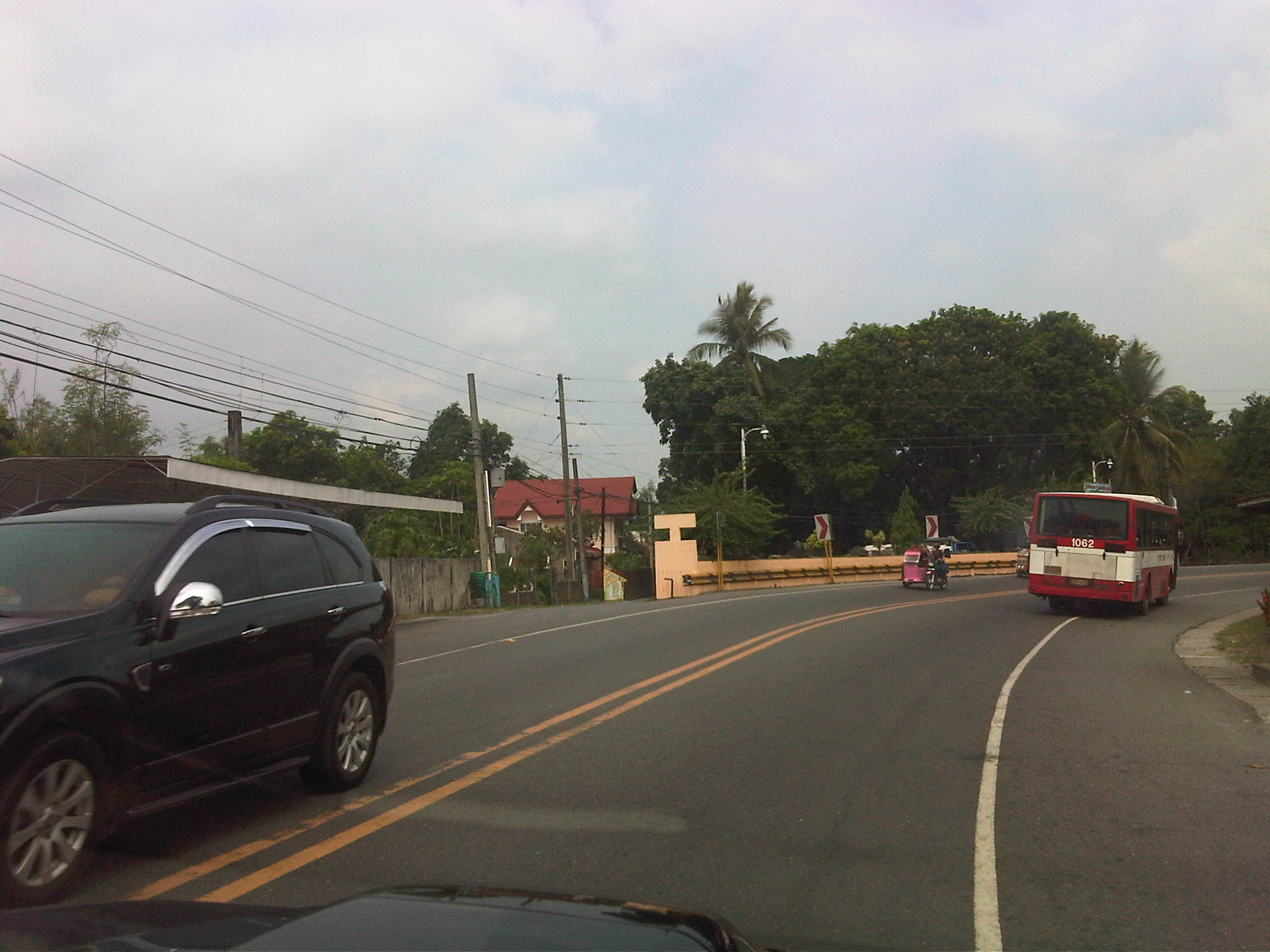 Turning – typical curve along the highway with the paved shoulders allowing for more maneuver space and improving sight distance
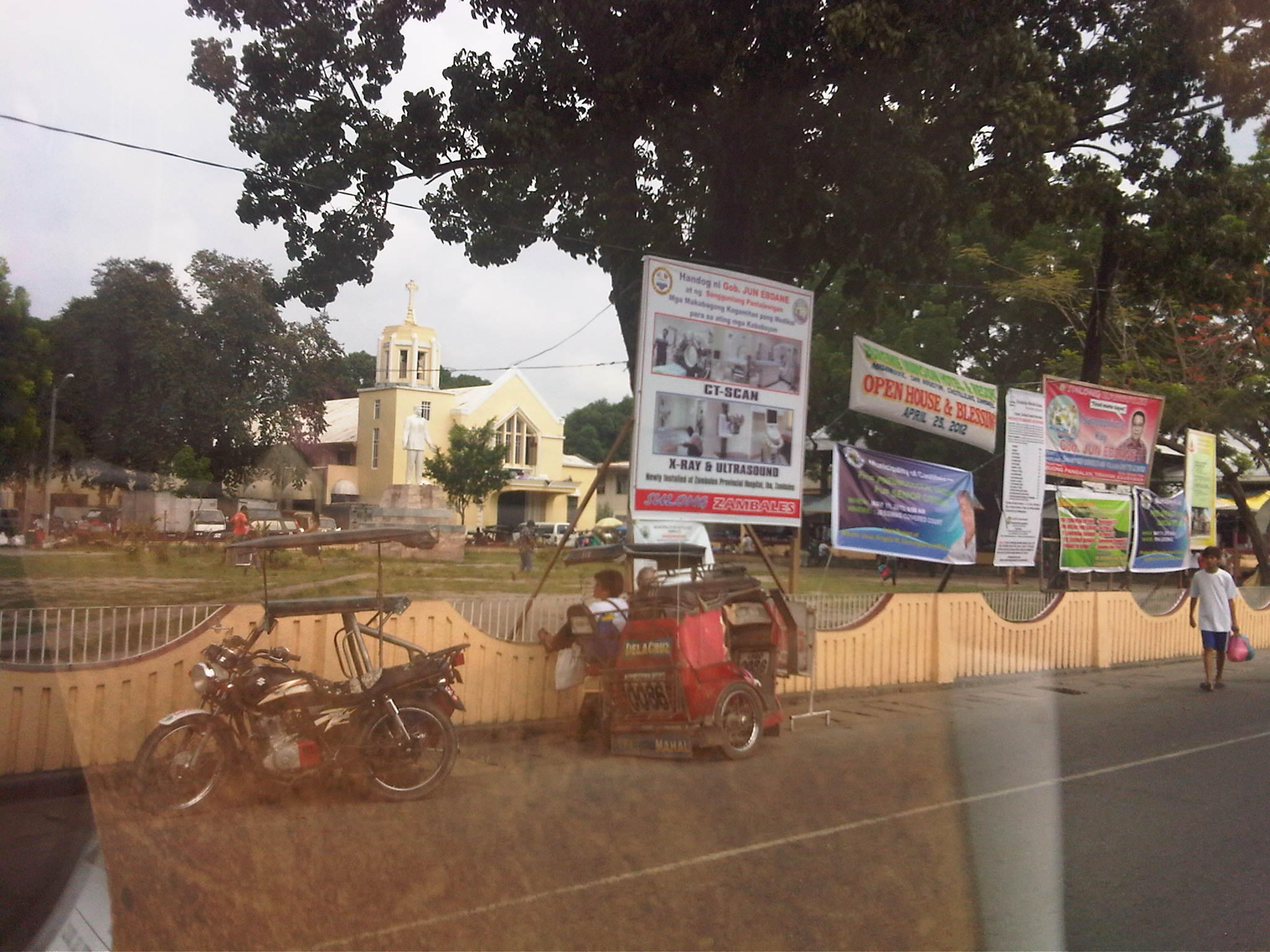 Town center – the poblacion or center of Castillejos is typical of most if not all old towns in the country with the Municipal Hall, Parish Church, local school and market are located together, and usually around or near a plaza.
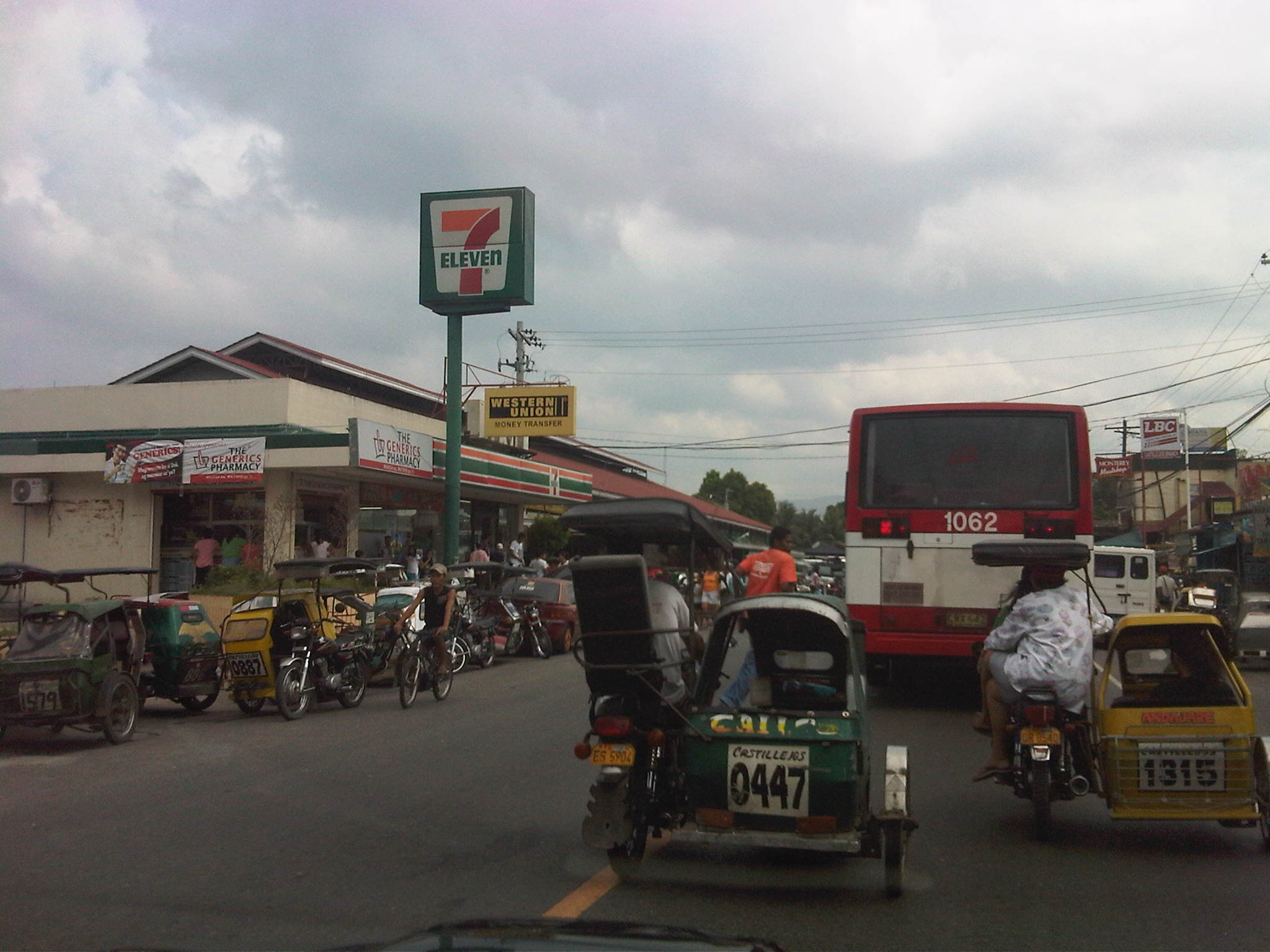 Tricycles galore – three-wheeled taxis everywhere around the market area. The location of the market along the national highway means local traffic during market days will surely impeded traffic flow.
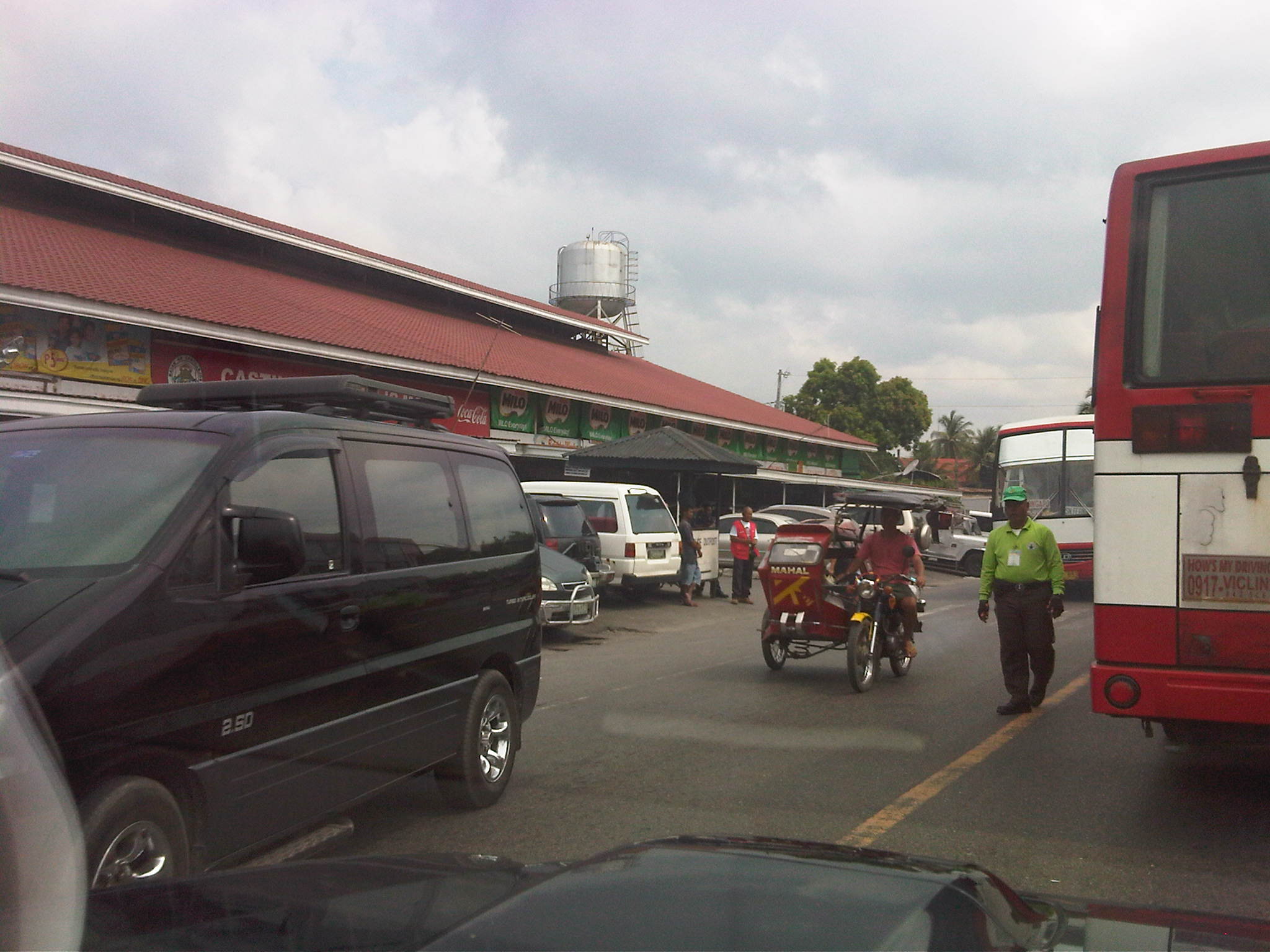 Marketplace traffic – it is common for travelers to encounter congestion due to the presence of a town’s market along national roads. There are enforcers like the one in green in the photo but they are usually helpless and reduced to managing for the maneuvers of parked vehicles or helping people to cross the road.
 Opposite congestion – after passing the market area, we were relieved that we could proceed with much less congestion. Traffic along the other direction would have to contend with the congestion.
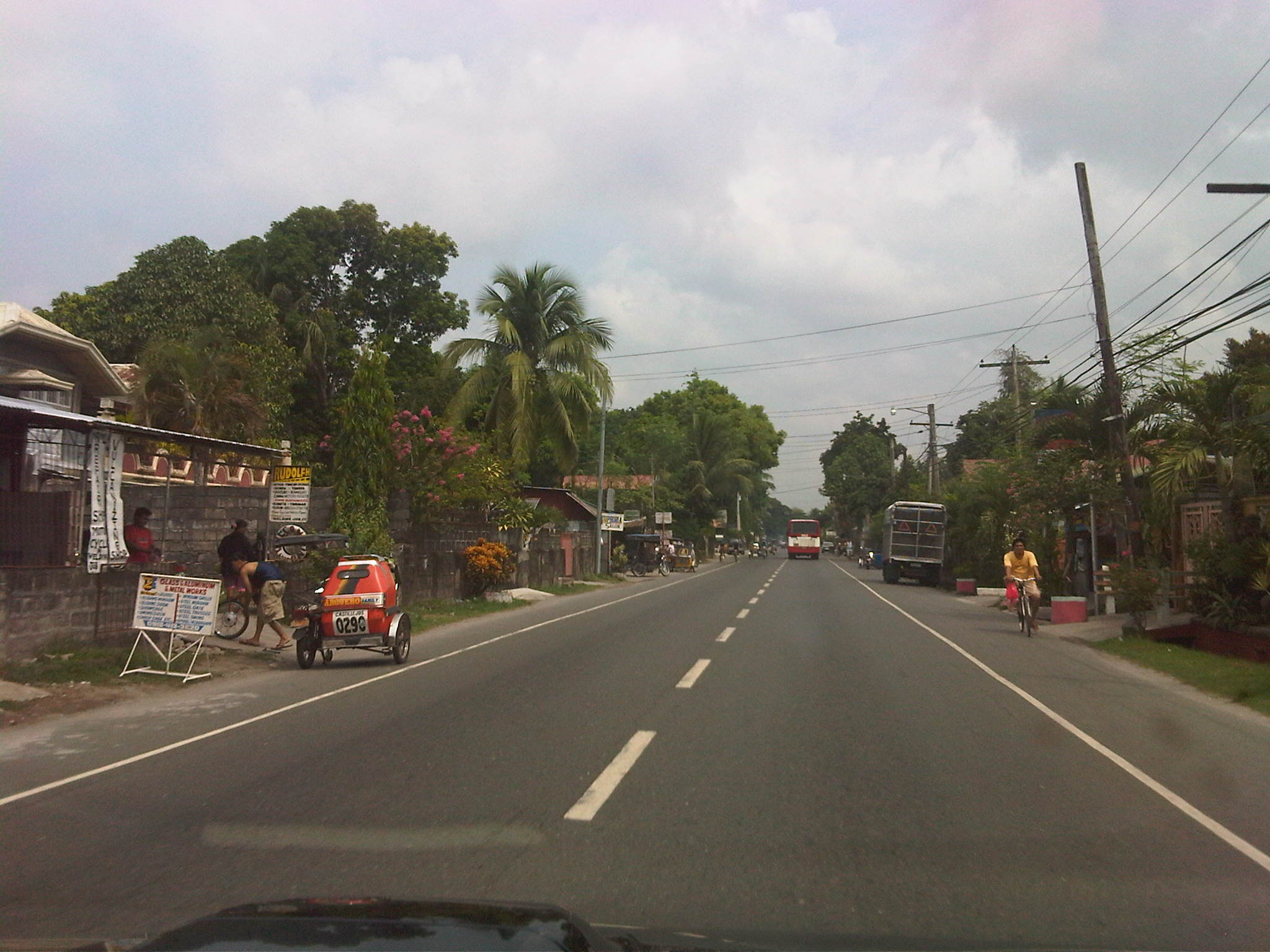 Usable shoulders – we were pleased to see that the shoulders were paved and in excellent condition. Such cases allow for walking and cycling off the carriageway such as the example shown by the cyclist on the right. Tricycles would also be able to pull to the side to avoid impeding general traffic. A concern though would always be parked vehicles on the shoulders.
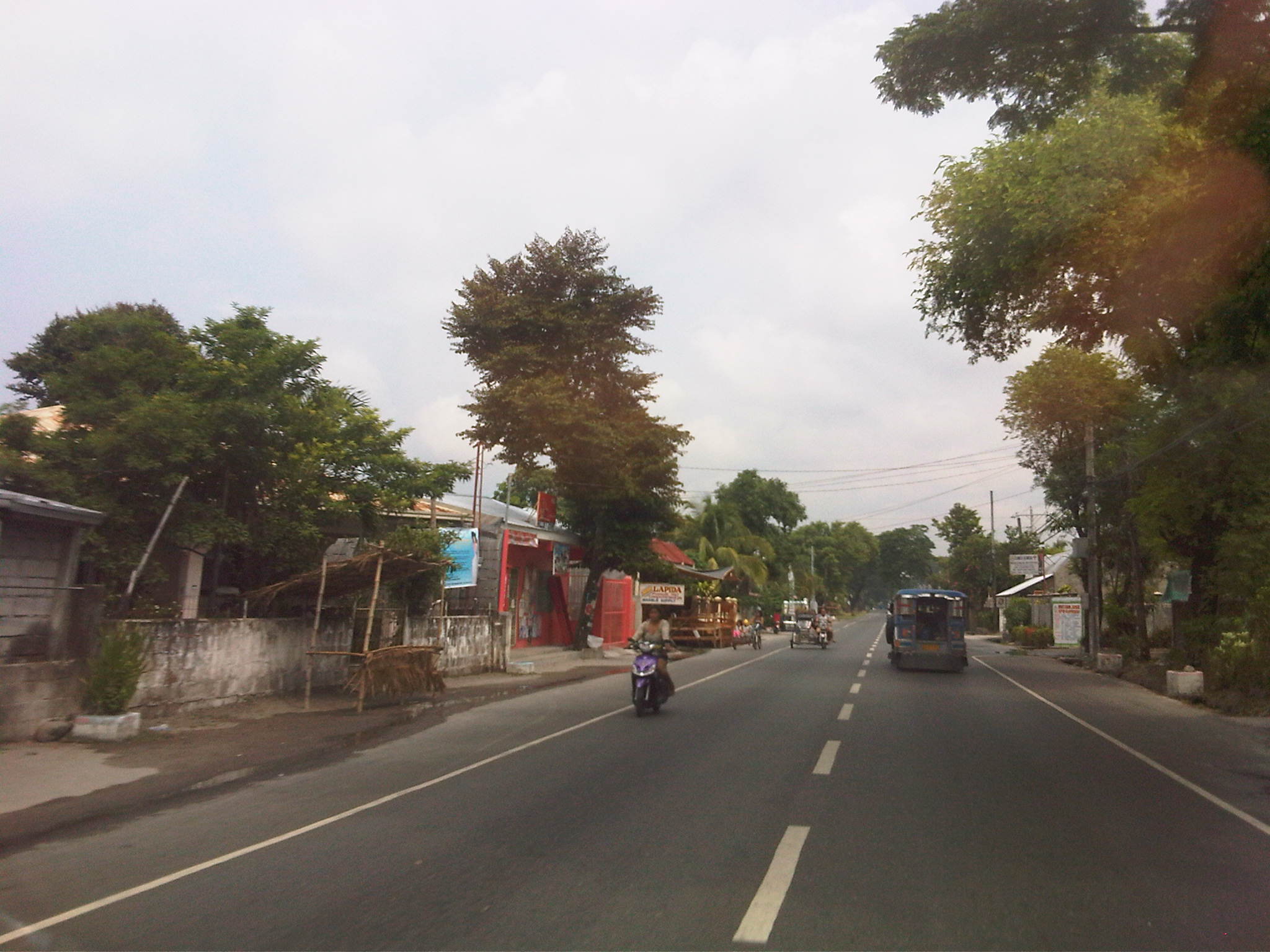 Minimal encroachments – we were also pleased to observe that there were few properties encroaching upon the RROW along the highway, especially in populated or built-up areas like the one shown in the photo above. Such is not the case with many other towns where stores, shops and houses practically dominate shoulder space and even take up parts of the carriageway.
 Free flow – these tricycles seem to be racing and could actually pick up speed even with passengers in the cab, probably due to the straight level road and the excellent pavement as shown in the photo. The shoulders are paved and should be sufficient for tricycles to use in order to not impede the flow of other vehicles.
 Unimpeded flow – the photo above shows further proof of minimal encroachments on the RROW and especially along the shoulders, which are paved and usable.
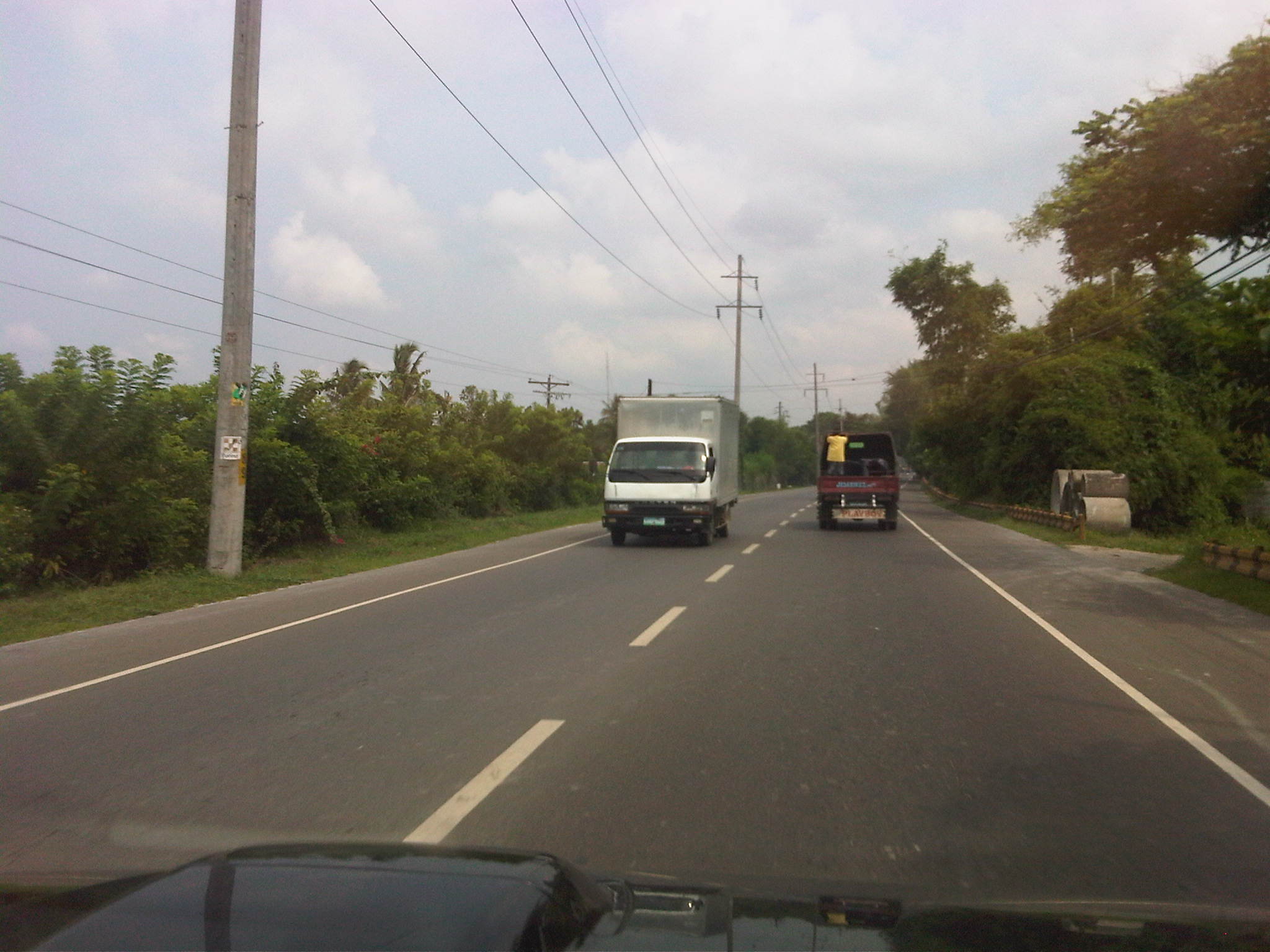 Light traffic – traffic was quite light along the highway the time that we traveled.
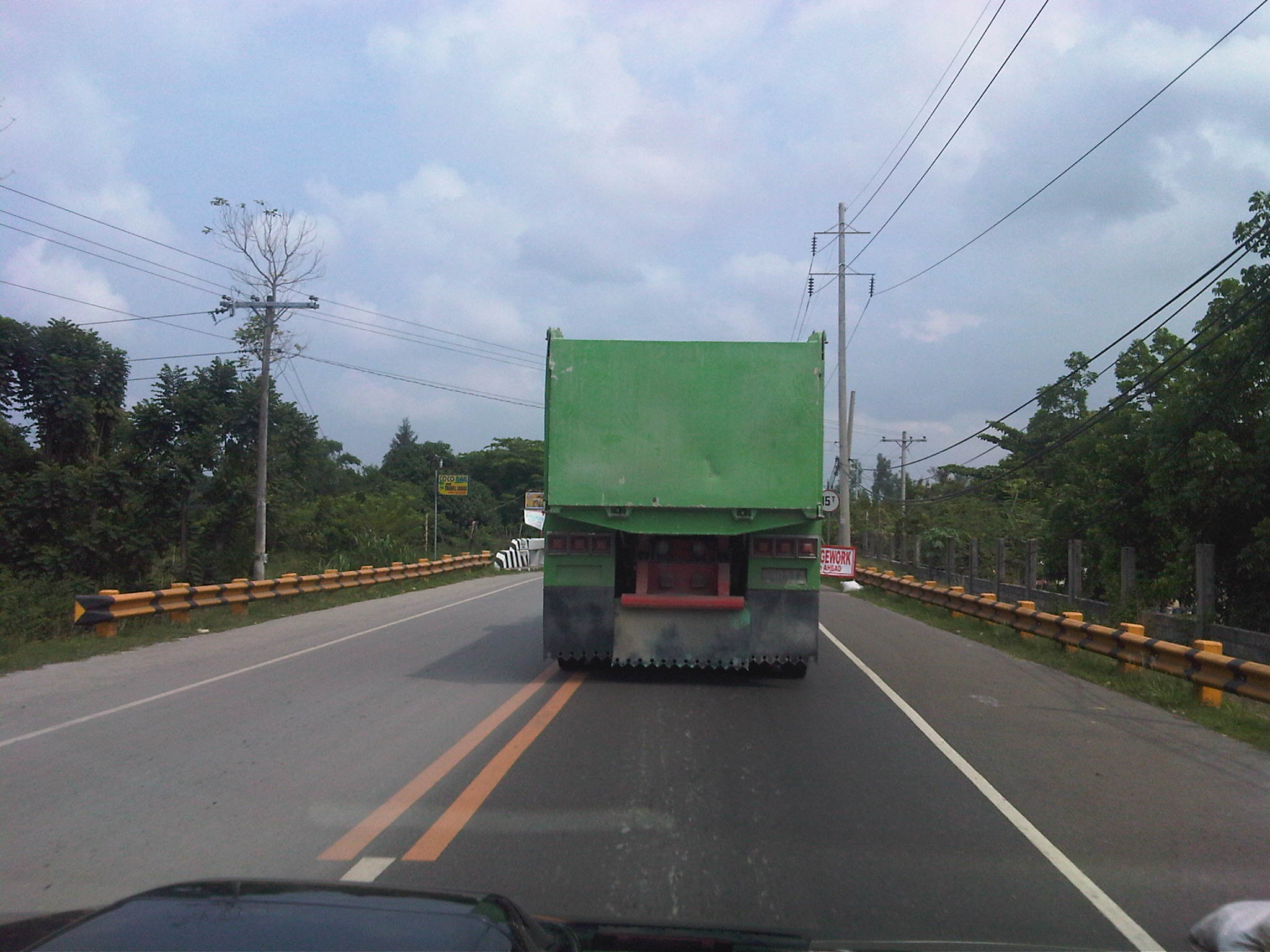 Bridge ahead – the roadside barriers and the signs already visible from a distance inform motorists of the bridge ahead. We didn’t see any advance temporary signage for the construction site that would have been ideal to advise motorists about the work site.
 Detour – the sign speaks for itself but seems to have been placed quite late into the approach to the bridge construction site.
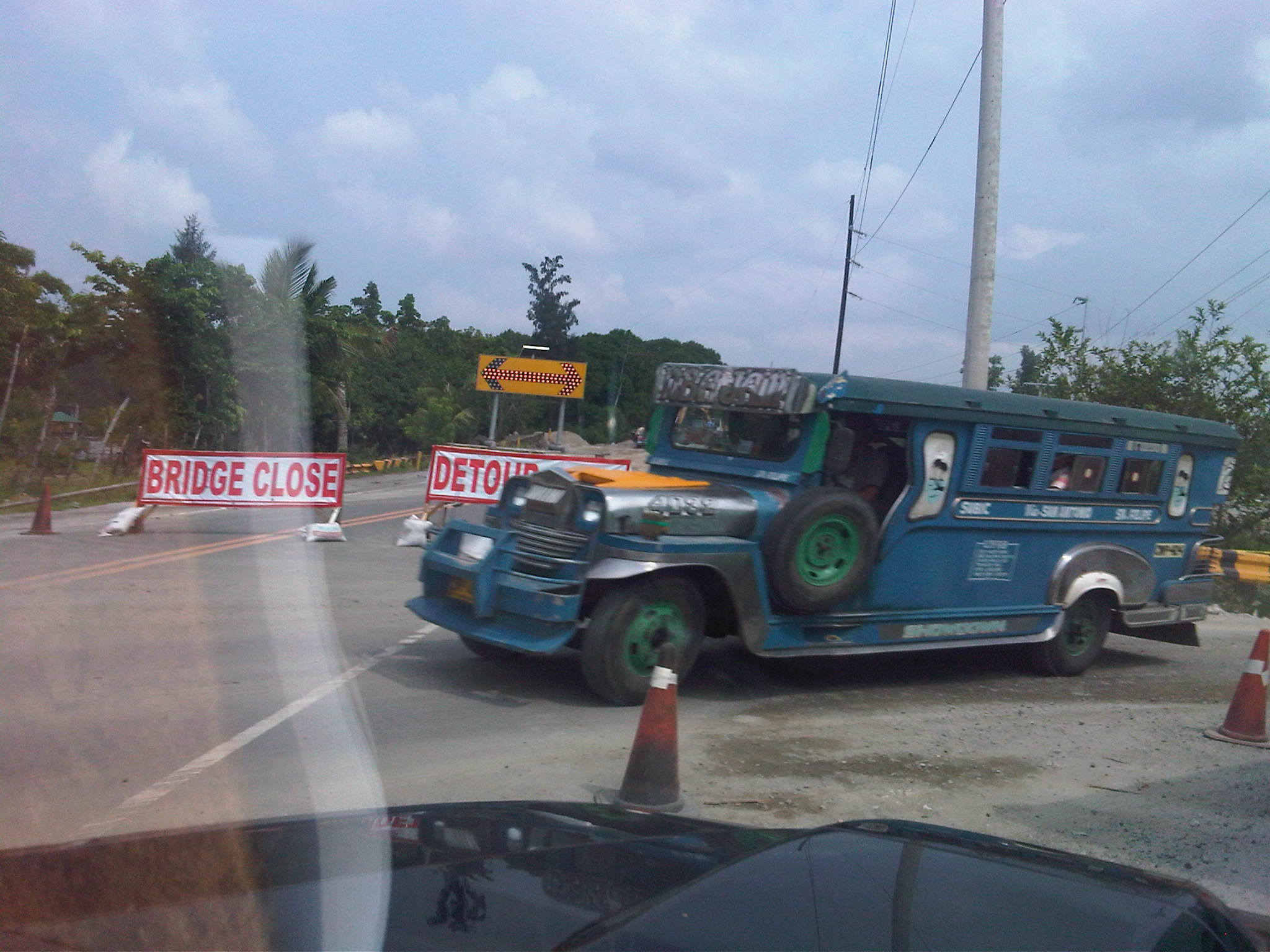 Blocks – signs block the way towards the bridge under construction along the highway while a jeepney emerges from the temporary diversion road.
 Sight distance? – while there is sufficient sight distance along the diversion road, there are cones along the middle of the road to discourage overtaking.
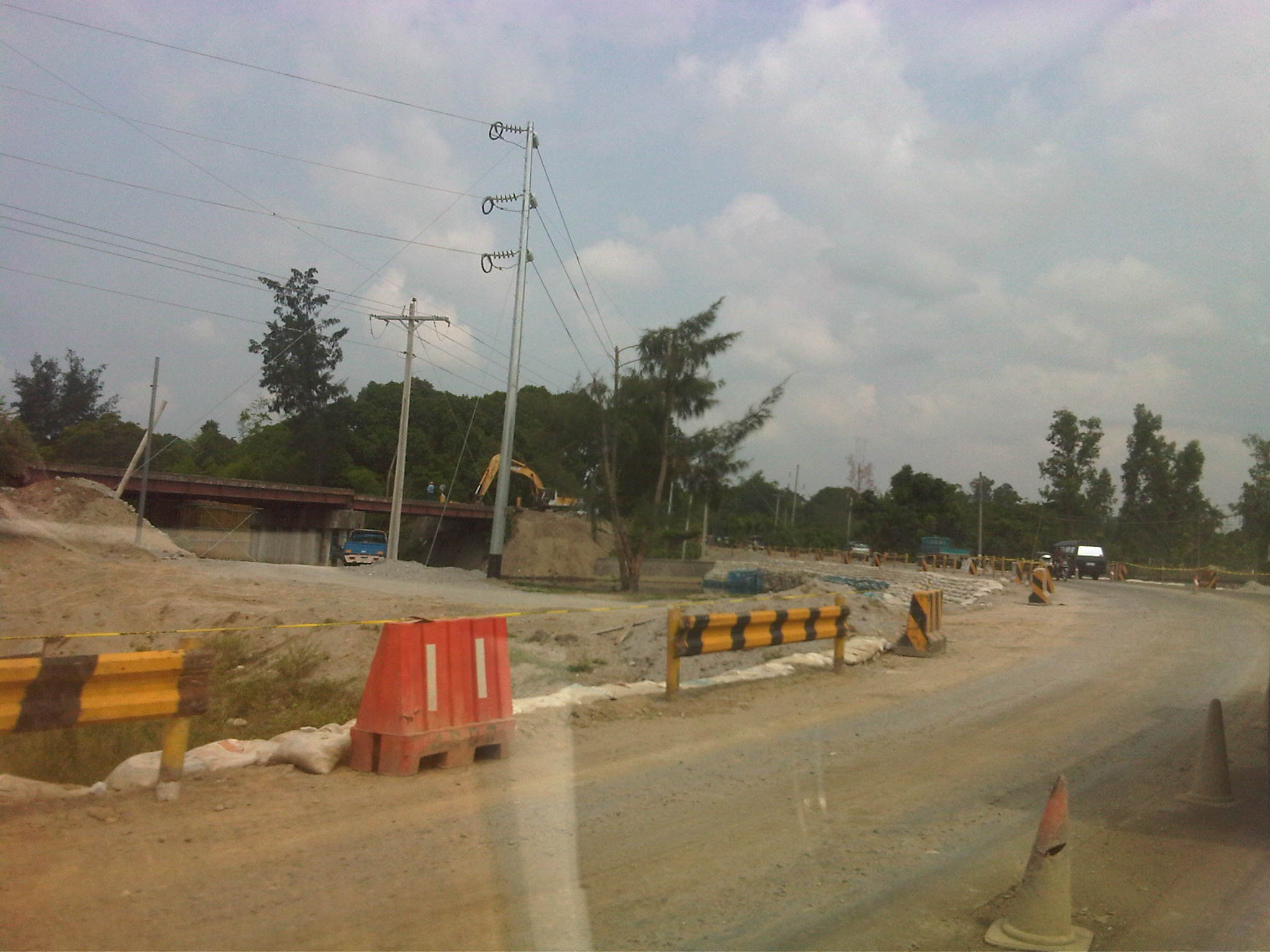 Gravel surface – the temporary diversion road was well-graded and wasn’t that rough unlike many other roads built for such purpose.
 Steel structure – steel girders laid across the river and on top of the columns in the middle.
 End support – a backhoe was working on material to reinforce the embankment at the northern approach to the bridge.
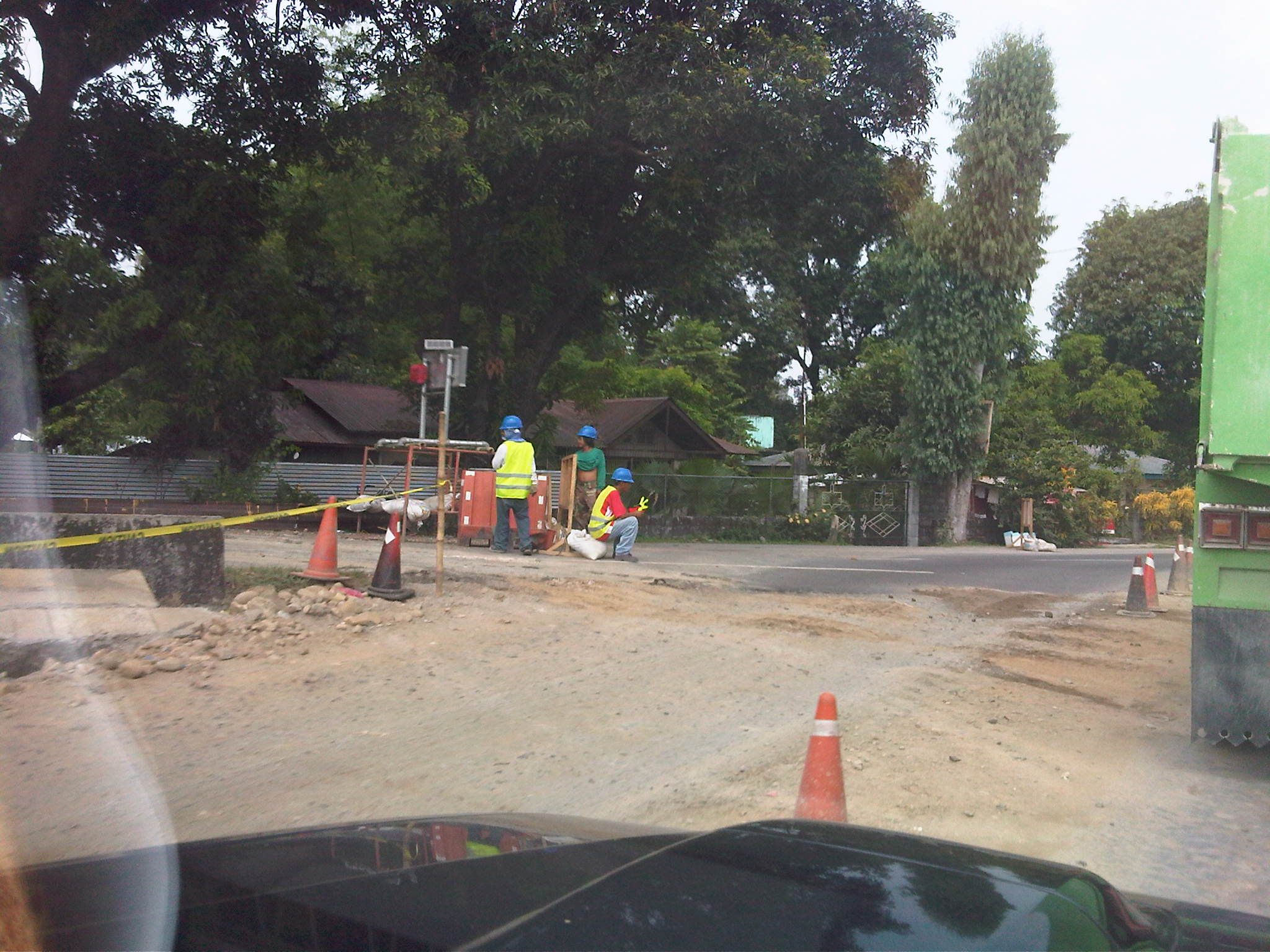 End of the road – the diversion road, that is, at the other end of the bridge.
 Boundary – arch symbolizing the gateway to the next town of San Marcelino.
–
Road and drainage works along A. Tuazon Ave., Marikina
Driving to the dentist on a Saturday morning, I came across roadworks along Angel Tuazon Ave. in Marikina City. The road connects the Marikina portion of Sumulong Highway with Marcos Highway in the Pasig/Cainta area and was also known as Fernando Sr. Ave. at one time. With the completion of works along Marcos Highway and Imelda Avenue, I was happy to see another road near my residence getting some much needed attention.
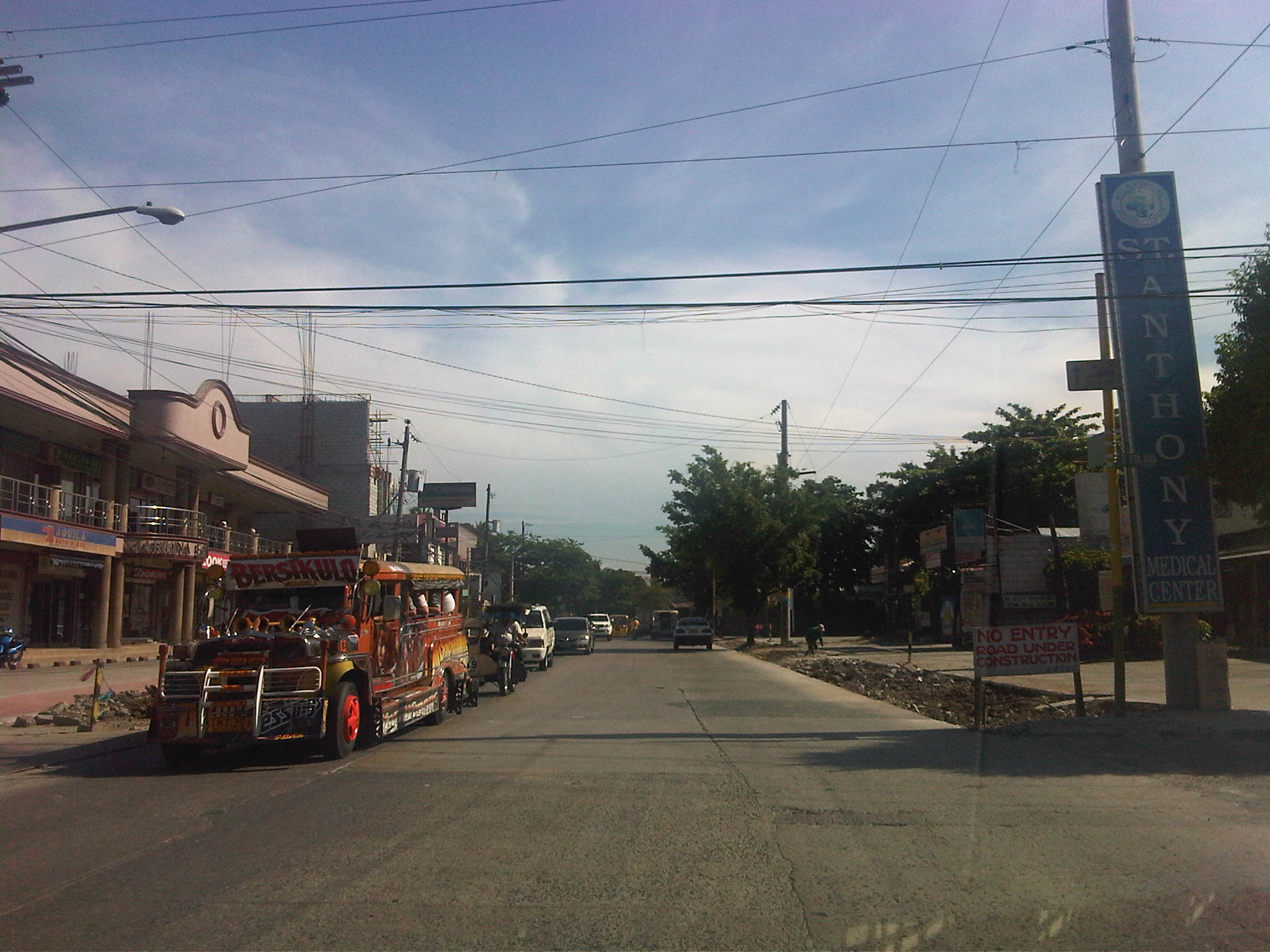
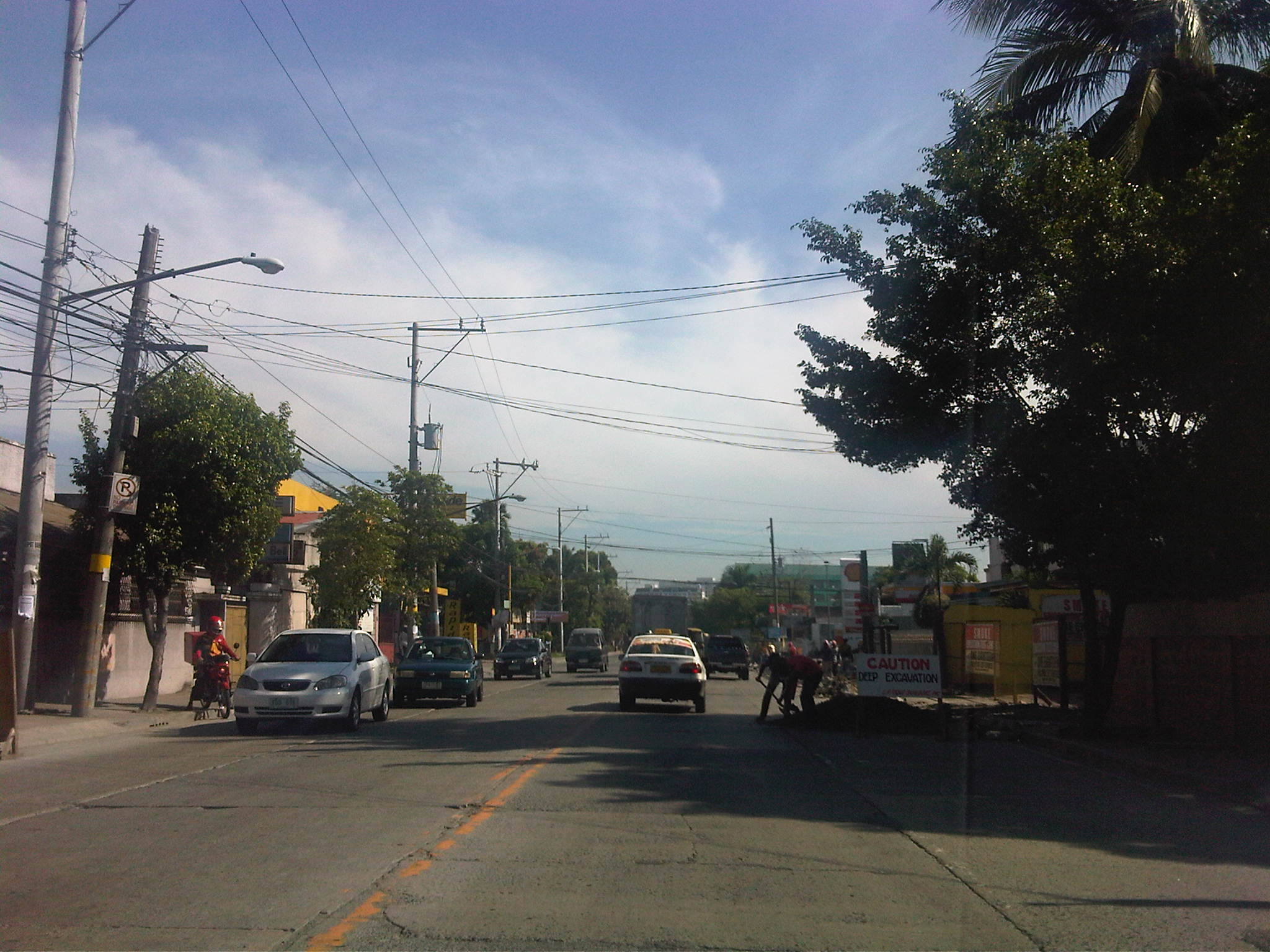
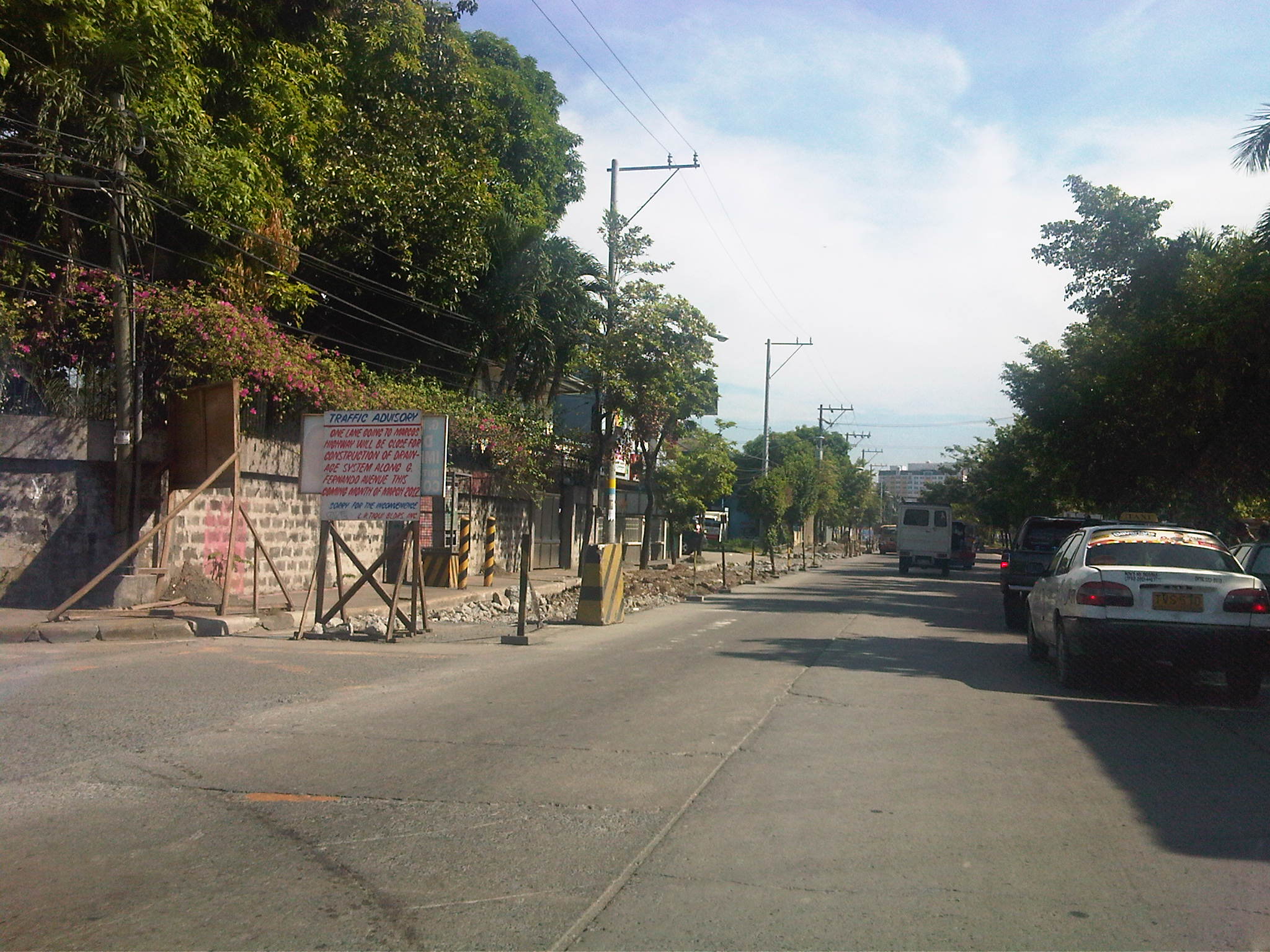
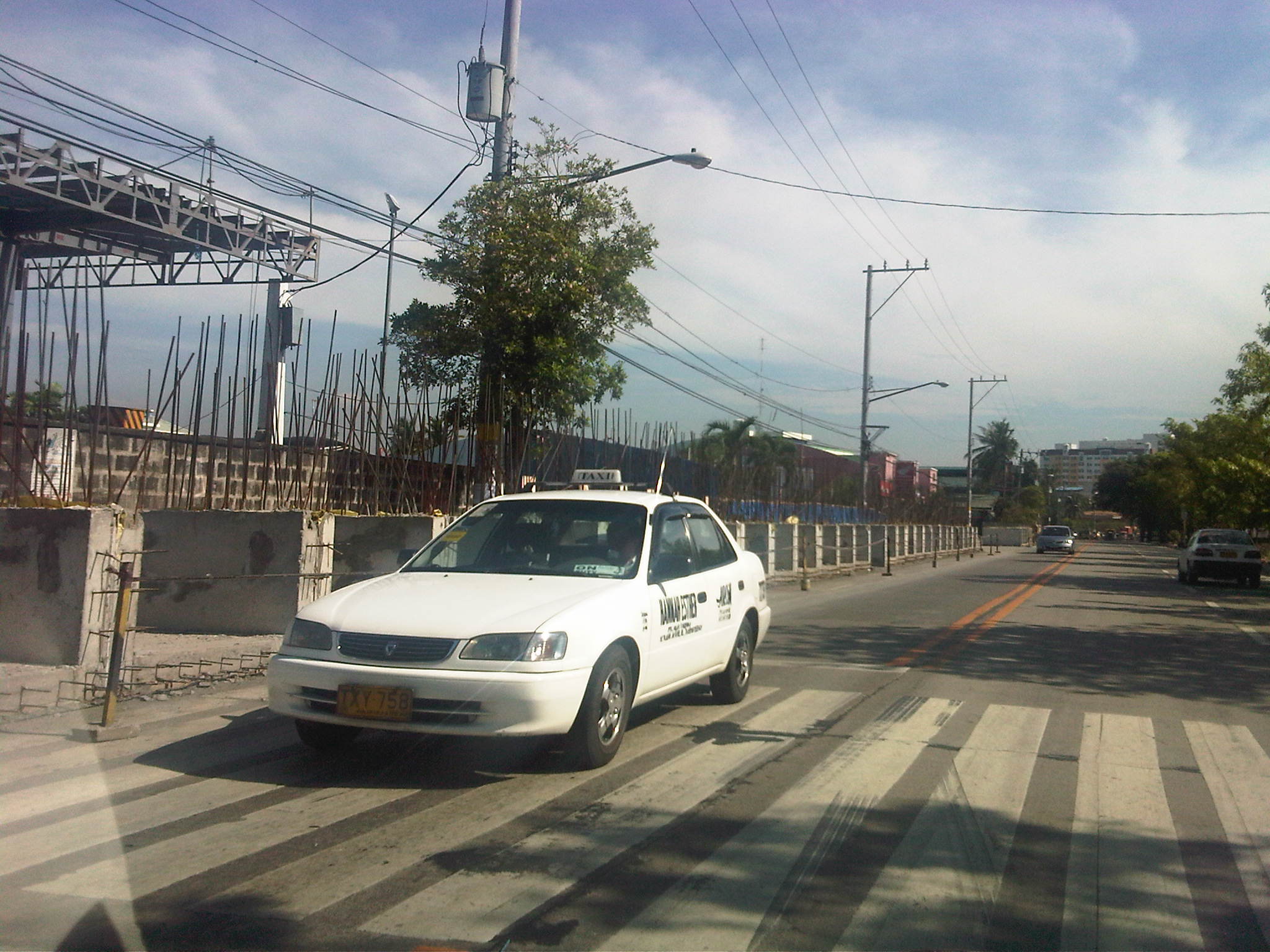
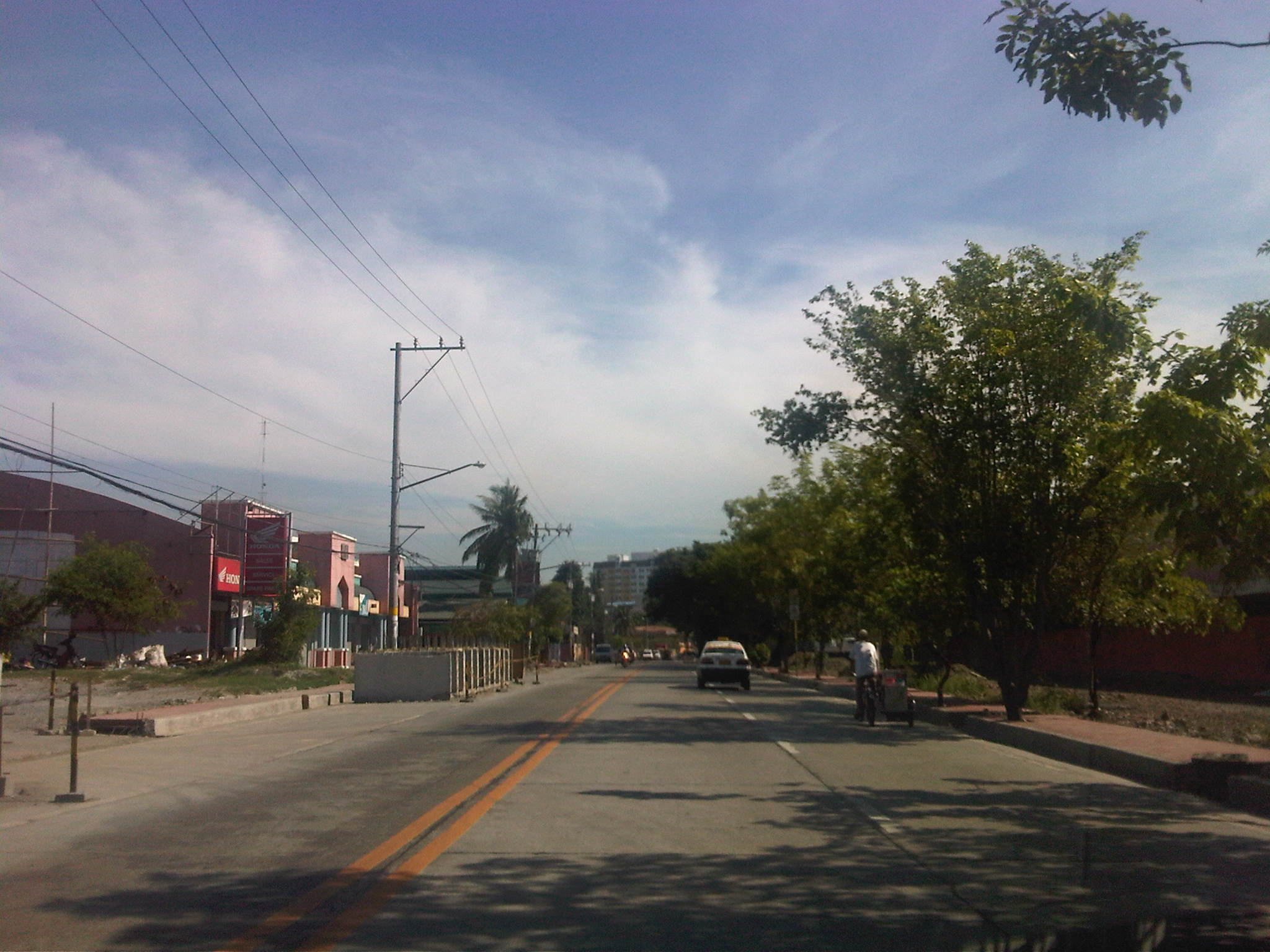
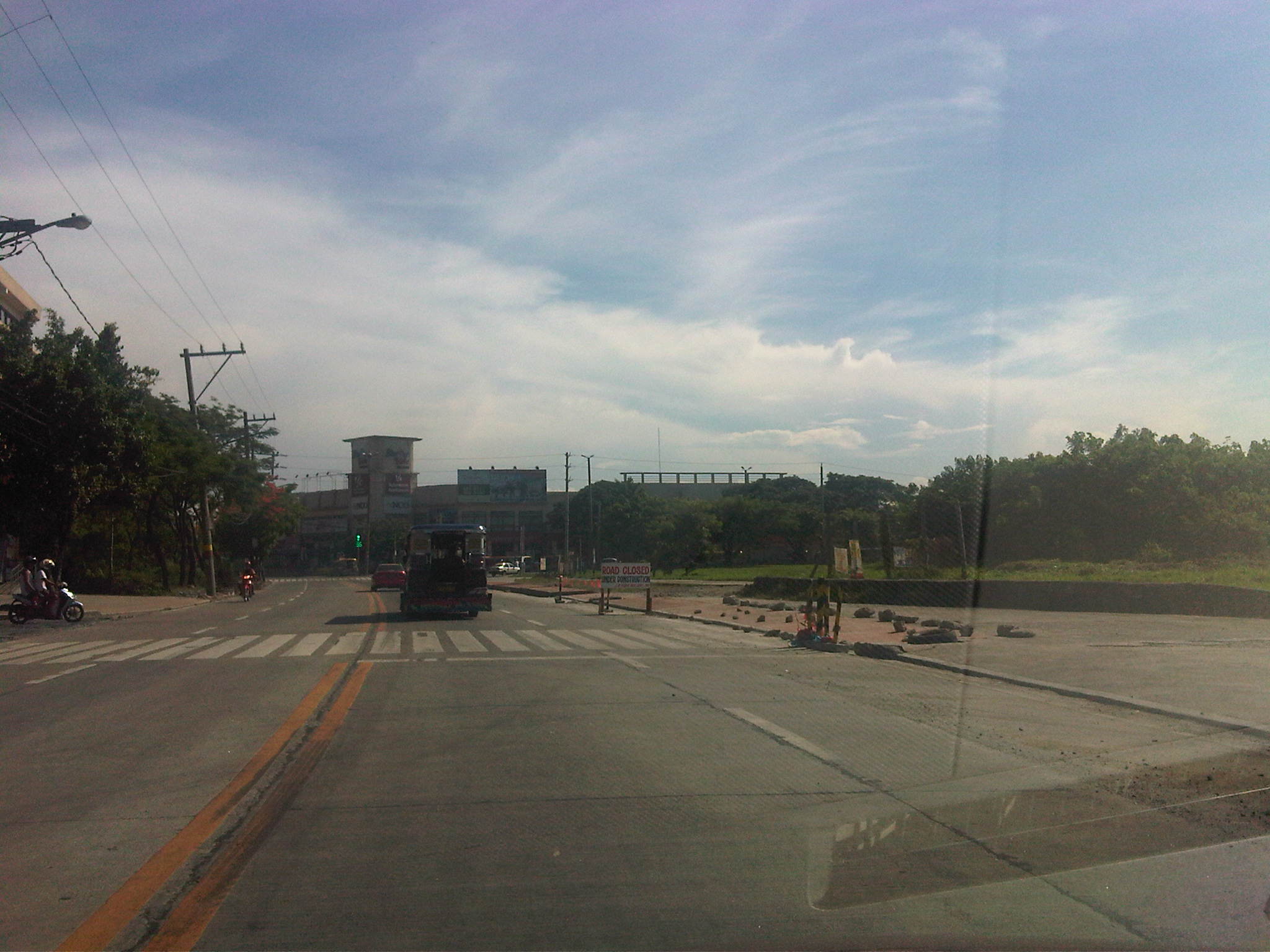
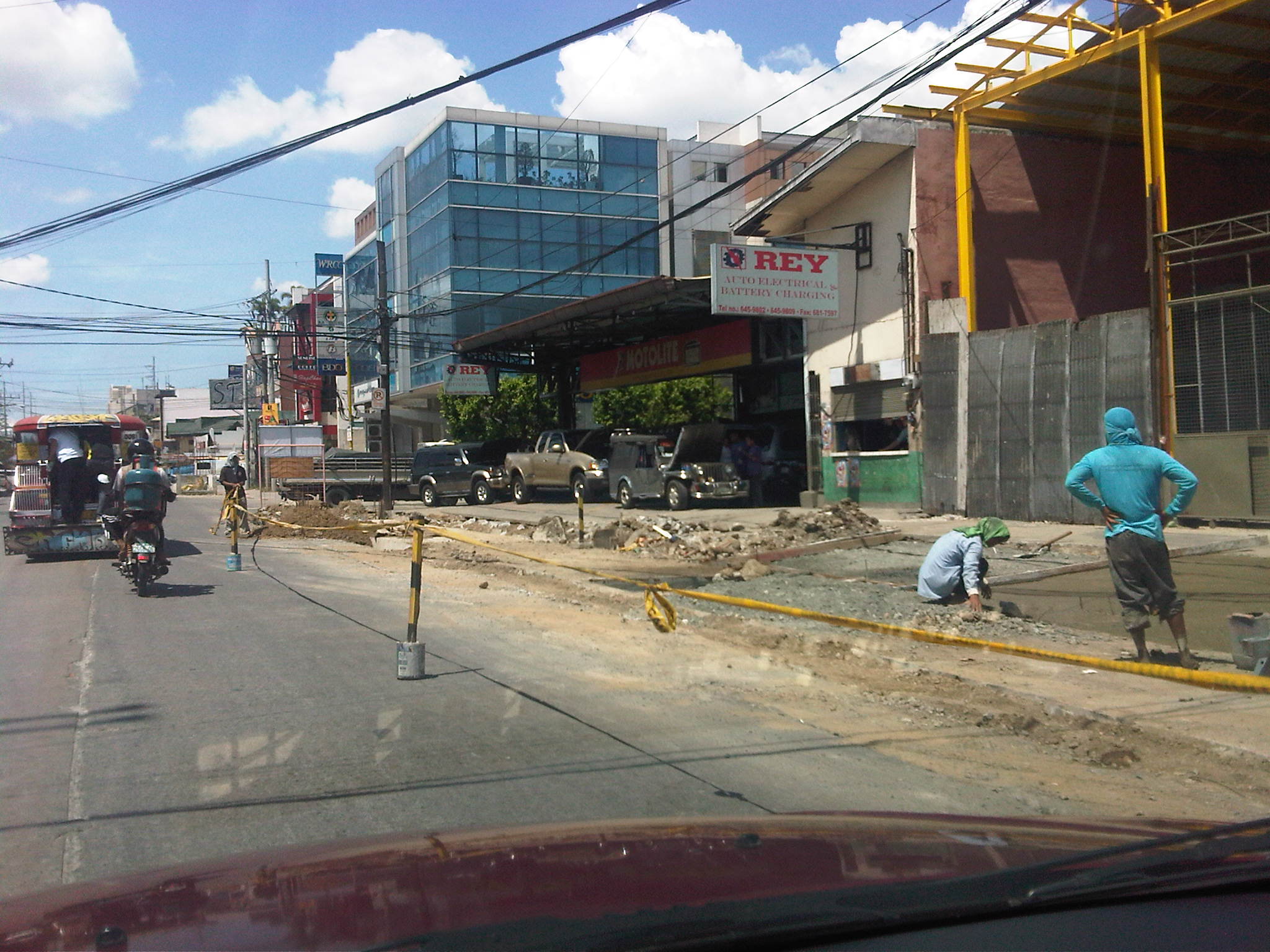
I thought that the works were just for the rehabilitation/concreting of damaged or weather pavements but it turned out to be something of a larger scope that includes drainage/flood control. The following photos were taken along the stretch of A. Tuazon last Saturday. Shown in the photos are road repairs, re-blocking/re-paving, drainage works and sidewalk construction in various stages of implementation. By the looks of it (there were a lot of people working along different sections of the avenue) the project will finish in time for the opening of school in June. Kudos to Marikina leaders for doing their jobs in this road and area that are usually subject to flooding during times of severe rain.
 1
1
 2
2
 3
3
 4
4
 5
5
 6
6
 7
7
 8
8
 9
9
 10
10
 11
11
 12
12
 13
13
 14
14
 15
15
I didn’t bother to put captions on the photos as they pretty much speak for themselves.
–
Olongapo-Castillejos Road: Subic
I took the following photos en route to the venue of our annual planning workshop. This year our office went to San Antonio, Zambales and our trip allowed me to photograph road conditions and characteristics along the Olongapo-Castillejos Road, which is a national highway. Like most Philippine highways, one will notice the operations of the ubiquitous tricycle, a motorized three-wheeled paratransit mode popular and dominant in many towns and cities.
 City limits – boundary of Olongapo City and Subic municipality with one of the most colorful arches I’ve seen along a national road
 Rounding the curve – some congestion due to the slow-moving trailer carrying a backhoe/excavator
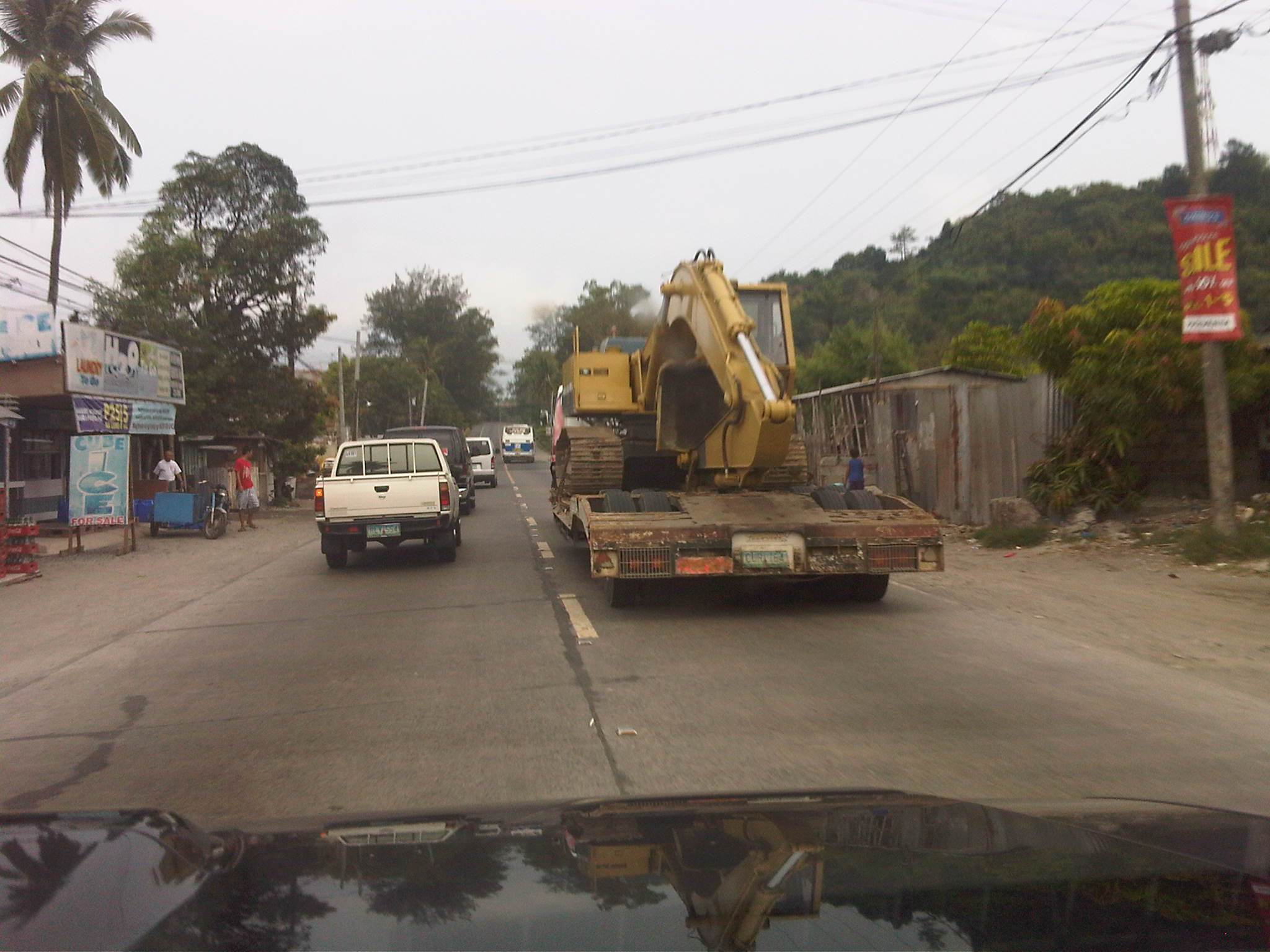 Passing distance – a platoon of vehicles passes the slow-moving truck. With no vehicles along the opposing lane, many vehicles succeed in the passing maneuver
 Regional buses – including mini-buses tend to stop anywhere along their routes and tend to cause congestion like pedicabs, tricycles and jeepneys
 The real Subic – Municipal hall of Subic town. People always refer to Subic as the former US naval base; the area of which was carved out from the provinces of Zambales and Bataan. In reality, no part of the Subic Freeport is in Subic town and the name comes from the bay rather than the town.
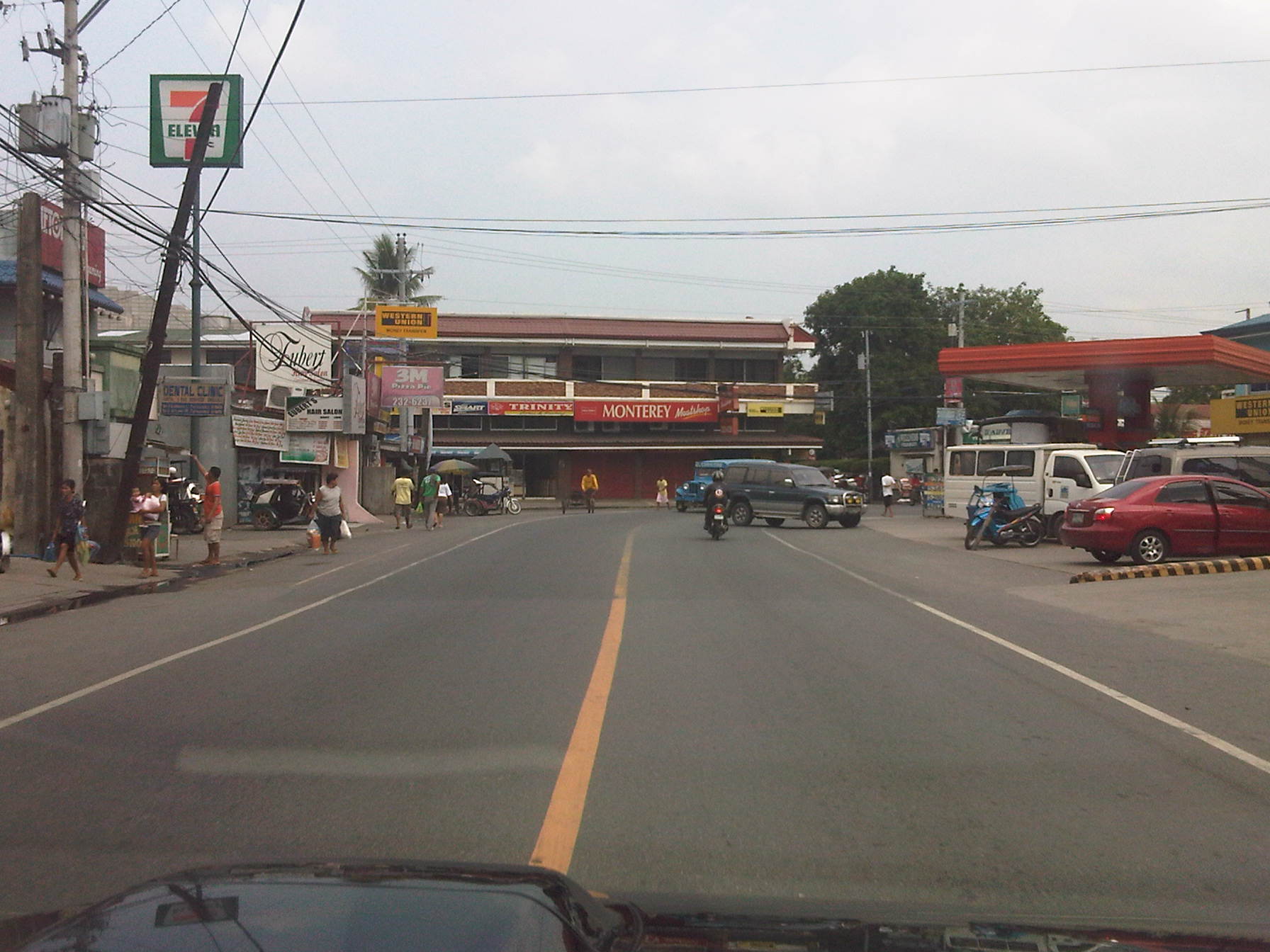 Good roads – the roads along the national highway were mostly in good or excellent condition including those in the CBD or bayan
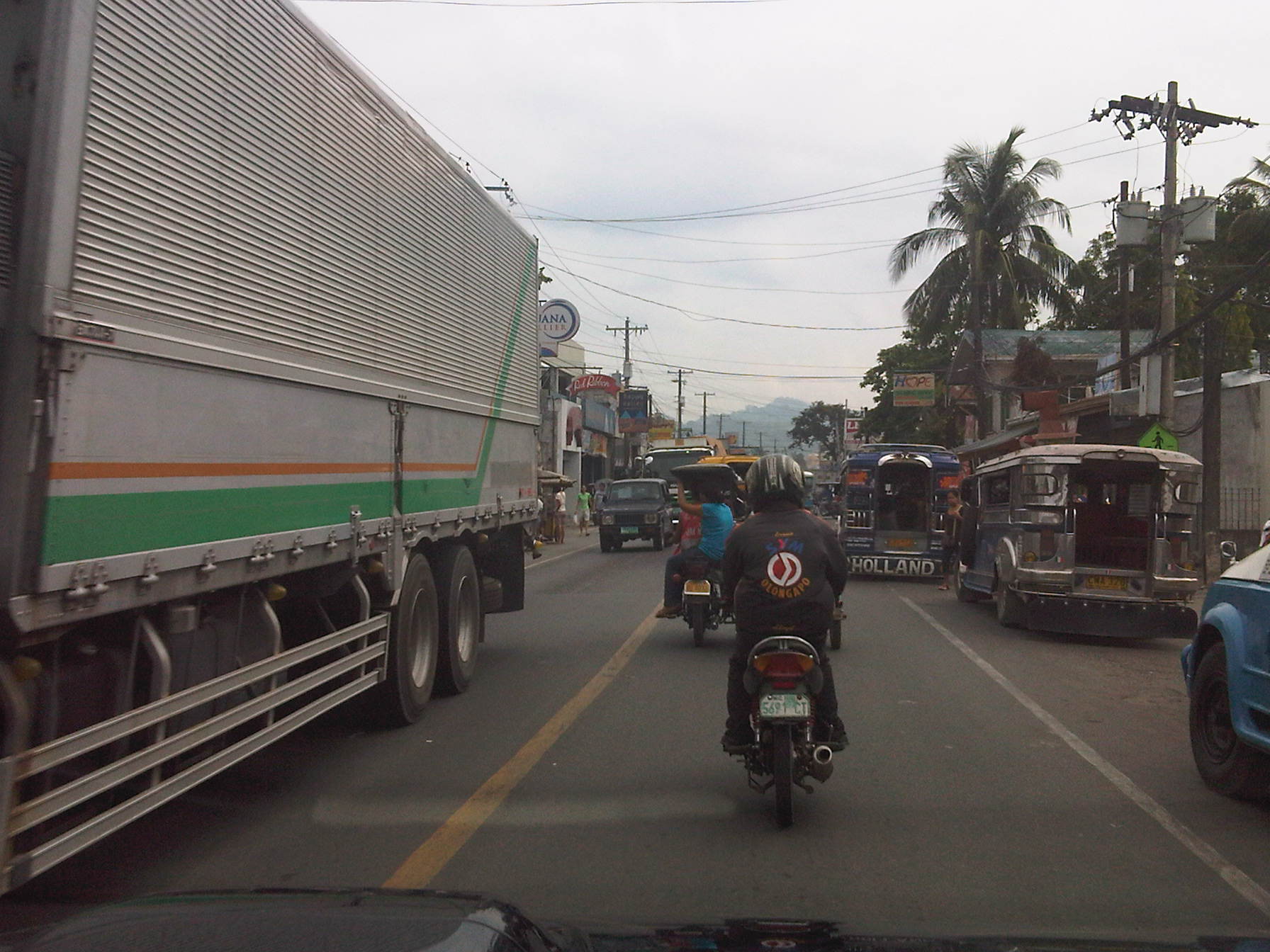 Busy streets – traffic was relatively heavy along the highway at Subic
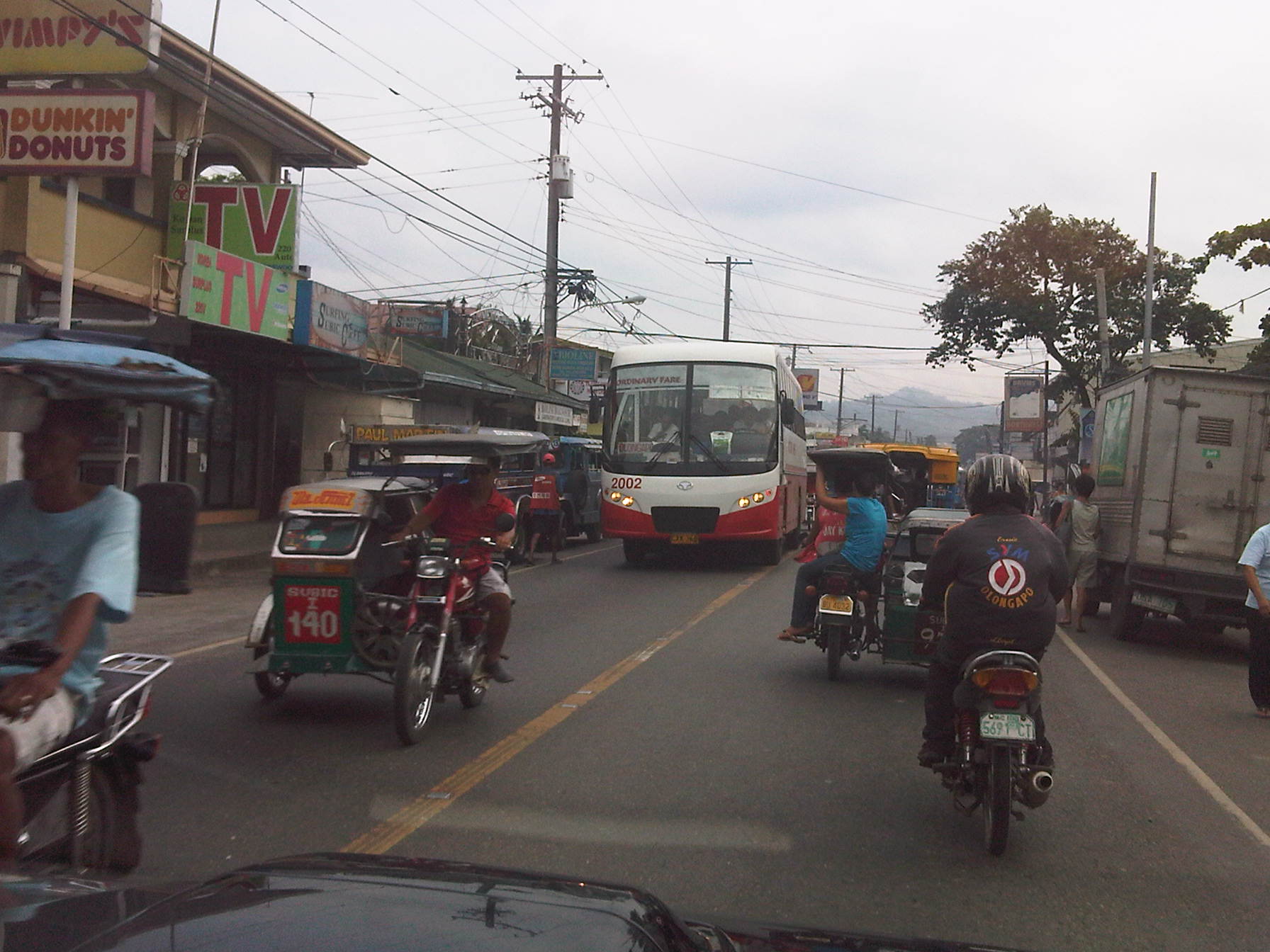 Mixed traffic – aside from the typical jeepneys, tricycles and motorcycles everywhere, there were a significant number of buses and trucks
 Parade of tricycles – like most towns around the Philippines, roads are often dominated by local traffic most especially tricycles that are used for public transport in even large cities
 Air conditioning? – we came upon this tricycle carrying a block of ice (apparently purchased by a passenger) and wondered what would be left of the block once they reach their destination
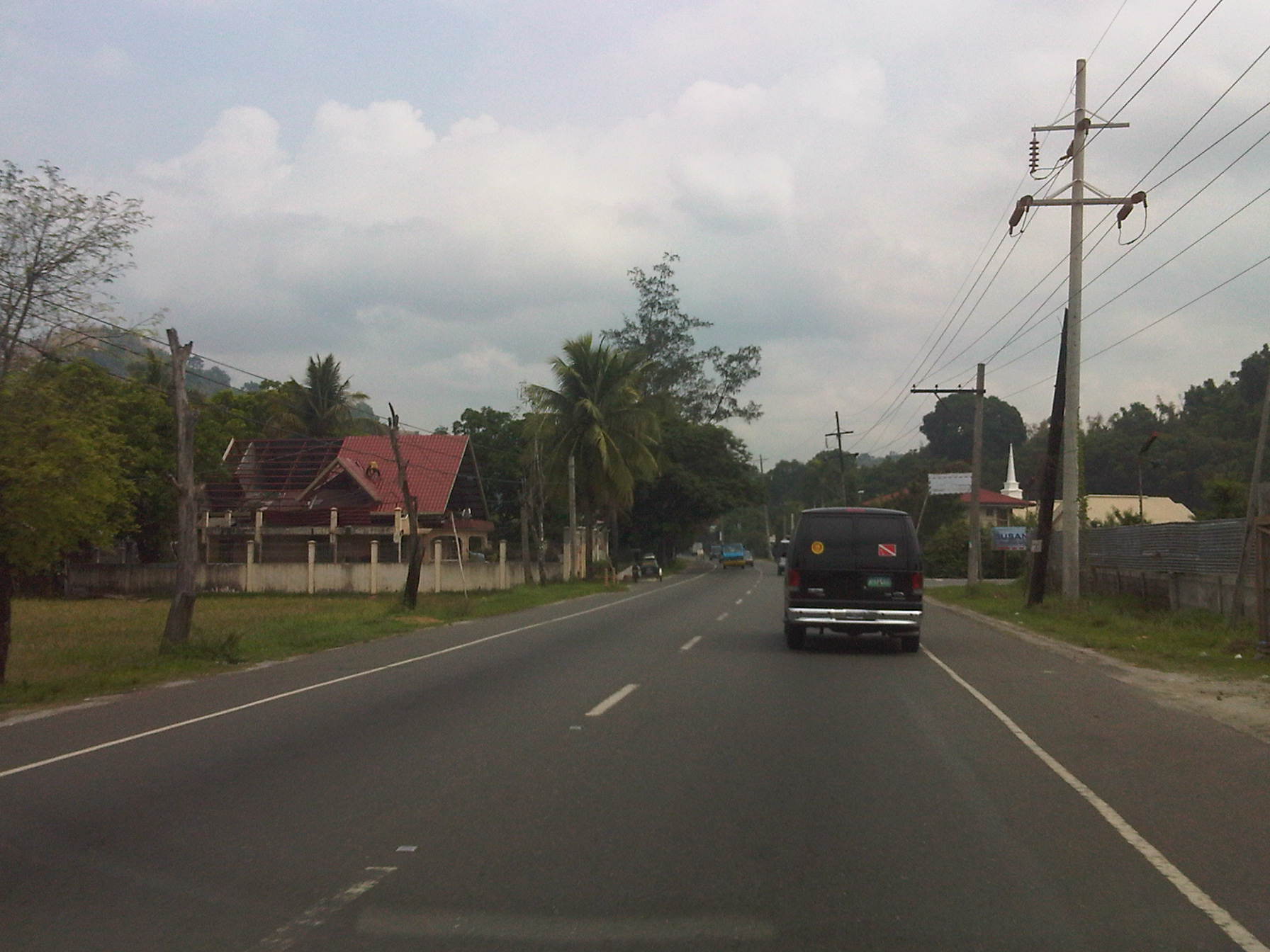 Open road – past Subic town center, traffic was already very light
 No overtaking – many sections along the road featured a solid orange-yellow line along the middle of the highway that should be understood as no overtaking. Shoulders are also clearly marked by the solid white lines on either side of the carriageway
 Curvature – overtaking is discouraged along curves as sight is limited and therefore restricts drivers’ and riders’ capabilities to properly discern opposing vehicles.
 Passing sight distance – the view from our position as we prepared to pass a slower moving vehicle in front of us illustrates sufficient PSD for us to succeed in our maneuver. Note the perceived distance between us and the vehicle in the opposing lane.
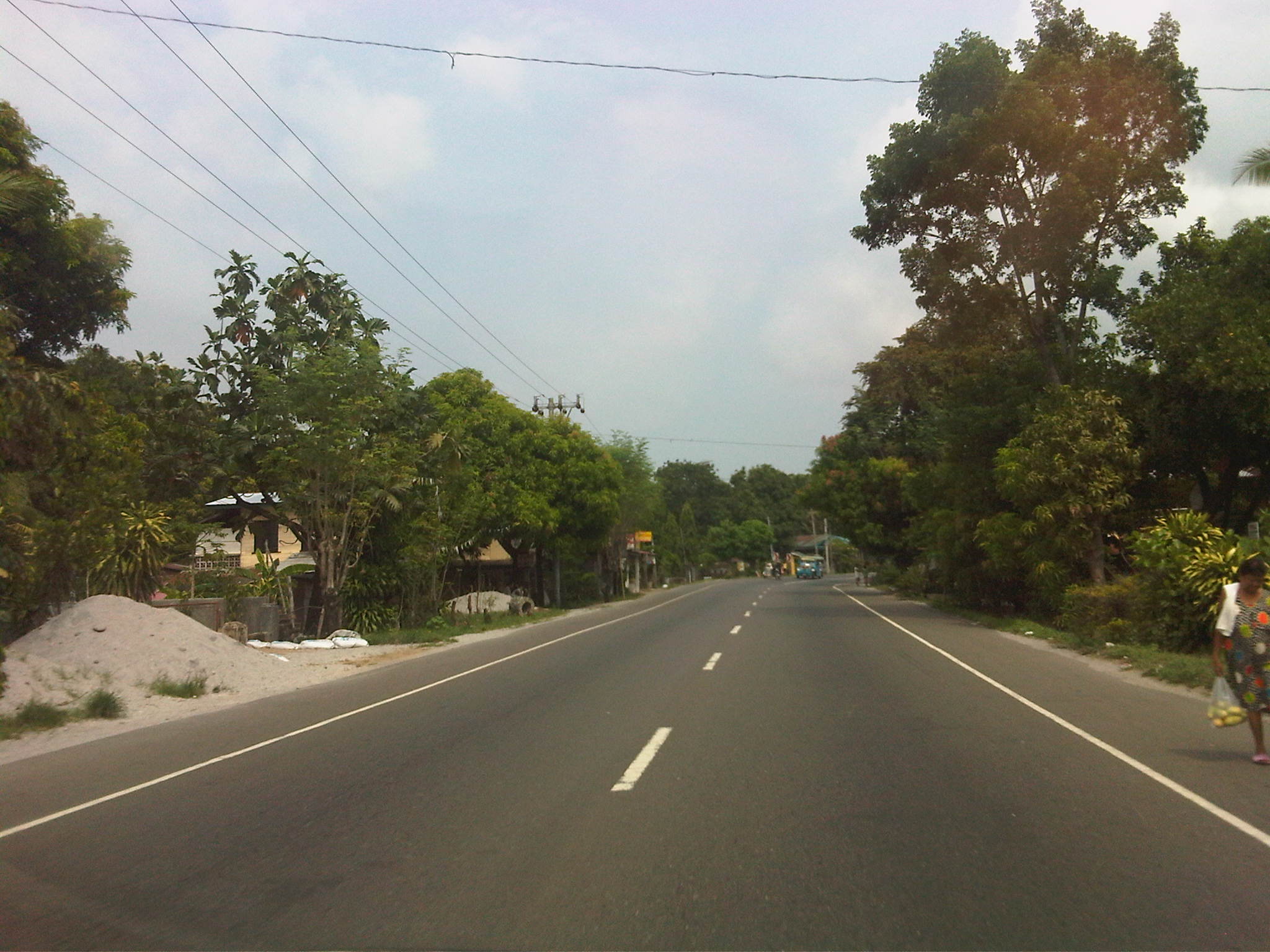 Clear for take-off – such scenes along low traffic volume highway sections around the country and elsewhere seem to invite drivers to speed up.
 Bridge before the boundary – I didn’t pay attention enough to see the name of the bridge and had to google it. Pamatawan Bridge allows people to cross the Balaybay River in Zambales. Just after the bridge and visible downstream from our position in the photo is the arch welcoming travelers to the Municipality of Castillejos.
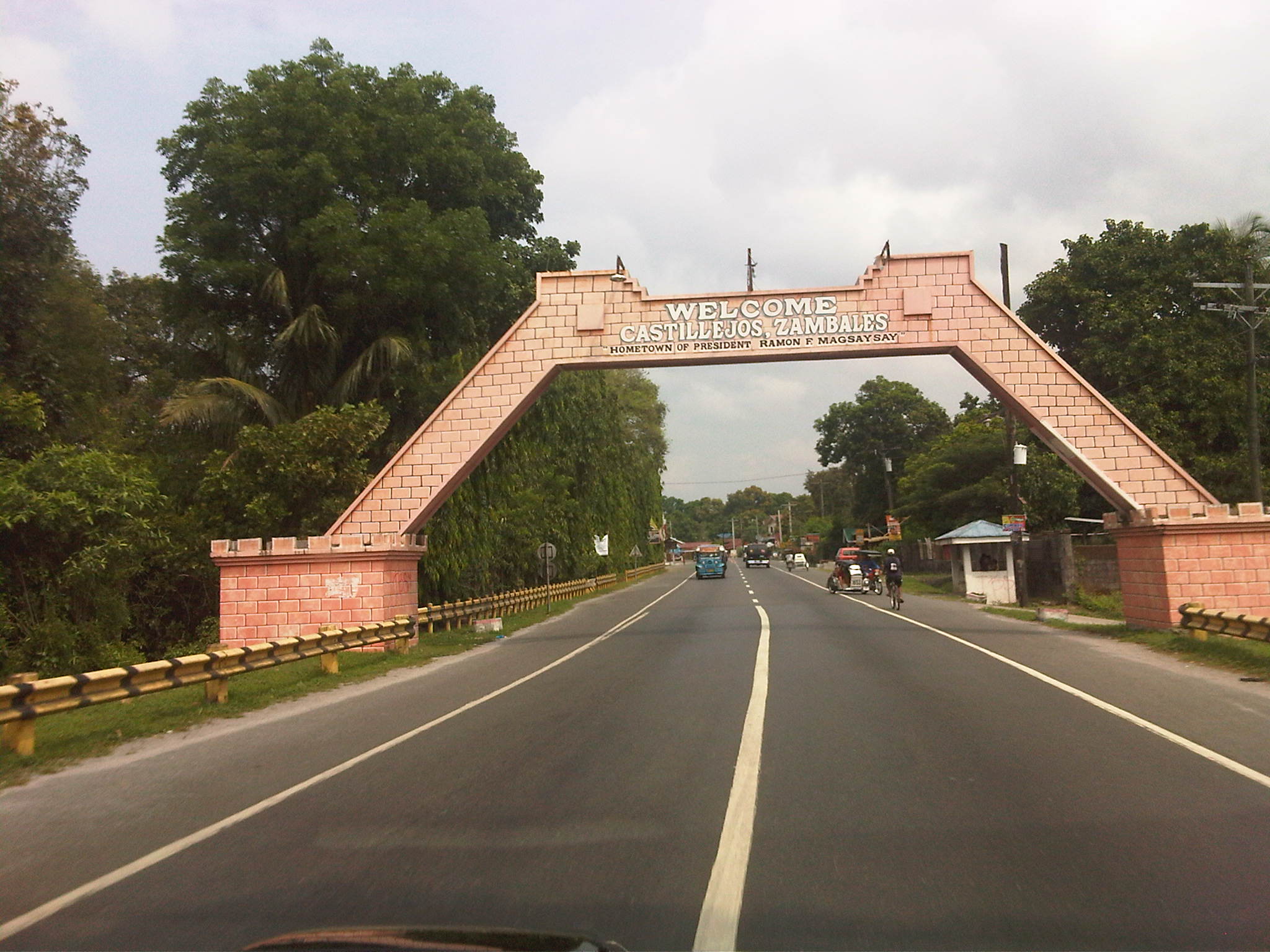 Municipal boundary – like many others across the country boundaries are marked by arches like the one in the photo welcoming travelers to Municipality of Castillejos. This one though is among the more appropriate ones given the town’s name, which translates to “small castle.”
–
Failure in transplant? – The trees along the Katipunan median island
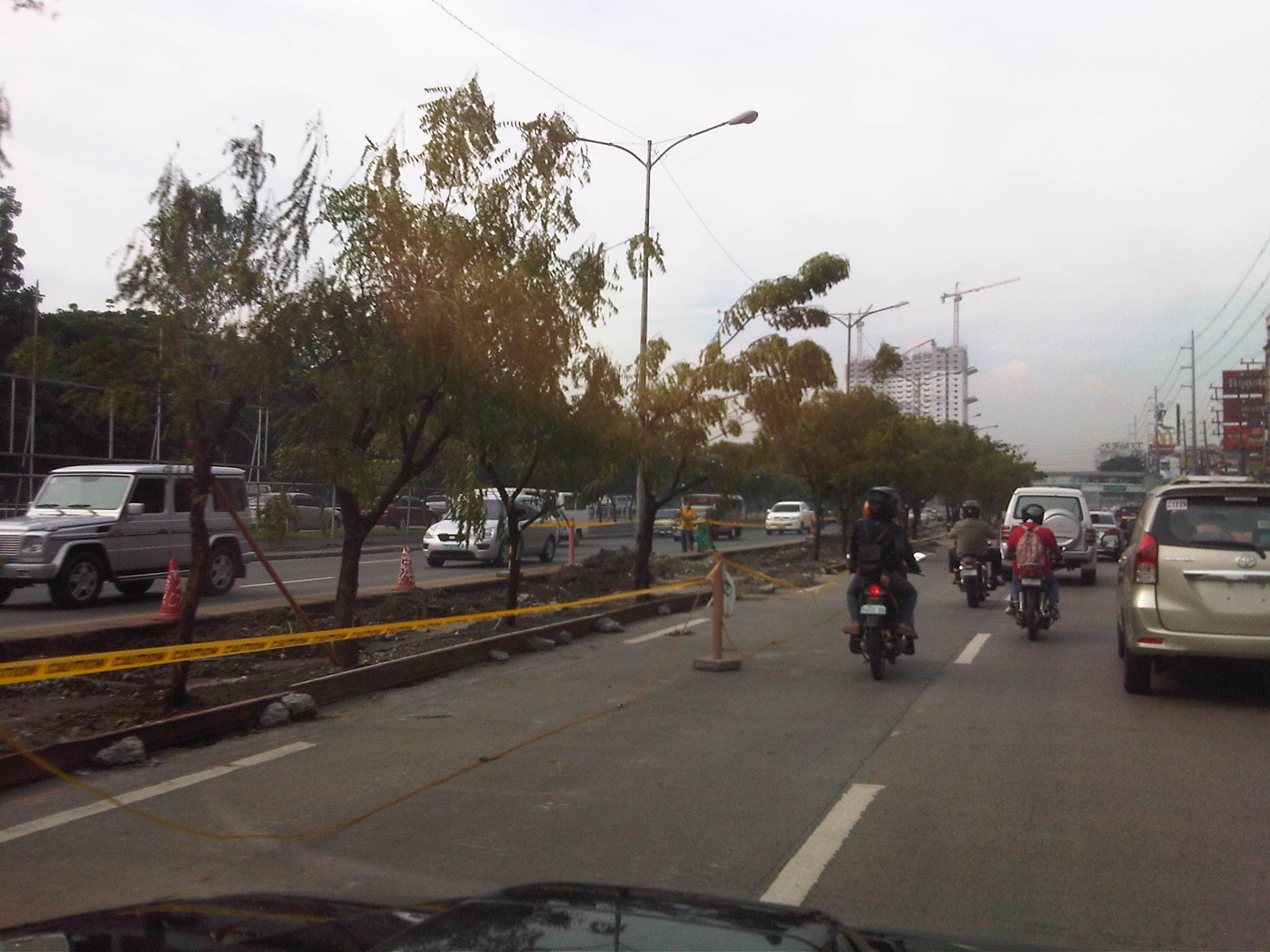
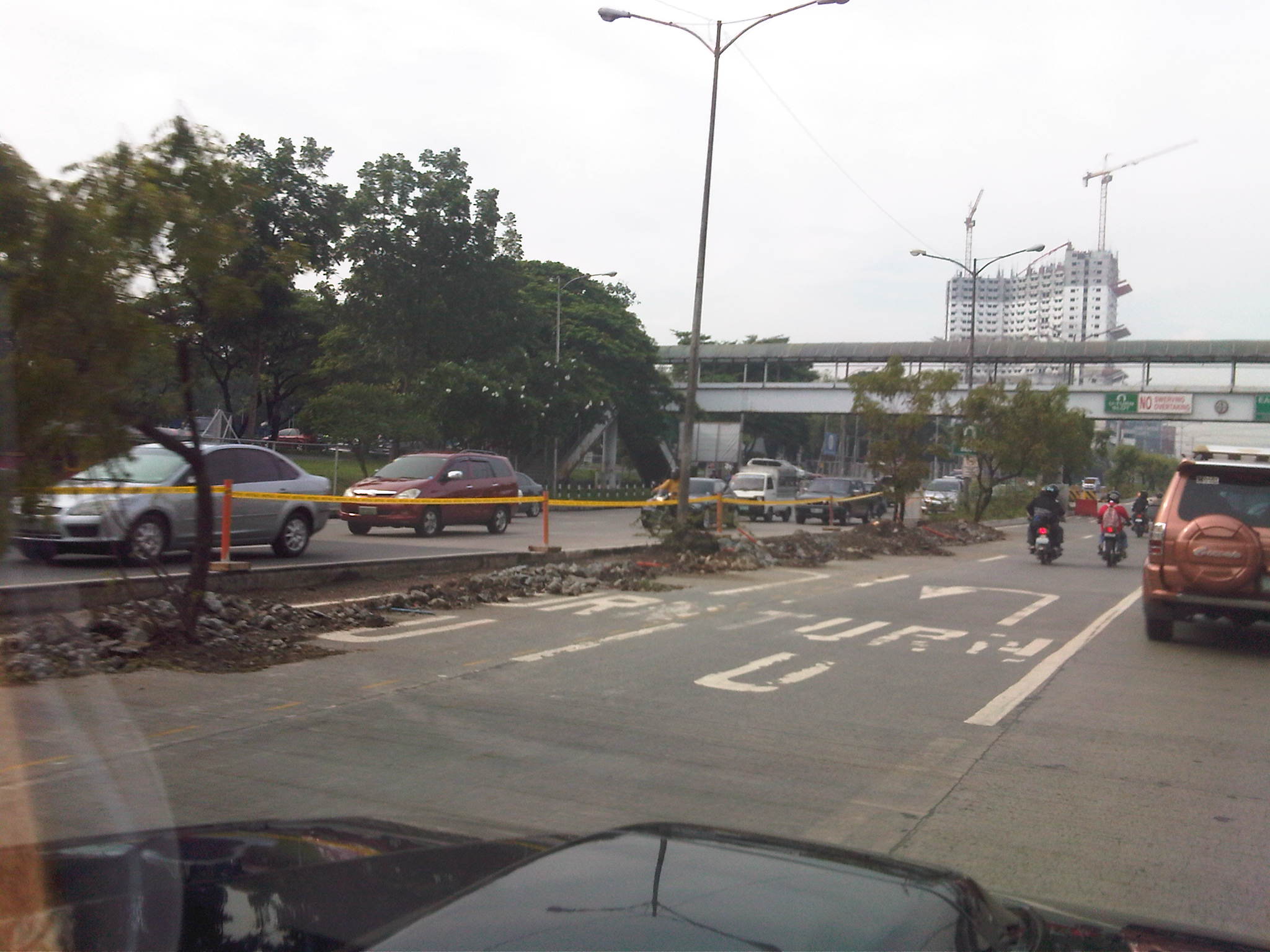
A day after featuring the ongoing lane rationalization project along Katipunan Avenue, I was able to take photos of the transplanted trees along the median as we traveled along the southbound direction of the road. The trees were transferred to the new median as will the light posts later.
Following are three photos taken last May 16, 2012 showing the transplanted trees with their leaves still green but already showing signs of withering (nalalanta na). I thought this was natural given the grown trees being balled and transferred plus the fact that we were still enduring the summer heat.
 1
1
 2
2
 3
3
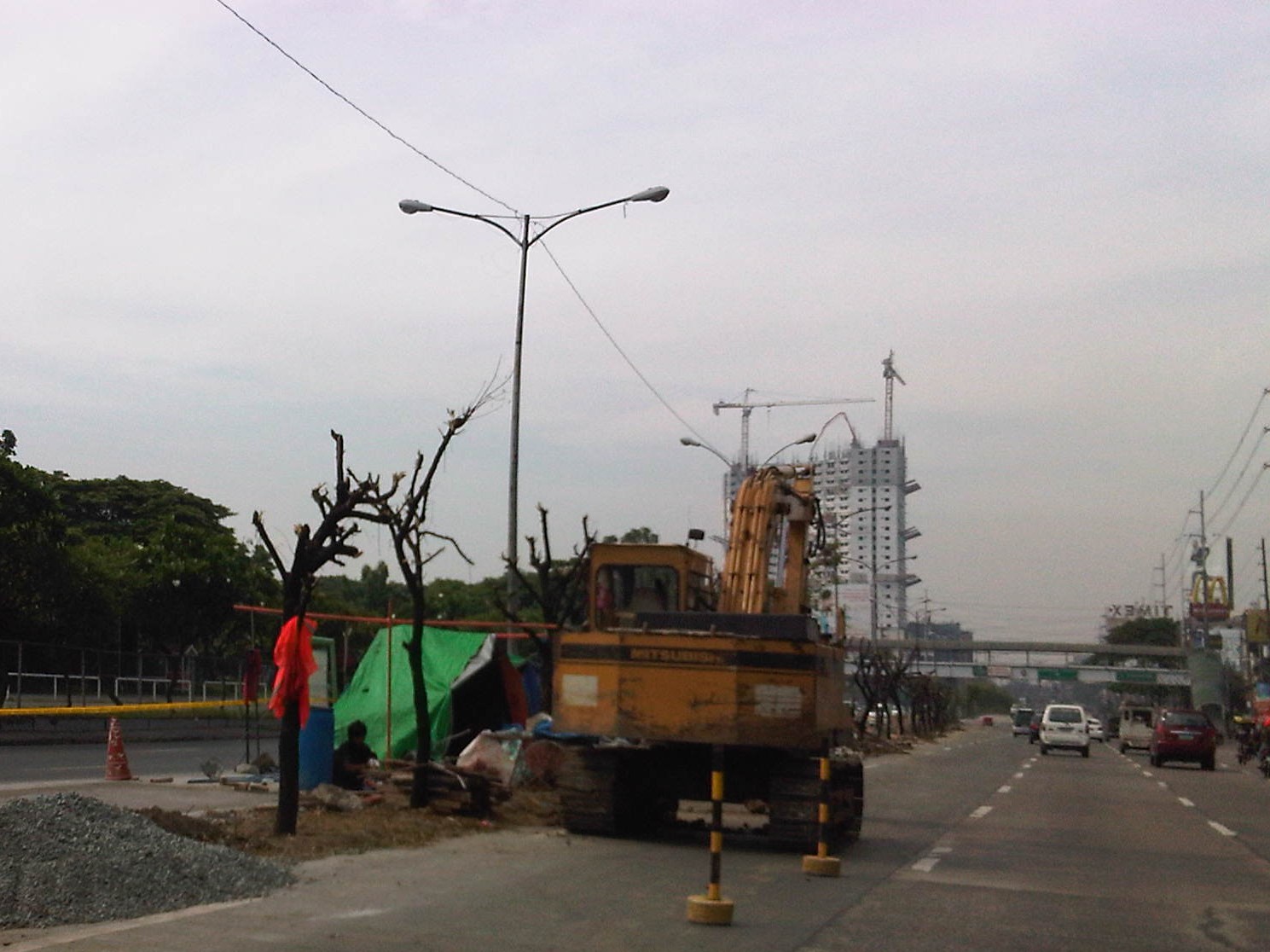
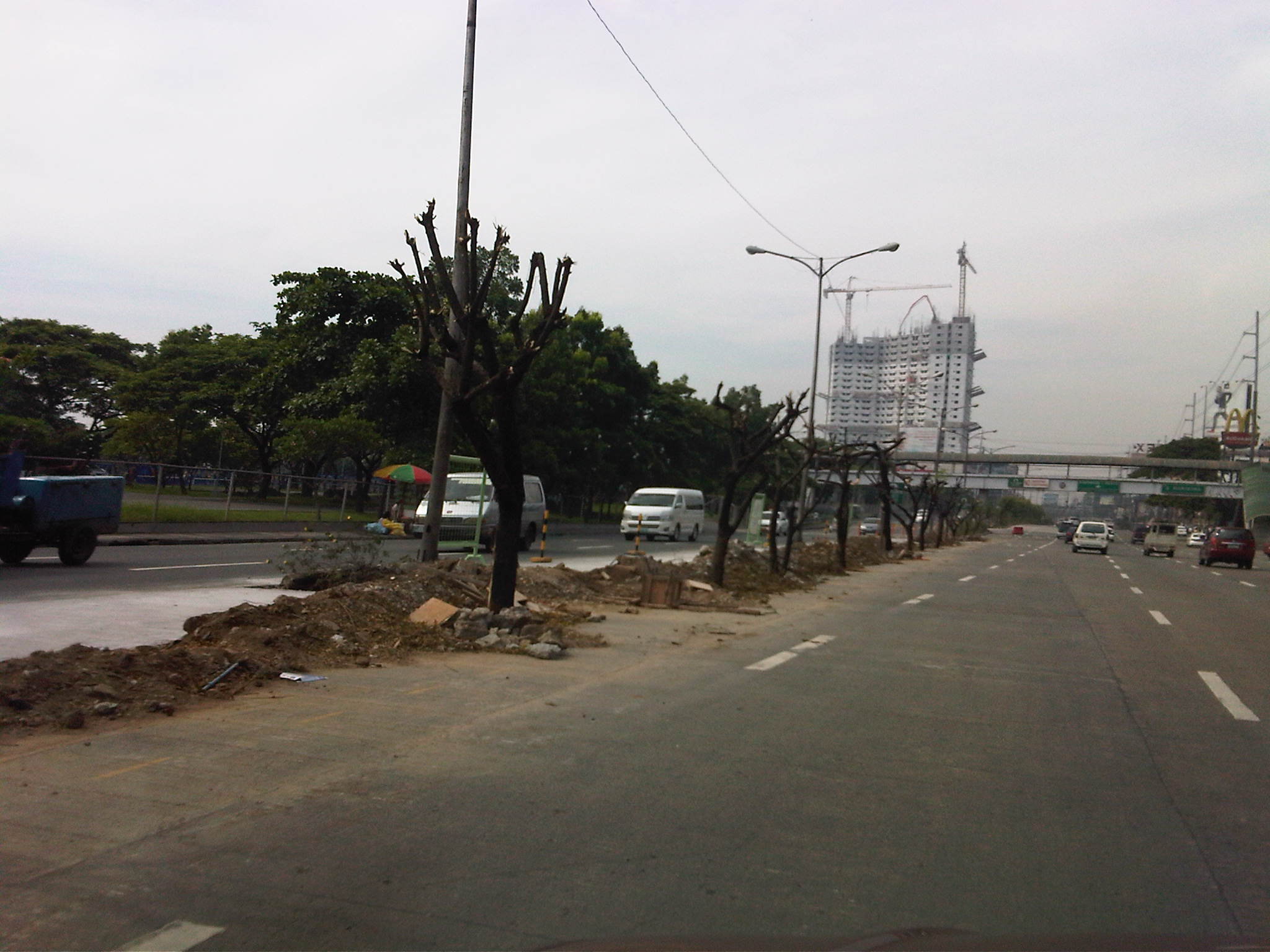
This morning (Sunday, May 20), as I drove along the same way I saw that the trees’ branches have been cut off. I am not a botanist or an expert with flora but perhaps this was done to allow the trees to recover? The optimist in me says leaves will eventually sprout from the stubs much like they did for the trees removed from the Katipunan service road about a decade ago that were transferred to the Marikina Riverbanks, many of which lived only to perish from Ondoy’s floods in 2009. The following photos are what’s left of the median island trees of Katipunan.
 4
4
 5
5
 6
6
–
Another look at the Muelle Del Rio
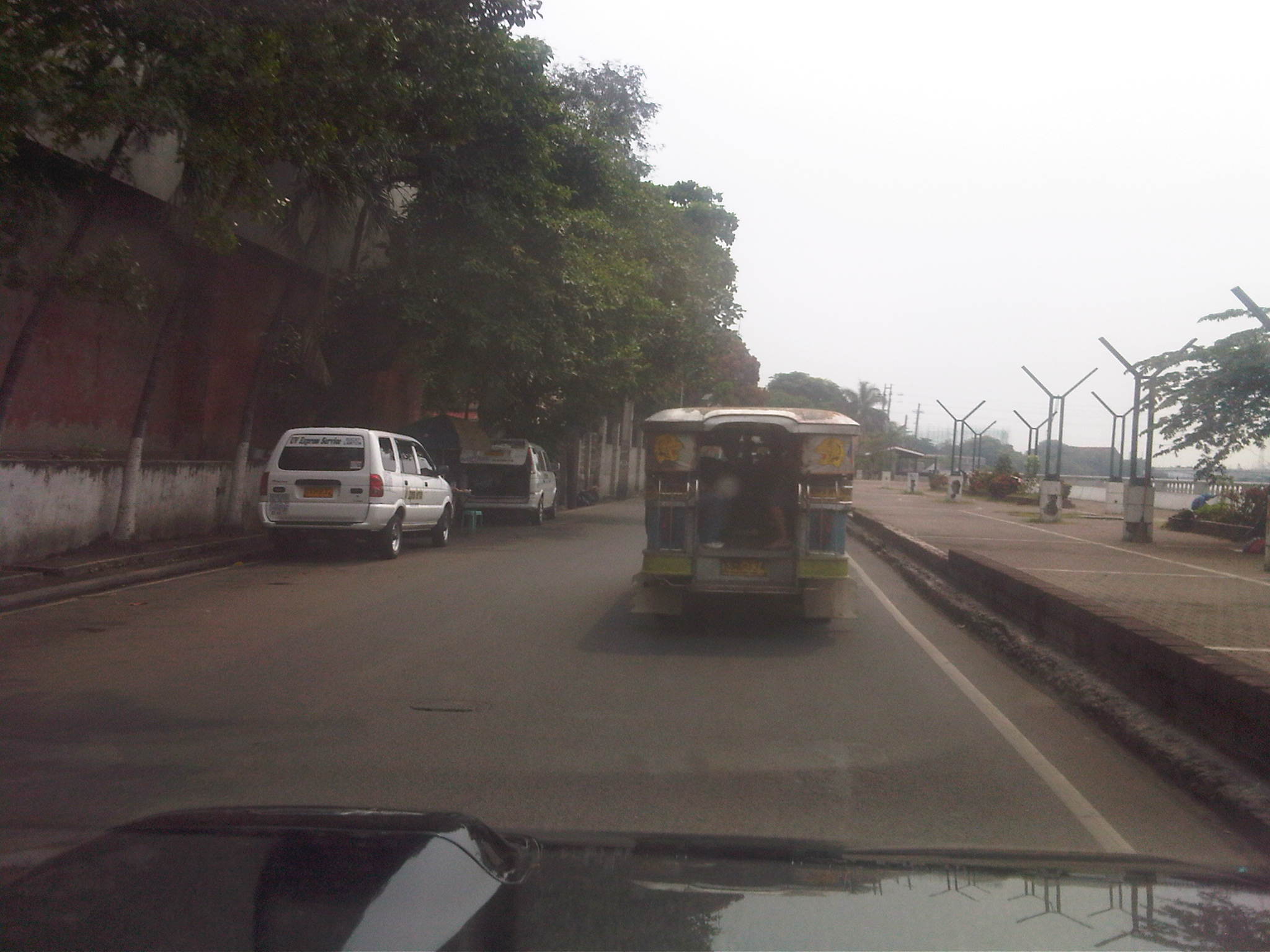
Got to pass by the Muelle Del Rio again en route to a meeting at the DPWH in the Port Area. We took this route as we wanted to avoid congestion in front of the Manila City Hall and along Padre Burgos. I made sure I took additional photos of the road including the approach from the Quezon Bridge to show the parked vehicles, mostly UV Express, parked along the road. Some maps already refer to the Muelle Del Rio as Riverside Drive. I think this is not appropriate especially from the perspective of heritage and the preservation of street names that are strongly linked with history. Such is an unnecessary simplification that should not be the case especially in the historic City of Manila and in the vicinity of Intramuros.
 Approach from the Quezon Bridge – UV Express (FX taxis) parked along the roadside
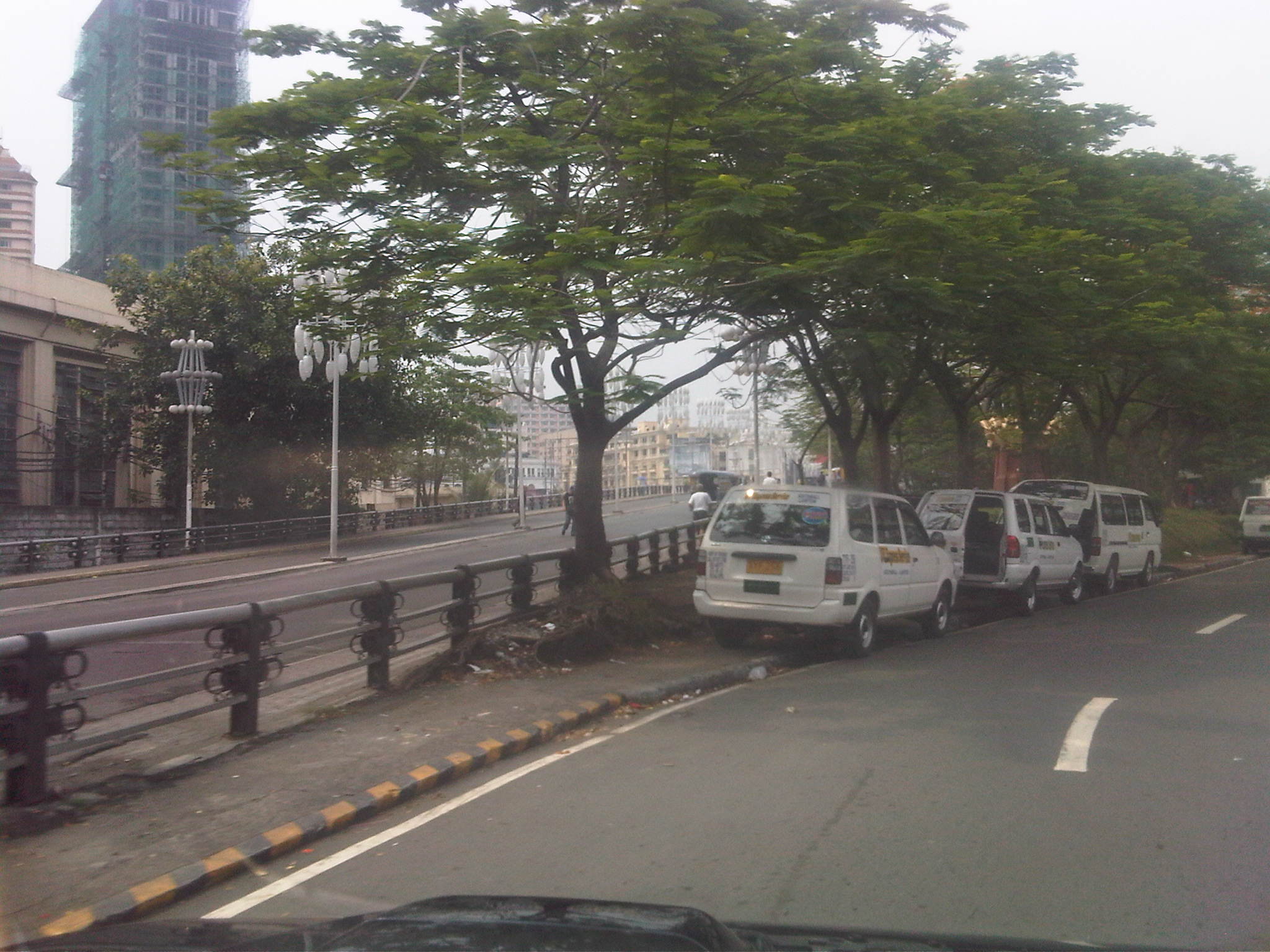 A bridge too close – the road comes quite close to the approach to MacArthur Bridge (the road on the other side of the barrier), which leads from Padre Burgos to Carriedo
 Taking a turn – turning from the approach towards the riverside portion of the Muelle del Rio, one can see the bridge for the LRT Line 1 and trees where homeless people usually take shelter. The driveway under the bridge is for a public transport terminal occupying the area under the bridge.
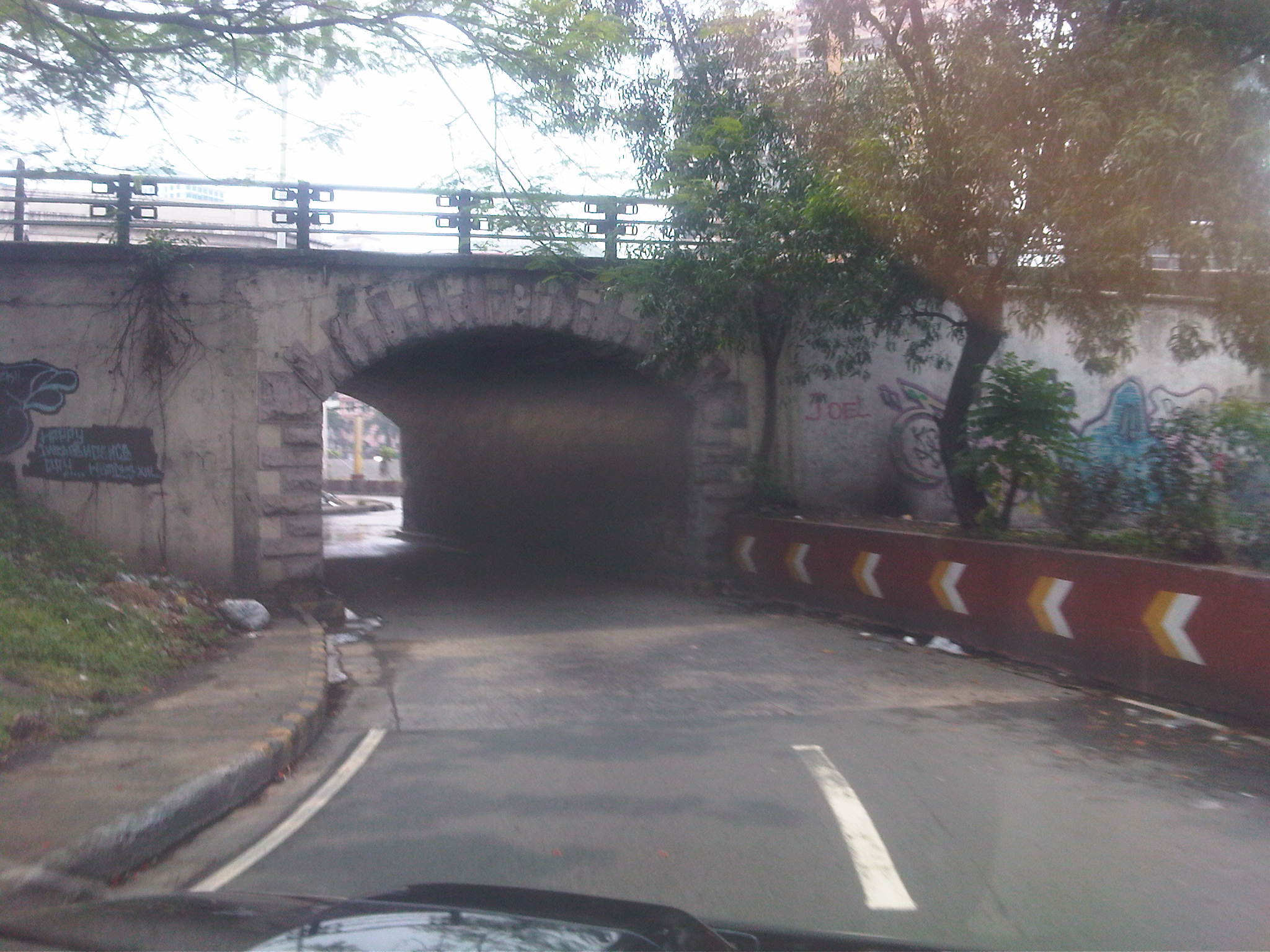 Underpass at MacArthur – the walls of the plant box are painted and seem to be well-maintained while that of the bridge are vandalized
 Behind the Post Office – the walls/fence of the post office is vandalized while there seems to be no one using the walkway along the Pasig River at the right of the photo. The yellow poles are light posts. There are no pavement markings along this stretch of the road.
 Pools – water from the mid-day rains accumulate along the gutters at either side of the road. The walls of the Manila Central Post Office look dirty from the combination of grime and vandalism.
 Sidestreet – approach to the junction to the sidestreet between the central post office and the building of the Philpost Bank before the underpass at the Jones Bridge
 Jones Bridge underpass – the underpass is obscured by the tree growing beside the wall. The stairs shown on the right of the photo is the pedestrian access to the bridge from the riverside walkway.
 After the bridge – there is significant traffic behind the National Press Club building
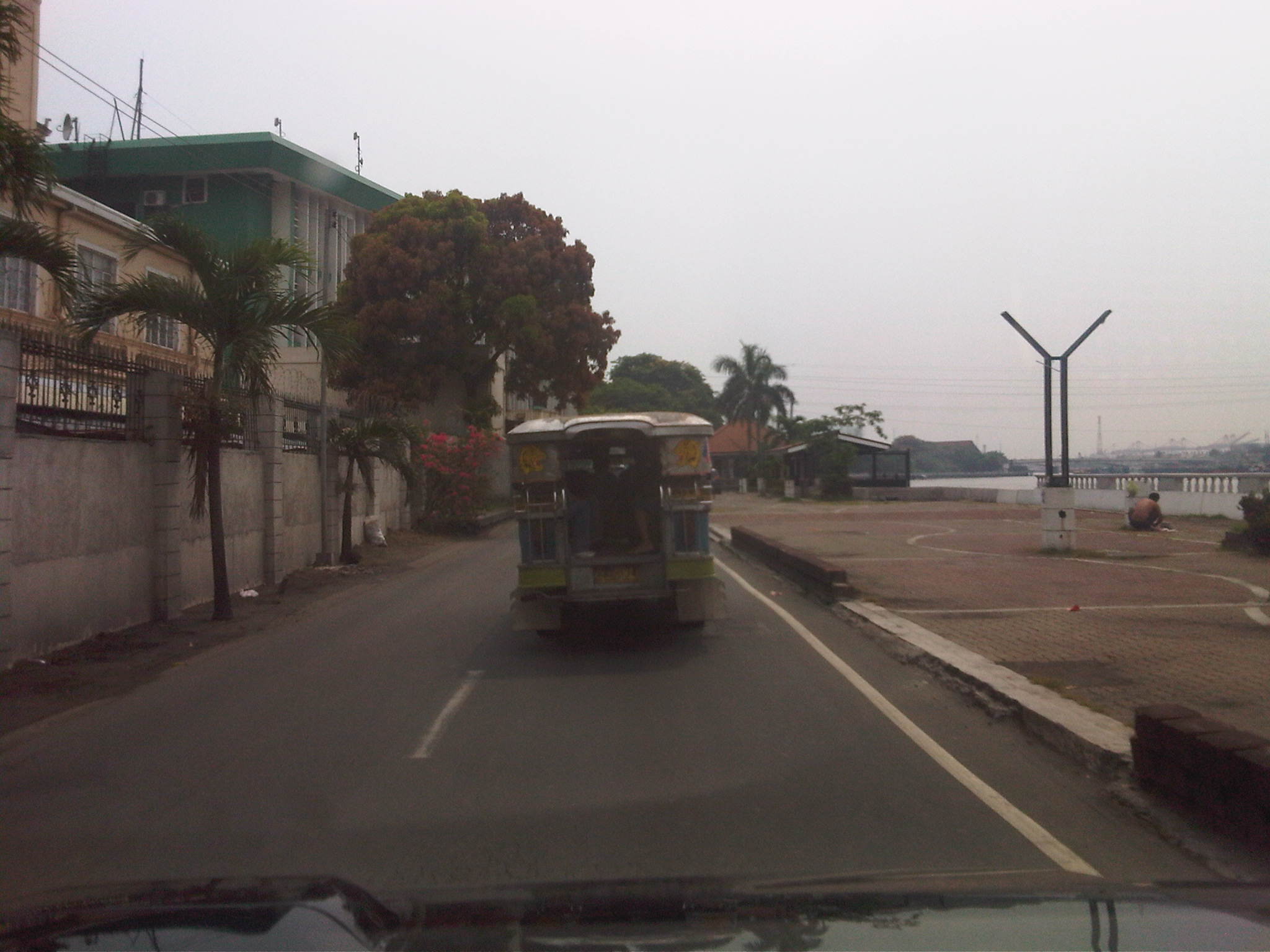
 Bureau of Immigration – the BI complex is behind the wall shown on the left of the photo. There is a wide buffer zone along the Pasig River that’s been developed into a riverside park by the City of Manila. The curious Y-shaped structures are lamp posts that provide ample illumination at night time.
 Approaching the terminal – the park area on the right is also used as parking space by visitors of the BI and those using the now non-operational Pasig River Ferry terminal at the mouth of the Pasig.
 Ferry terminal – parked vehicles along the terminal plaza are actually those of employees and visitors of the BI
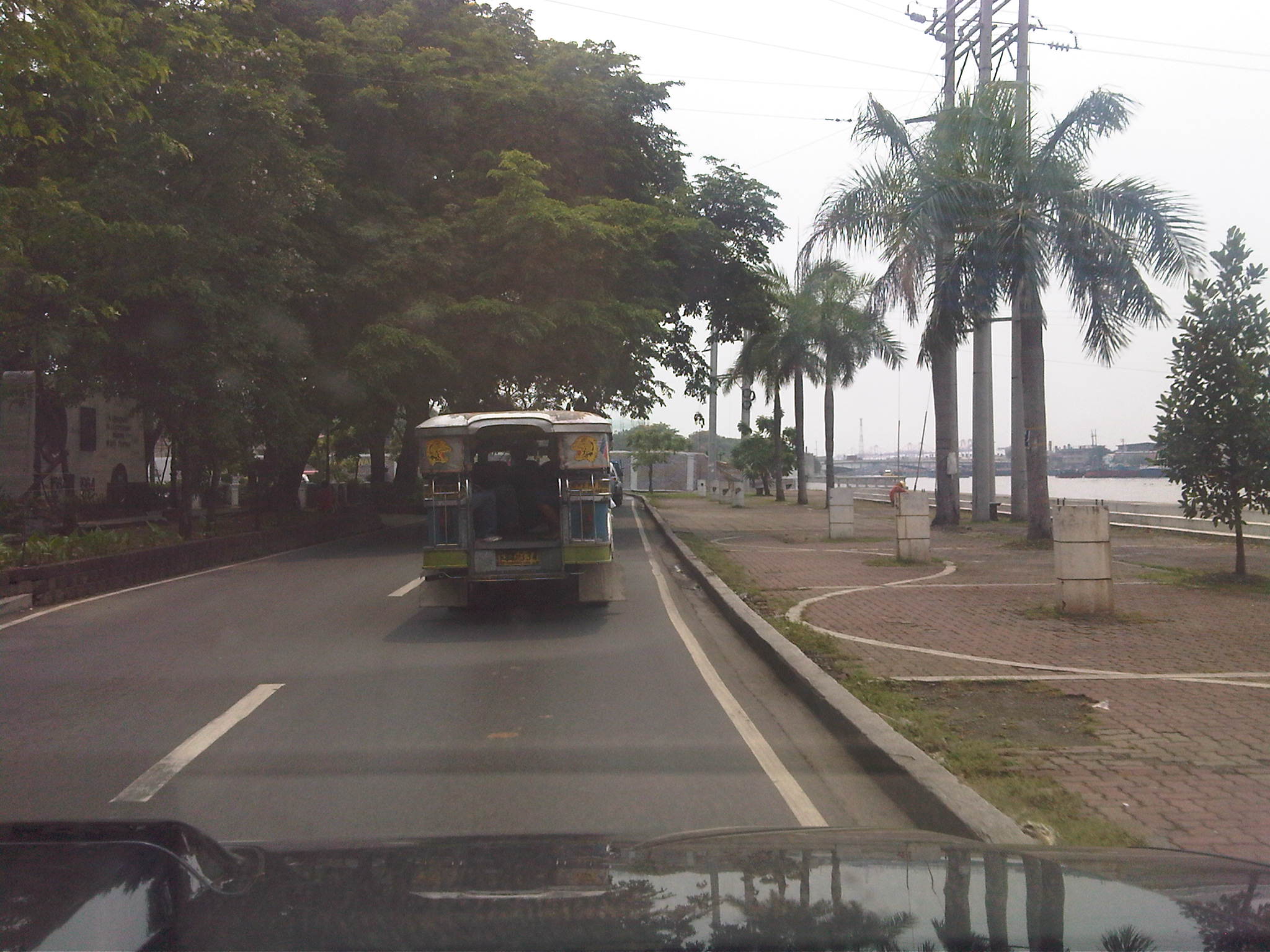 Post-terminal – the open area/riverside park continues after the ferry terminal and across the Plaza Mexico. Faintly visible on the left of the photo is the Acapulco Galleon Trade Monument that commemorated the trade route between the Philippines and Mexico during the Spanish Period. Across from the other side of Plaza Mexico are the ruins of the old Aduana (Customs) building.
 The dark side – the lamp posts seem to have been removed from their concrete bases. This was also shown in the preceding photo and I can just imagine how dark it is at night. The area has much potential as a park and the City of Manila should develop the place for it to attract people.
 Reconstruction – the Intramuros Administration and the Department of Tourism are already implementing some projects here and there but more would have to be done for Intramuros and the Muelle del Rio to be revived and become a major attraction if only for its heritage value. I certainly would like to see it developed like Melaka in Malaysia.
The Intramuros area including the Muelle del Rio may be considered for cycling and pedestrian facilities to encourage people to walk and cycle in the area. The stretch certainly has potential for walking and NMT, and should not be allowed to deteriorate further. Off-street parking facilities should also be considered and carefully planned such that on-street parking may be restricted and space be made available for pedestrian facilities. I am sure there are many planners and architects who would be up to this challenge.
–
Lane rationalization along Katipunan Avenue
While driving along Katipunan last weekend, I noticed the excavations beside the median island along the southbound direction. The excavations were of curious shapes as they were large holes that were conspicuously beside each of the small trees planted on the median island. It suddenly struck me that this was likely the implementation of the planned adjustment of the median island to allow for an additional lane along Katipunan northbound. A few more passes along the project site confirmed my suspicion and I was finally able to take a few photos this morning of the work along this section of C-5.
 The old median island has already been removed to make way for an additional lane along Katipunan (C-5) northbound. This will increase the number of lanes from 3 to 4 and should ease traffic when classes open in June. Meanwhile, the trees have been replanted on the adjacent lane on the southbound direction where a new median will be constructed.
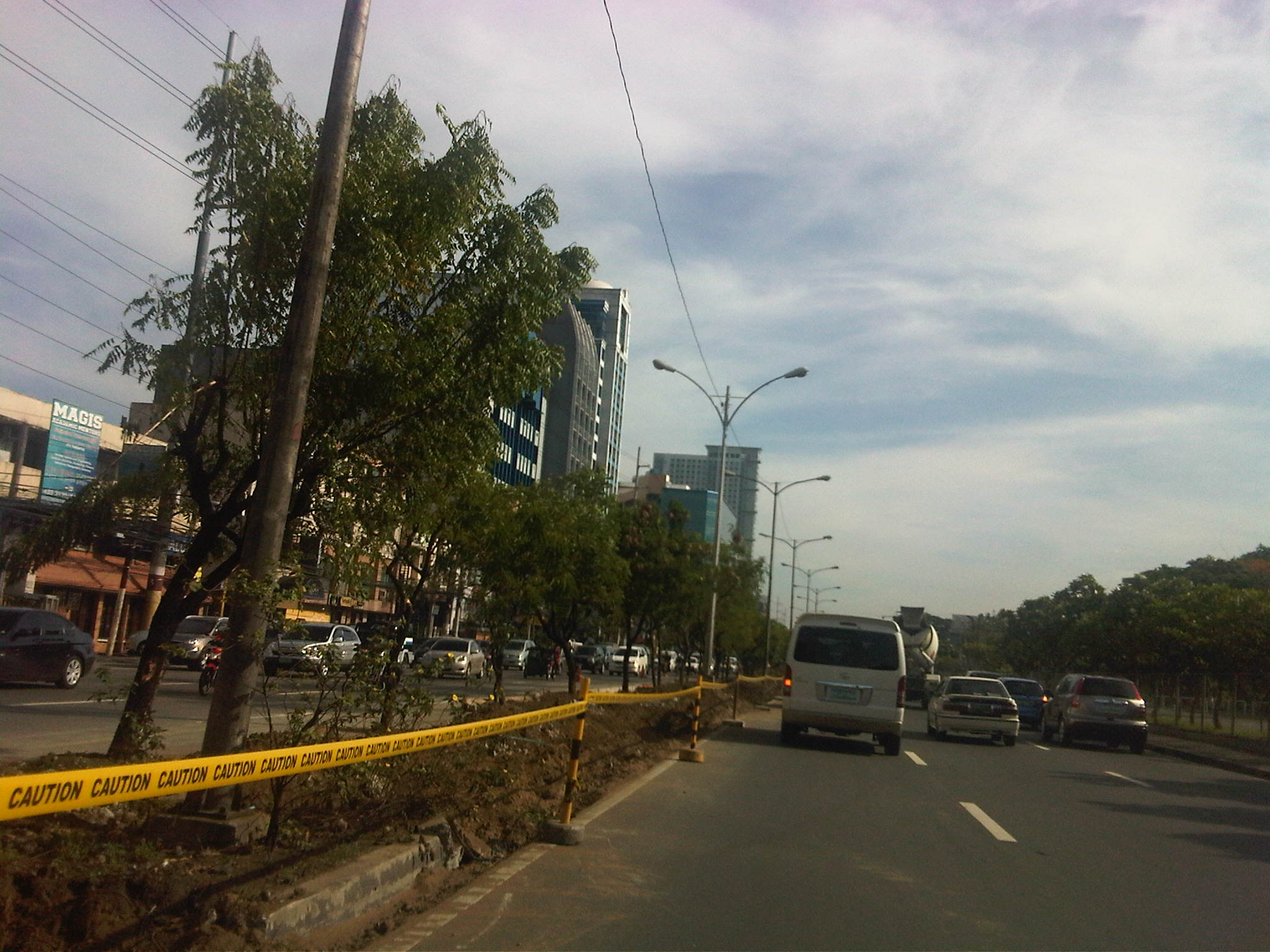 Aside from the trees, the light poles will also have to be transferred. I assume this will be done with Meralco and during the night time to reduce impacts on traffic.
 After transferring the trees, the old curb is demolished and the soil excavated and transferred to the new median on the other side. A new curb is being constructed and is visible in center of the photo.
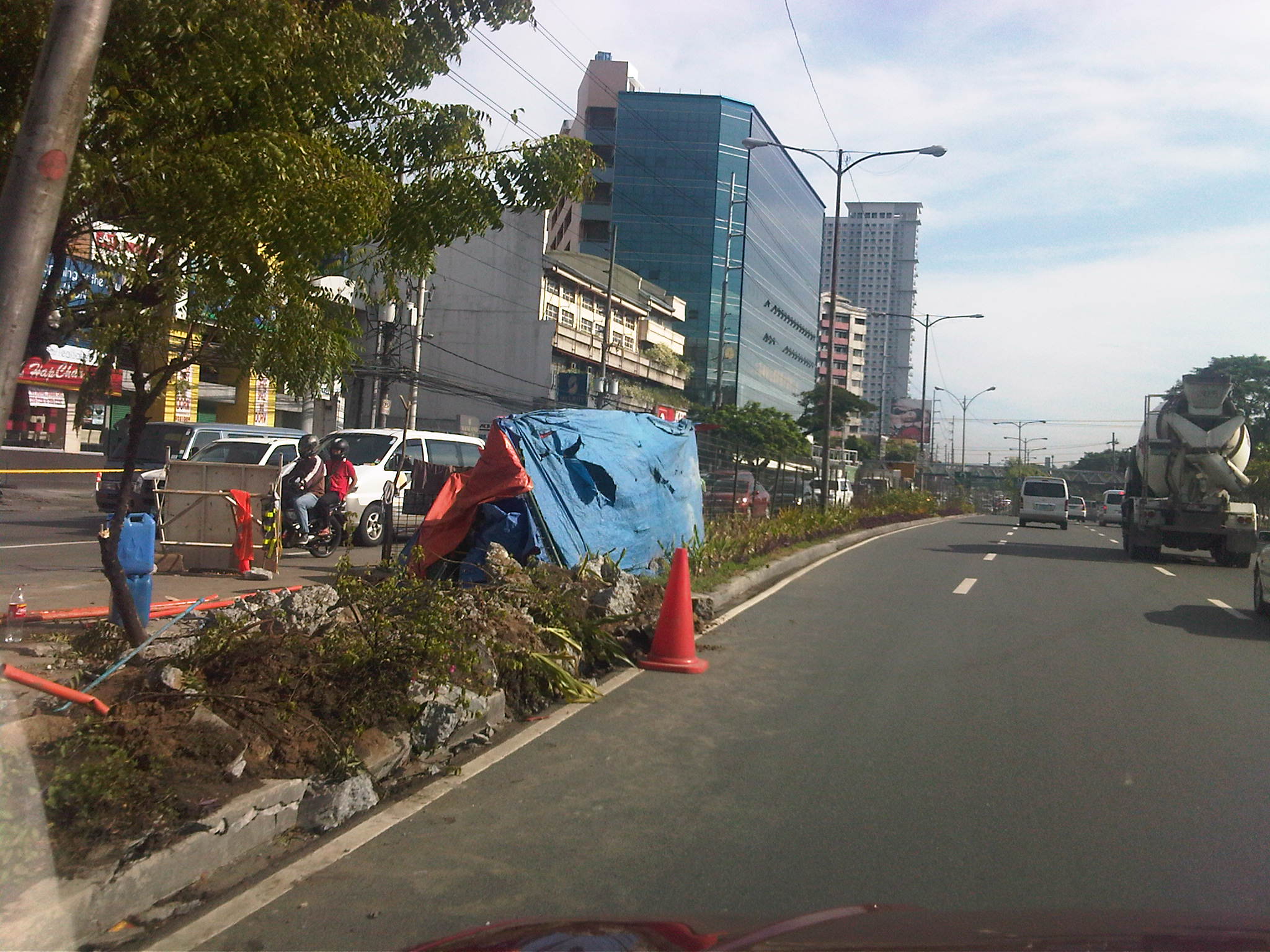 While the project is being implemented 2 lanes of the southbound side are effectively unusable to traffic with one lane being converted into a median and another being used by the contractor for their equipment and materials.
Once completed, the section of Katipunan should have 4 lanes along the northbound direction. Meanwhile, the southbound direction will have 5 lanes from the 6 it had after the west service road was removed as part of the U-turn scheme implementation by the MMDA 9 years ago. The 5 lanes are not all usable to general traffic since 1 or 2 lanes area often occupied by parked or standing vehicles in relation to the establishments on this side of Katipunan.
–
 Caught (up) in traffic