
Home » Public Transport (Page 50)
Category Archives: Public Transport
Anxious about the LRT Line 2 Extension
Among the overdue projects that have generated much attention and, quite recently, some excitement is the extension of the LRT Line 2 from the current end station at Santolan, Pasig to Masinag Junction in Antipolo. This is a 4 kilometer stretch that has been viable for quite a long time now but somehow has not been constructed for various reasons. It was among the low hanging fruits that the current administration should have picked that could have been completed and operating now if it were started sometime 2011 (i.e., factoring in the transition in government after the 2010 Presidential elections). For some reason, government officials had to get proof that there was passenger demand for the extension by considering having another study undertaken just for this purpose. As I’ve mentioned before, one only needs to observe the situation at Santolan Station and perhaps the Sta. Lucia/Robinsons Metro East area to understand just how many people will benefit from the extension to Masinag. I would even dare say that you can even justify extending the line further to Cogeo. Following are a few photos I recently took along Marcos Highway along with some comments pertaining to the Line 2 extension construction.
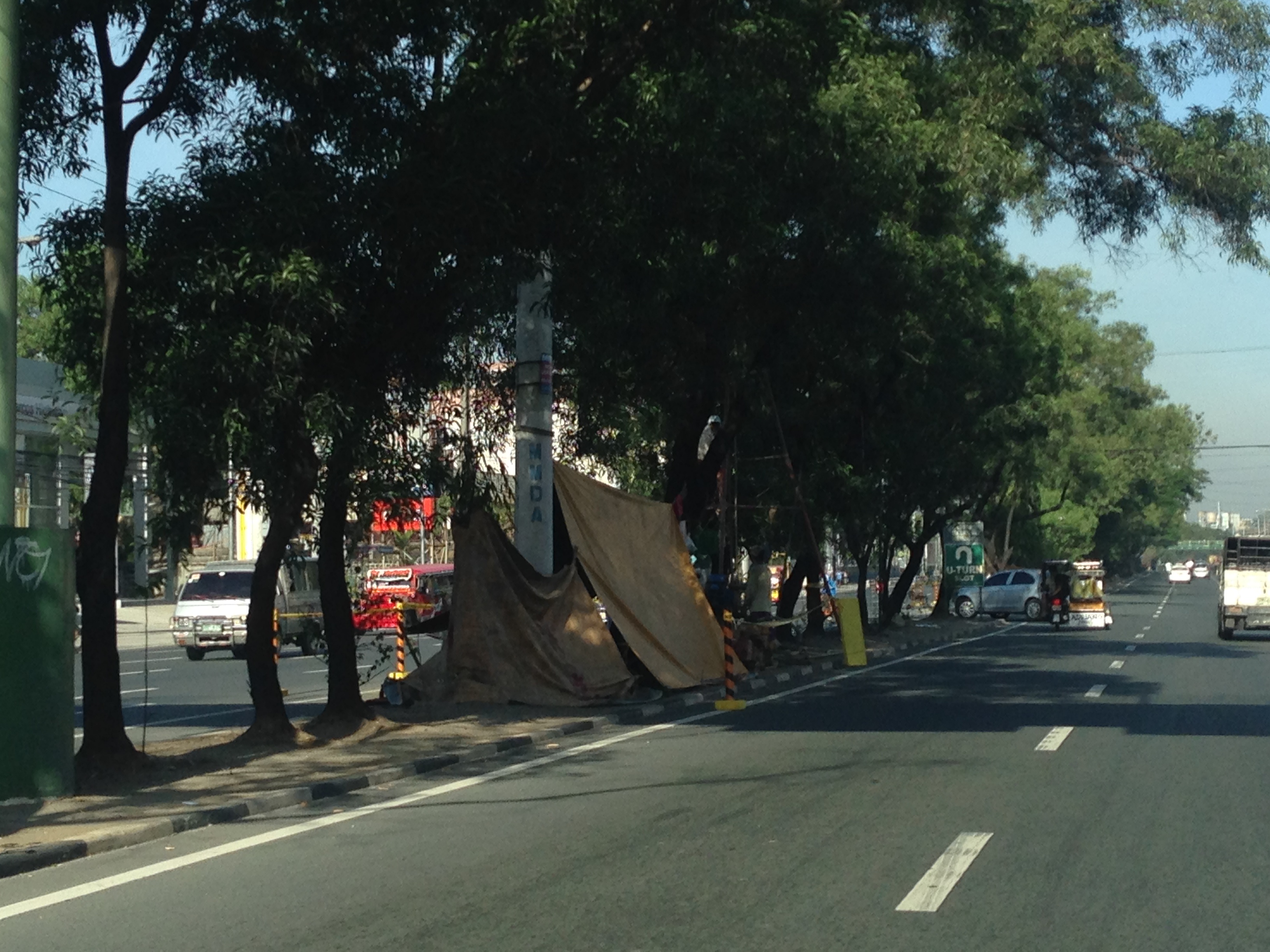 Soil testing site along Marcos Highway in Pasig City – these activities preclude the designs for the superstructure, which include the elevated tracks and the stations (there will be 2) along the Line 2 extension.
 Another soil test site – each location roughly correspond to the location of the columns that will be constructed to support the elevated tracks and stations.
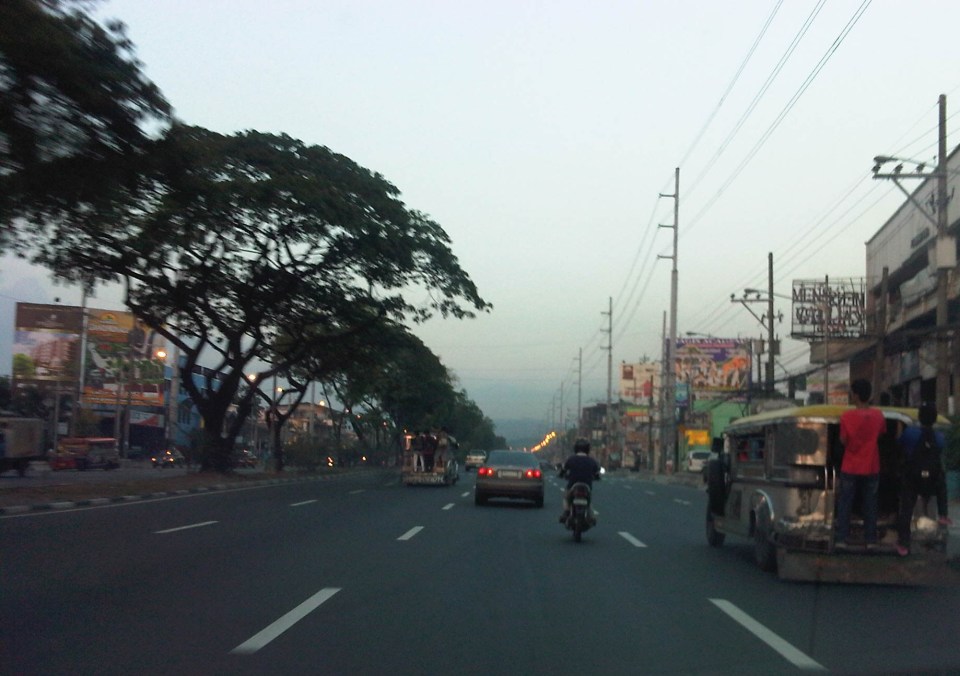 Scenes of overloaded jeepneys should no longer be the norm once the Line 2 extension is completed. However, such would probably be common for jeepneys coming to or from the last station at Masinag. There are no other choices for people taking public transport beyond Masinag except jeepneys bound for destinations like Antipolo Simbahan, Cogeo, Tanay and Marikina.
 Pedestrian overpasses such as this relatively new one near the Filinvest East main gate would have to give way to the elevated Line 2. Another option is for this and other overpasses to be reconfigured with respect to the future line. I just hope this will be done with utmost care so we won’t have overpasses similar to those along EDSA that go above or below the elevated tracks of the MRT 3.
 This overpass will like be removed to give way to the future end station of the Line 2 extension. The overpass in front of SM Masinag will have to be integrated with the station to be located in this area.
–
Future fare collection for jeepneys and other modes?
In the last Electric Vehicle Summit held in late February this year, I noticed a conspicuous device installed in the electric jeepney unit that was on display at the venue. The device is for electronic payment of fares; using a card much like the ones being used in other countries like Singapore and Japan, and soon, hopefully, for the LRT and MRT in Metro Manila. Such a capability has a lot of potential including a very convenient way to pay fares for public transport in Metro Manila. Other potential uses would be for payments of items bought at stores or shops (or vending machines) like Japan’s Suica card. Users would just have to “top up” or load their cards for these to be used in their commutes or purchases.
 The latest e-jeepney model features a side door instead of one at the rear.
 Boarding passengers will encounter device upon entering the vehicle. The current technology available should soon enable passengers to use “tap” cards to pay for their fares.
 Such a device will leas to a more efficient fare collection and eliminate the need for “conductors” or persons assisting the driver in taking passengers’ fares. These should also allow the driver to focus on driving rather than be distracted by fare collection including trying to keep track of who has paid and who has change due. This would likely translate into safer travel for most people.
 Electronic boards at the top behind the driver can provide travel information such as the next stop or traffic conditions along the transit route. Such information can be derived from various sources including the MMDA or local governments as well as from crowd-sourcing.
–
120-passenger capacity AGT prototype
The DOST-MIRDC has built another prototype vehicle for its Automated Guideway Transit (AGT) project. The vehicle is larger than the one at the University of the Philippines Diliman as each vehicle would have a capacity of 120 passengers (seated and standing). They are also building another elevated test track at the MIRDC compound across from the main DOST compound in Bicutan, Taguig City, and along Gen. Santos Avenue. This is a significant upgrade from the 30-passenger capacity vehicles at UP Diliman (60 for a 2-car train) as a 2-car train with 240 passengers means much more capacity for a real line using such vehicles. To compare, 5-minute headways along one direction could carry 720 passengers per hour for the UP Diliman prototype while the Bicutan model can carry 2,880 passengers per hour.
 Two prototype AGT vehicles with maximum capacity of 120 passengers at the MIRDC compound in Bicutan, Taguig City.
 The design is very much the same as the first prototype vehicle, with its distinctive look including the snout, headlights and skirt.
 The vehicle looks like it was inspired by the large provincial buses that, if seats are configured as benches and the body is stretched to be longer, can accommodate more passengers.
 The MIRDC is also building a test track in Bicutan within their compound and parallel to Gen. Santos Avenue.
I don’t know how long this elevated test track will be but to be able to have substantial tests for the new vehicles this should be longer and would need to be extended beyond the MIRDC compound. That means the tracks would pass through land occupied by the Polytechnical University of the Philippines (PUP), which is a state university, and Camp Bagong Diwa, which is under the Philippine National Police. Can this line serve the areas along Gen. Santos Avenue? I think so but it will be competing with tricycles and jeepneys. Tricycles are the dominant public transport mode here despite Gen. Santos being a national road. Taguig City would have to find a way to address issues pertaining to a reduction or phase-out of tricycles as the communities in the area might be dependent (unfortunately) on these for their livelihood.
–
Public transport fare hikes
Bus and jeepney groups often demand for an increase in the fares every time there is an increase in the prices of fuel. The latest one is mentioned in this article via Rappler, where a jeepney group is to hold a protest caravan as they seek a discount on diesel for all public utility vehicles. The reaction from readers is an overwhelming “Annoyed.” And rightly so because while these protests appear to be noble and are often linked by jeepney groups to petitions for fare hike increases (i.e., asking for fare increases if they cannot be given fuel or petroleum product discounts), closer scrutiny of operating costs will reveal flaws in their arguments for fare hikes and discounts. These same flaws also reveal why government agencies charged with public transport franchising and regulation (i.e., DOTC and LTFRB) should have the data and tools for a fair assessment of fares (pun intended).
Data from field surveys conducted quite recently (NCTS, 2012) show us that jeepneys typically average around 3 to 4 km/L on diesel fuel. This is a very low value that is comparable to the income from passengers for one trip over a distance of say 4 km. A fully-loaded jeepney with an average of 20 passengers (9 on each bench plus 2 beside the driver) operating a 4-km route will 160 pesos. However, there are limited reliable information or data on other costs such as maintenance costs and other items including “boundary” and “dispatching.” The boundary is basically a rental fee for the use of the vehicle while jeepney groups charge a fee for dispatching vehicles from the terminal or stop. In a day’s operation, such costs could easily accumulate into a significant total that would eat up a day’s income, usually leaving the driver with just enough to bring home to his family.
This brings us back to the argument against transport being treated as livelihood rather than a service. Many operators or owners of public utility vehicles, whether they have one or more units, tend to scrimp on the maintenance of their vehicles. Poor maintenance manifests in the form of smoke-belching and frequent breakdowns. While smoke-belching contributes to the deterioration of the environment and health costs, breakdowns often lead to road crashes (e.g., tires flying off, problems with brakes, etc.) like the recent bus crash in the Mountain Province where faulty breaks were blamed for the crash.
Jeepney groups often raise issues on the plight of small operators who are usually the drivers of the jeepneys themselves. Many of these people should not even be operating or driving jeepneys in the first place because safe and efficient service is not their priority. Service is second only to the desire to generate income, to earn a living, which makes them drive the way they currently do (i.e., recklessly) and improperly and haphazardly maintain their vehicles. There is seldom serious talk and little done to protect the interests of people who take public transport. These are the same people who are often shortchanged with the poor quality of public transport in our cities and have long suffered for this. Let us hope that the LTFRB will be guided as they decide on this matter of fares and furthermore for the agency to study the state of road public transport franchising in order to weed out people and groups who do not deserve to be operators. I believe there is more than enough data or evidence against such operators if the LTFRB truly wants to reform the system.
–
Snippets of Manila streets and traffic
Coming from a forum held at a hotel in Manila, I took a few photos of scenes along our route back to the university. These are snippets of everyday scenes in the Philippines capital city, which now has for its mayor the former President of the country who was ousted back in 2001 for allegations of plunder. He has been on the news quite frequently as his administration has introduced traffic schemes intended to address traffic congestion in that city. These include going after buses without terminals in Manila last year and quite recently an expanded truck ban that renewed discussions about logistics and the Port of Manila (i.e., decongesting the port in favor of Subic and Batangas ports).
 Traffic at the intersection of Bonifacio Drive, Roxas Boulevard and Padre Burgos Avenue. The trucks in the photo are coming from the Port of Manila and at the time this was taken, the window of the extended truck ban in Manila allowed these trucks to travel.
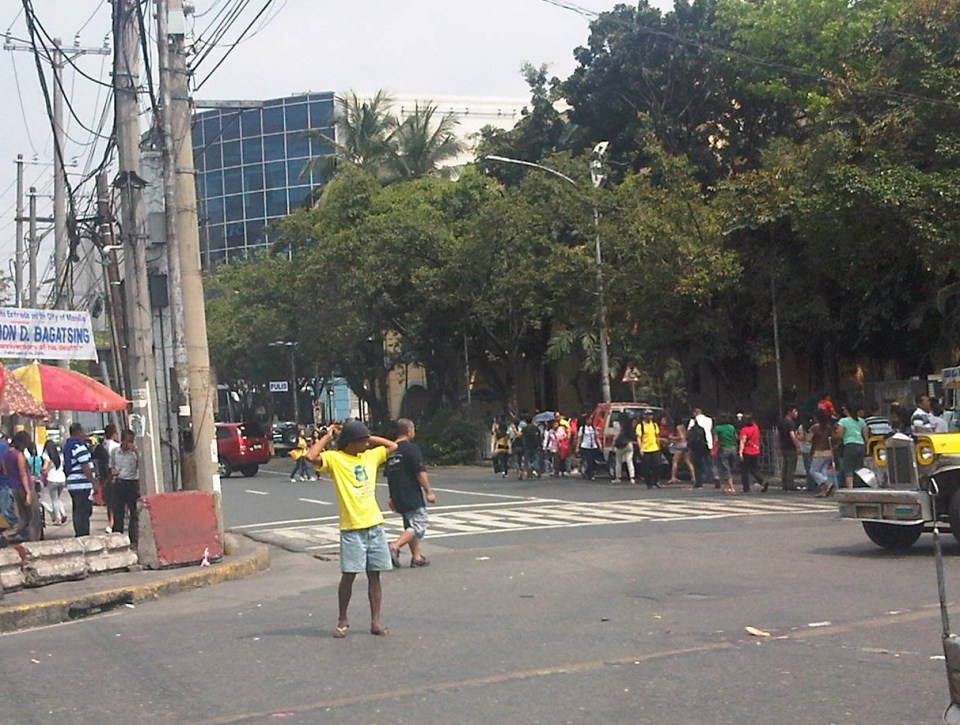 Barkers meet jeepneys head-on in the middle of the street just past Manila City Hall. A friend posted sometime ago that in Philippine streets, the uneducated dominate the educated and this seems so true in the case of public transport where barkers, paratransit drivers and their lot control how people should get a ride and how vehicles should operate.
 Organized mayhem – pedicabs run along most of Manila’s streets with many even traveling counter-flow. This photo was taken just across from the old, decrepit Metropolitan Theater just before the Quezon Bridge towards Quiapo.
 More pedicabs (also called padyak or trisikad), non-motorized 3-wheelers that notoriously violate traffic rules and regulations as they proliferate in many parts of the city.
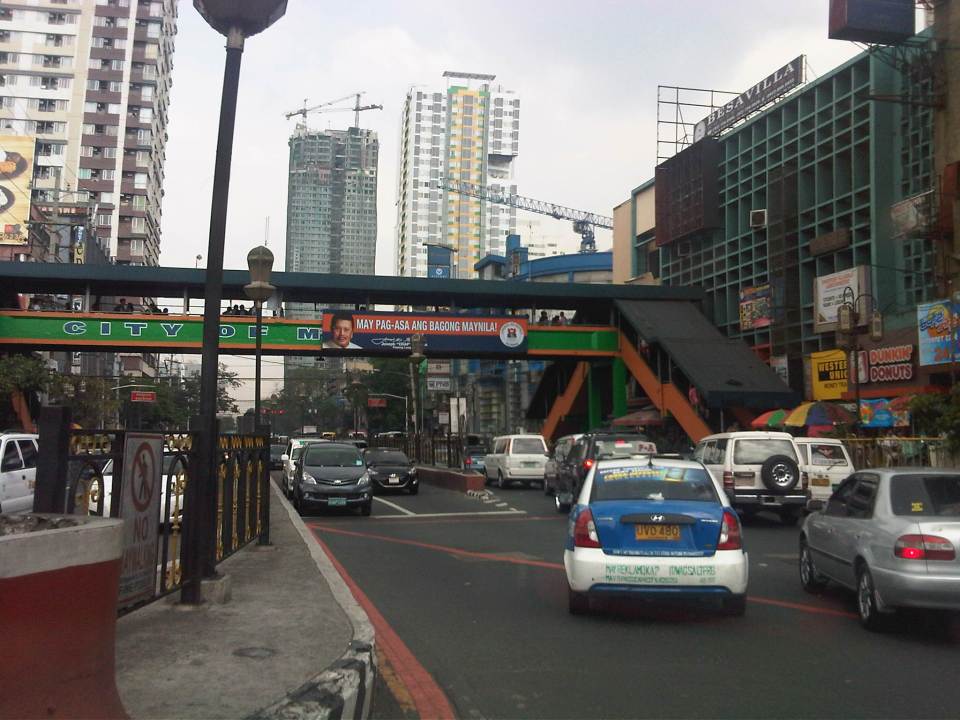 A sign stating “There’s hope for a new Manila.” with the face of former Philippines President Estrada, who was elected Manila Mayor last year.
 A modern public transport stop along the eastbound side of Espana Avenue shows a guide map and electronic message board that informs people who was responsible for the project.
 Another modern bus stop, this time just in front of the University of Sto. Tomas campus, which is along Espana Avenue.
 A side street to Espana Avenue reveals an on-street motorized tricycle terminal. There is a sign at the entrance to the street saying buses are not allowed along the road.
More on Manila in the next posts…
–
A study on a long-term transport action plan for ASEAN
The National Center for Transportation Studies of the University of the Philippines Diliman participated in the project “Study on the Long-Term Action Plan for Low Carbon Transport in ASEAN.” The study was funded by the Nippon Foundation and implemented by the Institution for Transport Policy Studies (ITPS) and Clean Air Asia with experts coming from ASEAN countries including Indonesia, Malaysia, the Philippines, Thailand and Vietnam, and Mizuho of Japan, which led the development of the Backcasting and Visioning Tools employed in the study. Detailed case studies were performed for Indonesia through the Universitas Gadjah Mada and for the Philippines through the University of the Philippines Diliman.
The Final Symposium for the study was held last February 20, 2014 at the Hotel Okura in Tokyo, Japan. A link containing information on the study, the symposium program, information on speakers, and presentation files are hosted by the Japan International Transport Institute, which is affiliated with ITPS.
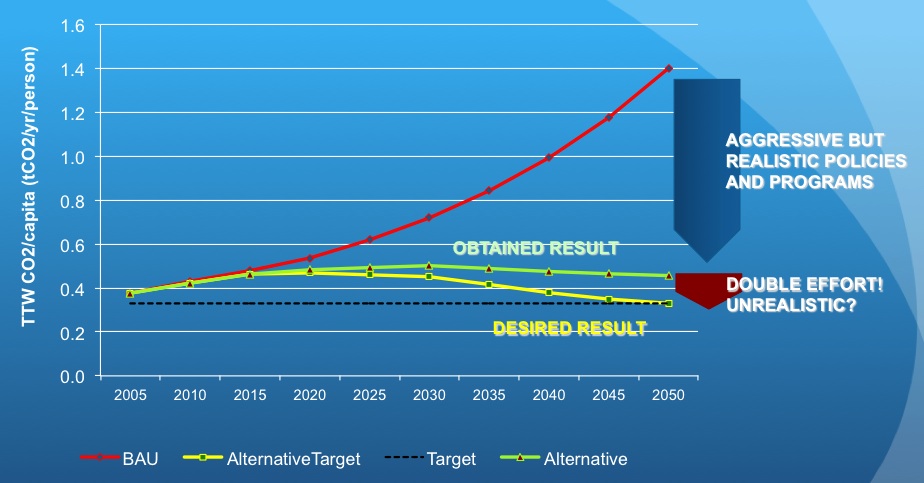 Graph of the result of backcasting for the Philippines using available transport data, policies and other information on various socio-economic and transport factors. (Image capture from the presentation by UP’s Dr. Regin Regidor)
–
Revisiting the Yurikamome AGT
Back in Tokyo last February, I made sure that time to go and ride the Yurikamome Line, an automated guideway transit (AGT) system serving the Odaiba area and beyond. These areas are reclaimed land from Tokyo Bay and features many modern buildings. It used to be that the only transit system resembling rail serving the area was the Yurikamome. It was relatively expensive compared to both Tokyo JR and subway lines and there weren’t much choices so people, especially residents in that area welcomed bus services and the Rinkai Line of the Tokyo Waterfront area Rapid Transit (TWR), which is the same company that operated the Yurikamome AGT. The AGT is a driverless train with rubber tires and running on guideway tracks instead of rail. Capacities are similar to light rail and are more suitable to residential and medium intensity commercial or office areas.
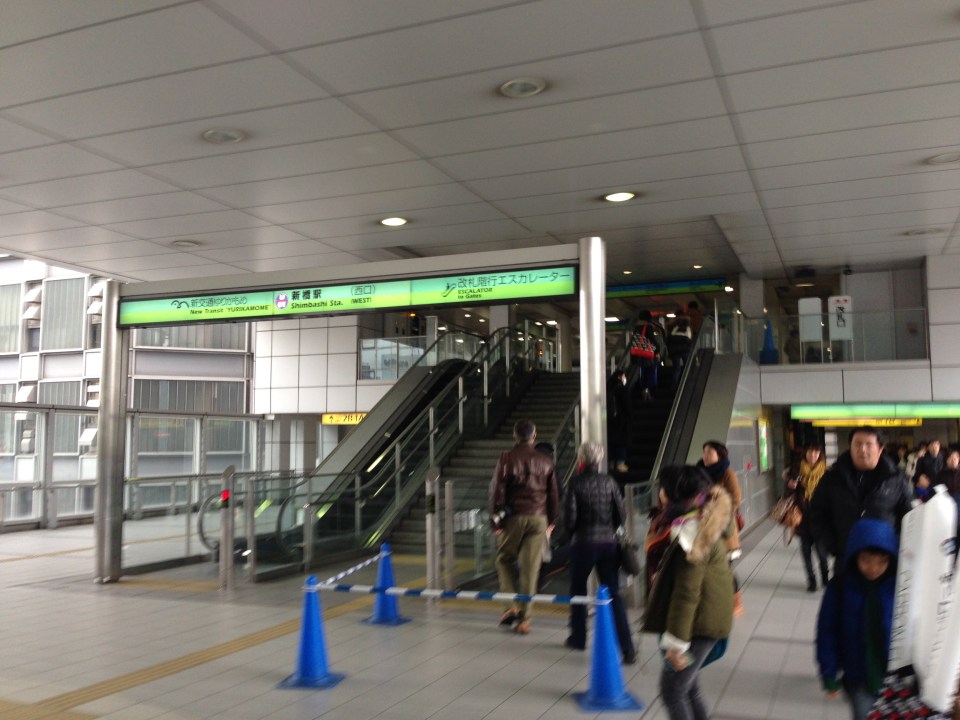 Escalators to the station platform at Shinbashi
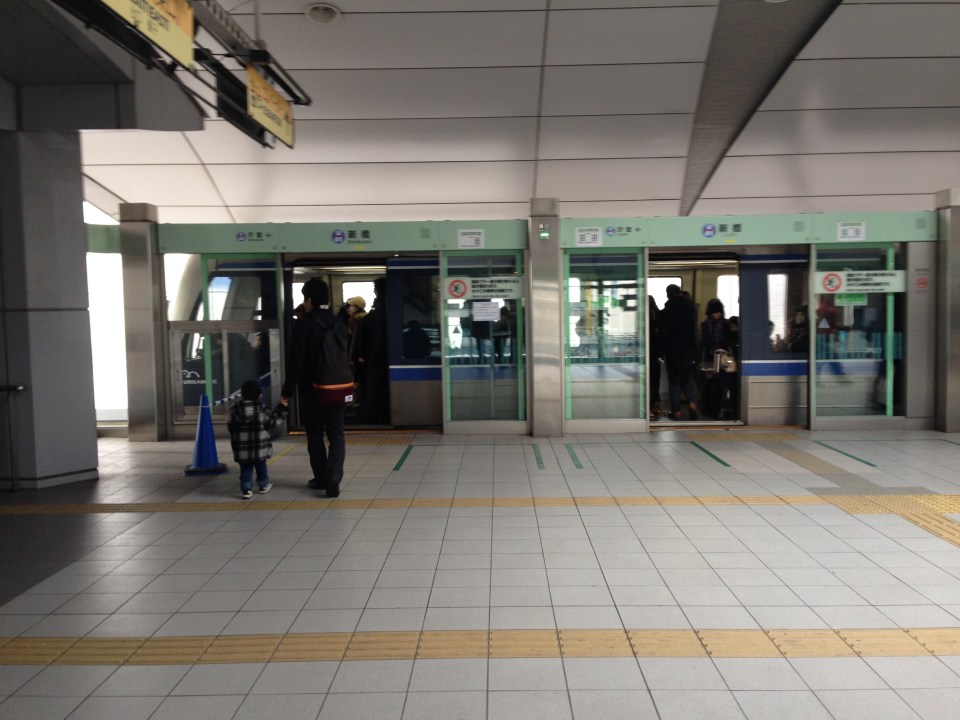 The Yurikamome is popular with children whom their parents usually take on the front seat for a magnificent view of the line and adjoining areas. I think some parents tell their children they can pretend to be the train driver given the best seats are right at front.
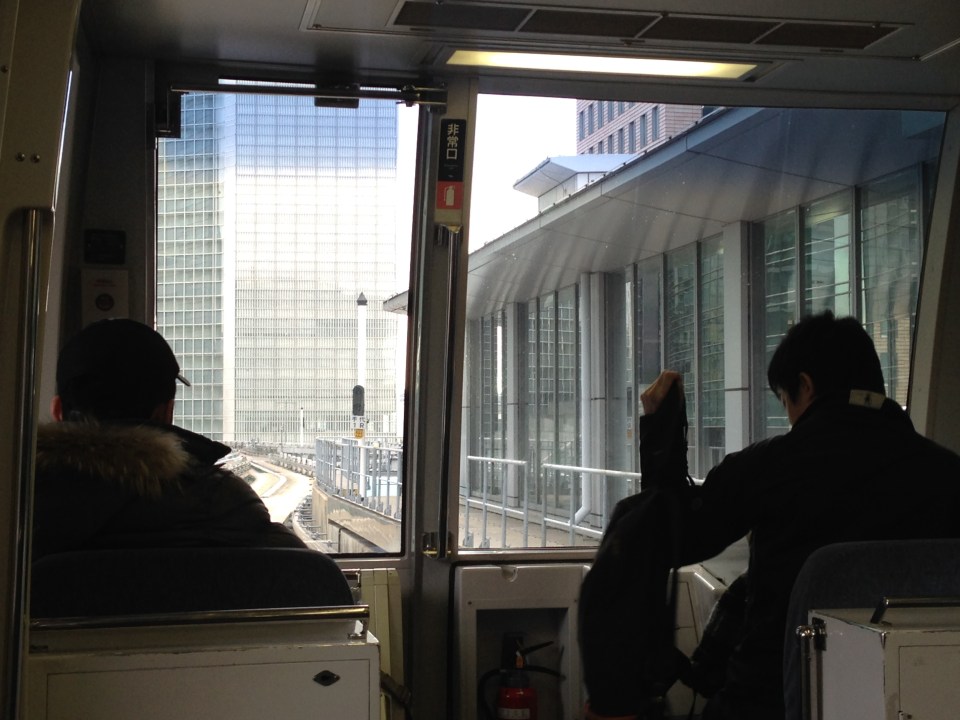 The AGT is driverless and that means you can be seated up front.
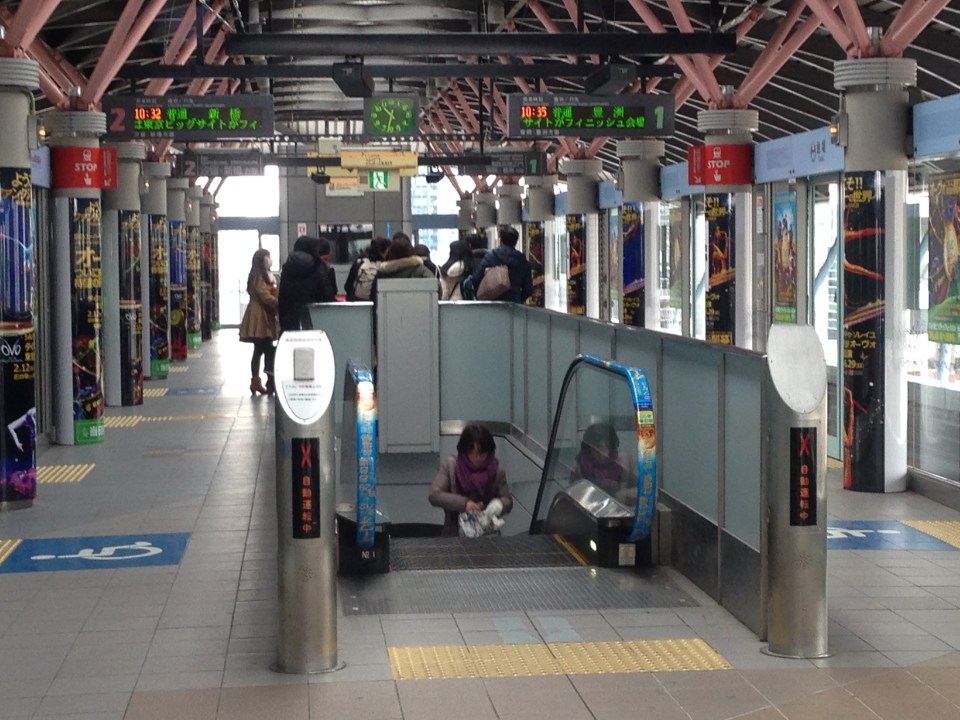 Escalator and platform at Daiba Station.
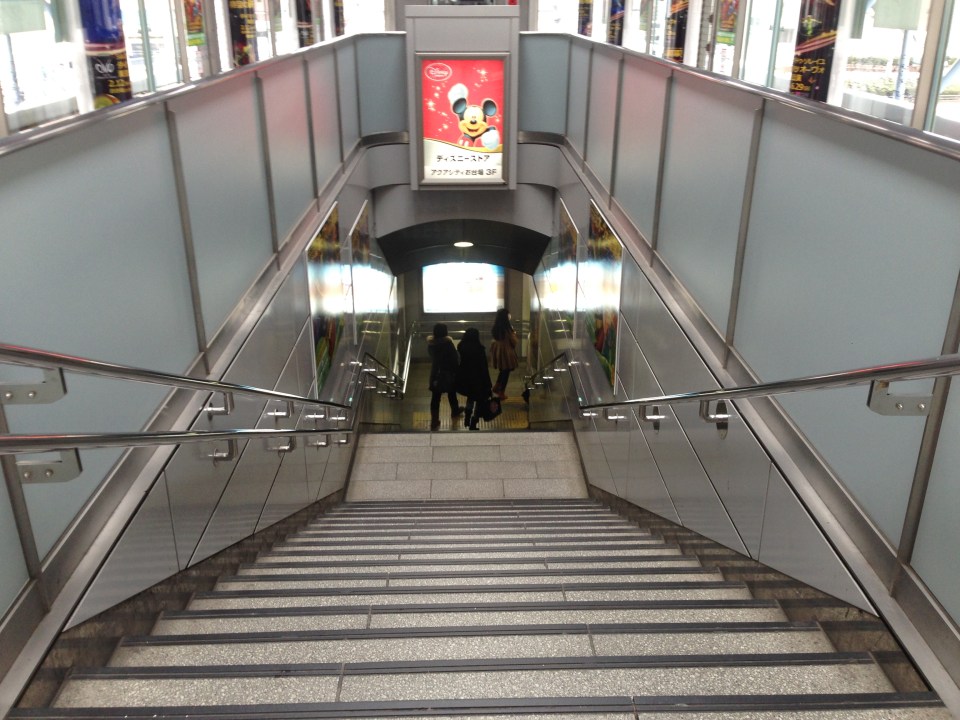 Stairs from the platform at Shinbashi Station
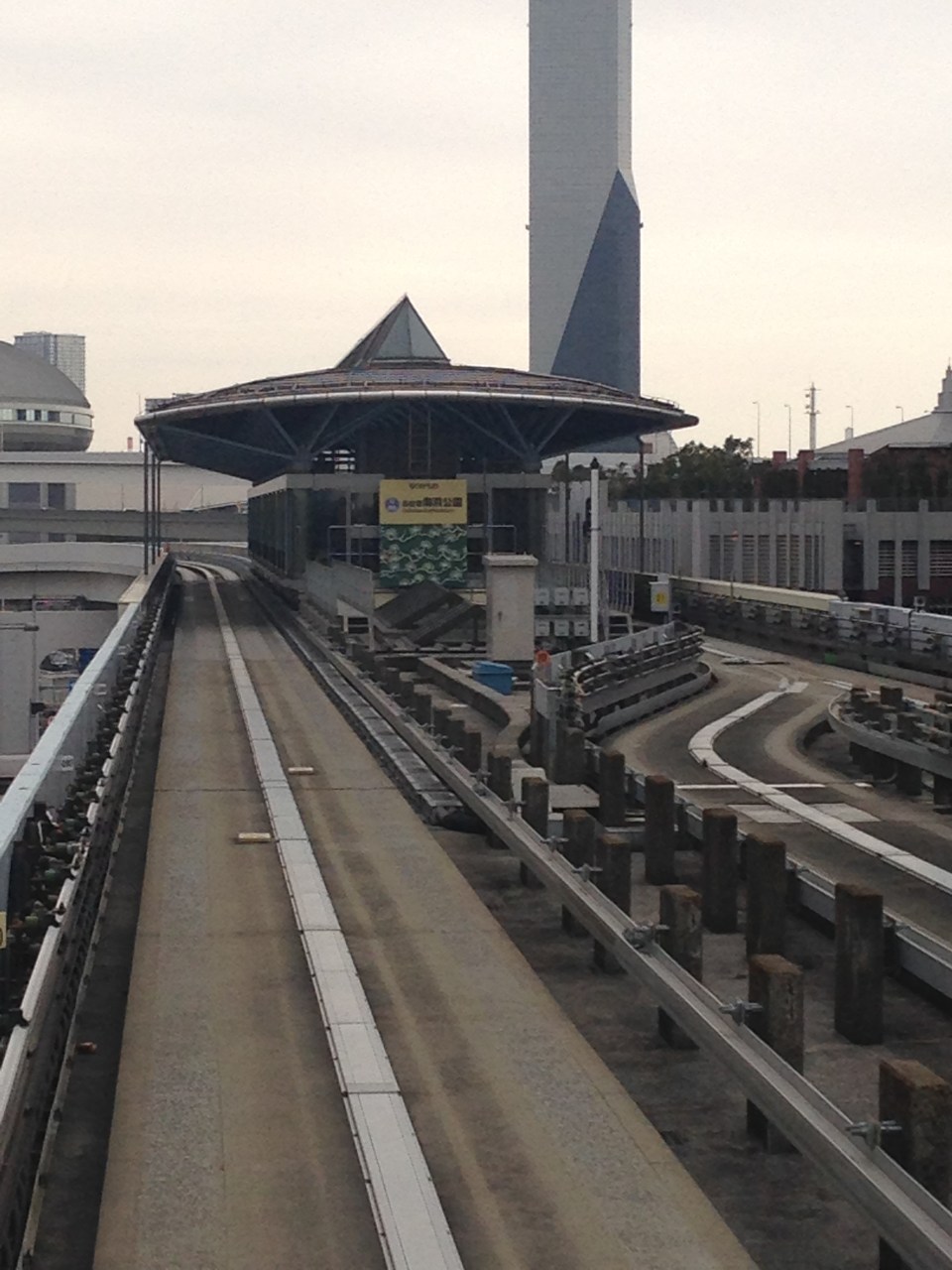 The approach to Odaiba Kaihin Koen Station from Daiba Station shows the equivalent of a switch (rail) for the guideway tracks along the other direction.
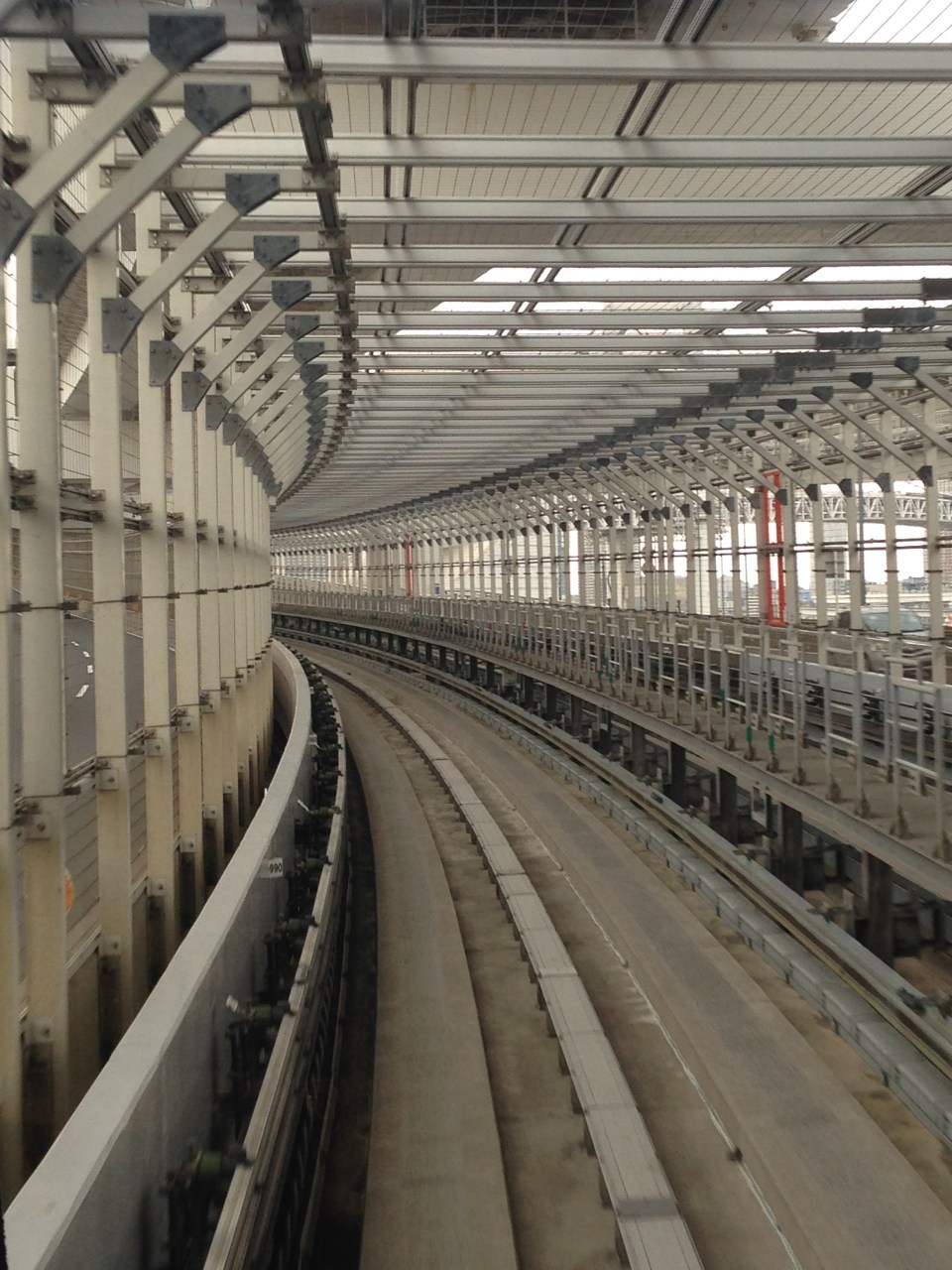 Section along the Rainbow Bridge. Note the roads on either side of the AGT guideways.
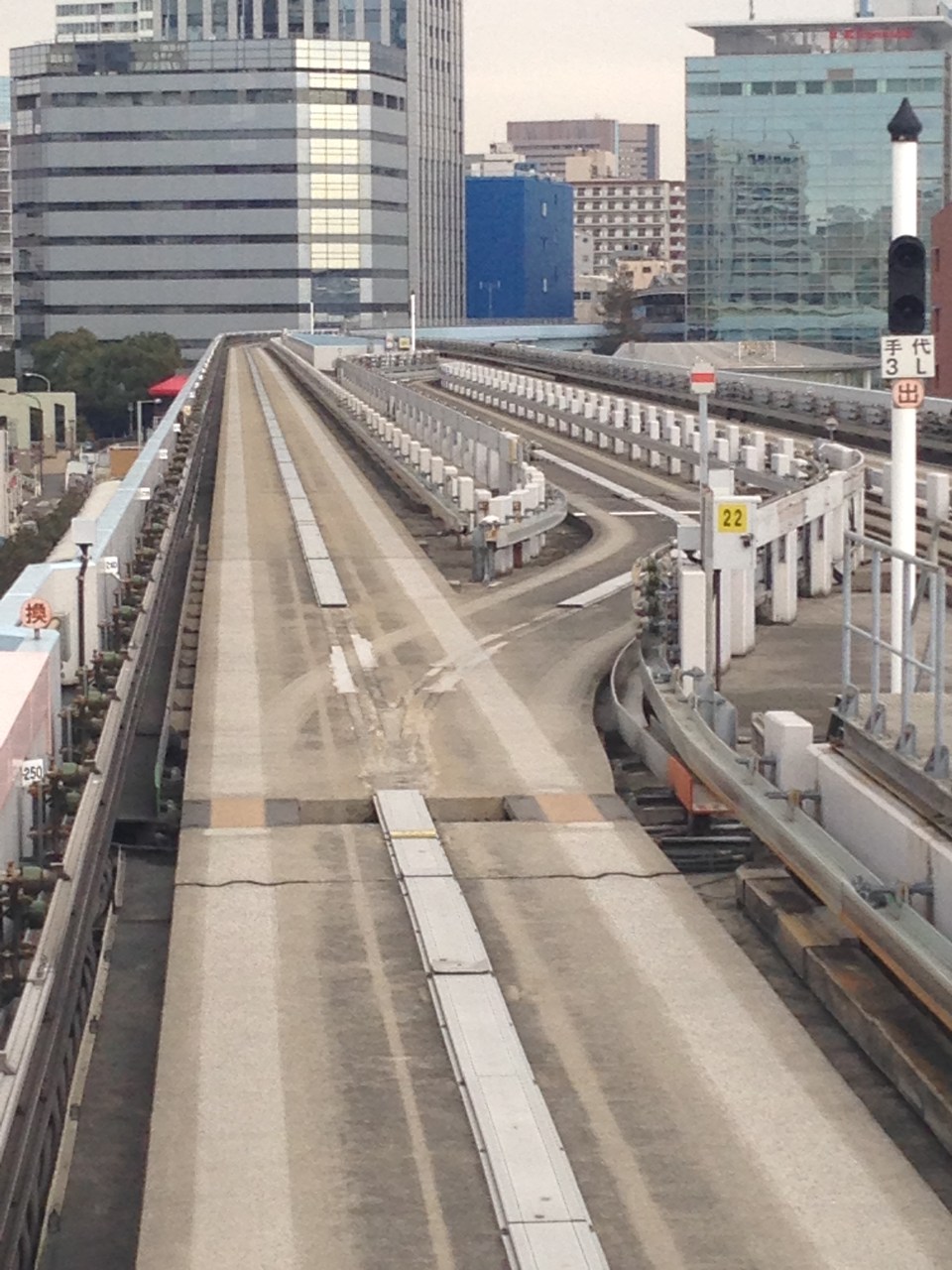 Auxiliary guideway tracks to allow trains to change guideways direction. Note that the train picks up electricity along its sides from the rails along either side of the guideway. This allows for continuous movement though there are breaks as the train shifts position.
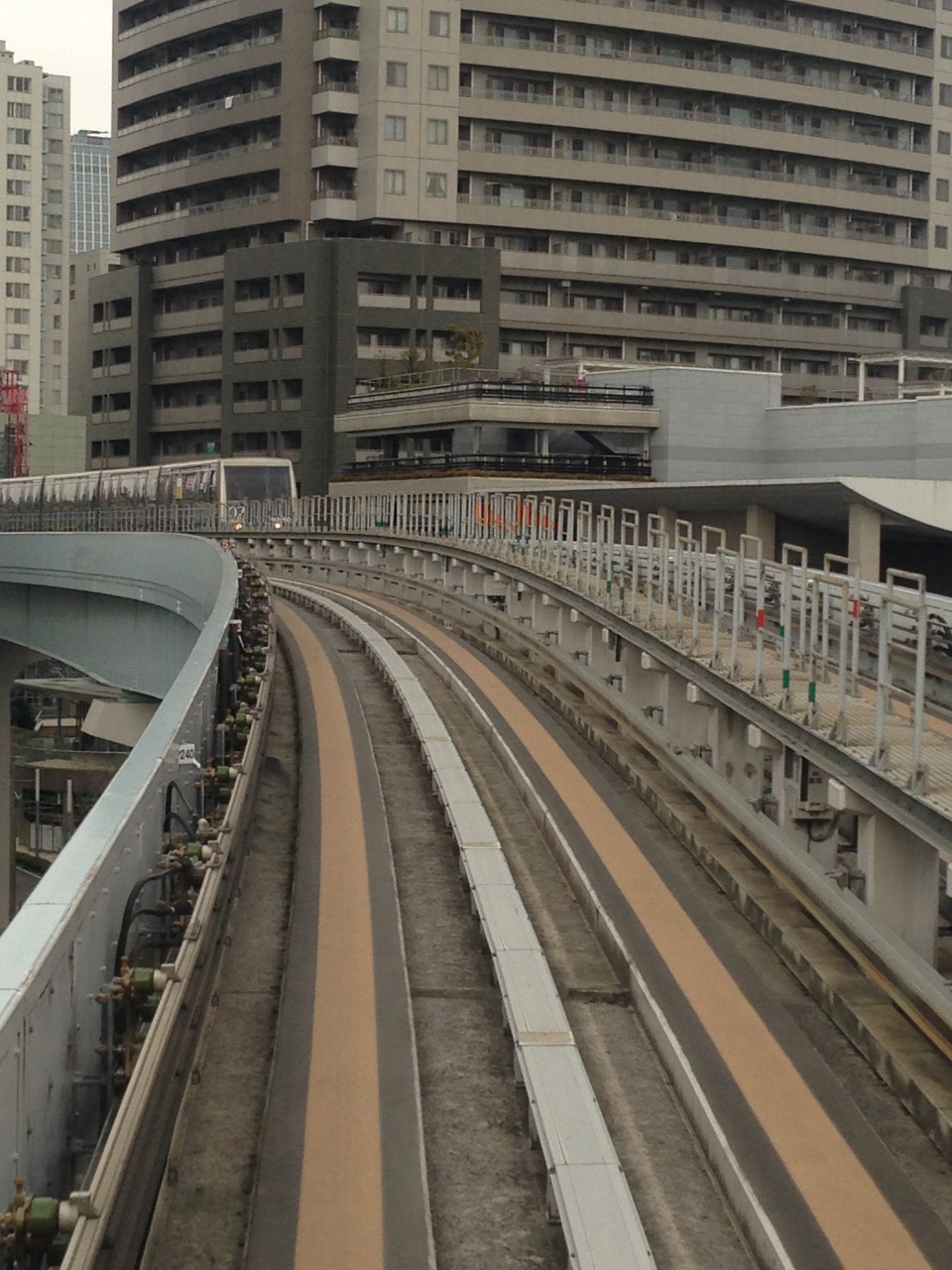 The guideway to between Takeshiba and Shiodome Stations feature what appears as a rubberized strip for better traction for the tires to the guideway tracks.
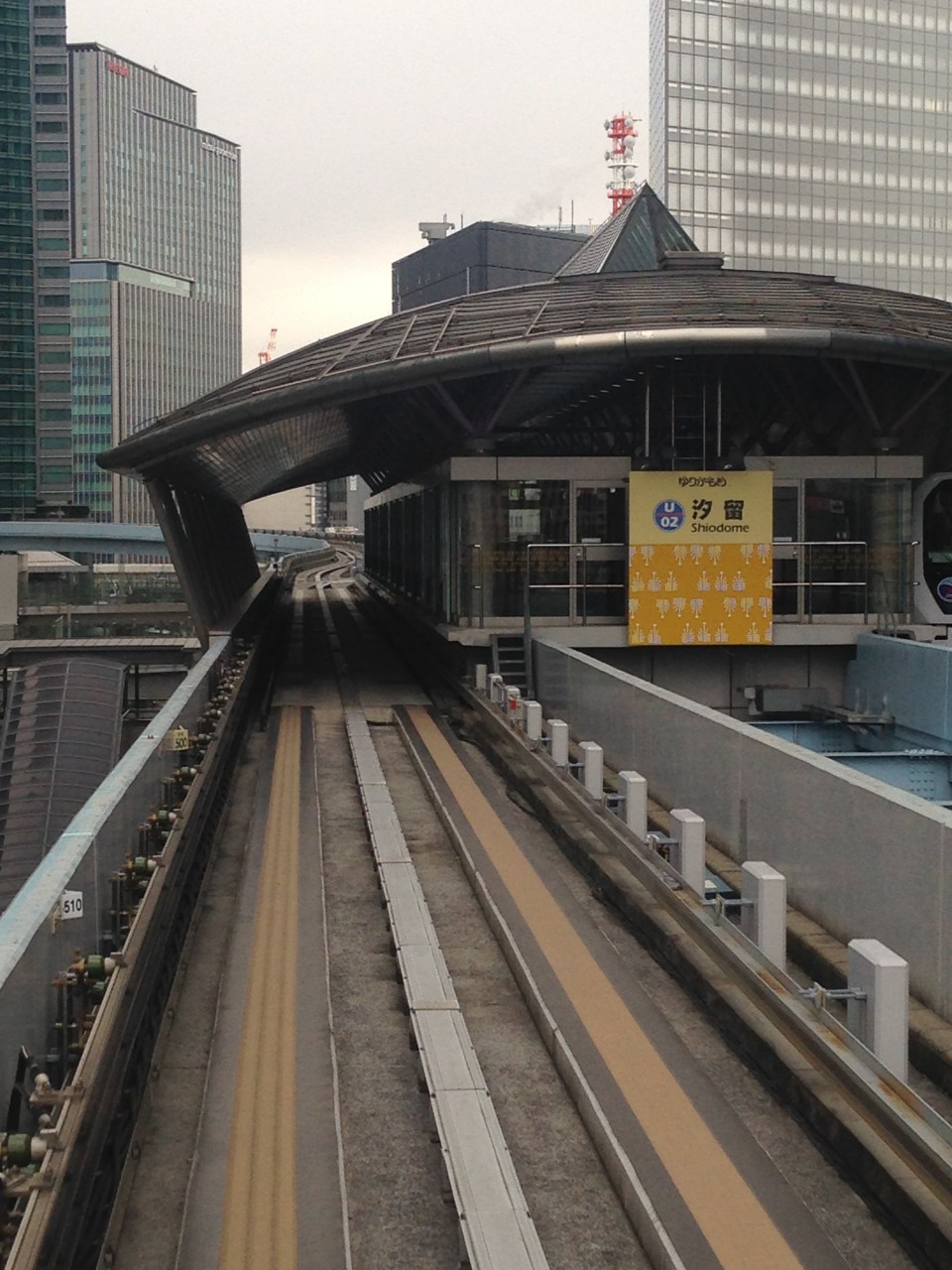 The approach to Shiodome Station.
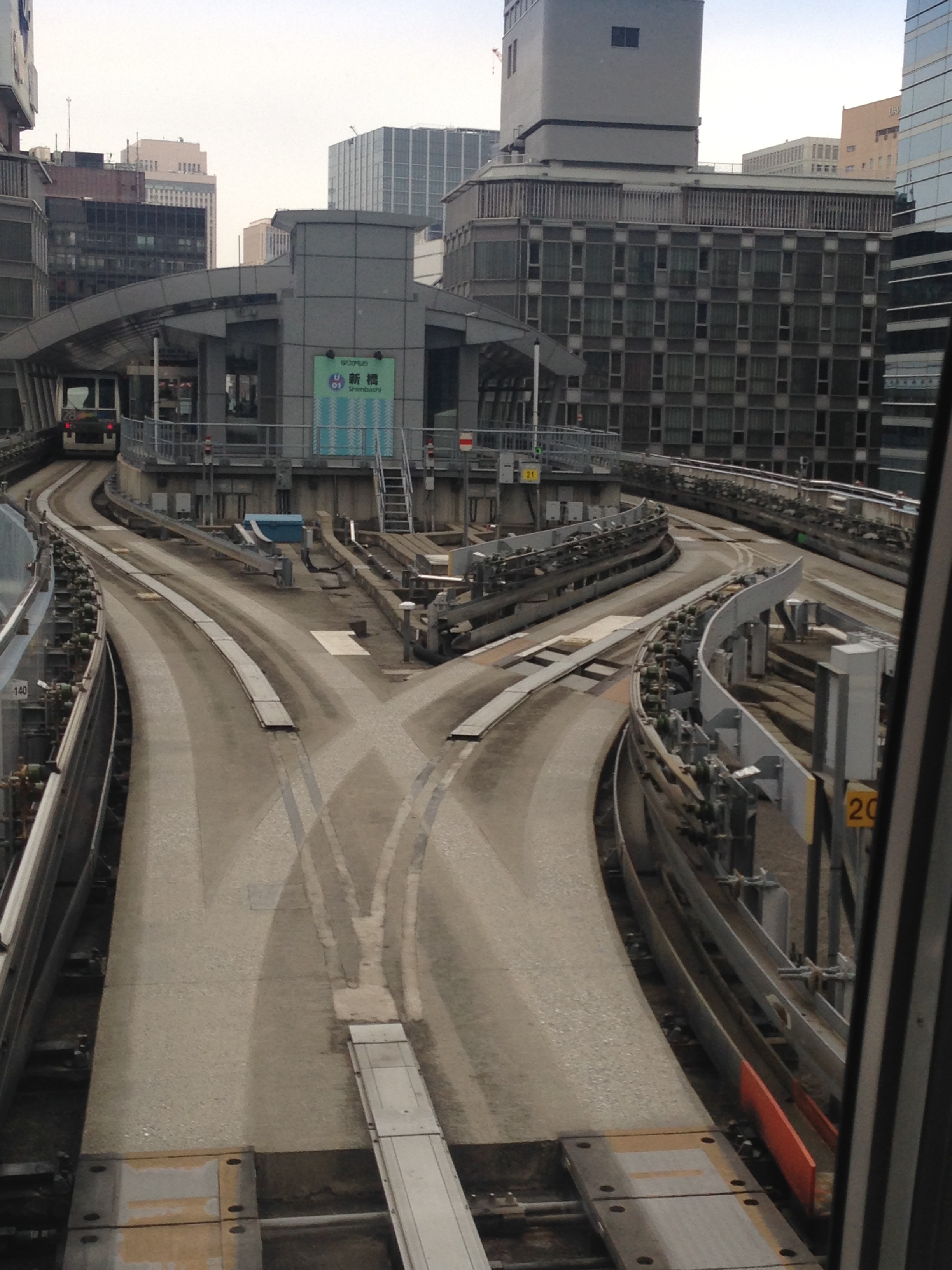 The approach to Shimbashi Station shows the AGT equivalent of a switch to allow arriving vehicles to change directions towards the platforms of the end station.
–
Transport and traffic purgatory, paradise and inferno
A lot of people have been referring to the traffic congestion and other derivative issues that will be the result of the construction of several transport projects around Metro Manila as “traffic armageddon.” Some friend have appropriately (I think) referred to it more as “car-mageddon.” This seems to be the case since it is perceived to have the most impact on car users than public transport users, cyclists or pedestrians. This is far from the truth as there are more people taking public transport, cycling or walking than those driving their own cars. In fact, estimates for Metro Manila indicate that 70-80% of travelers take public transport while 20-30% take private vehicles. These mode splits do not include bicycles or walking, which obviously will further decrease private car shares.
I would rather refer to this period of construction as a sort of “purgatory” though it has nothing to do with the cleansing that’s associated with it. There is still the suffering involved while improvements are being implemented. But, most importantly, there is hope at the end of this process. This “hope” is not necessarily the “light at the end of a dark tunnel” kind of thing as surely population and the number of vehicles will surely increase over time even as the transport projects are being implemented. By the time these are completed, there are sure to be more people, more vehicles, as well as more of other developments that will put our transport system to a stress test. We can only hope that the designs of these infrastructure we are building now are based on honest to goodness trip or traffic forecasts. Otherwise, we’ll end up with congested or saturated systems by the time they start operating.
Unfortunately, most projects mentioned and those we know have the green light and would likely be proceeding with construction in the near future are basically road projects. It’s ironic considering that what Metro Manila urgently, and maybe desperately, needs now are public transport systems including the much delayed MRT 7, LRT 2 Extension and LRT 1 Extension. The proposals for Bus Rapid Transit (BRT) seem to be in a limbo, too, despite extensive studies and surveys to support BRT along corridors such as Ortigas Avenue and Circumferential Road 5. These are blamed on institutional and legal impediments including allegations of shortcomings among officials of agencies responsible for these infrastructure.
I am aware of an initiative led by an environmental lawyer seeking to effect the redistribution of road space in favor of public transport users, cyclists and pedestrians. I think such actions are useful from the perspective of getting the attention necessary to push government and private sector players to have a sense of urgency not just in words but also in actions in as far as transport infrastructure programs and projects are concerned. We are already lagging behind our ASEAN neighbors with regards to infrastructure and at this pace, it is likely that less developed countries like Cambodia and Myanmar might just overtake us in the foreseeable future. From another perspective, it is hard to push for sharing the road when people really don’t have better options for commuting. Walking and cycling are not for everyone and many people have turned to the motorcycle to solve their transport woes. In the latter case, motorcycles are perceived as a vehicle that’s fuel efficient and allows the users to zip through congested streets often at high risks of being involved in a crash or spill.
We can only achieve “paradise” in our highly urbanized cities if we build these mass transit systems along with the pedestrian and cycling facilities that will complement each other. Those for whom car travel is a necessity would also benefit from reduced road congestion so it will eventually (hopefully) play out well for most people. Meanwhile, we would have to endure transport and traffic hell (some more and longer than others) as the government and private sector embark on this round of infrastructure projects implementation. It helps to look back at our experiences with the last major batch of projects in the latter part of the 1990’s when the number coding scheme was first implemented. At the time, it was implemented as a temporary measure to alleviate congestion while projects where being implemented. What was a temporary measure is now still being implemented along with a truck ban that has also been evolving the past years with the latest being the one implemented by the City of Manila starting last February 24. Will these vehicle restraint schemes be modified to cope with the traffic congestion expected from projects like the Skyway connector? Will these be relaxed or removed after all these projects have been completed? Your guess is as good as mine.
–
Harbinger of change for public transport?
Comets have been viewed as signs, omens or harbingers of something that will happen. I like the word “harbinger” more than “omen.” It brings about a certain mystery to it that does not necessarily imply something bad or evil. In this case, the comet is a vehicle and “Comet” stands for City Optimized Managed Electric Transport, an electric jitney that is being touted as a replacement for the ubiquitous jeepney that has evolved from its WW2 ancestor. It does have the potential of being a game changer if there is an enabling environment for it and if (a big “if”) it addresses fundamental issues with electric vehicles such as those that are technical (battery life, range, speed, etc.), pertaining to after sales (maintenance, technical support) and operational (suitable routes, fares, charging stations, etc.).
[All photos taken by Engr. Sheila Javier of the National Center for Transportation Studies]
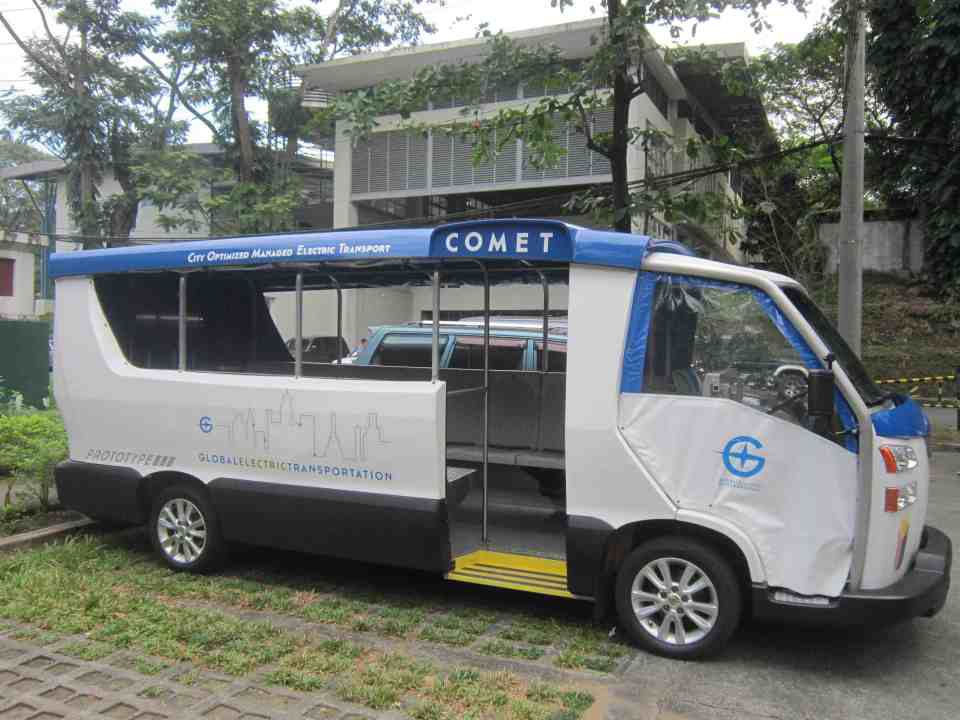 Prototype Comet at the NCTS parking lot – notice that it is larger than the AUV on the other side of the vehicle. The Comet will utilize a tap card for fares, similar to the card that is proposed for use in the Automated Fare Collection System for the LRT/MRT system.
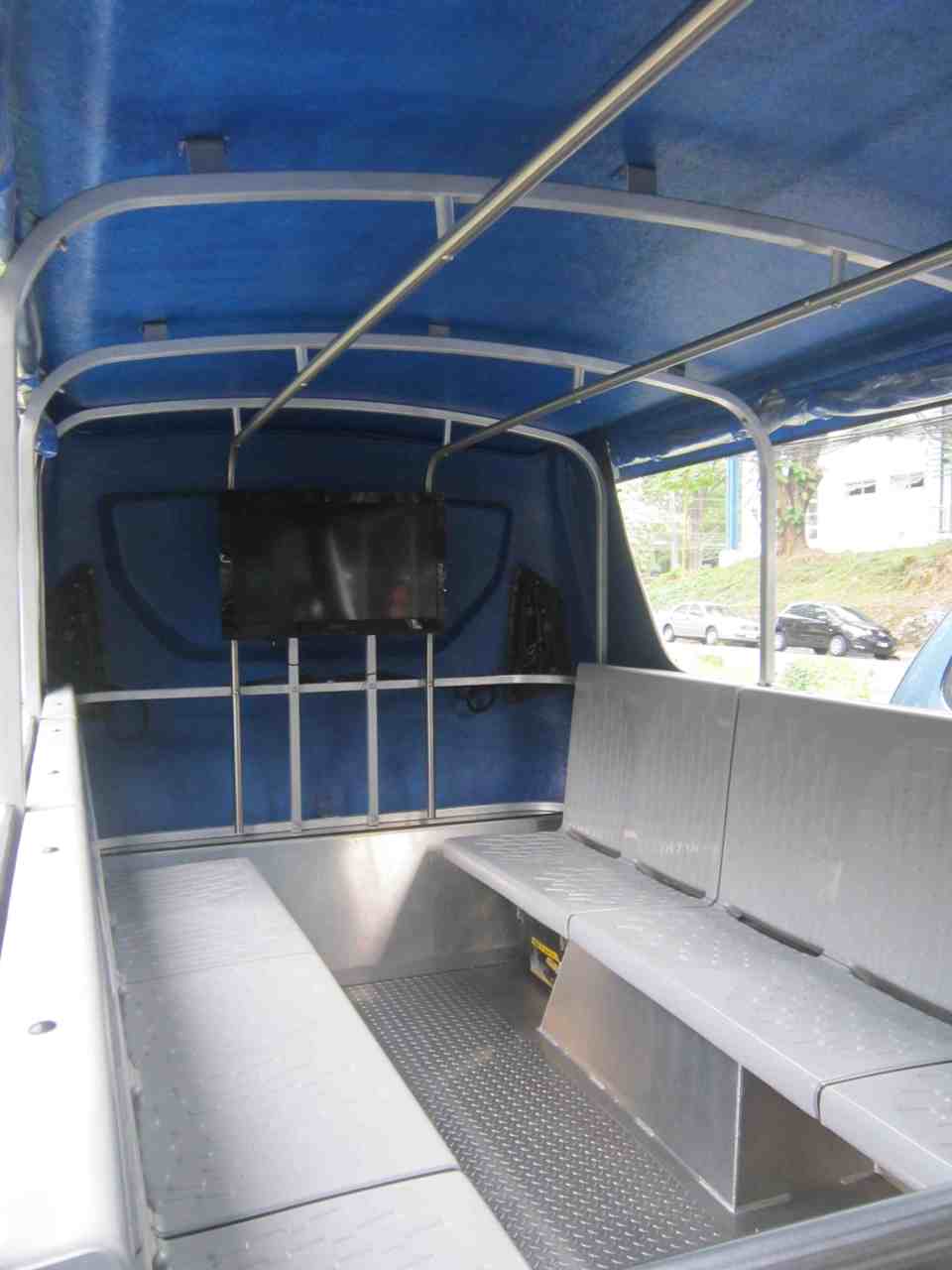 Inside the vehicle, one immediately gets a feeling of space. In fact, a person can stand inside the vehicle unlike the case of jeepneys where people need to bend so as not to bump their heads at the ceiling.
 The vehicle has a side entrance and exit unlike the rear doors of typical jeepneys.
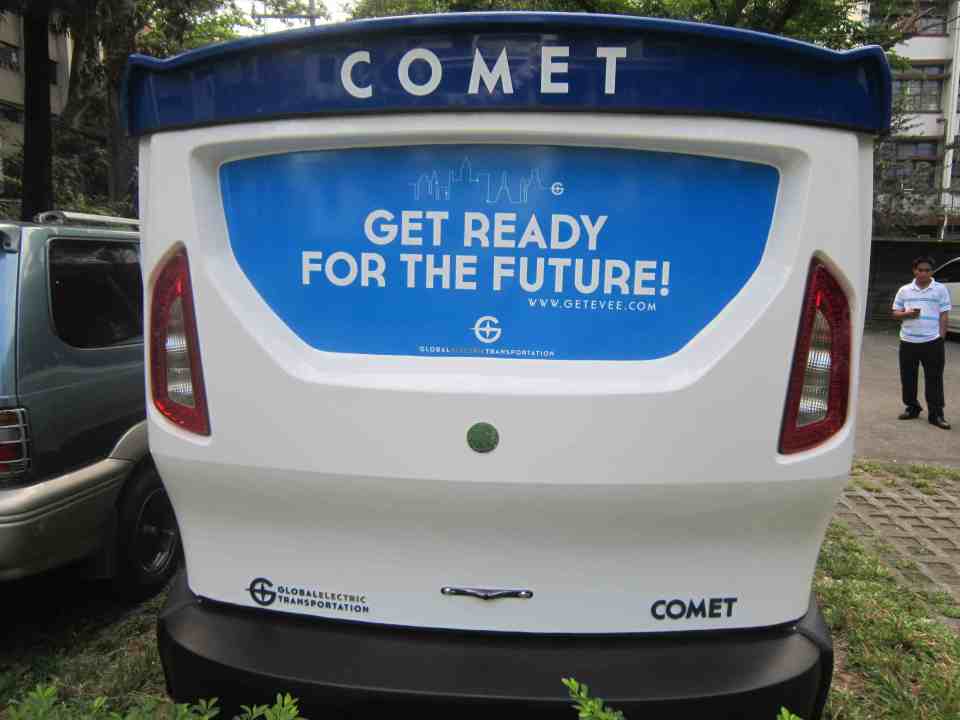 The Comet looks like a mini-bus from behind. Proponents have stated that drivers will be trained for road safety as well as operations for designated stops and scheduled services.
The Comet is being touted as a replacement for the jeepney and is being promoted via an initial route that would connect SM Megamall in Ortigas Center, Pasig City to SM City North EDSA in Quezon City. The route will be counter-clockwise from SM Megamall to SM North EDSA via Circumferential Road 5 including E. Rodriguez Avenue and Katipunan Avenue, UP Diliman, Commonwealth Avenue, Elliptical Road and North Avenue. From SM North to SM Megamall, it will take EDSA. While I am not sure if the Comet has been granted a franchise and how many units they can deploy, this proposed route will overlap with existing jeepney and bus routes including direct competition with UP-Katipunan and UP-North EDSA routes, and buses plying routes that cover the stretch from North EDSA to Ortigas Center. I think that this route is mainly for publicity considering there are probably other, more suitable routes for the Comet. It has not been subject to rigorous tests (just like the e-jeepneys before it), which is not a good thing, considering the experiences of the e-tricycle in Taguig and the e-jeepneys in Makati. Hopefully, they have learned the lessons from these past efforts and that they already have the answers hounding EVs as applied to public transport.
–
From FX to UV Express – a story of evolution
For those not familiar with its evolution, the UV Express has an interesting history. It started as a contracted taxi service utilizing the new Asian Utility Vehicle (AUV) model released by Toyota that they called the FX (The same model is known as the Kijang in Indonesia.). I can say that I witnessed the birth of FX services in the 1990s when taxis were approached by commuters having common destinations. I was among those who were desperate enough to get home and tired of getting into those long lines of people waiting for jeepneys in Cubao. The lines were not all that bad though as it used to be worse when people had to box out one another to board a jeepney as they arrived near Ali Mall.
Taxis had the advantage of not having fixed routes so they could bypass congested road sections. They could take alternate routes that despite covering longer distances, incurred shorter travel times. Passengers negotiated with the drivers for a common destination and a fare that’s typically higher than what would be charged if the meter was used. I remember that there were times when passengers (like me) negotiated with the driver with the dare to run the meter just to prove that he’d be better off with the money we would be paying rather than wait for regular fares. Of course, this practice of negotiating was illegal as taxis in Metro Manila were metered. But passengers were quick to help out the cabbie in case he gets caught, with everyone claiming that he or she knew the others and that they were traveling as a group. One use of a running meter was that they were a group paying regular fare.
Taxi operators and drivers quickly caught on to the idea and many eventually became enterprising. These were mostly FX drivers who could carry 5 to 7 passengers depending on the seat configuration for the vehicles. Toyota took full advantage of government incentives for AUVs by introducing what was claimed to be 10 seater vehicles, maximizing space at the middle and rear to seat a total of 8 people in addition to 2 in the front. This also translated into a maximization of revenue per load of 10 people and soon, “standard” fares were being established for certain routes like Cubao-Cainta Junction, which I remember cost 20PhP per person regardless of whether you were alighting before Cainta Junction. Eventually, issues were raised regarding their operations as contracted vehicles as they were still classified as metered taxis and should have not refused single or few passengers. There were also issues regarding their competing directly with jeepneys as some FX plied routes similar to jeepneys especially when traffic was more manageable. Eventually, the DOTC and the LTFRB moved to regulate this emergent transport service and formalized (fixed) routes and franchises rather than retain their flexibilities like taxis. In effect they became express shuttle services and fares and rules were also set accordingly, also to protect the interests of the riding public.
 Toyota Revo AUV UV Express vehicle plying the Pasig-Ayala Center route
It became known as Garage to Terminal (GT) Express during the last administration. There was a joke then that the term used was according to the nickname of the then Chairman of the LTFRB. It’s name again was changed into Utility Vehicle (UV) Express after the change in administration.
 Nissan Urvan van UV Express at the Puregold at the NLEX Valenzuela Exit
UV Express now proliferate around Mega Manila and come in different vehicle types and sizes. Most are AUV’s like the Toyota Revo, Isuzu Crosswind or Mitsubishi Adventure. There are also vans like the Toyota Hi-Ace and Nissan Urvan. But there are also custom made vehicles like those utilizing the Mitsubishi L300 prime mover and fitted with a cab that seats 14 to 16 passengers. The latter types have capacities similar to jeepneys and airconditioning is somewhat weaker compared to the legit AUVs and vans. I think the UV Express vehicles are here to stay and they do serve a certain segment of commuters. However, while I also think their numbers are excessive (and government through the LTFRB needs to address this) there is really not much to argue about if more efficient and higher capacity and good quality transit systems cannot be realized in our cities. People deserve options for commuting and for those taking public transport, these UV Express services provide good quality transport that they are willing to pay for. Many of these services might just meet a natural death or decline once a better transport system is in place along main corridors but that seems a long way off from now given continued failures in mass transit project implementation.
–
 Caught (up) in traffic