
Home » Public Transport (Page 61)
Category Archives: Public Transport
Sustainability and the roads to Baguio
News about the garbage in Baguio City and the slide that caused the death of many in that city brought back memories of my last visit. That was back in June 2009 when we were conducting consultation workshops for the formulation of the national environmentally sustainable transport strategy. We stayed and held the workshop at a hotel that was a short walk away from the Good Shepherd Convent. The convent, of course, is famous for the strawberry jams and other delicacies bearing the convent’s name. Also nearby was the Mines View Park that used to give a breathtaking view of mountains covered with pine trees. Those among my older friends who were able to experience this many years ago attest to the pleasing scent of pine in the cool breeze that is also a characteristic of this city. Nowadays, the view is mainly of mountains covered with shanties and looking downwards you would have a good view of a lot of roofs and, surprise, even a couple of structures that look like graves! If you’re unlucky enough, you would be taking in the scent of smoke coming from something that is being burned nearby.
Another thing that caught my attention in 2009 was the uncollected garbage along the streets and in front of many houses and other buildings leading to the convent and the park. Residents explained to us that Baguio already had a garbage problem and that waste management and disposal has been an issue in the city for quite some time. Previous to this visit, I had the chance to go to the city a few other times, even staying there for almost week in 2004 when we were conducting another study. At that time, I was not aware of the garbage problem probably because the problem has not yet manifested itself as it did in 2009. It is sad that the city has done little to address such issues considering the many indications of impending (if not ongoing) disaster due to their waste. It is also disappointing to see their leaders pointing fingers at others but seemingly refusing to take responsibility for the tragedy of the garbage slide.
On the way up to Baguio, we usually take Kennon Road, which is usually my choice when riding our own vehicle, rather than the more common Marcos Highway. The latter is a relatively easier route that was constructed as a safer alternative to the two more traditional routes via Kennon or Naguilian Roads. I usually choose Kennon because the drive provides great vistas including those you can view from observations points along the road. During bad weather, however, Kennon and Naguilian can be treacherous with both being relatively narrow as compared to the newer and upgraded Marcos Highway. There are many incidences of rockslides or landslides that have often made these roads impassable. In fact, Kennon Road is usually only for light vehicles and can be challenging to those who are unfamiliar with its combination of curves and slopes. Naguilian is no longer a choice among travelers from Metro Manila as it starts further from both Kennon and Marcos. Buses and trucks commonly use Marcos Highway, which has slope protection along critical sections and even a roof along one that makes it look like a tunnel section. It is also easier to negotiate this highway for most motorists though there is one long climbing section just before you get off the highway that has caused many radiators to overheat or brakes and clutches to malfunction.
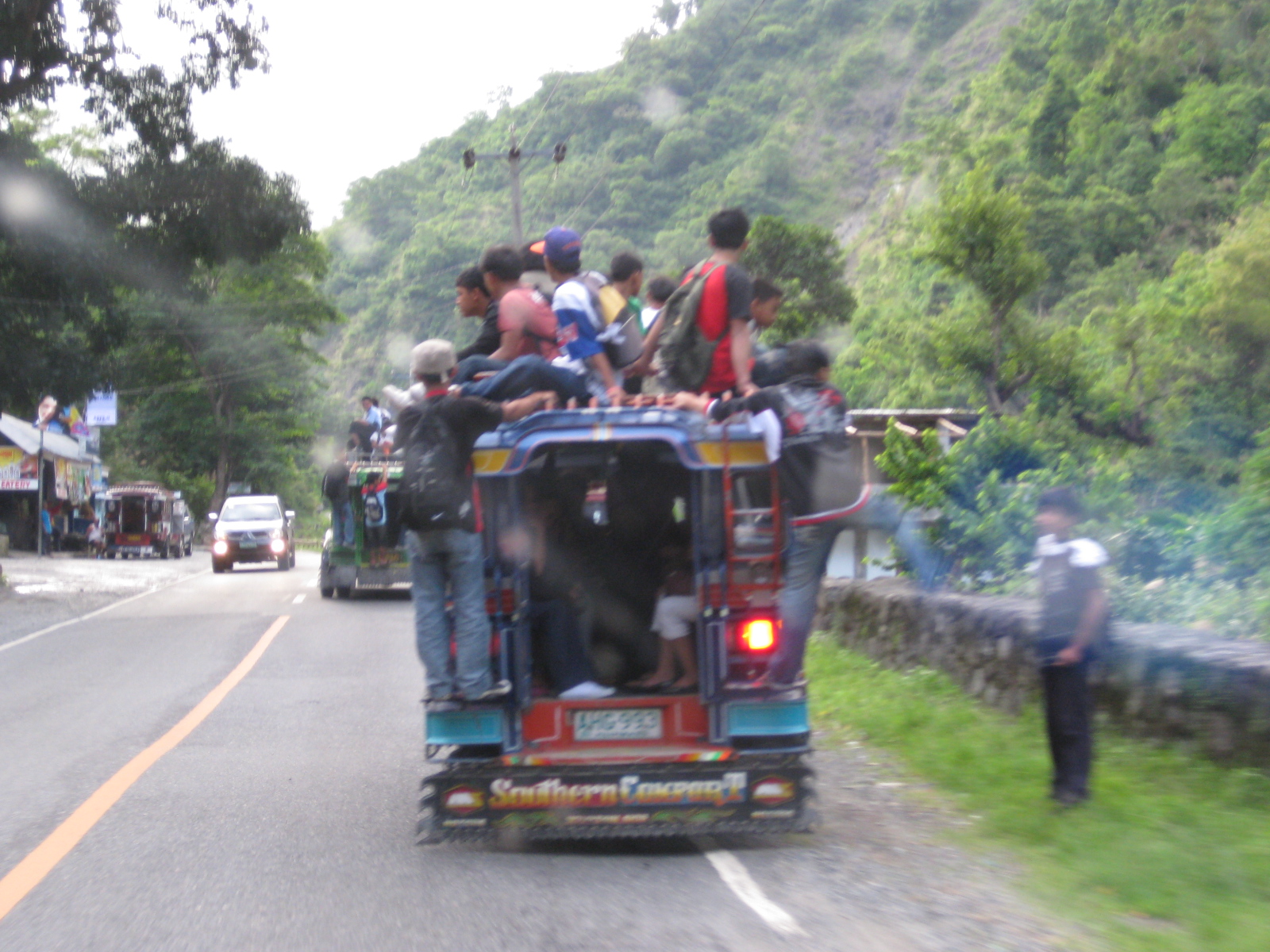
The photo below was taken as we negotiated a populated area along Kennon Road in 2009. Note the two jeepneys in the photo that are loaded with passengers. It was a surprise that no passengers were hanging by the door of the jeepney like what we usually see in Metro Manila during the peak hours. Nevertheless, such an image suggests that the public transport supply is no longer sufficient for the passenger demand along this route. Perhaps their numbers are no longer enough or maybe there is a need for a public utility vehicle with a larger capacity? One thing is sure and that the practice of overloading is unsafe and is a fatal crash waiting to happen given the geometry of Kennon Road. While this seems acceptable to many (I couldn’t even count how many people were sitting on the roofs of the jeepneys we passed.), this is not something that should be encouraged, and careful examination of services is necessary for both the local government (in this case Baguio) and the national agency in-charge (LTFRB).
More on Baguio and jeepneys on future posts.
Buses tagged…now what?
The MMDA issued a memo requiring all Metro Manila buses to paint their license plates at strategic areas of the bus exterior. These include standard sizes for “tags” to be placed on the roof, front, sides and back of the bus that are supposed to clearly show consistency with the license plate. Needless to say, if the license plate and the painted tags do not match, then the bus will be labeled colorum or illegally operating. Tags are also colored according to the general routes of the buses, with the yellow background applicable to buses plying routes along EDSA while an orange background applies to non-EDSA routes like those along Ortigas Ave. and Quezon Ave.
The tagging seems to be the latest in a long list of schemes that have been implemented to address the issue of colorum public transportation. While this is generally a matter for the LTFRB, the agency with the mandate to regulate road public transportation, the enforcement aspect is really quite demanding for an agency with few personnel to do this. As such, the LTFRB is usually assisted by other agencies like the MMDA or local government units. Franchise enforcement, however, is generally not the province of the MMDA or LGUs unlike their being deputized by the LTO in enforcing traffic rules and regulations (thus allowing the MMDA and LGUs to issue traffic tickets). The deputized MMDA and LGU enforcers may apprehend public utility vehicle drivers for traffic violations and in an ideal set-up, such violations should be considered when evaluating franchises for renewals. The propensity for violating traffic rules and regulations is a manifestation of poor driving habits and unsafe behavior on the road. Again ideally, such should be taken against operators who have the responsibility for hiring and training their staff. Operators should be held accountable should there be a high incidence of traffic violations and especially when there are incidences of crashes.
I am curious as to how the MMDA will be taking advantage of the bus tags in managing not only public transport but overall traffic as well. The tags present an opportunity where data collection may be facilitated and for various purposes. Such include a variation of the license plate surveys that are usually conducted to trace the movement of vehicles and determine whether they are speeding or travelling too slowly. An application of the outcomes of such surveys is the estimation of travel time along particular routes. For enforcement purposes, one can determine the reasonable turnaround time for public transport vehicles and allow for the checking of trip-cutting and the verification of the incidence of multiple plates. With the video cameras located at strategic points along Metro Manila’s major thoroughfares, sophisticated software employing image processing may be able to expedite the process, an example of an intelligent transport systems (ITS) as applied to public transportation.
The MMDA could even go further by consolidating travel time/speed data from public transport vehicles in order to derive real-time road network statistics. These could easily be visualized using digital maps that can be made online and shared to motorists and commuters alike to allow for better travel planning around the metropolis. Travel time/speed data have been used by researchers and agencies in other countries to estimate road traffic performance throughout the day and may be employed in modeling traffic in order to predict travel characteristics given typical factors affecting the traffic stream. Private vehicle characteristics are approximated by taxis that operate pretty much like private vehicles given that they do not have fixed routes and are not confined to lanes normally assigned to buses and jeepneys.
Such a comprehensive and sophisticated system for traffic management would require that all public transport vehicles be tagged including jeepneys and taxis. This also requires both hardware and software, and most importantly, capacity and on the part of Perhaps this is an alternative to requiring all to have GPS or RFID installed. Of course, the latter devices have more applications due to their potential for data storage (e.g., vehicle registration, franchise, location, etc.) but unfortunately, there are issues that still need to be addressed and questions left unanswered that are associated with these devices. Sayang! But even so, the bus tags (and maybe jeepney and taxi tags in the future) already present a lot of opportunities for monitoring, evaluation and improvement of traffic in Metro Manila. If only such potential can be realized and maximized by the MMDA and other agencies…
Locally made AGT
I got my first look at the vehicle currently being developed by the DOST-MIRDC at the DOST complex in Bicutan. This was the same vehicle that was shown on some news programs a couple of days ago when there was some buzz about a MOA being signed between UP and DOST for the development of an automated guideway transit (AGT) prototype and test track at UP Diliman. The DOST Secretary was supposed to have said that it would cost somewhere between a fourth or a fifth of those developed elsewhere (read: other cities abroad) and that it would have a capacity of 60 passengers. The Secretary also was reported to have said that the AGT would eventually be travelling at 100 – 120 kilometers per hour! That’s quite fast for something that’s being packaged as an urban mass transit system.
Together with the reports, both on TV and print (I haven’t heard anything from radio.), were images of a transit vehicle used by DOST in publicizing the project. What appeared was an artist’s impression (or so it seems) of what looked more like a monorail than an AGT. But coming to Taguig for a meeting, I made it a point to ask our friends at DOST to give us a brief tour of the test track they constructed at the complex where the MIRDC with a little help from another agency involved in rail transit was testing a prototype vehicle that was shown on TV. I wasn’t able to catch those news reports so I was a little excited to see the vehicle being developed and by local engineers and scientists. Below are a few of photos of the vehicle together with the test track.
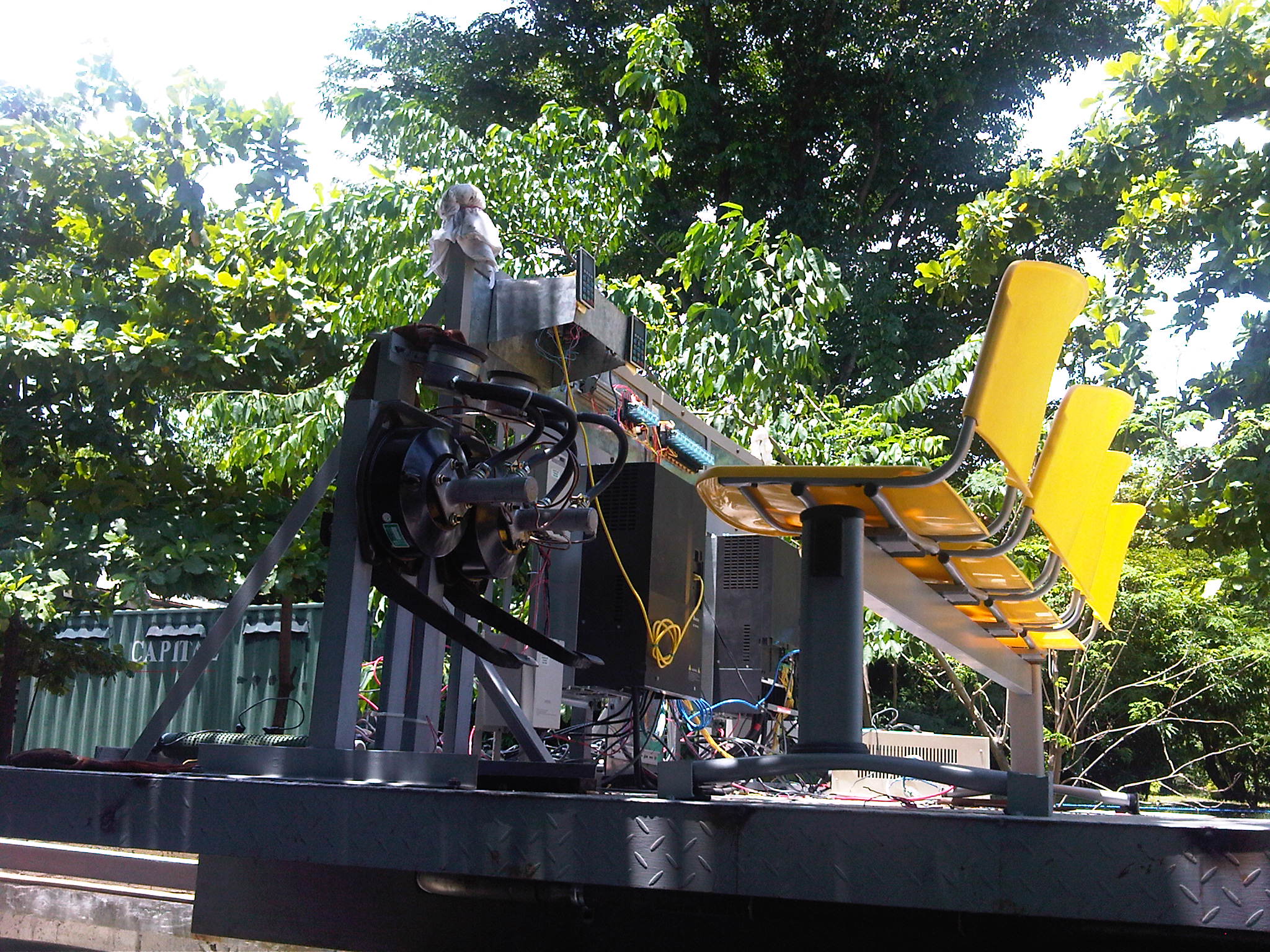
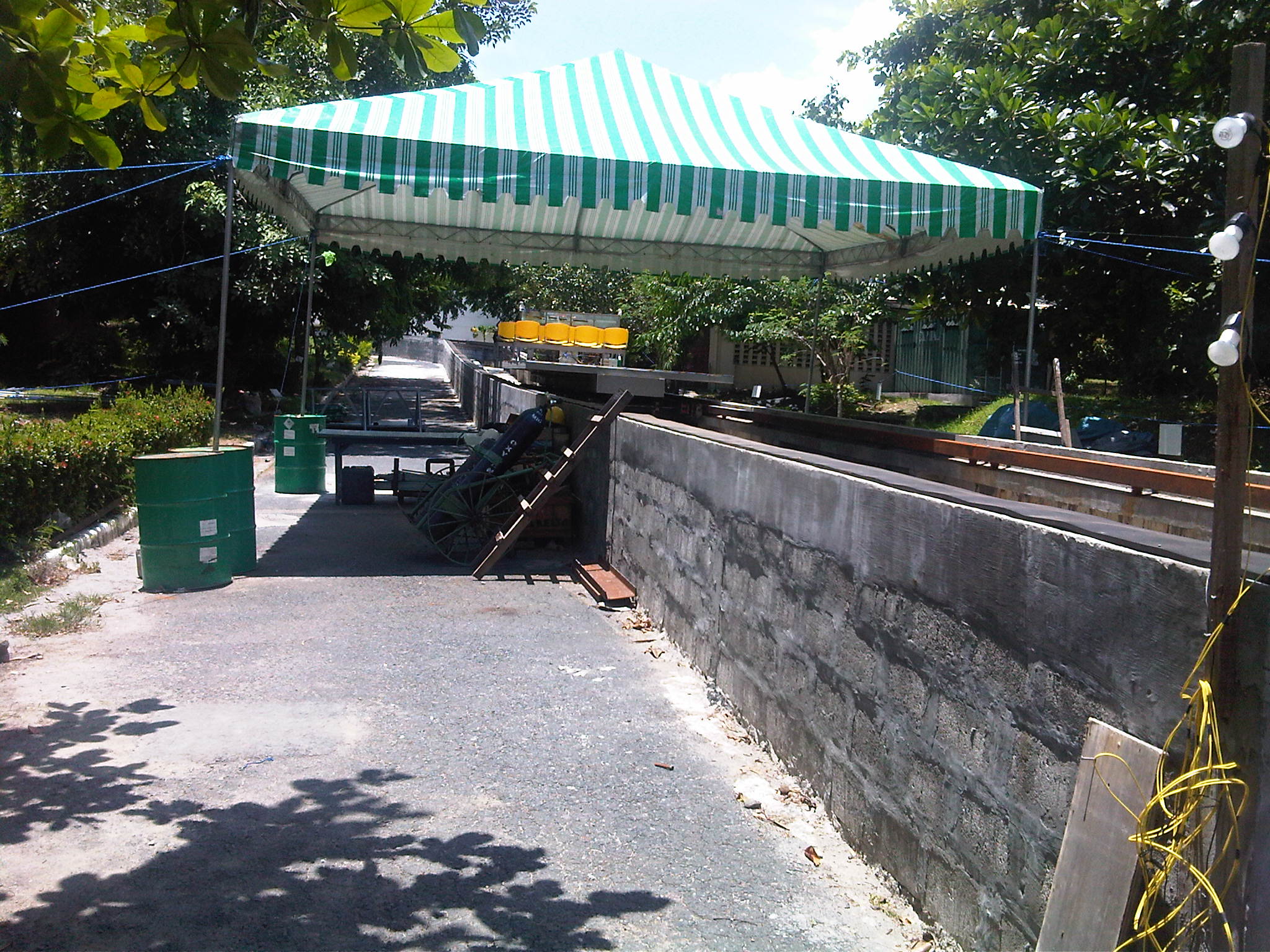
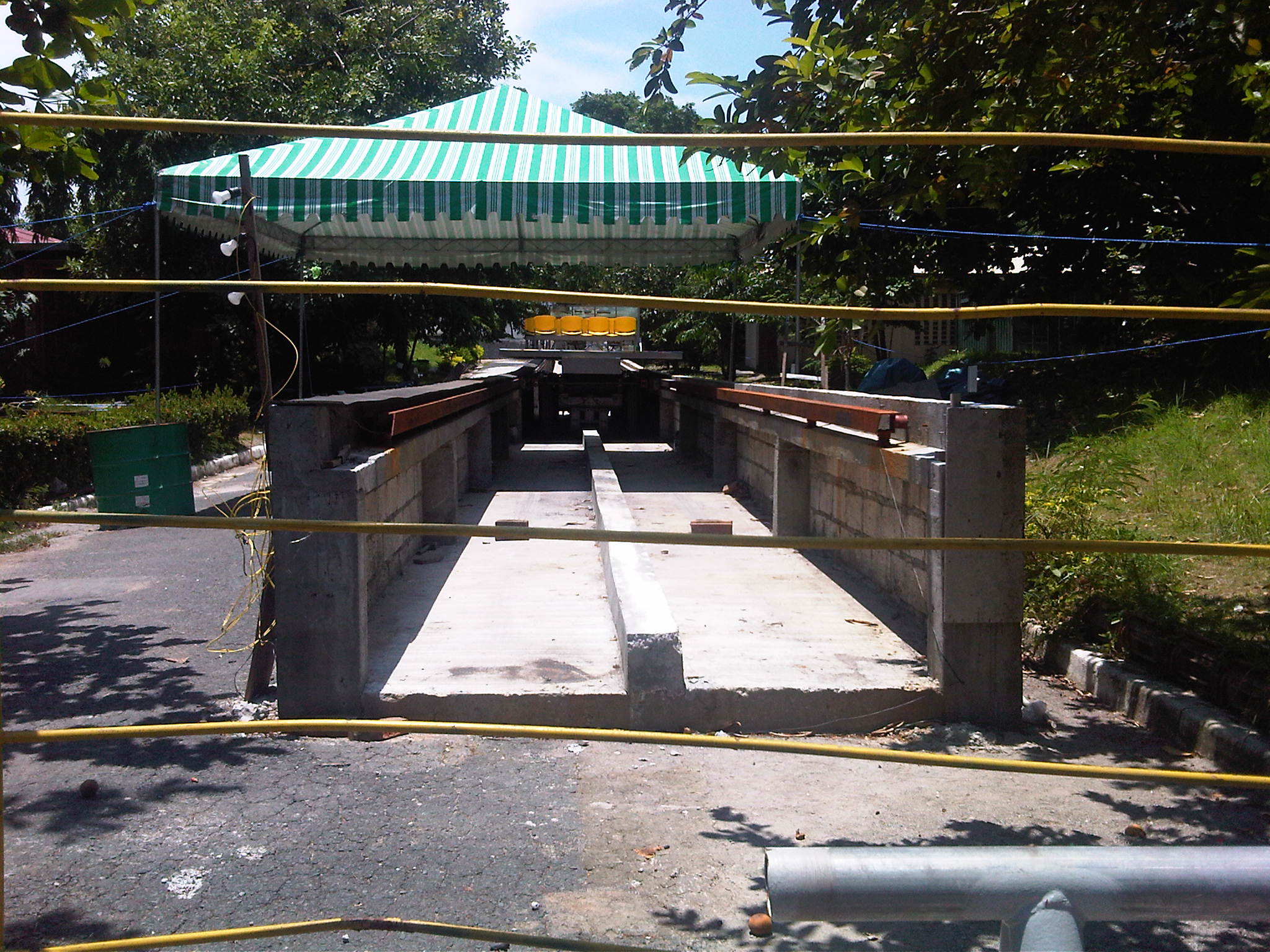
I’m sure a lot of pundits out there were disappointed with what they saw after getting all the hype about the UP AGT. However, it turns out that this won’t even be what will run along the test track to be constructed at UP Diliman. Our friends at the DOST say that this was just a practice vehicle of sorts that DOST staff experimented on just to prove that we (Filipinos) are capable of developing a transit vehicle and the track that will carry it. Of course, the future track and the proposed loop in UP Diliman will be overhead. Also, there will be other challenges pertaining to the superstructure (foundations, columns, girders, stations, etc.). Then there is the vehicle itself that should be safe and comfortable with designs adhering to ergonomic standards, an efficient motor and controller (it will be electric), and a suspension system that should give a smooth ride. Needless to say, the vehicle should also look good to be able to attract people and for it to be marketable. These are tremendous expectations indeed and it could really use all-out support from the government and maybe the private sector. I would not be talking about the funds and other resources required for this undertaking. Info on these are already available from the DOST and UP, and there are already initiatives to attract the private sector into having a look at the project and perhaps provide support in whatever way they can.
I can’t help but be proud of what has been accomplished and what is still to come in as far as the project is concerned. I believe we should be eager to pitch in what we can in order to ensure the success of this collaboration between UP and DOST. Who would not want to be involved in a project where Filipino engineers and scientists will come together to come up with a product we can not only showcase as home-grown but something that would have a significant impact on public transportation in this country.
Meanwhile, it would be better for DOST and UP to temper expectations so as not to put undue pressure on those who will be involved in the project. Pronouncements claiming that the system will replace the IKOT jeepneys are at this stage premature and only raises flags that would not be in the interest of the project. Claims, too, that the vehicle will run at 100 kph is unfounded and unnecessary considering, for one, that the average running speeds of such systems would be between 30 and 40 kph and probably top at 60 kph if there were sufficient distance between stations. I understand that the statements made were probably words of encouragement but I guess we have our work cut out before us and the challenges have been revealed on the way to the development of a home-grown AGT.
Technology-driven transit system development
The proposed UP transit system, whether it will be an AGT or a monorail, is a technology-driven project. As such, it can be argued that it does not need hard studies to establish the need for the system. Indeed, it is packaged as a prototype and one which, if implemented properly, will hopefully be a good example that can be deployed elsewhere where such a system is necessary. Such places may include CBDs like the rapidly emerging one in Bonifacio Global City or in small cities where there is a need for a more efficient form of mass transportation but could not afford the conventional MRTs or LRTs that have been constructed in Metro Manila. Also, a significant part of the initiative is the development of the vehicle, which is being undertaken by the DOST’s MIRDC. Their design and their production process should be replicable and they should have been able to bring down the costs according to the marching orders of their Secretary. After all, this system is being touted as something that would cost a fifth of a conventional system.
The conventional way of planning, designing and building transit systems require a lot of studies including the so-called ridership studies that would establish the demand for the system. Of course, there are also considerations pertaining to the stations and analysis of the superstructure that will also cost something. It is no joke that the best examples of AGTs or monorails in other countries are priced so because of all the effort and expertise that went into their developments. We should not kid ourselves by claiming this will cost much less because we did not take into consideration just compensation to people who will be devoting their time and expertise to develop a “home-grown” version of what has been built in other cities. We shouldn’t also sacrifice the quality of the superstructure that includes the stations just because we want to reduce costs. We have to keep in mind that the infrastructure should be able to resist typhoons and the possibility of earthquakes. The foundations for the columns, in fact, should be designed well considering UP’s soil characteristics.
On Wednesday I might just get my first look at the prototype vehicle when I visit the DOST for a meeting not quite related to the proposed transit system although it would be about customized vehicles. The vehicle that is the rolling stock for the proposed system is supposed to have already been built and being tested on a very limited basis at the DOST compound. Perhaps I can see for myself if it is something that will eventually be an impressive piece or something that will need much work once it is brought to UP.
An AGT at UP
The signing of a Memorandum of Agreement (MOA) and groundbreaking for a proposed prototype transit system at the University of the Philippines Diliman campus is scheduled for the morning of July 18, 2011, Monday. The site will be at the open lot near the corner of Lakandula and Jacinto Streets just across from the College of Fine Arts and near UP Diliman’s Campus Maintenance Office (CMO). The prototype system is a pet project of the DOST Secretary and was originally billed as the system to replace the IKOT jeepneys of UP Diliman. It will be a major undertaking for the university considering that its expertise (i.e., faculty, staff and students) will be tapped to undertake the studies and designs for the system. It will be a multi-disciplinary project that would involve architects, engineers and planners as well as social scientists who will be assigned with the unenviable task of securing social acceptability of the project.
The prototype system will have several phases in order to complete a loop. It is to be designed as a one-track, and therefore likely a one-way system. The “rolling stock” of modified buses each with a capacity of 60 passengers are supposed to have already been finished and are being tested at the DOST compound in Bicutan. It is still not known what the capacity of the system will be since there have been no studies to support demand (i.e., ridership), which will be affected by factors such as the route, direction and headways. among others. The project is one that is technology-driven rather than demand-driven. It is going to be an experimental system and one that will probably have to be tweaked from time to time given that it will be “home-grown” and attempting to reduce costs commonly associated with existing systems in other countries. Below is one of the proposed alignments for the system showing the initial phase from Philcoa (in yellow). The circles indicate the 2-minute walking distance radius although this is a crude concept considering people will be walking along the roads or sidewalks and not necessarily along a straight line leading to the proposed stations.

Whether it will eventually replace the jeepneys is still up in the air but the stakes are high considering that a locally made AGT may be transferable or feasible in other settings. Perhaps areas such as Bonifacio Global City, the reclamation areas along Macapagal Boulevard and even the Batasan can have their own AGTs in the future. My only hesitation for the prototype at UP Diliman is that it is still unclear who will be shouldering the operations and maintenance costs of a system that is sure to have revenues that won’t be able to cover such. Then there is the issue of aesthetics that cannot really be addressed now considering most plans are still in the minds of the proponents and have not been transferred unto the drawing boards or computers. We hope to be able to answer these questions and answer them correctly and appropriately. Otherwise, our legacy for the campus would be a white elephant that nobody would have wanted in the first place.
Regular salary or commission?
Still related to the topic of the road crash that claimed the life of a UP Professor last week are current discussions on the compensation of public utility vehicle drivers – particularly drivers of buses. The boundary system is the one that is predominantly employed by many operators or companies with their drivers. It is quite a simple system where the driver practically rents the vehicle from the operator for a certain amount that is related to the characteristics of the route that he or she will be plying. Thus, the longer routes with the higher passenger demands typically pay more than shorter ones or those with less demand.
What a driver would earn during his shift (in a day) would include the amount he would be spending for fuel and maintenance costs. This means that the driver would have to earn significantly more than what he plans to take home because from the gross income for a day’s work he would have to subtract the boundary (vehicle rental) fee, fuel costs and maintenance costs. Should he be apprehended for any traffic violation, he may also have to shell out more money for fines or, in certain cases, bribes to crooked traffic enforcers. Theoretically, however, if a driver is able to cover more round trips in a day he has the potential earn more in terms of net income. Thus, it can be inferred that traffic congestion would be among his main problems if he is to reach his goal of a decent take home pay. As such, the objective for any driver is to maximize his passengers for every trip that he makes and maximize the number of trips that he makes in order to maximize his income.
Meanwhile, the salary type of compensation involves a fixed payment for services rendered by a driver regardless of the number of passengers he is able to pick up or of even maybe the number of round trips per day that he is able to make. The latter parts of that last sentence is probably the most significant difference in the characteristics of the two compensation schemes that we are now attempting to compare. These are the characteristics that are often mentioned whenever inefficiencies and inconveniences in road public transport services are discussed since it is argued that scheduled services and behavior change, ergo better public transport services, will be possible if drivers won’t have to compete against each other for passengers or recklessly speed up in order to cut travel and turnaround times.
But can a fixed salary or a system much like those in most conventional or regular companies be acceptable in the first place to both driver and operator? What are the views from the drivers and operators themselves? What would be the implications and impacts of having salaried drivers much like employees of a conventional company?
The theoretical answer to the first question, and one that would most likely be provided by proponents of regular salaries, is a resounding yes. However, the response to the second question would be problematic once one realizes that the answers to number three seem to be unfavorable to both driver and operator while appearing to be beneficial for commuters. For the first question, a fixed salary may not necessarily be acceptable to drivers since it is not necessarily advantageous to them. A fixed salary means they will lose the potential of earning more income that is possible from the current practices of driving aggressively and pursuing as many passengers as possible.
The idea of putting a cap on their income is one thing, the prospect of having a paper trail for a regular salary is another. If, as proposed, drivers would have regular salaries like most employees working in offices, then companies may have to employ a system similar to that in other business where they will now be withholding taxes and other dues for benefits like social security and healthcare. While the BIR might end up happier with this set-up, surely the drivers who until now perhaps do not even pay their taxes at all will oppose a system where they will end up with potentially less net income.
On the part of the operator or company, having drivers with fixed salaries would also mean less potential income at the end of the day as revenues may be reduced. The reduction would be mainly due to less passengers as drivers are no longer pressured to take as many passengers as they can. They are, after all, assured of a fixed salary and do not have to stay longer at stops just to maximize the number of passengers they could pick up. Such result would definitely be welcome to passengers who would benefit from shorter dwell times (delays) and faster travel speeds. But from the perspective of operators or companies, it is bad business and they may end up being exposed for their financial incapacity.
This perspective of the operators and drivers is validated by the recent interviews by news crews of the former group where they practically opposed regular salaries for drivers. Operators reasoned that drivers would be on the losing end of the deal while not discussing how it would affect them and how the prospect of salaried drivers may lead to increased efficiencies of public transport services and even alleviate traffic congestion. On the part of the drivers, there are basically mixed views on regular salaries with one group saying it is acceptable to them and another saying it is disadvantageous in their cases. The impression for both groups, however, is that they are basically ill-informed and do not fully understand the implications of having regular wages. Perhaps their understanding is limited also by the fact that many of these drivers might feel beholden if not loyal to their operators/companies.
While the jury is still out on salary vs. commission, it should be noted further that salaries may only be applicable to companies or operators with several units of PUVs (perhaps something that resembles a fleet). As such, the preceding discussions and arguments may not be applicable to drivers of jeepneys or AUVs and perhaps even tricycles and pedicabs, most of which are individually owned. This becomes a weakness of the proposal for regular salaries as it becomes clear that only buses will be affected and their operations influences. In Metro Manila, perhaps the impacts would be marginal since jeepneys comprise much of the public transport supply and would pose more unique problems pertaining to driver compensation.
Some opinions on safety and public transport
I’m re-posting below some opinions I’ve stated on Facebook reflecting things coming to mind since Friday’s tragic incident along Commonwealth. A lot of the ideas I posted and the comments made by friends are actually old ones that have yet to be realized given the apprehensions of those who have the power or authority to once and for all bring order to traffic along our highways and streets.
– Perhaps we should cap bus and jeepney speeds along Commonwealth to 40kph. These should also be limited along the 2 outermost lanes and not allowed to race or overtake each other. The MMDA and HPG /QCPD should work 24 hours to ensure speed limits and other rules are strictly enforced and violators should be penalized immediately. PUV drivers involved in crashes should have their professional licenses revoked. They are engaged in a public service, and safety is non-negotiable!
– I think it’s time to hit where it hurts to send a clear message that authorities are serious about the matter of public safety. Revoke the franchise when an operator’s unit is involved in a fatal crash 3 times. Suspensions seem to be only a slap on the wrist.
– Simplify is a word that needs to be appreciated in as far as public transport in the Philippines is concerned. The routes are too complex and the service sucks. It seems that while there are calls for fare increases all the time, there are no calls from people to have safe efficient service in return.
Tragedy and mockery
Friday the 13th turned out to be tragic to a faculty member of the College of Mass Communications of the University of the Philippines Diliman. Prof. Lourdes Estella-Simbulan was killed when a bus hit the taxi she was riding along Commonwealth Avenue in Quezon City at around 6:00 PM yesterday. By the looks of the crumpled taxi cab shown in photos and videos taken by the media, it would have been a miracle if she survived such a crash.
Adding insult to injury were reports that the bus driver fled after the incident. The name of the bus company is not familiar to me despite our Center currently immersed in a project developing a planning support system for public transportation that included a database component that required us collecting data on companies and operators of public transport in Metro Manila. I suspect that the bus is one of those fly-by-night units taking advantage of the night in operating illegally or maybe one that is part of the kabit system that would be difficult to take to task by the HPG or the LTFRB. It is indeed a mockery of traffic rules and regulations that drivers can get away with murder when they are involved in crashes such as this. It is even more frustrating that the most common reason mentioned by drivers when asked why they drive recklessly is that they are just “naghahanap buhay” or earning a living. Such is unacceptable and those charged to bring order to traffic should be decisive and assertive on acting to prevent such crashes from happening again.
To me there is some irony in what had transpired considering that a couple of days ago, the Philippine joined other countries around the world in launching a program geared towards the reduction of road crashes and victims in the next ten years. Forget about the decade – there is a need to reduce crashes and victims NOW. This is because people are getting killed (or dare I say murdered) now, and there are terrible costs even as I write this post.
The College of Mass Communications is a partner in our advocacy for road traffic safety. In fact, that college produced a video for driver education that was supported by resources extended by the private sector led by the Automobile Association Philippines and Toyota Motor Philippines. I am sure that their faculty are now wondering if their efforts have been to naught considering the proliferation of drivers disregarding traffic rules and regulations, throwing caution to the air when they drive their vehicles.
On my part as head of a Center providing training to public utility vehicle drivers, I feel responsible and frustrated at the same time as I question myself if indeed our efforts are even having the slightest influence to improve PUV drivers’ behaviors. In fact, I have been admonishing participants in our training courses about how they sit in and pretend to learn, and then go out and drive like hell. I just hope that the driver involved in the crash that killed Prof. Simbulan is not among those whom we trained at the Center. It would be a shame and one that makes a mockery out of our efforts in promoting road safety. It is our failure as educators that our students and trainees do not practice what they are taught in terms of road safety. We just take it with a grain of salt, so to speak, that responsibility for such PUV drivers’ behavior can also be linked to a flawed licensing system as well as shortcomings in the regulations of public transport services. Indeed, we have our work cut out for us and we can only hope that our persistent efforts would eventually prevail and lead to a significant improvement to safety along our roads.
Going electric in the Philippines
The Asian Development Bank (ADB) hosted and co-organized a forum on electric vehicles with the Department of Energy (DOE) today. The forum was divided into two parts where the first part included remarks from the DOE Secretary and two presentations from invited speakers. The second part included mainly presentations of experiences in the deployment of electric vehicle technology around the country and a presentation by the ADB on their program to support electric vehicle deployment in the Philippines.
In the first part, the DOE Secretary was very clear in his message in support of electric vehicles. He emphasized the importance of addressing concerns pertaining to the use of fossil fuels, mentioning the need for fuel efficiency and our transport system’s (over)dependence on fossil fuels. He also expressed concern over environmental aspects, recognizing the direct association between emissions and fuel consumption. His remarks was followed by two presentations on experiences on electric vehicle applications abroad. One presentation was mainly on the infrastructure for charging e-vehicles and included material on the experiences in China. Another was on battery technology but included also the different e-cars that are currently available in the market (e.g., Volt, Leaf, Tesla, etc.).
I must admit, modesty aside, that I was disappointed with the presentations as they were both mainly on private vehicle applications including electric motorcycles and electric cars. I was unimpressed, as were others, with the presentations that had material one could easily pick out of the internet. Even information on battery technology did not provide any new knowledge to most participants that included proponents/advocates of electric vehicles in the Philippines. The comment of one participant said it all when he mentioned that in the Philippines the focus was on public transport applications of e-vehicles.
The second part was more interesting, although two presenters tended to stray away from the topic of electric vehicles. The first presentation of the second part of the forum was delivered by the Congressman representing Taguig City. He did not use any slides but chose to make a rambling speech on Taguig’s experience during his time as mayor of the city. He explained his administration’s push for the e-trikes in Bonifacio Global City and made it appear as if his administration was progressive in its push and that the private sector (i.e., Ayala Land, which had a say on transport at BGC) did not have foresight. In truth, the question that needed to be answered at the time of their push was if the e-trike was the appropriate transport mode at the Fort. Ayala knew it was not but it was clear that Taguig insisted on the deployment of e-trikes at BGC rather than take the more progressive (radically) yet risky push of replacing conventional tricycles in the old Taguig east of C5. His speech was really more a conscious delivery of soundbites and I must say, was quite pretentious and self-serving. It was, for me, simply lip service and a waste of time. In fact, one person near us was already snoring by the time the Congressman finished his speech.
The second presentation was delivered by a representative of the Puerto Princesa Mayor. It was straightforward and wasted no time in explaining PPC’s programs and clearly showed their efforts in deploying environment-friendly transport systems. He also mentioned the incentives that the city has so far offered and proceeded to ask those present to partner with them in promoting e-vehicle use.
The third presentation was on Makati’s experience on electric vehicles. The presenter was city’s traffic consultant and I was expecting him to focus on the electric jeepneys now operating along three routes in that city’s central business district. Instead, he took up much time presenting on Makati’s transport plan including the proposed Bus Rapid Transit (BRT) system and its extensive pedestrian facilities that included walkways connecting buildings and to the shopping district. Nevertheless, his presentation had its saving grace in that it mentioned how the e-jeepney could serve as feeders to the BRT and how the pedestrian facilities complemented public transport services.
The fourth presentation was by a representative of Mandaluyong City, which is the first recipient of the incentives being granted by the ADB in support of e-vehicles. This was another straightforward presentation and clearly covered the main points of the e-trike application in that city including the infrastructure they put up for charging. These charging stations represented an innovation that can be picked up by entrepreneurs in coming up with a business model for charging stations. It was not clear though if Mandaluyong has set out to replace conventional tricycles as my impression was that the e-trikes they acquired will be on top of the existing tricycles plying routes around the city.
The fifth presentation was from Ateneo De Manila University, and focused on that school’s efforts to pilot e-vehicles for the use of their students and staff. The presentation mentioned their rationale and the apparent marching orders from their newly installed president, who is an acknowledged expert on environment, to address air quality in the vicinity of the campus. I found their presentation awkward and at the very least hypocritical of the fact that the problem they have to face is the overwhelming number of private vehicles the school generates and their continuing coddling of tricycles whose phase out along Katipunan is long overdue. Perhaps I will expound on this and other issues when I write about Katipunan transport and traffic in the future.
The last presentation was a quick one from the ADB. It was mainly on the ADB’s program supporting e-vehicle promotion. It was also explained why ADB chose to focus on tricycles and was unapologetic in their argument that tended to generalize the problem on transport in the Philippines. There was no mention of rationalization considering that there is actually an oversupply of tricycles and this too needs to be addressed.
While it is commendable that the ADB has extended assistance in the form of grants incentives to promote e-vehicles, there are still questions on the sustainability of this effort given that they chose to focus on tricycles. Of course, the statistics on the number of tricycles and their environmental and energy impacts clearly argue for addressing this problem pertaining to conventional motor tricycles. However, the ADB must realize that local government units (LGUs) can be quite fickle-minded or hard-headed in their approaches to public transport regulations. This is a fact given that there are few LGUs that have been successful in regulating tricycles and particularly in restricting their numbers and their operations along routes or areas where they are suitable. If we take a look at many cities, we will find tricycles running on national roads and causing congestion in CBDs. We would also see that many of these cities, among them highly urbanized cities (HUCs), have a need to graduate from these low capacity modes into middle or even high capacity vehicles.
It was noticeable that there were no representatives from the Department of Transportation and Communications (DOTC) nor its attached agencies like the Land Transportation Office (LTO) and the Land Transport Franchising and Regulatory Board (LTFRB) at the forum. Despite pronouncements by the DOE Secretary that the DOTC and the Department of Science and Technology (DOST) were on-board in the former’s push for e-vehicles, experience has shown that DOTC and its attached agencies have been the bottlenecks in the forward movement of e-vehicles. This includes the absence of clear policies pertaining to e-vehicles including their registration as well as the lack of direction pertaining to their mainstreaming as public transport modes (i.e., franchises). Also, lest we forget, all the talk on e-vehicles while being spearheaded by the DOE, is very much the province of the DOTC since we are, after all, talking about transport. It is the main responsibility and the mandate of the DOTC to see the e-vehicles through and lead in the mainstreaming of these vehicles in the context of environmentally sustainable transport. It is a pitch for e-vehicles that would go a long way into ensuring that a critical mass can be realized and that the tipping point for the shift to electric would be reached in the near future.
All roads lead to Antipolo
The title of this post is based on a saying referring to the Shrine of Our Lady of Peace and Good Voyage that is located in what is now the City of Antipolo in the Province of Rizal, to the east of Metro Manila. The saying is based on observations during May when the feast of Our Lady is celebrated the entire month. While people flock to the shrine throughout the year often to pray for safe travel, many devotees go up the city in the Sierra Madre range during Lent to pray the novena to Our Lady, hear Mass, or simply to partake of the other attractions of this city.
Antipolo has been a popular pilgrimage site since the Spanish Period ever since the reports of miracles performed through the image of Our Lady of Peace and Good Voyage. These include her image being reportedly found among the Antipolo tree that is the basis for the name of the town that now is a highly urbanized city and capital to the Province of Rizal. Rizal, of course, is the name of the province that once was generally called Morong. One town of the province still bears that name and it, too, has a beautiful, picturesque church. The Shrine is often visited by those seeking safe travel, perhaps these days it has even become more popular due to the tremendous numbers of overseas foreign workers (OFWs) employed abroad. Antipolo is also allegedly the richest among the most popular shrines or churches in the Philippines, supposedly ahead of Quiapo (Black Nazarene), Cebu (Sto. Nino), Baclaran (Our Lady of Perpetual Help), Naga (Penafrancia) and Manaoag (Our Lady of Manaoag), though not necessarily in that order. I think I read about this in one of Ambeth Ocampos’ columns from the Inquirer.
The popularity of the Shrine is so much so that a road was built to directly connect it with Manila, particularly to Intramuros where the seat of government was at the time. This road is most probably along the corridor that is now Ortigas Avenue. Of course, in the Spanish Period, this would be a more general route that would have likely included many rough trails considering that the Ortigas we know now was only developed in the 1970’s. I witnessed this when we moved from Mandaluyong to Cainta in 1976, often seeing huge machines work their way along what is now Valle Verde to carve out a wider right of way for Ortigas Avenue.
During the American Period, the trams operated by the Manila Electric Rail and Light Company (MERaLCo) included a line that went up to Antipolo. Those trams were the state of the art and representative of high technology in public transportation in those years after the turn of the century and a line to Antipolo reinforced the shrine’s importance to many people and the government’s recognition of this. The tram network, which was probably the most developed in Southeast Asia if not in Asia at the time, was destroyed during World War 2 and was never rebuilt for some reason. It is something that Metro Manila now continues to regret if only to postulate what might have beens and what could have beens if the network was revived after the war. Of course, this bit of history is related to the eventual rise of the jeepneys but that is another story for another post. Nevertheless, there still exists in Antipolo some remnants of the tram’s glory days and it is remembered as a road which is still called “daang bakal,” as the railways were fondly called then and now.
There are now many ways from Metro Manila and its neighboring provinces to Antipolo, although several of these eventually merge into three main roads en route to the Shrine. One is via the old route along Ortigas Avenue, a second is the route via Sumulong Highway, and the third is through a “back door” via the Antipolo-Teresa Road. Routes from the general areas of Manila, Makati, Pasig, Mandaluyong, Taguig and the southern cities of Metro Manila and towns from Laguna, Batangas and Cavite will most likely merge to Ortigas Avenue. Meanwhile, people coming from Quezon City, Caloocan, Marikina, Bulacan, Pampanga and the northern Rizal towns of San Mateo and Rodriguez (Montalban) will likely converge along Sumulong Highway. Meanwhile, those coming from the east including the Rizal towns like Tanay, Teresa, Morong, and Jala-jala, the Laguna towns like Paete, Pakil, Pangil, the Quezon towns of Luisiana, Lucban, Infanta and General Nakar, and others will most likely take the Antipolo-Teresa Road that climbs from the east of Antipolo. People from Marikina, Cainta and Pasig generally may take either the Ortigas or the Marcos Highway/Sumulong Highway route.
Public transport to Antipolo these days include mostly jeepneys as the city is the end point of many routes – a testament to its importance even as a reference point for public transportation. One can easily spot the Antipolo-Cubao jeepneys in the Araneta Center in the Cubao business district in Quezon City. There are two lines, one via Cainta Junction (where jeepneys eventually turn to Ortigas Avenue) and another via Marcos Highway, turning at the Masinag Junction towards Sumulong Highway). Another terminal is at the EDSA Central near the Ortigas Center in Mandaluyong where Antipolo-Crossing jeepneys are queued. And still there is another, albeit somewhat informal terminal near Jose Rizal University (JRU, which was formerly a college and hence the old JRC endpoint), which passes through Shaw Boulevard, Meralco Avenue and eventually turns towards Ortigas Avenue. Other jeepneys from the Rizal towns all have routes ending in Antipolo simbahan, referring to the shrine.
There are now also Filcabs or AUV Express, shuttles offering express trips between Antipolo and the same end points of Cubao or Crossing. Others go all the way to Makati in the Ayala financial district. These evolved out of the Tamaraw FX taxis that started charging fixed fares during the 1990’s and competed directly with the jeepneys. These are popular, however, with office employees and students during weekdays and the nature of their ownerships and operations do not make them serious competitors to the jeepneys during the merry month of May and the Lenten Holy Week.
There was an Antpolo Bus Line before. These were the red buses that plied routes between Antipolo and Divisoria in Manila. These died out sometime between the late 80’s and the early 90’s probably due to decreasing profitability and likely because of its competition with the jeepneys. That bus company, along with the green-colored G-Liners, the red EMBCs (Eastern Metropolitan Bus Co.) and CERTs, and the blue Metro Manila Transit Corp. buses used to form a formidable mass transport system for Rizal and the eastern towns of Metro Manila. There were even mini-buses (one I recall were the Antipolo “baby” buses and those that plied routes betwen Binangonan and Recto). Most of these, except the G-Liners eventually succumbed to the jeepneys.
In the future, perhaps the jeepneys should give way to buses as the latter will provide a higher level and quality of service along Ortigas Avenue and Marcos and Sumulong Highways. Already in the drawing boards is a plan to ultimately extend LRT Line 2, which currently terminates at Santolan, Pasig, to Masinag Junction and then have a branch climb along Sumulong Highway and terminate near the shrine. This will bring back the trains to Antipolo and would surely make the church and the city very accessible to people. I look forward to these developments both in my capacity as a transportation researcher-engineer and a Catholic who also visits the Shrine to pray for safe travel for loved ones and myself.
 Caught (up) in traffic