
Home » Public Transport » Paratransit (Page 6)
Category Archives: Paratransit
Habal-habal in Metro Manila
Motorcycle taxis, called habal-habal in the many parts of the Philippines, are usually associated with rural areas where 4- or even 3-wheeled vehicles would have a difficult time traveling. Meanwhile, larger vehicles probably won’t fit in narrow rural roads, which can be more like a trail than a road. I saw this habal-habal station along Circumferential Road 6 in the Pasig City part of the road. The area is part of a large relocation area for informal settlers. The settlement is basically unplanned, with homes/buildings a mix of shanties and other design-your-own structures with narrow streets and alleys. The latter is most suitable to walking, bicycles and yes, motorcycles.
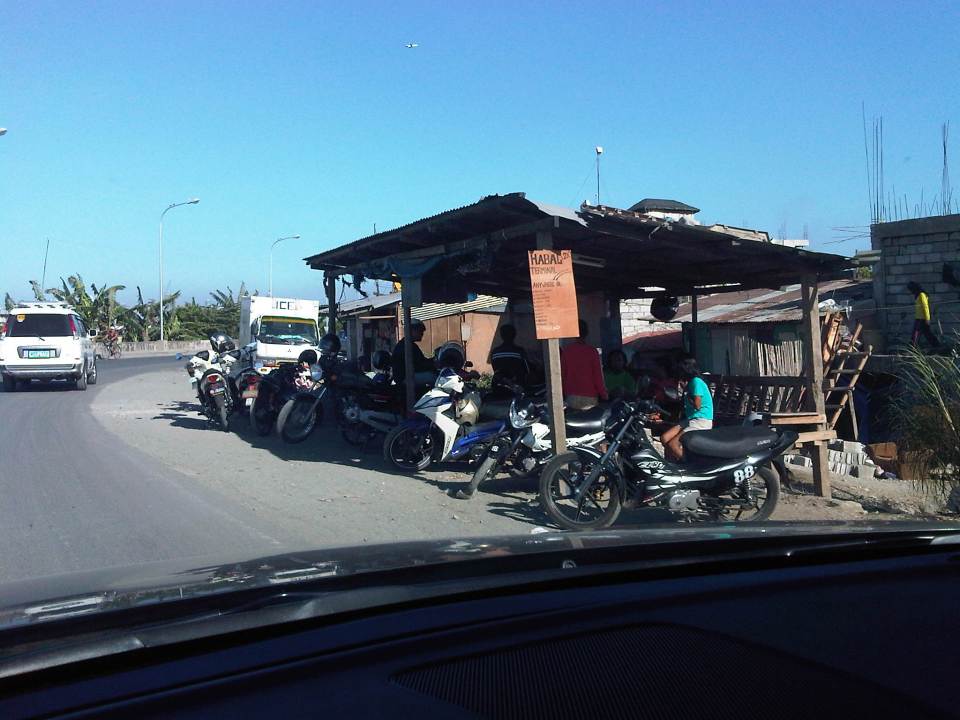 Habal-habal terminal along C-6 in Pasig City near the Napindan Channel
Despite the denial of many local governments including the MMDA, there are motorcycle taxis operating around Metro Manila. Many of these are in areas where there are no public transport services. Tricycles or pedicabs are not allowed or cannot access these areas (streets too narrow or in bad condition). Walking could have been an option but pedestrian facilities are probably even worse or walking distances are long and therefore inconvenient and uncomfortable to most. I don’t know about the fares for their services but I’m sure these are based on what people are willing to pay and established from what providers initially asked for such services. It is likely to that the operators of these services and their passengers know each other as the people in the communities served by habal-habal tend to know each other or another from other people (i.e., everyone knows everyone else).
–
Future jeepney: COMET
Another vehicle being considered for the study on the comparison of customised vehicles being used for public transport is the COMET (City Optimised Managed Electric Transport). This is a 20-seater vehicle that we have written about in previous posts and was touted by its makers and supporters as the best and most suitable replacement for the conventional jeepney. Unlike the BEEP that was featured in the previous post, it is currently operating along a route with trip ends at North Avenue and Aurora Boulevard via Mindanao Avenue, Congressional Avenue, Luzon Avenue and Katipunan Avenue. This route overlaps in operation with established jeepney routes in those areas and thus competes directly with these jeepneys.

Notice that both the COMET and the BEEP have seating capacities of 20 passengers (except the driver). However, the COMET is the larger vehicle as it is both wider, longer and higher than the BEEP. In fact, a passenger can stand inside the COMET without having to bow his/her head so as not to bump against the ceiling. Perhaps the more significant difference with current operations is that COMET drivers have been trained to drive more responsibly (i.e., less aggressively) than the typical jeepney driver. So far they do not weave in traffic and stop only at designated points along their route. Future jeepneys should have drivers like these but they should also be compensated according to the requirements of their jobs as drivers. Such compensation schemes are among the biggest factors for the way jeepney drivers behave in traffic. Technology-wise, current and subsequent developments in motors, batteries and other components of the vehicle itself should make electric and other environment-friendly vehicles more attractive as replacements (successors?) to jeepneys.
–
Future jeepney: BEEP
The National Center for Transportation Studies (NCTS) of the University of the Philippines Diliman (UPD) is part of the Phase II of a research comparing the performances of customized local road vehicles (CLRV) for use in public transport. This project is being conducted together with the Vehicle Research and Testing Laboratory (VRTL) of UPD’s Department of Mechanical Engineering (DME), Electrical and Electronics Engineering Institute (EEEI) and the National Engineering Center (NEC) with funding from the Department of Energy (DOE). Phase II considers a longer route for the comparison of vehicles. In the previous Phase I, the route was UP Diliman-North EDSA while in this phase, the route will be Lagro-Cubao, which is significantly longer in distance compared to the previous study route.
Here are the specs for the BEEP, which features some significant design changes from the earlier versions of the e-jeepney:
 It is worth noting the following for the BEEP:
1. The door is already located on the side of the vehicle instead of at the back.
2. The motor is rated at 30kW, a significant upgrade from the 15- and 20kW motors in previous e-jeepneys.
3. The seating capacity is for 20 passengers (excluding the driver) by about 2 to 4 people from previous e-jeepney models.
These are the most obvious changes in the BEEP and would be factors that could affect its performance and acceptability. Most jeepneys these days are “siyaman” meaning they seat 9 passengers on each of the bench seats plus 2 on the front seat for a total of 20 passengers. Also, jeepneys should be able to negotiate steeper slopes that have been among the problems for e-jeepneys. Not mentioned are the specs of the batteries and the charging time although the range claimed for a full charge is 85 km. This study will hopefully validate these claims and show us if the BEEP will be up to the challenge of replacing the conventional jeepneys on long routes.
–
Bullish about electric vehicles in the Philippines
We were invited to the opening of an electric vehicle assembly plant in Cavite recently. BEMAC Electric Transportation Philippines, Inc. formally opened their plant last February 11 at the Almazora compound at the Golden Mile Business Park in Carmona, Cavite. We were very impressed at the plant and learned that BEMAC is partnering with Almazora, a local company specialised and experienced in vehicle body assembly. I am sharing photos I took of the plant so readers can have an appreciation of what an assembly plant looks like.
 BEMAC’s e-tricycle model, the 68VM, has a comfortable seating capacity for 6 passengers at the back with the driver the sole occupant of the front seat.
 Batteries by Toshiba Japan
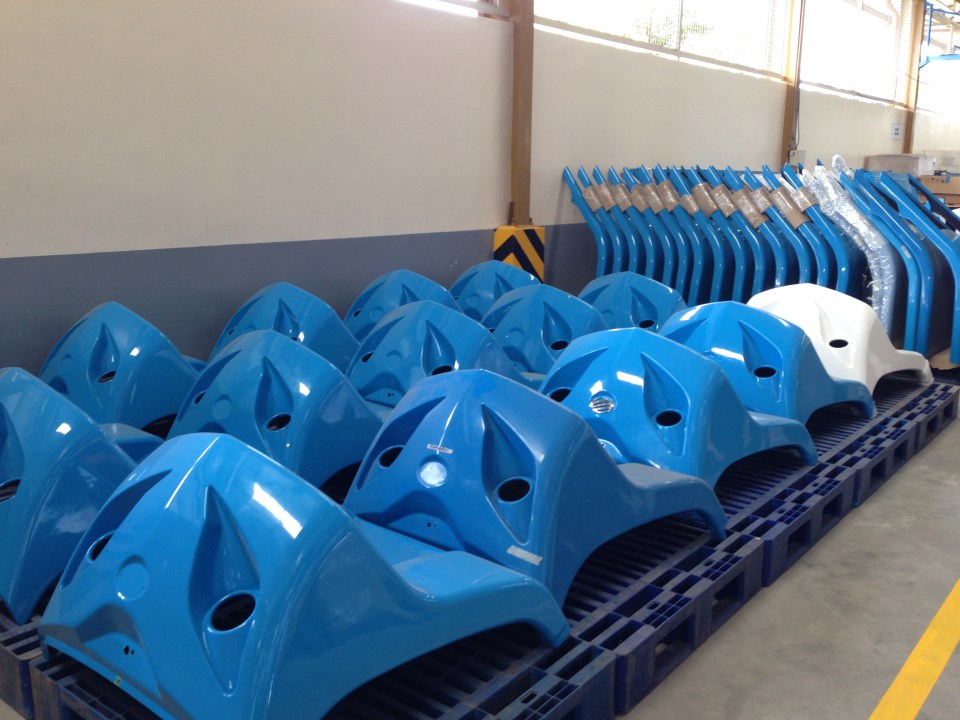 E-trike body parts
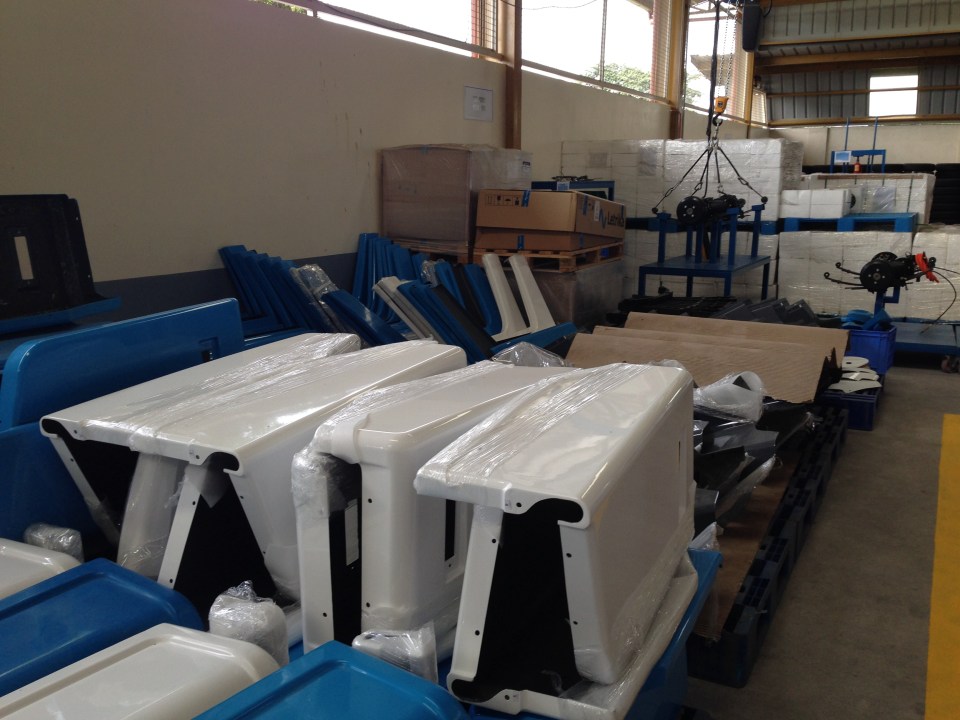 More parts
 Assembly area for the drives
 Axles stacked and waiting for assembly
 A closer look at the drive assembly
 Assembly line showing e-trikes in various stages of assembly
 Another look at the assembly line
 Assembly line showing the chassis of the e-trike and the body being assembled.
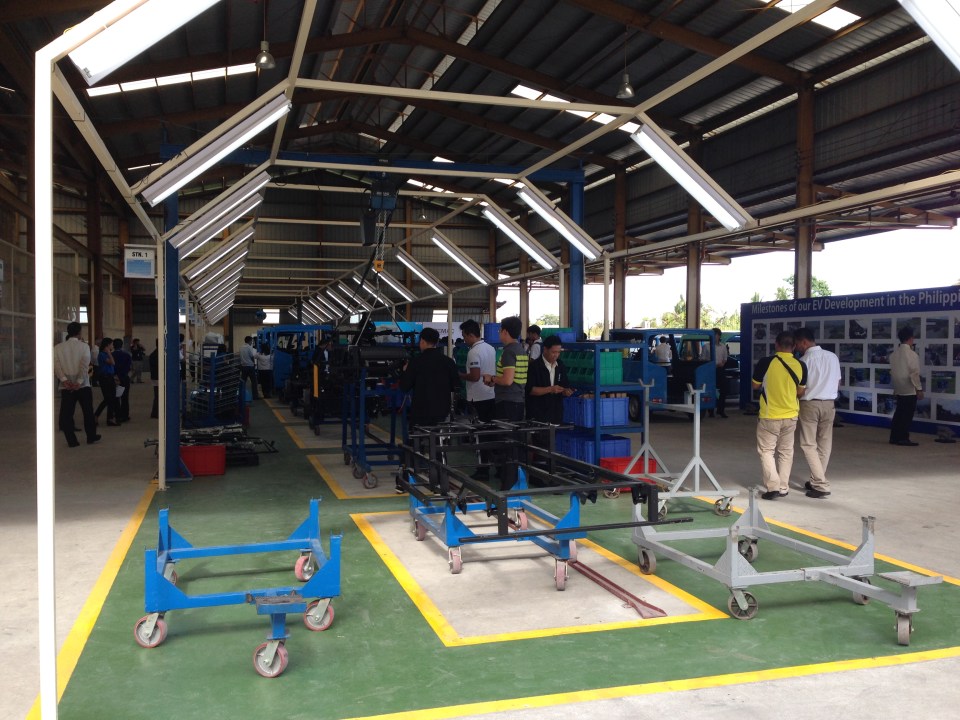 A view of the assembly line from the rear
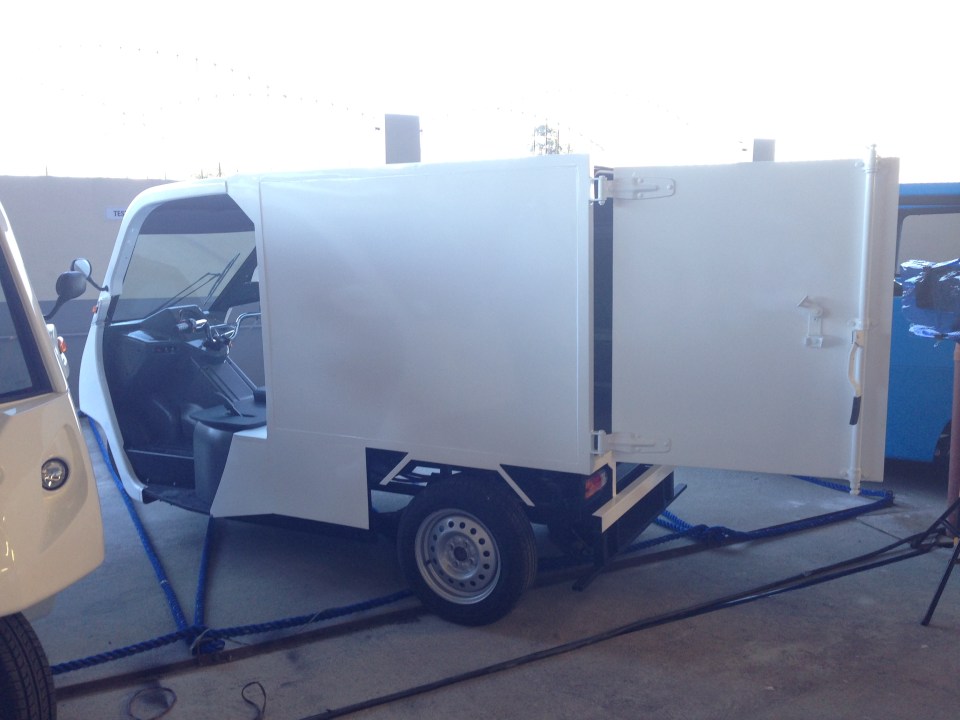 E-vehicle intended for goods transport
 A closer look at the initial stages of assembly showing the e-trike chassis and body frame
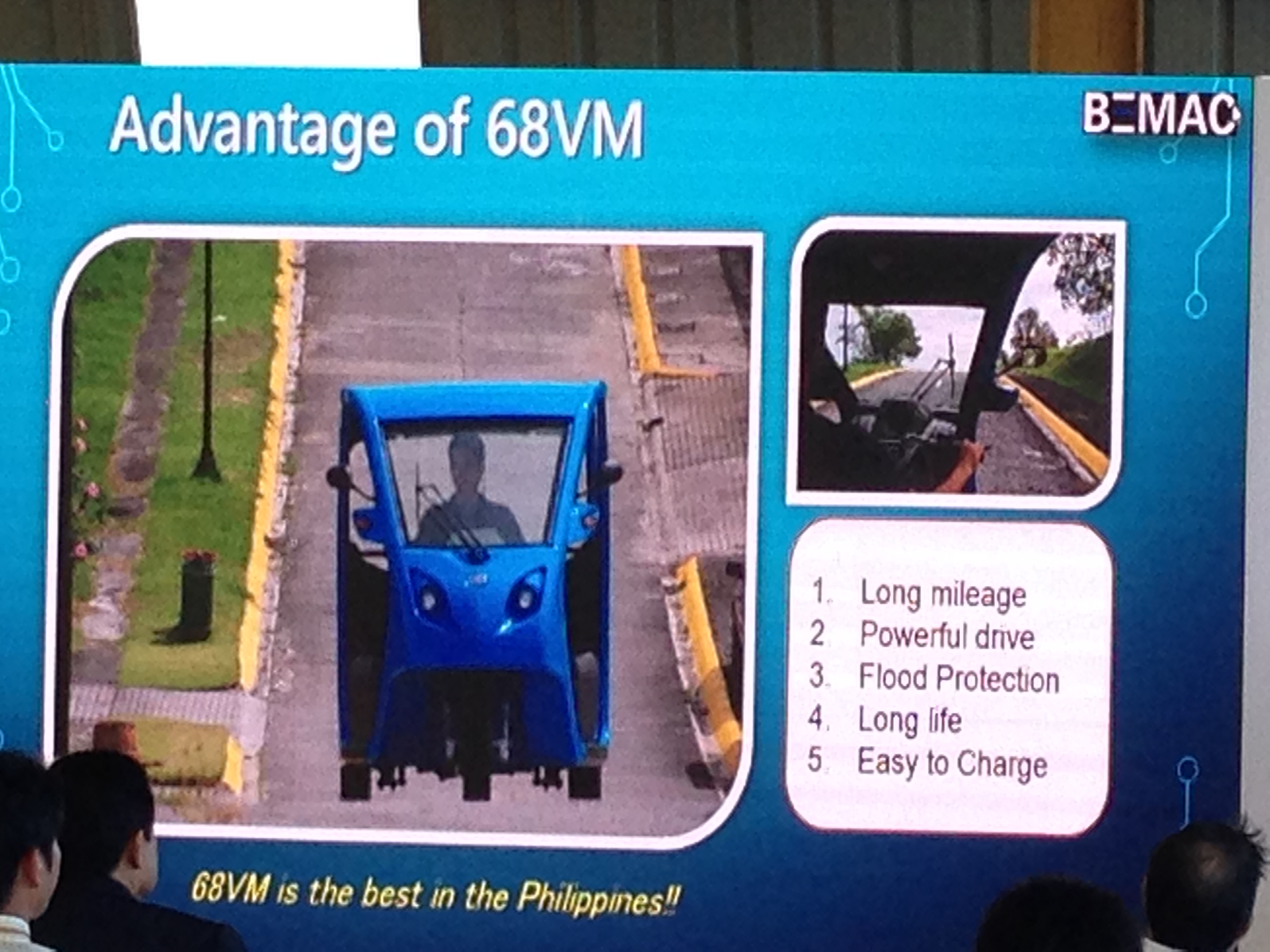 A slide in BEMAC’s presentation shows its 68VM
BEMAC’s e-trike model is the best we’ve seen so far among e-trike models in the Philippines. It is supposed to have been tested under various conditions except actual (or simulated) operations that are closer to real-world conditions (i.e., operation as conventional tricycles in the country). It is claimed to be capable of running at a top speed of 80 kph and its motor can power the vehicle up steep slopes, which is a typical feature in many municipalities and cities in the Philippines. Details for BEMAC Philippines may be found in their website.
There will be an Electric Vehicle Summit on February 26-27, 2015. The 4th Philippine EV Summit will again be held at the Meralco Multi-Purpose Hall in Ortigas, Pasig City. The two-day summit organised by the Electric Vehicle Association of the Philippines (EVAP) in partnership with Meralco and the Partnership for Clean Air (PCA) will feature an exhibit on the current electric vehicle models available in the Philippines, which I think is among if not the main highlight of the summit. There will also be several talks and panel discussions on e-vehicles including those on technology/R&D, industry, incentives and green communities. The program also mentions a lot about sustainable mobility, a term prolifically used by advocacy groups but not really one I’d attribute to e-vehicle proponents (One colleague made the observation before that not everyone is really into e-vehicles because of its environmental aspects.). I’m not sure all the top officials they invited will show up or give good talks. Past summits had good potentials as venues for serious discussions that could have led to fruitful outcomes. However, it seems that they fell short of these objectives and ended up with boring talks that to me often were reduced to lip service from government agencies especially on topics like incentives that will pave the way for the turning point for e-vehicles.
Hopefully, this year’s talks would be more interesting and engaging considering the plenary set-up where people farther from the front tend to have meetings and discussions of their own. E-vehicles have a great potential in improving air quality in a country like the Philippines. There is also the promise of less noise and, more important to many especially operators and drivers, better revenues than translate to increased incomes to those dependent on it for their livelihood. We look forward especially to the transformation of the tricycle sector from the current conventional trikes to the more modern and environment-friendly models such as those by BEMAC.
–
A tale of two consultants
I attended a seminar last November where there were two foreign consultants who gave talks about public transport and the reforms required for Metro Manila. One consultant had extensive experience in public transport, having worked in Hong Kong and Singapore, and is currently a consultant in Jakarta. The other appeared to have the more limited experience but claimed credit (I think partial at best) for public transport reforms in a major Asian city. I was impressed by the first in part because he was very honest with his statements especially as he explained a list of prerequisites for fixing public transport in Metro Manila (and other large cities). The bottomline from his presentation was that it was not possible to have a quick fix and there are no easy paths towards solving public transport problems in Metro Manila and elsewhere in the Philippines.
The second consultant was more on the patronizing side – promising a lot and a little too optimistic to be realistic or practical in his presentation on how to solve Metro Manila’s public transport woes. His material was hodge-podge at best with lots of visuals but not really getting to the point in terms of concrete solutions. It only betrayed his very limited if not unfamiliarity with transport and traffic in the metropolis despite his being a consultant with the office of the highest official of the transport department. There is a saying that if something seems to good to be true, it probably is. I think the same applies to what the second consultant presented to us that morning.
We need more of the first type of consultants who will tell us how it really is with regards to the “challenges” we face in solving transport and traffic problems in this country. The second type just lets us into a false sense of confidence or a feeling that the problems are not so big or complicated and that we are not in a big, deep hole that we need to climb out of. Its one thing to throw caution to the wind and another to have oneself firmly grounded in terms of the understanding of the problem at hand. Understanding the problem is the first step in the formulation of suitable alternatives and allows for the elimination or at least the minimisation of non-practical and non-realistic options.
–
COMET – just another jitney?
The COMET (City Optimized Managed Electric Transport) is a 20-seater vehicle designed along the lines of the jeepneys operating along many streets in Philippine cities and towns. More information on the vehicle, its operations and the organisation behind it may be found in their website. The COMET has been in experimental operation for a few weeks now but has been a rare sighting considering only 20 units are operating along a relatively long route that happens to be have congested sections depending on the time of day (e.g., Katipunan Ave. can be very congested during the day and Congressional Ave. is not necessarily a free flowing corridor given jeepney and tricycle operations along the road).
A good feature of the COMET is the GETPass, which is a card that is used to pay for fares. The card is something that should have been available many years ago and for use in most if not all transport modes (LRT, bus, jeepney, taxi, etc.). At present, it can be reloaded via COMET staff who are assigned to each vehicle or stationed at the designated stops. They help promote the transport as they sell the tap cards to passengers and other potential users of the mode. Here are photos showing the GETPass and the brochure that comes with it.
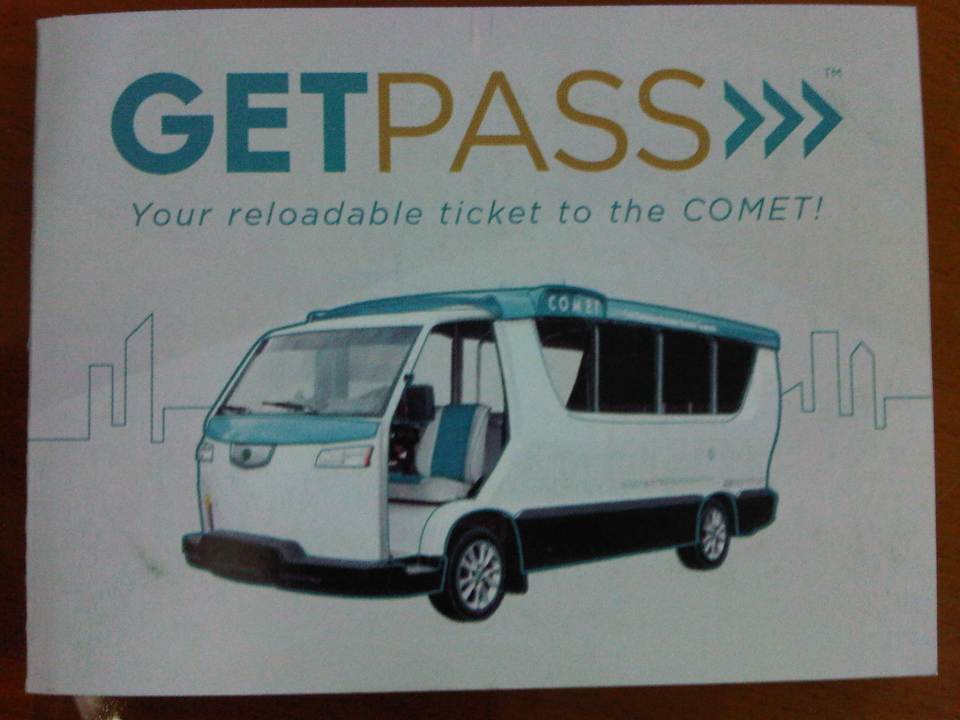 The GETPass card comes with a brochure on the COMET and how to use the card.
 Basic information on the GETPass card.
 Illustrative example of how to use the card.
 The GETPass card
 Instructions at the back of the card.
 More information on Global Electric Transport.
 Southbound designated stops for the COMET.
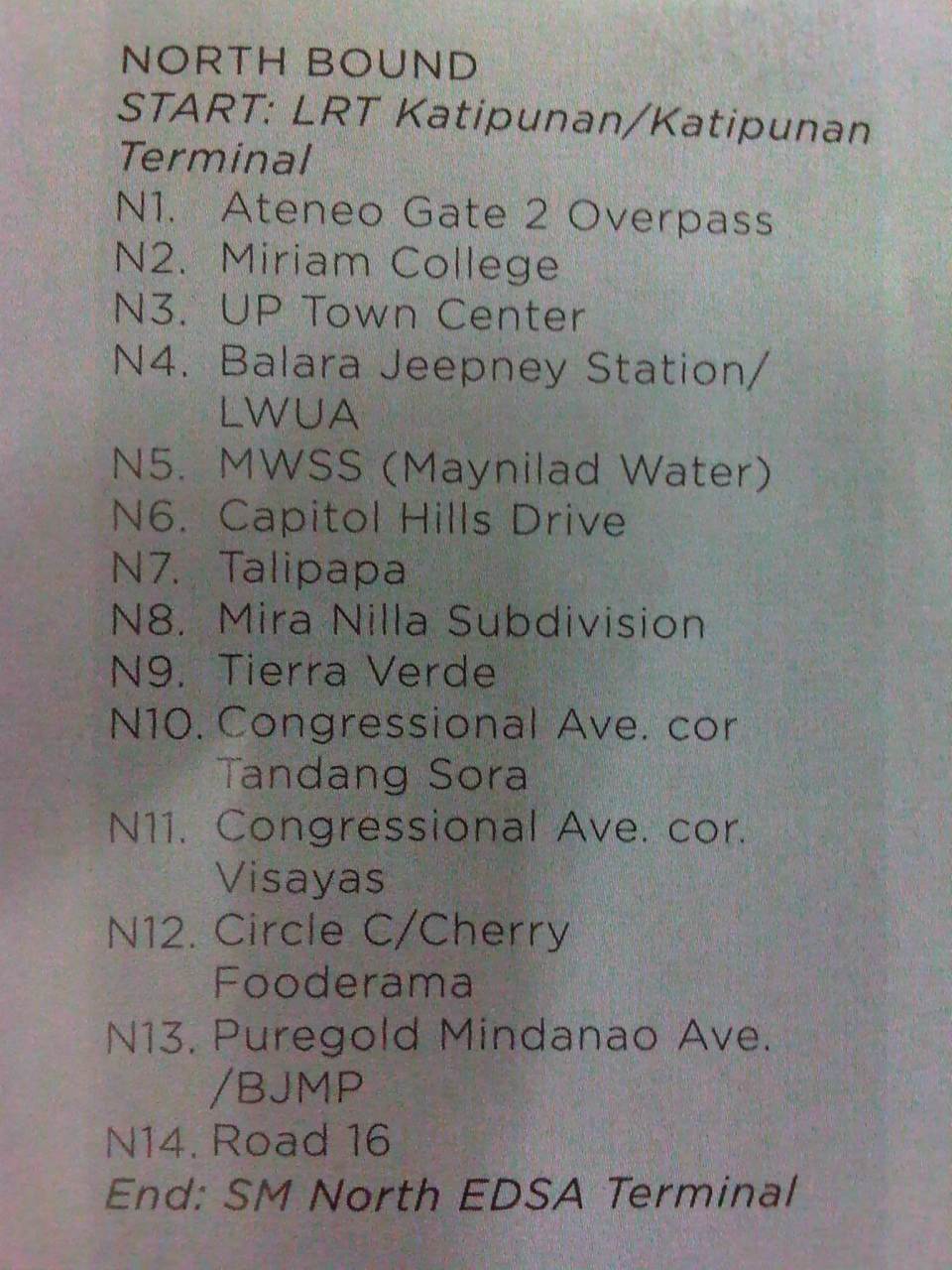 Northbound designated stops for the COMET.
 Route map included with the tap card brochure.
 COMET in operation along the southbound side of Katipunan Avenue (C-5).
The current experimental route of the COMET overlaps with several jeepney routes including Katipunan and Tandang Sora jeepneys. If the objective is simply to demonstrate vehicle performance (and reliability) using this route and with actual traffic conditions, then this would be a very fruitful exercise. However, more suitable routes should be considered for the COMET including possibly new routes like missionary routes or feeder routes that are not yet served by any formal public transport. This is one way for the COMET to be mainstreamed and for the low emission vehicle to have a significant impact on transport and environment. Another way that would certainly be the more challenging one is the prospect of the vehicle replacing conventional jeepneys along established routes. I say this is a challenge because there has been a need to retire or phase out conventional jeepneys in favor of higher capacity modes (i.e., bus) and the jeepney sector (operators and drivers) have always been somewhat averse to proposals modernizing jeepneys due in part to financial implications of transitioning to low emission options like the e-jeepney or the COMET. If these are not considered, the COMET will just be an additional vehicle along Metro Manila’s streets, contributing to the chaotic road public transport, and its hyped benefits will not be realised.
I do hope that the COMET will not be just another paratransit mode that is integrated with all the other land transport modes currently in operation throughout the country. I believe there is a big potential for the vehicle and similar other models like it for cities and towns that are not yet as highly urbanized as Metro Manila or perhaps Cebu. There are corridors or areas where buses are not or will not be viable within the foreseeable future (next 5 to 10 years?) given the demand for this period. These are where jeepneys thrive (assuming tricycle operations are restricted or strictly regulated) and where the COMET would be most suitable.
–
Streets of Malabon
I happened to be in Malabon one weekend for a get-together with the wife’s relatives who lived in the area. Malabon is an old town that is often mentioned in history books (i.e., during the Spanish period). Though the name of the town is said to have been derived from the term “ma-labong,” which is short for “maraming labong” or plenty of bamboo shoots, it is likely, too, the place was named after San Francisco de Malabon. Here are a few photos we managed to take as we drove along Malabon’s streets. I was not familiar with the area but Waze and Google maps provided ample information for us to navigate our way around.
 Gen. Luna Street in the Malabon city proper is a one way street. Other streets in the CBD have also been designated as one-way streets as all (and not just a few or most) roads are narrow.
 Non-motorized transport are popular in Malabon and you will see a lot of bicycles and pedicabs along the streets. These are usually in mixed traffic and seem to blend quite well with motorized vehicles. This seems to be a good example of practicable road sharing.
 While the streets are designated one-way for motor vehicles, bicycles and pedicabs generally travel counterflow and oblivious to the risks of doing so. Still, motorists seem to be okay with this and traffic enforcers do not mind the practice.
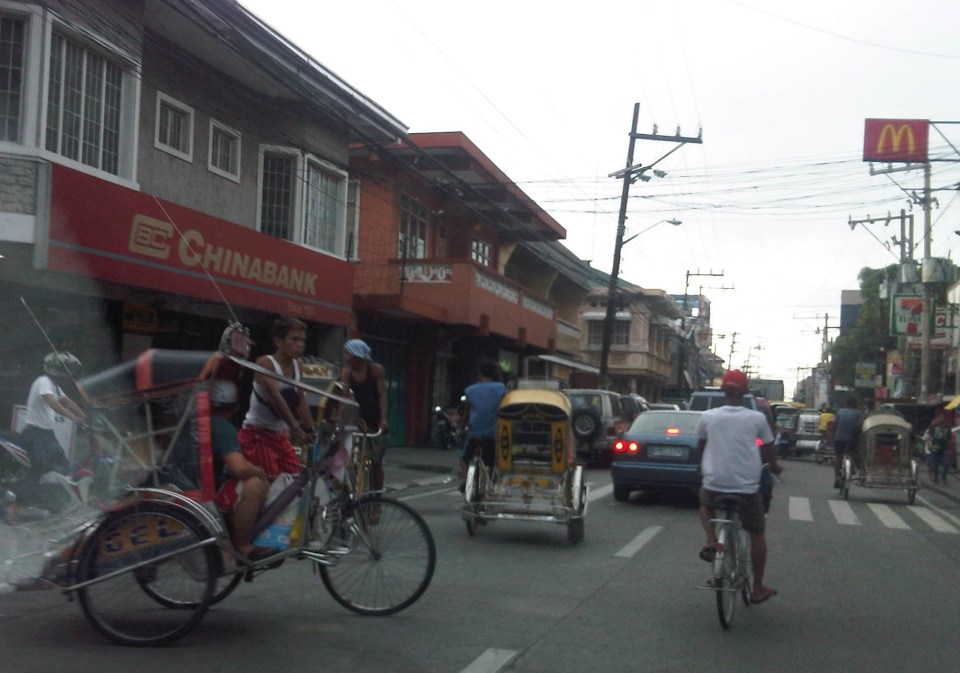 There are many people using bicycles and pedicabs in Malabon. Noticeable are the unique designs of sidecars as the bicycles used in the trikes are taller than the usual bikes elsewhere.
 One of the narrow side streets in Malabon. I think these should only be used for walking or cycling and motor vehicles (including motorcycles) should not be allowed to use these. Malabon can be developed as a walkable city and since it has narrow streets, traffic circulation needs take into consideration how to effectively use one way scheme or combinations in the network.
Malabon is a flood-prone area. Combined with its narrow streets, the area needs an all weather transport system. Non-motorized transport like bicycles and pedicabs can provide this as well as buses perhaps, though the narrow streets and tight turns at intersections can definitely be tricky for large vehicles. It would be interesting how the city will continue to develop considering the constraints. The town proper itself is challenged in terms of the area available for development and perennial flooding will always be an issue that will be quite difficult to overcome. Still, the city and its citizens persist and have been able to overcome these challenges. It can only be hoped that the city will continue to thrive amidst the challenges.
–
Habal-habal in Metro Manila?
Habal-habal is the term used for motorcycle taxis that proliferate in many rural areas but are steadily making their presence felt in urbanised areas as well. In Metro Manila, there are already some reports and spottings of habal-habal operations at Bonifacio Global City and in the White Plains area in Quezon City. I’m sure there are other areas where these informal services are being offered and the easiest way to spot these are by way of observing if there are motorcycle riders waiting in an area with extra helmets. The usual excuse if they are accosted is that they are just going to fetch someone (perhaps a relative or a friend) so they bring along that extra helmet for that person. When they do engage a passenger, I would like to think that they just ask the passenger to play along with them should they be apprehended and asked about their business.
Checkpoints around Metro Manila and many other cities and towns routinely stop motorcyclists to check on their registrations (i.e., there are many unregistered motorcycles around the country) and to pre-empt crime involving those “riding in tandem.” Motorcyclists with more than one passenger are risky and have a higher likelihood for severe crashes. The provision of services in exchange for monetary compensation (i.e., payment) puts these informal transport under the category of colorum services. These are not covered by insurance as required for formal public transport and so there are issues of liability should there be a crash involving these vehicles. No insurance means that passengers cannot claim for anything except compensation they can demand from the service provider (assuming he survives the crash) or the other parties involved (if it can be established that the other party is also at fault). You can always sue people but in this case, the pre-condition is that they shouldn’t have been riding a habal-habal in the first place.
 Alleged habal-habal waiting in front of an establishment along Katipunan Road. These typically cater to employees of establishments or staffs of households in the exclusive villages along this road, which has no formal public transport service due mainly to its being a private road that happens to tolerate through traffic. You can find other motorcycle riders offering such services at the corner of Katipunan with Boni Serrano Avenue.
–
Green light for the Cebu BRT
The NEDA Board chaired by the Philippines’ President approved last week a number of major infrastructure projects. One project is particularly important as it seeks to introduce an innovative public transport system in the Philippines. The Cebu Bus Rapid Transit (BRT) project was finally given the green light and is projected to be completed and operational by 2017. I remember that the Cebu BRT was conceptualised while we were doing a social marketing project for Environmentally Sustainable Transport (EST) that was supported by the UNDP. That was back in 2006-2007 and right before we embarked on the formulation of a national EST strategy that was supported by UNCRD. I remember, too, that sometime in 2009, Enrique Penalosa, the former mayor of Bogota, Colombia who has championed the BRT cause visited the Philippines to give some talks in Cebu and Metro Manila about public transport and pursuit of better quality of life through good transport systems. From that time onwards, a lot of work has been put into the studies to support this system including social marketing for stakeholders to understand what such a system will require including its impacts on existing transport modes. It took sometime for this project to be approved but that should no longer be an issue and focus should now be on the detailed design and implementation of the project.
There are many detractors of this BRT project. While I respect the value engineering work that was supposed to have been conducted by NEDA, I would like to speculate that perhaps it was unclear to them how important a functioning, operational BRT in Cebu is as a strategic accomplishment in transport in this country. For most people, the idea of bus transport is what they have seen along EDSA in Metro Manila. The impact on commuting behaviour of a high quality public transport system like a BRT would be very hard to quantify and the criteria and metrics used would be quite tricky considering the strategic and behavioural aspects of the system. Such evaluations can also be tricky depending on who were doing the study in the first place as the outcomes could easily be affected by the biases of those who undertook the evaluation. Thus, it is important that value engineering exercises be done by open-minded, flexible if not disinterested parties to the project of interest.
Many of those who have expressed skepticism about the BRT are likely pining for a rail transit system that was earlier proposed for the city but which has failed to gain the critical support. For one, the LRT that was proposed for Cebu City was simply too expensive and financing would have been difficult for a system that would have been less flexible in operations compared to an at-grade bus system. The numbers supporting the LRT were also in need of much updating as the study on that system was already quite dated and had not considered the major developments in Cebu and its surrounding cities that loosely or informally comprise what people refer to as Metro Cebu. These realities would need a new and more robust study that could surely result in a recommendation for a rail system but upon close comparison with a BRT option should lead to a conclusion that Cebu will be better off with BRT at this point and in the foreseeable future.
The truth is that while rail transport remains as an ultimate goal for high demand corridors in highly urbanised cities, it is an expensive proposition and ones that will take more time to build. We don’t have that time in our hands as our cities are rapidly growing both in terms of economy and population. We cannot sustain this progress if our transport system remains primitive. And strategically, too, a BRT system may just pave the way for a future rail system in Cebu. This model for transport system development can be replicated in other cities as well including Davao, Iloilo, Bacolod, and Cagayan de Oro, to name a few. But we should always not forget that building this system requires holistic development of complementing infrastructure such as pedestrian walkways and bikeways, and the rationalisation of jeepney and multi cab services with respect to the mass transit system. I believe those behind the Cebu BRT project have these covered and it is now a matter of time before the country’s first BRT becomes operational in the “Queen City of the South.”
–
Future fare collection for jeepneys and other modes?
In the last Electric Vehicle Summit held in late February this year, I noticed a conspicuous device installed in the electric jeepney unit that was on display at the venue. The device is for electronic payment of fares; using a card much like the ones being used in other countries like Singapore and Japan, and soon, hopefully, for the LRT and MRT in Metro Manila. Such a capability has a lot of potential including a very convenient way to pay fares for public transport in Metro Manila. Other potential uses would be for payments of items bought at stores or shops (or vending machines) like Japan’s Suica card. Users would just have to “top up” or load their cards for these to be used in their commutes or purchases.
 The latest e-jeepney model features a side door instead of one at the rear.
 Boarding passengers will encounter device upon entering the vehicle. The current technology available should soon enable passengers to use “tap” cards to pay for their fares.
 Such a device will leas to a more efficient fare collection and eliminate the need for “conductors” or persons assisting the driver in taking passengers’ fares. These should also allow the driver to focus on driving rather than be distracted by fare collection including trying to keep track of who has paid and who has change due. This would likely translate into safer travel for most people.
 Electronic boards at the top behind the driver can provide travel information such as the next stop or traffic conditions along the transit route. Such information can be derived from various sources including the MMDA or local governments as well as from crowd-sourcing.
–
 Caught (up) in traffic