
Home » Traffic Congestion (Page 20)
Category Archives: Traffic Congestion
Road and drainage improvements along Marcos Highway
People driving or commuting from the eastern part of Metro Manila and the towns of Rizal Province have been experiencing traffic congestion for quite some time now due to the civil works associated with the improvement of Marcos Highway. The project is part of the Metro Manila Urban Transportation Integration Project (MMURTRIP) that finally pushed through after failed bids that caused significant delay to its implementation. The major components of the project include road widening and pavement rehabilitation, and the improvement of drainage along the highway. The latter component is quite important as the drainage system is supposed to contribute to the alleviation of flooding in areas along the highway. Who knows if the system could have prevented or at least mitigated the floods brought about by Ketsana (Ondoy) in 2009 if the project had been implemented according to its original schedule?
The photos below were taken during a regular commute along the highway and shows civil works in various stages of completion.
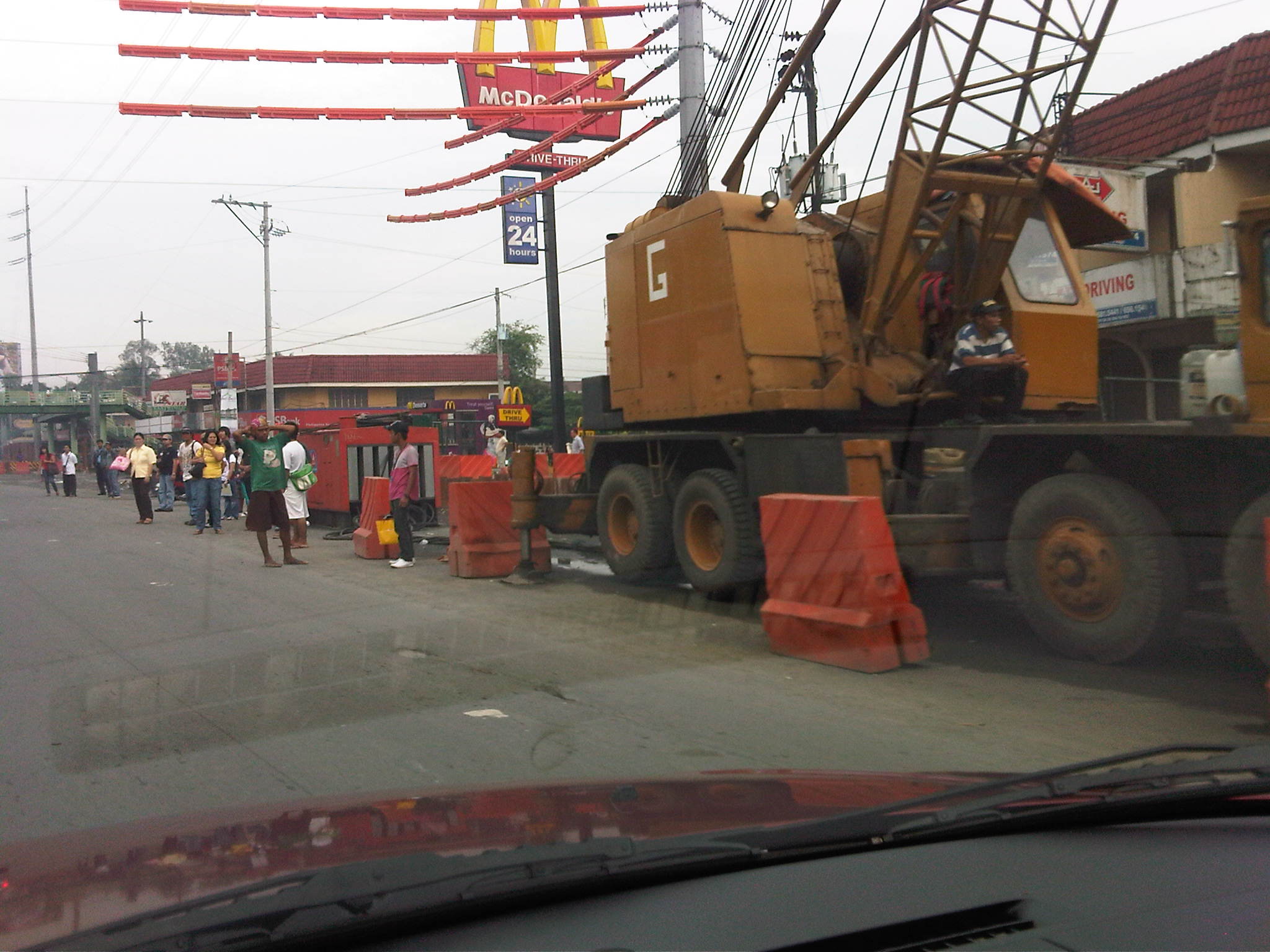 Crane deployed along westbound lane of Marcos Highway – Note the barriers and other equipment that effectively occupy about 2 lanes of the highway and the passengers waiting along the highway.
 Partly completed works along Marcos Highway westbound just after the junction with Felix Ave./A. Tuazon Ave. and across from Sta. Lucia Grand Mall
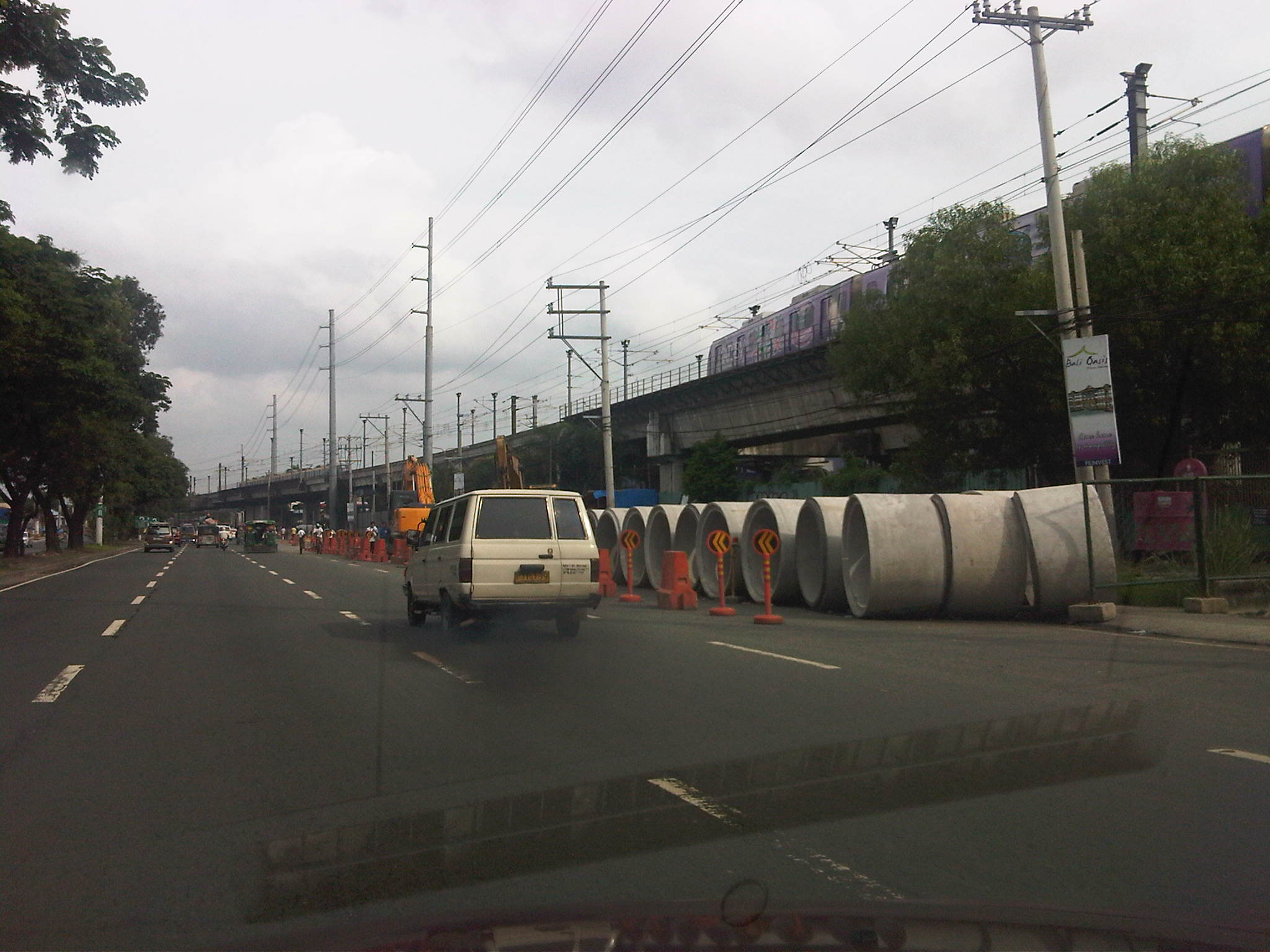 Civil works along Marcos Highway eastbound in front of the LRT2 Depot in Santolan
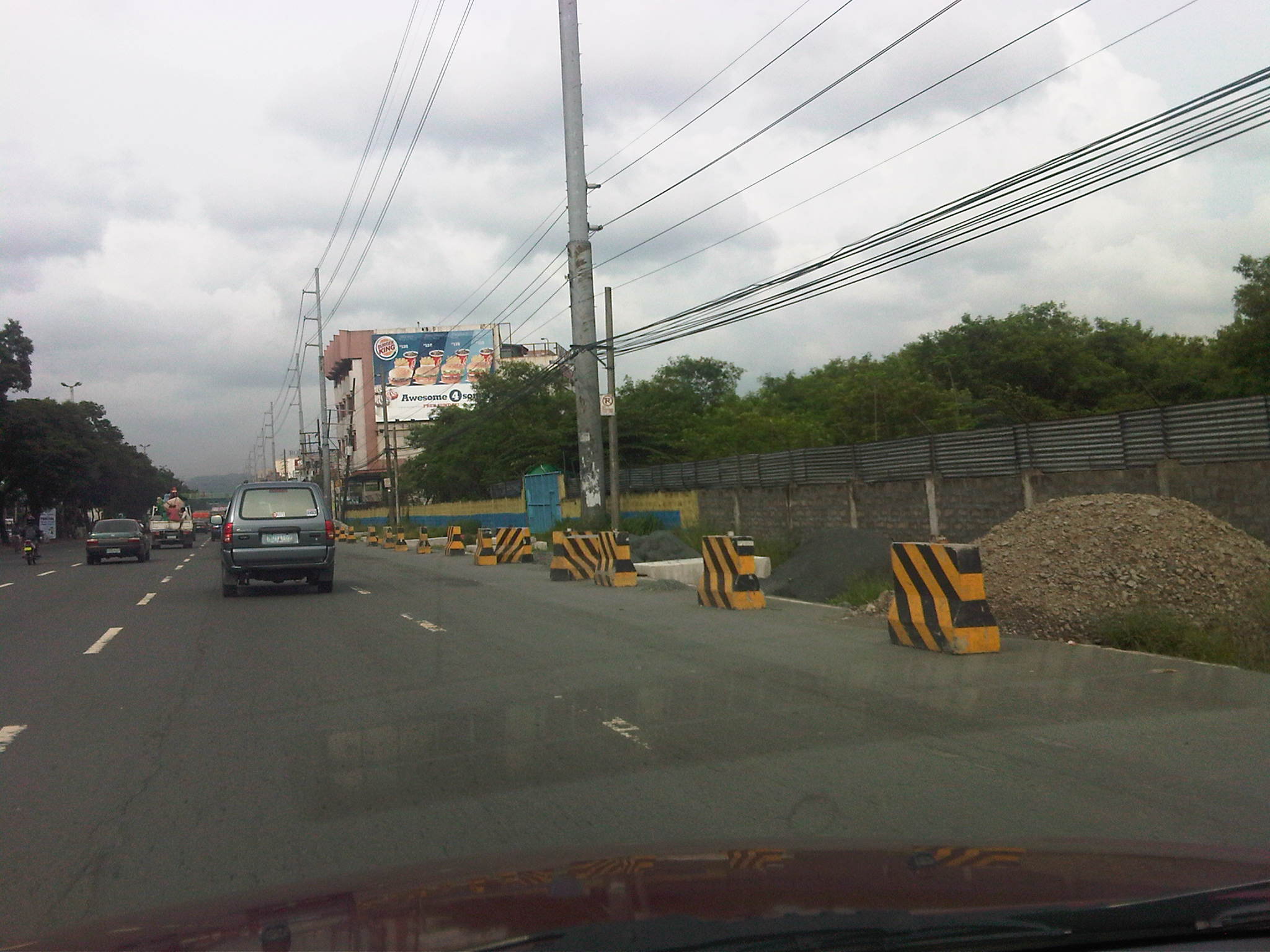 Partially completed works along Marcos Highway eastbound just after junction with A. Rodriguez Ave. (Ligaya)
 Project equipment and materials and informal barracks along Marcos Highway eastbound near the Barrio Fiesta/Slimmer’s World
 Excavations along Marcos Highway eastbound
Due perhaps to the magnitude of the project, traffic congestion along many if not most sections of the highway have been inevitable though prolonged. But partly responsible for the congestion is the Manila Water concessionaire that also did their own civil works at the same time as the DPWH project. As such, the capacity of the highway was significantly reduced with the outer lanes affected by the DPWH project and the inner lanes impacted by Manila Water works.
We should be hopeful though that once the project is completed, traffic flow will greatly improve and flooding may be alleviated along the highway and its catchment area. Works seems to be continuing although there seems to be less people working on the project these days compared to when the project started. Maybe they are just spread out along the highway? The following photos show examples of progress in the civil works.
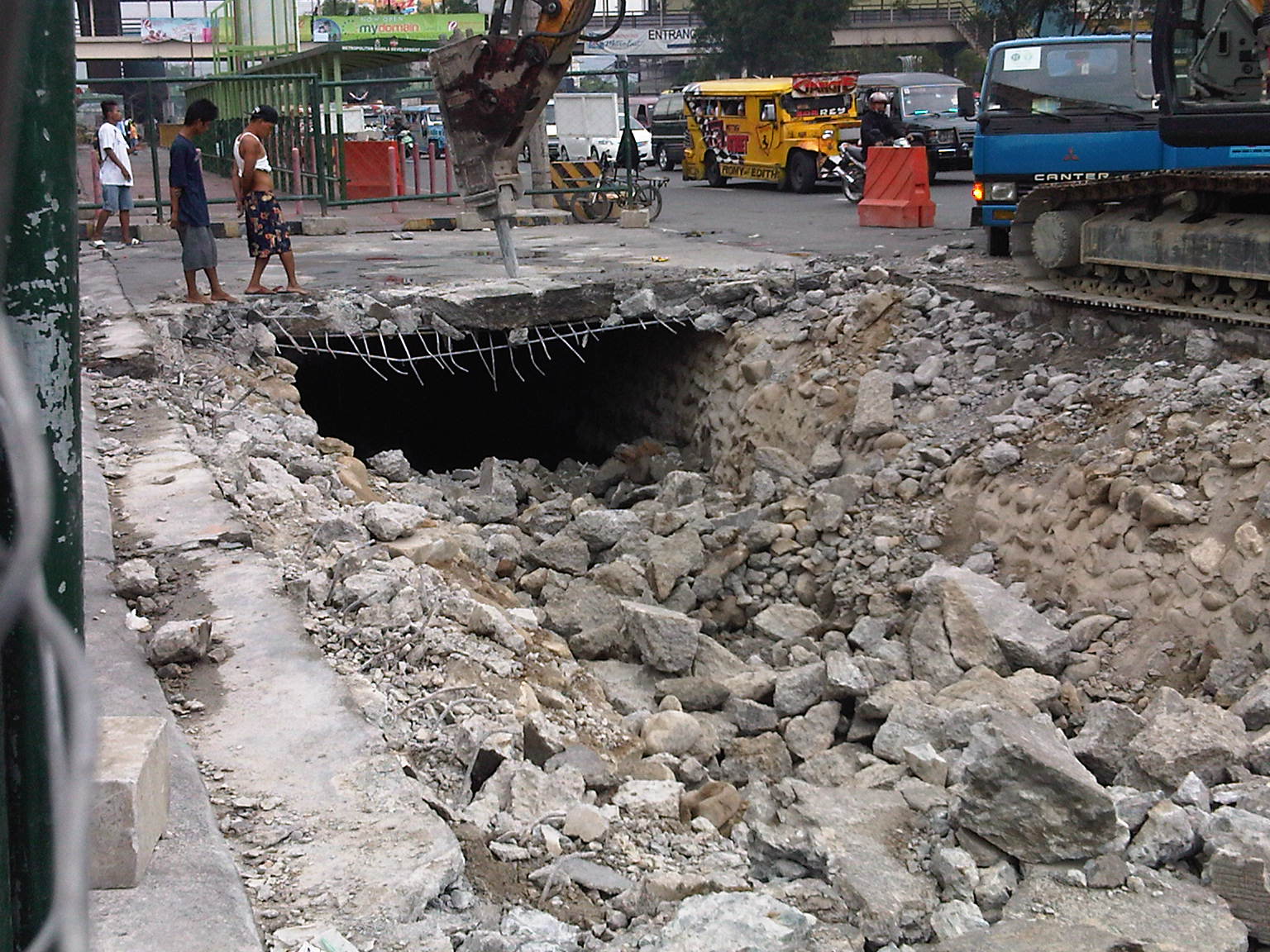 Demolition work of slab covering drainage along Marcos Highway westbound (before)
 Drainage canal covered and pavement engineering works (progress/after)
While it is expected that vehicle flow will be facilitated by the project, it can be said also that this may only encourage more vehicular traffic. As such, perhaps the next project that could be considered for this corridor is the also much-delayed extension of LRT2 towards Masinag.
Still on Katipunan
Katipunan is again the subject of attention thanks to the Sunday newspaper article by Prof. Randy David in his column at the Inquirer. The problem is not really new and I have been familiar with the congestion and its derivatives from the time I first studied in UP Diliman in 1988 and up to now when I continue to pass through the avenue between home and workplace.
I was able to dig up a 2003 study on Katipunan conducted by the National Center for Transportation Studies (NCTS) of UP for a consortium chaired by then DENR Secretary Bebet Gozun. The study was the group’s response to the MMDA’s effort to install their U-turn scheme along Katipunan, encouraged at the time by the scheme’s apparent success along Commonwealth and EDSA while not acknowledging the problems experienced along Quezon Avenue. The photos below were taken during the time when the study was being undertaken and are very much the same picture of Katipunan today during the peak periods.
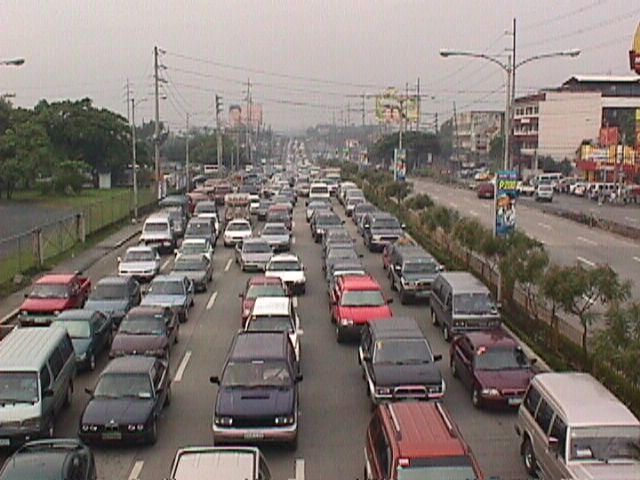 Figure 1: Morning traffic congestion in 2003 along the northbound direction of Katipunan Avenue in front of the Ateneo De Manila University (notice that there was no U-turn slot near Gate 2 at the time)
 Figure 2: Ateneo-bound vehicles blocking through traffic along the service road and the Aurora flyover
The study involved contributions from most if not all stakeholders including Ateneo and Miriam, the private sector and civil society groups, the Transportation Science Society of the Philippines (TSSP), and some government agencies particularly the DENR, who convened the group to formulate an alternative to the MMDA’s initiative that was personally being pushed by its then Chair Bayani Fernando. I reproduce below, word for word, the conclusions and recommendations from that 2003 study:
{Conclusion}
“After a thorough evaluation of the traffic problems along Katipunan as well as the solicited and unsolicited solutions from stakeholders, it becomes clear that the answer to the Katipunan traffic question is not the introduction of the U-turn scheme into the system. Indeed, while the U-turn scheme has met with relative success along major thoroughfares including Marcos Highway and Commonwealth Avenue, it has also contributed if not created congestion along Quezon Avenue. The notion that “success in EDSA and Commonwealth means there is no reason why the scheme won’t work in Katipunan” would not hold water in the light of the requirements for effective implementation of U-turns. Simply said, the traffic volume along Katipunan during the peak periods alone will assure that the U-turn scheme will cause more congestion rather than mitigate it.
{Recommendations}
- Optimization of traffic signals – coordination of signals need to be implemented particularly for the intersection pairs identified in this report. The Traffic Engineering Center (TEC) must be consulted with respect to the operation of the traffic signals along Katipunan.
- Restriction of roadside parking – parking restrictions must be strictly enforced and establishments along Katipunan should adhere to the required parking slots corresponding to the traffic they generate.
- Removal of parts of the islands to improve flow – geometric improvements to ease flow (i.e., increase road capacity) may be explored. Note that this report is not entirely opposed to removal of parts of the islands. However, their outright removal with the trees for the sole purpose of the U-turn scheme is not acceptable to most stakeholders. This must be carefully evaluated.
- Construction of an internal road between Ateneo and Miriam – the internal road will allow common vehicles to circulate within the campuses thereby eliminating traffic that would otherwise make several entries and exits to the campuses via Katipunan.
- Open additional gate at Ateneo – the possibility of opening another gate at Ateneo between the existing Gates 2 and 3 must be explored.
- Encourage carpooling or car-sharing – it is strongly recommended that Ateneo and Miriam consider carpooling or car-sharing schemes. It has been found that traffic along Katipunan is primarily composed of private vehicles will low occupancies bound for the two schools. While the surveys showed high return rates from grade school and high school students, very low returns came from college students. It is these people who account for a majority of the vehicles that clog Katipunan and they should take part in the formulation and implementation of such schemes that would lead to a significant improvement to traffic along Katipunan.
- Strict implementation of the zoning laws – this last recommendation points to the inconsistency in the granting of building permits to developers of high-rise condominiums along Katipunan. This is a constant issue and a controversial one since residents in the area and the two major schools (Ateneo and Miriam) have always opposed the “spot zoning” practice along Katipunan.” (NCTS, Study on the Traffic Management of Katipunan Avenue, 2003)
The study recommended alternative solutions in lieu of the U-turn scheme for Katipunan Avenue that was at the time being pushed by the MMDA as the solution for traffic congestion in the area. The recommended measures considered different aspects: traffic management per se, geometric improvements or road construction, travel demand management, land use, and other measures. However, it seems that 8 years after there has been practically no change in conditions along Katipunan Avenue.
The support and commitments of the different stakeholders (academic institutions, residents, business establishments, professional organizations, government agencies, and concerned citizens) are essential for the successful implementation of the recommendations contained herein. It is only through a strong partnership that sustainable and long-term solutions to the traffic problems in Katipunan Avenue can be achieved.
However, it is realized that there should be some sacrifices involved including a dramatic or drastic change in the travel behavior of those mainly responsible for the congestion. The vehicle trip generation of both Ateneo and Miriam are the roots of the problem and their continuing resistance to proposed solutions while not offering any viable countermeasures or proposals will only serve to perpetuate congestion in the area even as the external costs associated with the traffic they generate spread to a larger area. Recent studies at the UP Diliman, which is an open campus, has shown that private vehicle through traffic (i.e., traffic that has nothing to do with UP) has also grown and most of these are Ateneo and Miriam-bound trips.
It seems awkward and even confusing to see that 8 years after what was perhaps the last (maybe even the first?) serious look into Katipunan traffic, conditions have only worsened. This is due to additional developments in the area including high density residential projects that also tend to generate a lot of traffic, and commercial establishments that do not provide sufficient parking spaces. But although these contribute to congestion, their vehicle generation pale in comparison to that of the schools in the area. This is perhaps a case where one is able to see the flaws of others and yet refuses to look in the mirror to see for oneself something that needs critical attention.
School traffic generation – Part 1
One thing I will miss about summers is the relatively light traffic along Katipunan Avenue, which is where I pass through almost everyday between my home and workplace. There is still some congestion during the mid-day and the afternoons but these are typically due to truck traffic as Circumferential Road 5 (C5) is a truck route. During the rest of the year, however, with the exception of most weekends and holidays, severe congestion is experienced along Katipunan during the peak periods, particularly in the mornings between 6:30 AM and 7:30 AM. This is due primarily to the traffic generated by schools along Katipunan Avenue, most notably the Ateneo De Manila University and Miriam College. The following photos show typical traffic conditions along C5 during the peak periods.
 Slow-moving vehicles along the northbound side of Katipunan Avenue
 Congestion along the northbound direction of Katipunan atop the Aurora Blvd. overpass
 Congestion along the Katipunan southbound service road leading to the U-turn slot underneath the Aurora Blvd. overpass
Traffic along the southbound service road leads to a U-turn slot under the overpass where many vehicles turn, heading in the general direction of Ateneo. Most turn here in order to enter the university via its Gate 1, which is the main access to the Grade School. On most times, congestion is caused by these vehicles turning right at Gate 1 as they effectively occupy the two lanes of the northbound service road and block all other traffic. This is shown in the following photo where it is clear that vehicles bound for Ateneo and turning at Gate 1 are the main cause of congestion. Beyond Gate 1, the traffic lanes are practically free of congestion.
 Vehicles turning right to Ateneo’s Gate 1 blocking traffic along the Katipunan northbound service road
The afternoon peak is exacerbated by traffic generated by these schools that lead to longer periods of congestion as the number of private vehicle traffic dramatically increases when there are classes between June and April. Meanwhile, there is a noticeable decrease in traffic during the weekends and holidays. Such phenomenon is mostly attributable to the trip generation characteristics of schools, and especially those that tend towards the generation of much private vehicles. Ateneo and Miriam along Katipunan are just two examples. The traffic they generate and the consequential congestion is replicated in other places as well, giving headaches to motorists and commuters passing along major roads affected by these schools. Ortigas Avenue, for example, is usually congested during the weekdays because of traffic generated by LaSalle Greenhills, and ADB Avenue at the Ortigas Center is usually congested due to traffic attributed to Poveda.
Traffic congestion in Metro Manila: Is the UVVRP still effective? – Part 2
In the past decade, there has been a sharp rise in the motorcycle ownership around the country and especially in Metro Manila. From about 1 million motorcycles registered in 2000, the number has increased to 3.2 million in 2009, a 320% increase over a period of 10 years. Motorcycles have become associated with mobility, in this case the motorized kind, and have become the mode of choice for many who choose to have their own vehicles but cannot afford a four-wheeler. These people also choose not to take public transport for a variety of reasons but mainly as they perceive their mobility to be limited should they use public transport services that are available to them. This rise of the motorcycle is also a response to the restrictions brought about by UVVRP with the scheme not covering motorcycles. In fact, should motorcycles be included in the UVVRP, it would be a nightmare for traffic enforcers to apprehend riders considering how they maneuver in traffic. Add to this the perception and attitude of riders that motorcycles are practically exempt from traffic rules and regulations (and traffic schemes!). One only needs to observe their behavior to validate the argument.
To understand UVVRP, it must also be assessed in the context of its original implementation when Metro Manila had to contend with congestion due to infrastructure projects being constructed everywhere during the 1990’s. EDSA MRT was being constructed, interchanges were also being put up, and a number of bridges were being widened to accommodate the increasing travel demand. Road widening projects generally benefit private vehicle users more than public transport users. In the case of Metro Manila, many areas are already built-up and acquisition of right of way for widening is quite difficult for existing roads. As such, it is very difficult to increase road capacities to accommodate the steady increase in the number of vehicles.
In transportation engineering, when traffic/transport systems management (TEM) techniques are no longer effective or yield marginal improvements we turn to travel demand management (TDM) schemes to alleviate congestion. In the former, we try to address congestion by tweaking the system (i.e., infrastructure) through road widening, adjustment of traffic signal settings, etc. while in the latter, we go to the root of the problem and try to manage the trips emanating from the trip generation characteristics of various land uses interacting with each other. By addressing the trip generation characteristics through restrictions, we influence travel demand and hopefully lessen traffic during the peak periods while distributing these to others.
This is the essence of UVVRP where the coding scheme targets particular groups of private cars (according to the end number on the license plate) each weekday. Meanwhile, the scheme is not implemented during weekends due to the perception that, perhaps, travel demand is less or more spread out during Saturdays and Sundays. However, there is a problem with this approach as the traffic taken away from the peak hours are transferred to other times of the day, thereby causing in some cases the extension of what was originally a peak hour unto a longer period. What was before a morning peak of say 7:30 – 8:30 AM becomes spread out into a peak period of 7:00 – 9:00 AM. The problem here is when you have major traffic generators like central business districts (e.g., Makati and Ortigas) where congestion is experience for more than 2 hours (e.g., 7:00 – 10:00 AM or 4:00 – 7:00 PM).
The UVVRP is not implemented in all of Metro Manila. Several LGUs, particularly those in the outer areas like Marikina City and Pateros. This is simply due to the information and observations of these cities that their roads are not affected by the build-up of traffic since most traffic is bound for the CBDs located in Makati, Pasig, Mandaluyong, Quezon City and Manila. This is the case also for LGUs in the periphery of Metro Manila like the towns in the province of Rizal, which is to the east of the metropolis, where the typical behavior of traffic is outbound in the morning and inbound in the afternoon. The great disparity between inbound and outbound traffic is evident in the traffic along Ortigas Avenue where authorities have even implemented a counterflow scheme to increase westbound road capacity.
There have also been observations of traffic easing up during the mid-day. As such, the MMDA introduced a window from 10:00 AM to 3:00 PM to allow all vehicles to travel during that period while retaining the restrictions of the number coding scheme from 7:00 – 10:00 AM and 3:00 – 7:00 PM. However, while many LGUs applied the window, some and particularly those found in central part of the Metropolis like Makati, retained the 7:00 AM – 7:00 PM ban. This stems from their perspective that traffic does not ease up at all (e.g., try driving along Gil Puyat Ave. during lunchtime) along their streets during the window period.
Nowadays, there seems to be the general perception that one can no longer distinguish between traffic during the coding period and the window. Traffic congestion is everywhere and there are few opportunities for road widening. Traffic signal control adjustments are limited to those intersections where signals have been retained (mostly in Makati) since the MMDA replaced signalized intersections with U-turn slots during a past administration where the U-turn was hailed as the solution to the traffic mess.
Traffic congestion in Metro Manila: Is the UVVRP still effective? – Part 1
I was interviewed last week about the traffic congestion generally experienced along major roads in Metro Manila. I was asked whether I thought the Unified Vehicular Volume Reduction Program (UVVRP) more popularly known as the number coding scheme was still effective, and I replied that based on what we are experiencing it is obviously not effective anymore. The reasoning here can be traced from the fact that when the scheme was first formulated and implemented, the main assumption was that if the number of license plates on registered vehicles were equally distributed among the 10 digits (1 to 0), then by restricting 2 digits indicated as the end/last number on a plate we could automatically have a 20% reduction in the number vehicles. This rather simplistic assumption was sound at the time but apparently did not take into consideration that eventually, people owning vehicles will be able to adjust to the scheme one way or another.
One way to adjust when the number coding scheme was implemented was to change traveling times. Everyone knew that the scheme was enforced from 7:00 AM to 7:00 PM (i.e., there was no 10:00 AM to 3:00 PM window at the time) and so people only had to travel from the origins to their destinations before 7:00 AM. Similarly, they would travel back after 7:00 PM, which partly explains why after 7:00 PM there is usually traffic congestion due to “coding” vehicles coming out to travel. In effect, the “coding” vehicle is not absent from the streets that day. Instead, it is only used during the time outside of the “coding” or restricted period.
Another way that was actually a desired impact of the coding scheme was for people to shift to public transport, at least for the day when their vehicle was “coding.” That way, the vehicle is left at home and there is one less vehicle for every person who opted to take public transport. This, however, was not to be and people did not shift to public transport. Perhaps the quality of services available or provided to them were just not acceptable to most people and so they didn’t take public transport and a significant number instead opted for a third way.
That third way to adjust was one that was the least desirable of the consequences of number coding – people who could afford it bought another vehicle. This was actually a result that could have been expected or foreseen given the trends and direct relationship between increases in income associated with economic growth where people would eventually be able to afford to buy a vehicle. Actually, there is no problem with owning a car. The concern is when one uses it and when he opts to travel. Of course, this does not necessarily mean that people started buying new cars outright, making this something like an overnight phenomenon. It happened over several years and involved a cycle that starts when the wealthier people decide to purchase a new vehicle and discards their old ones. These used vehicles become available on the “second hand” market and are purchased by those with smaller budgets. Some of these may have even older vehicles that they will in turn discard, and eventually be owned by other people with even less budget. Note that in this cycle, very few vehicles are actually retired, if at all considering this country has no retirement policy for old vehicles. The end result? More cars on the roads and consequently, more severe and more frequent congestion.
Below is an excerpt from the news report on News TV Channel 11:
Valentine’s traffic
Valentine’s Day or, to be exact, Valentine’s night is perhaps among the busiest in terms of traffic in many cities. Traffic is often comparable to that experienced during the Christmas season. This is attributed to an increase in the activities during this day that generally includes dating. Malls and restaurants are usually full of couples or families celebrating the day of hearts regardless of whether it is a weekday such as the case this year when Valentine’s is on a Monday.
Parks and other recreational places are also full of people who celebrate love by being with their dear ones. There are also concerts scheduled today and the days preceding and succeeding the 14th. Still popular among Filipinos are aging artists who can still belt out favorite songs from yesteryears including the haunting “Foolish Heart” and “Beauty and Madness.” Other artists have already performed ahead of the 14th since the preceding days happened to be during the weekends.
The congregation of people at the malls, restaurants, recreational areas and concert venues often results in traffic congestion in the vicinity of these facilities. I won’t even mention another place where traffic typically peaks this time of year. Parking may also be difficult due to the traffic generating nature of Valentine’s Day. Getting a taxi ride may also be challenging though trying to get a jeepney or bus ride may not necessarily be more difficult than on a regular Monday. Taking a taxi after having dinner on this day is considered a special trip and taxi are popular since they are a substitute to a private car.
I know this and other such variations in traffic during the year and it helps a lot when planning routes considering that one needs to avoid roads that are typically congested. This is the sort of information that needs to be provided for travelers in order to reduce congestion along roads that would otherwise be avoided for their association with traffic generators.
Ortigas traffic
Ortigas Avenue traffic is very familiar to me. For one, I have used the road since childhood because it was the most direct route to and from school. We lived in Cainta and I went to school for 11 years in Mandaluyong. Before that, I even have memories of the section of Ortigas Avenue where Valle Verde phases are now located being carved quite literally from the adobe mountain that it was back in the mid 1970’s. Ortigas was the only access for those living in the east, particularly the Antipolo-Cainta-Taytay-Binangonan-Angono towsn of Rizal Province, for quite some time. Marcos Highway was still a dirt road and Marikina and Cogeo were somewhat out of the way. Meanwhile, Ortigas was already an important corridor as it led to Antipolo, an important religious and popular recreational site.
As the populations of the Rizal towns I mentioned increased, mostly due to their proximity to Metro Manila and being popular for residential developments then as now, Ortigas became congested. The avenue itself was widened but as any traffic engineering textbook will tell us, the bottlenecks were really the bridges. And I also remember the Rosario Bridge across the Pasig River being widened twice, both before the Manggahan Floodway was constructed. I experienced the impacts of both widening endeavors and did not enjoy having to wake up earlier than when I usually did because of the horrific traffic. It was worse, I guess, when the Manggahan Floodway was being constructed and there were too few options as to alternative routes. In fact, there were too few bridges across the floodway and Pasig River.
Nowadays, traffic congestion along Ortigas Avenue seem much worse than before. This I get from my siblings who still use the corridor as part of their routes to their workplaces. I trust in their assessment considering that my brother went to the same Mandaluyong school I attended and my sister attended another exclusive school in Pasig. My sister’s husband attests to the worsening traffic as he’s also lived at a residential area along Ortigas. From firsthand observation, I can also validate that Ortigas is worse these days than say 10 and 20 years ago.
The counterflow scheme along Ortigas is not new. In fact, my father and our school service drivers knew about this and would often time their trips to coincide with the scheme so that they can drive almost continuously to their destinations in the morning. Back then, I remember that the counterflow scheme was in effect for 10 to 15 minutes at the 0630, 0700, 0730 and 0800 times. It was also actually a regulated one-way scheme and was called thus since it benefited vehicles traveling along the outbound (from Rizal) direction. Inbound traffic were stopped at strategic points along the avenue including Rosario Bridge.
Such schemes are possible only when there is a dominant direction during the peak hours. In the case of Ortigas the directional distribution before was practically 90% outbound in the morning peak. A one-way, counterflow scheme was possible and practical for an undivided road. There were no medians or island to prevent vehicles from moving over to the opposing lane and back. That was then and at a time when I suppose that there were less friction along the avenue. Road friction, particularly those caused by public utility vehicles stopping for passengers, is more serious these days as the number of PUVs have also dramatically increased to address the demand for travel. Only now, there seem to be more informal terminals and longer dwell times at strategic points along Ortigas. These cause the bottlenecks that are also complicated by Ortigas now having median barriers along its length.
I believe congestion can be significantly alleviated by developing and implementing a simple dispatching system for PUVs along strategic points like the designated loading and unloading zones at either ends of the Manggahan and Rosario bridges. The dispatching system should be implemented along with a strict enforcement regime to ensure quick boarding and alighting times and prohibiting PUVs from spilling over and occupying other lanes, that often results in blockage of general traffic. Perhaps, a counter-flow scheme may be re-evaluated and become unnecessary. This recommendation comes in the heels of a survey we conducted along Ortigas only yesterday, February 10 in Manila, where I personally experienced PUVs making a terminal out of the outbound lanes before the Manggahan bridge and effectively blocking outbound traffic along the avenue. I can imagine the frustration of those caught in traffic along Ortigas and its implications along the extension and the Imelda and Bonifacio Avenues from Cainta Junction. The result of that blockage and the implementation of a counterflow around 0715 is shown in the following two photos I took.
 Figure A: Image downstream along Ortigas Avenue (to Rosario Bridge and C5)
 Figure B: Image upstream along Ortigas Avenue (from Cainta Junction)
It is clear from the photos that private vehicles were the ones who benefited from the counterflow. However, it is interesting to see that the outbound lanes were practically empty especially along the Manggahan Bridge. This clearly shows that there is actually enough road capacity but that it is not utilized (and counterflows were required) because of the blockage caused by PUVs upstream of our position. This is another strong case for going back to the basics in as far as traffic engineering and management is concerned. It does not take a PhD degree to see what’s wrong in the photos and certainly an advanced degree is not required for a solution to the problem.
Discipline along a killer highway
Commonwealth Avenue in Quezon City was given a tag as a killer highway due to the frequent occurrence of road crashes along the road, many of them resulting in fatalities. Only last December, a retired judge was about to cross the highway on his vehicle, his wife (a retired teacher from a prestigious science high school) with him as they were heading to church. It was very early in the morning since they were going to the Simbang Gabi or night mass – a tradition in the Philippines during the Advent Season leading up to Christmas Day. Despite probably signalling and their being cautious enough, their vehicle was hit by a speeding bus. The driver of the bus was to claim later that he used his lights and horns to warn the judge against crossing. There was no mention if the bus driver attempted to slow down, the safest thing to do when driving at night and knowing that there are many crossings along the road he is traversing. In fact, this should be the first thing on the mind of anyone aware and conscious about safe driving.
There are many incidents like the one above and not just along Commonwealth or other Metro Manila road. Road crashes occur along many of our national and local roads everyday and the casualties just pile up, and many are often just treated as statistics especially when nothing is done to address the issue. Such road crashes occur due to many factors that are usually categorized into human, vehicle or environment-related. Most often, as findings in the Philippines indicate, it is the human factor that results in a road crash.
Driver error, poor maintenance of vehicles, and ill-designed roads can all be traced to human shortcomings. Environmental factors are also ultimately rooted on the human element. Speeding is one thing and aggressive driving is probably another but altogether general driver behavior along Philippine roads are clearly a manifestation of a lack of discipline and not necessarily the lack of skill, although the latter is also a significant factor if one is to focus on public transport and trucks.
There are few exceptions and it seems “few” is a relative term often leading to the example of Subic. At Subic, we always wonder how and why drivers seem to be disciplined. Some say it is because of the fines or penalties for traffic violations. Others say it is psychological and a legacy of the base being previously under the US military. I would say it is more of the traffic rules and regulations being enforced firmly and fairly in the free port area. I would add that motorists and pedestrians have embedded this in their consciousness such that there is something like an invisible switch turning on when they drive in Subic and turning off once they are out of the free port.
For a corridor like Commonwealth, perhaps the best example to emulate would be the North Luzon Expressway (NLEX). Along that highway, its operators the Tollways Management Corporation (TMC) have established a strict regimen of enforcement and have applied state of the art tools for both monitoring and apprehension. These tools include high speed cameras equipped with speed radars that detect speeds and capture on photo cases of overspeeding. Photos are used as evidence upon the apprehension of the guilty party at the exit of the expressway.
The current campaign along Commonwealth is premised on the strict enforcement of a 60 kph speed limit along the arterial and the designation of PUV lanes (e.g., yellow lanes) along the length of the corridor. The initiative would be manpower intensive and features novel tools such as the use of placards, loudspeakers and public relations in order to encourage motorists and pedestrians to follow traffic rules and regulations. The results as of today look promising and there has been a significant reduction in speeds and general compliance for PUVs serving the corridor. The numbers might be misleading if we attempt to conclude about the success of the program now. Perhaps the more reliable statistics would come out after the campaign has been implemented and the effort sustained over a month’s time. Nevertheless, it gives us a nice feeling to see less speeding and less weaving among vehicles that were once observed as though they were driven along a race track. It would be nice to once and for all kill the “killer highway” tag and make Commonwealth an example of how traffic management should be implemented. We are always searching for examples of good if not best practices that can be replicated elsewhere. If we succeed in the “Battle of Commonwealth” then perhaps we could eventually win the “War Against Irresponsible Driving and Jaywalking.”
Traffic discipline and technology
In a recent post entitled Replicating success, I stated that the challenge for the government is to replicate the success of the campaign against wangwang or the illegal use of sirens. I indicate a short list of four items that I wished would be part of a Top Ten list of road traffic rules violated by motorists and pedestrians. Perhaps the list should include swerving and aggressive lane changing. Maybe even add to that tailgating and beating both green and red lights at the intersections.
The point is that there are just so many rules and regulations that are ignored by motorists and pedestrians who are used to lax traffic enforcement with the exception of perhaps only a few places in this country. These few places include Subic and for a time, Bonifacio Global City. In 2007, UP Diliman and its partners from the private sector led by the Automobile Association Philippines (AAP) and Toyota established a model traffic safety zone in the campus, focusing on the Academic Oval. The initiative included the introduction of traffic schemes such as a one-way counter-clockwise circulation for the oval, and the installation of standard traffic signs and road markings. Training was also provided to the university police force as well as to the traffic enforcers deployed around the oval.
Even without traffic tickets to issue to violators, the university was successful to some degree in enforcing traffic rules and regulations, particularly apprehending and firmly reminding motorists about traffic rules inside the campus. Constituents were also made aware of the issues pertaining to road safety and many stakeholders like students and staff contributed with some even stopping counterflowing vehicles and turning them back despite resistance and even arrogance and profanity in some cases. In most cases, motorists guilty of violating traffic rules and regulations were not even constituents of the university though some claimed to be alumni or relatives of students. These included drivers of vehicles with red plates (indicating they were government vehicles) and young motorists who seem to fit what some people would like to define as stereotypes of people likely to ignore rules. However, it took UP Diliman 3 years to achieve this level of discipline in its roads and there are still many complaints, primarily directed at jeepney drivers who seem to be quite hardheaded when it came to changing their driving behaviors (and habits). Subic was not an overnight success either and yet motorists seem to change when they enter the former military base’s gates and drive along its streets.
The question now is whether wangwang is just a fluke, a lucky punch in boxing parlance. Our enforcement agencies are often accused of being ningas cogon, a common practice where enthusiasm and activity is present only at the start but rapidly wanes as time passes by, much like how grass burns strongly at first but fizzles out later. Surely, this is not a case of sustainable traffic management.
The challenge, therefore, is still on sustainability but also and always building capacity to be firm and consistent with enforcing traffic rules and regulations. Such includes the use of emerging technologies that enable non-contact apprehension (and the MMDA is right on in this aspect) but should also lead to more aggressive campaigns to ensure public awareness and comprehension that they are being monitored. But more than this, it should be emphasized that those monitoring should be competent and fair in their observations such that non-contact apprehension will succeed and will not be subject to ridicule by a knowledgeable public who are already wary of abuses by government. It is very important that at this stage when IT is being introduced to enhance traffic management including public transport and logistics, that technology is not misconstrued as invasive and a tool for corruption. That way, we can move forward and perhaps, in the near future, enable intelligent transport systems to enhance traffic and safety in our roads.
Replicating success
In his inaugural speech, P-Noy stated his disdain for “wang-wang,” referring to the abusive of the sirens by certain people. “Wang-wang” then symbolized how these people practically claimed privilege over other people haplessly caught in traffic jams. The mere reference to “wang-wang” and the marching orders for the PNP-HPG and the LTO to crack down on the abuse led to an aggressive, fast and effective campaign that resulted in the confiscation of illegal sirens. In effect, the campaign brought back the sirens to its original purpose. And that is to get the attention of motorists for them to give way to emergency vehicles such as ambulances and fire trucks.
I’ve always wondered after that successful campaign why our agencies can’t replicate this for other traffic violations as well. Surely, a similar campaign will go along way in establishing firm enforcement of traffic rules and regulations – something that has been cited time and again as what needs to be done to bring order to the traffic mess we experience everyday.
Perhaps we can start off by listing something like a Top Ten rules that are violated and apply the “wang-wang” campaign to these. I nominate the following to be included in the Top Ten:
1. Counterflowing
2. Use of illegal license plates
3. Speeding
4. Jaywalking
These combined with another aggressive campaign but this time on the environment side (i.e., no-nonsense emission testing and anti-smoke belching) should help ease traffic in many major thoroughfares. These could all be under the banner of a Traffic Discipline Zone (TDZ) or corridor and if implemented properly may help bring respect back to our traffic enforcers. I am optimistic that enforcement will go beyond just being a motherhood statement and that its contributions would be very significant.
 Caught (up) in traffic

