
Home » Posts tagged 'academe' (Page 2)
Tag Archives: academe
EASTS 2021 Conference
I would have been in Hiroshima, Japan today if it weren’t for the pandemic. I would have been attending this conference from this weekend (September 12 to 14) where my colleagues and I will be presenting our papers at the respective sessions according to the topics of our work. This year, the conference is virtual and we submitted recorded presentations though presence during the sessions is still required to answer questions about the papers presented. A pre conference even was already held yesterday that attracted early career research in transportation. Here is the link to the conference hosted by Hiroshima University.
I have been to Hiroshima once but unfortunately it was a busy trip to the university and I could not go around. I had wanted to go the memorial to the atomic bomb attack on the city. The plan we had before the pandemic was to have a post conference trip to Kyoto and then proceed to Tokyo on what could have been another sentimental journey for me and close friends who have also studied in Japan. Perhaps there will be another opportunity soon and that we can already travel even with the restrictions or health protocols pertaining to Covid-19.
–
Undergraduate and graduate research topics, 2021
I noticed again that there seem to be a lot of ‘hits’ for articles I wrote years ago about research topics. Many appear to be looking for topics for their university/college/school research projects including those who might be looking for thesis or dissertation topics. Here are some of my past postings on research topics:
October 23, 2020: https://d0ctrine.com/2020/10/23/research-topics-in-the-time-of-covid-19-part-1/
August 11, 2017: https://d0ctrine.com/2017/08/11/topics-for-transportation-research/
September 28, 2016: https://d0ctrine.com/2016/09/28/research-topics-for-transportation-engineering-and-planning-for-2016-2017/
December 11, 2015: https://d0ctrine.com/2015/12/11/undergraduate-research-topics-for-academic-year-2015-2016/
July 4, 2015: https://d0ctrine.com/2015/07/04/research-topics-on-transport-and-traffic-in-the-philippines/
October 22, 2014: https://d0ctrine.com/2014/10/22/undergraduate-research-topics-on-transportation-for-ay2014-2015/
August 27, 2013: https://d0ctrine.com/2013/08/27/undergraduate-research-topics-on-transportation-at-up-diliman-2013/
October 17, 2012: https://d0ctrine.com/2012/10/17/undergraduate-research-topics-on-transportation/
October 12, 2011: https://d0ctrine.com/2011/10/12/undergraduate-research-topics-on-transportation-2011-2012/
It is from the July 4, 2015 article where I wrote something that is still very much applicable today or perhaps anytime someone asks about what topics should be pursued by undergraduate, graduate and even faculty research:
“Schools need to develop their own research agendas. That is so that students would be able to choose topics that their faculty can realistically and effectively guide their students instead of sending them out to become the burdens of others. These would include topics concerning local issues. Are there road safety issues at locations such as intersections near the school? Are the streets in the nearby CBD experiencing congestion? Is there an oversupply or lack of public transport services in the city or a nearby town? It seems awkward for a university in Pampanga, for example, to have students taking on a topic concerning EDSA-MRT or students of a university in Metro Manila taking on a topic on Mindanao railways, if their faculty have no relevant experiences or capabilities to properly guide the students.
I would encourage schools to identify topics concerning local issues first. As they say, charity begins at home, and working on solutions for local problems should be top of the agenda of any school. That includes us at UP and there are many topics that focus on issues in and around UP Diliman. If we can’t solve our own problems then how can we be believable in addressing those outside our direct influence area?”
I do encourage prospective student researchers to take on topics addressing local transportation issues. Some recommendations are as follows:
- Active transport – topics on bike use, bike lanes planning and design, pedestrian or cycling facilities, safety, funding and investments, integration with public transport, end of trip facilities, IEC or C4D materials development and deployment, etc.;
- Road/highways – topics on road safety, road capacity (e.g., assessing the necessity and/or effectiveness of road widening projects);
- Public transportation – topics on rationalization, modernization, services in the time of Covid-19, business models including service contracting, motorcycles as public transport (i.e., motorcycle taxis);
- Anything relating transport and the pandemic – topics about transport in the so-called new normal, impacts of Covid-19 on transport, traffic, commuting, etc. These topics can be framed a number of ways and can be very local (i.e., based on local experiences) and/or comparative.
There are obviously more including the “classic” ones on traffic engineering and management (e.g., traffic congestion, intersection analysis, development of micro-simulation models, etc.), transport planning (e.g., travel demand forecasting, transport model development, etc.), as well as those on the various modes of transport (air, maritime and rail come to mind). The objective is to be able to contextualize and address issues closer to your home rather than far from it. I think that’s how best you can contribute to addressing transport problems rather than be over-ambitious or messianic in your research topic(s).
–
So what’s the role of academe in transport development again?
I was in a meeting that started off well enough but was accentuated and concluded on sour notes. It was where 2 governmentt officials basically berated and ridiculed us representing academe. Dinaan lang kunyari sa mapalamuting pananalita nila. Well, no matter how you twist your words, we could still decode their meaning. I guess that goes with years of experience listening to all kinds of talk from government officials, politicians, people in private sector, consultants, faculty members, researchers and yes, students. You know bullshit even if its hiding behind a bunch of flowers.
I think the idea of certain government officials about the role of academe in development is to essentially be rubber stamps of the administration. Those who offer criticisms or disagree with plans, policies or parts of these are often branded as “bad apples”. Bawal kumontra. I guess that comes from people who are basically insecure with their work or outputs? Or perhaps they are just worried about their standing and image considering the very political environment they are working in. I could not use the word ‘validate’ to describe the expectation from academe from the government officials in that meeting since the process of validation may end up either positive or negative (thereby invalidating something such as a plan or a policy).
There will always be newer tools and newer models. I remember the times when JICA STRADA was supposed to be the state-of-the-art travel demand forecasting software. It was easily overtaken by the like of CUBE and Vissum. Even its simulator was not at par with VISSIM, Dynasim and a host of other micro-simulation software packages that were more user friendly. Better tools allow for better models, but also only if you do your part in collecting the data required for calibration and validation and formulate sound assumptions. As they say, garbage in, garbage out. No matter how sophisticated your computer models seem to be, they are nothing if your assumptions and data are rubbish. As Howard Stark states in his recorded message to Tony, “I am limited by the technology of my time. But one day, you’ll figure this out.” And not only will there be newer tools and models, there will also be newer methods including those that allow for more sophisticated data collection.
Plan formulation and acceptance are not as simple as 1+1 as one official used as an example. It’s actually more complicated than that. Plans don’t and should not be described in absolutes but should be dynamic or evolving since the future is also uncertain and there are so many factors in play that cannot be all represented or modeled. And no, we’re not going to toe the line nor will we tell other academics to do so. In fact we will continue to be outspoken because that is part of how it is to be objective, and to be encouraging of critical thinking. It is the latter that needs to be instilled in many government agencies where people tend to forget about it likely for convenience as well as to conform with the political atmosphere.
The presence of respected Japanese professors in the meeting and their likely role in convincing JICA to convene an experts’ panel meeting. The meeting was with certain academics representing schools that were not initially engaged by government. JICA’s nod is recognition enough of the accomplishments and reputation of those of us who were invited to the meeting. Unfortunately, their expertise are not appreciated by their own government but that seems to be the consistent policy for the current administration that rewards those who toe the line while shunning those who are more objective and critical.
Culturally though, I am not surprised of the proceedings because we don’t have the same reverence for academe as they have in Japan or other countries where academics are regularly called upon to provide insights to address problems such as those pertaining to transportation. That is why they have strong advisory councils in those countries. And in the case of the US, for example, their National Academies have contributed much to transport development. I have experienced something similar from a top government official before regarding traffic management and policies in Metro Manila. Whether that set-up in the US and Japan can be realized here remains to be seen.
–
Professorial Chair Colloquium of UP’s Institute of Civil Engineering
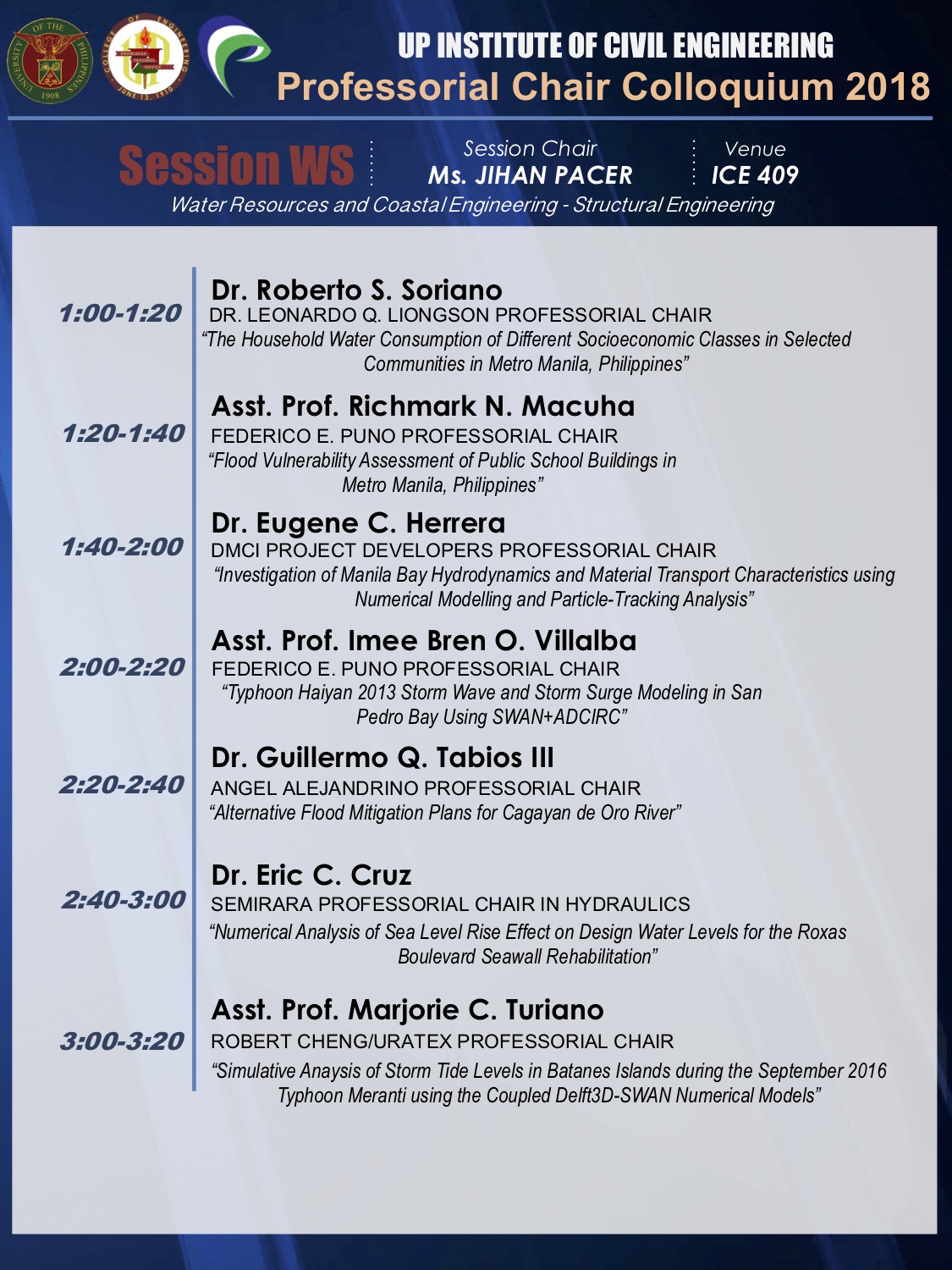
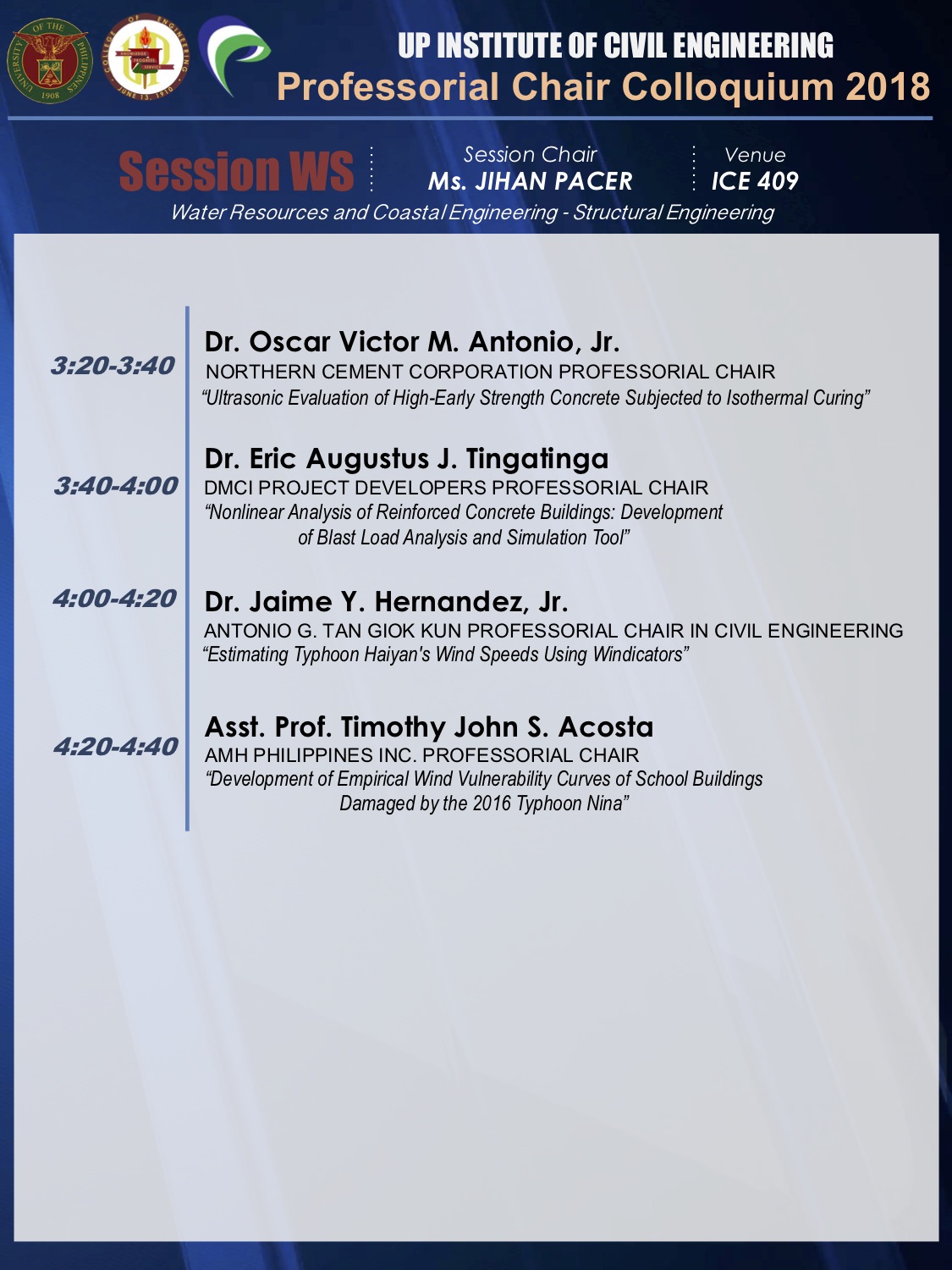
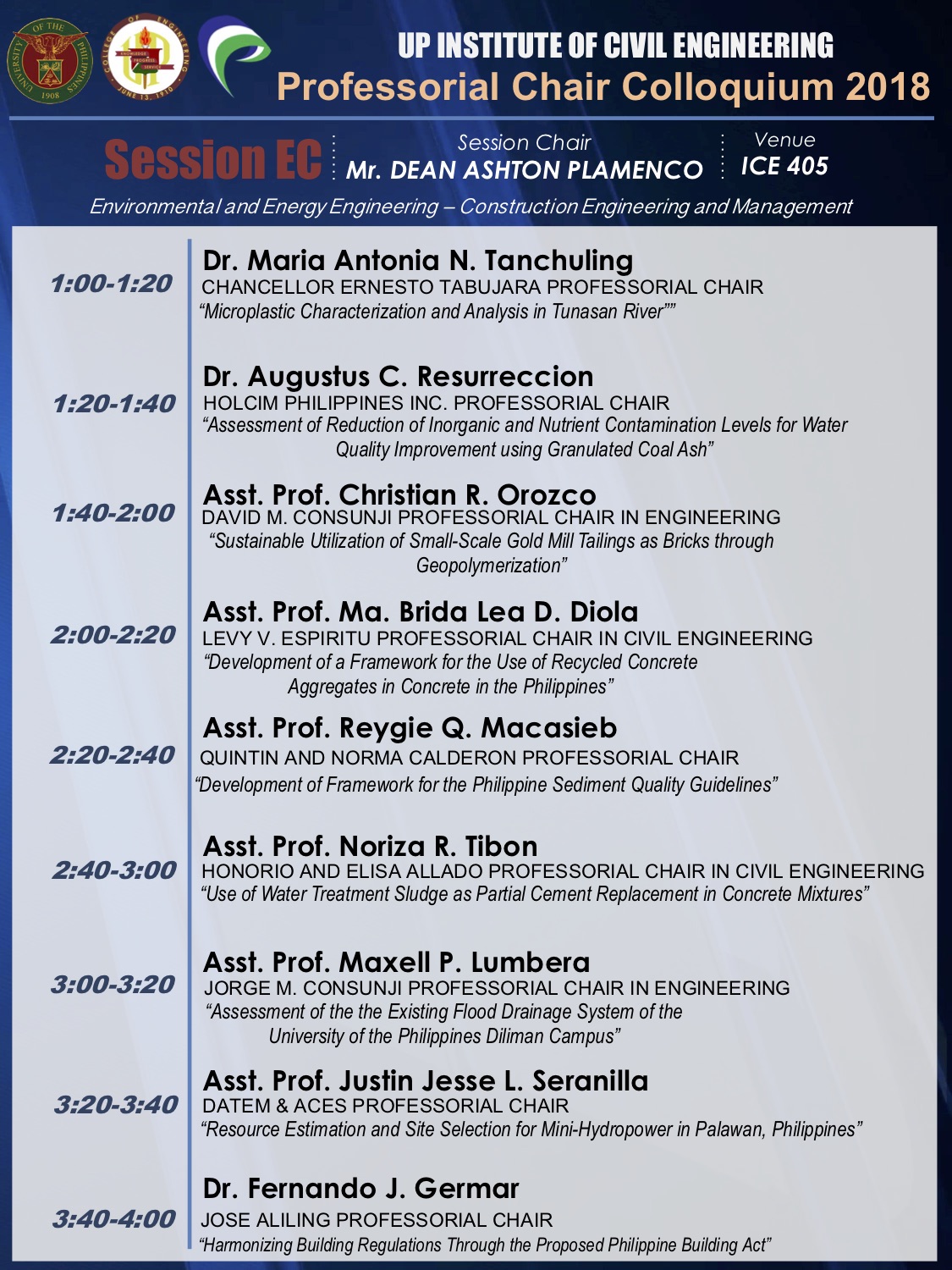
We start the month of November with an announcement. This is for the Professorial Chair Colloquium of the Institute of Civil Engineering of the University of the Philippines Diliman, which will be held on November 16, 2018 (Friday). The sessions are open to the public and surely there will be interesting topics not just regarding transportation but on the other fields as well. Following are information on the lecture topics:


–
8th Regional Symposium on Infrastructure Development (RSID)
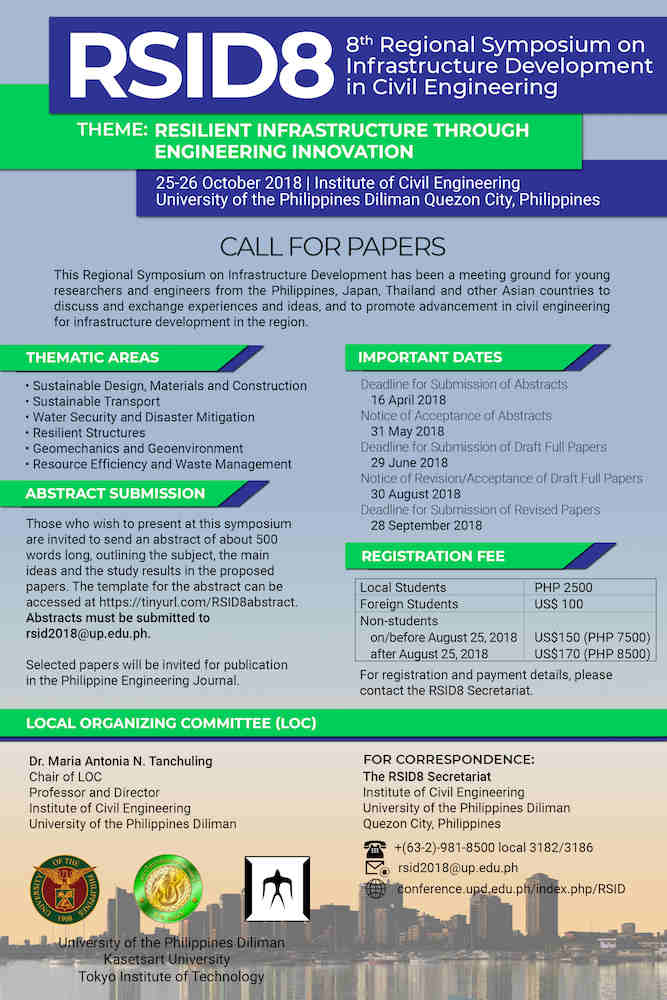
I would like to promote a symposium that our Institute of Civil Engineering (ICE) at the University of the Philippines Diliman will be hosting this year.
The Institute of Civil Engineering, University of the Philippines Diliman together with Kasetsart University (Thailand) and Tokyo Institute of Technology (Japan) is pleased to invite you to participate in the:
8th Regional Symposium on Infrastructure Development
in Civil Engineering (RSID8)
Theme: Resilient Infrastructure Through Engineering Innovation
Date & Venue: October 25-26, 2018 Institute of Civil Engineering,
University of the Philippines Diliman, Quezon City Philippines
Abstract Submission:
Those who wish to present in this symposium are invited to submit and abstract of about 500 words under the following themes:
Sustainable Design, Materials and Construction
Sustainable Transport
Water Security and Disaster Mitigation
Resilient Strudtures
Geomechanics and Geoenvironment
Resource Efficiency and Waste Management
Deadline for Abstract Submission: April 16, 2018
Template: tinyurl.com/RSID8abstract
Please see attached poster of call for papers for more details.
Kindly disseminate to your colleagues who may be interested.
For more information of the conference please contact:
Christian R. Orozco
RSID8 Secretariat
Institute of Civil Engineering
University of the Philippines Diliman
Email: rsid2018@up.edu.ph
Website: conference.upd.edu.ph/index.php/RSID
–
EASTS 2017 Conference in Ho Chi Minh City, Vietnam
The 12th International Conference of the Eastern Asia Society for Transportation Studies (EASTS) will be held in Ho Chi Minh City, Vietnam from September 18-21, 2017. The conference promises to be an improvement from the 11th conference held in Cebu City, Philippines two years ago. That conference was not as well attended as past conferences and the arrangements were quite shaky considering a lot of supposed commitments for sponsorships backed out during the critical stages of the organization. That included the host city and the transport department (the then Department of Transportation and Communications or DOTC), both of which promised so much when the conference was proposed but somewhat disappeared when the going got tough. EASTS 2017 should exorcise that memory and perhaps the Philippines can host another conference in the future to make amends for Cebu.
Here’s a link to the local organizing committee’s conference site for the details on the EASTS 2017 conference:
12th International Conference of the Eastern Asia Society for Transportation Studies (EASTS 2017)
–
TSSP 2017 Conference
The Transportation Science Society of the Philippines (TSSP) holds its 24th Annual Conference tomorrow, July 21, 2017. It will be held at the National Center for Transportation Studies at the University of the Philippines Diliman, Quezon City. More than a hundred participants are expected to attend this 1-day affair.
The final program for the conference may be found in the following link:
http://ncts.upd.edu.ph/tssp/index.php/2017/07/17/tssp-conference-program/
The theme for this year’s conference is “Improving Quality of Life in Urban and Rural Areas Through Inclusive Transportation.” This is also the theme for the panel discussion in the morning. The afternoon will feature four parallel technical sessions where 18 papers will be presented.
The keynote lecture will be delivered at the start of the conference by Prof. Tetsuo Yai of the Tokyo Institute of Technology, who is also the current President of the Eastern Asia Society for Transportation Studies (EASTS) under whose umbrella the TSSP is part of. TSSP is a founding member of EASTS and actually preceded EASTS by a year.
–
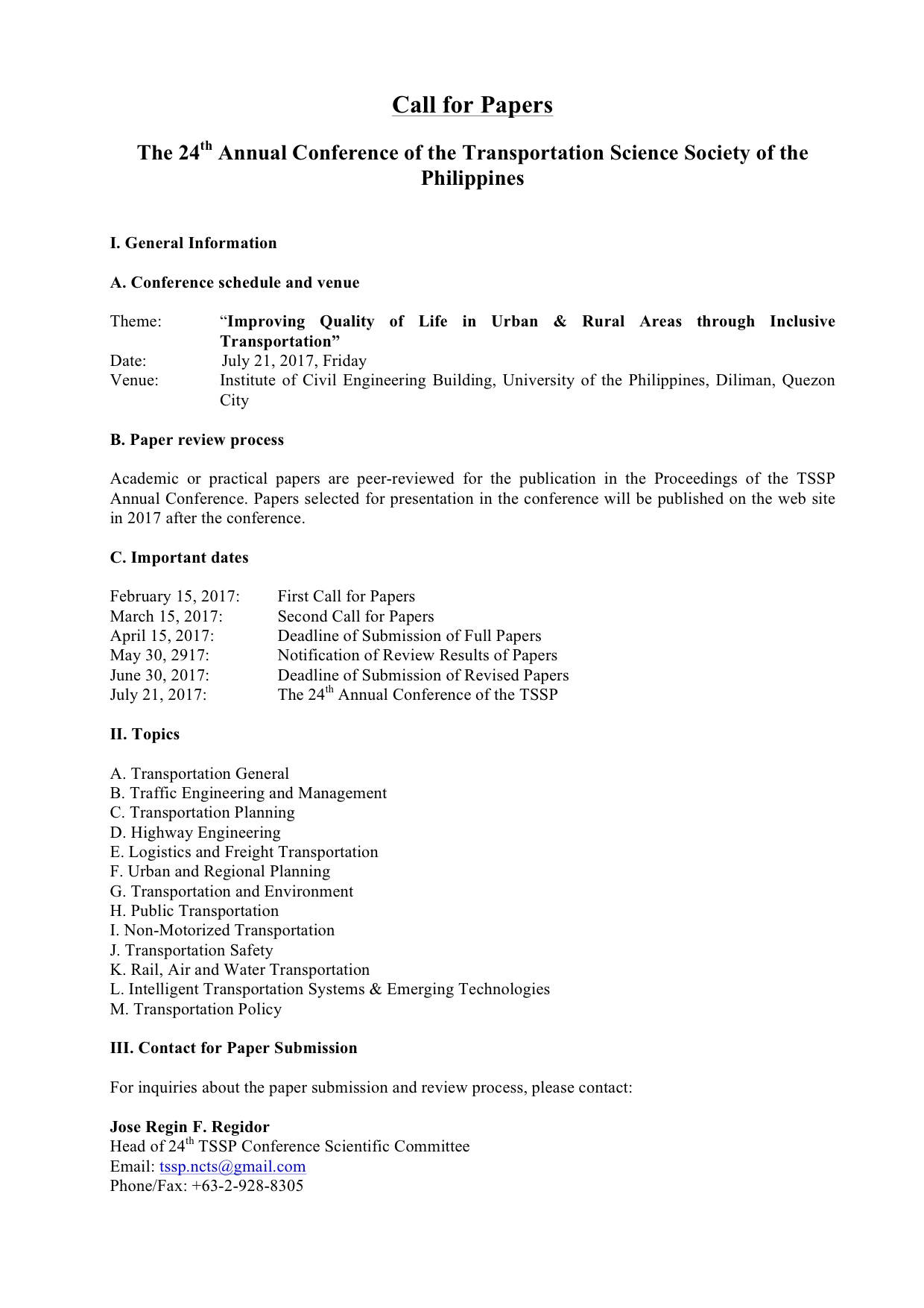
First call for papers for the TSSP 2017 conference
The first call for papers for the 24th Annual Conference of the Transportation Science Society of the Philippines came out last Wednesday, Feb. 15:
–
TSSP 23rd Annual Conference Proceedings
The 23rd Annual Conference of the Transportation Science Society of the Philippines (TSSP) was held at the University of the Philippines (UP) Diliman last August 8, 2016. It was hosted by the National Center for Transportation Studies (NCTS), which for some time was practically inactive in its dealings with the society. The conference was a very successful one with more than 170 participants, mostly students from the undergraduate programs of Mapua Institute of Technology (MIT), De La Salle University (DLSU) and UP Diliman.
The Proceedings of the 23rd Annual Conference contains 22 technical papers, which I have already listed in a previous post showing the technical program for the conference. The link is to the current website of the TSSP hosted by NCTS. Those wishing to have copies of the papers may download them directly from the link. Meanwhile, those interested in the presentations should contact the authors. Their contact information are stated in the paper and it is ethical to get the nod of the authors for their presentation file as these still fall under what can be defined as their intellectual property. I am aware of people who tend to get presentation slides and then pass them of as their work when they use the slides or the data/information therein. There are proper ways for citations of references and sources but sadly such ways are not observed by many.
–
TSSP 2016 Conference Program
I am sharing the banner and final program for the Transportation Science Society of the Philippines 23rd Annual Conference to be held on Monday, August 8, 2016. The final program features a Keynote Speech by the Undersecretary for Road Transport and Infrastructure Anneli R. Lontoc, a Panel Discussion on Road Safety, and technical sessions in the afternoon.


 –
–
 Caught (up) in traffic