
Home » Posts tagged 'ridesharing' (Page 3)
Tag Archives: ridesharing
Origins of ridesharing/ride-hailing?
Here is a very interesting article on the beginning of Uber:
Campbell, G. (2017) “The Beginning of Uber,” Medium, August 23, 2017, https://medium.com/@gc/the-beginning-of-uber-7fb17e544851 (Last accessed 11/10/2017).
The article contains the company’s first pitch and should be of interest to researchers (that includes my students) who may want to know about and from the Uber’s origins. It might be useful to taxi operators and drivers as well since the slides show their characterization and what (good) features distinguished Uber from the conventional taxis at the time.
–
New study on ride-hailing
Here’s a nice article that has a link to a study conducted at the University of California-Davis written by one of the authors of the study:
Clewlow, R.R. (2017) “New Research on How Ride-Hailing Impacts Travel Behavior” in Planetizen, October 11, 2017.
And here’s an article about that same study:
Bliss, L. (2017) “The Ride-Hailing Effect: More Cars, More Trips, More Miles ” in Citylab, October 12, 2017.
As usual, I am posting this for reference not just for my readers but for myself and my students who are currently doing research on ridesharing/ride-hailing in the Philippines.
–
Are ridesharing services paratransit modes?
Vuchic (Urban Transit Systems & Technology, 2007) defines paratransit as an “urban passenger transportation service mostly in vehicles operated on public streets and roads in mixed traffic; it is provided by private or public operators and it is available to certain groups of users or to the general public, but it is adaptable in its routing and scheduling to individual user’s desires in varying degrees.”
Based on the definition and how paratransit modes have evolved over many years, then we could say that the current ridesharing or car sharing services like Uber and Grab are essentially paratransit modes. They definitely fit the definition as do conventional taxis.
–
Some thoughts on the ridesharing vs taxi issues in Metro Manila
A lot have been said and written about the issues concerning ridesharing and taxis in Metro Manila. There are the personal posts you read and are being shared around social media. There are the obviously sponsored posts and articles going around. These are usually by trolls but may also include some personalities who are more than willing to lend their names to a cause they think is worth taking on. Unfortunately, the supposed victim here is also an oppressor if one tries to delve into their operations and practices. The real victims here, aside from the commuters who patronize ridesharing, are drivers and operators.
I stated Metro Manila because there seems to be no serious issues on ridesharing or taxis in other Philippine cities. Why is that? Is it because taxis provide better services in other cities like say, Cebu, Davao or Iloilo? Is it because public transport in other cities are better compared to Metro Manila? Or is it because ridesharing companies cannot compete with local, taxi-like transport like tricycles? Let me put it like this: Metro Manila public transport has deteriorated in the past decades. This deterioration comes in many forms including the very slow development of mass transit systems and the continued dominance of road-based modes.
Private vehicle mode shares have increased significantly over the last four decades. In the 1970s, the estimated split between public and private transport was about 75/25. In the 1980s, it was close to 70/30 but with public transport enjoying just about 70% shares. In the 1990s, the 70% had already been breached with public transport share estimated to be about 68%. The 2000s saw public transport shares to have been eroded further, with closer to 65% of trips using public transport. The last decade likely saw the further rise of private transport shares with the rapid increase in motorcycle ownership and use and the emergence of ridesharing such as Uber and Grab. This, despite the increase in population for the metropolis and also the increase in road public transport vehicles particularly UV Express.
These road-based modes are generally low capacity and require so many vehicles to transport so many people. And yet people choose them (e.g., purchase and ride a motorcycle, patronize Uber or Grab, etc.) because their options for their commutes are generally worse off. Motorcycles are not for everyone and not everyone can afford to or want to own a car. And yet, there seems to be a sizable population wanting (not necessarily needing) to be driven to and from their homes, workplaces, schools or other places of interest but not via conventional taxis; as evidenced from the popularity of ridesharing services.
Perhaps the only way to resolve the issue lies not only in the drastic improvement of conventional taxi services. Operators and drivers have had a lot of chances to do this but there seems to be little positive change here. Maybe, and ultimately, the solution is in the expedited development of mass transit systems like rail transit lines and bus rapid transit (BRT). And so the initiatives of the current administration along such infrastructure projects are most welcome and may stave off the decline of public transport mode shares (revival?). Better public transport should help make commutes more bearable. Commutes should be safer, faster and relatively inexpensive compared to owning and operating a car. And may I add that using conventional public transport should be more attractive than ridesharing.
–
Praise and criticism about Uber
I found a couple articles on Uber. These are by the same author and are interesting because of some changes in perspectives considering the more than 1 year separating the two.
In Praise of Uber [by Jean-Louis Gassee in mondaynote.com, Medium, May 9, 2016]
Uber’s Complicit Board [by Jean-Louis Gassee in mondaynote.com, Medium, June 26, 2017]
I’m posting these here as additional references on ridesharing/ridesourcing. Such perspectives are also invaluable for us doing research on these topics. I am not so much interested in the personalities but on the operations and the experiences and preferences of passengers.
–
Some nice articles on innovation in transport
Following are a couple of articles on innovation as applied to transport. Uber is often seen merely as a transport option much like the taxi but there’s more than meets the eye in terms of its operations never mind its surge pricing schemes. It has succeeded in much part because it is an innovative company with innovative people. They were not afraid to take on the challenges against what the establishment had regarded as an upstart in a sector that was seen as having fewer opportunities for thinking out of the box.
Today is my first day at Uber [by Chris Messina in Medium, January 5, 2016]
Today is my last day at Uber [by Chris Messina in Medium, January 7, 2017]
–
Challenges for Uber, and ridesharing in general
Uber was in a crises of sorts after several leading to its controversial head stepping down a few days ago. Several articles came out including one from Wired that provided some details to some of the significant stumbling blocks or obstacles Uber had to go through the past years (even recent months). There’s an even better article by one of Uber’s co-founders, which I found and regard as “even better” because it appears to be a self assessment, a reflection of how the company should move forward.
Following are the two articles, one from Wired and another from Uber (via Medium):
- A Short History of the Many, Many Ways Uber Screwed Up [by Davey Alba in Wired, June 21, 2017]
- Uber’s path forward [by Garrett Camp in Medium, June 21, 2017]
These are important to us who are doing studies on ridesharing/ridesourcing. I believe Uber and its kind including Grab has revolutionized transport and contributed in significantly improving mobility among a lot of people who have been marginalized by what we have termed as conventional transport. Senior citizens and persons with disabilities, for example, who have had difficulties getting rides can (if they can afford it) get Uber or Grab vehicles to take them where they need to be. There are indeed issues but as the article by Camp states, these can be resolved or addressed to improve the services provided by ridesharing/ridesourcing companies.
–
Some issues abroad on car sharing/ride sharing companies
There are two articles recently that are worth reading for those who are into ride-sharing/car-sharing. And I am not necessarily referring to those who regularly take Uber or Grab, or those who opt to use these whenever they need a taxi ride. There are many who are already studying these services being provided not by your traditional or conventional taxi companies or rental vehicle companies but by supposedly private individuals who supposedly have the spare time and spare vehicle that they can use to provide transport for other people. I use the word “supposedly” here because this is a big assumption and the premise by which transport network companies like Uber, Grab and Lyft have been able to go around the bureaucratic processes that taxi and other companies have to go through as formal public transport (i.e., public utility vehicles). These articles are along the lines of the discussions in previous articles I have posted here about ride-sharing/car-sharing, and are mostly based on the experiences in countries who have more developed and presumably better transport than us in the Philippines.
Denton, J. (2017) Two Federal Lawsuits Could Spell Big Trouble for Uber, Pacific Standard, http://www.psmag.com, April 10, 2017.
McGraw, D.J. (2016) How Lyft and Uber are Ignoring the Poor, Pacific Standard, http://www.psmag.com, May 12, 2016.
I leave it up to my readers (any researchers out there?) to pick-up the main points and perhaps look at the issues from different perspectives. I have pointed out before that the situation in Metro Manila could be very different from the situations in other major cities like Cebu, Davao and Iloilo. And so transport network companies may not necessarily succeed in cities where taxi services, for example, are significantly better than what we have in Metro Manila.
–
Grab at NAIA Terminal 2
Here is another useful post for travelers especially during this Holy Week and the summer holiday season in the Philippines. Many people usually look for a ride heading out from the airport. Not everyone would have someone to fetch them. There are several options now for those wanting to take public transport. Aside from the conventional taxis, there are also airport taxis, vans and the more recent airport bus service provided by UBE Express. Ridesharing or car sharing services are also available and the most visible will be Grab with options for either car or taxi available via you own app or through their booths located at the NAIA airport terminals. There should be a Grab booth located at the arrival areas of NAIA’s terminals. They also have a booth at the Mactan Cebu International Airport terminal.
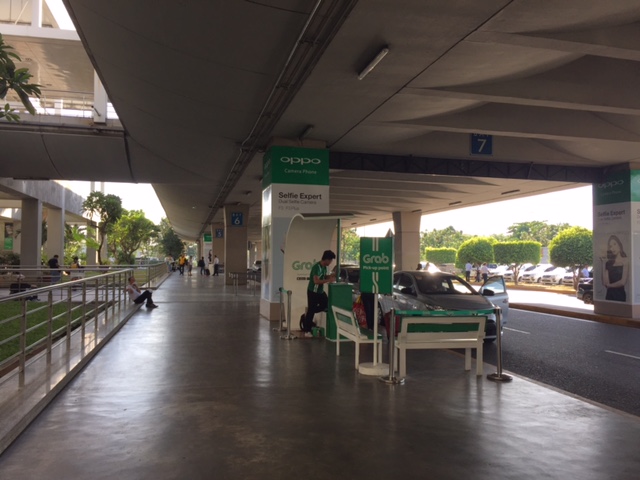 You can easily spot the Grab booth and pick-up area as you exit the terminal’s arrival lounge.
 You can book a ride with the grab staff at the booth if you don’t have a smart phone and the Grab app. You can also just call for a car or taxi using the app. This is the pick-up point for Grab Cars. Grab Taxis would have to use the driveways for taxis parallel and just to the left of this driveway.
Grab has become a game changer for taxis out of the airport. In fact, my own father found them to be a convenient and safe option for a recent trip from Terminal 2 to our home in Cainta. He didn’t have to negotiate fares and he paid a very reasonable fare while enjoying his ride on a recent model car.
–
Contradictions in transport mode choices?
A friend posted a photo on social media and it immediately got my attention as it featured an ad by popular ridesourcing company Uber on a public bus in Singapore. There is a slogan there that reads: “Because weekends come once a week, make your move.” This statement is a promotion for Uber, which is already making inroads in the city state where taxi services are probably among the better ones in the world in terms of service quality and efficiency.
The ad itself is a contradiction in terms of who is promoting itself and where it is being promoted. Such promotion gimmicks are not beyond companies like Uber, which project themselves as mavericks in what are considered as traditional areas such as transport. Here is the photo of Uber advertising on a public bus in Singapore:

Taxi ownership and operations (i.e., driving) in Singapore is restricted to Singaporeans. Uber faced some issues with their operations as there were a significant number of foreigners, it seems, who took to Uber as a means for employment. In a city-state like Singapore, which discourages private car ownership and use through schemes like congestion pricing and the provision of high quality public transport services, Uber could face a much stiffer challenge to its march towards dominating conventional taxis.
–
 Caught (up) in traffic