
Home » Posts tagged 'road safety' (Page 18)
Tag Archives: road safety
Fatal road crash at Masinag, Antipolo City
I learned this evening about a major road crash that occurred at the Masinag Junction in Antipolo City in the late afternoon. This was probably why there was a tremendous buildup of vehicles along Aurora Boulevard near Katipunan. Marcos Highway’s capacity is already reduced due to the ongoing construction of the LRT Line 2 Extension from Santolan, Pasig City to Masinag. A major traffic incident like the one this afternoon surely affects traffic along this very busy corridor connecting the already densely populated eastern cities and towns (i.e., Marikina, Antipolo, Cainta) with Metropolitan Manila. This was actually along one of my usual routes between my workplace and my home in Antipolo. Today, however, I decided to take Ortigas Ave. Extension as advised by Waze.
I had written about Marcos Highway already being a killer highway (Another killer: highway…, August 6, 2014) though I think it is not at the level of Commonwealth Avenue in Quezon City. Still, the potential is high for road crashes occurring along Marcos Highway and this potential has increased due to the hazards posed by the construction works between Santolan and Masinag. As they say, such crashes are disasters waiting to happen and such a disaster in terms of both lives lost and traffic congestion costs happened this afternoon when a truck plowed into a building at Masinag.
Hopefully, this crash will be an eye opener and would lead to immediate actions from the LGUs and agencies responsible for ensuring safe roads and safe travels to commuters passing through Masinag Junction and the two major highways converging there, Marcos Highway and Sumulong Highway.
–
Safe steps – Road Safety
I would like to share on an initiative that’s close to my heart – road safety. I had been part of several road safety initiatives before and continue to be part of several today. I have also been doing research on pedestrian and cycling safety together with my students as part of our institute’s research agenda. Here is an example of very good promotional material on road safety including videos highlighting relevant statistics on safety that we should be aware of as well as encourage us to act and contribute towards safer roads for everyone.
Featured in the videos is Road Safety Ambassador Michelle Yeoh, whom people might remember for the movie “Crouching Tiger, Hidden Dragon” that now has sequel at Netflix. I had the honor and pleasure of meeting her many years ago when she was in Manila to speak on road safety at the Asian Development Bank’s Transport Forum. In fact, she visited the University of the Philippines Diliman to inaugurate the road safety and traffic discipline zone that is the campus core and along the Academic Oval. I had the privilege of driving her around the oval on an electric jeepney.
–
Voyeurism
This seems to be an unusual topic for this blog. However, I thought I’d comment about voyeurism in relation to transport or traffic as I observed a lot of people having cameras installed on their vehicle’s dash boards and local government units utilizing CCTV cameras for monitoring traffic.
In the case of LGUs, while there are already many cases where action was taken by authorities for traffic violations and other anomalies that they see on their camera, there are still as many cases when there are no actions taken to address issues. These include instances where CCTV cameras recorded reckless driving or riding and the videos were clear enough to identify the vehicles involved. These videos were likely not used to
Then there is the concern with motorists who have dash cams and are able to record reckless driving and other issues as they travel. Some post their videos on social media with the more interesting ones becoming click baits as they are shared by many. I found it disturbing that people take videos of road crashes and appear not to help the victims. They are essentially voyeurs, too. Posting these things on social media doesn’t count as help. It seems insensitive and unemphatic for people to be recording stuff and saying something about how these shouldn’t be and yet do nothing about the situation. Certainly, these are sins of omission that can be regarded along the lines of the sins committed that they recorded and shared.
–
Counterflow culture: pang-iisa
There are several videos currently circulating in social media showing counter-flowing motorists. In one, a driver with a camera on his dashboard proactively positions his vehicle along the middle lane of the correct side of the road and engages a counterflowing motorist who initially appeared as if he were going to insist on his wrong behavior (feeling entitled perhaps?). The driver with the dash cam didn’t budge or give way and the errant driver had to go back to his correct lane.
In another, more serious video, another dash cam records a scene along a curved 2-lane section of Marcos Highway where an oncoming motorcycle slammed into a counterflowing vehicle coming from the left side of the vehicle with the dashcam. It was clear that the counterflowing motorist violated the double yellow line rule, which led to the dreadful crash.
These are examples of what seems to be a counterflow epidemic among many motorists. Counterflowing is not only prevalent among motorcycles and public utility vehicles but among private vehicles as well. There are even those who follow emergency vehicles that legitimately and urgently use the opposing traffic lane. This behavior seems to be associated with these motorists wanting to get ahead of others. In Filipino or Tagalog, the term is translated to pang-iisa or gustong maka-isa (wanting to get one up on other people). This behavior can be attributed to a person being impatient, undisciplined, reckless, feeling entitled, or – all of the above.
Such issues could have been preempted by a stricter licensing system that can be administered by the Land Transportation Office (LTO). However, since many already have their licenses then the burden for correcting such behavior falls upon traffic enforcement agencies and their personnel including the Highway Patrol Group (HPG) and the MMDA. Hopefully, such errant behavior can be corrected and our roads can be safer for all users.
–
The benefits of walking
I came across an old article on walking that appeared in The New Yorker in 2014. This was after reading another article my wife shared that also was about walking. One is about both the physical and intellectual benefits of walking while the other was about walking without a purpose. Both were about walking and thinking, and definitely about the benefits of even a short stroll to our physical and mental being.
Here’s the article from The New Yorker: Why walking helps us think
And the article from BBC: The slow death of purposeless walking
I highly recommend both articles as we ponder about making our cities safe for pedestrians/walking.
–
Tire conditions
While stopped at an intersection, my eyes wandered to look at the vehicles around me. I took a photo of the rear tires of a truck stopped beside me. Following are some observations about the tires:
- Most if not all the tires were re-treads
- Most of the tires are worn out
- One tire is already damaged and should not have been used in the first place

Such conditions of trucks’ tires reflect the state of many commercial vehicles in the country. The same observation applies to public utility vehicles. I guess there have been many instances of tire blow-outs involving trucks and jeepneys. These have not been reported as they often lead to traffic congestion (i.e., when a vehicle is forced to stop and block traffic), which is not at all an uncommon experience to many. Few perhaps have led to high profile road crashes featuring fatalities. Still, the potential for major crashes is there and it is contributory to disasters that are always just waiting to happen in many of our roads.
–
Endangering others by your behavior on the road
A major concern in road safety is the behavioral aspect that includes the attitudes of drivers and riders. Aggressive and irresponsible driving can be observed along many Philippine roads including low traffic roads along which there is a tendency for motorists to speed up. Social media contains many posts of videos showing reckless behaviour (e.g., vehicles zig-zagging along roads), placing other road users in danger with the possibility of crashes involving or influenced by these same vehicles. There are also posts of photos allegedly taken by speedsters boasting of the high speeds they are able to attain or cruise along on tollways and even regular roads.
Such behavior, however, may be influenced by strict and proper enforcement of traffic rules and regulations. I would like to believe that it it should be easier these days to determine if vehicles are speeding beyond the safe speeds roads are designed for. There are many tools such as speed guns or radars. However, these are few with the Metro Manila Development Authority (MMDA) having only two guns at their disposal. Operators of NLEX and SLEX are supposed to have their own speed guns and they have been apprehending speedsters as best they can. However, it seems that there are still many who are not apprehended and continue to pose as dangers to their fellow travelers. (I assume that those apprehended may also continue to speed up and do not get caught in most times they do.)
One creative approach for traffic law enforcement should be to browse social media of posts by people who claim to be running their vehicles at high speeds, violating road speed limits. Speeding is dangerous because drivers and riders will have less control over their vehicles and other elements affecting the vehicle. Perhaps the Land Transportation Office’s (LTO) enforcement arm should have an internet unit charged with searching for such cases online and investigate the identities of these people in order to flag them in the LTO licensing system?
 Example photo posted on social media where the driver boasts of his reaching high speeds while driving in a Metro Manila road.
–
Sudden intended acceleration? Intended ones are more dangerous!
The motoring community in the Philippines has been in rather heated discussions regarding the Mitsubishi Montero’s alleged defect that causes what has been termed as ‘sudden unintended acceleration’ or SUA. This term refers to the vehicle suddenly, and without the driver doing anything, rapidly accelerating, forward or backward, and hitting anything in its path. The proofs to these alleged incidences are supposed to have been documented by many including videos that have been uploaded to YouTube and even shared or used by mainstream media. The vehicle’s manufacturer itself denies that there is a defect in the model(s) being cited for SUA. They have also released a new model of the vehicle in the market and most people not paranoid about SUA seem not to mind the buzz about the alleged defect. The new model, after all, is supposed to be free of that particular defect considering the manufacturer, despite its denials, should have been aware of the complaints and concerns.
Defect or none, I think what’s more dangerous is not the ‘sudden unintended acceleration’ of vehicles. In fact, I am not aware of any fatalities attributed to this and all the videos I’ve seen alleging the defect happened in parking lots and driveways. These have caused only minor injuries and, surely, damage to properties. What is more dangerous and should be the concern by all is the intended acceleration leading to speeding (or over-speeding) that is so common in our roads regardless of whether these are expressways or city streets. Such behaviour are almost always intended and therefore the drivers are very much aware of their actions and in control of their vehicles. In control, that is, until they hit something or, worse, someone. Such irresponsible and often reckless behavior plague our roads and one person’s folly can be the doom of others as is usually the case in road crashes involving (over)speeding.
–
Towards safer roads: design, respect and education
Fatal crashes involving cyclists have been posted in social media including a recent one involving a mother of two who was run over by a garbage truck that encroached on the on-street/painted bike lane in, of all places, Marikina City. Emphasis on Marikina is made here because it is a city well-known for its comprehensive bikeways network. The network is comprised of segregated and on-street bikeways.
Following are some photos showing examples of good and bad practices pertaining to bikeways design in the Philippines:

Example of segregated bikeway at the University of the Philippines Diliman campus. Cyclists actually share the carriageway lane allocated from the Academic Oval with pedestrians and joggers. They are not physically protected from motor vehicles that can encroach on the bike lane.

Example of segregated and protected bikeway along Marcos Highway in Pasig City (similar design for the sections in Marikina, Cainta and Antipolo) – bikeway is on the sidewalk and cyclists essentially share space with pedestrians despite delineations.

Example of segregated and protected bikeway/walkway along EDSA in Makati City – note that space to be shared by pedestrians and cyclists is very constricted.

Example of poor design along White Plain Avenue – the MMDA seems to have designated the entire sidewalk space for cyclists.
Three examples from Marikina’s bikeways are shown below:
 Painted, segregated bikeways on the carriageway on either side of a two-way road [Note: This is basically the design along the street where the crash in Marikina occurred.]
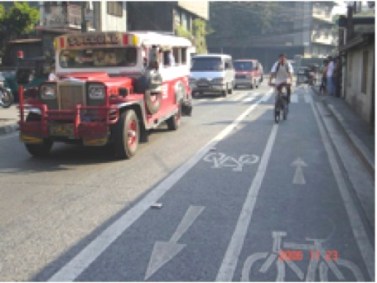 Painted, segregated bikeways on the carriageway along a one way road
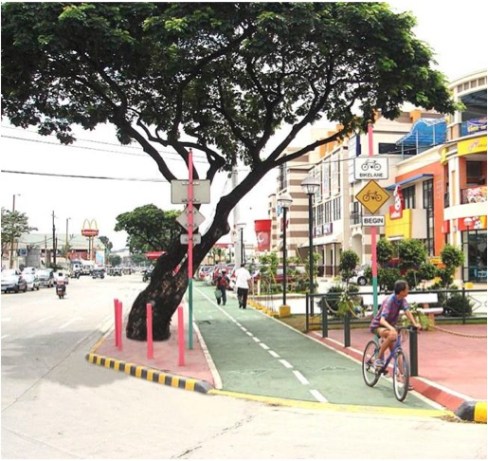 Segregated and protected bikeway off the carriageway along Sumulong Highway
Granted that the ideal set-up would have segregated or protected bikeways that are designed properly, we take a look at two other very important elements that are not at all as technical as design and planning of bikeways – respect and education.
Education is an important aspect of driving. Many Filipino drivers are poorly educated in terms of traffic rules and regulations, road design as well as local policies pertaining to transport and traffic. As such, there is a tendency for many drivers to disregard rules and drive/ride aggressively and recklessly. This must change and it starts with reforms in the way licenses are issued to all types of drivers including perhaps stricter certification systems for truck drivers and public utility vehicle drivers. Traffic education should also be integrated into the academic curricula of schools starting at a very young age. Road safety parks are one way to promote traffic education for kids.
Respect is partly derived from education but is also related to attitude. No matter how much driver or road user education or skill you get if you have a bad attitude, you will still have the tendency to be reckless or irresponsible with your actions on the road. One way to curb bad attitudes on the road and to educate road users (particularly errant drivers and riders) is strict traffic enforcement. Many cities already have CCTVs installed at major intersections that allow law enforcement units to be able to monitor traffic behavior and perhaps zoom in to determine driver and vehicle information including license plate numbers.
The crash that killed the single parent in Marikina is not so much as an issue one whether we need segregated and protected bikeways but is more an urgent need to assess the state of traffic education and enforcement in this country.
–
Articles on the crash and calls for reforms may be found in this link.
Common causes of crashes involving bicycles
I found a guidebook of sorts as I browsed one of my shelves for some references on public transport. It was something that I got from a seminar hosted by the Land Transportation Authority (LTA) of Singapore many years ago (I think in 2009.). The book contains tips for road users, whether motorist, pedestrian or cyclist. One page from the guidebook provided a list of common causes of accidents involving pedal-cyclists.

The page is practically a checklist for cyclists – reminding them of items that they need to keep in mind when traveling. In Singapore and elsewhere, there are rules for cyclists to follow in order to ensure safety on the roads. The assumption here is that other road users, especially motorists, will respect the right of cyclists. Each road user is expected to be responsible with his/her behavior whether as driver, rider, pedestrian or cyclist. Everyone is vulnerable and even the most safety conscious and careful road user may be involved in a road crash.
–
 Caught (up) in traffic