
Home » Posts tagged 'tricycles'
Tag Archives: tricycles
Public transport in Iloilo
I took some snapshots of public transportation on my recent travel to Iloilo. These are typical PUVs you would find in most towns across the country. Iloilo’s have some distinct features that they also share with other towns in other provinces.
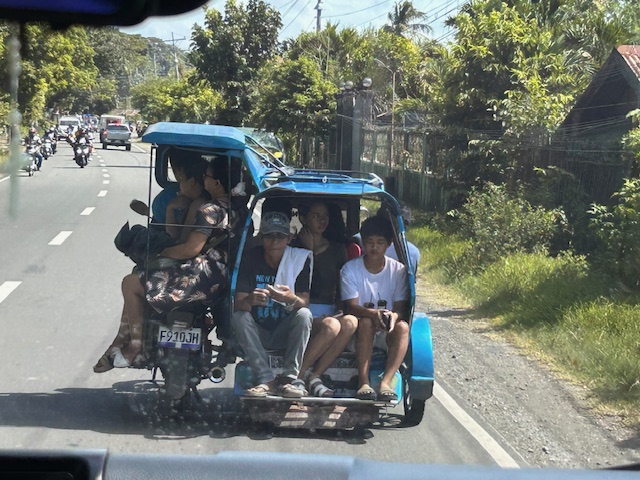 A typical tricycle along the Iloilo-Antique road seats 8 to 9 passengers. Sometimes passengers even sit on top of the sidecar. Sidecars here and other provinces often have roofs designed to carry heavy loads including agricultural products. Usual trike sidecar seating have passengers facing front. This one has them “talikuran” or “back to back” with some passengers facing back – not really a nice view when traveling along a highway and vehicles tailing or bearing down on the trike.
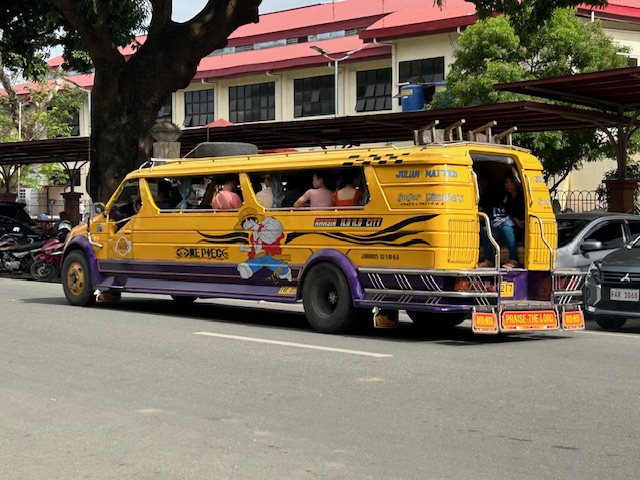 The typical jeepney in Iloilo is stretched whether it’s for inter-town or city operations. Instead of having the ‘face’ of the jeep (from which jeepneys evolved from), they use the front of the Toyota Fortuner or Mitsubishi Montero. These seat 20 to 24 passengers not counting those who are seated on the bench along the aisle. I wonder what engines they now use for these vehicles.
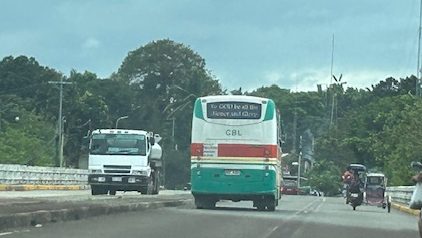 I took this fleeting photo of a bus. For me it wasn’t just a regular bus like the Ceres buses that now dominate the inter-provincial routes. This was a Calinog Bus Line (CBL) bus. We used to take their buses whenever we traveled from Cabatuan town proper to Tigbauan Road. One of my aunts also rode on these buses going to work as a teacher in another town along its route.
–
E-trikes in Naga City
Just like other cities in the Philippines, Naga City now has electric tricycles operating and providing transport services. These are welcome developments for many cities and municipalities as these trikes are low emission and low noise vehicles. They also basically have higher passenger capacities compared to the conventional trikes though service characteristics may not be so different from the conventional trikes. For example, ‘special’ rides mean fewer passengers.
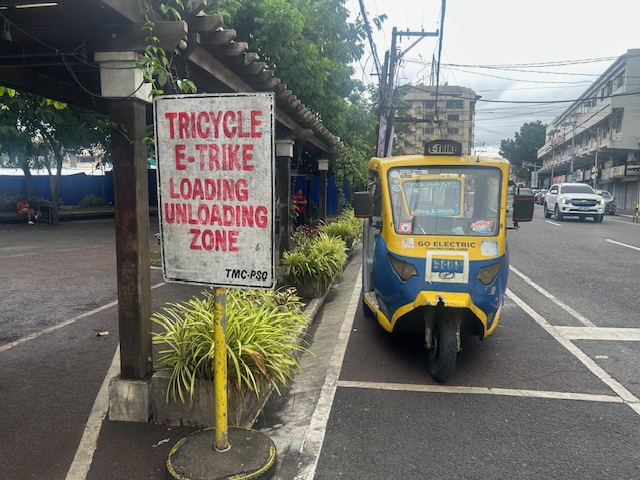 E-trike station at Plaza Rizal
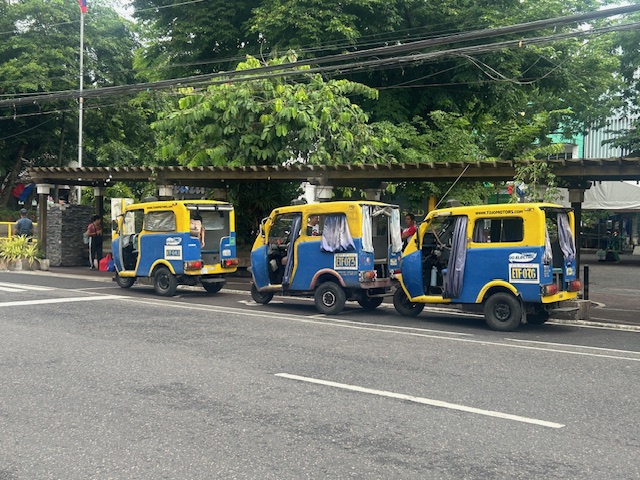 E-trikes queued at the station
Despite the popularity, there are still many questions regarding e-trikes. These include durability, battery life and profitability. With the proliferation of e-trikes and their various models, these issues hope to be resolved in the next few years as more evidence relating to these and other issues come out.
–
Tricycle policies in Zamboanga City
I forgot about these photos I took at the driveway of a shopping mall in Zamboanga City. The tarps state the penalties for erring tricycle drivers in the city under a couple of City Ordinances (185 and 485, series or year not stated in the tarp) and the fare matrix based on City Ordinance 416 (series or year also not stated).
 Penalties for erring tricycle drivers in Zamboanga City. As stated in the tarp, the typical offenses include: overcharging, refusal to convey passengers, insolent, discourteous or arrogance, undue preferences or unjust discrimination, and operation of motorized tricycle for hire in prohibited areas. It is also clear that the penalties are not just for drivers but the owners/operators of the trikes with erring drivers.
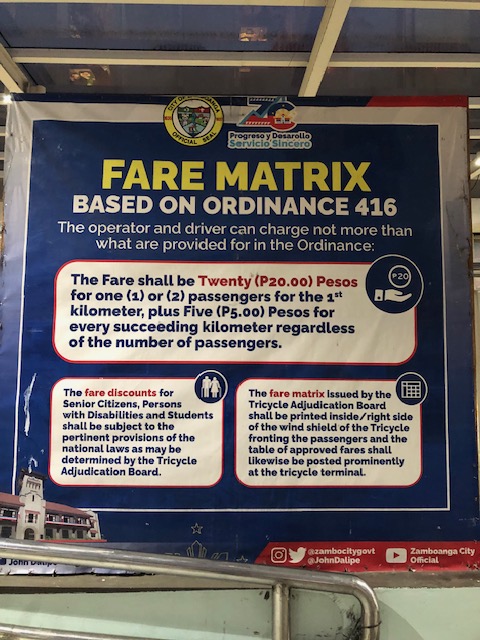 Simple fare calculation stated on the tarp. I assumed there were specific matrices posted in each tricycle but there was none since operations are free-for-all regardless of TODA in the city. That is, trikes in the city practically have no zones of operation where they are restricted or confined similar to what they have in other cities like Olongapo or Quezon City. In the latter, they can issue specific matrices or tables for the passengers’ reference much like what you have in jeepneys that have fixed routes. This can be confusing to passengers and creates situations that may lead to drivers taking advantage and overcharging passengers.
In a city like Zamboanga where there are many one-way streets, tricycle drivers can easily lengthen or appear to lengthen trips leading to overcharging of fares. Where tricycles do not have zones or areas of operations per TODA, this becomes the weakness or flaw even with ordinances in place for erring drivers and a simple fare matrix for passengers’ reference. Of course, regular commuters should be familiar with the usual fares they pay so perhaps that’s among the basis for knowing if you’re being overcharged. Visitors though will likely pay more if the driver consciously takes advantage of the situation. Again, this is a matter for enforcement of the ordinances passed by the city and an example of how such ordinances will be implemented.
–
Public transport along Route 8: Cubao-Montalban
I had to go back to my usual commuting route to my workplace via Tumana as Marcos Highway is usually congested in the mornings. As such, I had the opportunity to take some photos of public transport modes along the way.
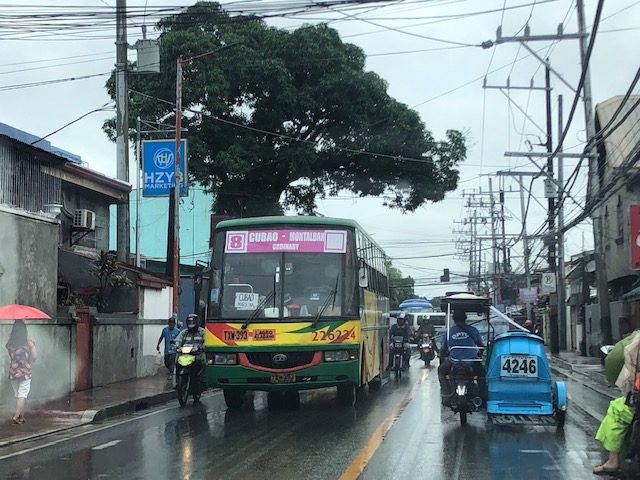 Bus plying Route 8 – Cubao Montalban along the Marikina – San Mateo – Montalban Road (J.P. Rizal Avenue in Marikina City). Montalban is the old name of the Municipality of Rodriguez in Rizal Province.
 A Beep, a modern jitney that is actually a minibus plying to Parang-Stop & Shop route that used to be dominated by conventional jeepneys. That is, of course, a conventional tricycle on the other side of the road. By conventional I mean a motorcycle with a side car, which is the most common type of 3-wheeler in the country.
Recently, I saw G-Liner buses along Route 8. That means the bus company’s fleet is now distributed along 3 routes serving Rizal province and connecting it to Metro Manila. While, capacities are still limited due to physical distancing requirements, these buses should be able to carry a lot more passengers once the situation ‘normalizes’ so PUVs are able to maximize their seating (and standing) capacities.
–
Social distancing on trikes
We came alongside this tuktuk-type tricycle. The model produced by Piaggio is not the motorcycle & sidecar combination that is the most common type of motorized 3-wheeler in the country. The latter currently has a one passenger limit due to the health protocols instituted in light of the pandemic. The layout of the former, however, allowed for a physical barrier in the middle of the back seat that allowed for 2 passengers for the trike.
 A peak inside a Piaggio shows the plastic barrier between passengers seated at the back of the vehicle. There is also a plastic barrier between the driver and his passengers.
Being able to carry two passengers at a time contributes to reducing the number of these vehicles required to transport people. However, most passenger tricycles function as taxis and are not in the same category as buses or jeepneys in terms of the number of people they could carry. Some cities have also taken advantage of the pandemic to reduce the number of trikes going around. In the case of Antipolo, the LGU has a program encouraging trikes to take on deliveries instead of passengers. The current passenger limit should not be used to justify more of these trikes in any city or municipality.
–
On tricycle capacity in the time of COVID-19
With the current rationalization and modernization of public transport vehicles and services being implemented by the national government, many jeepneys, mostly the conventional or traditional ones, have been unable to ply their routes again. Along some routes, buses have taken over but have been limited in the number of passengers they could carry due to physical distancing restrictions. But these are mostly for routes and roads that carry people between their residences and workplaces that typically are longer distance trips (e.g., more than 4 kilometers one way). For shorter distance trips, the more relevant mode of motorized transport is the tricycle. The conventional trike in the Philippines is one involving a motorcycle with a side car. Side car designs vary around the country with some seating 4 people (e.g., back to back with 2 facing backward) but usually with only two seats inside the cab. one or two passengers can be accommodated behind the driver on the motorcycle.
New model trikes include the models endorsed by the Asian Development Bank for the e-trike project that is laid out like a small jitney with benches seating 3 to 4 people on one side (total 6 to 8 passengers) and the popular tuktuk designs that seat 3 people at the back. With the quarantine restrictions in place, conventional trikes can only take one passenger inside the sidecar and none behind the driver. Tuktuks can seat 2 behind the driver but with a barrier (usually a plastic curtain) between the passengers.
 Conventional or traditional trike with plastic sheet between the driver and the passenger (in the side car).
 Tuktuk-type trike with plastic sheet between the driver (in front seat) and passengers in back seat. The back seat allows for 3 people seated together but due to distancing requirement
I have been informed by a former student that certain e-trike models (e.g., BEMAC model e-trikes) are allowed to carry 4 passengers, 2 each on the benches behind the driver who is on the front seat. That still means less passengers than they could usually carry. This would seem to be part of the new normal and will be the set-up for the foreseeable future until perhaps a vaccine for COVID-19 is approved and people get vaccinated. Then, health protocols may be eased to allow for the full seating capacities of public transport vehicles.
–
On the DOTr Guidelines for Public Transport – Layouts for Distancing
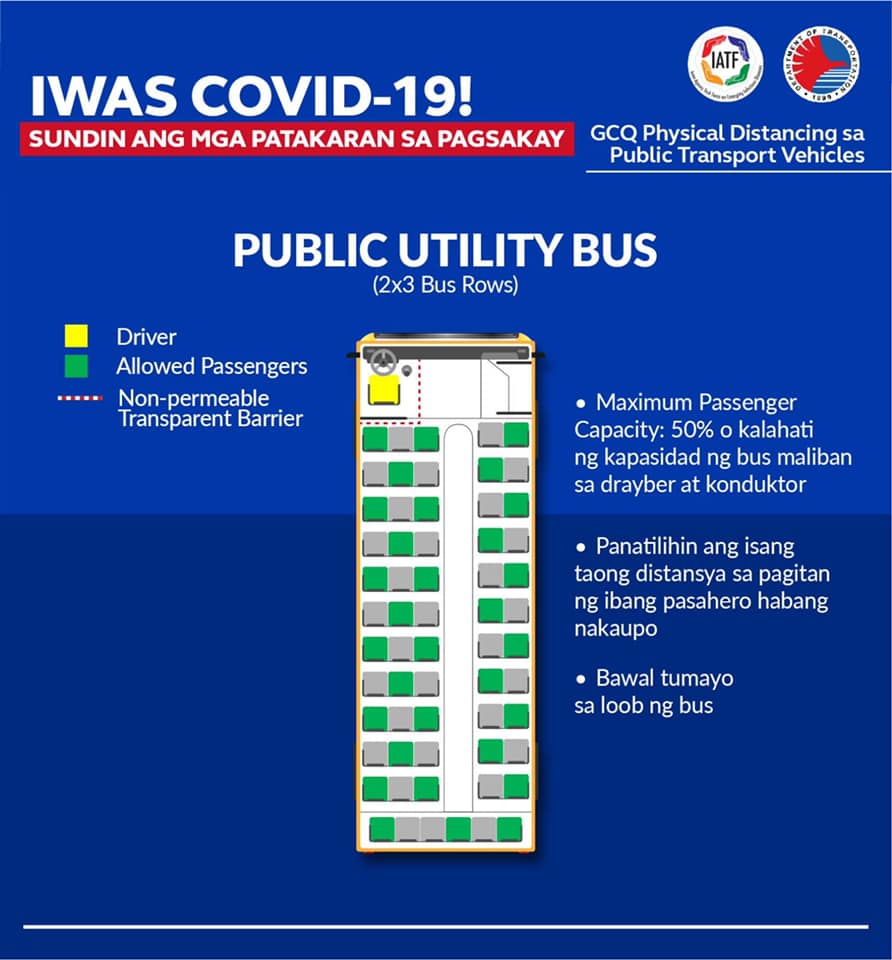
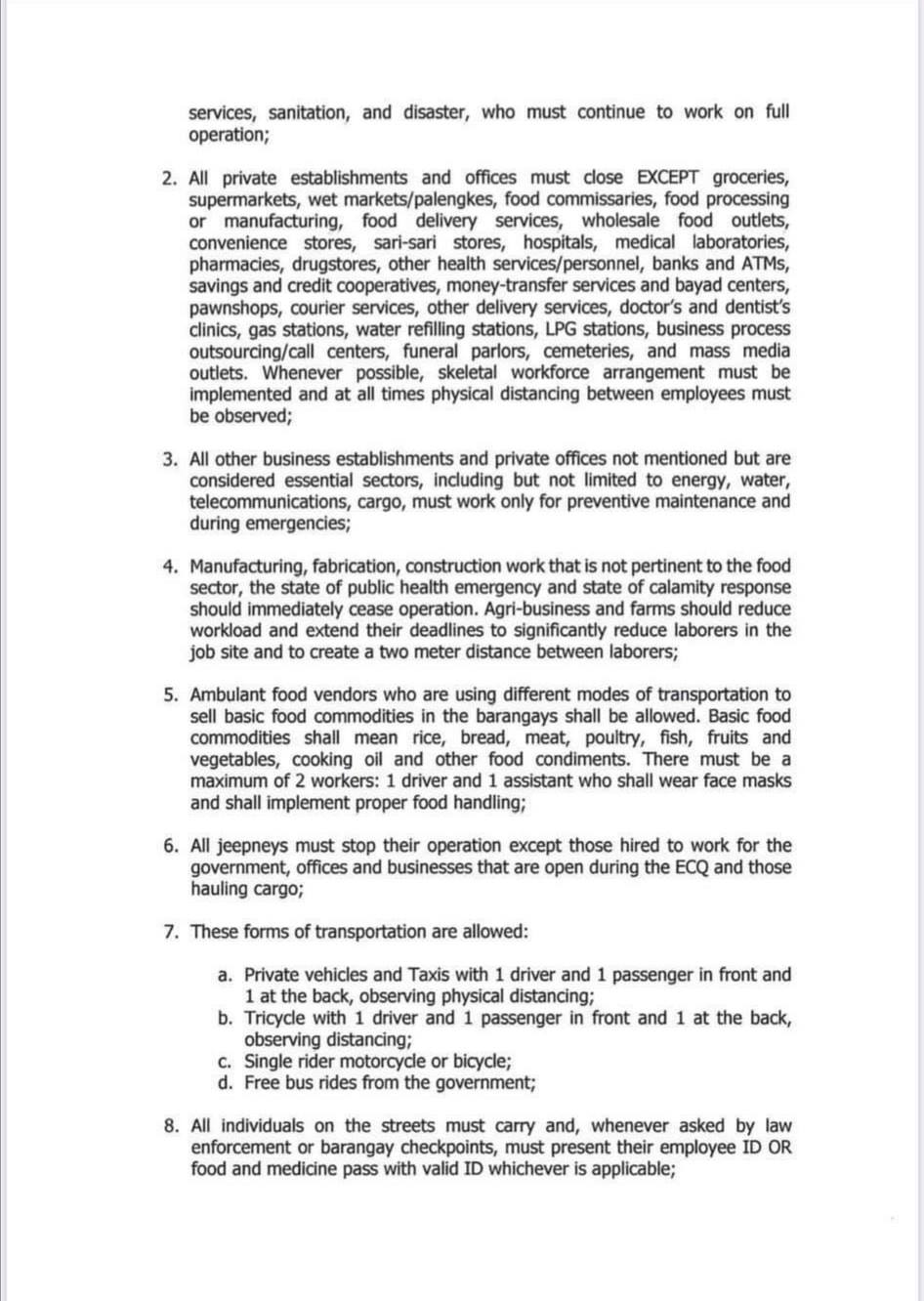
Here again, for reference, are the guidelines issued by the DOTr in relation to the transition from ECQ to GCQ and beyond (immediate rather than far future). The following images show the physical distancing prescribed for road transport.




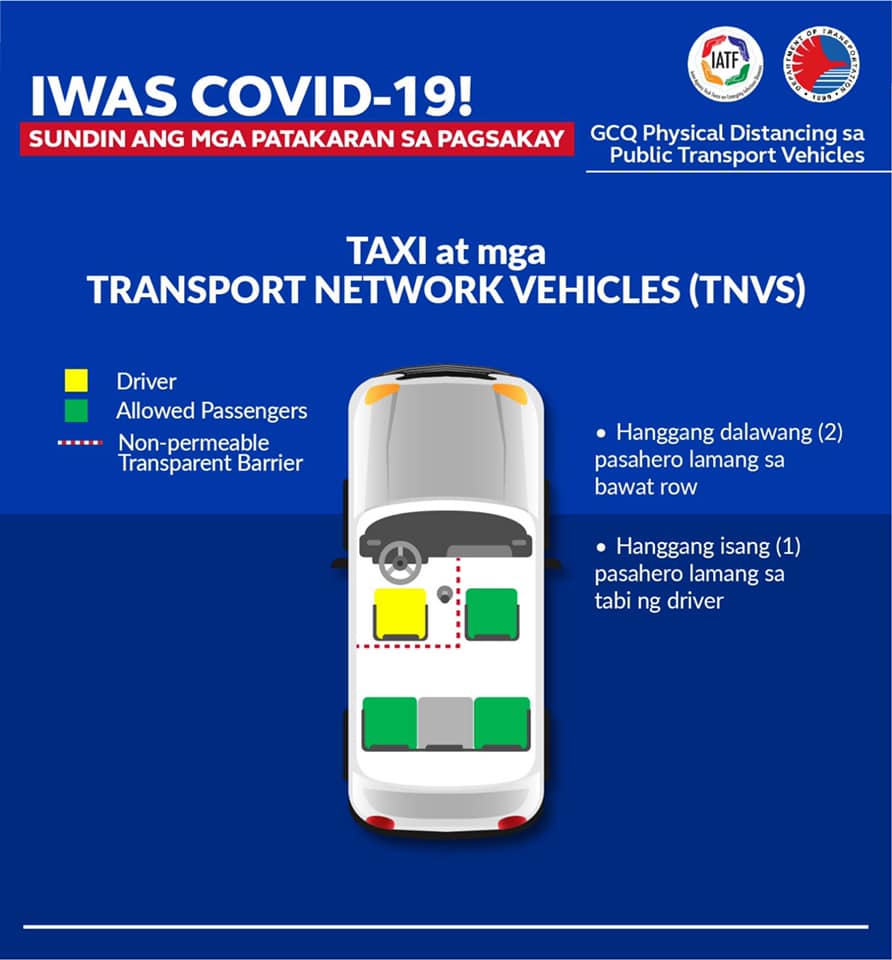

The last image for the tricycle is something that should have been allowed at least for a limited number of tricycles during the ECQ period. That could have eased transport woes for many people especially those who had to walk long distances in order to get their supplies. Some LGUs like Davao were able to issue Executive Orders to that effect that the IATF did not contend (or is Davao a special case?). Now, we see a lot of LGUs issuing EO’s and ordinances allowing public utility tricycles to operate again but limiting their numbers through odd-even schemes. Perhaps the same should be applied to pedicabs or padyak (non-motorized 3-wheelers), too.
–
On Davao’s Executive Order No. 23 allowing tricycles as a transport mode during the ECQ
The other day, I posted about the Pasig City Ordinance promoting cycling or the use of bicycles for transport during the Enhanced Community Quarantine (ECQ) or lockdown period. Here is the Executive Order issued by the Davao City mayor where tricycles are allowed by the city (i.e., one driver and one passenger only) as a form of transport. The justification by the City Mayor in subsequent statements and interviews is so simple and common sense that you wonder why such cannot be allowed in other cities like Pasig, which at first allowed tricycles (also with the one driver, one passenger set-up) but was rebuked by national government for their alleged violation of rules set out by the task force in-charge of the nationwide ECQ. While the Davao Executive Order is in itself a formal document and statement, it is interesting to note that after issuing the EO, the Davao City Mayor, who happens to be the daughter of the Philippines’ President, also issued a statement that basically says she will answer all queries and criticisms of this EO; short of threatening those who will oppose it. Surprisingly or not surprisingly, depending on which side of the fence one is, national government was mum about the EO and let Davao be. Thus, it now presents a precedent for other LGUs to follow or invoke. Otherwise, there will be a double standard and it will seem as if Davao will always be a special case.



–
Modified sidecars for tricycles
I googled the modified tricycles that I remembered was featured on TV before. Here’s what I’ve found from a news program of ABS CBN.
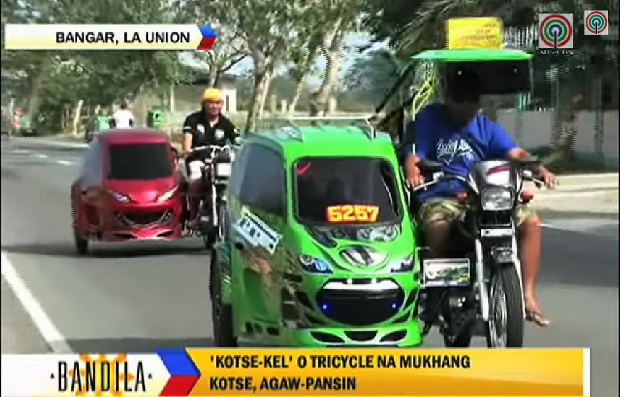 Credits to Bandila for this image of tricycles in La Union province.
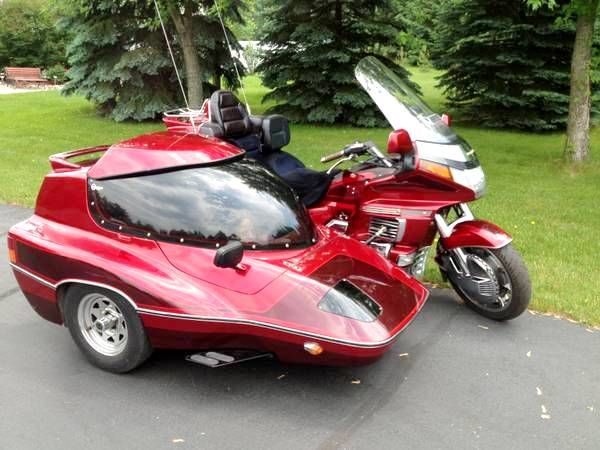 Here’s from another internet source showing a rather sporty sidecar and a motorcycle that comfortably seats 2 people.
There are many tricycle sidecar makers around the country. Many of these are home industries or small shops that make and sell few sidecars. At times, the products are on-demand. As the first photo showed, it is possible to come up with sleek designs from our local shops.
During this quarantine period and sfter we get through this COVID-19 challenge, perhaps we should rethink how transportation system should be to ensure not just road safety but also safety from other health hazards as well. Of course, that is something we should take on together with other issues (e.g., employment, city planning, housing, health care systems, etc.) that are now so obvious we have no excuse of not taking notice of them.
–
Use and modification of the tricycle for the quarantine situation
With the whole country practically in quarantine to contain the spread of the COVID-19 virus, transportation has become very difficult to many people requiring services as the commute mainly between their homes and places of employment or work. First and priority are the frontline workers – medical personnel like doctors, nurses, technologists and other health and allied workers battling to detect, test and treat people with COVID-19. Our uniformed personnel in the armed forces and police as well as barangay officials and tanods are also doing their part in containing this virus. And then there are many who need to go to their workplaces to earn a living – not all have the luxury of working from home despite its necessity in these times. While there are vehicles to shuttle frontline workers, there are fewer for those who don’t have their own (private) vehicles. Mayors have taken the reins, it seems, for managing the situations in their respective areas and many have stepped up in trying to bridge the gaps including those for transportation.
The subject of this post is the contention by national government officials that tricycles cannot be permitted for public transport because the desired social distance cannot be attained for the trike. Many, including me, have opined that it can, given some modifications (or add-ons), and subject to the driver and passenger (one passenger only!) exercising caution and wearing the required protective gear. I picked up the following drawing showing a modified tricycle:
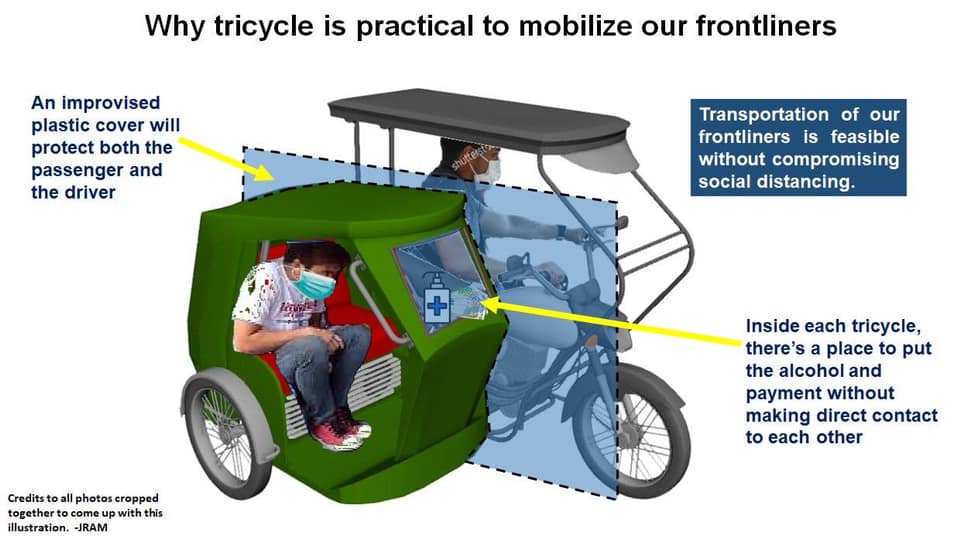
[Credits to Jini Maraya for her idea and illustration]
The set-up could also be applied to pedicabs or padyak – the non-motorized version of these tricycles. Operationally, too, I would suggest that only a limited number of tricycles be allowed to transport people per day. The purpose of the quarantine will be defeated if we had hundreds or even thousand of tricycles roaming our streets with their drivers looking for fares. Perhaps a system can be devised to determine the optimum number per day. Perhaps LGUs can even take control of the trikes and pay their drivers so as to make their services free to those needing it (e.g., people going to the market or grocery for food, people going to drugstores to purchase medicines, etc.). And so the idea of Pasig Mayor Vico Sotto can work. It is not so difficult after all to refine his idea so it will comply with the requirements of the situation. As they say: “Kung gusto gagawa ng paraan. Kung ayaw, maraming dahilan.” [Very roughly – there are so many excuses for stuff certain people don’t want to try out.] This also shows we need to use more brain cells during these challenging times. Promise, it won’t hurt! 🙂
Take care and keep safe everyone!
–
 Caught (up) in traffic