
Home » Academe (Page 11)
Category Archives: Academe
Special lectures on transportation after the 2011 tsunami in Japan
We recently had the honor of hosting two professors from the Tokyo Institute of Technology (Tokyo Tech). Prof. Tetsuo Yai was an adviser to two (2) faculty members of the Institute of Civil Engineering of UP Diliman and Dr. Daisuke Fukuda was adviser to a former student of ours who is now with De La Salle University. While both are in the transportation field, their laboratories are located in different campuses of Tokyo Tech. Prof. Yai’s laboratory is at the Suzukakedai campus in Yokohama while Dr. Fukuda’s lab is at the main campus in Ookayama where Prof. Yai used to have his laboratory.
Prof. Yai delivered a lecture on “The Progress of Miyako Recovery Plan from Tsunami Disaster” while Dr. Fukuda presented on the “Impacts of Rolling Blackouts on Railway Transport Service in Tokyo Metropolitan Area after the 2011 Tohoku Earthquake.” The lectures were held at the Toyota Training Room of the National Center for Transportation Studies (NCTS) with an audience comprised mainly of graduate and undergraduate students of Civil Engineering.
 NCTS Director Sean Palmiano opening the lectures and introducing Prof. Yai to the audience.
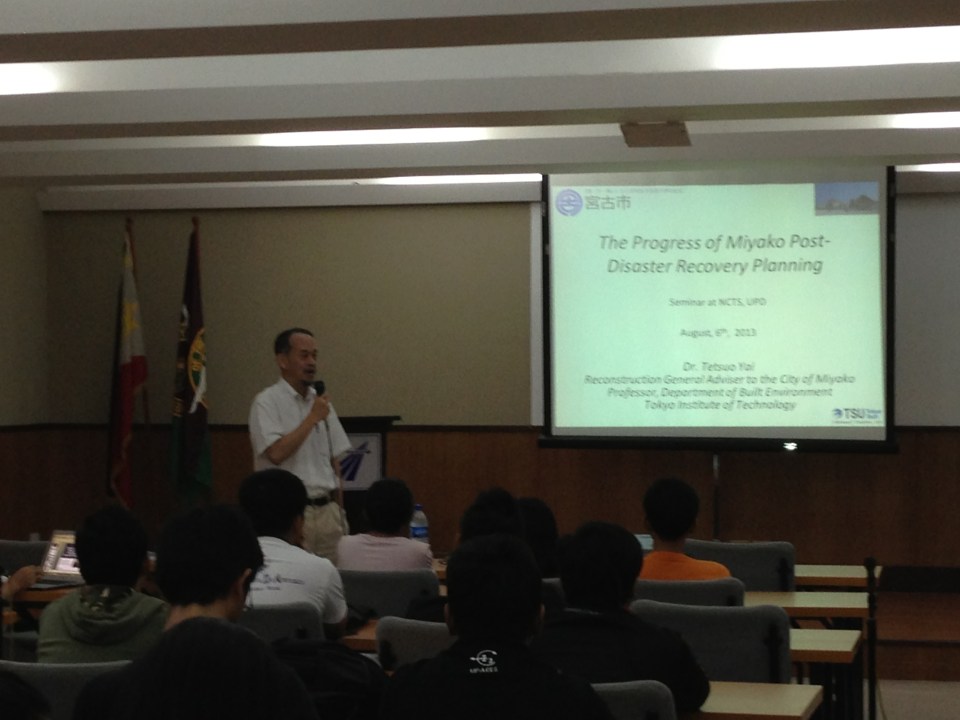 Prof. Yai introducing his topic and talking about the earthquake and tsunami that hit the Tohoku region in 2011.
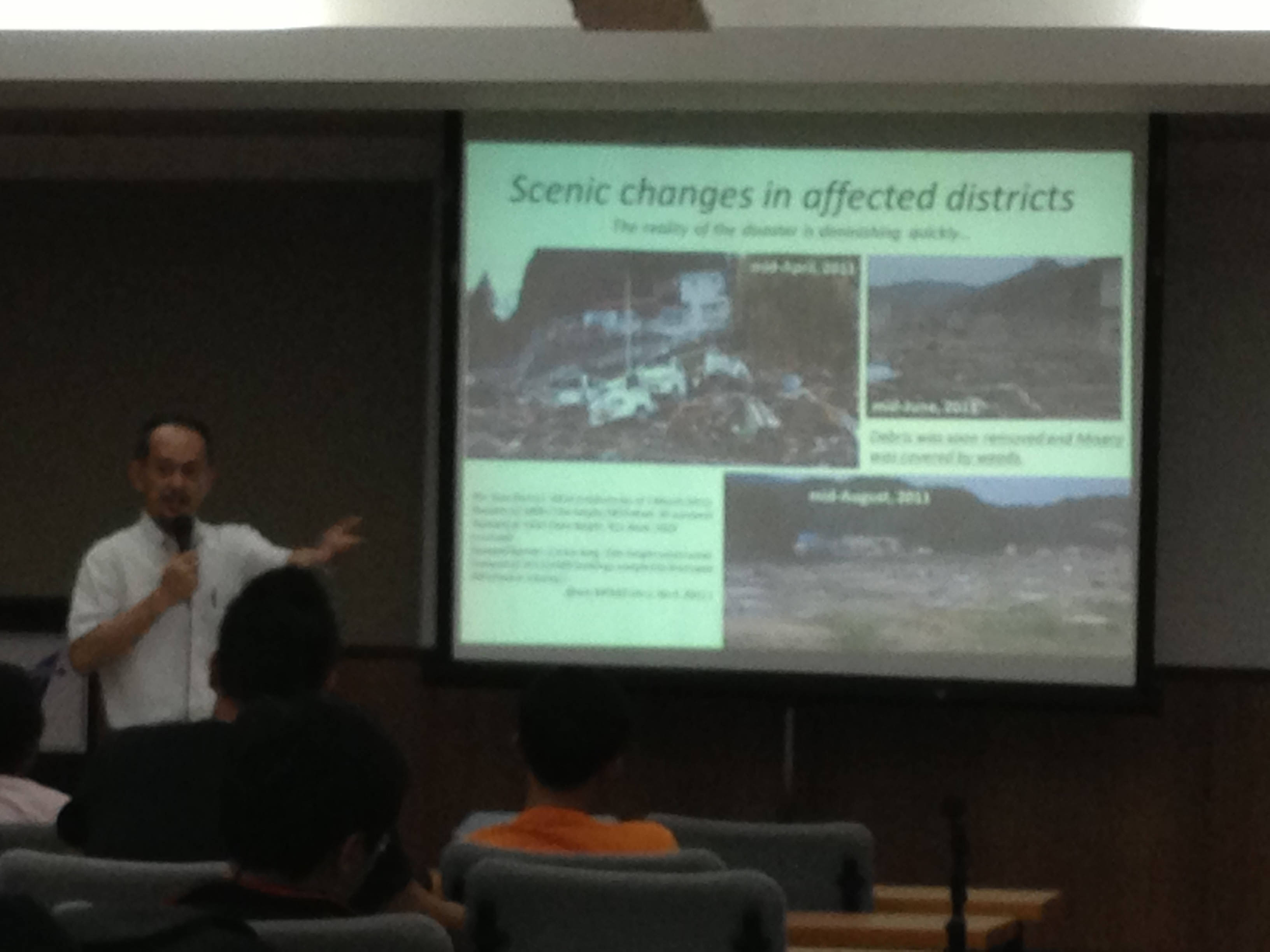 Prof. Yai explaining about the effects of the tsunami on Miyako City and the initiatives for recovery.
 Dr. Fukuda describing the urban rail network in the Tokyo Metropolitan Area.
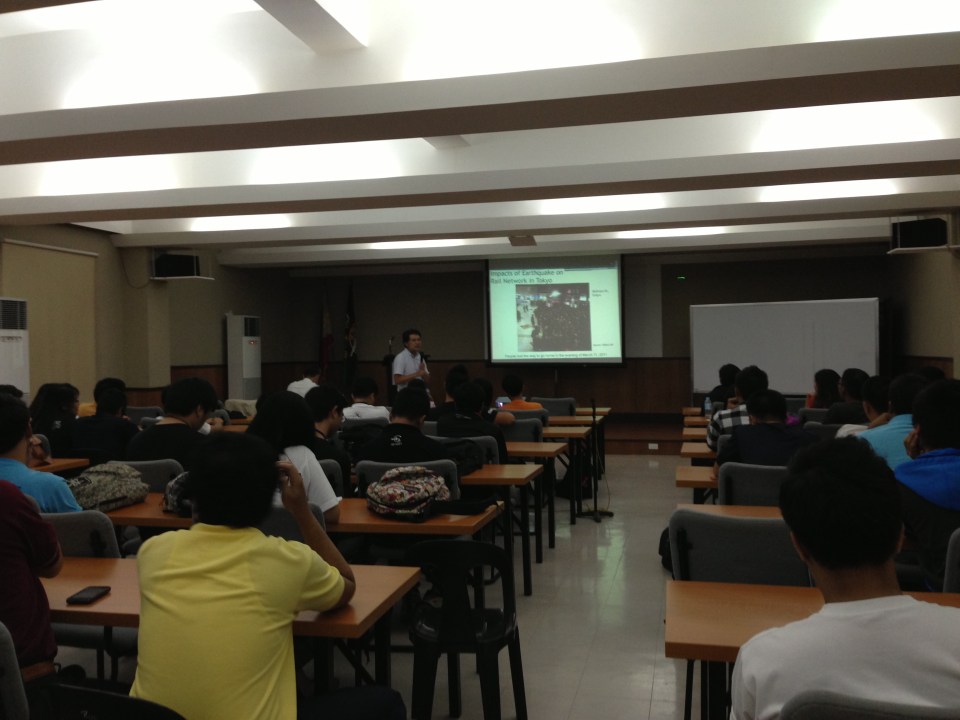 The lectures were well-attended.
 Dr. Fukuda explaining on the impacts of blackouts on rail transport and commuting times in Tokyo and its surrounding areas.
–
Transport related topics in the 2013 UP College of Engineering Professorial Chair Colloquium
The College of Engineering of the University of the Philippines Diliman is holding its Professorial Chair Colloquium on July 11 and 12, 2013. These will be held mainly at the Melchor Hall, which has been the home of the College since it transferred to Quezon City after the Second World War. The colloquium is an annual event where Professorial Chair holders deliver lectures on selected topics of research being undertaken in the various institutes and departments of the college.
On July 11, 2013 (Thursday) at the Geodetic Engineering Theater, 4th Floor, Melchor Hall, U.P. Diliman:
- Dr. Hilario Sean O. Palmiano, Institute of Civil Engineering, “Traffic Noise Perception in UP Campus Dormitories” [DMCI Developers Professorial Chair] – 0950 to 1010.
- Dr. Nathaniel B. Diola, Institute of Civil Engineering, “Blended Cement for Road Construction” [Prof. Jose Ma. Diago de Castro Professorial Chair in Civil Engineering] – 1010 to 1030.
- Dr. Ricardo G. Sigua, Institute of Civil Engineering, “Blackspots and Their Identification” [Primary Group of Builders Professorial Chair Award in Engineering] – 1050 to 1110.
On July 12, 2013 (Friday) at the Maynilad Room, 3rd Floor, Melchor Hall, U.P. Diliman:
- Dr. Jose Regin F. Regidor, Institute of Civil Engineering, “Transport Infrastructure, Poverty and Inclusive Growth” [Pozzolanic Philippines Inc. Professorial Chair] – 0910 to 0930.
- Asst. Prof. Gerald Jo C. Denoga, Department of Mechanical Engineering, “Optimization of Parallel-Series Hybrid Powertrain for Public Transportation” [Emerson Professorial Chair in Engineering] – 0930 to 0950.
- Dr. Karl B.N. Vergel, Institute of Civil Engineering, “Evaluation of Compliance of Specifications of Customized Local Road Vehicles (CLRV) with Local Regulations and International Standards” [Maynilad Professorial Chair] – 0950 to 1010.
- Dr. Edwin N. Quiros, Department of Mechanical Engineering, ” Coconut Methyl Esther (CME) Performance and Emission Characteristics Using a Common-Rail Direct Injection (CRDI) Engine” [Emerson Professorial Chair in Mechanical Engineering] – 1010 to 1030.
Dr. Palmiano is the current Director of the National Center for Transportation Studies (NCTS). Dr. Diola is the immediate past Director of the Building Research Service (BRS). Dr. Sigua is the head of the Road Safety Research Laboratory (RSRL) of the NCTS. Dr. Regidor is past Director of the NCTS. And Dr. Vergel is the head of the Transport & Environment Laboratory of the NCTS.
Asst. Prof. Denoga is the past Chair of the Dept. of Mechanical Engineering (DME) and has led teams in the design of vehicles that participated and won in international competitions on energy efficient vehicles, representing the country and the university in these contests. Dr. Quiroz is the head of the DME’s Vehicle Research and Testing Laboratory (VRTL).
These lectures as well as others on the mornings of July 11 and 12 are open to the public. Venues are at the Melchor Hall (along the Academic Oval), and the UPAE Hall and the EEEI Building at the College of Engineering Complex along Velasquez Street (across from the College of Science complex).
–
MNTC Donation to UP-NCTS Road Safety Research Laboratory
The Manila North Tollways Corporation (MNTC) recently donated software and equipment to the University of the Philippines Diliman’s Road Safety Research Laboratory (RSRL) at the National Center for Transportation Studies (NCTS). Gracing the Turnover Ceremony were no less than MNTC Chair Manuel V. Pangilinan and UP System President Alfredo E. Pascual. Dr. Hilario Sean O. Palmiano, the current NCTS Director, welcomed guests from MNTC and its parent firm Metro Pacific Tollways Corporation as well as from UP and the media. Dr. Ricardo DG. Sigua provided a background on the RSRL and how the donated equipment would help in the implementation of researches. The following photos show some highlights of the Turnover Ceremony last April 11, 2013.
 UP President Alfredo E. Pascual shaking the hands of MNTC Chair Manuel V. Pangilinan after they delivered messages during the Turnover Ceremony held at the NCTS. Looking on are Road Safety Laboratory Head Dr. Ricardo Sigua and NCTS Director Sean Palmiano.
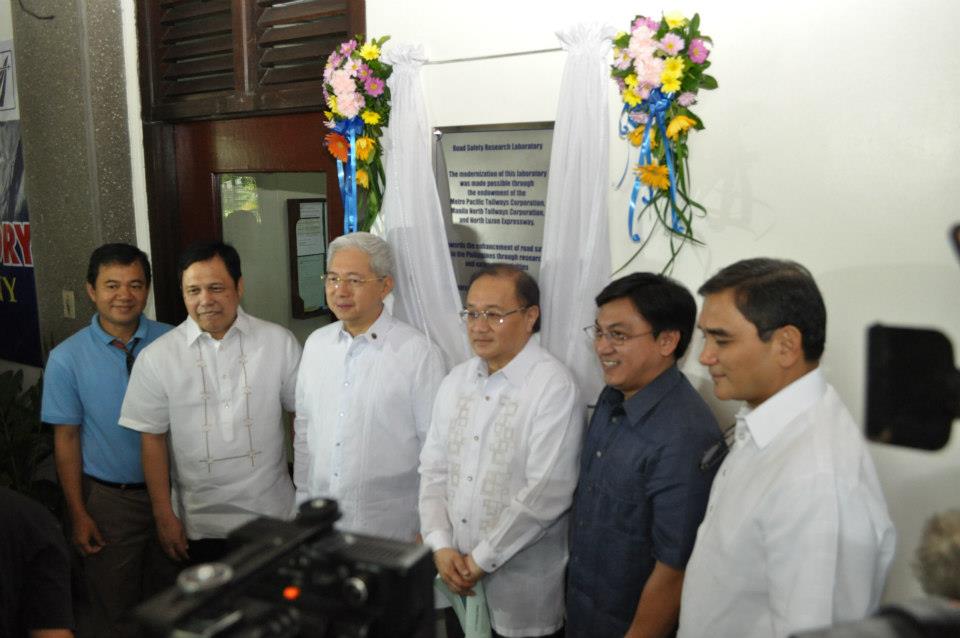 Unveiling of the plaque by (L-R) Dr. Ric Sigua, MNTC President & CEO Rodrigo Franco, UP Pres. Alfredo Pascual, MNTC Chair Manny Pangilinan, Dir. Sean Palmiano, and Metro Pacific President & CEO Ramoncito Fernandez
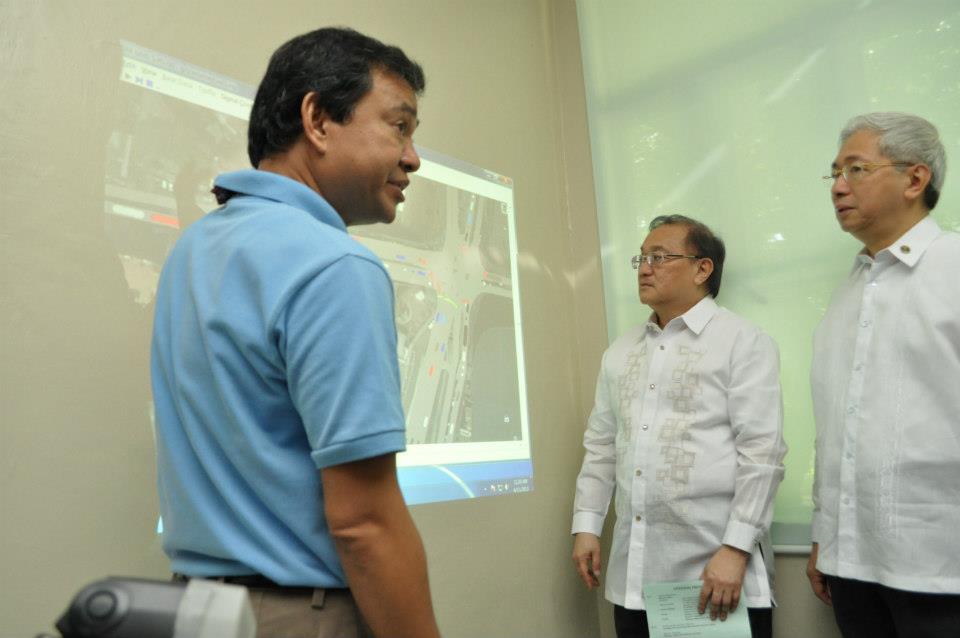 Dr. Sigua demonstrating VISSIM, one of the software donated by MNTC to UP-NCTS
 MNTC Chair MVP making a point about the microsimulation demo as UP Pres. Pascual looks on.
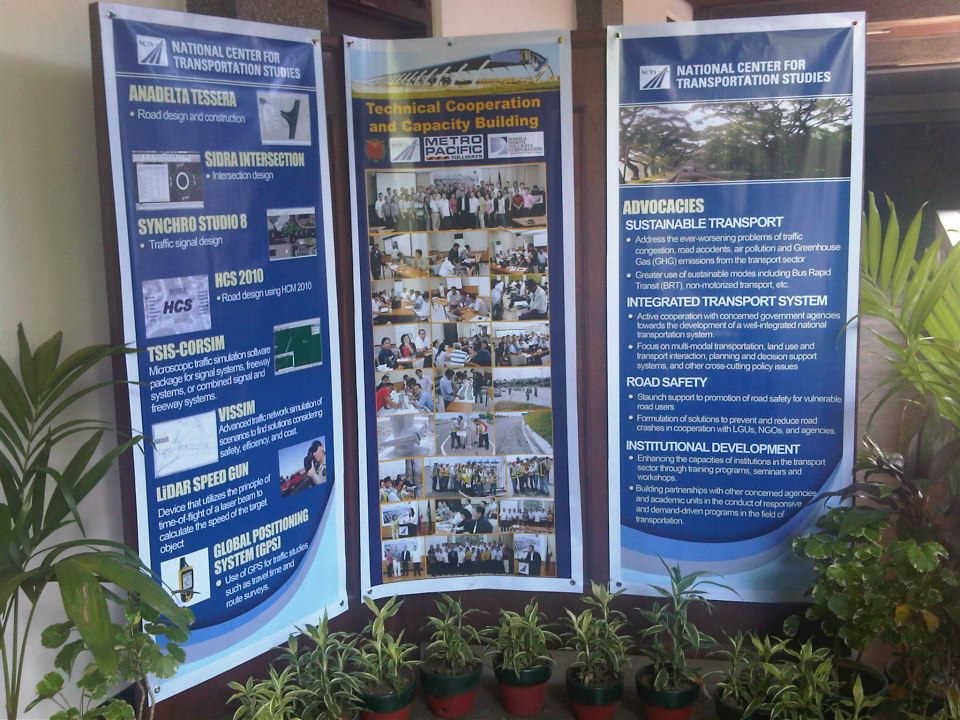 Tarps on display showing a list of donated software and equipment, photos of technical cooperation and capacity building between NCTS and MNTC/MPTC, and the advocacies of NCTS.
The following links are for news items on the turnover:
AKSYON TV ANDAR NG MGA BALITA Road Safety Lab binuksan para sa pagaaral ng kaligtasan sa kalsada
http://article.mediabanc.ws/stream/default.aspx?cc=T0T06d8bb4U%3d&file=k177n0SVBnt2RaICvoFJhiFjxgfZyCtN6NoXOXnMSGyal1UJ64YKNpL2BU77bIOvciz4Fow7jHs%3d&title=t52vKVnKl2UOiPwLKMoBIY7qOmbKBwO1BvxSsh3vvK9bxrfWReUGvonLroiSCcRES9sS3xiZeZJwE1Fge2YBny9SUwnOgsxVTV5 AKSYON Dalawang aksidente kada minuto nangyayari sa buong mundo
ayon sa pag aaral
http://article.mediabanc.ws/stream/default.aspx?cc=T0T06d8bb4U%3d&file=k177n0SVBnsls4maYTmszSUZ5hGB8cannnCtIw38rXSPzVAYSki5Ja9OXLfu2SRW0MoCtizKBHI%3d&title=lpnzG7ZYupO9oIfbLTmmnyPuzDcsckTf7KQri2OPzrjD3PZBucpQvITV0xUGBlObShdIgViH%2fltBVsTf70AwjRR5y3I
+hqdT0uag3PAgkU0%3d
[Note: To view the videos, you must have Microsoft Silverlight installed on your computer.]
–
New Director of UP’s National Center for Transportation Studies
The National Center for Transportation Studies (NCTS) of the University of the Philippines (UP) has a new head. Dr. Hilario Sean O. Palmiano formally took over the reins of the NCTS from Dr. Jose Regin F. Regidor. Dr. Palmiano is an Assistant Professor of the Institute of Civil Engineering of the UP College of Engineering. He obtained his doctorate and master’s degrees from the Tokyo Institute of Technology (Tokyo Tech) and his baccalaureate degree in Civil Engineering from UP Diliman. His researches are mainly on road safety and non-motorized transport.
 Staff and Fellows of the National Center for Transportation Studies with its new Director, Dr. Sean Palmiano, in the center of the front row. Also in the photo are former Directors, Dr. Ricardo Sigua, Dr. Hussein “Tho” Lidasan and Dr. Regin Regidor. At center of the 2nd row is Dr. Mario Delos Reyes, current Dean of UP’s School of Urban and Regional Planning (SURP).
–
Special lectures on Traffic Engineering and ITS
The National Center for Transportation Studies hosted a series of lectures by a visiting professor last November 27 and 28, 2012. The lectures were delivered by Dr. Takashi OGUCHI, Professor, Department of Human and Social Systems and the Advanced Mobility Research Center of the Institute of Industrial Science of the University of Tokyo. Dr. Oguchi is currently a Visiting Professor under the Engineering Research and Development for Technology (ERDT) Program of the Department of Science and Technology (DOST) and is hosted by the Institute of Civil Engineering (ICE) of the UP Diliman College of Engineering.
The lecture on Nov. 27 was on Traffic Engineering and was well attended by students, UP staff and guests from government agencies. Dr. Oguchi lectured on the basic concepts of traffic flow theory including bottleneck phenomena.
 Dr. Oguchi talking about traffic congestion
 The NCTS Toyota Training Room was full with participants including students, staff and guests from government agencies.
 Dr. Oguchi explaining about the difference between time mean speed and space mean speed using an illustrated example.
The lecture on Nov. 28 was on Intelligent Transport Systems (ITS)
 Dr. Ric Sigua of the ICE introduces Dr. Oguchi before the latter’s lecture. Like the previous lecture, the venue was full with attendees from UP and government agencies.
 Dr. Oguchi also spoke about the ITS World Congress to be held in Tokyo next year.
 Dr. Oguchi fields a question from Dr. Eric Cruz of the ICE during the open forum right after the lecture.
–
Carbon footprint accounting tool development
The French Development Agency (AFD) is supporting the capacity and capability building for Greenhouse Gas accounting for transport projects in the Philippines through a project connected with the current initiatives on Bus Rapid Transit (BRT). Part of their engagement is the development of a tool for assessing carbon footprints of transport projects that can easily be used by officials and staff involved in evaluation work. Consultation seminars were conducted last July with various agencies and particularly the Department of Transportation and Communications (DOTC). And technology transfer is being undertaken through the National Center for Transportation Studies of the University of the Philippines Diliman, which will also be tasked with sharing the knowledge and providing training for the use of the tool for other users as well. A series of trainings were recently conducted by the consultant, Carbone 4, a Paris-based firm that was engaged by AFD for the project.
 Julien Blanc of Carbone 4, the firm appointed by AFD to develop the GHG accounting tool, explains the features of the software.
 NCTS Fellows, staff and graduate students participated in Day 1 of the training. Days 2 and 3 involved participants from various government agencies invited for the 1 day training.
 Everyone was required to have a computer to have hands-on experience on using the tool with exercises provided by Julien.
 In certain cases, Julien had to help out when some features did not work on some of the computers or when some participants had different results from what was expected from the exercises.
 The tool is MS Excel-based and employs macros for calculations and to produce the graphs illustrating outputs such as fuel efficiency profiles for vehicles.
The tool is not yet completed as there are still features to be included but it is already a working version that allowed us to input values and manipulate the tool for familiarity. The tool was developed using MS Excel and employs macros for calculations and the production of graphs to illustrate outputs such as comparative fuel efficiency profiles for vehicles having different engines. The tool should be compatible with computers running the Windows or OS-X (Mac) systems.
–
Taming the beast(s) of traffic
An article came out of Rappler last weekend referring to addressing one of the most persistent problems in Metro Manila – traffic. It is a problem that is the result of years of neglect, poor planning, inconsistencies and a lack of foresight for future transport needs.
“Perhaps there are more than one beast to talk about considering that there is not one cause of the transport and traffic problems we experience everyday in Metro Manila (and elsewhere). We love ranting about how traffic is bad and how other people should leave their cars at home and yet we do little ourselves to pitch in to improve the situation. And so we are beasts ourselves in this manner. The discussions on public transport and road infrastructure have been going on since perhaps the author decided to practice transportation engineering. What has changed? Have things improved or have they worsened? It is really difficult to effect change when decision-makers and policy-makers are short of memory or have no memory or understanding at all of what’s going on. It seems that we are always starting on a clean slate every time someone new is at DOTC, DPWH or whichever agencies are supposed to handle transport and traffic in MM (and the country). Perhaps some criteria should be applied to whoever will be in-charge of transport and traffic, and one should be that the person or persons should be someone taking public transport to the workplace. At the least, we can be assured that he/she has first-hand experience of the painful way we travel each day and lead the person to really work towards improving transport in this country.”
I don’t usually write replies or comments on material posted online. I believe it is a very public platform and nowadays, when there’s a lot of talk on items like plagiarism, transparency, freedom of information, etc., it seems so easy to solicit opinions and comments from anyone who would care or dare post one. And transport and traffic seems to be a topic where everyone has his/her own opinion so much so that some people tend to project themselves as experts on the topic. Nevertheless, I thought that an opinion was necessary in order to offer another perspective on the matter of the “beast.” I would like to believe that in our case, we probably have had one too many “thought leaders” in transport and traffic. It is time that we also have “action leaders” who would do rather than simply say or write. We need people who will practice what they preach and actively and willingly contribute when called upon for help in solving this traffic mess we are in.
–
Undergraduate research topics on transportation
Our undergraduate students are presenting today and are divided into two groups: those presenting research proposals under the CE 190 course and those presenting the outcomes of their research implementation unse CE 199. Following are topics related to transportation as administered by their respective groups under UP Diliman’s Institute of Civil Engineering and associated with the University’s National Center for Transportation Studies (NCTS) and the Building Research Service (BRS).
Research proposals (CE 190)
Transportation Engineering Group (TEG)
- Study on Parking Supply and Demand in UP Diliman (Jonard Apilado and Kathleen Perez)
- An Assessment of Heavy Vehicle Factors and Other Current Practices Relating Traffic and Pavement Design (Maricar Biscocho)
- Trip Generation and Trip Distribution Modelling of Lipa City (Dominic Aloc and Jan Aaron Amar)
- Compliance of Jeepneys with Selected National Vehicle Regulations and Standards (Raphael Dela Cruz and Abhigael Marabut)
- Development of Bus Passenger Origin-Destination Table of EDSA-Commonwealth Avenue Routes (Angelica Neri and Abigail Sunga)
- Development of Bus-Passenger Origin Destination Table for EDSA Bus Routes with Turnaround Points Covering Southern to Northwestern Metro Manila (Jake Aaron Chua Yap)
- Improving the Passenger Queue Conditions of North and Taft Avenue Stations of Metro Rail Transit 3 (Michael Macaraig and Marc Cyril Tuazon)
- Identification of Traffic Bottlenecks inside UP Diliman Campus (Diana B. Andino)
- Locational Analysis: Centralized Provincial Bus Terminals in Metro Manila (Carl Buzon and Franz Flores)
- Philippine Maritime Transport Safety: Analysis of Incidents over the Last 10 Years (John Michael Escarro)
- Blackspot Mapping of UP Diliman Campus Using Google Earth (John Michael Parco)
- Designing A Simple Procedure to Manually Count Traffic Volumes in Large Roundabouts (Patrick Nepomuceno)
- Designing Bike-friendly Intersections (Zara Alaira)
- Motorcycle lane safety evaluation (Fatima Cipriano and Karl Vicenta)
Research Implementation (CE 199)
TEG:
- Perception of Traffic Noise Inside U.P. Campus (John Carlo D. Villar and Michelle Monelle S. Quilatan)
- Level of Service of Pedestrian Facilities in University of the Philippines Diliman (Angel U. Gacutan and Maria Jenna M. Tan)
- The Assessment of the Effects of Billboard to Safe Driving (Dave Andrei Rivera)
- Analysis of the Presence of Urban Air Pollutants from Road Vehicles Within UP Diliman (Joshua Carlo S. Padilla and Tsuyoshi A. Sakurai)
- Assessment of Public Transport Supply and Demand Characteristics for the UP-Philcoa Route (Ms. Jessica Mae Anaque and Ms. Kylie Dianne Erika Landingin)
- Determination of Walkability Index of UP Diliman (Niki Jon Y. Tolentino)
Geotechnical Engineering Group:
- Simulation of the Bottom-Up Cracking Performance of Portland Cement Concrete Pavement (PCCP) with Cement-treated Sub-base using the Mechanistic-Empirical Road Design Framework (Ma. Karenina J. Lardizabal and April Anne Acosta)
Construction Engineering & Management Group:
- Comparison of Strength Parameters of Concrete for Road Application Using Different Types of Cement (Shioichiro S. Sato)
- Performance of Cement as a Stabilizing Agent for Selected Soil Classifications in Cement Treated Bases (Gerard Christopher Filart Lahoz)
–
Nomination for the next NCTS Director
The nomination process for the next Director of the National Center for Transportation Studies of the University of the Philippines is currently underway. The Nomination Committee is comprised of three members – Dr. Aura Matias (Dean, UP College of Engineering & Committee Chair), Dr. Mario Delos Reyes (Dean, UP School of Urban and Regional Planning), and Dr. Rene Rollon (Director, Institute of Environmental Science and Meteorology of the UP College of Science). The nomination was open to all qualified persons from the University and particularly from the units currently having an active part with the NCTS through the Research and Extension Fellows from these units (i.e., Engineering, SURP, National College of Public Administration and Governance or NCPAG).
As of the deadline last September 28, 2012 only one person has been nominated. The lone nominee is Dr. Hilario Sean O. Palmiano, an Assistant Professor from the Institute of Civil Engineering and currently the ICE’s Deputy Director for Students and Alumni. Dr. Palmiano previously held posts as technical staff of the NCTS, first as Transport Development Officer in the early 1990’s when the Center was still known as the Transport Training Center (TTC). Later, he was a University Extension Specialist and headed the Traffic Engineering & Management Group of the NCTS before eventually joining the faculty of the College of Engineering of UP Diliman. Dr. Palmiano graduated with a degree in BS Civil Engineering from UP Diliman and obtained his M.Eng. and Dr. Eng. degrees from the Tokyo Institute of Technology.
Formal presentations were made today including one on the accomplishments of the NCTS under its outgoing Director, Dr. Jose Regin F. Regidor, also from the ICE followed by Dr. Palmiano’s on his proposed plans and programs for the Center. The presentations were followed by an open forum and afterwards, interviews of stakeholders and the nominee by the Committee.
 Dr. Palmiano starting his presentation on his proposed plans and programs for the next 3 years.
 Dr. Palmiano reading from his notes during his presentation.
 The presentation was attended by staff and fellows of the NCTS.
The Nomination Committee is to complete their evaluation this week and submit their recommendation to the UP Diliman Chancellor next week. The new NCTS Director will assume his post from November 2012.
–
Loss of productivity due to congestion and inefficient public transport
I recently read two articles appearing in a major Philippine daily and a popular online site. The first one is an article that appeared in the Philippine Daily Inquirer – “PH economy losing $3.27B in human productivity due to traffic mess” – last September 25, 2012. The other article was posted on Rappler – “Traffic and infrastructure delays cost the Philippines” – last September 27, 2012. These were articles written after the authors’ attendance of what was an Energy and Infrastructure Forum last Sept. 25 where a transport official mentioned a recent study in his talk that estimates productivity losses of about 3.27B USD per year from Metro Manila traffic alone.
 Traffic congestion along Commonwealth Avenue
 Unusual traffic management scheme along Ortigas Avenue
The study from the National Center for Transportation Studies that was mentioned in both articles was actually first featured in a Yahoo! Philippines article – “Traffic congestion costs Metro Manila P137B per year” – that appeared a month earlier in Aug. 28, 2012. The study being referred to is actually a paper presented by Dr. Jose Regin F. Regidor in his Professorial Chair lecture at the University of the Philippines Diliman’s College of Engineering Colloquium in early August 2012. A copy of the paper may be found below:
Prof Chair 2012 JRFR 02July2012
The main reference for this paper is the study on congestion costs that was produced by the National Center for Transportation Studies back in 2000. Credits go to the core team of Dr. Ricardo Sigua (Institute of Civil Engineering of UP Diliman), Dr. Noriel Tiglao (now with the National College of Public Administration and Governance) and Dr. Val Teodoro (now in the US) for the study. The
Economic Impacts of Traffic Congestion in Metro Manila – Cover+Chap 1 and 2
Economic Impacts of Traffic Congestion in Metro Manila – Chap 3
Economic Impacts of Traffic Congestion in Metro Manila – Chap 4 and 5
Economic Impacts of Traffic Congestion in Metro Manila – Appendix
A much needed update may be possible in the next two years once the traffic model for Metro Manila is updated and calibrated using new data from Household Informations Surveys (HIS) and other transport and traffic surveys under the current MUCEP study that is supported by the Japan International Cooperation Agency (JICA). Hopefully, such a model can be updated and calibrated more often in order to assess losses due to congestion and our continuing inability to provide the necessary infrastructure to alleviate the situation. While the paper and the study mentioned above focus on productivity losses, it should be emphasized that there are other costs that should be highlighted including those related to health (respiratory diseases and road crash fatalities and injuries), energy (fuel consumption and inefficiencies), and emissions (carbon and other GHG).
–
 Caught (up) in traffic