
Home » active transport (Page 11)
Category Archives: active transport
On the future on urban transportation
I’m sharing the following article on the idea of mobility hubs in cities:
Descant, S (March 16, 2022) “Are mobility hubs the future of urban transportation?” Government Technology, https://www.govtech.com/fs/are-mobility-hubs-the-future-of-urban-transportation [Last accessed: 3/18/2022]
To quote from the article:
“As cities reimagine transportation and transit, they’re turning toward innovative attempts to bring multiple modes together, with the essential aim of making it easier for residents and others to choose a mode of travel other than the single-occupancy car.”
Though I support this idea, I think it only implies that housing issues are already covered. In reality, there should be clear-cut and simultaneous initiatives covering both housing and transport. In Metro Manila’s case, for example, the sprawl is over a much wider area and covers at least 4 provinces surround the metropolis where people have chosen to settle/reside due to the high and rising cost of housing in the MM. While the example of Tokyo and its railway lines may be used as inspiration, it will take a lot for Metro Manila to have such a transit network to carry so many people around MM+.
–
On bicycle economics in the Philippines
I am sharing this link to a newly minted reference that should be useful to policy or decision-makers (yes, that includes politicians) in justifying bicycle facilities including bike lanes around the country.
https://www.freiheit.org/philippines/bikenomics-assessing-value-cycling-philippines
There’s been a dearth in local references and this should suffice for now pending more in-depth studies on the benefits of cycling and related-facilities and programs in the Philippines. Note that while the reference mentions certain calculations and unit costs, it would be better to have the actual numbers from the various LGUs that have constructed bike lanes and facilities, and implementing bike programs and projects. Quezon City and Mandaue City, for example, should have the numbers that can serve as initial data for compiling and eventual publication of unit costs per type or design of bike lanes or bikeways. LGUs and national government should gather, process and make use of such data in aid of bike facilities and infrastructure development that will attract people away from private motor vehicle use while reinforcing both active and public transport mode shares.
–
Take a hike or a walk?
Here’s an interesting article calling for people to go out and spend some time with nature.
https://www.inverse.com/mind-body/doctors-free-nature-prescriptions-treat-chronic-diseases
The prescriptions mentioned are not at all new, content-wise but the article does mention that people tend to follow prescriptions from their doctors. Perhaps the prescription will be treated or perceived as a more serious matter compared to verbal ones that are interpreted as suggestions and not really all that serious? No matter, the important thing is to be active and keep walking, hiking, jogging or cycling.

–
On development density and transportation
The term ‘density’ here does not refer to transport or traffic density in the traffic engineering sense but to density of development such as urban density or building density. Here is an interesting article about building during a climate crisis. While it is very much applicable to any situation, the need to revisit plans and designs has become more urgent with the current pandemic.
Alter, L. (November 19, 2021) “What’s the Right Way to Build in a Climate Crisis?” Tree Hugger, https://www.treehugger.com/what-is-right-way-to-build-in-climate-crisis-5210156 [Last accessed: 2/23/2022]
There are mentions to various references throughout the article so it is not entirely an opinion piece but supported by evidence or studies. There is also a note that the article has been fact-checked. Quoting from the article:
“Adding gentle density can help ensure there are enough people in a neighborhood to support local schools, health, and community services and keep shops and restaurants open. It can provide a range of housing types and tenures that support the needs of individuals and families throughout all stages of life and allow for aging in place. It can also support public transit services, providing residents with efficient and affordable transportation options without relying on private automobiles.”
What do you think is the ‘right’ density for Philippine cities and municipalities?
–
Roadside bike repair stations
Walking along 38th Street at the Uptown side of Bonifacio Global City (BGC) in Taguig, I came along this mini bike repair station conveniently located along the bike lane and just across from the schools along the street. It had some tools and a pump. Typical of what a cyclist or biker may need in case some quick repairs, adjustments or tire inflation are required. The first time I saw something like this was along Commonwealth Avenue; provided by a bicycle group that helped promote bike-to-work along that corridor and Quezon City.

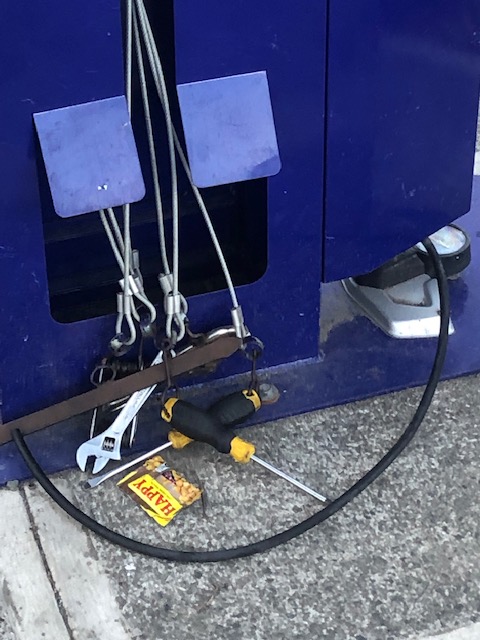

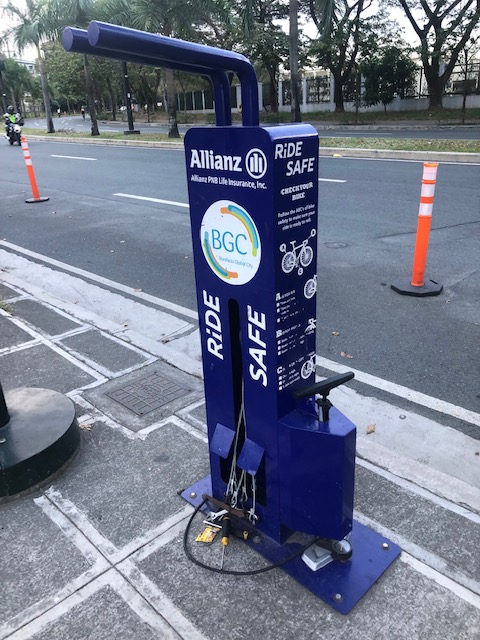
We need more of these especially along the major roads used by cyclists; especially those who bike to work. Granted that there are many bike shops and perhaps the vulcanizing shops as well as cyclists bringing their own tools and pumps but you never know when you will need some tools or perhaps a pump to inflate tires. Of course, these will need to be secured as there are people who have the propensity to steal, damage or vandalize tools.
–
Article on how cities can rapidly expand bike networks
With the increasing popularity of bicycles for utilitarian use (e.g., bike to work, bike to school, etc.), the need for strategies, programs and projects to support cycling has become more urgent. This is mainly to sustain the increase of bicycle use and partly to enhance the safety of cyclists. Here is an article that discusses how cities can rapidly expand bike networks:
https://www.urban.org/urban-wire/how-can-cities-rapidly-expand-access-cycling-infrastructure
To quote from the article:
“Our research points to several key recommendations for other cities hoping to expand their cycling infrastructure and encourage a more rapid shift toward biking and away from cars.
– Local governments can lead the implementation of a large-scale expansion of cycling infrastructure if local leaders can commit to ambitious, quantified mileage goals that will help structure how capital dollars are spent.
– Local implementation goals should include metrics related to increasing equity, particularly for people of color and those with low incomes. Although the Final Mile program increased the number of miles of cycling infrastructure, it did not directly prioritize the people who could benefit most from improvements.
– Philanthropic funders interested in supporting climate-friendly infrastructure should ensure their funds help hold local policymakers accountable to achieving their commitments instead of funding infrastructure projects directly. They can also encourage collaboration between cities and nonprofit advocates while working to fill local capacity gaps, such as through engineering consultants.”

Article on evaluating transport equity
Here is another quick share of an article on transportation equity:
Litman, T. (February 2, 2022) “Evaluating Transportation Equity: ITE Quickbite,” Planetizen, https://www.planetizen.com/news/2022/02/116058-evaluating-transportation-equity-ite-quickbite [Last accessed: 2/4/2022]
Transportation equity is a very relevant, very timely topic as people in the Philippines are just beginning to understand and weigh the advantages of having more efficient transport in the forms of active and public transport over private vehicles.
–
Some thoughts on mobility in Metro Manila
I spotted these two riding what appears as monocycles in Bonifacio Global City (BGC). I was taking a walk between our our building to get to another when I saw them crossing the intersection ahead of me.
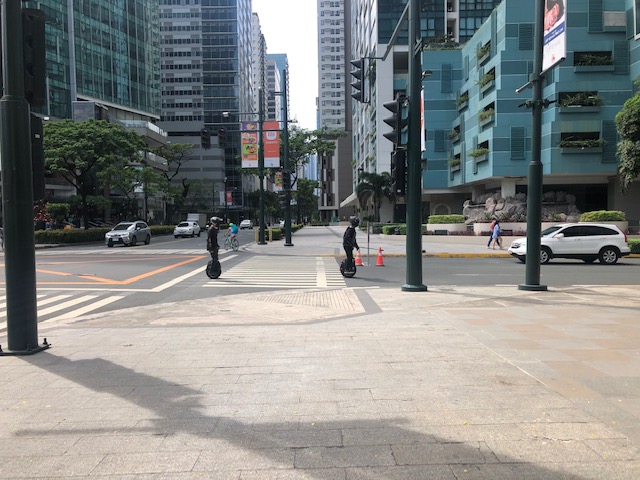
I thought these were cool modes of transport but I am unsure I can balance myself on these. I would more likely use a bicycle like the other guy in the photo (far side of the intersection crossing). I would also most likely use a bike on the sidewalk if this were allowed and also considering how wide the sidewalks there are. BGC also has protected bike lanes along certain roads so that’s another option if its prohibited to use your bike on sidewalks.
I keep mentioning sidewalks and how wide they are (at least in the photo) because we do need wide sidewalks that we can use for walking or cycling (basically moving about). It is always mentioned in various threads that we should plan and build our cities for the most vulnerable among us. That means a shift from the current car-centric set-up to a more people-oriented system. The latter requires more infrastructure for walking and cycling that includes wide sidewalks and protected bike lanes and paths. This also means more effort and resources will be required to improve public transport services since these have the most synergy and impact.
–
Cities and Automobile Dependence: What Have We Learned?
We end the year with an article from Todd Litman via Planetizen. The topic is something that we really need to ponder on as we or if we are to move towards more sustainable transportation for our cities and municipalities. The experiences during this Covid-19 pandemic should have provided us glimpses of how it could be if we put active and public transport above automobile dependence or car-centricity.
Source: Cities and Automobile Dependence: What Have We Learned?
The main article may be found here (in proper citation for academic/researchers reading this):
–
Lessons to be learned about e-scooters
I recently wrote about e-scooters and I am sharing this article on the experience of Chicago from their pilots of this emerging new mobility option.
I won’t be offering much in terms of opinions at this point as there really hasn’t been much about e-scooters at present in the country. You see them every now and again but not as frequently as motorcycles and bicycles. There seems to be something about them on social media but out on the road, they are not yet significant in terms of volume but are a concern regarding safety.
–
 Caught (up) in traffic