
Home » Public Transport » Terminals
Category Archives: Terminals
Fare rates for the Antipolo – Iloilo bus service
I found these information on fare rates for the newly opened Antipolo – Iloilo bus service:

The information above indicates that there are three routes to Iloilo:
1) On the left is the route via the central roads of Panay Island (i.e., via Passi City, Iloilo);
2) In the middle is the route to the east of Panay Island to Kalibo, Aklan and Roxas City, Capiz, and terminates at Estancia, Iloilo; and
3) On the rights is the route along the west and crossing the province of Antique. This terminates at Oton, Iloilo and will pass through the town of Miag-ao, which is famous for its church recognized as a UN Heritage Site.
To book a seat on the bus, here is the step-by-step procedure shared on social media on the official Facebook page of Robinsons Antipolo:
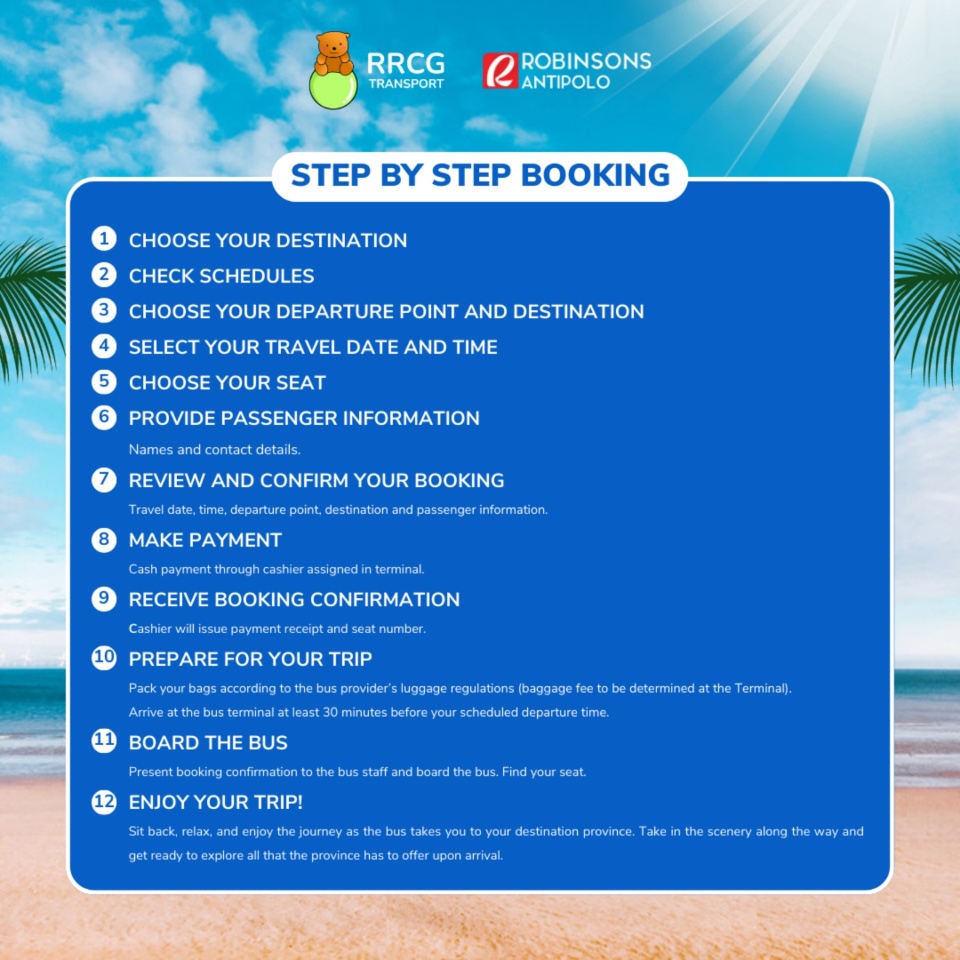
–
Antipolo to any point of the Philippines
I wrote several times in the past about every road leading to Antipolo. Recently, a new route opened between Antipolo and Iloilo. This is interesting for me since my father’s hometown, which I also consider mine, is Cabatuan, Iloilo. We usually flew to the province though we also rode on inter-island ferries when I was a child. I have memories riding on the ships operated by the now defunct Negros Navigation and Sulpicio Lines. I had never used the SuperFerry ships that now connect the major islands of Luzon, Visayas and Mindanao.
 Buses at the public transport terminal at Robinsons Antipolo include those regularly dispatched to Cubao and Quiapo. There are many provincial and RORO buses including those bound for the Bicol Region and Eastern Visayas (i.e., Samar and Leyte). The latter are operated by several bus companies including RRCG whose buses are shown in the photo.
 RRCG bus bound for Iloilo via Batangas, Mindoro, Aklan (Caticlan), and Antique. The fare to Iloilo City is 2,700 pesos. It’s 2,400 pesos until Caticlan.
 New sign for the route connecting Antipolo City and Iloilo City. Caticlan in the province of Aklan is along the way. I estimate the travel time to be roughly a day considering the bus will still go to Marikina’s transport terminal across from SM City Marikina. From there, the bus will proceed to Batangas Port via C5, SLEX and STAR Tollway. The bus will queue to be loaded unto a RORO ferry bound for Mindoro. It will travel by land to cross Mindoro Island before being transported via ferry from Mindoro to Caticlan.
 One bus company provides services to destinations in the Bicol Region. Both air-conditioned and ordinary (non-aircon) buses are available.
–
On the ‘modern jeepney’, consolidation and the modernization program
Last April 30, 2024, the deadline for consolidation of jeepney operators and drivers expired. That basically and generally meant the phaseout of individuality in so far as operators were concerned. It also meant, for many, the phaseout of the conventional jeepney in favor of the so-called ‘modern jeepney’, which are actually mini-buses by specs and design. There are many ‘modern jeepney’ models (I recently posted photos on these.). Some are better than others in terms of their features including the engine, seats, air-conditioning and suspension. Thus, there are models that are superior to the conventional jeepneys that are all practically custom built and utilizing surplus engines. Others may be of questionable quality as evidenced from reports that many are more prone to breakdowns than others. There is, of course, the issue of cost. These new vehicles are more expensive than conventional jeepneys and many individual operators cannot afford to purchase new units even with the current incentives government has provided. This is probably the bigger issue rather than the vehicles themselves despite claims pertaining to culture and aesthetics.
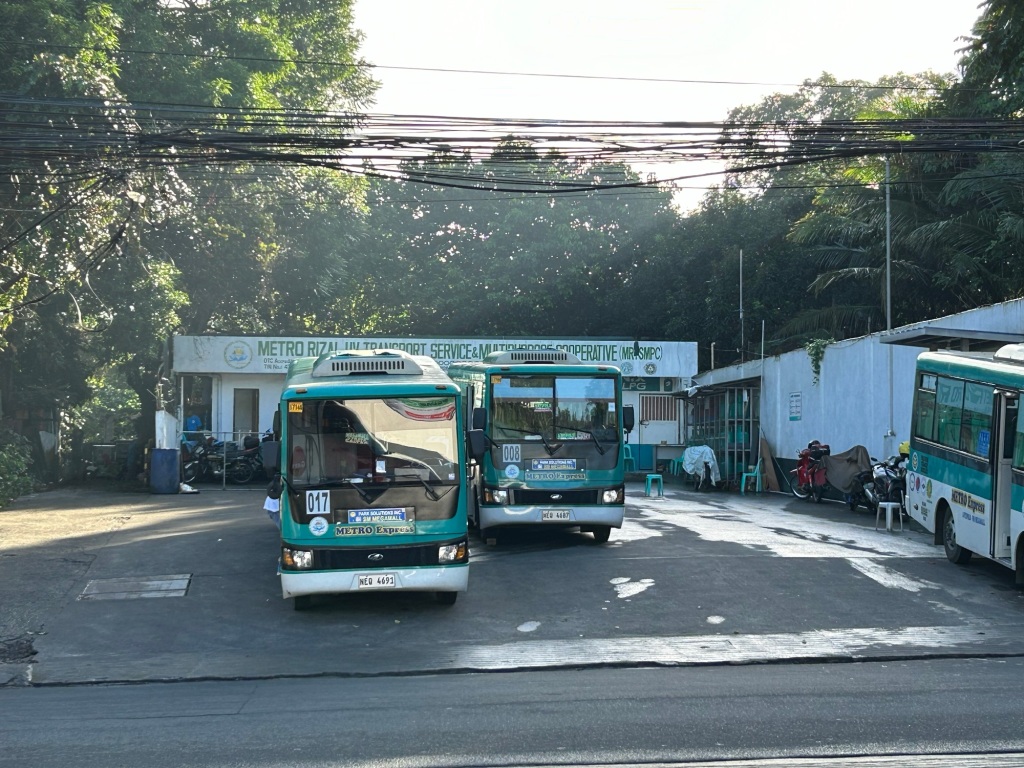
Operators and drivers were required to consolidate or organize themselves into cooperatives. Banks or other financial institutions were supposed to engage these cooperatives for financing the acquisition of new vehicles. While the DOTr has pushed for this, there seems to be a lot still lacking from their modernization program considering the feedback/ backlash it has received from stakeholders. The department has pursued modernization and rationalization at least more than 2 decades ago. These have not materialized for various reasons including shortcomings on the government side and the persistent resistance of the transport operators and drivers. The latter and their supporters though are not without fault as they have not provided viable alternatives aside from status quo.
–
Congestion near bus terminals during the Christmas season
I attended a formal event yesterday at the Philippine International Convention Center (PICC) in Pasay City. Along the way and back, I already noticed the congestion along Gil Puyat Avenue (formerly Buendia Avenue) as well as the congestion or how crowded the bus passenger terminals were. In fact, the buses at the JAC Liner terminal along Gil Puyat were all on the streets. The terminal itself was filled with passengers, many of whom were queued as they waited to board their buses. Others I assumed were in line to purchase tickets there. The latter apparently have not done so online, which is already an available and more convenient option for provincial travel.
 |
| Buses lined along the Makati-bound side of Gil Puyat Avenue. These are queued towards to the U-turn slot that will take them to the bus terminals on the other side and near Taft Avenue. |
 |
| Other buses are lined along the Pasay-bound side of Gil Puyat Avenue. These come from the South Superhighway where these buses eventually head to after boarding passengers en route to Southern Luzon, Bicol and even Visayas and Mindanao destinations. |
Then as now, the junction of Gil Puyat and Taft Avenues is a major convergence area for transportation especially provincial routes. Even before the construction of the LRT Line 1 (which has a station at Gil Puyat) there have been a number of bus terminals here. Currently, I am aware of the JAC Liner and DLTB bus terminal near the junction. There are others including small terminals or garages for provincial buses. These generate much traffic particularly during this Christmas, which is considered peak season for travel in the country.
–
On the Robinsons Antipolo Transport Terminal – again
I took the following photos of the transport terminal at Robinsons Antipolo last December 24. I have shared photos at the ground level and mostly close-ups of the buses, vans and tricycles that operate to and from the terminal. I was at the toy shop last Saturday for a last minute purchase and saw a nice vantage point to show the expanse of the terminal.
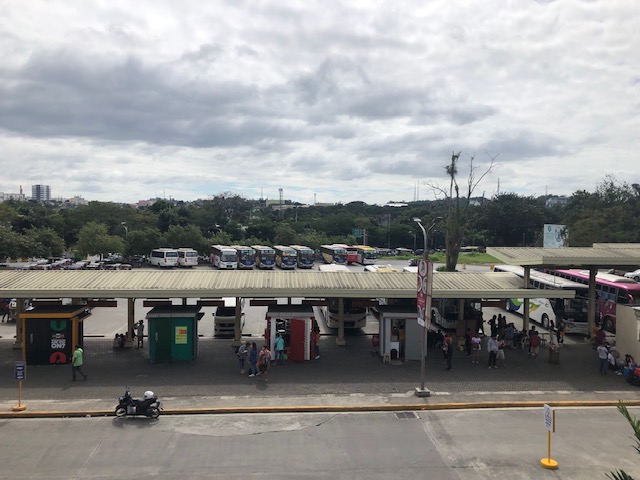 Bus ports and garage (in the distance)
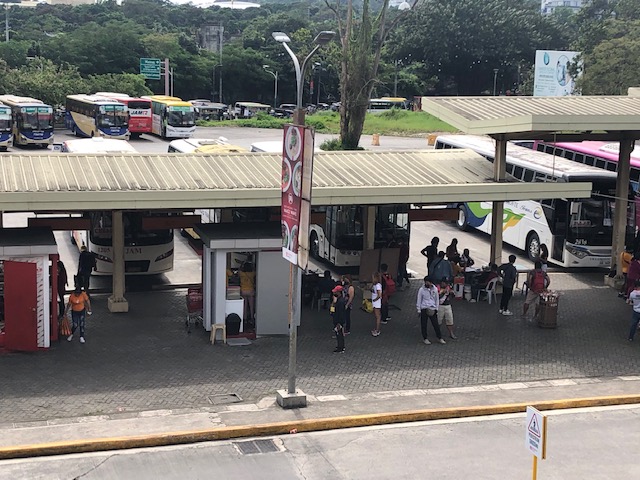 There are regular trips here between Antipolo and Cubao (aircon buses), Antipolo and Ortigas Center (P2P buses), and Antipolo and other provinces (Quezon, Bicol, Samar, Leyte and Bohol).
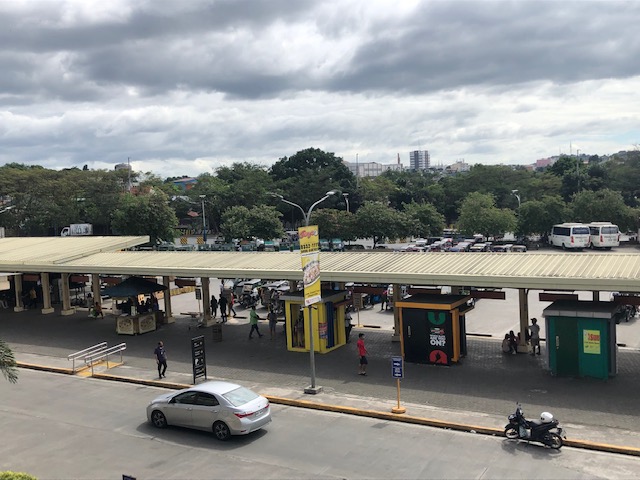 People can transfer to modern Jeepneys (actually mini buses) that ply the Antipolo-Marikina route or perhaps take a tricycle (conventional or electric) to their final destinations.
–
Commuting from/to Antipolo via the public transport terminal at Robinsons Antipolo
I was at the Robinsons Antipolo public transport terminal to take a P2P bus to Ortigas. I took a few photos before boarding the bus. The bus no longer terminates at Robinsons Galleria but instead goes to Greenhills. This is very convenient for people who need to go to Virra Mall or somewhere in its vicinity (e.g., Cardinal Santos Medical Center, LSGH, etc.).
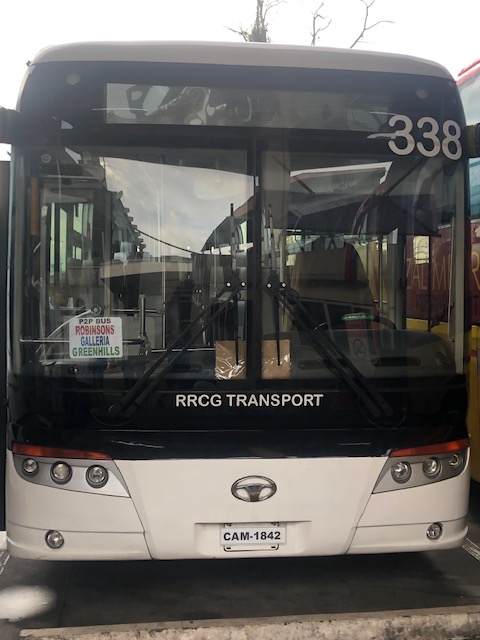
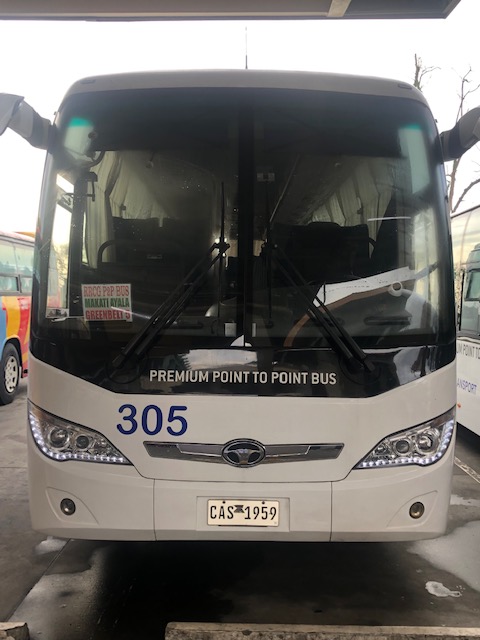
Then there are the buses plying the Antipolo-Cubao route via Sumulong Highway-Marcos Highway-Aurora Boulevard. These are regular aircon buses (not P2P) operated by various companies including G-Liner, RRCG, Jayross, etc. Below are photos of Diamond Star buses loading passengers bound for Cubao.
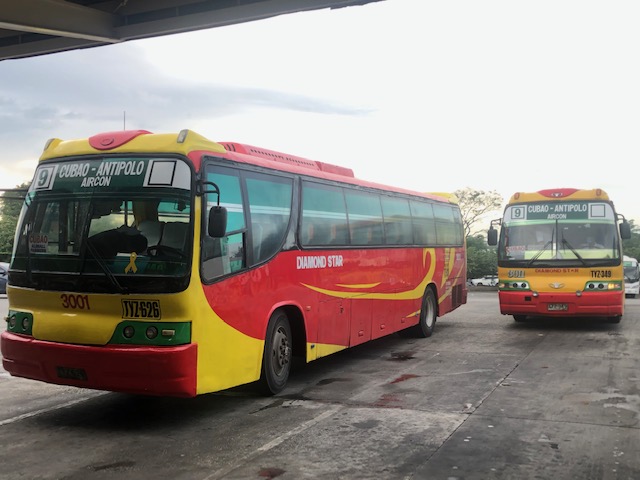
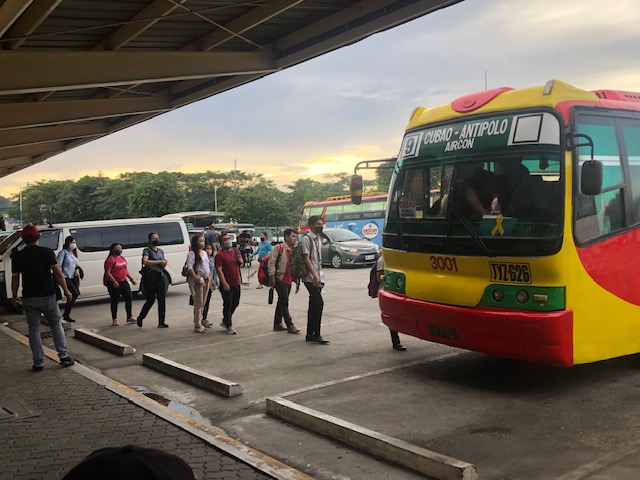
The lines can be very long depending on the time in the morning but I guess the assurance of a seat makes it worthwhile to go to the terminal rather than wait for the bus along its route. Passengers loads are practically back to pre-pandemic levels and with some jeepneys back, that means competition for the buses.
–
Some observations and thoughts about the EDSA carousel
Much has been written or said about the EDSA Carousel. This is the express bus service the government implemented along Metro Manila’s busiest thoroughfare, EDSA or Circumferential Road 4. I feel that it is a decent effort from government to address the lack of supply to address the huge demand for public transport along EDSA considering that it serves to also distribute trips collected from major roads connecting to it. Is it an admission of something wrong in terms of the transport infrastructure along EDSA? Perhaps and from the current administration and DOTr. The admission of flaws certainly did not or will not come from the previous administrations that failed to address problems pertaining to Line 3 including maintenance and operations issues.
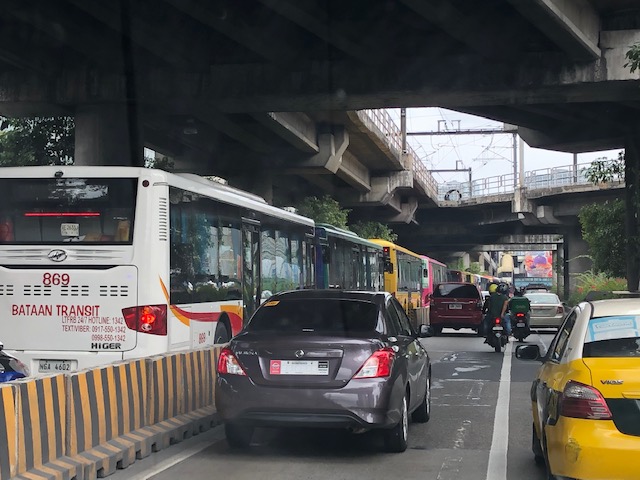 Buses queued before the Trinoma/North Avenue Station of the carousel. Overhead is the junction to the EDSA-MRT depot underneath Trinoma.
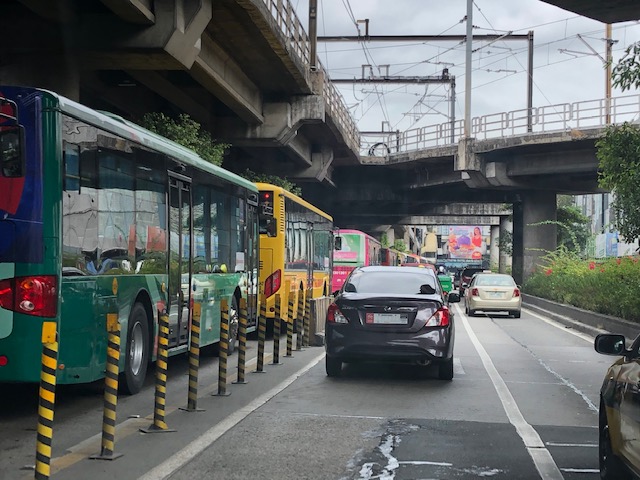 The overhead junction is the MRT’s branch to/from the depot
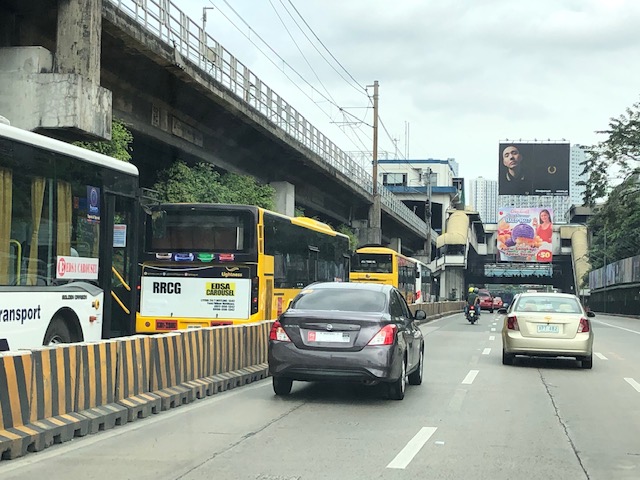 Buses queuing towards the North Avenue Station
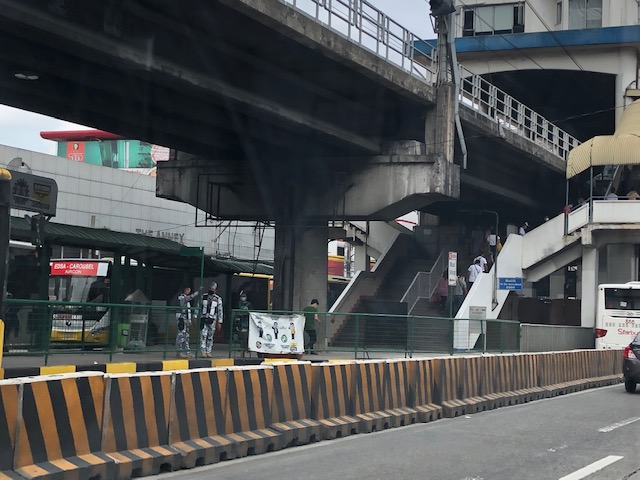 The carousel stations are basically part of the MRT station with the platform located at ground level at the otherwise underutilized space that is the median island of EDSA. Access to the express buses are via the MRT stations as there are no other means for crossing to/from the carousel berths.
The carousel is an attempt to have a Bus Rapid Transit (BRT) along EDSA. It is perhaps the most practical solution to supplementing the already limited capacity of elevated Line 3 despite the continued operations of regular buses. The express bus service is not a new idea along EDSA since Line 3 had to compete with a BRT proposal (though it didn’t use the term BRT then) back in the 1990s. Insiders at NEDA relate that it was then President Fidel V. Ramos himself who allegedly ‘lobbied’ for the MRT instead of an elevated bus transit system. Unfortunately, the MRT proposed, constructed and now in operation is a light rail system like Line 1 and could not easily be upgraded to a heavy rail system like Line 2 or the future Line 7. The line is already problematic due to maintenance issues and the aging rolling stock. And there are questions regarding interoperability with Line 1 (definitely not interoperable with Line 7). So the grand central station currently under construction will really be a terminus for 3 lines as trains will not be able to pass through to other lines like how it is in other countries.
Will the carousel be a permanent fixture along EDSA? Perhaps. But it should be improved further for the convenience of commuters as well as for more efficient operations. The current buses being used are the not the right vehicles if capacity is to be maximized. Articulated buses would be necessary for this purpose. The current barriers should also be replaced with more appropriate and perhaps more clever designs partly for aesthetics but for the system to be safer and more functional in terms of spaces for passengers and vehicles.
–
Pasig to Lucena vans
I was surprised to see a sign at the transport terminal of SM East Ortigas announcing van services between the mall and Lucena City (SM City Lucena terminal). This seems to be a very convenient service and it is via a route I consider to be quite scenic. This is the one via the “backdoor” of Rizal through the towns of Teresa, Morong, Tanay, Pililla in Rizal, Laguna province (Famy, Paete, Lumban, Pagsanjan, etc.) and Quezon province (Luisiana, Lucban, Tayabas).
 Modern jitneys (actually more like mini-buses)
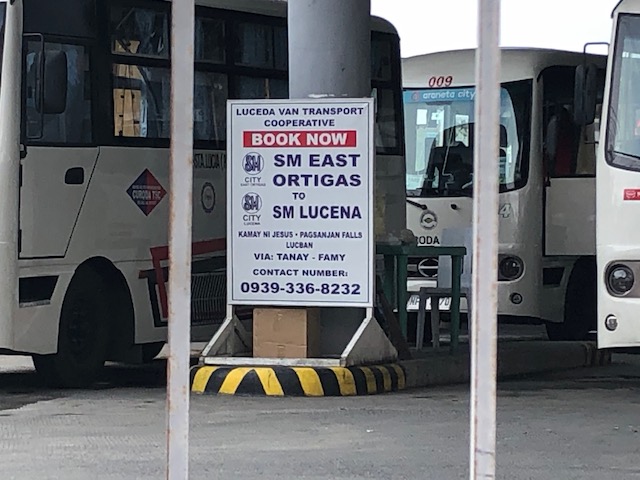 Close-up of sign showing the transport service between SM East Ortigas and SM Lucena in Quezon Province.
–
Antipolo’s bus port
I like taking photos of aircraft of various airlines in airports. Among the photos I like taking are of their tails aligned to show the different airlines docked at the terminals. As we were stopped at an intersection just across from the Robinsons Antipolo public transport terminal, the wife took this photo of buses at the terminal. To me, the terminal has become somewhat like a bus port; with buses serving the long distance routes between Cubao in Quezon City and Antipolo in Rizal province. That’s about 20+ kilometers via Marcos and Sumulong Highways.
What used to be a small amusement part has been cleared prior to the lockdown in March and the area now functions as a parking lot for buses serving the Antipolo-Cubao via Masinag Junction and Antipolo-Ortigas Center routes. The latter was already operational prior to the lockdown with P2P buses leaving every 30 minutes.
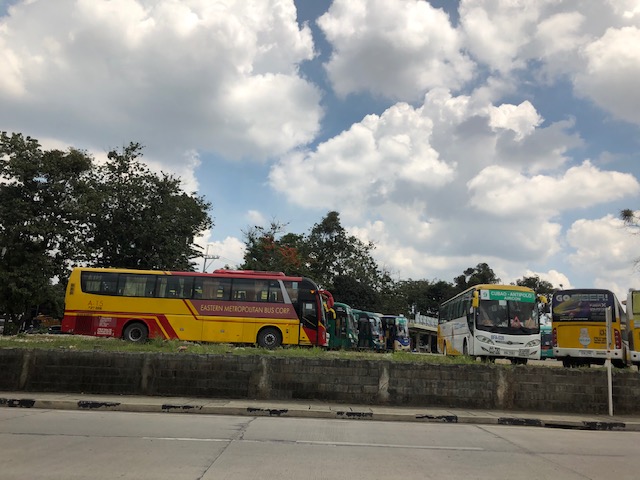
When the Antipolo-Cubao bus route first started operation when Rizal and Metro Manila first transitioned to GCQ, there were three (3) companies operating along the route – G-Liner, RRCG and EMBC. All used air-conditioned buses. Before MECQ in early August, there were additional companies including those that deployed regular or non-aircon buses. I will try to take more photos of the terminal, the buses and the paratransit providing local transport (i.e., within Antipolo). These are tricycles of different models including the conventional motorcycles with sidecar, the tuktuks, and the e-trikes.
–
The plight of commuters during GCQ
I write this on the eve of the imposition of Modified Enhanced Community Quarantine (MECQ). It is another unfinished article that was intended to be a quick post showing the typical conditions for commuters during the GCQ. Public transport supply was slow to return to adequate levels as the government took advantage of restrictions to impose route rationalization and modernization programs. The following scenes were common along my commuting routes:
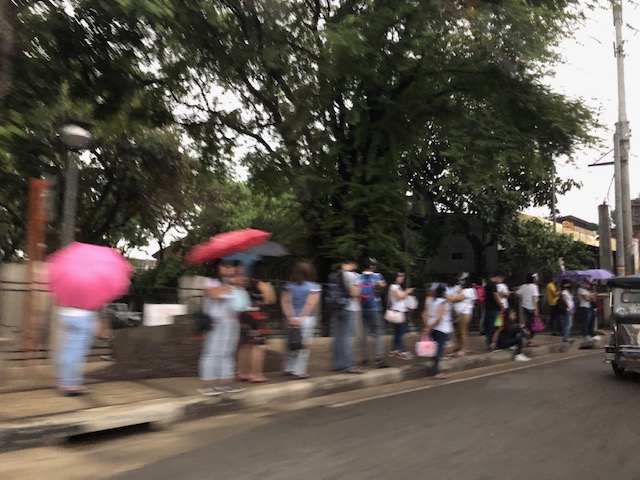 Commuters waiting for a ride near the provincial capitol
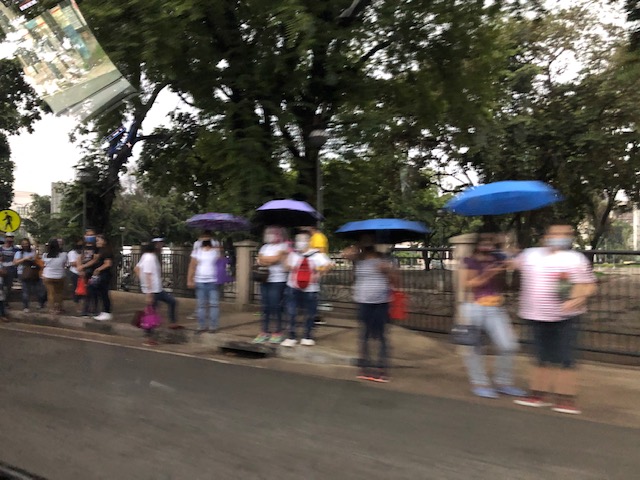 The rains of the wet season added to the misery of the wait.
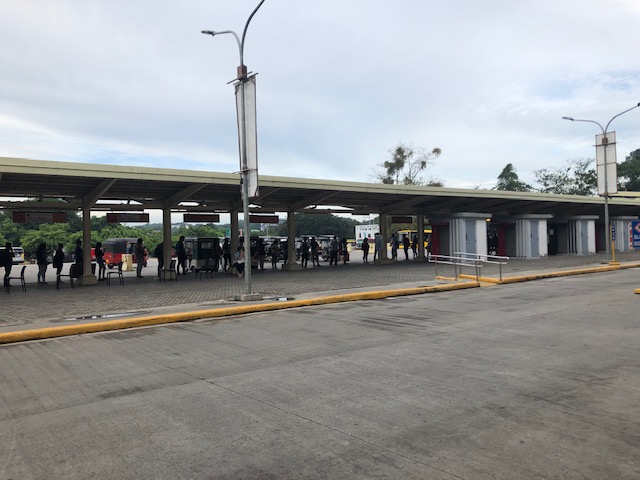 Long queue at the public transport terminal at Robinsons Antipolo, which is the terminus for buses connecting Antipolo with Cubao and Ortigas Center.
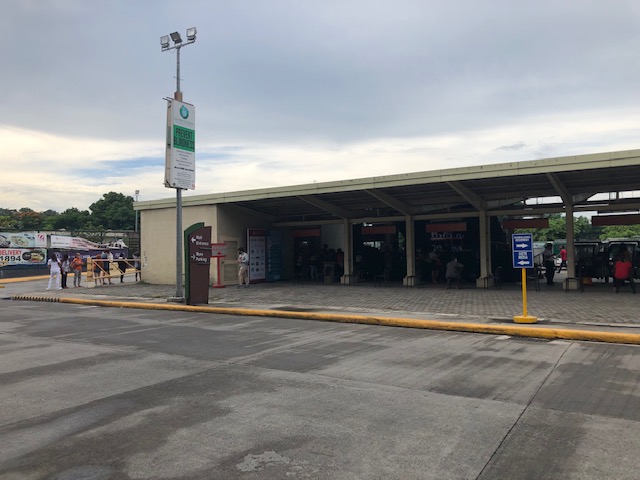 The queue reaches beyond the shaded areas of the terminal.
I think national government should be the one to provide for the public transport needs of frontliners (i.e., health care workers including doctor, nurses, medical technologists, pharmacists, etc.) and other essential workers. My definition of the latter are those required for logistics to function as well as those to ensure the required production or manufacturing for the rest of us who need to stay at home. Not everyone has the same, fair circumstances as there are those who can afford to stay at home and those who need to work for them to live, often on a day-to-day basis.
The pandemic has taken a toll not only on the physical but the mental health of many of us. Government rants and retorts are unnecessary and uncalled for given its dismal performance. I dare say dismal as the evidence shows certain local government units and the Office of the Vice President doing much, much more despite their limited resources. We are not in this quandary because government performed well and to the best of their people’s abilities. If that was their best then they have no business staying in their positions. If our health care system fails, then there is nothing to stop this pandemic from claiming much more than lives.
–
 Caught (up) in traffic