
Home » Posts tagged 'jeepneys' (Page 4)
Tag Archives: jeepneys
Future of jeepneys?
I spotted a jeepney on my way home with a message (or tagline, depending on how you see it) printed on its side. It says BEEP, which was supposed to stand for Bagong Jeep (translated as New Jeep). From the looks of the vehicle, there was nothing new about it, except maybe this sign that was painted over an older design on the vehicle’s body. Apparently, the tagline does not refer to the vehicle itself but to the image of the jeepney. “Bago” or “New” here refers to a new image for jeepneys. Long regarded as the “King of the Road,” the jeepneys have become synonymous to reckless driving, uncomfortable rides and unreliable services. They have also come to represent unsustainable transport what with most jeepneys being fuel guzzlers and smoke belchers.
 I already spotted several jeepneys plying the Cogeo-Cubao route sporting this sign that’s apparently a campaign to uplift the image of jeepneys. It seems really a stretch to call these ‘bago’ as the vehicles I’ve seen are the same customized bodies with second hand engines running them.
There is a campaign to rehabilitate the image of the jeepneys and perhaps it should start with driver behavior and not necessarily the vehicle. Many jeepney drivers (as well as drivers of other public utility vehicles) have attitudes leaning on the rude side. You see many of them driving recklessly along our roads and stopping just about anywhere (e.g., in the middle of the road). Such behaviour is due to many factors including the way these people learned to drive and their motivations for their means of earning a living. Much can also be said about their education both formal and regarding their driving.
There are also many vehicles vying to be the replacement for the jeepneys and among these are electric vehicles including the electric jitneys that I have featured in past articles on this blog. Incidentally, one of those electric jitneys is actually a more recent model of the electric jeepneys that’re currently in operation in Makati and Alabang, and it happens to be called the Beep. Operating in Filinvest City, the e-jeepneys there have been lauded as a viable option for replacing the conventional jeepneys. So far, so good and time will tell if indeed, conventional jeepneys will be phased out in favor of e-jeepneys. The jury is still out there in terms of the e-jeepney’s reliability and durability.
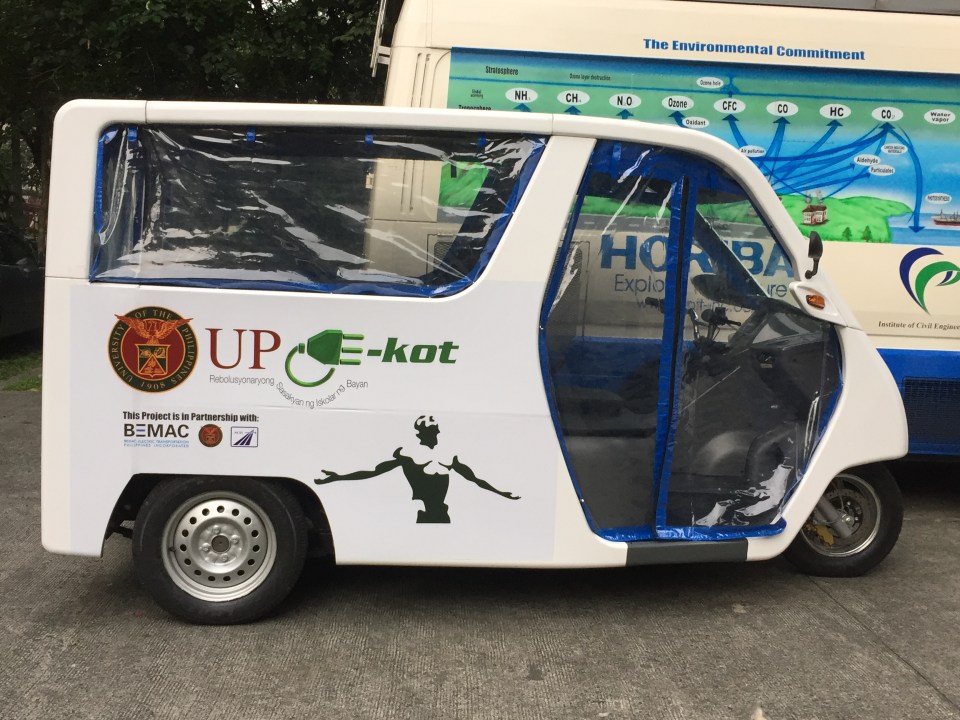 An electric tricycle currently undergoing experimental operations at the University of the Philippines Diliman campus is more a replacement for tricycles and multicabs than for jeepneys.
–
Future jeepney: COMET
Another vehicle being considered for the study on the comparison of customised vehicles being used for public transport is the COMET (City Optimised Managed Electric Transport). This is a 20-seater vehicle that we have written about in previous posts and was touted by its makers and supporters as the best and most suitable replacement for the conventional jeepney. Unlike the BEEP that was featured in the previous post, it is currently operating along a route with trip ends at North Avenue and Aurora Boulevard via Mindanao Avenue, Congressional Avenue, Luzon Avenue and Katipunan Avenue. This route overlaps in operation with established jeepney routes in those areas and thus competes directly with these jeepneys.

Notice that both the COMET and the BEEP have seating capacities of 20 passengers (except the driver). However, the COMET is the larger vehicle as it is both wider, longer and higher than the BEEP. In fact, a passenger can stand inside the COMET without having to bow his/her head so as not to bump against the ceiling. Perhaps the more significant difference with current operations is that COMET drivers have been trained to drive more responsibly (i.e., less aggressively) than the typical jeepney driver. So far they do not weave in traffic and stop only at designated points along their route. Future jeepneys should have drivers like these but they should also be compensated according to the requirements of their jobs as drivers. Such compensation schemes are among the biggest factors for the way jeepney drivers behave in traffic. Technology-wise, current and subsequent developments in motors, batteries and other components of the vehicle itself should make electric and other environment-friendly vehicles more attractive as replacements (successors?) to jeepneys.
–
Future jeepney: BEEP
The National Center for Transportation Studies (NCTS) of the University of the Philippines Diliman (UPD) is part of the Phase II of a research comparing the performances of customized local road vehicles (CLRV) for use in public transport. This project is being conducted together with the Vehicle Research and Testing Laboratory (VRTL) of UPD’s Department of Mechanical Engineering (DME), Electrical and Electronics Engineering Institute (EEEI) and the National Engineering Center (NEC) with funding from the Department of Energy (DOE). Phase II considers a longer route for the comparison of vehicles. In the previous Phase I, the route was UP Diliman-North EDSA while in this phase, the route will be Lagro-Cubao, which is significantly longer in distance compared to the previous study route.
Here are the specs for the BEEP, which features some significant design changes from the earlier versions of the e-jeepney:
 It is worth noting the following for the BEEP:
1. The door is already located on the side of the vehicle instead of at the back.
2. The motor is rated at 30kW, a significant upgrade from the 15- and 20kW motors in previous e-jeepneys.
3. The seating capacity is for 20 passengers (excluding the driver) by about 2 to 4 people from previous e-jeepney models.
These are the most obvious changes in the BEEP and would be factors that could affect its performance and acceptability. Most jeepneys these days are “siyaman” meaning they seat 9 passengers on each of the bench seats plus 2 on the front seat for a total of 20 passengers. Also, jeepneys should be able to negotiate steeper slopes that have been among the problems for e-jeepneys. Not mentioned are the specs of the batteries and the charging time although the range claimed for a full charge is 85 km. This study will hopefully validate these claims and show us if the BEEP will be up to the challenge of replacing the conventional jeepneys on long routes.
–
“No” to additional jeepneys?
I finally got a photo of a banner that I’ve seen on many jeepneys plying the Katipunan route. This appeared on jeepneys a couple of weeks ago and the message on it is clear: “No to more jeeps, to more traffic in Katipunan.” I became curious about this as I noticed that list of transport groups that had their names printed at the bottom of the tarpaulin. Noticeable is the absence of one group, Pasang Masda, among the list that includes, among others, LTOP, ALTODAP and the party list group 1-Utak, which used to have a seat in the Philippines House of Representatives.
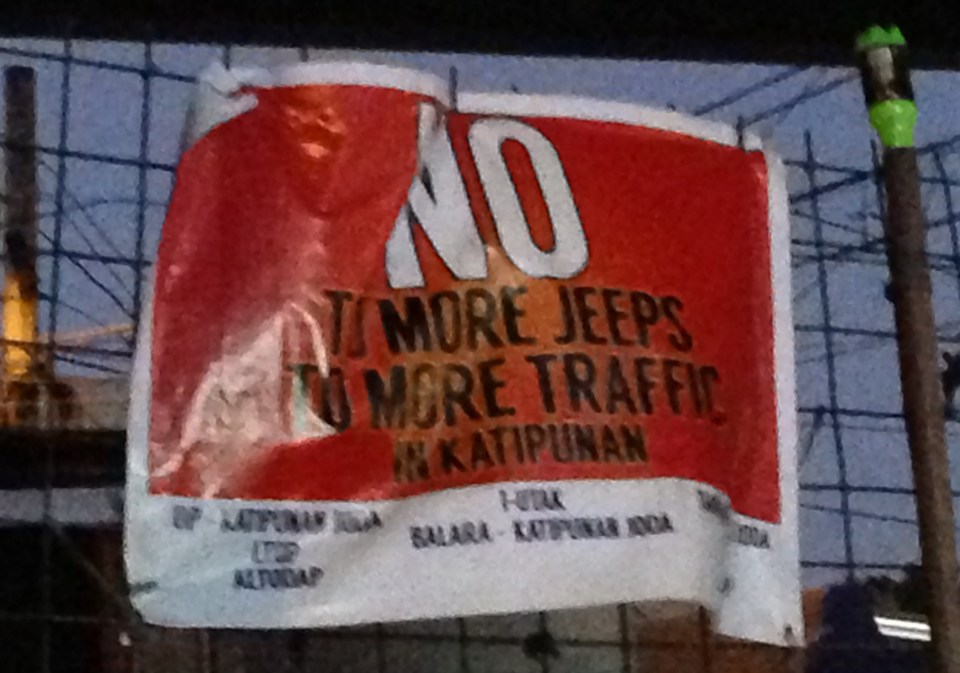 Tarpaulin sign hanging at a wire fence at the Katipunan jeepney terminal under the Aurora Blvd. flyover.
Pasang Masda is supporting the Comet jitneys currently plying the North EDSA-Aurora Boulevard route (via Mindanao Ave., Congressional Ave., Luzon Ave. and Katipunan Ave.). In fact, the head of the group is reported to have bought a few units, likely convinced of it as a good investment. Is it? Only time will tell considering its route is not necessarily the best for it, overlapping with several jeepney routes including the UP-Katipunan route. Is the Comet a game changer? So far, it isn’t and that’s mainly because of its single roue that’s not exactly favorable for a demonstration of the vehicle’s capability and claimed advantage over the conventional jeepneys. A colleague even says that it seems the route approved for it doomed its operation in the first place. But that’s an entirely different story from the opposition to it that’s stated in the tarps at the Katipunan jeepney terminal and some of the jeepneys plying the route.
So, is it a “no” to more jeepneys because their numbers are really already excessive OR is it a “no” because the additional jeepneys are from other groups or those not affiliated or in league with the undersigned? It seems that the latter case applies here and this should be taken as an example of what to expect along the way as initiatives to phaseout or replace conventional jeepneys get going. It is a bit complicated due to mainly to the social aspects of a phaseout or replacement but it gets more complex with the personalities involved including and especially the leaderships of various transport groups.
–
Practicable road sharing in Antipolo
As there are increased calls for more bikeways, we try to look at some good examples of what I’d call “practicable” road sharing. I term it “practicable” because it is something doable or is already being done or practiced. I tried to find a few good examples of practicable road sharing to show that it can be done and usually if all road users respect each others’ right to use the road. This respect can be developed over time and requires some familiarity for each users behaviors. Of course, there will always be abusive or disrespectful people on the road including drivers of different types of vehicles. Reckless or unsafe driving is not limited to public transport or truck drivers. There are also many unruly private vehicle drivers who endanger the lives of others whenever they are on the road. Then there are the motorcyclists, cyclists and pedestrians – all road users and also with bad apples or “pasaway” among them.
Road sharing happens everyday in Antipolo City in the Province of Rizal. Along Ortigas Avenue and Sumulong Highway – the two main routes to and from Antipolo, you will see motor vehicles, bicycles and pedestrians sharing what are mostly 4 lane, undivided sections of the two major roads. Antipolo is a very popular destination for cyclists so even during weekdays you will find a lot of people cycling up and down the mountain roads even during the night time and very early mornings. While many are recreational riders, many, too, are doing this for health. I would bet that a good percentage might be biking to work or school but there are no hard statistics to show this (topic for research?).
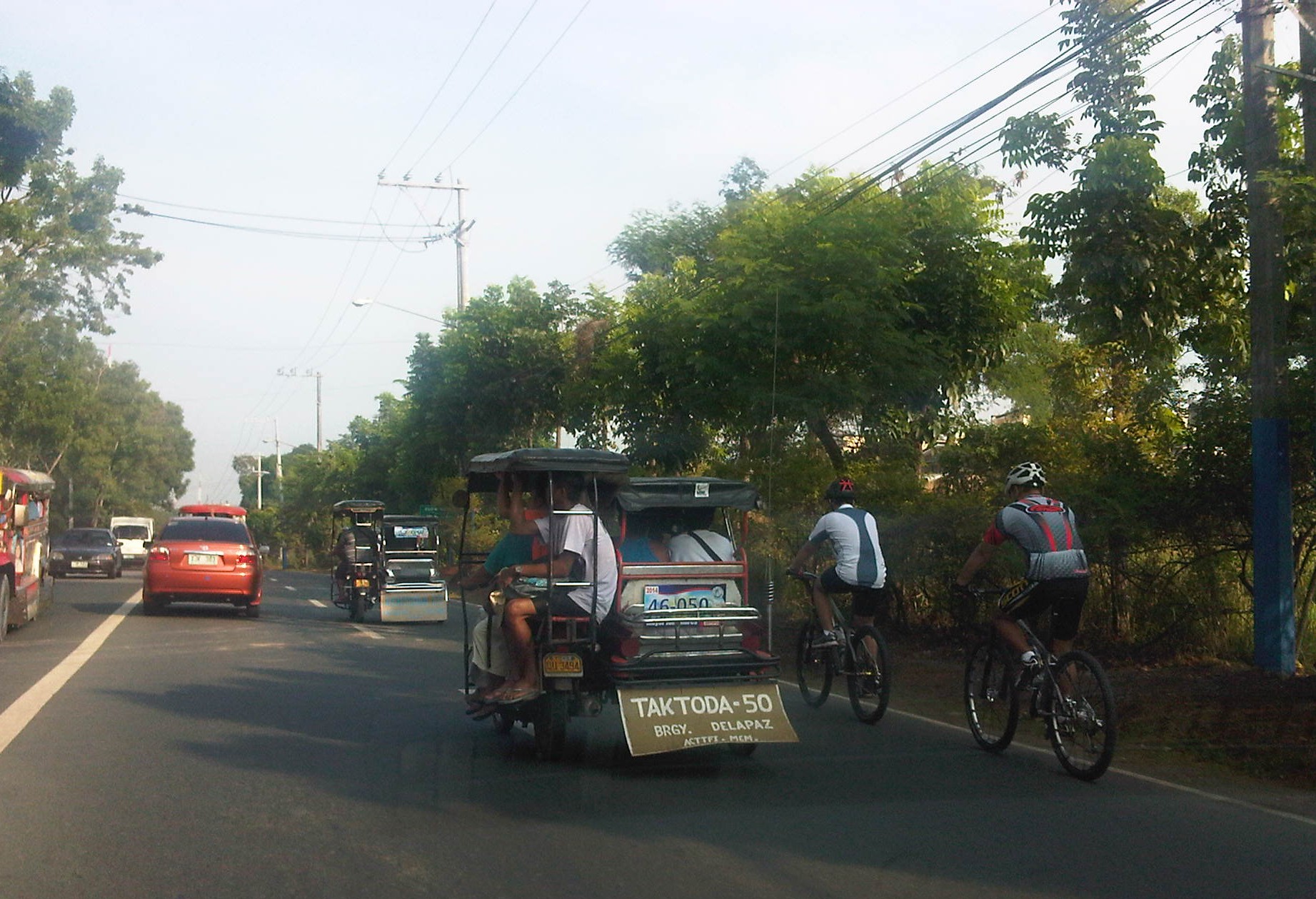 Motorists and cyclists “sharing the road” along Sumulong Highway
Sharing the road shouldn’t be too difficult. However, road users need to have respect for each other’s right to use the road. I have observed many instances where one or more road user types are guilty of “disrespect” and tend to hog the road as if making a statement that “i am king of the road” rather than “i have the right to use the road.” Here are among my pet peeves:
1. Slow moving trucks or jeepneys hogging two lanes and not giving way to other vehicles to pass them.
2. Jeepneys and private vehicles racing up or down the mountain roads and overtaking even in perilous sections (i.e., those already identified as prone to crashes).
3. Tricycles taking up the middle lanes and maneuvering anywhere.
4. Cyclists taking up the middle lanes or sometimes the entire two lanes of any direction preventing other road users to pass them.
5. People crossing anywhere along the road especially at blind sections (curves) where sight distance is limited.
There are practically no pedestrian sidewalks along most of Ortigas Extension and Sumulong Highway so pedestrians would have use the carriageway. As there are a significant number of people walking (e.g., students, workers, and even joggers or walkers), motorists and cyclists need to be careful not to hit these people. The same people, however, need to be aware of these vehicles and should exercise caution, always being alert as they use the road properly. Ultimately though, I would like to see walkways built along Ortigas and Sumulong especially since there is already an increasing demand for walking especially during the summer months when Antipolo holds its fiesta and a lot of people go on pilgrimages on foot to the Shrine of Our Lady of Peace and Good Voyage.
There is practicable road sharing in Antipolo because most road users are already familiar with each others’ behavior and accept each others’ presence and rights on the road. These road users are likely residents of Antipolo or nearby towns or regular visitors to the city. They are “nagbibigayan sa daan.” The “pasaway” people are likely the newer ones who seem to think that the way they drive or ride (i.e., unsafe) elsewhere is the norm. Of course, that goes without saying that familiarity with the roads and its users also breed risk takers who think they already know the road and have the skill and experience to drive like crazy. Here is where effective enforcement (e.g., timely apprehensions and reminders) and engineering (e.g., traffic signs and pavement markings) comes in to address the gaps in safety in order to reduce if not totally eliminate crash incidence along these roads.
–
Tales from a jeepney ride
Jeepneys get a lot of flak these days for the poor services they provide including many cases of reckless driving that could cause (if not already have caused) road crashes. Many of these crashes do not involve serious injuries or fatalities. Often, these are sideswipes or rear-end collisions, the latter being the result of aggressive drivers not being able to brake in time partly as they like to tail-gate (tutok) other vehicles. The social side of a jeepney ride is often the subject of many tales that illustrate typical human behaviour. There are the body language involved in passing fares between passengers and the driver or conductor. There are the scents and smell of different passengers. There’s music and there’s talk among people riding the jeepney (e.g., friends or colleagues commuting together). There are even cases of PDA or public displays of affection, including among students who go home together. I think it is still common for males to show their affection by taking their partners home (to make sure they get home safely).
One time during a ride home, I was fortunate to get a jeepney whose driver wasn’t reckless and whose conductor was a jolly fellow who engaged passengers in small talk while we were on our way to Antipolo from Katipunan. One passenger asked him how come it was more expensive to go to Antipolo Simbahan via Sumulong compared to the older route via Junction. He answered correctly that the former was a longer route (Google maps will tell you that the route via Sumulong Highway is 16.1 km while the one via Cainta Junction is 15.0 km.) but quickly added that the route via Junction usually took more time to travel along due to the congestion along Felix Avenue, Junction and Ortigas Extension. The other passengers agreed and joined the conversation, commenting on how many Antipolo-Sumulong jeepney drivers and conductors often try to choose passengers or attempt to cheat passengers on their fares (e.g., not giving back the right change or in some cases not even returning change). The good conductor offered his own observations in an accent that seemed to me as one for a native of Rizal. I wanted to join the candid discussion but decided to just listen in and be a spectator in this exchange.
 This jeepney conductor was honest and engaged passengers in conversation. The driver was not reckless unlike many others of jeepneys I have rode on. (He was at least middle-aged but nearing senior status based on his looks.) I thought this was quite rare given the many “patok” jeepneys operating these days and the younger drivers and conductors who don’t care about safety or passengers’ rights like senior citizens’ and students’ discounts.
I think it wouldn’t have been like this where conductor and passengers were interacting the way they did if this were a “patok” jeepney. “Patok” or “popular” jeepneys often feature loud music (though many people will regard this as noise and no longer music) and passengers can hardly hear themselves talk. Often the loud music is an excuse for the driver or conductor not giving back the right change or any change at all to passengers despite the latter shouting at the driver/conductor. We were also lucky that our driver drove safer than your average driver. That meant a somewhat longer trip but I guess the interaction among passengers and conductor allowed for us not to notice the time. I guess these types of trips and interactions are what distinguished jeepneys from other transport. This is very much how commuting can be romanticised and is certainly something we will perhaps miss should the jeepney be phased out. Will it be phased out and is it necessary to remove jeepneys from our roads? I don’t think it will be phased out completely, and I believe that there is a need for the jeepney to be modernised but at the same time operate within a sustainable framework and hierarchy. And we need more of this conductor and his driver to be part of this system while purging out the reckless, abusive and disrespectful kind who make commuting unsafe and uncomfortable for many.
–
Future fare collection for jeepneys and other modes?
In the last Electric Vehicle Summit held in late February this year, I noticed a conspicuous device installed in the electric jeepney unit that was on display at the venue. The device is for electronic payment of fares; using a card much like the ones being used in other countries like Singapore and Japan, and soon, hopefully, for the LRT and MRT in Metro Manila. Such a capability has a lot of potential including a very convenient way to pay fares for public transport in Metro Manila. Other potential uses would be for payments of items bought at stores or shops (or vending machines) like Japan’s Suica card. Users would just have to “top up” or load their cards for these to be used in their commutes or purchases.
 The latest e-jeepney model features a side door instead of one at the rear.
 Boarding passengers will encounter device upon entering the vehicle. The current technology available should soon enable passengers to use “tap” cards to pay for their fares.
 Such a device will leas to a more efficient fare collection and eliminate the need for “conductors” or persons assisting the driver in taking passengers’ fares. These should also allow the driver to focus on driving rather than be distracted by fare collection including trying to keep track of who has paid and who has change due. This would likely translate into safer travel for most people.
 Electronic boards at the top behind the driver can provide travel information such as the next stop or traffic conditions along the transit route. Such information can be derived from various sources including the MMDA or local governments as well as from crowd-sourcing.
–
Public transport fare hikes
Bus and jeepney groups often demand for an increase in the fares every time there is an increase in the prices of fuel. The latest one is mentioned in this article via Rappler, where a jeepney group is to hold a protest caravan as they seek a discount on diesel for all public utility vehicles. The reaction from readers is an overwhelming “Annoyed.” And rightly so because while these protests appear to be noble and are often linked by jeepney groups to petitions for fare hike increases (i.e., asking for fare increases if they cannot be given fuel or petroleum product discounts), closer scrutiny of operating costs will reveal flaws in their arguments for fare hikes and discounts. These same flaws also reveal why government agencies charged with public transport franchising and regulation (i.e., DOTC and LTFRB) should have the data and tools for a fair assessment of fares (pun intended).
Data from field surveys conducted quite recently (NCTS, 2012) show us that jeepneys typically average around 3 to 4 km/L on diesel fuel. This is a very low value that is comparable to the income from passengers for one trip over a distance of say 4 km. A fully-loaded jeepney with an average of 20 passengers (9 on each bench plus 2 beside the driver) operating a 4-km route will 160 pesos. However, there are limited reliable information or data on other costs such as maintenance costs and other items including “boundary” and “dispatching.” The boundary is basically a rental fee for the use of the vehicle while jeepney groups charge a fee for dispatching vehicles from the terminal or stop. In a day’s operation, such costs could easily accumulate into a significant total that would eat up a day’s income, usually leaving the driver with just enough to bring home to his family.
This brings us back to the argument against transport being treated as livelihood rather than a service. Many operators or owners of public utility vehicles, whether they have one or more units, tend to scrimp on the maintenance of their vehicles. Poor maintenance manifests in the form of smoke-belching and frequent breakdowns. While smoke-belching contributes to the deterioration of the environment and health costs, breakdowns often lead to road crashes (e.g., tires flying off, problems with brakes, etc.) like the recent bus crash in the Mountain Province where faulty breaks were blamed for the crash.
Jeepney groups often raise issues on the plight of small operators who are usually the drivers of the jeepneys themselves. Many of these people should not even be operating or driving jeepneys in the first place because safe and efficient service is not their priority. Service is second only to the desire to generate income, to earn a living, which makes them drive the way they currently do (i.e., recklessly) and improperly and haphazardly maintain their vehicles. There is seldom serious talk and little done to protect the interests of people who take public transport. These are the same people who are often shortchanged with the poor quality of public transport in our cities and have long suffered for this. Let us hope that the LTFRB will be guided as they decide on this matter of fares and furthermore for the agency to study the state of road public transport franchising in order to weed out people and groups who do not deserve to be operators. I believe there is more than enough data or evidence against such operators if the LTFRB truly wants to reform the system.
–
Harbinger of change for public transport?
Comets have been viewed as signs, omens or harbingers of something that will happen. I like the word “harbinger” more than “omen.” It brings about a certain mystery to it that does not necessarily imply something bad or evil. In this case, the comet is a vehicle and “Comet” stands for City Optimized Managed Electric Transport, an electric jitney that is being touted as a replacement for the ubiquitous jeepney that has evolved from its WW2 ancestor. It does have the potential of being a game changer if there is an enabling environment for it and if (a big “if”) it addresses fundamental issues with electric vehicles such as those that are technical (battery life, range, speed, etc.), pertaining to after sales (maintenance, technical support) and operational (suitable routes, fares, charging stations, etc.).
[All photos taken by Engr. Sheila Javier of the National Center for Transportation Studies]
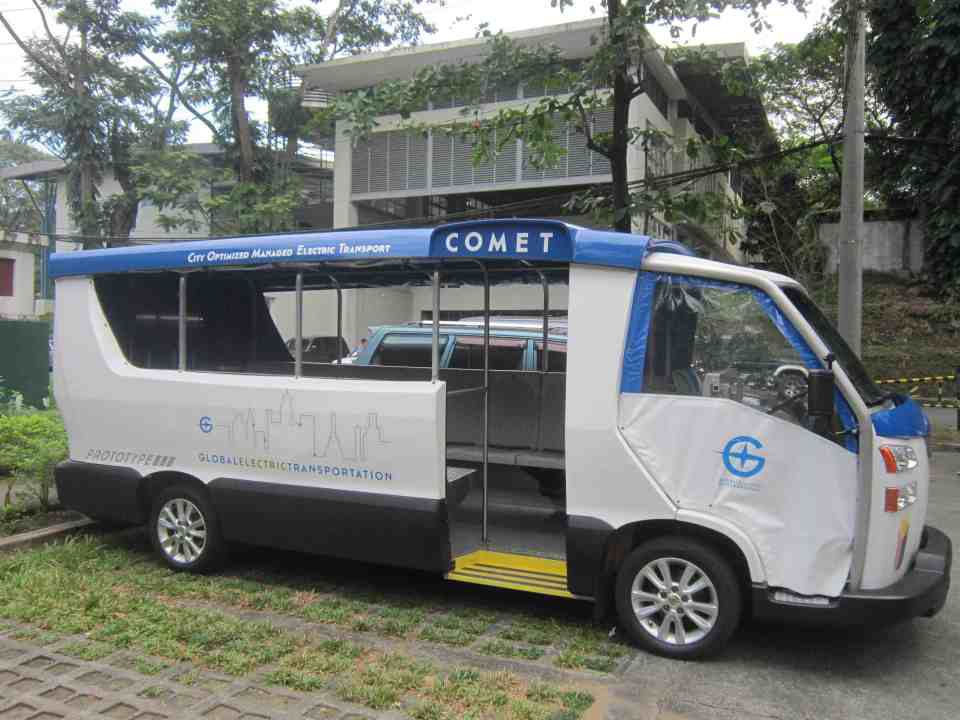 Prototype Comet at the NCTS parking lot – notice that it is larger than the AUV on the other side of the vehicle. The Comet will utilize a tap card for fares, similar to the card that is proposed for use in the Automated Fare Collection System for the LRT/MRT system.
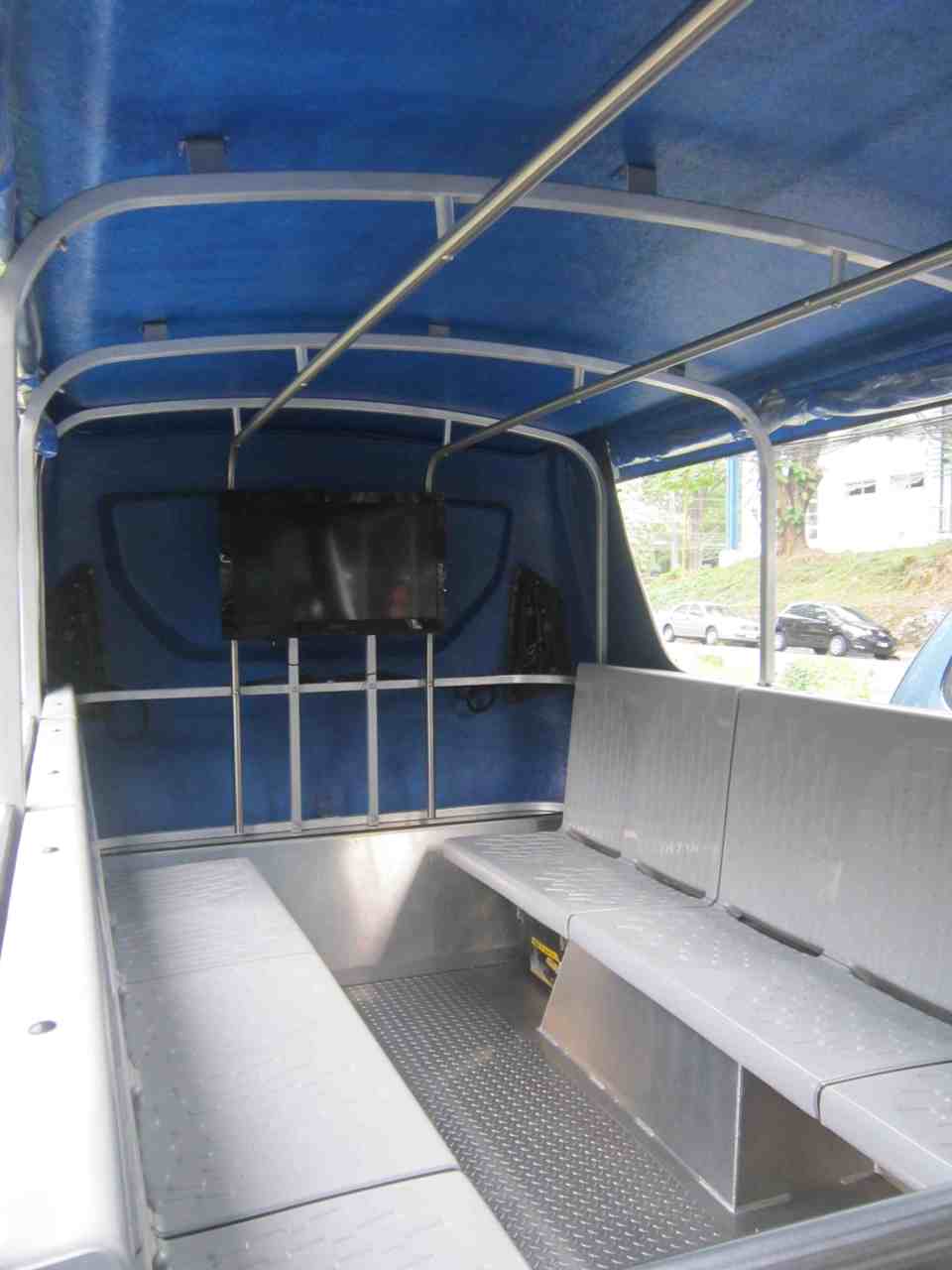 Inside the vehicle, one immediately gets a feeling of space. In fact, a person can stand inside the vehicle unlike the case of jeepneys where people need to bend so as not to bump their heads at the ceiling.
 The vehicle has a side entrance and exit unlike the rear doors of typical jeepneys.
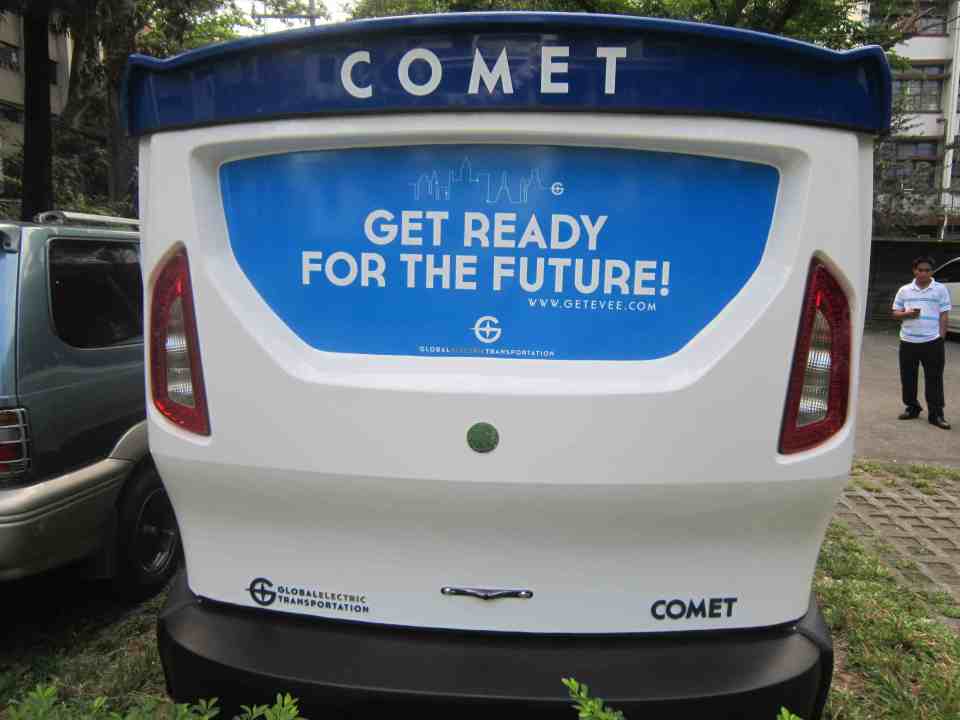 The Comet looks like a mini-bus from behind. Proponents have stated that drivers will be trained for road safety as well as operations for designated stops and scheduled services.
The Comet is being touted as a replacement for the jeepney and is being promoted via an initial route that would connect SM Megamall in Ortigas Center, Pasig City to SM City North EDSA in Quezon City. The route will be counter-clockwise from SM Megamall to SM North EDSA via Circumferential Road 5 including E. Rodriguez Avenue and Katipunan Avenue, UP Diliman, Commonwealth Avenue, Elliptical Road and North Avenue. From SM North to SM Megamall, it will take EDSA. While I am not sure if the Comet has been granted a franchise and how many units they can deploy, this proposed route will overlap with existing jeepney and bus routes including direct competition with UP-Katipunan and UP-North EDSA routes, and buses plying routes that cover the stretch from North EDSA to Ortigas Center. I think that this route is mainly for publicity considering there are probably other, more suitable routes for the Comet. It has not been subject to rigorous tests (just like the e-jeepneys before it), which is not a good thing, considering the experiences of the e-tricycle in Taguig and the e-jeepneys in Makati. Hopefully, they have learned the lessons from these past efforts and that they already have the answers hounding EVs as applied to public transport.
–
On commuting and jeepneys
There is an online petition calling for public officials to take public transportation instead of traveling in their own cars (with or without chauffeurs). The assumption seems to be that our so-called leaders, particularly those tasked to come up with solution to our transport and traffic problems, do not themselves used public transportation. As such, they are basically oblivious to the daily frustrations of many commuters who have to suffer the uncomfortable, inefficient and, in many cases, unsafe transport that we have in most if not all our cities and towns.
But who’s afraid of riding public transport and jeepneys in particular? I would like to think that many if not most or all Filipinos had to ride a jeepney at one point in their lives. After all, the jeepney is second only to the motor tricycle in terms of being the most widespread mode of transport in the country. [Yes, that’s right. The jeepney is not really the king of the road in the Philippines. That title is perhaps more suitable to the tricycle, and I’ve explained this in past posts about the tricycle.] Why do people continue to ride the jeepney despite it being perceived as unsafe and not an environment-friendly mode of transport? Why are these aspects not being corrected by the responsible agencies? These are questions that are difficult to answer only because of the social implications that the government does not want to deal with head-on.
–
The way jeepneys are designed all over the country, drivers have to deal with the cramped space of the front seat that have implications personal health as well as road safety. The cramped space and overall design of the vehicle affects the driver’s posture as he is forced to stoop in order to have a good view through the windshield. In some cases, those with longer legs would have to orient their seated bodies in a position that is not ergonomic. Such practices or positions may contribute to injury over the long term as well as affect the way the driver operates the vehicle.
 I’m not into taking photos inside jeepneys (quite risky as it invites attention to you and to your phone) so there’s few (and not so good) photos of my commutes. This one is a good one inside a jeepney bound for Quiapo, Manila from Philcoa, Quezon City.
I think that for visitors from other countries, a trip to the Philippines would not be complete without experiencing a jeepney ride. When we do have visitors at the university and if they have the time, we take them around the campus on a jeepney. Of course, this is an easy and relatively safe ride for them considering the “Ikot” and “Toki” jeepneys have routes within the campus and do not pass through busy streets or wide highways that tend to invite speeding.
It’s a different thing and quite an experience when you ride the “patok” jeepneys usually plying the longer distance routes like Cubao-Montalban or Cubao-Antipolo. The drivers of these jeepneys are generally risk takers and many are reckless to the point that a slight mistake in driving would likely lead to a serious if not fatal crash. It’s a wonder that they don’t make mistakes often enough for authorities to clamp down on them. Despite this, many people take such jeepneys because they have no choice or if they did, they opt for the aggressive drivers because of the perception that these will get you to your destination faster (Jokingly, it is said that hopefully your destination is not the afterlife.).
–
 Caught (up) in traffic