
Home » Public Transport » Paratransit (Page 5)
Category Archives: Paratransit
Mainstreaming e-trikes?
The big news on electric vehicles in the Philippines today is about what the City of Manila has announced as a phaseout of tricycles and pedicabs (i.e., motorized and non-motorized three-wheelers):
Manila will say goodbye to old school tricycles and pedicabs on October 15
According to the article, these will include conventional tricycles, kuligligs (bicycles fitted out with motors or generators + sidecar), and pedicabs. Manila has thousands (about 25,000 according to the article) of these plying roads where they are not supposed to be (tricycles and pedicabs are prohibited by law from traveling along national roads especially as public transportation). From the article, it seems to me that the date mentioned will be the start for a pilot in the Binondo area. No details are given as to how exactly the local government of Manila will be going about replacing 25,000 tricycles, kuligligs and pedicabs with 10,000 e-trikes, including how the e-trikes will be financed and what will happen to the phased out tricycles and pedicabs. We are, however, hopeful that Manila will be successful and perhaps be a model for other LGUs to emulate.
–
Is Antipolo ripe for high capacity and premium transit services?
About 5 years ago, I wrote about transport in Antipolo in another blog. The article was more about this old city being a major destination attracting people for pilgrimage (Shrine of Our Lady of Peace and Good Voyage) and tourism (e.g., Hinulugang Taktak). I am quoting from that article from 5 years ago and adding a few comments here and there. Note that for most of the article, nothing much has changed except perhaps that the Line 2 extension from Santolan to Masinag is now underway.
“There are now many ways from Metro Manila and its neighboring provinces to Antipolo, although several of these eventually merge into three main roads en route to the Shrine. One is via the old route along Ortigas Avenue, a second is the route via Sumulong Highway, and the third is through a “back door” via the Antipolo-Teresa Road. Routes from the general areas of Manila, Makati, Pasig, Mandaluyong, Taguig and the southern cities of Metro Manila and towns from Laguna, Batangas and Cavite will most likely merge to Ortigas Avenue. Meanwhile, people coming from Quezon City, Caloocan, Marikina, Bulacan, Pampanga and the northern Rizal towns of San Mateo and Rodriguez (Montalban) will likely converge along Sumulong Highway. Meanwhile, those coming from the east including the Rizal towns like Tanay, Teresa, Morong, and Jala-jala, the Laguna towns like Paete, Pakil, Pangil, the Quezon towns of Luisiana, Lucban, Infanta and General Nakar, and others will most likely take the Antipolo-Teresa Road that climbs from the east of Antipolo. People from Marikina, Cainta and Pasig generally may take either the Ortigas or the Marcos Highway/Sumulong Highway route.”
I didn’t mention there that another backdoor was via Marcos Highway if one were coming directly from Tanay instead of through Teresa. This route is now popular and traffic has been steadily increasing due in part to some additional attractions in that part of Antipolo and Tanay.
“Public transport to Antipolo these days include mostly jeepneys as the city is the end point of many routes – a testament to its importance even as a reference point for public transportation. One can easily spot the Antipolo-Cubao jeepneys in the Araneta Center in the Cubao business district in Quezon City. There are two lines, one via Cainta Junction (where jeepneys eventually turn to Ortigas Avenue) and another via Marcos Highway, turning at the Masinag Junction towards Sumulong Highway). Another terminal is at the EDSA Central near the Ortigas Center in Mandaluyong where Antipolo-Crossing jeepneys are queued. And still there is another, albeit somewhat informal terminal near Jose Rizal University (JRU, which was formerly a college and hence the old JRC endpoint), which passes through Shaw Boulevard, Meralco Avenue and eventually turns towards Ortigas Avenue. Other jeepneys from the Rizal towns all have routes ending in Antipolo Simbahan, referring to the shrine.”
There are also UV Express and shuttle vans (legitimate vans for hire or colorum operations) offering express trips between Antipolo and the same end points of Cubao or Crossing. Others go all the way to Makati in the Ayala financial district. These evolved out of the Tamaraw FX taxis that started charging fixed fares during the 1990’s and competed directly with the jeepneys. These are popular, however, with office employees and students during weekdays and the nature of their ownership and operations do make them serious competitors to the jeepneys even during the merry month of May (fiesta period) and the Lenten Holy Week.
“There was an Antipolo Bus Line before. These were the red buses that plied routes between Antipolo and Divisoria in Manila. These died out sometime between the late 80’s and the early 90’s probably due to decreasing profitability and likely because of its competition with the jeepneys. That bus company, along with the green-colored G-Liners, the red EMBCs (Eastern Metropolitan Bus Co.) and CERTs, and the blue Metro Manila Transit Corp. buses used to form a formidable mass transport system for Rizal and the eastern towns of Metro Manila. There were even mini-buses (one I recall were the Antipolo “baby” buses and those that plied routes betwen Binangonan and Recto with the cassette tapes stacked along the bus dashboard). Most of these, except the G-Liners eventually succumbed to the jeepneys.”
At present, there is another bus company operating along Ortigas Ave and the Manila East Road – RRCG. There is also a revival of the EMBC with buses providing transport services between Quiapo and Tanay. The only other bus is the inter-provincial Raymond Transit, which operates between Crossing, Mandaluyong and Infanta, Quezon via Antipolo, Teresa, Morong and Tanay.
“In the future, perhaps the jeepneys should give way to buses as the latter will provide a higher level and quality of service along Ortigas Avenue and Marcos and Sumulong Highways. Already in the drawing boards is a plan to ultimately extend LRT Line 2, which currently terminates at Santolan, Pasig, to Masinag Junction and then have a branch climb along Sumulong Highway and terminate near the shrine. This will bring back the trains to Antipolo and would surely make the church and the city very accessible to people. I look forward to these developments both in my capacity as a transportation researcher-engineer and a Catholic who also visits the Shrine to pray for safe travel for loved ones and myself.”
This proposition for rationalizing public transport to/from Antipolo and other towns of Rizal plus Marikina is all the more important as the Line 2 extension from Santolan, Pasig to Masinag, Antipolo is currently underway. There is an opportunity here to upgrade public transport following the hierarchy of transport modes. I have noticed, for example, electric and conventional tricycles providing what are basically feeder services but along Marcos Highway between Cogeo and Masinag. And a lot of people have been stranded or have difficulty getting a jeepney or UV express ride along the Marcos Highway corridor. I am aware that the DOTC in the previous administration was mulling an express bus service through Marcos and Sumulong Highways terminating and turning around at Robinsons Place Antipolo. That, of course, never happened but is something that I think is worthwhile and would be beneficial to a lot of commuters.
–
Latest model electric jeepney
In case my readers missed my feature on the recent electric vehicle summit hosted by Meralco, here are a few photos of the latest model of the electric jeepney. Note the passenger door is no longer at the rear but at the side across from the driver. They have also added a distinctive snout to the vehicle. This model is the latest from PhUV, which also manufactures electric tricycles.
 Profile of the electric jeepney currently in use for a Department of Energy-funded project being undertaken jointly by the National Engineering Center (NEC), the National Center for Transportation Studies (NCTS) and the Vehicle Research and Testing Laboratory (VRTL) of the Department of Mechanical Engineering; all of the University of the Philippines Diliman.
 A peak at the interior shows the passenger seats in bench layout and a more generous headroom for passengers.
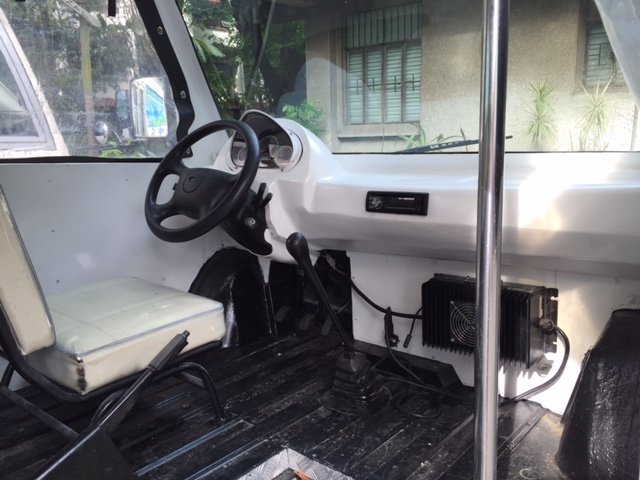 Driver’s seat and panel. There is space to install fare collection machines like the ones that can enable the use of BEEP cards by passengers.
 E-jeepney front showing the distinctive face from its conventional ‘ancestors/predecessors’. A colleague noted that perhaps the manufacturer should add some accessories like horses or airplanes on the hood.
This model is already similar in size with the big COMET electric jitneys. They also run on a more powerful electric motor that will enable these vehicles, according to the maker, to climb slopes like those along the route of Antipolo jeepneys. We hope that this design gets mainstreamed (read: replace conventional jeepneys) along the many existing jeepney routes not just in Metro Manila but in other cities as well.
–
On e-trikes again
I saw this electric tricycle while traveling along Marcos Highway in Antipolo City. There are already a number of e-trikes operating in many cities around the country including several in Metro Manila but this one seems to be the inferior to the designs I have features in previous articles in this site (Note: Refer to the post on Vehicles at the 3rd Electric Vehicle Summit for a sampling of e-trike designs). Those designs were mostly inspired by the Asian Development Bank (ADB)’s concept electric tricycle design for their project that sought to replace conventional tricycles with electric ones.
 Antipolo e-trike along Marcos Highway
This e-trike appears to be a clumsy design and I have questions regarding its stability and operating characteristics, which have implications on road safety. Note that the e-trike in the photo above is not registered. Otherwise, it should bear an orange plate from the Land Transportation Office (LTO), which incidentally classifies e-vehicles as low-speed vehicles. This classification basically restricts most e-vehicles from traveling along national roads such as Marcos Highway. Did Antipolo secure an exception or exemption for these vehicles? Are traffic law enforcement personnel turning blind eye to the operation of these vehicles along busy highways like Marcos Highway and Sumulong Highway? How safe are these vehicle designs?
–
Mainstreaming the motorcycle taxi via current transport tech trends
The motorcycle taxi is common in Southeast Asia and it seems that bringing it to the next level means taking advantage of available technology to facilitate getting a ride. In the forefront is Grab, the company behind GrabTaxi and GrabCar, which is a similar service to the popular Uber. GrabTaxi facilitated getting a taxi and is already popular for being quite effective to many who have availed of the service. I am among those who have used GrabTaxi and so far has been satisfied with the service.
Recently, Grab had been in the news for a service it has been providing elsewhere and which also appeared on their app in the Philippines – GrabBike. I also saw this feature on their app and was curious about how they were able to go mainstream on this in the Philippines because motorcycle taxis (e.g., habal-habal) are basically illegal in most cities and are unregulated except by barangays or a few local governments where their services have been recognized. The Land Transportation Franchising and Regulatory Board (LTFRB) ordered Grab to stop offering this feature of their services. It seems they haven’t done so as GrabBike is still there and the service very much alive.
 GrabBike feature on the old GrabTaxi App available in the Philippines
In fact, we tried to check if there was a GrabBike near our office and voila! There was one unit that appeared in our screen. I would bet that there would be more appearing on one’s screen if he/she happened to be in an area where there’s demand for motorcycle taxis services (e.g., Eastwood, BGC, Ortigas, Makati CBD, Cubao, etc.).
 GrabBike featured on Grab’s new look app
Motorcycle taxis are popular in the provinces and especially in rural areas not just because of the convenience they provide (easily hailed and can maneuver through congested roads) but because they are a necessity, being practically the only public transport mode available to people. The main issues against them in the Philippines are safety-related. Not all providers practice safe riding and most if not all are sure to have no insurance to cover their passengers in case they are involved in a crash. One cannot fully blame motorcycle taxi service providers for offering their services considering the traffic mess in many highly urbanized cities especially in Metro Manila. However, offering such services to the public means that service providers should bear responsibility for ensuring the safety of their passengers. This would basically be in the form of insurance and regulation particularly for fares they charge. I wouldn’t even go to the tax implications of the income they derive from their operations.
These services will no doubt continue to be offered, even clandestinely, as traffic conditions remain bad and continue to worsen. People will gravitate towards such services in order to reduce the travel times in their commutes. This is expected to happen as long as people perceive that nothing is happening to significantly improve transportation in this country.
–
Emergence of motorcycle taxis in Metro Manila and other cities
Motorcycle taxis operate in many Asian cities. In Southeast Asia, in particular, there are formal and legal motorcycle taxi services in cities like Bangkok and Jakarta. These motorcycle taxis are called “habal-habal” in many parts of the Philippines and are accepted modes of public transport particularly in rural areas where roads are not the same quality as those in urban areas. Motorcycles and motor tricycles are the most preferred modes of transport and their characteristics are usually most suitable for such roads.
In Metro Manila, there are motorcycle taxis operating in many locations including Bonifacio Global City, Eastwood City and White Plains. These are basically discrete operations and providers are low key so as not to attract the attention of authorities. Services though are worst kept secrets considering they have a steady clientele. In Pasig City, and I assume other Metro Manila cities as well, there are ‘formal’ habal-habal terminals. I took a photo of one in a low income residential area that was designated as a relocation site for many informal settlers around the metropolis.
 Habal-habal terminal in Pasig City near the Napindan Channel where the Pasig River meets Laguna de Bay
A friend at the Cebu City Traffic Operations Management (CCTO or CITOM) told us that there is a growing number of motorcycle riders offering transport services in their city. These are illegal but are being tolerated in many cases due to the growing demand for their services particularly during unholy hours late at night or in the early morning. I also saw many of these operating in Tacloban and even crossing the San Juanico Bridge to Samar Island from Leyte.
There are also many habal-habal in tourism areas including in island resorts where there is a lack of formal public transport services. This mode is a necessity and so far, there are only rare reports of these vehicles and their riders being involved in road crashes. This is the case despite their being perceived as unsafe modes of transport. I guess they will continue to be popular in rural areas and will quickly become popular should they be mainstreamed in urban areas just like their counterparts in neighboring countries in Southeast Asia. In fact, the demand is already there and just waiting to be tapped given the horrendous traffic jams that will drive people towards modes they think can allow them to escape traffic congestion.
–
Tricycle fares in Antipolo City
Tricycles in Antipolo City practically have no defined or restricted areas of operations. Unlike other cities, say Quezon City or Manila, tricycle operations in Antipolo is practically free ranging. You can get a tricycle in Mambugan and ride it directly to the National Shrine of Our Lady of Peace and Good Voyage (Simbahan ng Antipolo); a distance of 8 to 10 kilometers depending on the route taken. As such, there has been a tendency for tricycle drivers to overcharge passengers even though fares were subject to negotiations and there have bee established average or usual fares for certain trips. Nevertheless, there have been and are still lots of complaints about tricycle fares in the city. This is evidenced from the queries posted on the city’s social media accounts.
This situation begs an important question on whether Antipolo City has official tricycle fare rates. The answer is yes, it does have official rates and this is stated under City Ordinance No. 2009-316. I assume that ‘2009’ here refers to the year the ordinance was signed into law by the City Council. Here’s a graphic from Antipolo City’s Facebook page showing official tariffs and warnings against negotiating fares as well as the maximum number of passengers a tricycle can carry.
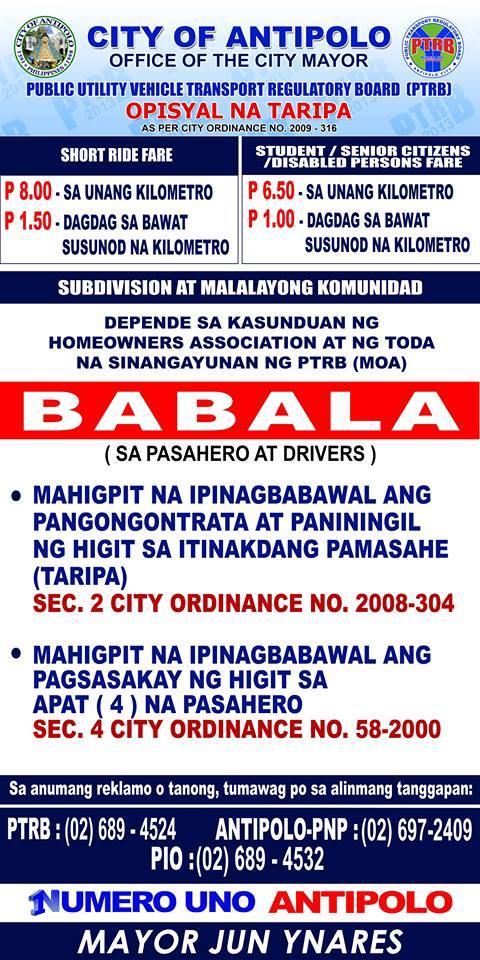 Tricycle fares based on official tariffs under City Ordinance No. 2009-316
Those two other ordinances seem to be among the most abused by tricycle drivers and likely very difficult to enforce considering the ranges of tricycles. According to netizens, many tricycle drivers still tend to negotiate fares for long trips and tricycles carrying more than 4 passengers is a common sight in the city especially tricycles that are used as school service vehicles. I tend to wince myself whenever I see a tricycle overloaded with school children negotiating Ortigas Ave Extension or Sumulong Highway. These are unsafe and put a lot of young lives at risk.
Below is an example fare matrix for tricycles posted at the New Public Market along Sumulong Highway and across from the new Robinsons mall in the same area:
 Illustrative fares to/from the New Antipolo Public Market
I think there should be similar information posted in other areas around Antipolo City. This is so that people will not be confused about the tricycle fares and so as to minimize the instances when tricycle drivers take advantage of passengers not familiar with trip distances and the fare rates.
The Antipolo City Government is working towards improving transport and traffic in this highly urbanized city. I think this should include regulating tricycle services so that the city could reduce their numbers along national roads like Marcos Highway, Sumulong Highway and Ortigas Ave. Extension. Tricycles have become a nuisance in traffic and not just for motorists but for cyclists and pedestrians as well. They shouldn’t be traveling long distances and along rolling and mountainous terrains. They tend to be noisy and, perhaps most problematic, are smoke belchers. Hopefully, this can be addressed in the next years as the city continuous to grow and become more progressive. This only means that the city should strive towards a modern, efficient and people & environment-friendly transport system.
–
EASTS 2015 – Cebu City, September 11-13, 2015
The 11th International Conference of the Eastern Asia Society for Transportation Studies (EASTS 2015) will be held in Cebu City this September 11-13, 2015. For information on the conference and program, check out their website here:
You can also download a brochure about EASTS here:
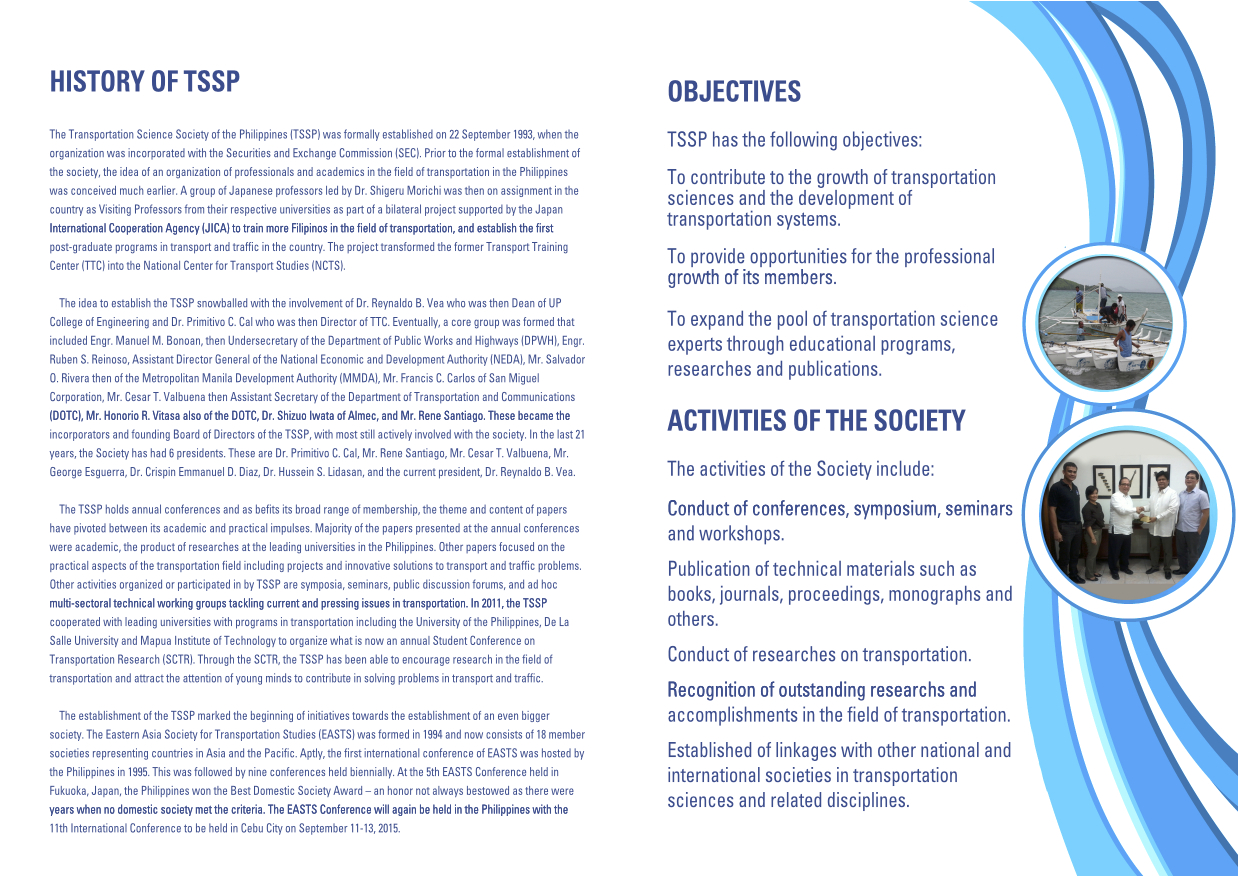
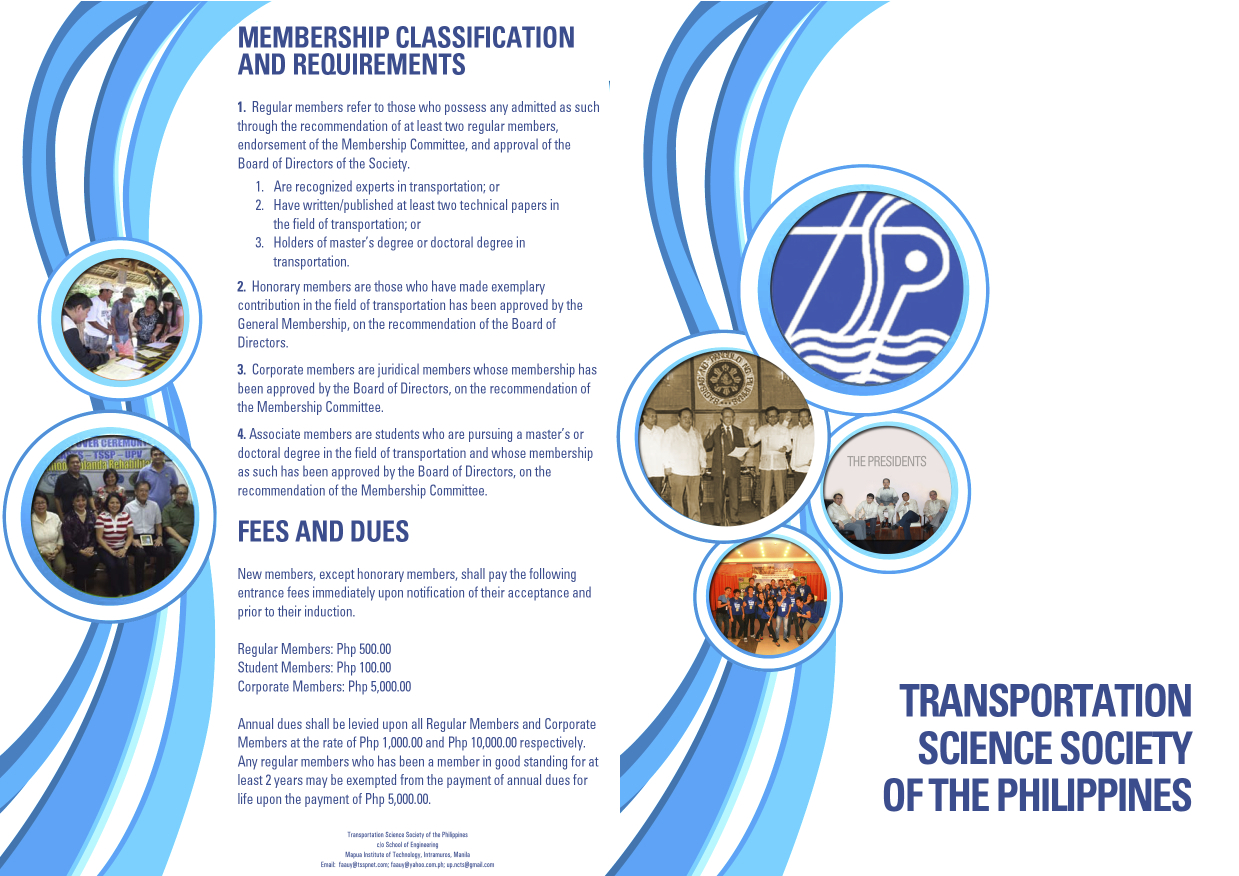
The conference is hosted by the Transportation Science Society of the Philippines (TSSP), which is the local affiliate of the EASTS. More information on the TSSP are found below:
–
Future of jeepneys?
I spotted a jeepney on my way home with a message (or tagline, depending on how you see it) printed on its side. It says BEEP, which was supposed to stand for Bagong Jeep (translated as New Jeep). From the looks of the vehicle, there was nothing new about it, except maybe this sign that was painted over an older design on the vehicle’s body. Apparently, the tagline does not refer to the vehicle itself but to the image of the jeepney. “Bago” or “New” here refers to a new image for jeepneys. Long regarded as the “King of the Road,” the jeepneys have become synonymous to reckless driving, uncomfortable rides and unreliable services. They have also come to represent unsustainable transport what with most jeepneys being fuel guzzlers and smoke belchers.
 I already spotted several jeepneys plying the Cogeo-Cubao route sporting this sign that’s apparently a campaign to uplift the image of jeepneys. It seems really a stretch to call these ‘bago’ as the vehicles I’ve seen are the same customized bodies with second hand engines running them.
There is a campaign to rehabilitate the image of the jeepneys and perhaps it should start with driver behavior and not necessarily the vehicle. Many jeepney drivers (as well as drivers of other public utility vehicles) have attitudes leaning on the rude side. You see many of them driving recklessly along our roads and stopping just about anywhere (e.g., in the middle of the road). Such behaviour is due to many factors including the way these people learned to drive and their motivations for their means of earning a living. Much can also be said about their education both formal and regarding their driving.
There are also many vehicles vying to be the replacement for the jeepneys and among these are electric vehicles including the electric jitneys that I have featured in past articles on this blog. Incidentally, one of those electric jitneys is actually a more recent model of the electric jeepneys that’re currently in operation in Makati and Alabang, and it happens to be called the Beep. Operating in Filinvest City, the e-jeepneys there have been lauded as a viable option for replacing the conventional jeepneys. So far, so good and time will tell if indeed, conventional jeepneys will be phased out in favor of e-jeepneys. The jury is still out there in terms of the e-jeepney’s reliability and durability.
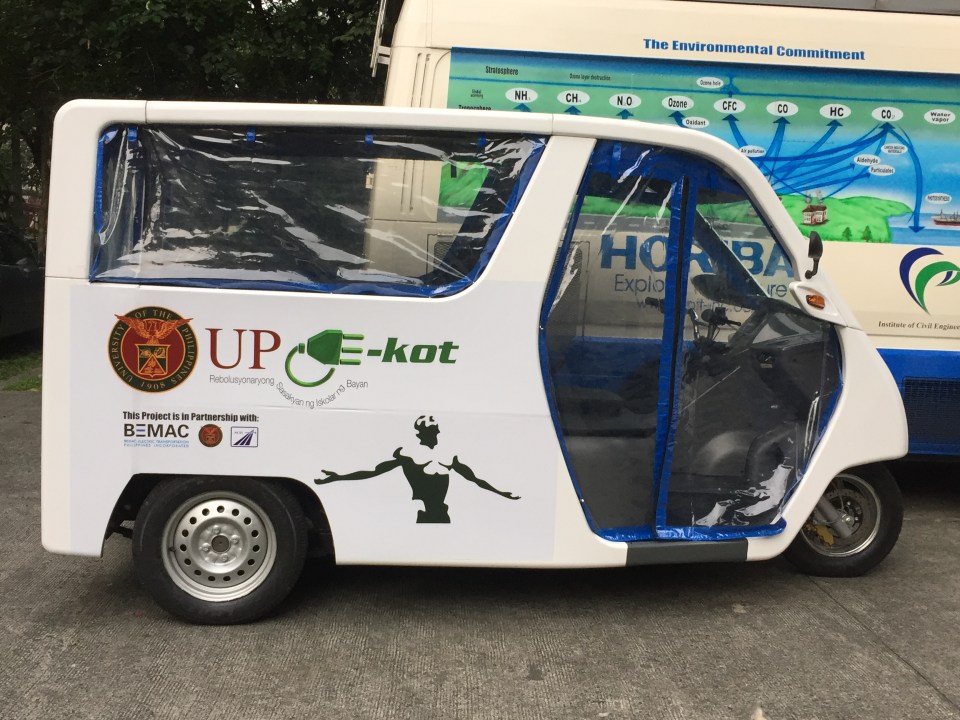 An electric tricycle currently undergoing experimental operations at the University of the Philippines Diliman campus is more a replacement for tricycles and multicabs than for jeepneys.
–
Pedicabs in San Diego
I was surprised to see a familiar vehicle going around San Diego as I took a walk around the Gaslamp District. I had to do a double take as I saw three-wheeled non-motorised transport (NMT) along a busy road. Many were brightly decorated or sported lights that made them noticeable among the vehicles on the streets when it got dark. Many drivers were also dressed to attract passengers. Many wore helmets or some head gear (hats or caps for others). Motorists seem to be well-adjusted to these pedicabs running along San Diego roads but then traffic in the CBD appears to be lighter compared to downtown Los Angeles or San Francisco.
 Bicycles and cycling are very popular in San Diego so pedicabs seem to be a natural extension of that
 Three-wheeler with a smiley
 Pedicabs could carry 2 to 4 passengers depending on their seating configuration
 A pedicab decked with rope lights is followed by one with well-dressed passengers. The pedicabs were quite popular with delegates/participants of the INTA conference held at the San Diego Convention Center.
 I like this photo I took of a pedicab ferrying a passenger to the historic Sta. Fe train station. A San Diego trolley is also in the photo. The image shows the complementation among transport modes.
The pedicabs in San Diego are basically for tourism and not necessarily for commuting. They do, however, agree to carry people who would rather ride the pedicab than take a taxi or walk to their destinations. You just have to negotiate a fair price for the ride. The good thing with the pedicabs in San Diego is that their operations there provide a good example, a proof of concept if I may state, of how motorised and non-motorised options can co-exist. These options for travel include the rail-based trolley and provide people with a plethora of options for sustainable mobility. I think this should work in medium sized, highly urbanised Philippine cities as well.
–
 Caught (up) in traffic