
In most if not all of our projects that require traffic analysis, it is our standard practice to convert the mixed traffic counts to equivalent values in terms of passenger car units (PCU). This conversion as applied to most vehicles such as trucks and buses allows us to obtain their equivalent in terms of space occupied on the road. Subsequently, the values are used for capacity analysis including the determination of level of service (LOS) based on the volume to capacity ratio (VCR) that can be computed. Motorcycles and tricycles also have their equivalent factors, which can be obtained or estimated from research, and in certain cases like the Department of Public Works and Highways (DPWH), is published and ready to use by projects. We observed though that even with the conversion from motorcycles and tricycles to their equivalent in PCU, the resulting VCR’s calculated usually don’t match the situation at the study area. VCR’s may approach and exceed 1.0 (i.e. LOS E to F) and yet the observed situation is closer to D at worst. Perhaps this is due to motorcycles in particular filtering through traffic?
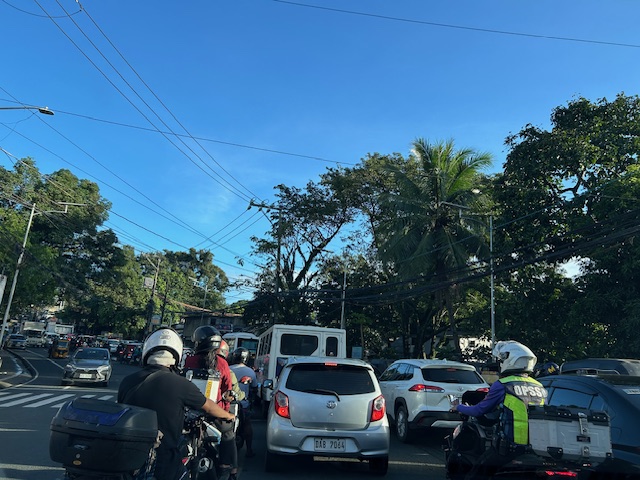 Motorcycles filtering between the lanes
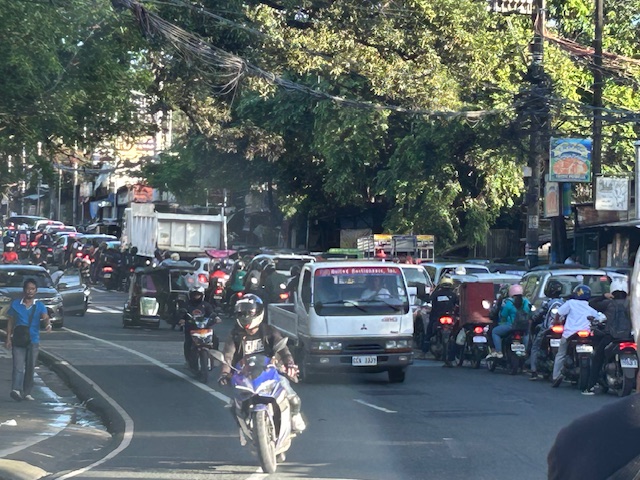 Motorcycles using the bike lane or the space along the median to beat traffic. Trikes may actually fit unprotected bicycle lanes and use these to get past congested roads.
If we simply assume that motorcycles will use the traffic lanes, then we will end up having saturated roads (i.e., volume exceeding capacity or LOS F). In reality, it is quite different and you’d find roads to be less congested compared to what is on paper. Thus, it may be more prudent or practical to reduce the number of motorcycles in the analysis by applying a factor, say 50%, aside from the conversion using passenger car equivalence.
Of course, this must be subject to studies to establish the factors and empirical evidence for this approach. Meanwhile, we can make assumptions and compare the results with field observations to determine if they’re consistent with real world conditions.
–

