
Tartanilla – Calesas in Cebu City
We spotted these calesas or horse drawn carts while walking around downtown. These are also called ‘tartanilla’, which is familiar to us since its the same term used in Cagayan De Oro for their version of this transport mode. Here are a few photos:
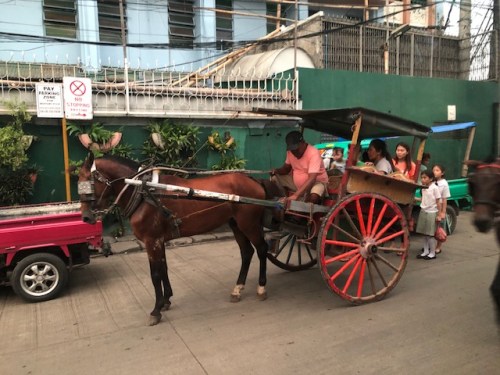 Although mainly used for tourism purposes in Manila, the tartanilla in Cebu seems to enjoy some non-tourist ridership. Most of the passengers we saw riding them didn’t look like tourists.
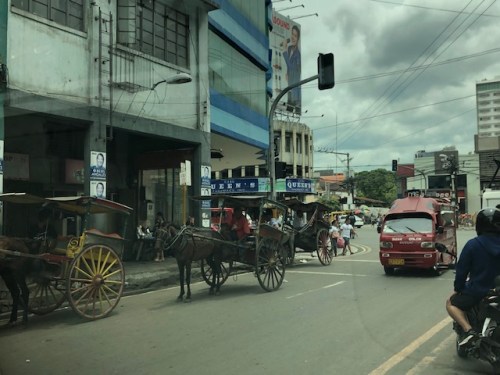 There are on-street stations for these tartanillas.
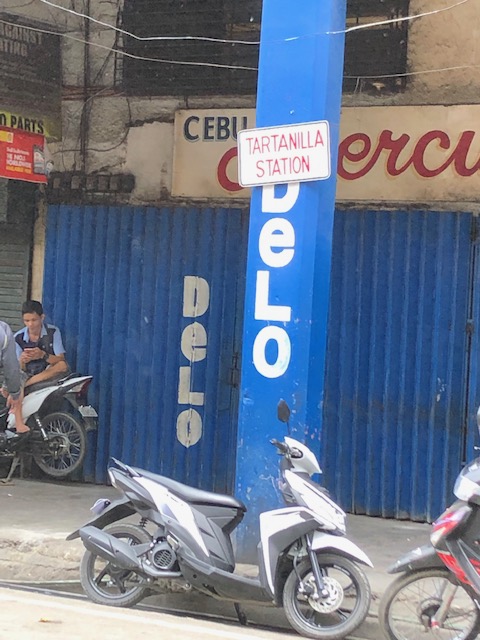 Tartanilla station sign – the stations appear to be informal but I guess the city is regulating their services and retaining them as part of the heritage of the city.
–
We need to work on road safety for children
Working on a project on road safety for children, I have had an increasing appreciation for the need to improve the plight of our children who are among the most vulnerable of road users. I have shared or posted many images showing examples of children being exposed to risk. These include children crossing streets without assistance and those riding on motorcycles with minimal protective gear (not that such gear can really save them from serious injury or worse should they be involved in a motorcycle crash).
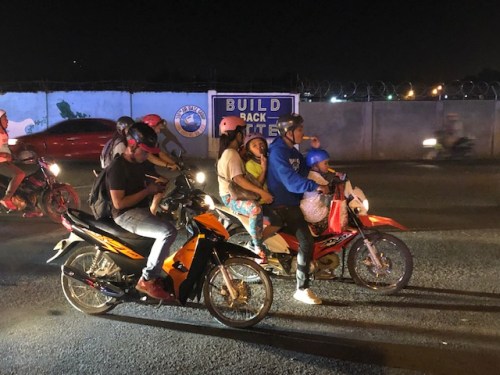 I took this photo as we waited for the signal to allow us to cross a very busy intersection in Zamboanga City. The entire family seems to be coming from dinner or the grocery where they picked up their popsicles. I hope the father is focused on balance and safe riding with his family considering the potential for tragedy here.
Some people may say that such scenes show the norm. But we must realise that treating these as normal means we accept that our children (and all other people) will be hurt one way or another. Is this really what we like or accept to be the situation? Perhaps not. And so the challenge is to find ways to make the journeys of children safer and one aspect we can focus on is the journey between home and school. This is perhaps the most common trip by children is between the home and school (to and from), which covers a significant share of the total trips made everyday.
In order to do this, we need to know, assess and understand the manner of their commutes and the facilities they use. We should collaborate with people who guide them including their parents/guardians and teachers. And we should engage those who are in the position to implement solutions such as government agencies or local governments in effecting interventions.
–
Dangerous situations for school children
We are currently implementing a project to improve the safety of journeys of children between their homes and schools. Ocular surveys of 25 schools in Zamboanga City revealed a lot of issues pertaining to their commutes. Critical locations include the main access roads (e.g., across school gates) and intersections. All schools have reported incidence of road crashes involving their students and mentioned that in many cases, drivers or riders do not slow down upon approaching the critical locations. These cases of speeding are despite the many countermeasures (including informal and creative ones) that schools and Barangay authorities have implemented to improve safety.
Here are some photos we took at Sinunuc Elementary School along the national highway in Zamboanga City:
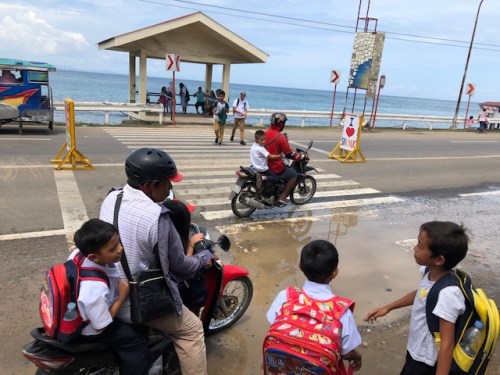 Children waiting to cross the highway and on-board motorcycles with their parents/guardians who fetched them from school
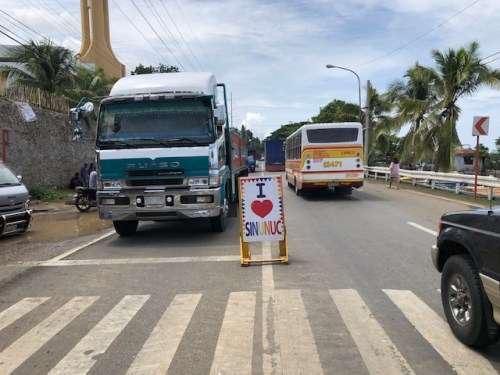 Large vehicles including trucks and buses traverse the highway and the signs offer little in terms of refuge or protection against these for students and other people crossing the highway.
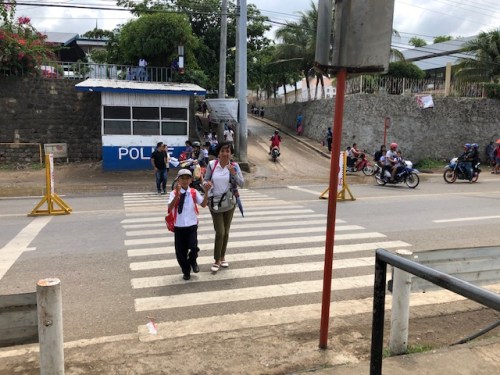 Child crossing with a parent/guardian
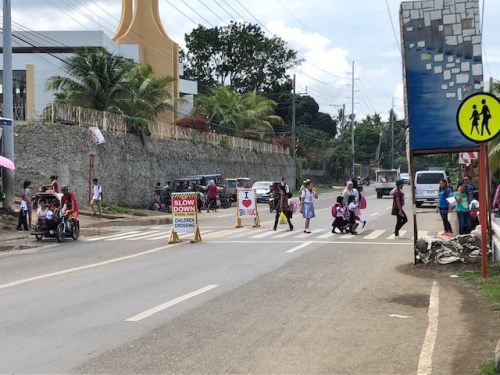 Children crossing the highway – photo also shows a pedestrian crossing sign at the road side along the direction towards the city centre.
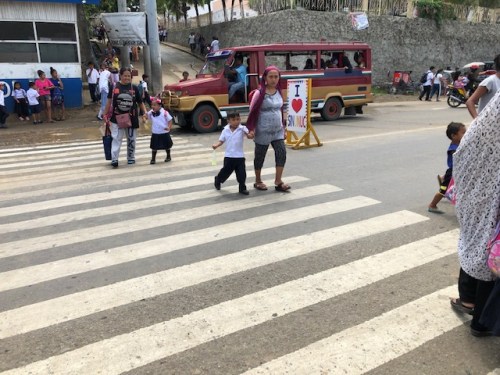 Children crossing with their parents/guardians as a jeepney is stopped right before the pedestrian crossing.
Though it may not be so obvious for some observers or viewers of the photos, these situations present high risks for students and others using the roads. And we hope our assessments in cooperation with the schools, agencies and city officials will be fruitful in improving road safety especially for the children.
–
MyBus at the Mactan Cebu Airport
Arriving at the Mactan Cebu International Airport (MCIA), we moved towards the transport terminal where a rental van was picking us up. We were a big group and had luggage for a week’s stay so we arranged for the van, which we rented until the evening so we can go to dinner without hassle. As we walked towards the terminal, I saw a man waving a board with MyBus on it. He was calling out to passengers who might want to take this bus to Cebu City (MCIA is in Lapu-Lapu City). I wasn’t able to take a photo of the man but was able to take few as we waited for our van.
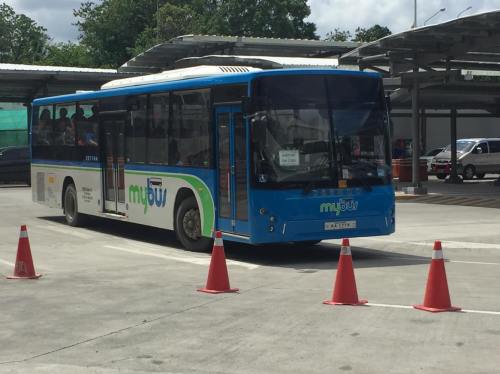 MyBus turning along the MCIA terminal driveway after picking up passengers
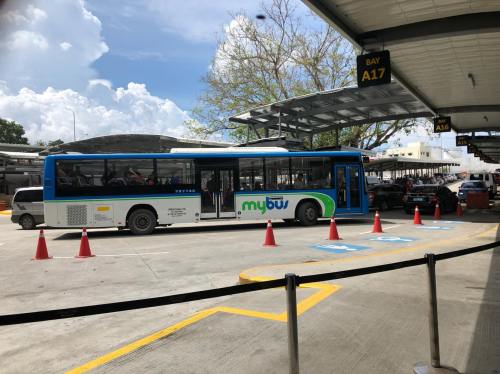 MyBus turning towards the terminal exit. There were a good number of passengers on the bus so that’s a good thing. That means they already have established some ridership between the airport and Cebu City.
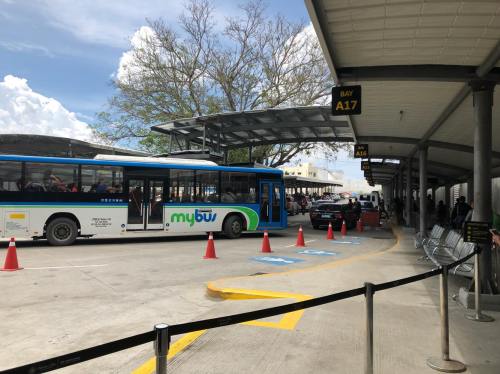 Another photo of the bus as it waited for a car to clear its path. MCIA has very good road transport terminal facilities, which I thought was excellent when compared to those in other airports in the country.
Perhaps I would try MyBus next time I am traveling to Cebu and with less luggage? The bus as shown in the photo is configured for city operations and not for long distance travel (i.e., with luggage compartments on belly of the bus) like the limousine buses I took in Japan.
–
Grab tours?
One of my former students who did research on ridesharing showed me a new feature on the Grab app. There is a vehicle for rent option now in the app as shown in the screen capture below:
 Booking by the hour means you get to set the duration of service. The conventional service is point-to-point (i.e., taxi).
 Choosing “booking by the hour” will lead to a selection of vehicles and the number of hours corresponding to a type of rental.
We showed these to our suking van rental in Cebu and our driver commented that these were expensive. Still, we thought this was a good way to go around the province (not just Cebu City). Of course, such rentals may be more applicable for those who like set pieces when they travel or go on tour. If you’re the more adventurous type, then perhaps you will consider public transportation and walking. It will certainly be less expensive and give a more memorable experience however it goes.
–
Politics: Fresh Faces at the Local Level?
A major factor in shaping our cities and municipalities is the leadership in the form of local politicians, most especially the Mayors, who are the decision-makers for many aspects of their constituencies. Mayors have a hand in most if not all policies pertaining to land use (e.g., zoning, planning, etc.) and transportation (e.g., schemes, policies, franchises, etc.).
The likes of Vico Sotto, Isko Moreno and Francis Zamora are currently being praised for what seems to be their fresh and aggressive approach to addressing problems and issues in their respective constituencies. The three’s ascendance to mayor of their respective cities have also exposed the alleged graft and corruption of their predecessors. The dominance of the latter in the form of dynasties have all but assured that whatever anomalies passed on from one term to another are internalised and made unknown to their constituencies who are to remain blind to these abnormalities. Instead, the people are made to believe that progress is achieved with some worthwhile projects here and there to show that taxpayers’ money are spent well.
Prior to these personalities, there were others who sort of broke the dynasties in their respective towns. I can name at least two cases that I am very familiar with; both with the Municipality of Cainta – Mon Ilagan and Kit Nieto. Both ended long reigns with Ilagan making Cainta history by finally upending the Felix dynasty there. Previous to him, the only one who almost upset the then reigning dynasty was a woman – Eunice Fermindoza. Ironically, Ilagan’s attempt at a dynasty by making his wife run after his 3 terms was up was nipped by Nieto, an erstwhile ally who has come to represent not just the emergence but the establishment of people who have settled in suburban town in the various subdivisions developed over the course of the last 50 years. These are the middle class comprised of professional and office workers and their families who decided to reside in Cainta because of the town’s proximity to Metro Manila and homes their being relatively affordable.
Even before Sotto, Moreno and Zamora have embarked on their own programs, Nieto has shown that the efficient use of resources coupled with transparency and a genuine feel for the requirements of his constituents will get one re-elected and gain attention. Cainta has transformed and blossomed under this current mayor. For one, he has been able to complete many infrastructure projects and strengthened social and medical programs in the municipality. It is a wonder how Cainta is not yet a city considering its income and continued growth. One only wishes this growth is not sustained by poorly planned land use development where the town basically relies on developers (i.e., Megaworld and Filinvest) for the plans instead of being involved in order to avoid exacerbating the enduring traffic and flooding issues that are still the bane of this town. Unfortunately, Nieto is on his last term and it is unclear for now who might be competent and progressive enough to replace him. Among the current councilors in the current administration is a Felix and an Ilagan, scions of the two previous families that lorded it over Cainta. Will one of them rise again to reclaim what they probably regard as their right place? Hopefully not…Kawawa naman ang Cainta.
–
Public transport terminal at the Sta. Lucia East Grand Mall
Sta. Lucia’s East Grand Mall reconfigured its transport terminal and made it somewhat more formal than it was before. Previously more like a informal terminal with jeepneys parked along their driveways, the mall relocated its terminal to be closer to the Line 2 Station currently under construction just across from the Robinsons Metro East Mall and Sta. Lucia’s main access road from Marcos Highway.
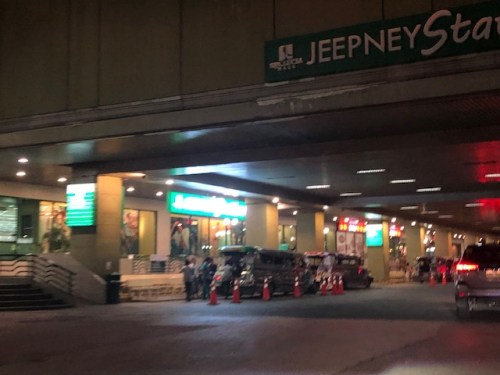 Jeepney station for eastbound PUJs including those bound for Cainta, Taytay, Angono and Binangonan via Felix Avenue (formerly Imelda Avenue) and Cainta Junction
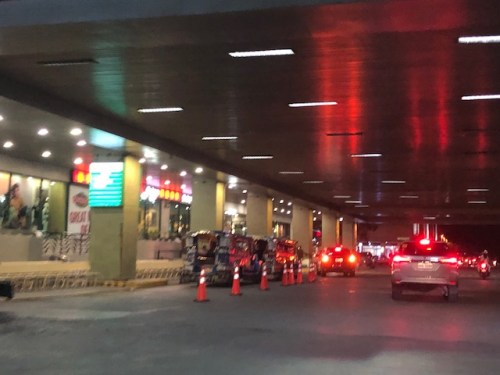 There is space for 4 to 5 jeepneys depending on how they are parked. There are also seats for waiting passengers and the area is fully occupied during the peak hours in the afternoon and evening when there is higher demand and jeepneys are not able to come back as fast to pick-up passengers.
This is a welcome development as passengers have a better place to get a ride. The terminal is more secure and protected from the environment (i.e., it is practically covered as shown in the photos). Then, of course, there is the proximity from the Line 2 Station making transfers between rail and road transport more efficient. The walk between the station and the terminal is not a difficult one as there should be adequate space along the Sta. Lucia mall driveway that has an improved pedestrian sidewalk, too.
I will post more photos of this terminal soon!
–
TSSP 2019 Conference in Cebu City
We just concluded the 2019 version of the Annual Conference of the Transportation Science Society of the Philippines (TSSP). This year’s conference was co-organised with the University of San Jose-Recoletos (USJR), whose College of Engineering hosted the event. The conference included a pre-event activity – the Workshop for Young Researchers (WYRe) held on July 25, the conference proper on July 26, and the Technical Tour at the project site of the Cebu-Cordova Link Expressway (CCLEX) project on July 27. Here are some initial photos from the conference:

Dr. Sheilah Napalang, former Director of the National Center for Transportation Studies (NCTS) and now Asst. Secretary of the Department of Transportation (DOTr), facilitating the Workshop for Young Researchers (WYRe).

Backdrop for the plenary sessions of the conference
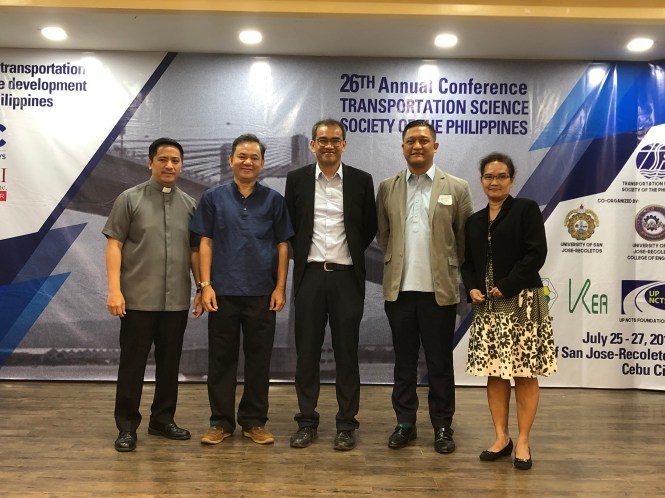
Opening program speakers included (L-R) Rev. Fr. Cristopher Maspara, OAR (USJR President), Dr. Ricardo Sigua (TSSP President), Dr. Enrico Paringit (DOST-PCIEERD Executive Director). The photo also shows our co-organizers, Dr. Dennis Anthony Kilongkilong (Dean of the USJR College of Engineering) and Engr. Elvira Sales (Chair of USJR Dept. of Civil Engineering).
More photos on the conference in the next post!
–
Walking in downtown Cebu City
Last month when we were in Cebu to coordinate with our counterparts at the University of San Jose-Recoletos (USJR), I took some quick photos of the sidewalk scenes near the university. We stayed at a nearby hotel so that meant we only needed to walk to/from USJR for our meetings. Here are some of those photos.
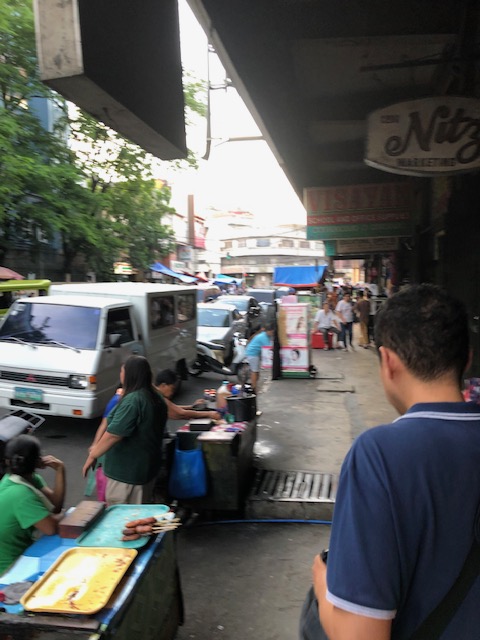 Many buildings in the downtown area have designs where sidewalks are practically covered, protecting pedestrians vs. the elements. This alludes to arcade design architecture you find in many old cities’ downtowns including Manila, Iloilo and Bacolod.
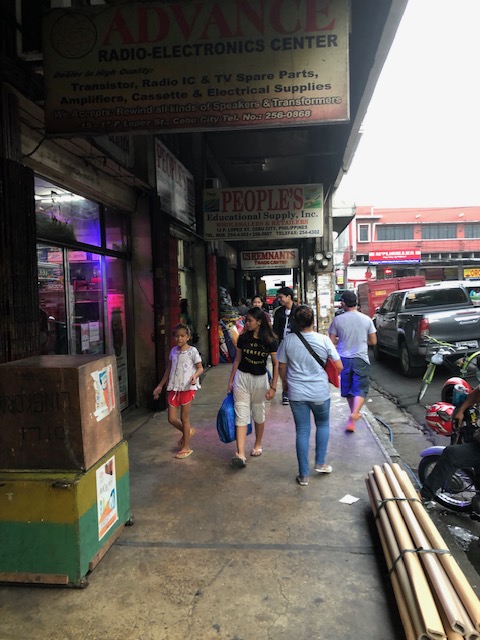 There are many shops and stores at ground level. Depending on the area, there will be hardware stores, electronic stores, school supplies and others.
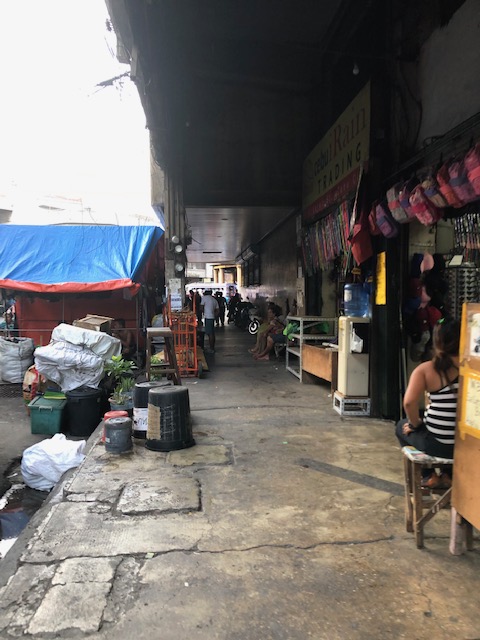 Along some streets, one will find makeshift stalls occupying the road itself. I assume these are allowed by the city along certain streets.
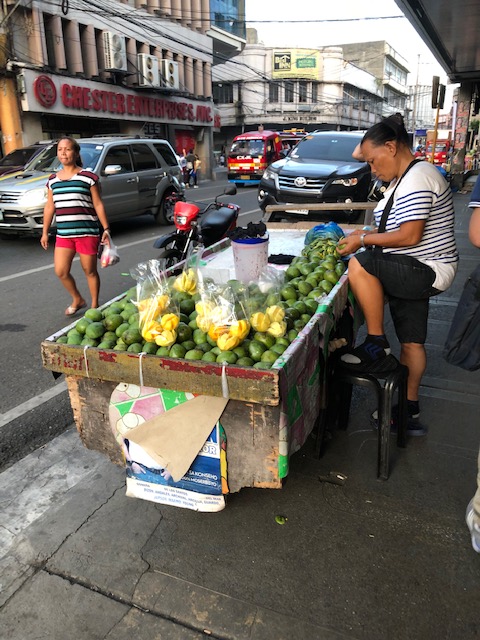 Typical street vendor with his mobile store. Fruits, local delicacies and snacks, and refreshments are popular.
I believe these scenes reflect on the character of the city and gives the visitor a view of life in the downtown area of the city, which in this case is Cebu, the oldest city in the country. I will be back in Cebu soon and will be taking more photos around downtown. I’ll be posting these, too.
–
One small step and a giant leap
Here’s a different kind of article that blends three of my favourite topics – transport, space and watches. Its the 50th anniversary of the first moon landing. That’s the Apollo 11 mission in 1969. It took a lot of calculations for men to finally reach the moon and return safely to earth. There certainly were a lot of factors that affected the trip and these are not as simple as traveling between points A and B like what we usually try to figure out for conventional earthbound transport.
Did you know the first watch on the moon was an Omega Speedmaster chronograph? They needed them and other instruments for their precision that’s required for such sensitive and demanding missions.
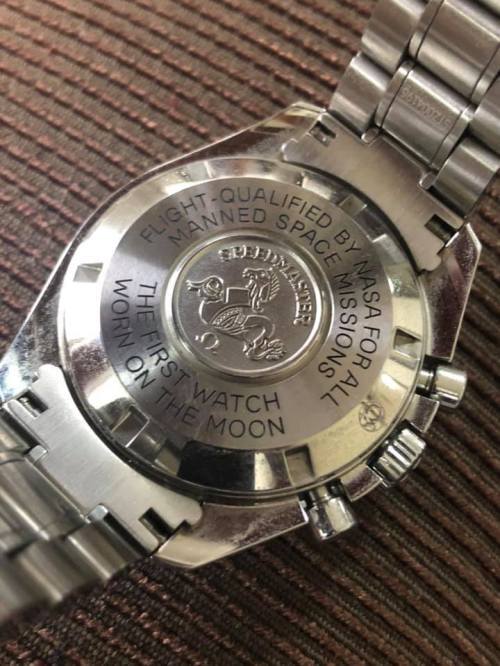 Subsequent versions of the moon watch have already had updated movements inside them but these Speedmasters are still the standard in as far as NASA is concerned.
There were actually 2 moon missions in 1969. The first one, Apollo 11, in July and the second, Apollo 12, in November. The next one, Apollo 13, was a failure in terms of the moon mission but succeeded in terms of the astronauts surviving what must have been a terrifying ordeal in space. If you watched the movie, there was a part there that was supposed to have happened where they used it the chronograph of their watch to time a procedure they had to do while troubleshooting their module.
Quite expensive these Omegas are. However, there’s another watch that has been officially recognised as used on a moon landing. That other moon watch is a Bulova (sorry Rolex but the watch that was supposed to have been brought to the moon was more an accessory or memento than an instrument actually used by an astronaut on the moon). Here’s a piece associated with the 4th (Apollo 15 in 1971):
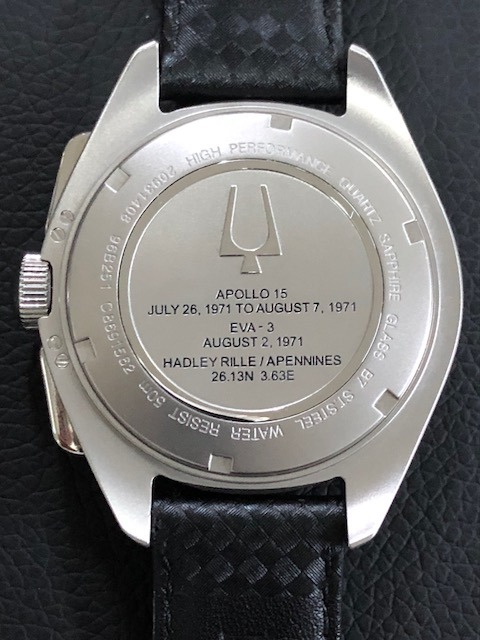 Back of a Bulova moon watch model stating the mission when it was used.
–

