
Article share: on pedestrian facilities and climate change
Here is an article that articulates the importance of walking and pedestrian facilities in sustainability and ultimately fighting climate change. It argues that if we had the infrastructure and facilities to make it easier for people to walk, they will and are likely to walk rather than use their cars. This is not limited to short trips as walking can be in combination with public transportation, making it an integral part of trips where public transportation covers the main commute and walking is the proverbial last mile travel.
To quote from the article:
“Walking, biking, and transit need to be prioritized, and treated as legitimate forms of transportation. This means stepping up efforts to collect data on sidewalks the way we do for roads, investing in complete walking networks before engaging in expensive new road projects and making sidewalk construction and maintenance a municipal responsibility rather than an individual one.”
Child’s perspective of road safety
As adults, many of us seem to have forgotten how it was to be a child and to see things from a child’s perspective. This perspective is important in many cases, situations or scenarios. One area where we can use this perspective to improve how things are is in road safety. As they say, streets that are safe for children are safe for everyone else. I am sharing this guide that also includes a project involving coming up with a reverse periscope. The reverse periscope is intended for an adult to have the view of a child.
How Do Kids Experience Streets? The Reverse Periscope Companion Guide
This guide would be something that can be used in road safety seminars or workshops that include some field activities. Participants can use the reverse periscope to simulate being a child as they walk and cross streets. An activity can be designed for transport and highway officials, even local government staff involved in planning, design and assessment of streets.
–
Article share: Redesigning Streets for Livability: A Global View
I am sharing this article on redesigning streets. It is actually a promotion for a book: “Streets For All: 50 Strategies for Shaping Resilient Cities”.
To quote from the article:
“Streets For All: 50 Strategies for Shaping Resilient Cities is an expansive 270-page volume that explores the evolving potential of the most ubiquitous public space in our cities. It offers ideas, tactics and strategies from across the world on how our streets are being, and, can be rethought, recast, repurposed and redesigned towards greater resilience and resourcefulness. The globally diverse opinions and case studies in this book remind us why cities with limited means can offer profound lessons to affluent societies that take their prosperity for granted. And in turn, how the virtues of effective urban administration and reinforcement seen in developed societies could reassuringly serve to inspire less economically developed ones.”
Traffic congestion at the UP Diliman campus
The University of the Philippines returned to face-to-face classes last week. That meant many students who have been admitted to the various programs of the university finally set foot on campus. Many, unsurprisingly, drove their own cars or were driven by their parents who themselves may probably were first-timers on campus, too. And given that many students come from middle to upper class families (they are the ones coming from the better schools and more likely to be admitted to UP), it is not surprising that many if not most have cars. The result is vehicles going around the campus even for short trips that could have been made by walking or cycling. Public transportation in the form of jeepneys were also affected as their routes were clogged by private cars. Jeepney users ended up similarly caught in traffic.
The same week, the UP Fair was also held. This was the first UP Fair in 2 years after the lockdowns. The trips generated by activities associated with the Fair contributed to the congestion along the main roads in the campus core. Note that much of the Academic Oval remained closed to traffic and these roads are the widest on campus. Still, portions were open to general traffic including sections to access the parking lot across from Palma Hall.
Will this congestion persist or will it go away eventually? Are a significant part of this actually through traffic? We’ll know very soon for sure once students settle down and realize going around on their cars are not the way to travel around the campus.
–
[Updates on this later]
Top urban problems in Metro Manila
I was looking for material to include in my introductory lecture for a graduate class. I came upon this slide from the study “Roadmap for Transport Infrastructure Development for Metro Manila and Its Surrounding Areas (Region III and Region IV-A)” that was conducted by JICA through a consulting firm and completed in 2014. The slide shows the top three urban problems identified in Metro Manila (or perhaps what we now refer to as Mega Manila or, as what was tagged as NCR plus during this pandemic).
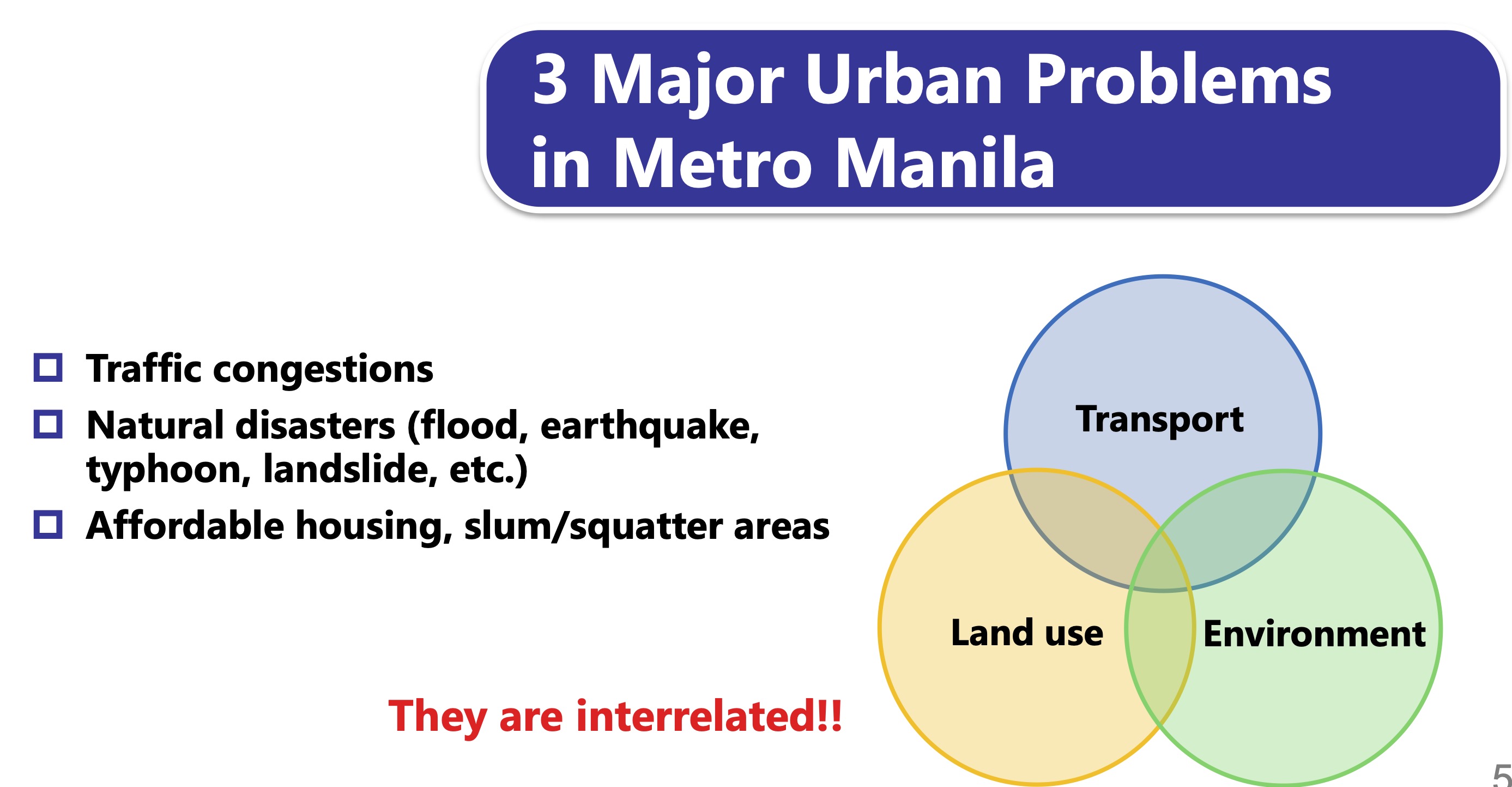
Traffic congestion was identified as one of the top problems if not the top problem itself. This is not independent of the other two (or other problems identified in the survey). All of them are intertwined somehow as illustrated in the simple Venn diagram in the slide. Affordable housing, for example, affects our transportation system and puts much pressure to transportation infrastructure development as well as to the provision of transport services. People continue to choose living in the periphery of Metro Manila or outside NCR because of the expensive residential choices particularly in the CBDs where most people have their workplaces and where many of the elite schools are also located. These people would have to commute long distances and experience longer travel times than what seems to be the reasonable. The result is loss in productivity and transport related costs that include fuel and maintenance costs.
What do you think about these urban problems? How can be address them in a comprehensive manner?
–
Early risers and commuters
I was half surprised the other day when I went out to go to our office at 5:00 AM. I am no stranger to early morning or very late night travels including driving myself. I’ve done so under various circumstances before including going to the airport for an early flight or driving to a hospital due to an emergency. You don’t see many people waiting for rides at 11:00 PM or perhaps 3:00 AM. These are basically what people refer to as ‘unholy’ hours. People are asleep during these times. If not, they probably are working the so-called graveyard shift. The latter used to be for workers employed in facilities like factories that usually operate 24/7. Nowadays, these include business process outsourcing (BPO) workers who are active in part due to their employers being in countries in different time zones (e.g., US and Europe).
At one point before the pandemic, transport and traffic had become so bad that people had to leave their homes earlier than when they had. For example, instead of leaving at 7:00 AM, employees had to leave at 6:00 AM in order to reach their workplaces at 8:00 AM. Students have to leave at 5:30 AM to reach their schools at 7:00 AM. Now that we are still in a pandemic but returning to the ‘old normal’ it seems to have become worse than before.
At one point during the pandemic, a senior transport official stated that people will just have to wake up earlier if they want to get to their destinations on time. Whether this was serious or in a joking manners, to tell people to wake up early (or earlier) if they want to get a comfortable ride or just even to get a ride is insensitive. It only shows officials to be uncaring. But that probably is linked to their being elitist or privileged that they cannot even empathize with the regular commuters. With a new administration in place, we seem to have more of the same kinds of officials in our transport agencies but hopefully, the younger staff can convince their bosses to be otherwise and really work towards improving commutes.
–
Push and Pull: The Link Between Walkability and Affordability
Here is a quick share of an article about the link between walkability and affordable housing.
To quote:
“While early pandemic pundits predicted the ‘death’ of urban areas, recent trends show that people—perhaps more than ever—value the benefits of compact development and easily accessible amenities and services. But “Demand drives up costs and can reduce low- and moderate-income households’ opportunity to live in highly walkable areas,” the report warns.”
Source: Push and Pull: The Link Between Walkability and Affordability
Some people seem to be baffled why people choose to purchase homes and reside in the suburbs or away from the city centers. It is actually simpler than what many tend to overthink and attribute purely to the condition of our transportation system. It takes two (or more apparently) to tango and housing affordability is critical for the Philippines’ case.
–
Recent transport features of fast-food restaurants
We went to a McDonald’s drive thru a couple of weeks ago to get some food before picking up our daughter at her school. We decided to go a new branch along the way from the office and found a new feature at the fastfood chain’s parking area – electric vehicle charging stations. There were two slots where e-vehicles can re-charge while owners eat at the branch.
 Electric vehicle charging station at the new McDonald’s branch along Sumulong Highway (Mambugan, Antipolo)
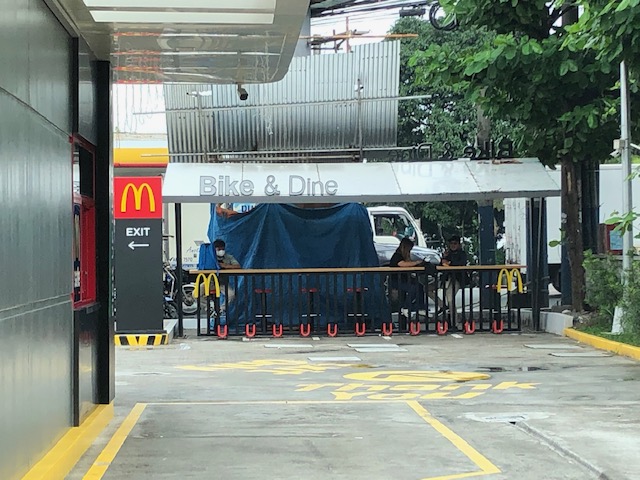 Bike dining station – you can park your bike at one side and have a comfy seat while eating and drinking on the other side
The bike and dine is not a new feature but one that McDo has installed in many of their new branches and retrofitted old one with during the pandemic. Still, we hope they have this in and the charging stations in most if not all their standalone branches. Of course, other chains should follow suit especially rival Jollibee, which has more branches and an even wider network of companies (e.g., Chowking, Greenwich, etc.) under it. This will help in promoting both cycling and e-vehicles.
–
On electric vehicles overshadowing public transportation
There seems to be much ado about electric vehicles. Here in the Philippines, there is much hype about hybrid and electric cars as incentives are now in place for people to purchase them at reduced prices and in Metro Manila at least, there is that additional incentive of these vehicles being exempted from the number coding (vehicle restraint) scheme. Here’s an article
Woodhouse, S. and Mohsin, S. (January 26, 2023) “EV Hype Overshadows Public Transit as a Climate Fix,” Bloomberg, https://www.bloomberg.com/news/articles/2023-01-25/public-transit-gets-left-behind-in-us-climate-change-conversation [Last accessed: 1/28/2023]
Some quotes from the article pretty much describes why we must focus on improving public transportation to increase or at least retain riderships:
“If we want to reduce carbon emissions we can’t just have technology-focused answers…
“Buses and trains have a fraction of the greenhouse gas impact of private cars, whether internal combustion or battery-powered, according to the International Transport Forum. A 2021 study from the National Academies of Sciences, Engineering, and Medicine concluded that the energy saved by passengers in the US using public transit rather than personal vehicles saved 63 million metric tons of carbon dioxide in 2018 — roughly the equivalent of taking 16 coal-fired power plants offline for a year…
“In the postwar era, the US prioritized building out its road network, leaving transit behind. For decades, highways and roads have consumed about 80% of federal transportation funding, with transit getting only 20%. In 2019 state and local governments spent $203 billion on highways and roads alone, with a quarter of expenditures coming from federal transfers. At the local level, continued car use is fueled by suburban development patterns and land-use practices like minimum parking requirements, which require developers to set aside space for vehicles. Outside of major cities, transit options are often limited, and historically low level of public support translate into poor convenience and reliability…
“We’re not going to be able to successfully fight climate change — and prevent more damage to the climate — without heavily investing in mass transit and specifically public transit.”
Here is something I shared last year:
You’ve probably seen the image that evolved from the original comparison of 50 people on cars, bus and motorcycles from Munster, Germany. The variant is 50 people on conventional cars, 50 people on electric cars and 50 people on self-driving cars. That is another perspective (road capacity and congestion-wise) of how electric vehicles will affect traffic.
–
On the need to change mindsets about bike lanes
Public acceptance of bike lanes has grown during the pandemic. Prior to the pandemic, there were few supporters especially among local government units and national agencies that seem to be comfortable with the status quo. Few like Iloilo and Marikina had any bike facilities worth mentioning. The pandemic was supposed to change that and it did for many. However, the acceptance and the gains seem to be eroding as we return to face-to-face activities and the ‘old’ normal situation.
I’m sharing below an article on the need to change mindsets about bike lanes and cycling in general:
Thompson, C. (January 24, 2023) “The Battle Over Bike Lanes Needs a Mindset Shift,” Wired, https://www.wired.com/story/the-battle-over-bike-lanes-needs-a-mindset-shift/ [Last accessed: 1/27/2023]
To quote from the article:
“Maybe bike lanes will always be fraught, until enough of the public is finally in a true lather about climate change—and it seems reckless to not have them.
Crises, after all, have a way of opening people’s eyes to possibilities. During Covid, restaurants and cafés lost so much business that cities nationwide began allowing them to build curbside seating areas where people could sit, safely, in the open air. It greatly reduced parking—but because, well, crisis, shop owners didn’t see any way around it. Patrons loved the outdoor seating so much that cities are making it permanent: A New York City study of several streets closed during Covid found storeowners making more than before, and diners digging the al fresco lifestyle. If data won’t change minds, customers might.”
There are two opposing sides on this matter. On one side are advocates who naturally will push for bike lanes and will promote them as The solution (emphasis mine) rather than one of a cocktail to address the transport mess we are in. On the other side are conservative, status quo types (or car-lovers as bike advocates will call them) who believe cars should have the roads to themselves. Unfortunately, many in government and particularly in transport agencies are with the latter. Perhaps they should be the first ones that need to be converted to favor active transport?
–
 Caught (up) in traffic