
Some takeaways from a lecture
I lecture from time to time at the Philippine Public Safety College. This is the counterpart of the National Defense College. In the latter graduates are conferred a Masters in National Security Administration (MNSA) while in the former, graduates are conferred a Masters in Public Safety Administration (MPSA). It is no wonder that many who take these courses are military or police officers seeking graduate degrees that may later be useful for them after their typically early retirement (military and police officers retire at 56 years old instead of the typical 65 years mandatory retirement for other government employees). There are many civilians who take these programs, too. The MNSA degree actually promotes a person to a high rank as a military reservist. I am not sure about the MPSA degree but graduate degrees like these are useful for promotions in their respective offices.
I lectured recently to a class consisting of two batches of their MPSA program. Each batch consists of uniformed (mostly senior police officers with a rank equivalent to at least a Lt. Col.) and non-uniformed personnel (from various offices and professions including public and private universities, private companies, etc.). I get a lot of questions and comments regarding transport and traffic during my lectures. Some can be out of context or perhaps posed in a smart-aleck fashion but most are well-intentioned. After all, who doesn’t want to “solve” traffic? Among the more notable comments during my recent lecture are as follows (not in any order):
- There is a need to have better urban planning for our cities;
- Investments for transportation infrastructure need to be shared by government and the private sector;
- A holistic approach is required and we cannot isolate transportation or traffic;
- There is a need to have a law restricting vehicle ownership (mostly related to parking);
- There is a need to invest or allocate more resources to develop other cities to help decongest the larger cities.
Based on my experience having lectured at the PPSC over 5 years, these two batches had more listeners and were more sensible when they posted their comments and opinions on the chatbox (the lecture was via Zoom). There were only a couple of comments with ideas I did not agree with:
- Transferring the capital to another location – this seems to be a trendy (read: “nakikiuso”) topic and a very tempting one for discussion but it is not a simple task and has had mixed results in other countries that tried it (e.g., Brazil, Pakistan and Malaysia). Is it worth exploring? Probably.
- Cable cars for Metro Manila – I explained that this is still band-aid solution that does not address the roots of the transport problems experienced by Metro Manila. It is not suitable as for one, it will not have the capacity required for regular commutes and, to me at least, it is more a novelty than a solution. Resources would be better allocated elsewhere such as active transport.
Overall, I thought that this most recent lecture generated the best feedback so far from my students. I look forward to more lectures and interactions like this. And perhaps the next one will be face to face.
–
Work trips abroad
We are traveling again abroad for work. Work-related travel was mostly limited to road trips and local travel (e.g., to Zamboanga) in the past 2+ years. We used to average at least 2 foreign trips per year with my wife usually raising that average due to the nature of her work that used to make her travel to the US at least twice a year.
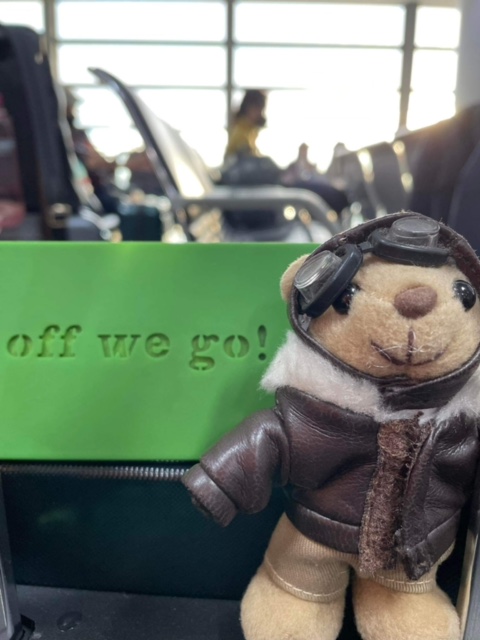 I got this bear in Arnhem, The Netherlands. He’s supposed to be an Air Force aviator, symbolizing one of those who braved the skies to bomb enemy positions or deliver paratroopers during Operation Market Garden as depicted in the movie “A Bridge Too Far.”
–
On getting started on bike commuting
Here is another article on bike commuting. It really is a challenge to get people into bike commuting even if their workplaces or schools are close to their homes. What more for people who have to travel longer distances between their homes and workplaces or schools?
Bassett, E. (December 1, 2022) “The No B.S. Guide to Getting Started Bike Commuting,” Medium, https://erikbassett.medium.com/the-no-b-s-guide-to-getting-started-bike-commuting-5dd0cbb87e5b [Last accessed:
To quote from the article:
“Assume you’re invisible until proven otherwise.
Like every city I’ve lived or ridden in, yours probably paints pictures on the ground and calls them “bicycle infrastructure.” Road designs encourage excess speed; vehicles aren’t meaningfully separated from cyclists and pedestrians; there are conflicting rights-of-way at intersections, driveways, and so forth.
And that is not right. It’s a sad commentary on urban “planning” in most places that anything but car use requires this degree of paranoia. It points to a profound dysfunction that few (with any serious influence) are willing or even interested to change…yet.
But unless or until it improves, the only viable response is to assume you don’t exist in the eyes of whoever’s driving nearby. “If I weren’t here, would they gun it to make a right turn on red?” Well, assume they will. “If I weren’t here, would they merge up there?” You guessed it: assume they will.
This is unquestionably the worst aspect of bike commuting, and if it’s too stressful in your situation, that’s perfectly fine. But in the spirit of a “no-B.S.” guide, I’d be remiss not to drive home a life-saving lesson that all these years of cycling have so deeply ingrained in me.”
The author also states the difference between bike commuting and sports biking including noting the differences in the objectives or goals for each.
–
Why do we keep widening roads?
I’m just going to share this article here. The article from The NY Times asks a question that has been bugging planners and engineers, particularly those who are in government and perhaps under the agencies like the DPWH, DOTr and NEDA. This also applies to planners, engineers and those from other disciplines involved in transportation infrastructure development and particularly roads or highways.
–
Safest airlines in 2022/2023?
One magazine published an article recently about the safest airlines in the world. This is very relevant as people have returned to traveling during this period despite the pandemic and the new strains coming out. It is useful especially for people who are traveling overseas since airline choices might be very limited for domestic routes. Here is the article:
Puckett, J. (January 5, 2023) “This is the safest airline in the world,” Condé Nast Traveler, https://www.cntraveler.com/story/the-safest-airlines-in-the-world?utm_source=nl&utm_brand=spotlight-nl&utm_campaign=aud-dev&utm_mailing=thematic_spotlight_010623_2&utm_medium=email&bxid=5bd6761b3f92a41245dde413&cndid=37243643&hasha=cf6c402001bc473063a8744033fe9be3&hashb=ec2bb753c2e6299f5107823241955221da67bd1f&hashc=09f65c608bfb62050199733de500e3cd82827631b36d537ce8386d41a3bd1ff7&esrc=FYL_SEG_APR18&sourcecode=thematic_spotlight&utm_term=Thematic_Spotlight_Afternoon [Last accessed: 1/7/2023]
To quote from the article, the basis for the ranking is as follows:
“The site’s staff analyzes each airline’s records for crashes over the last five years, serious incidents over two years, audits from aviation’s governing bodies and associations; fleet age, expert analysis of pilot training, and COVID protocols. In addition to these criteria, each airline that makes the list is also at the top of the industry in terms of safety innovations and have added cutting-edge aircraft to their fleets, like the Airbus A350 and the Boeing 787…”
There are not so many Asian airlines in the list especially if you don’t include the Middle Eastern airlines. Only Singapore Airlines, EVA Air and Cathay Pacific are in the list. I was expecting at least one Japanese airline and perhaps Thai Airways to be in the list. I was not surprised Philippine Airlines was not on the list considering the criteria.
There’s a separate list for low-cost carriers in the article and Air Asia is one though there are actually several Air Asia companies operating out of Southeast Asian countries. It would be nice to see how Air Asia Philippines compares with the mother company based in Malaysia. Cebu Pacific is categorized under LCC’s but with so many of these companies around the world, it won’t be a surprise they didn’t rank among the Top 20 either.
–
Video games for aspiring planners?
I saw this article on what are supposed to be the best video games for would-be or aspiring planners. To put this into the proper context, these are mostly newer games (or so I think considering certain games evolve over the years from the time they were first released).
Smith, A.N. (December 23, 2022) “These are the best video games for wannabe urban planners,” Bloomberg CityLab, https://www.bloomberg.com/news/articles/2022-12-23/these-are-the-best-city-builder-video-games-of-2022
When I was younger, the games to play were SimCity and Civilization. These have also evolved, and I think SimCity and Cities: Skylines (a game introduced to me by one of my students) might be the better ones for aspiring planners. You can test many concepts on these games such as transit oriented development (TOD), compact cities, etc. Of course, one can also play with actual planning and simulation software. If one has access to the transport model for Metro Manila, for example, you can test scenarios on this to see how the model will ‘react’ to various conditions or situations.
–
Another definition of the 15-minute city
We begin 2023 with an informative article defining the “15-minute city”. This is actually an entry in Planetizen’s Planopedia, which contains definitions of fundamental concepts in urban planning:
Ionescu, D. (December 2022) “What is a 15-minute City?” Planetizen, https://www.planetizen.com/definition/15-minute-city?utm_source=newswire&utm_medium=email&utm_campaign=news-12292022&mc_cid=ee083e2ee7&mc_eid=9ccfe464b1 [Last accessed: 1/1/2023]
I’ve written and shared articles about this concept before. Here are a couple from 2021 where I offered my opinions about the concept as already applied in the Philippines:
Didn’t we already have 15-minute cities and towns in the Philippines?
–
Examples of legislative actions in support of active transport
While the Philippine government and various local government units seem to be reneging on their commitments to support active transport, other countries have been building on their gains during the pandemic. Here are examples of legislations in New York State that will support active transport through funding of complete streets projects and institutional arrangements for representation of transit dependent individual:
The article is about two legislations:
Legislation (S.3897/A.8936-A) Provides Funding for “Complete Streets” Projects Inclusive of a Holistic Approach to Street Design
Legislation (S.3959-B/A.7822-C) Adds Board Seats to NFTA, RGRTA, CDTA, and Central New York Regional Airport Authority Dedicated to a Transit Dependent Individual
We hope to see something like these at least at the local level. Perhaps if LGUs are able to legislate and implement these, there will be more good practice examples that will compel national government to support active transport development. The latter is actually ironic considering that many plans are supposed to spell out the national government’s commitment to active transport. There are still live memorandum orders and department orders supporting and promoting active transport. Are these also being waylaid? That will be tragic for transportation if we didn’t learn or gain anything from the experiences during this pandemic.
–
On electric vehicles and road safety
Electric vehicles are still basically motorized vehicles and should be treated so on the roads. While the previous models were slow and small, many of the newer ones coming out of the factories have similar performance features (e.g., speed, power, etc.) and dimensions as conventional vehicles. Many conventional models have electric or hybrid variants as companies attempt to attract customers using their tried and tested models and brands. BMW, for example, has electric sedans that are practically the same in interiors and exteriors with their conventional models. It is not surprising that vehicle safety researchers are now studying how electric vehicles fit into the road safety conundrum. I am sharing this brief but informative article that describes the efforts of the Insurance Institute for Highway Safety (IIHS) of the US in studying the EVs and safety:
Tucker, S. (December 27, 2022) “How electric cars are creating new challenges in car safety,” MarketWatch, https://www.marketwatch.com/story/how-electric-cars-are-creating-new-challenges-in-car-safety-11671646057?mod=technology [Last accessed: 12/29/2022]
To quote from the article:
“It’s comforting to know that EVs will face the same tests as gas-powered cars. But the fact that the IIHS worried it might need to build new equipment to accommodate them illustrates something important.
At the rate the auto industry is modernizing toward EVs, almost all of us will be driving them someday. But there will inevitably be an overlap period when some cars on the road are electric, and others are gas-powered.
In an accident, weight matters…
Crash tests can only estimate the likelihood of injury to someone inside the tested car. They can’t predict injuries in the other car. And we’re all about to share the roads with other cars that dramatically outweigh ours.”
–
On the coordination of traffic signals
I took a couple of photos while we were traveling along Espana Boulevard. I wanted new photos of the traffic signals along Espana to use as visuals for my examples whenever I discuss traffic signals and their coordination or synchronization in my lectures.
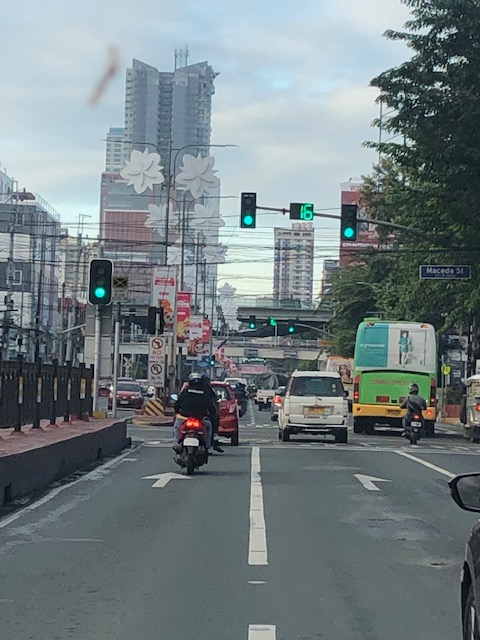 Green signal for traffic. If the traveler is able to travel at the optimum speed, one will be able to catch the green light at so many intersections along Espana. The road is the major thoroughfare in the area and traffic along it is prioritized over those from the side roads to maximize the throughput along Espana.
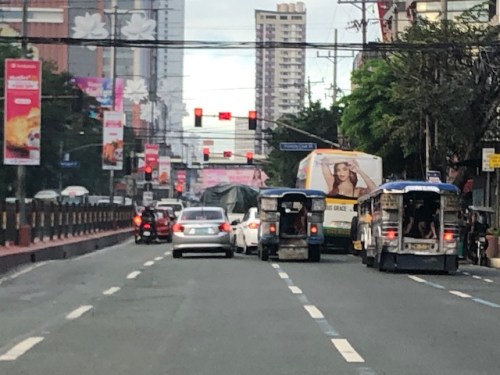 If one catches a red light at one intersection, it is possible that the traveler will catch a red light in the next intersection(s).
–
 Caught (up) in traffic