
On the arguments vs. free transit
Here is a quick share of an article discussing about the idea of free public transport (no fare or minimal fares):
Grabar, H. (June 1, 2021) “The Problem with Free Transit,” Slate, https://slate.com/business/2021/06/free-transit-is-not-a-great-idea.html [Last accessed: 6/16/2021]
Apparently, “better transit, not cheaper transit” should be the mantra for both providers (operators including government) and users (commuters). It is a very sensitive topic for regulatory bodies though since higher fares are generally unpopular to the commuting public. One transport official recently stated that fare setting is a political issue. I tend to agree with this but only because the riding public is currently still largely ignorant or unappreciative of the benefits of efficient public transportation. Perhaps this is also because we’ve really had no efficient public transportation such as the ones we see in other countries including Singapore and Hong Kong? In Singapore, for example, the road pricing policies have educated people about the true costs of transport and that convinces most to take public transportation over private cars.
–
Guidelines pertaining to bike lanes in the Philippines
The Department of Transportation (DOTr) and the agencies under it are now promoting bicycle use. Part of the campaign is to improve the safety of cyclists, most especially those using bikes for commuting (e.g., bike to work). Recently, the agencies have posted infographics showing the guidelines for bicycle lanes. Here is one from the Land Transportation Office (LTO), which is in-charge of vehicle registration and the issuance of driver’s licenses:

These are still basically guidelines that apparently do not carry a lot of weight (i.e., no penalties mentioned) in as far as enforcement is concerned. As they say, these appear to be merely suggestions rather than rules that need to be followed or complied with. Perhaps local government units can step in and formulate, pass and implement ordinances penalizing people violating these guidelines? These penalties are important if behavior change among motorists is to be achieved.
–
Revising the DPWH Design Manuals
A friend posted about the current initiatives in the US as they embark on revising their Manual on Uniform Traffic Control Devices (MUTCD). This manual along with AASHTO’s Geometric Design of Highways and Streets and their Highway Capacity Manual are something like the holy trinity for Highway and Traffic Engineers. These are also the main references for our DPWH for the manuals and guidelines we use in traffic and highways.
Here are a couple of articles calling for the revisions to reflect recent designs mainly from NACTO, which itself publishes guidelines for roads to be more inclusive rather than car-centric:
NACTO (May 2021) Modernizing Federal Standards: Making the MUTCD Work for Cities, https://nacto.org/program/modernizing-federal-standards/
NACTO (May 11, 2021) A Blueprint to Update America’s Street Manual, https://nacto.org/2021/05/11/a-blueprint-to-update-americas-street-manual/
We don’t have to pattern revisions after the MUTCD but then that requires that the DPWH through its Bureau of Research and Standards (DPWH-BRS) do its part in compiling, reviewing, studying and adopting materials from various countries, and developing suitable standards and guidelines for roads in the Philippines. Do they have to reinvent the wheel? Not so and they can still refer to the US manuals as long as again these are localised for our conditions and situations.
–
On local maritime transport
I rarely write about maritime transport so I took this opportunity to take photos of the typical boats used for fishing and transport in the Philippines. Here are a few photos I took one morning in Laiya, Batangas.
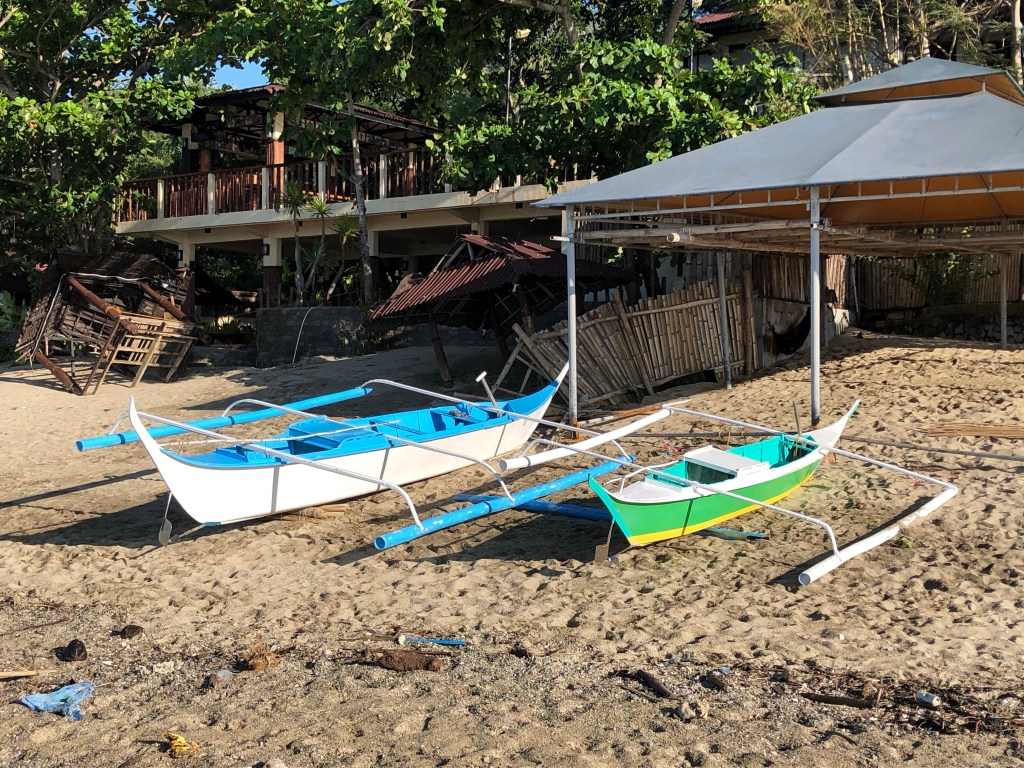

More on these bancas soon!
Roadside scenes – the Kalayaan hydro power plant
Last weekend’s getaway allowed me to take a few quick photos of a familiar sight that is the Kalayaan hydro-electric power plant located in the town of Lumban, Laguna at its border with Kalayaan town in the same province. Built in 1982, it was the first of its kind in Southeast Asia and is the only pumped storage plant in the Philippines. Basically, what ‘pumped storage’ means is that it can reverse its turbine to suck water from the basin at the level of Laguna de Bai to charge what could be a depleted Caliraya reservoir. It can then draw water from the lake to generate power. If water levels at the reservoir are normal to high such as during the wet season, it can draw water more than it needs to pump back into the lake.

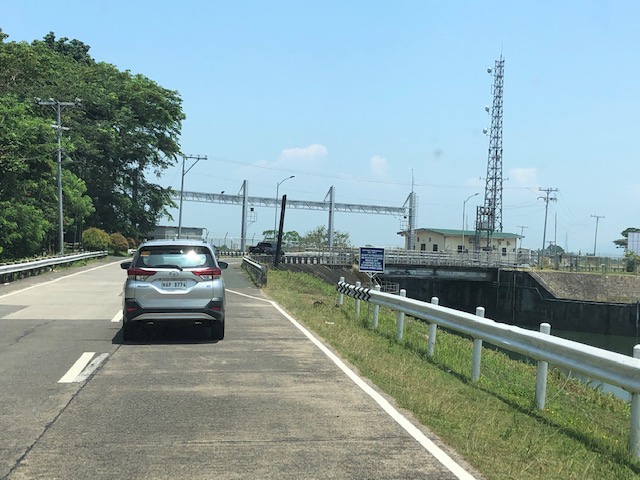

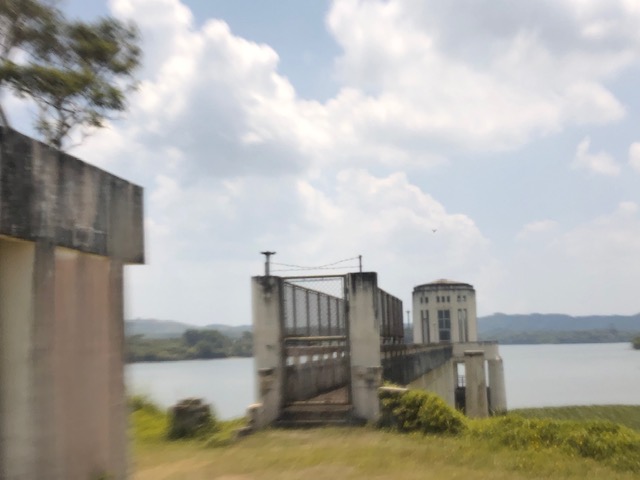


There is another power plant in the area, the Caliraya Hydro Electric Power Plant. It is not located along the national highway but to the west of the northern tip of the lake and near Pagsanjan River. I will write about that in another article.
Some opinions on active transport
Here are some good reads for those who are following the discussions and arguments pertaining to active transport:
The statements by Engr. Rene Santiago in the article ticked off some people who suddenly were attacking him instead of addressing his arguments. Unfortunately, Santiago is not on any of the social media platforms like Facebook or Twitter so he could not explain his points further. It would have been interesting to read that exchange between him and all comers. Actually, he doesn’t need to be in socmed, and has nothing to prove to those reduced to saying the guy needs to be involved in relevant projects than giving what detractors thought were flawed opinions. Santiago was and still is involved in many projects that are relevant impactful. The body of work speaks for itself unless you aren’t or choose not to be aware of his accomplishments. Perhaps his faults, if you can consider these as faults, are that he is very direct and speaks his mind? But aren’t being direct and speaking your mind supposedly among the attractions of whom old-timers (boomers?) might refer to as upstarts?
Here are a couple of articles from another experienced professional relating about personal experience and expounding on the ideas from Santiago’s interview:
Villarete, N.P. (May 25, 2021) “Walking and biking,” The Freeman, https://www.philstar.com/the-freeman/opinion/2021/05/25/2100630/walking-and-biking [Last accessed: 6/1/2021]
Villarete, N.P. (June 1, 2021) “The concept of quiet streets,” The Freeman, https://www.philstar.com/the-freeman/opinion/2021/06/01/2102287/concept-quiet-streets-streetlife [Last accessed: 6/1/2021]
These opinions are important in the discourse on active transport that we are currently engaged in. No one has a monopoly on ideas and perhaps we need differing opinions to enrich the discussion. What are your thoughts on walking and cycling? Shouldn’t we also give walking equal if not greater priority in terms of policies and infrastructure even as we push for more bike lanes and other cycling-related facilities?
–
On the history of “jaywalking”
I am an avid reader of history and have been involved in some history projects myself, particularly those concerning transportation. Recently, a former staff of mine who now works in the archives section of the university library discovered a treasure trove of magazines with articles about road safety written back in the 1950s. Then as now, road safety has been an issue and concern for society.
Here is a good read about “jaywalking”, which basically refers to the illegal crossing of streets by pedestrians:
Stromberg, J. (November 4, 2015) The forgotten history of how automakers invented the crime of “jaywalking”, Vox, https://www.vox.com/2015/1/15/7551873/jaywalking-history [Last accessed: 5/27/2021]
The article is very relevant today as we grapple with the specter of road crashes and its outcomes including fatalities and injuries that have long term effects on those involved and affected. We generally regard those crossing anywhere along the streets as jaywalkers; even branding them as “pasaway” (naughty or pesky) as what we learn early on is that there are designated places to cross streets (e.g., crosswalk, pedestrian overpasses and underpasses). And we see all those signs vs. jaywalking including the “Bawal ang tumawid dito” signs by local government units. Were these appropriate in the first place and are we prioritizing vehicles over pedestrians in most cases where “jaywalking” is considered illegal?
While this article maybe factual in as far as history is concerned, we still need to contextualize jaywalking in the current world. There still should be rules albeit these need to be revised, too. Along what roads can we have pedestrians first and cars last? What re-designs do we need to do to make roads safe? While I’m sure engineers and planners are prepared to design and implement these, the buck stops with the decision-makers, who are often politicians with their own agendas. How do we convince them and other authorities about making “jaywalking” legal?
–
On the road again for a weekend break
It’s been a while since The last road trip. We finally pushed through with our weekend break from our now typical work from home set up. Heading to our airbnb somewhere in Laguna, we passed by the Pililla Wind Farm. The gigantic wind turbines are a sight to behold.
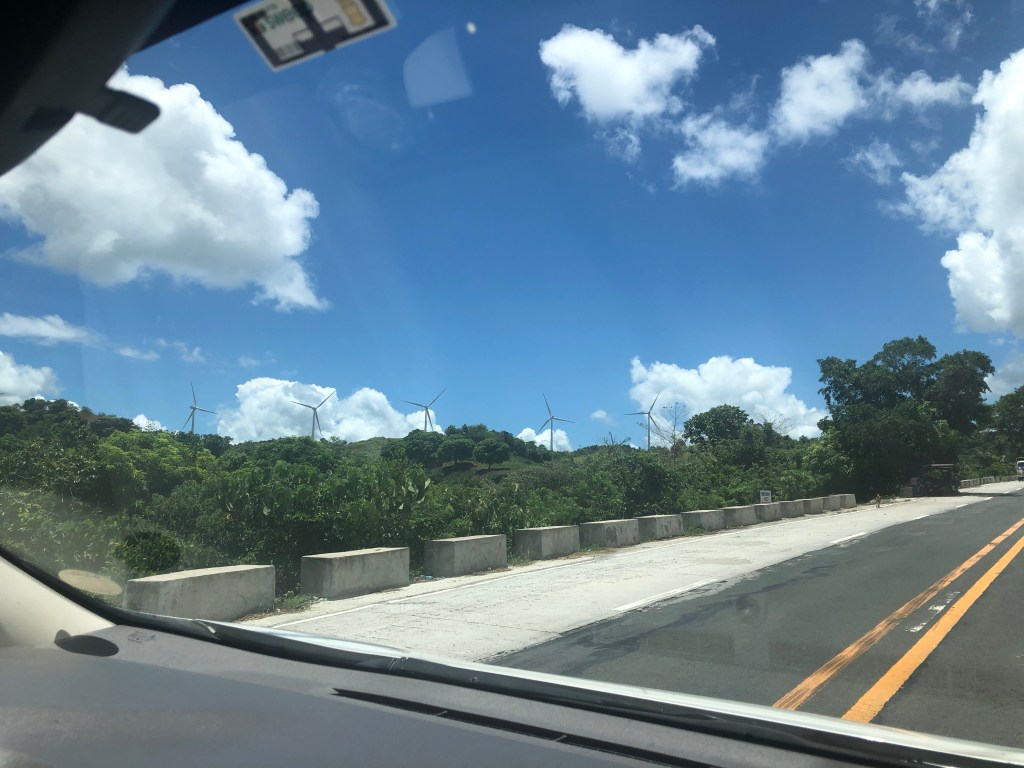
The wind farm is still closed to the public. The energy company or the LGU probably didn’t want people to be congregating there for sightseeing while there is still the pandemic. Along the way, you see a lot of motorcycle and bikers groups in numbers approaching pre covid level. Are they among the vaccinated? Or are they just oblivious to the risks they impose on others should they be infected but asymptomatic? Just asking…
Anyhow, here’s the view at the end of our trip:

Vienna Conventions on Traffic and Road Signs
There are two important international conventions or agreements that the Philippines is a signatory to. These are the
Vienna Convention on Road Traffic (November 8, 1968):
and the Vienna Convention on Road Signs and Signals (November 8, 1968):
These are important as signatories are bound but the agreements on road traffic rules and regulations and standard signs and signal. I included the links to each agreement as they also include the exceptions taken by different countries such as Thailand and Vietnam declaring they will not be bound by Article 44, choosing to classify mopeds as motorcycles. Apparently, the Philippines did not declare exceptions or objections to any of the articles.
–
Are the traffic signs in the Philippines the same as those in the US?
This seems to be a simple question with a simple answer. And the answer is no. While the Philippines is signatory and has ratified the Vienna Convention on Road Traffic and the Vienna Convention on Road Signs, the United States hasn’t. The US also depends on their Manual of Unified Traffic Control Devices (MUTCD) that is by their Federal Highway Administration (FHWA).
Here is a nice article on Wikipedia for a comparison of signs in different countries:
https://en.wikipedia.org/wiki/Comparison_of_traffic_signs_in_English-speaking_countries
I recall an interesting project I was involved in where we audited signs along what was a new Subic Clark Tarlac Expressway (SCTEX). The signs from Clark to Subic followed international convention while the ones from Clark to Tarlac followed the MUTCD. We recommended that the latter signs be changed to international convention. I am not sure if the tollway operator changed the signs as I recall there were still US standard signs there particularly for speed limits.
–
 Caught (up) in traffic