
Is the concept of induced demand a hard sell?
Here’s a quick share of an article on ‘induced demand’ particularly why it appears to be a hard sell:
Blumgart, J. (February 28, 2022) “Why the concept of induced demand is a hard sell,” Governing, https://www.governing.com/now/why-the-concept-of-induced-demand-is-a-hard-sell [Last accessed: 3/8/2022]
To quote from the article:
“Transportation experts say that the way to defeat induced demand, and actually ease traffic, would be to price roadways through tolls and congestion fees. But such alternatives are not popular. It’s hard to imagine running a political campaign on such a promise, as opposed to pledging an answer that looks free and easy… “Highway expansion is an attractive project regardless of your political orientation or what the state of the economy is,” says Thigpen. “There’s always a good argument for why we should be expanding highways. We need more jobs, or we need to unlock economic opportunity. There’s always a good political argument in favor of that.”
That last statement there relating highway or road expansion to politics is relevant everywhere. In our case in the Philippines, politicians are perceived to be very conservative and the type to use road projects as accomplishments. They are not as progressive as politicians abroad who may have the backgrounds and/or advocacies relating to sustainable transport to pursue the more difficult programs and projects needed improve the transport system. Instead, most are content with projects that they can put their name on and claim as hard accomplishments. Many of their constituents appear to agree. And agencies like the DPWH are only too happy to support this never-ending road construction and widening projects with the length of roads and the number of lanes added being their metrics for success. Of course, these (e.g., understanding and how to address induced demand, performance metrics, etc.) need to change if we really want to transform our transportation system towards something more efficient for everyone’s benefit.


–
Take a hike or a walk?
Here’s an interesting article calling for people to go out and spend some time with nature.
https://www.inverse.com/mind-body/doctors-free-nature-prescriptions-treat-chronic-diseases
The prescriptions mentioned are not at all new, content-wise but the article does mention that people tend to follow prescriptions from their doctors. Perhaps the prescription will be treated or perceived as a more serious matter compared to verbal ones that are interpreted as suggestions and not really all that serious? No matter, the important thing is to be active and keep walking, hiking, jogging or cycling.

–
Compilation of railway incidents
I found this page on Medium that’s features railways incidents (e.g., derailments, crashes, etc.). It is a good resource or reference for railway safety since the articles provide details about each incident. The writing style is investigative so they make for engaging reads:
https://mx-schroeder.medium.com
There’s another site about air crashes that I will also share later.
–
On development density and transportation
The term ‘density’ here does not refer to transport or traffic density in the traffic engineering sense but to density of development such as urban density or building density. Here is an interesting article about building during a climate crisis. While it is very much applicable to any situation, the need to revisit plans and designs has become more urgent with the current pandemic.
Alter, L. (November 19, 2021) “What’s the Right Way to Build in a Climate Crisis?” Tree Hugger, https://www.treehugger.com/what-is-right-way-to-build-in-climate-crisis-5210156 [Last accessed: 2/23/2022]
There are mentions to various references throughout the article so it is not entirely an opinion piece but supported by evidence or studies. There is also a note that the article has been fact-checked. Quoting from the article:
“Adding gentle density can help ensure there are enough people in a neighborhood to support local schools, health, and community services and keep shops and restaurants open. It can provide a range of housing types and tenures that support the needs of individuals and families throughout all stages of life and allow for aging in place. It can also support public transit services, providing residents with efficient and affordable transportation options without relying on private automobiles.”
What do you think is the ‘right’ density for Philippine cities and municipalities?
–
On women and the railroads in Ukraine
Ukraine has been in the news lately due to what analysts think is an impending invasion by Russia. Ukraine, of course, used to be part of the Soviet Union. However, they have initiated what Russia thought was unacceptable, which is applying to be a member of the North Atlantic Treaty Organization (NATO). That constituted a threat to Russia right at its doorsteps. Russia, though appear to be egging for a fight ever since they snatched Crimea from Ukraine and covet resources in that country that would likely benefit the west more as Ukraine moves to closer ties with what Russian leadership still regard as enemies.
The article I am sharing though is not about conflict but of railways in a country rich in railways history and heritage. Ukraine’s railway system date back to pre-communist times, before their inclusion in what was the Union of Soviet Socialist Republics (USSR). Here’s a nice read on Ukrainian railroads and the women who help keep their trains running:
Mallonee, L. (May 31, 2020) “The Women of Ukraine’s Railroads Keep the Trains Running,” Wired, https://www.wired.com/story/women-ukraine-railroads/?utm_medium=social&utm_social-type=owned&mbid=social_twitter&utm_source=twitter&utm_brand=wired [Last accessed: 2/21/2022]
–
More frequent road crashes?
My personal observations during my commutes lead to a conclusion that there is indeed an increase in the number of road crashes and perhaps this is attributable to the conditions during this pandemic. During my almost daily trips the past weeks, I have witnessed or passed by road crash incidents. These mostly involved motorcycles but last Friday, there was severe congestion along Ortigas Avenue due to a large truck that slammed into a post and ended up blocking most of the westbound lanes of the road. Yesterday, my wife sent me photos of a truck on its side after also being involved in a crash where it was reported that the driver lost control of the vehicle. Also involved, based on the Taytay report posted on their social media page, was a tricycle whose passengers sustained minor injuries. The incident could easily have been fatal to those involved considering the truck hitting the tricycle.


So are these incidents to be called accidents like how media and local governments still label them? These appear to be preventable. For one, vehicle-related problems could have been addressed by proper maintenance of the vehicle. But then there is also the question of whether the drivers or riders involved in these crashes were practicing safe driving or riding. Were they speeding or doing any risky maneuver? Were they aggressive or reckless? These are but a few factors that come into play and that led to a crash such as the one shown in the preceding photos.
–
On the increase of road crash fatalities during the pandemic
The general observation has been that roads have become less safe as drivers and riders have tended to speed up their vehicles during this pandemic. Speeding up apparently is just part of a bigger picture and even bigger concern considering what is perhaps also an issue related to mental health. We’ve read, heard or watched something about people’s transformation once they are behind the wheel or riding their motorcycles. I remember a Disney cartoon showing how Goofy transforms from being mild-mannered to somewhat demonic once behind the wheel of the car. The article below reinforces that and relates this behavior with the pandemic.
To quote from the article:
Art Markman, a cognitive scientist at the University of Texas at Austin, said that such emotions partly reflected “two years of having to stop ourselves from doing things that we’d like to do.”
“We’re all a bit at the end of our rope on things,” Dr. Markman said. “When you get angry in the car, it generates energy — and how do you dissipate that energy? Well, one way is to put your foot down a little bit more on the accelerator.”
Roadside bike repair stations
Walking along 38th Street at the Uptown side of Bonifacio Global City (BGC) in Taguig, I came along this mini bike repair station conveniently located along the bike lane and just across from the schools along the street. It had some tools and a pump. Typical of what a cyclist or biker may need in case some quick repairs, adjustments or tire inflation are required. The first time I saw something like this was along Commonwealth Avenue; provided by a bicycle group that helped promote bike-to-work along that corridor and Quezon City.

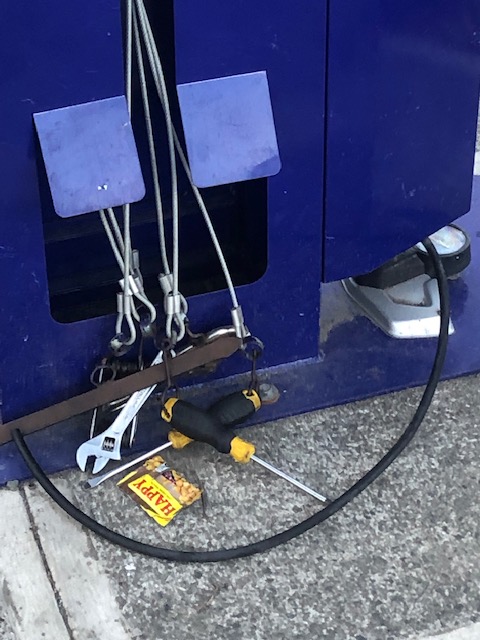

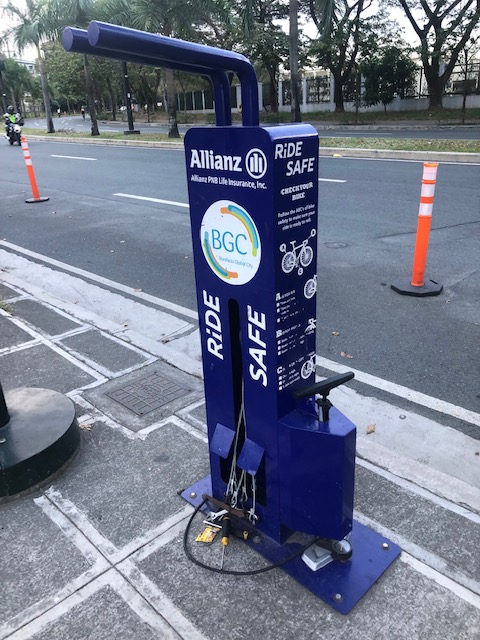
We need more of these especially along the major roads used by cyclists; especially those who bike to work. Granted that there are many bike shops and perhaps the vulcanizing shops as well as cyclists bringing their own tools and pumps but you never know when you will need some tools or perhaps a pump to inflate tires. Of course, these will need to be secured as there are people who have the propensity to steal, damage or vandalize tools.
–
Article on how cities can rapidly expand bike networks
With the increasing popularity of bicycles for utilitarian use (e.g., bike to work, bike to school, etc.), the need for strategies, programs and projects to support cycling has become more urgent. This is mainly to sustain the increase of bicycle use and partly to enhance the safety of cyclists. Here is an article that discusses how cities can rapidly expand bike networks:
https://www.urban.org/urban-wire/how-can-cities-rapidly-expand-access-cycling-infrastructure
To quote from the article:
“Our research points to several key recommendations for other cities hoping to expand their cycling infrastructure and encourage a more rapid shift toward biking and away from cars.
– Local governments can lead the implementation of a large-scale expansion of cycling infrastructure if local leaders can commit to ambitious, quantified mileage goals that will help structure how capital dollars are spent.
– Local implementation goals should include metrics related to increasing equity, particularly for people of color and those with low incomes. Although the Final Mile program increased the number of miles of cycling infrastructure, it did not directly prioritize the people who could benefit most from improvements.
– Philanthropic funders interested in supporting climate-friendly infrastructure should ensure their funds help hold local policymakers accountable to achieving their commitments instead of funding infrastructure projects directly. They can also encourage collaboration between cities and nonprofit advocates while working to fill local capacity gaps, such as through engineering consultants.”

Paper: Estimation of Transportation Energy Demand of the Philippines Using A Bottom-up Approach
Our paper from a conference last year is finally published in an open access journal. The paper is on the “Estimation of Transportation Energy Demand of the Philippines Using A Bottom-up Approach.” Here is the abstract of the paper:
“In the years 2000–2016, the sector with the largest share of total final energy consumption in the Philippines is transportation with an average share of 34.2%. The study aims to estimate the baseline transportation energy demand of road, maritime, air and rail transportation modes in 2016 using a bottom-up approach. Through a bottom-up approach and utilizing available transportation activity and fuel economy/energy efficiency data from secondary sources coupled with primary road transportation activity and fuel economy and railway operations survey data, the baseline transportation energy demand of the Philippines is estimated to be 12,956.1 ktoe in 2016. A comprehensive estimation of transportation energy demand of the country using bottom-up methodologies with more detailed transportation activity and vehicle fleet of the different transportation modes is implemented. Finally, the collection and keeping of certain data that are critical in the estimation of the transportation energy demand are recommended.”
Here is the link to the paper, which is published in the Asian Transport Studies, Vol. 8, 2022: https://authors.elsevier.com/sd/article/S2185-5560(22)00004-9
–
 Caught (up) in traffic